지역 가중치 적용 퍼지 클러스터링을 이용한 효과적인 이미지 분할
나이마 알람저*,1)김종면*
Effective Image Segmentation using a Locally Weighted Fuzzy C-Means Clustering
Nyma Alamgir*, Jong-Myon Kim*
요 약
본 논문에서는 기존의 퍼지 클러스터링 기반 이미지 분할의 성능과 계산 효율을 개선하기 위해 퍼지 클러스터링 의 목적 함수를 수정하는 이미지 분할 프레임워크를 제안한다. 제안하는 이미지 분할 프레임워크는 주변 픽셀들에 가중치를 부여함으로써 현재 센터 픽셀 연산을 위해 주변 픽셀들의 중요성을 고려하는 지역 가중치 적용 퍼지 클러 스터링 기법을 포함한다. 이러한 가중치들은 각 멤버쉽들의 중요성을 표시하기 위해 현재 픽셀과 대응되는 각 주변 픽셀들 사이의 거리차에 의해 결정되어 지며, 이러한 프로세서는 향상된 클러스터링 성능을 보장한다. 제안하는 방 법의 성능을 평가하기 위해 분할 계수, 분할 엔트로피, Xie-Bdni 함수, Fukuyzma-Sugeno 함수와 같은 네 가지 클러스터 유효성 함수를 이용하여 분석하였다. 모의실험 결과, 제안한 방법은 기존의 다른 퍼지 클러스터링 기법들 보다 클러스터 유효성 함수들뿐만 아니라 분할과 조밀도 측면에서 우수한 성능을 보였다.
▸Keywords : 퍼지 클러스터링, 이미지 분할, 클러스터링 유효성 함수, 객체 인식
Abstract
This paper proposes an image segmentation framework that modifies the objective function of Fuzzy C-Means (FCM) to improve the performance and computational efficiency of the conventional FCM-based image segmentation. The proposed image segmentation framework includes a locally weighted fuzzy c-means (LWFCM) algorithm that takes into account the
∙제1저자 : Nyma Alamgir ∙교신저자 : 김종면
∙투고일 : 2012. 8. 25, 심사일 : 2012. 10. 3, 게재확정일 : 2012. 11. 24.
* 울산대학교 전기공학부(School of Electrical Engineering, University of Ulsan)
※ 이 논문은 2012년도 정부(교육과학기술부)의 재원으로 한국연구재단의 지원을 받아 수행된 연구(No. 2012-0004962)이 며, 중소기업청에서 지원하는 2012년도 산학연공동기술개발사업(No. C0031322)의 연구수행으로 인한 결과물이며, 또한 지식경제부의 광역경제권 선도산업 육성사업의 일환인 “동남광역경제권 선도산업 지원단”의 2012년 연구비 지원으로 수행되 었음
influence of neighboring pixels on the center pixel by assigning weights to the neighbors.
Distance between a center pixel and a neighboring pixels are calculated within a window and these are basis for determining weights to indicate the importance of the memberships as well as to improve the clustering performance. We analyzed the segmentation performance of the proposed method by utilizing four eminent cluster validity functions such as partition coefficient (Vpc), partition entropy (Vpe), Xie-Bdni function (Vxb) and Fukuyama-Sugeno function (Vfs). Experimental results show that the proposed LWFCM outperforms other FCM algorithms (FCM, modified FCM, and spatial FCM, FCM with locally weighted information, fast generation FCM) in the cluster validity functions as well as both compactness and separation.
▸Keywords : fuzzy c-means, image segmentation, cluster validity function, object recognition
I. 서 론
Image segmentation, especially object based image segmentation is an essential and challenging aspect in the field of image processing and pattern recognition research[1]. Segmentation means delineating the structures and the other regions of interest that are non-overlapping, constituent regions. Clustering algorithms use many different feature types, such as brightness (pixel intensity of a gray-scale image) and geometric information (pixel location) because algorithm’s effectiveness is very much dependent on the feature used.
Fuzzy sets were introduced in 1965 by Lotfi Zadeh to merge mathematical modeling with human knowledge in the engineering sciences [2]. In advanced information technology, Fuzzy models and algorithms for pattern recognition are widely used [3]. One of the most well-known methodologies in clustering analysis is fuzzy c-means (FCM) clustering which was proposed by Dunn et al. in 1974 and extended by Bezdek in 1981 [4]. FCM clustering depends on the Euclidean distance between samples based on the assumption that each feature has equal importance. However, in most real-world problems, features are not considered to
be equally important. Thus, this assumption seriously affects the performance of clustering. To improve the performance of FCM, many techniques have been proposed [5-10].
Research approaches to achieve robust segmentation by modifying the conventional FCM algorithm can be divided into two groups: (1) methods evaluating the segmentation performance by modifying the object function, and (2) methods evaluating the segmentation performance by modifying the membership value. Numerous researchers [7, 11-13] have addressed the effectiveness of modifying the object function of the FCM. Pham et al. [11] proposed a new objective function to yield a lower error rate for the segmentation of corrupted images. Krishnapuram and Keller [7] introduced a possibility-based approach that corresponds to the intuitive concept of a degree of belonging or compatibility, leading to reduced problems in a noisy environment. Krinidis et al. [12] proposed a novel FCM algorithm by introducing fuzzy factor that incorporates both local spatial and gray level information. This factor is then used for modifying the objective function in order to get a new objective function. Beevi et al.
[13] presented an approach for the segmentation of noisy images. The approach utilized histogram-based FCM in which the spatial probability of the
neighboring pixels is incorporated into the objective function of FCM so as to increase the robustness against noise. However, in practice, a suitable parameter value for a data set may be very specific making it necessary to select different parameter values for different data sets by trial and error. For these reasons, the possibility-based approach may be impractical in the real world.
Membership values of the FCM are renewed by considering the resistance of neighbors [14-17] or feature-weight learning [9] to improve the performance of FCM clustering. Wang et al. [9]
proposed a feature-weight assignment method to improve the performance of FCM clustering. Liew et al. presented a spatial fuzzy clustering algorithm that exploits the spatial contextual information in an image’s data [14]. In the approach, the influence of neighboring pixels is suppressed in non-homogeneous regions of the image. The difference between the pixel intensity and the centroid of a cluster, called the dissimilarity index, is utilized to take into account the influence of the neighboring pixels on the center pixel. The dissimilarity index is calculated using a new weighting function l(¶) that does not depend on the relative location as well as does not provide the correct information for a sigmoid distribution in all areas of the image. Thus, this weighting function should be dynamically calculated from the pixel characteristics. Mohamed et al. [15] described a modified fuzzy c-means (MFCM) clustering algorithm where the spatial influence on the center pixel is considered as an explicit modification of its membership value. The influence is “crisp” in the sense that a crisp cluster assignment is performed based on the proximity of the center pixel to its neighbor pixels (only two pixels are considered).
However, this method has two drawbacks. First, the modification of the membership value is based on the distance between the center pixel and its neighbors. As the pixel intensity between the center pixel and its neighbors are not considered, the
weighting coefficient does not provide the exact relationship. Second, fixed weights are assigned as the weighting coefficients in a three by three neighboring matrix (for example, a weight of 1 is assigned to the left, right, top, and bottom neighbors, while a weight of 2 is assigned to the top-left, top-right, bottom-left, and bottom-right neighbors), whereas the spatial intensity correlation between the center pixel and its eight nearest neighbors of a 3x3 matrix is different in the image.
More recently, Chuang et al. [16] presented a fuzzy c-means cluster with spatial information (FCMSI).
The local spatial information incorporated into the membership function is the summation of the memberships in the neighborhood of each pixel under consideration. Cai et al. presented a fast generalized FCM algorithm (FGFCM) that incorporates local spatial and gray information together to enhance the clustering performance [17].
The local spatial and gray similarity measure provides robustness to noise and detail-preserving for images, while at the same time removing the empirically-adjusted parameter.
To enhance the clustering performance, we propose a locally weighted fuzzy c-means algorithm (LWFCM) that utilizes not only the given pixel attributes, but also spatial information by enabling the membership of the center pixel in a three by three window to be influenced by its eight neighbors, similar to the methods in [14], [15], and [16]. Our proposed LWFCM calculate the weighting coefficients from the pixel intensities that differ from each other in different areas of the image. Thus, LWFCM can provide an optimal correlation result between the center and its neighboring pixels, leading to a significant improvement in clustering performance. Experimental results obtained with various numbers of clusters indicate that the proposed LWFCM outperforms other FCM-based clustering algorithms such as FCM [4], spatial FCM [14], modified FCM [15], FCM with spatial information [16], and fast generalized FCM [17]
with good interpretation. It also allows for the partition of samples in one cluster to be compact and those in different clusters to be well-separated.
The paper is organized as follows. Background information on the FCM algorithm and four selected cluster validity functions for evaluating the clustering performance is given in Section 2. The proposed LWFCM algorithm is then presented in Section 3. The performance of the proposed LWFCM and that of other FCM-based algorithms are compared in section 4, with some conclusions presented in Section 5.
II. Background Information
1. Fuzzy C-Means Clustering
FCM [18] is one of the most well-known methodologies in clustering analysis. Clustering is the process of portioning an image into regions (or classes) such that each region is homogeneous and none of the unions of two adjacent regions is homogeneous. FCM clustering is an iterative based clustering technique that produces an optimal number of c partitions, with centroids V = {v1,v2,
…, vc} which are exemplars, and radii which define these c partitions. Suppose the unlabeled data set X
= {x1,x2, …, xn} is the pixel intensity, where n is the number of image pixels whose memberships are to be determined. The FCM clustering process partitions the data set X into c clusters. The objective function of the standard FCM is defined as follows:
2
1 1
( , ) ( , ),
c n
m
m ik k i
i k
J U V u d x v
= =
=åå (1)
where d(xk, vi) represents the distance between pixel xk and centroid vi, n is the set of neighbors falling into a window around xk, and uik represents
the fuzzy membership of the kth pixel with respect
to cluster i with the constraint 1
1
c
ik i
u
=
å = , and the degree of fuzzification m ≥1.
The data point xk belongs to a specific cluster vi which is given by the membership value uik of the data point to that cluster. Local minimization of the objective function Jm(U,V) is accomplished by repeatedly adjusting the values of uik and vi according to the following equations:
1 1 2 1
2 1
( , ) ( , ) .
c m
k i
ik
j k j
d x v
u d x v
- -
=
é æ ö ù
ê ú
= ç ÷
ç ÷
ê ú
è ø
ë û
å (2)
0
0
, 1 .
n m ik k k
i n
m ik k
u x
v i c
u
=
=
= £ £
å å
(3)
As Jm is iteratively minimized, vi becomes more stable. The pixel clustering iterations are terminated when the termination measurement
{ ( ) ( 1)}
1
t t
u i
i c
max v v - e
£ £ - < is satisfied, where vi( )t are the new centroids for 1£ £i c, vi(t-1) are the previous centroids for 1£ £i c,and e is a
predefined termination threshold. The output of the FCM algorithm is the cluster centroids V and the fuzzy partition matrix UCxN.
To improve the clustering performance, we incorporate both the given pixel attributes and the locally calculated spatial information of the neighboring pixels by assigning weights to neighboring elements based on the distance between the center pixel and its neighborhood.
2. Cluster Validity Function
Cluster validity functions are often used to evaluate the performance of clustering in different indices and even to compare two different clustering
Validity
Function Functional
Description Optimal Partition partition
coefficient
2
1 1
( )
n c
ij
j i
pc
u V U
n
= =
=
åå max(Vpc)
partition
entropy 1 1
( ) 1 log
n c
pe ij ij
j i
V U u u
n = =
ì ü
ï ï
é ù
= - í ë ûý
ï ï
îåå þ min(Vpe)
Xie-Beni function
{ }
( )
2 2
1 1
( ) 2
min
n c
ij j i
j i
xb
i k
i k
u x v V U
n v v
= =
¹
-
=
´ -
åå min(Vxb)
Fukuyama-Su geno
function 1 1
(
2 2)
( , ; )
fs
n c
m
ij j i i
j i
V U V X
u x v v v
= =
=
- - -
åå min(Vfs)
methods [9, 18]. Many cluster validity criteria have been proposed for image segmentation, but most studies have only considered the number of clusters.
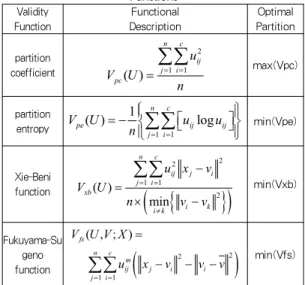
Among the criteria, two important types of cluster validity functions are used: those based on a fuzzy partition of the sample set, and those dependent on the geometric structure of the sample set. In cluster validity functions based on a fuzzy partition of the sample set, a less fuzzy partition leads to better performance. The representative functions for the validity function based on the fuzzy partitions are the partition coefficient Vpc [19] and partition entropy Vpe [20], which are defined, respectively, as follows:
2 1 1
( ) ,
n c
ij
j i
pc
u V U
n
= =
=
åå (4)
1 1
( ) 1 log ,
n c
pe ij ij
j i
V U u u
n = =
ì ü
é ù
= - í ë ûý
îåå þ (5)
where the maximum Vpc and minimum Vpe lead to the best interpretation of the samples considered.
The disadvantages of Vpc and Vpe are their lack of direct connection to a geometrical property and their tendency to decrease monotonically with c. It is clear that the best partition is one in which the samples among different clusters are separate. This is quantified, for example, by the Fukuyama-Sugeno function Vfs [21] and the Xie-Beni function Vxb [22], which are respectively defined as follows:
(
2 2)
1 1
( , ; ) ,
n c
m
fs ij j i i
j i
V U V X u x v v v
= =
=åå - - - (6)
{ }
( )
2 2
1 1
( ) 2 ,
min
n c
ij j i
j i
xb
i k
i k
u x v V U
n v v
= =
¹
-
=
´ -
åå (7)
where 1
1 c
i i
v v
c =
= å , and minimizing Vfs or Vxb leads
to a good partition.
A brief summary of the four selected cluster validity functions that were used to evaluate the performances of the proposed LWFCM and the conventional FCM clustering algorithms is given in Table 1.
Table 1. A Brief Summary of the Four Selected Validity Functions
III. A Locally Weighted Fuzzy C-Means Algorithm
Conventional FCM determines the membership value uik by calculating only the distance between the data point xk and the centroid vi of cluster i.
However, the neighbors of xk provide important information about their impact on the center with respect to clustering. To improve the clustering performance, we propose a LWFCM algorithm that incorporates both the given xk and the spatial information of the neighbors by assigning them weights in [0, 1] to indicate the importance of their membership values. Our method modifies the membership function such that the membership value of the features in the current pixel is calculated as a weighted sum of both the
membership value of the features in the current (center) pixel and the membership values of neighboring features.
LWFCM utilizes a neighboring weighting coefficient pik to take into account the locally calculated spatial information of the neighbors. This coefficient is defined as
1
( , ) ,
Nk
ik k j ij
j
p h x x u
=
=å (8)
where uij represents the fuzzy membership of the jth pixel with respect to cluster i, and Nk is the set of neighbors falling into a window around xk. In (8), h(xk, xj), which is a distance coefficient between the center pixel xk and neighbor xj, is defined as
2 1
2 1
( , )
( , ) ,
( , )
Nk
k j
k j
l k l
d x x h x x
d x x
-
=
æ ö
= çç ÷÷
èå ø (9)
Combining (9) with (8), pik is derived as follows:
2 1
2
1 1
1
2 2
1 1
( , ) ( , )
1 ,
( , ) ( , )
k k
k k
N N
k j
ik ij
j l k l
N N
ij
l k l j k j
d x x
p u
d x x u
d x x d x x
-
= =
-
= =
æ ö
= çç ÷÷
è ø
æ ö
æ ö
=ç ÷ çç ÷÷
è ø è ø
å å
å å
(10)
where xk is the gray value of the kth pixel, uij represents the fuzzy membership of the jth pixel with respect to cluster i, xj and xl represent the neighbors of xk, and Nk is the set of neighbors falling into a window around xk. A smaller distance between the feature in the center pixel and features in the neighboring pixels leads to a higher probability that the features in both the center pixel and the neighbors are in the same cluster. In other words, the more neighbors that are in the same
cluster, the higher the probability that the center pixel is in the cluster. The proposed LWFCM is significantly different from other FCM clustering algorithms in that its weighting coefficient is calculated from pixel intensities, not from pixel locations or any probabilistic distribution. As such, the LWFCM algorithm provides better correlation information between neighboring pixels.
The weighting coefficient pik in (10) can be in the range of [0, 1] with j∈Nk. This is because
1 1
c i uij
= =
å by definition in the standard FCM such that membership functions of fuzzy set uij are in the interval [0, 1].
If all pixels within window Nk, including the center pixel xk and its neighboring pixels xj, belong to the same cluster i, all membership values uij may converge to 1. Then, the value of pik in (10) also
converges to 1 because both
1
2 1
1 ( , )
Nk
l d x xk l
-
=
æ ö
ç ÷
èå ø
and
2 1
1 ( , )
Nk
j= d x xk j
æ ö
ç ÷
ç ÷
èå ø
are cancelled out.
If all pixels within the window do not belong to cluster i, all membership values uij may converge to 0. Then, the value of pik in (10) also converges to 0.
If each pixel within the window belongs to different clusters, each membership value uij may be in the range of (0, 1). Then, the value of pik in (10) is also in the range of (0, 1).
The calculated pik is subsequently incorporated into the membership function of the fuzzy partition matrix UCxN. As a result, a new distance between the data xk and centroid vi is defined as follows:
2 ( , ) 2( , ) ( ),
new k i k i ik
d x v =d x v f p (11)
where d2(x vk, )i is the Euclidean distance between pixel xk and the ith cluster centroid vi, and
f(pik) is a function of the weighted coefficient pik in (10) which is the summation of the membership function in the neighborhood and the Euclidean distance between pixel xk and its neighboring pixels.
The weighted coefficient function, f(pik), is incorporated into the membership function of the standard FCM in (2) as follows:
( )
1 1 2 1
2 1
1/ 1 1 2
2 1/ 1 1
1
1 1 2 1
1 1 2
1
2
2
( , ) ( , )
( , ) ( )
( , ) ( )
( , )
( ) ( , )
( , ) ( , )
c m
new k i
ik
j new k j
m
k i ik
c m
k j jk
j
c m
k i m
ik
l k j
k j
k l
d x v d x v
d x v f p d x v f p
d x v
f p
d x v d x v d x v w
- -
=
- -
- -
=
- -
-
=
é æ ö ù
ê ú
=ê çç ÷÷ ú
è ø
ë û
é ù
ê ú
ë û
=
é ù
ë û
é æ ö ù
ê çç ÷÷ ú
ê è ø ú
ë û
=
æ ç è
å
å å
1 1
1 1
1
1 1
1 1
1 1
1
( )
( )
.
( )
c c m
m jk
j l
m
ik ik
c m
jk jk
j
f p
u f p
u f p
- -
-
= =
-
-
=
é ö ù
ê ç ÷÷ ú
ê ú
ë ø û
=
å å
å
(12)
We can summarize the proposed LWFCM algorithm in the following six steps:
Step 1: Distribute pixels into data set X and
initiate centroids
{ }
(0) (0) (0) (0)
1 , 2 ,..., c
V = v v v .
Step 2: Compute all membership values uik of the features in each pixel against the c centroids using (2).
Step 3: Calculate the following membership function ωik in (12) using m=2 (the parameter m controls the fuzziness, or fuzzification, of the membership of each
datum) and ( ik) 1
ik
f p = p :
1 ik ik .
ik c
jk jk j
u p u p w
=
= å (13)
where the weighted coefficient pik is incorporated into the membership function of the standard FCM. The weighted coefficient pik is used to exploit the spatial information for clustering. Note that if pik =1, ωik is identical to the membership uik in the conventional FCM.
Step 4: Compute new centroid values vi such that
1 1
.
n m
ik k k
i n m
k ik
v w x
w
=
=
=å
å (14)
Step 5:Evaluate the threshold of the termination
condition max1£ £i c{vi( )t -vi(t-1) }<e,
where ||.|| is the Euclidean norm).
Stop if it is satisfied; otherwise, return to Step2.
Step 6: Assign all features in each pixel to clusters using the maximum membership value of all features. For instance:
{ }
1 1 1
1
max .
k k k
i c
x c if w w
£ £
Î = (15)
IV. Experimental Results
To evaluate the performance of the proposed LWFCM algorithm, we compare the LWFCM to the conventional FCM [4], the spatial FCM (SFCM) [14], the modified FCM (MFCM) [15], the FCM with spatial information (FCMSI) [16], and the fast generalized FCM (FGFCM) [17]. The performance of clustering was measured with the four validity functions described in Section 2.2.
1. Initialization of Parameters
Initialization for the degree of fuzzification m is very important in FCM. FCM clustering produces terminal partitionsU=éë1cùû when m→∞. In contrast, when m→1, this reduces to hard c-means and terminal partitions become more and more crisp. In the method of Bezdek et al. [3], the authors experimentally determined the optimal interval for the degree of fuzzification and found it to range from 1.1 to 5. In this study, we selected the value of m as 2 so as to have an optimal balance of speed and accuracy for all of the FCM-based clustering algorithms.
The termination threshold ε controls the duration of iteration as well as the optimal terminal partition of the fuzzy clustering. Bezdek et al. [3]
experimentally determined the optimal interval for the termination threshold and found it to range from 0.01 to 0.0001. In this study, we selected the termination threshold value to be 0.001.
The initialization of the centroid of a cluster is also important in FCM clustering because it is a searching technique that yields local maxima, thus greatly reducing the performance of clustering. In addition, when clustering is initialized from a different starting point, different solutions are found for the same terminal partition. In this study, the centroids were initialized by assigning the number of clusters (denoted as c), with points uniformly distributed according to the gray image (intensities ranging from 0 to 255).
We also used a three by three window as the neighboring matrix for all of the FCM-based clustering algorithms.
2. Simulation Results
The images used in this study are shown in Fig.
1. The FCM, SFCM, MFCM, FCMSI, FGFCM, and the proposed LWFCM clustering results as measured with the four selected cluster validity functions are
given in Table 2.
The proposed LWFCM algorithm outperformed the FCM, SFCM, MFCM, FCMSI, and FGFCM algorithms in all of the cluster validity functions (Vpc, Vpe, Vxb, and Vfs), where the maximum Vpc, the minimum Vpe, the minimum Vxb, or the minimum Vfs led to a good interpretation and partitioning of the samples. A comparison of the LWFCM, FCM, SFCM, MFCM, FCMSI, and FGFCM results for Vpc, Vpe, Vxb, and Vfs for various numbers of clusters is shown in Fig. 2(a)-(d), respectively.
LWFCM clearly outperformed FCM, SFCM, MFCM, FCMSI, and FGFCM with good interpretation and partitioning for all cases in which the samples in one cluster were compact and the samples in different clusters were separated. This is because LWFCM optimizes the membership and centroid functions by incorporating a weighting coefficient that can be calculated from the pixel intensities within a three by three window to the membership function.
However, the performance improvements of each cluster validity function are not similar to the proposed LWFCM over the conventional FCM methods. The value of Vpe (Vpc) is significantly greater (smaller) with the proposed LWFCM than with the conventional FCM methods because LWFCM incorporates a weighting coefficient that can be calculated from the pixel intensities within a three by three window into the membership function.
In addition, both Vpe and Vpc consider only the compactness measurement for each cluster using the membership function. However, as shown in Fig. 2, different results were obtained for the validity function based on the feature structure. For example, both Vfs and Vxb increased with the proposed LWFCM because they measured the compactness in the feature domain. Conventional FCM methods achieve a partition by minimizing the metric difference in the feature domain and thus, Vfs and Vxb are minimized. The proposed LWFCM
Image Algorith m
Values of validity functions
Image Algorith m
Values of validity functions
Vfs(×106) Vfs(×106)
Image 1(a)
FCM 0.8309 0.1371 0.0688 -338.2044 Image
1(c)
FCM 0.8850 0.1059 0.0600 -280.5691 SFCM 0.8085 0.1506 0.0601 -351.1016 SFCM 0.9106 0.0992 0.0569 -295.6341 MFCM 0.8757 0.1163 0.0678 -354.6989 MFCM 0.8656 0.1118 0.0484 -302.5563 FCMSI 0.8985 0.0738 0.0617 -379.7862 FCMSI 0.9276 0.0543 0.0528 -305.9055 FGFCM 0.8299 0.1394 0.0751 -311.5809 FGFCM 0.8783 0.1051 0.0546 -301.5337 LWFCM 0.9018 0.0713 0.0581 -394.9612 LWFCM 0.9407 0.0413 0.0497 -322.4728
Image 1(b)
FCM 0.8621 0.1561 0.0813 -250.2298 Image
1(d)
FCM 0.7812 0.1923 0.0878 -305.3329 SFCM 0.9057 0.1028 0.0976 -261.6357 SFCM 0.7539 0.1169 0.0947 -311.0358 MFCM 0.8401 0.1378 0.1092 -254.7050 MFCM 0.8167 0.1834 0.0851 -311.0777 FCMSI 0.9369 0.0486 0.0819 -332.9762 FCMSI 0.8526 0.0946 0.0888 -320.3031 FGFCM 0.8519 0.1646 0.0873 -246.1655 FGFCM 0.7987 0.1584 0.1258 -298.6037 LWFCM 0.9489 0.0443 0.0629 -348.1140 LWFCM 0.8922 0.0747 0.0629 -335.9741 Table 2. Evaluation results of the proposed algorithm and conventional fuzzy c-means algorithms with =3.
Fig. 1. Four selected images (a) Original Brain Image (b) Building (c) Ship and (d) Synthetic Wheel Image
Fig. 2. The FCM, MFCM, SFCM, FCMSI, FGFCM, and the proposed LWFCM clustering results for the cluster validity functions with various numbers of clusters: (a) function Vpc, (b) function Vpe, (c) function Vxb, and (d)
function Vfs
modifies the partition on the basis of the spatial distribution. This causes deterioration in the compactness in the feature domain and a subsequent increase in both Vfs and Vxb.
V. Conclusions
FCM is one of the most extensively used clustering algorithms. However, it does not fully utilize the spatial information in the image and this affects in clustering performance. Also low contrast and presence of noises make the segmentation accuracy lower. To overcome these issues, we proposed a locally weighted fuzzy c-means algorithm that takes into account the influence of the neighboring pixels on the center pixel. The algorithm assigns the neighboring pixels weights based on their distance to the center pixel in order to indicate the importance of their memberships. Experimental results for various numbers of clusters, as evaluated by four selected cluster validity functions, indicated that the proposed LWFCM significantly outperforms the other FCM-based algorithms.
References
[1] K. S. Fu and J. K. Mu, “A Survey on Image Segmentation,” Pattern Recogn., vol. 13, pp.
3-16, 1981.
[2] L. A. Zadeh, “Fuzzy Sets,” Inf. Cont., pp.
338-353, 1965.
[3] J. C. Bezdek, J. Keller, R. Krisnapuram, and N.
R. Pal, Fuzzy and Algorithms for Pattern Recognition and Image Processing, 1st ed., Springer, 1965.
[4] J. C. Bezdek, Pattern Recognition with Fuzzy Objective Funtion Algorithms, Plenum Press, 1981.
[5] A. Ali, G. C. Karmakar and L. S. Dooley, “Fuzzy Image Segmentation Using Suppressed Fuzzy C-Means Clustering (SFCM)” 7th Intl. Conf.
Computer and Information Technology, 2004.
[6] L. O. Hall, A. M. Bensaid, L. P. Clarke, R. P.
Velthuizen, M. S. Silbiger, and J. C. Bezdek, “A Comparison of Neural Network and Fuzzy Clustering Techniques in Segmentating Magnetic Resonance Images of the Brain,” IEEE Trans.
Neural Netw., vol. 3, pp. 672-682, 1992.
[7] R. Krishnapuram and J. M. Keller, “A Possibilistic Approach to Clutering,” IEEE Trans.
Fuzzy Syst., vol. 1, no. 2, pp. 98-110, 1993.
[8] A. G. Di Nuovo and V. Catania, “An Evolutionary Fuzzy C-Means Approach for Clutering of Bio-Informatics Databases,” Proc. Intl. Conf.
Fuzzy Syst., pp. 2077-2082, 2008.
[9] X. Wang, Y. Wang, and L. Wang, “Improving Fuzzy C-Means Clustering Based on Feature-Weight Learning,” Pattern Recogn.
Lett., vol. 25, no. 10, pp. 1123-1132, 2004.
[10] K. S. Tan and N. A. M. Isa, “Color image segmentation using histogram thresholding Fuzzy C-means hybrid approach,” Pattern Recognition, vol. 44, no. 1, pp. 1–15, 2011.
[11] D. L. Pham and J. L. Prince, “Adaptive Fuzzy Segmentation of Magnetic Resonance Images,”
IEEE Trans. Med. Imag., vol. 18, no. 9, pp.
737-752, 1999.
[12] S. Krinidis, V. Chatzis, "A Robust Fuzzy Local Information C-Means Clustering Algorithm,"
IEEE Trans. Image Proc., Vol, 19, No. 5, pp.
1328-1337, Jan. 2010.
[13] S. Z. Beevi and M. M. Sathik, “A Robust Segmentation Approach for Noisy Medical Images Using Fuzzy Clustering with Spatial Probability,” European J. Sci. Research, vol.
41, no. 3, pp. 437-451, 2010.
[14] A. W. C. Liew, S. H. Leung, and W. H. Lau,
“Fuzzy Image Clustering Incorporating Spatial Continuity,” IEE Proc. Image and Signal Process., vol. 147, no. 2, pp. 185-192, 2002.
[15] N. A. Mohamed, M. N. Ahmed, and A. Farag,
“Modified Fuzzy C-Means in Medical Image Segmentation,” Proc. Intl. Conf. Acoustics, Speech and Signal Process., pp. 3429-3432, 1999.
[16] K. S. Chuang, H. L. Tzeng, S. Chen, J. Wu, and T. J. Chen, “Fuzzy C-Means Clustering with Spatial Information for Image Segmentation,” Computerized Med. Imag.
Graphics, vol. 30, pp. 9-15, 2006.
[17] W. Cai, S. Chen, and D. Zhang, “Fast and Robust Fuzzy C-Means Clustering Algorithms Incorporating Local Information for Image Segmentation,” Pattern Recogn., vol. 40, no. 3, pp. 825-838, 2007.
[18] N. R. Pal and J. C. Bezdek, “On Cluster Validity for the Fuzzy C-Means Model,” IEEE Trans. Fuzzy Syst., vol. 3, no. 3, pp. 370-379, 1995.
[19] J. C. Bezdek, “Cluster Validity with Fuzzy Sets,” J. Cybernetics, vol. 8, no. 3, pp. 58-73, 1974.
[20] J. C. Bezdek, “Mathematical Models for Systematic and Taxonomy,” Proc. Intl. Conf.
8th Numerical Taxonomy, pp. 143-166, 1975.
[21] Y. Fukuyama and M. Sugeno, “A New Method of Choosing the Number of Clusters for the Fuzzy C-Means Method,” Proc. Intl. Conf. 5th Fuzzy Syst. Symp., pp. 247-250, 1989.
[22] X. L. Xie and G. Beni, “A Validity Measure for Fuzzy Clustering,” IEEE Trans. Pattern Anal.
Mach. Intell., vol. 13, no. 8, pp. 841-847, 1991.
저 자 소 개 Nyma Alamgir
2008 : Electrical & Electronic Engineering, Chittagong University of Engineering
& Tehcnology, 공학사.
2011 : 울산대학교 컴퓨터정보통신 공학부 석사과정 입학.
관심분야 : 의료영상처리, 워터마킹 Email: [email protected] 김 종 면
1995 : 명지대학교 전기공학사 2000 : University of Florida ECE
석사
2005 : Georgia Institute of Technology ECE 박사
2005 - 2007 :
삼성종합기술원 전문연구원 2007 - 현재 : 울산대학교 컴퓨터정보
통신공학부 교수 관심분야 : 프로세서 설계, 임베디드
SoC, 컴퓨터구조, 병렬처리 Email: [email protected]