An Enhanced Spatial Fuzzy C-Means Algorithm for Image Segmentation
Tung X. Truong*, Jong-Myon Kim**
영상 분할을 위한 개선된 공간적 퍼지 클러스터링 알고리즘
퉁 투룽*, 김 종 면**
*Abstract
Conventional fuzzy c-means (FCM) algorithms have achieved a good clustering performance.
However, they do not fully utilize the spatial information in the image and this results in lower clustering performance for images that have low contrast, vague boundaries, and noises. To overcome this issue, we propose an enhanced spatial fuzzy c-means (ESFCM) algorithm that takes into account the influence of neighboring pixels on the center pixel by assigning weights to the neighbors in a 3x3 square window. To evaluate between the proposed ESFCM and various FCM based segmentation algorithms, we utilized clustering validity functions such as partition coefficient ( ), partition entropy ( ), and Xie-Bdni function ( ). Experimental results show that the proposed ESFCM outperforms other FCM based algorithms in terms of clustering validity functions.
▸Keyword : fuzzy c-means algorithm, image segmentation, membership function, clustering validity functions
요 약
FCM(fuzzy c-means)은 일반적으로 영상 분할에서 좋은 성능을 보인다. 하지만 공간 정보를 사용하지 않는 일반적인 FCM 알고리즘은 낮은 대비의 영상, 경계선이 뚜렷하지 않은 영상, 잡음이 포함된 영상의 분할에는 좋지 않은 성능을 보인다. 이와 같은 문제를 해결하기 위해 본 논문에서는 3x3 크기의 윈도우를 이용하여 윈도우 내의
∙제1저자 : 퉁 투룽 ∙교신저자 : 김종면
∙투고일 : 2011. 05. 09, 심사일 : 2011. 06. 07, 게재확정일 : 2011. 06. 24.
* 울산대학교 전기공학부(School of Electrical Engineering, University of Ulsan) 석사과정
** 울산대학교 전기공학부(School of Electrical Engineering, University of Ulsan) 교수
※ 이 논문은 2011년도 정부(교육과학기술부)의 재원으로 한국연구재단의 지원을 받아 수행된 연구임(No. 2011-0017941).
중심 픽셀과 주변 픽셀간의 거리 정보를 소속 함수에 추가한 개선된 공간적 퍼지 클러스터링 알고리즘을 제안한다.
본 논문에서는 분할 계수, 분할 엔트로피, Xie-Bdni 함수와 같은 클러스터링 검증 함수를 이용하여 FCM 기반의 다양한 클러스터링 알고리즘과 제안한 알고리즘과의 성능을 비교하였다. 성능 평가 결과 제안한 알고리즘이 기존의 FCM기반의 클러스터링 알고리즘보다 클러스터링 검증 함수에서 성능이 우수함을 확인 할 수 있었다.
▸Keyword : 퍼지 클러스터링 알고리즘, 영상 분할, 소속 함수, 클러스터링 검증 함수
I. Introduction
Image segmentation plays a critical role in image understanding, image processing, pattern recognition, and computer vision. Therefore, many segmentation algorithms have been proposed [1, 2]. Among them, fuzzy c-means (FCM) algorithm is one of the most effective algorithms for image segmentation [3], and the standard FCM algorithm has been achieved considerable successes in partitioning images [4].
However, it depends on the Euclidean distance between samples based on the assumption that each feature has equal importance, and does not use spatial characteristics of the image. This results in low clustering performance for images that have low contrast, vague boundaries, and noises. In order to overcome these drawbacks and improve the performance of the standard FCM, many techniques have been proposed [4, 5]. These techniques can be divided into three groups.
Firstly, image smoothing techniques are included in clustering algorithms based on FCM to improve the clustering performance [6-8]. The main idea of these techniques is that they use a spatial filter to smooth the image before applying the standard FCM. Szilagyi et al. proposed the enhanced FCM (EnFCM) algorithm to improve the clustering performance and accelerate the image segmentation process [6]. In 2004, Chen et al. proposed an effective algorithm that is suitable for image segmentation by using FCM with spatial constraints [7]. These two algorithms utilized mean and median filters before performing FCM. This resulted in providing a high-speed and good-quality segmentat ion. Furthermore, Cai et al. proposed the fast generalized FCM (FGFCM) algorithm that
incorporates the spatial information, which is the intensity of the local neighboring pixels [8].
Secondly, the performance of conventional FCM was improved by modifying the object function [9-11].
Pham proposed a new objective function to yield a lower error rate for the segmentation of corrupted images [9]. Moreover, Kannan et al. proposed a novel FCM algorithm with a canter knowledge method for the segmentation of brain T1-T2 weighted images by modifying the objective function of the standard FCM algorithm [10]. In 2010, Krinidis et al. proposed a fuzzy local information c-means (FLICM) clustering algorithm [11], in which the authors introduced a fuzzy factor that incorporates both local spatial and gray level information. This factor is then used in the objective function to create a new objective function.
Finally, many researchers modified the membership function of the standard FCM to improve the clustering performance [12-15]. Liew et al.
presented a spatial fuzzy clustering algorithm that
exploits the spatial contextual information in image
data, where the influence of the neighboring pixels is
suppressed in non-homogeneous regions of the image
[12]. This method utilizes the difference between the
pixel intensity and the centroid of a cluster, called
the dissimilarity index, to take into account the
influence of the neighboring pixels on the center
pixel. Mohamed et al. proposed modified fuzzy
c-means (MFCM) algorithm that the membership
value was chosen to tolerate the resistance [13]. In
their technique, the spatial influence on the center
pixel is considered as an explicit modification of its
membership value. Chuang et al. proposed a fuzzy
c-means with spatial information (FCMSI) that
incorporates spatial information into the membership
function for clustering [14]. This spatial function is
the summation of membership values of neighboring pixels. Beevi et al. developed a robust segmentation technique that exploits histogram based FCM algorithm for the segmentation of medical images [15].
These techniques considerably enhanced the clustering performance of the standard FCM and have been applied to many fields such as image understanding, pattern recognition, and computer vision, especially medical image processing. Despite they have enhanced the clustering performance, most of these techniques still have some weaknesses: 1) some algorithms use smoothing filters which might cause information loss in boundaries or edges; 2) the performance of some algorithms crucially depends on some parameters, but the selection of the parameters is generally difficult; 3) some techniques use the spatial information to improve the performance of the standard FCM algorithm. However, they only use the gray level of pixel, or the spatial position of pixels.
Thus, the performance of these algorithms is still not very high. In order to solve these drawbacks of the conventional FCM algorithms and enhance the segmentation performance, we propose an enhanced spatial fuzzy c-means algorithm (ESFCM) that utilizes not only gray level information but also spatial position of neighboring pixels by introducing an effective factor. This factor is then incorporated into the membership function of the conventional FCM. Experimental results indicate that the proposed ESFCM provides better clustering performance than other FCM algorithms (FCM [3], EnFCM [6], FGFCM [8], SFCM [12], MFCM [13], and FCMSI [14]).
The rest of this paper is organized as follows.
Section 2 introduces the conventional FCM algorithm. Section 3 presents the proposed ESFCM algorithm in detail. Section 4 illustrates three well-known cluster validity functions to evaluate the performance of clustering algorithms, and analyzes experimental results. Finally, Section 5 concludes this paper.
II. Image Segmentation Using Fuzzy C-Means Algorithm
Fuzzy c-means (FCM) is an unsupervised clustering method. It is developed by Dunn in 1973, and then improved by J. C. Bezdek in 1981 [3].
This algorithm has been successfully applied to many fields of image processing such as feature analysis, image segmentation, classifier, and pattern recognition [4].
FCM clustering is an iterative technique that produces an optimal number of c partitions, with centroids which are exemplars, and radii which define these c partitions. Let an unlabelled data set represent the pixel intensity, where is the number of pixels whose memberships are to be determined. The FCM algorithm tries to partition the data set into clusters. The standard FCM objective function is defined as follows:
··· (1)
where represents the distance between pixel
and centroid , n is the set of neighbors falling into a window around , and represents the fuzzy membership of the th pixel with respect to cluster with the constrain
. The parameter is the degree of fuzziness, where ≥ , and is the total number of clusters. The values of and are then updated according to the following equations:
··· (2)
≤ ≤ ··· (3)
The pixel clustering iterations are terminated
when the stop condition ≤ ≤ m ax ∥ ∥ is satisfied, where are new centroids for ≤ ≤ ,
are the previous centroids for ≤ ≤ , and is a predefined termination threshold. The output of the FCM algorithm is the cluster centroids and the fuzzy partition matrix × .
III. Enhanced Spatial Fuzzy C-Means Algorithm One of important characteristics of an image is that neighboring pixels are highly correlated, that is the properties of pixels are similar to their neighboring pixels. Therefore, the probability that they are segmented into the same cluster is high.
This spatial information is important in clustering.
Although it is very useful to improve the performance of clustering algorithms, it was not utilized in the standard FCM algorithm.
Consequently, we propose an enhanced spatial FCM (ESFCM) algorithm in order to improve the clustering performance. The proposed algorithm exploits the influence of neighboring pixels on the center pixel by calculating new membership values that incorporate both the given pixel attributes and the spatial information of the neighboring pixels.
The ESFCM algorithm introduces as an effective factor to indicate the influence of neighboring pixels on the center pixel, and this factor is defined as
··· (4)
where is the number of pixels within a square window; is the center pixel; is the Euclidean distance of the intensity between center pixel and neighboring pixels ; and is the Euclidean distance of location between center pixel and neighboring pixels .
If equals to , we assign . Eq.
(4) can be represented as
···(5) The factor represents the probability that the center pixel belongs to cluster . The value of is in the range of and the following three cases are considered.
If all pixels including the center pixel and its neighboring pixels converges to 1 in accordance with (5) because values of (membership of the center pixel ) and (membership of neighboring pixels ) converge to 1.
If all pixels in the square window do not belong to cluster , the value of goes to 0. This is because values of and converge to 0.
If the number of pixels that are partitioned into cluster increases, the value of also increases in the range of .
The factor is then incorporated into the membership function as follow:
··· (6)
where is a new membership of the center pixel , and is an old membership of the center pixel . We observe the impact of the neighboring pixels on the center pixel as follows.
In regions where the pixels are homeogenous, all of pixels within the square window are partitioned into a certain cluster. Consequently, is same as the
when the center pixel belongs to cluster . Furthermore,
equals to 0 as the center pixel does not belong to cluster .
In regions where the pixels are non-homeogenous,
if the center pixel includes noise components, the
membership of center pixel is changed by the membership of neighboring pixels .
The proposed ESFCM algorithm is summarized as the following five steps:
Step 1: Distribute all of pixels in a target image into data set X and initialize the centroids
.
Step 2: Compute all memberships using (2).
Step 3: Computer all new memberships using (5) and (5).
Step 4: Calculate new centroid using (8)
.
··· (8)
Image1 Image2 Image3 Image4
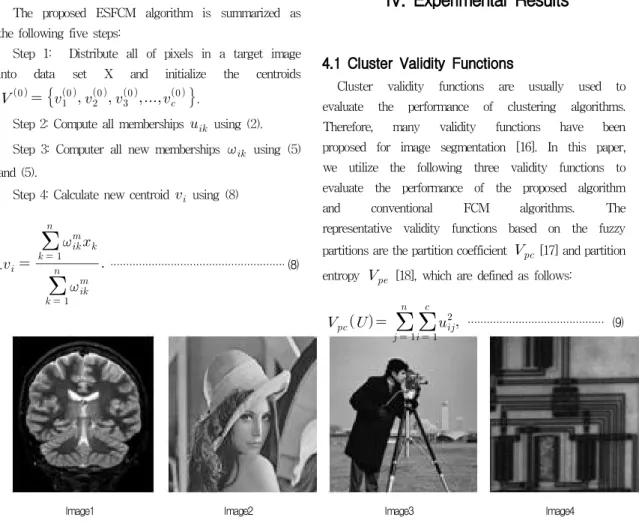
그림 1. 제안한 알고리즘과 다른 FCM 기반 알고리즘의 성능평가를 위해 선택된 타겟 이미지 Fig. 1. Selected target images for evaluating the performance of the proposed and other FCM based algorithms
Step 5: Identify whether the terminal condition max
≤ ≤ ∥ ∥ (where
∥·∥ is the Euclidean norm) is satisfied or not. The algorithm stops if the terminal condition is satisfied, otherwise go to Step 2.
IV. Experimental Results
4.1 Cluster Validity Functions
Cluster validity functions are usually used to evaluate the performance of clustering algorithms.
Therefore, many validity functions have been proposed for image segmentation [16]. In this paper, we utilize the following three validity functions to evaluate the performance of the proposed algorithm and conventional FCM algorithms. The representative validity functions based on the fuzzy partitions are the partition coefficient [17] and partition entropy [18], which are defined as follows:
··· (9)
Images Algorithm Values of validity functions
Images Algorithm Values of validity functions
Image1
FCM 0.86022 0.13535 0.06593
Image3
FCM 0.86891 0.14694 0.26471
SFCM 0.84613 0.13250 0.05506 SFCM 0.76096 0.19293 0.23201
MFCM 0.89316 0.04799 0.06503 MFCM 0.90464 0.11845 0.27123
EnFCM 0.85468 0.13974 0.06921 EnFCM 0.80831 0.17452 0.19101
FCMSI 0.92745 0.05494 0.04971 FCMSI 0.87443 0.09416 0.20463
FGFCM 0.85473 0.13968 0.06835 FGFCM 0.88664 0.13882 0.26632
ESFCM 0.93862 0.04676 0.04921 ESFCM 0.91558 0.06468 0.16926
Image2
FCM 0.79406 0.19353 0.07765
Image4
FCM 0.79224 0.18944 0.10329
SFCM 0.76297 0.19999 0.07593 SFCM 0.75674 0.20309 0.08687
MFCM 0.83355 0.16081 0.07873 MFCM 0.83333 0.16290 0.11076
EnFCM 0.79064 0.19404 0.07539 EnFCM 0.79738 0.18922 0.10858
FCMSI 0.88306 0.08808 0.07795 FCMSI 0.87326 0.09336 0.08755
FGFCM 0.79158 0.19547 0.07655 FGFCM 0.80090 0.18795 0.11591
ESFCM 0.90187 0.07388 0.07063 ESFCM 0.89835 0.07593 0.08722
표 1. c=4를 가지고 제안된 알고리즘과 기존의 퍼지 클러스터링 알고리즘의 평가 결과
Table 1. Evaluation results of the proposed algorithm and conventional fuzzy c-means algorithms with
=4.
log ··· (10)
where the maximum and the minimum lead
to the best interpretation of the samples considered.
However, these two validity functions have the lack of their direct connection to a geometrical property and their monotonic decreasing tendency with the number of cluster
. It is clear that the best partition is one in which the samples among different clusters are separate. This is quantified by the Xie-Bdni function [19], which leads to a good partition with the minimum value of and is defined as follow:
· min
≠
··
··· (11)
4.2 Performance Evaluation
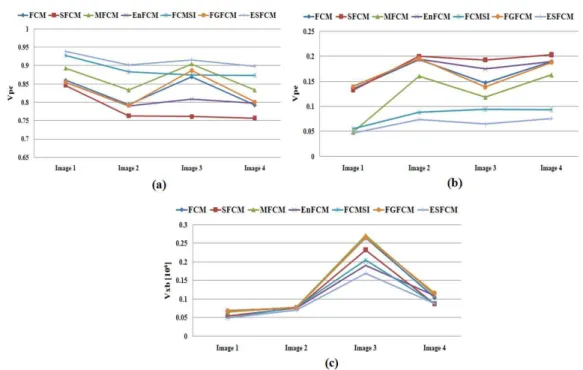
The clustering performance of the proposed algorithm is compared with that of six conventional fuzzy c-means algorithms including fuzzy c-means (FCM) [3], enhanced fuzzy c-means (EnFCM) [6], fast and robust fuzzy c-means (FGFCM) [8], spatial fuzzy c-means (SFCM) [12], modified fuzzy c-means (MFCM) [13], and fuzzy c-means with spatial information (FCMSI) [14]. The proposed algorithm and the conventional algorithms are implemented and simulated using Microsoft Visual C++ 2008. To simulate the proposed clustering algorithm, the following control parameter values were used: the size of the square window is 3x3 pixels, (which indicates the degree of fuzziness) is 2, the termination threshold is 0.0001, and the number of cluster is 4. Selected target images used for this study are shown in Fig. 1.
The FCM, SFCM, MFCM, EnFCM, FCMSI,
FGFCM, and the proposed ESFCM clustering results
as measured with the three selected well-known cluster
validity functions are given in Table 1. The proposed
ESFCM algorithm outperformed the FCM, SFCM,
MFCM, EnFCM, FCMSI, and FGFCM algorithms in all
그림 2. c=4를 가지고 제안한 ESFCM 알고리즘과 기존의 FCM 기반 알고리즘의 클러스터링 성능. (a)
, (b)
, and (c)
Fig. 2. Clustering performance between the proposed ESFCM algorithm and conventional FCM based algorithms with