ISSN 1225-6552
http://dx.doi.org/10.7853/kjvs.2012.35.3.239
< Case Report >
Veterinary Service
Available online at http://kosves.re.kr
*Corresponding author: Gee-Wook Shin, Tel. +82-63-270-3903, Fax. +82-63-270-3778, E-mail. [email protected]
이스라엘 잉어( Cyprinus carpio )에서 Aeromonas veronii 감염증의 증례: phylogenetic analysis와 항생제 내성
이승원ㆍ유명조ㆍ이해범ㆍ신기욱*
전북대학교 수의과대학 생체안전성연구소
A case of Aeromonas veronii infection in Israeli carp (Cyprinus carpio): phylogenetic analysis and antimicrobial resistance
Seung-Won Yi, Myung-Jo You, Hae-Beom Lee, Gee-Wook Shin*
Bio-Safety Research Institute and College of Veterinary Medicine, Chonbuk National University, Jeonju 561-756, Korea (Received 24 July 2012; revised 7 August 2012; accepted 13 August 2012)
Abstract
We reported an outbreak of Aeromonas (A.) veronii responsible for ulcerative dermatitis in Israeli carp (Cyprinus carpio). The major clinical signs were darkening body, abdominal extension, exophthalmos and severe ulcerative necrosis in the skin. The necropsy showed yellowish ascites, necrosis in liver and enlargement of kidney and spleen in the morbid fish. In blood agar for culturing bacteria, three different colonies were identified as A. veronii, Plesimonas shigelloides and Shewanella putrefaciens by phyloge- netic identification using 16S rRNA or gyrB gene sequences. A. veronii was the most dominant species among them and was resistant to ampicillin, nalidixic acid and oxytetracycline.
Key words : Israeli carp (Cyprinus carpio), Aeromonas veronii, Phylogenetic analysis, Ulcerative der- matitis, gyrB gene
서 론
어류에서 궤양성 피부염(ulcerative dermatitis)은 전 신성 감염성 질환과 연관하여 주로 담수어 양식 산업 에서 심각한 경제적 손실을 유발한다. 이 질병의 주 요 원인체로는 곰팡이, 기생충 그리고 세균이 있고 이 중 세균성 병원체에는 Vibrio, Pseudomonas 그리고
Aeromonas 등이 보고되었다(McGarey 등, 1991; Vog-
elbein 등, 2001). Genus Aeromonas의 몇몇 species는 어류에서 운동성 에로모나스 패혈증을 유발하고 외 관상 임상증상은 두부 및 측선 중앙에 궤양을 형성하 는 피부염을 유발한다. 이러한 피부병변에서 가장 높 은 검출률을 보이는Aeromonas spp.은 A. hydrophila
그리고 A. sobria지만(McGarey 등, 1991) 최근 방글라 데시에서는 어류에서 발생한 epizootic ulcerative syn- drome (EUS)에서 A. veronii의 검출률이 다른 Aero-
monas spp.에 비해 높다는 것을 보고하였다(Rahman
등, 2002). 최근, Yu 등(2010)은 2007년 봄에 이스라엘 잉어의 피부질환으로부터A. veronii의 첫 발생을 보
고하였다.Aeromonas spp.은 계통분류학적으로 매우 복잡한 그
룹이다(Janda와 Abbott, 2010). 기존 병원체의 동정을 위 해 주로 사용했던 16S rRNA sequences은 Aeromonas spp.의 몇몇 species에서 최대 99% 서열 유사성이 있기 때문에 species 수준에서 동정을 위한 적합한 genetic marker가 아니다(Küpfer 등, 2006). 또한, Aeromonas spp. 사이에서 생화학적 특성의 높은 유사성 때문에 phenotypic 동정 방법의 비정확성에 대한 많은 보고도A
B
C D
Fig. 1. Ulcerative dermatitis due to A. veronii infection in Israeli carp. The major clinical signs showed broad hemorrhage in head (A), abdominal distension due to ascitic fluid (A, B), hemorrhagic purpura (petechial and ecchymosis) in ventral region (B, D) and ulceration in peduncle region (D).
있다(Lamy 등, 2010). 최근, 환경, 의학 및 수의학에서
Aeromonas spp.의 역학연구는 주로 gyrB 그리고 rpoD
gene과 같은 housekeeping genes을 이용하여 주로 수행 되고 있으며 이러한 이전 연구들은 이 그룹의 species 수준의 동정에서 housekeeping genes이 유용한 genetic marker임을 증명해 왔다(Aravena-Román 등, 2011;Figueras 등, 2011; Fontes 등, 2011). 그러나, 국내 뿐 만 아니라 국외의 어류에서 발생하는 Aeromonas 감 염증 원인체의 동정은 대부분 16S rRNA sequencing 그리고 phenotype에 의해 이루어지고 있다.
이스라엘 잉어(Israeli carp; Cyprinus carpio)는 국내 어업 총 생산량 중 적은 부분을 차지하지만, 회(raw meat), 보신 및 낚시용으로 양식되고 있다. 국내 다른 양식어종에 비해 낮은 생산량 때문에 이스라엘 잉어 에서 감염성 질병의 보고는 거의 없는 실정이다. 그 래서 이번 증례에서는 전라북도 한 이스라엘 잉어 양 식장에서 심한 궤양성 피부염을 수반하는 높은 폐사 의 주요 원인체로 A. veronii를 진단하였기에 이에 보 고하고자 한다.
증 례
2012년 5월 31일 전북 고창군 소재 한 이스라엘 잉 어 양식장에서 체표 궤양 및 출혈을 동반한 폐사가 발생하여 병성감정이 의뢰되었다. 의뢰된 양식장은 지수식 사육형태로 체중 150∼200 g의 이스라엘 잉 어가 한 호지당 약 5톤 정도 사육되고 있었다. 폐사 발생 5일 전에 크기별로 선별 작업이 수행되었고 선 별 후 이틀째부터 체표 궤양 증상이 발생하였으며 이 후 폐사는 증가하여 병성감정 의뢰 당시 일일 폐사량 은 호지 당 20수에 이르게 되었다. 병어의 10수는 충 분한 산소를 공급한 채로 전북대학교 수의과대학에 운반되어 병성감정을 실시하였다.
외관상 병리학적 주요 소견으로는 병어의 체색 흑 화, 안구 돌출, 복부 팽만, 지느러미 부식 및 피부의 점상출혈, 궤양 및 출혈이 관찰되었다. 심한 궤양의 경우 최대 5 cm에 이르며 중심부위는 괴사 그리고 그 주변은 붉은색의 울혈 증상이 보였다. 괴사의 결 과 근육층이 노출될 정도로 피부층이 소실되었다. 특 히, 병어에서 피부의 병변이 현저하게 관찰된 곳은 꼬리지느러의 이음부위, 복부 그리고 두부였다. 그러 나 등지느러미의 기저부위 및 측선의 등쪽 부위에서 는 이러한 병변이 드물게 관찰되었다. 또, 아가미에
서는 울혈 또는 빈혈로 의심되는 색깔의 변화가 관찰 되었다. 현미경을 사용한 검경에서 새변 및 새박판의 구조는 정상이었으며 부착된 기생충은 관찰할 수 없 었다. 육안적 부검 소견으로는 모든 개체에서 황색을 띤 맑은 복수가 관찰되었고 내부 실질 장기에서는 간 의 괴사, 담즙의 정체 그리고 비장 및 신장의 종대를 관찰하였다(Fig. 1).
본 연구실에서 수행한 항생제 감수성 시험 결과를 근거로 하여 병성감정 의뢰 후 다음날 임상 수의사는 gentamicin을 사료에 첨가하여 1주일간 투여를 처방 하였고 투여 기간에 폐사는 감소하여 투여 1주일 후 에는 호지 당 2∼3마리로 감소하였다.
세균 배양 및 동정
원인체의 분리 및 동정을 위해 부검 시 내부 실질 장기 및 피부궤양을 직접 탐침하여 혈액배지에 도말 하여 27oC에서 24시간 배양하였다. 초대배양에서 부 검된 모든 개체 및 내부 실질장기에서 우점종은 β용
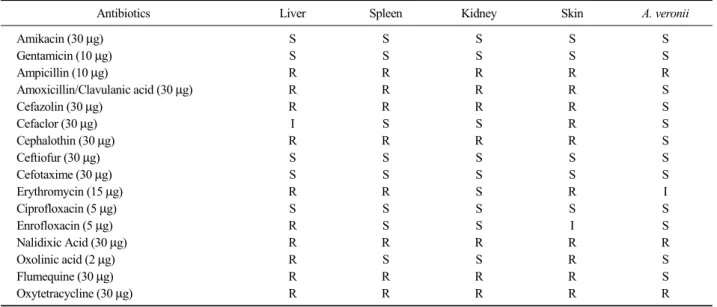
Table 1. Antibiotic susceptibility test for internal organs extracts, skin lesion and A. veronii isolate
Antibiotics Liver Spleen Kidney Skin A. veronii
Amikacin (30 μg) S S S S S
Gentamicin (10 μg) S S S S S
Ampicillin (10 μg) R R R R R
Amoxicillin/Clavulanic acid (30 μg) R R R R S
Cefazolin (30 μg) R R R R S
Cefaclor (30 μg) I S S R S
Cephalothin (30 μg) R R R R S
Ceftiofur (30 μg) S S S S S
Cefotaxime (30 μg) S S S S S
Erythromycin (15 μg) R R S R I
Ciprofloxacin (5 μg) S S S S S
Enrofloxacin (5 μg) R S S I S
Nalidixic Acid (30 μg) R R R R R
Oxolinic acid (2 μg) R S S R S
Flumequine (30 μg) R R R R S
Oxytetracycline (30 μg) R R R R R
Fig. 2. Unrooted neighbor-joining phylogenetic tree based in the gyrB (882 bp) gene sequences showing the relationship be- tween the present A. veronii isolate and its related Aeromonas spp. type strains. Numbers at nodes indicate bootstrap values (1000 replicates).
혈성 집락이었다. 한편, 한 개체에서는 β용혈성 집락 과 유사한 수를 가진 γ용혈성 집락을 관찰할 수 있었 고 다른 한 개체의 간에서는 적은 수의 γ용혈성이면 서 주황색의 집락이 관찰되었다. β용혈성인 우점종 집락은 Vitek-2 system (BioMérieux, France)으로 우선 적으로 동정하였고 그 결과 A. sobria로 동정되었다.
또한, 초대배양에서 유도된 세 가지 집락은 순수 배 양을 위해 혈액배지 그리고 tryptic soy agar (TSA)에 서 각각 한 번씩 더 배양하였다. 순수 배양된 세균의 DNA는 DNA extraction kit (Bioneer, Korea)를 이용하 여 추출하였고 16S rRNA sequences를 분석하기 위해 Macrogen sequencing service center (Korea)에 보내졌 다. 획득한 16S rRNA sequences은 BLAST searching에 의해 동정하였고 그 결과 우점종인 β용혈성 세균은
A. veronii였다. 한편, 한 개체에서
γ용혈성의 우점종 인 세균은Plesiomonas shigelloides으로 동정되었고
다른 한 개체의 γ용혈성의 적은 집락은 Shewanellaputrefacins이었다.
β용혈성 세균의 더 정확한 동정을 위해gyrB gene을 이용한 서열 분석에 이어 phyloge-
netic tree를 작성하였던바, A.veronii의 type strain과 함 께 같은 cluster를 형성하였고 둘 사이에서 sequence 유사성은 98.2%였다(Fig. 2). 따라서 현 병성감정을 의뢰한 이스라엘 잉어 양식장에서 발생하고 있는 질 병의 주요 원인체는 A. veronii인 것을 알 수 있었다.항생제 감수성 시험
현 이스라엘 잉어 양식장에서 발생하고 있는 질병의
급속한 경과로 인해 신속한 처방의 필요성이 인정되 었던바 부검 시간, 비장 그리고 신장의 분쇄액 그리 고 피부병변은 직접 탐침에 의해 Muller-Hinton agar 에 도말 후 다양한 항생제 disc를 이용한 agar dif- fusion test에 의해 항생제 감수성 시험을 수행하였다.
또한, 우점종인 A. veronii는 순수배양 후 CLSI 방법 (Miller 등, 2003)에 근거하여 항생제 감수성 시험을 하였다. 그 결과 모든 시험에서 amikacin, gentamicin, ceftiofur, cefotaxime 그리고 ciprofloxacin에 감수성을 보였으나 oxytetracycline, nalidixic acid, 그리고 ampi- cillin에는 저항성을 보였다. 조직 분쇄액의 항생제 감 수성 시험에서는 amoxicillin/clavulanic acid, cefazolin, cephalothin, 그리고 flumequine에 저항성을 보였지만,
A. veronii의 순수 분리주에서는 이 항생제들에 대하
여 감수성을 보였다(Table 1).고 찰
어류에서 운동성 에로모나스 패혈증의 주요 원인 체로는 A. hydrophila, A. sobria, A. veronii 등이 있다.
다양한 어류에서 이 감염병의 주요 증상은 출혈성 패 혈증과 연관하여 피부의 궤양 및 출혈인 것으로 보고 되고 있다(McGarey 등, 1991; Rahman 등, 2002). 그러 나 국내에서 이스라엘 잉어와 관련한 궤양병의 보고 는 Yu 등(2010)이 2007년 5월에 전라북도 양식장에서 발병사례가 유일하다. 그 증례에서도 이스라엘 잉어 궤양병의 원인체는 16S rRNA sequencing에 의해 A.
veronii로 단일 균에 의한 감염을 보고하였지만 발병
원인에 대해 충분히 언급하지 않았다. A. hydrophilaa,A. sobria와 더불어 A. veronii는 A. salmonicida와는 달
리 중온성 세균으로 수온 상승 및 고수온기에 주로 질병을 발생시키고 또한, 어류의 잘못된 사양관리로 인한 스트레스로 임상증상을 발휘하는 기회성 병원 체이다(Robert, 2001). 이번 증례에서는 수온이 상승 하는 5월에 발생한 점과 발병 이전에 선별작업을 수 행한 점으로 미루어 보아 어류에 심한 스트레스 발생 으로 인해 장내에 상주하는 A. veronii가 다른 조직으 로 이행 함으로써 심한 감염증이 유발된 것으로 고려 된다. 이러한 추정은 이번 증례에서 Plesiomonas shi-gelloides와 Shewanella putrefacins가 드물지만, 내부장
기에서 분리된 점으로 증명될 수 있다. 두 세균의 경 우 어류의 장내의 정상 세균총인 것으로 광범위하게 보고되고 있지만, 어류에서 병원성은 드물게 보고되 었다(Salgado-Miranda 등, 2010; Navarrete 등, 2010).Genus Aeromonas는 최근 10년 동안 새로운 균주의 출현 및 기존 종의 새로운 명명에 의해 매우 계통학적 으로 복잡한 그룹이다(Janda와 Abbott, 2010). 많은 연구 자가 16S rRNA sequences를 이용한 동정에서는
Aeromonas가 종 간에 고도의 서열 유사성을 보이기 때
문에 종 수준까지의 동정은 어렵다는 것을 보여주었다 (Janda와 Abbott, 2010; Küpfer 등, 2006). 예를 들어, A.veronii의 16S rRNA sequences는 A. allosaccharophila, A. jandaei, A. sobria 그리고 A. fluvialis와 98.8% 이상
의 유사성이 보고되었다(Küpfer 등 2006). 그러므로,Aeromonas의 동정에서 16S rRNA sequences는 종
(species) 수준의 동정에는 적합하지 않을 수 있다. 반면,gyrB gene은 Aeromonas의 같은 종 내에서도 2.4% 이하
의 서열 변이성이 존재하기는 하지만. 다른 종 간에서는 3% 이상의 서열 변이성이 관찰되어 genus Aeromonas에 서 종 수준 동정에 매우 유용한 marker인 것으로 보고되었다(Yáñez 등, 2003; Küpfer 등 2006). 이러한 측면 에서, 이번 증례로부터 A. veronii 분리주는 gyrB gene을 이용한 phylogenetic analysis로 정확한 동정을 수행하였 다. 한편, Vitek 2 system에서는 이번 증례의 A. veronii 분리주를 A. sobria로 잘못 동정하였다. Lamy 등(2010) 은 이 system의 database에서 A. veronii biovar sobria를
A. sobria로 잘못 표기하고 있다고 보고하였다. 따라서 A. veronii가 이 system에서는 A. sobria로 잘못 동정될
수 있기 때문에 사용상의 주의를 필요로 한다.양식장에서 급성 경과로 인해 신속한 처방의 요구로 부검 시 피부의 직접적인 탐침 및 내부장기의 분쇄액을 이용하여 항생제 감수성 시험을 수행하였다. 또한, 순수 배양된 A. veronii 분리주는 CLSI 방법(Miller 등, 2003)에 근거하여 항생제 감수성 시험을 하였다. A.
veronii의 분리주는 ampicillin, nalidixic acid, oxy-
tetracycline에 대한 고등도의 내성과 erythromycin에 대한 중등도의 내성을 보였지만 나머지 항생제들에 는 감수성을 보였다. 그러나 이러한 결과는 crude한 시료로부터 항생제 감수성 시험과는 차이를 보였다.항생제 감수성 시험에서 접종량과 같은 다양한 인자 들은 내성 및 감수성 판정에 영향을 미치는 것으로 보고되었다(Miller 등, 2003). 따라서 이전 연구들에 근거해 볼 때, 이번 증례의 병어 조직 및 병변에 부하 된 세균은 CSLI법에 의해 제시된 접종량(McFarland 0.5)보다 많아, 그 결과 몇몇 항생제에 대한 저항성을 초래하는 것으로 생각한다. 이러한 방법은 신속 처방 을 위한 방법으로는 유용하지만 환경 산재 비병원성 세균의 저항성을 유발할 수 있기 때문에 진단 시 주 의를 필요로 한다.
결 론
2012년 5월 전라북도 고창지역의 한 이스라엘 잉 어 양식장에서 일일 폐사량이 호지당 20여 마리에 도 달하는 질병이 발생하여 본 대학에 병성감정을 의뢰 하였다. 병어의 주요 임상증상은 출혈성 패혈증과 연 관된 피부 궤양 및 괴사 소견이 현저하게 관찰되었 다. 세균학적 동정 결과 A. veronii, Plesiomonas shi-
gelloides, Shewanella putrefacins이 동정되었고 이 중
A. veronii는 주요 병원체임을 알 수 있었다. A. veronii
의 정확한 동정은 gyrB gene sequences를 이용한 phy- logenetic analysis에 의해 수행되었다.참 고 문 헌
Aravena-Román M, Harnett GB, Riley TV, Inglis TJ, Chang BJ.
2011. Aeromonas aquariorum is widely distributed in clinical and environmental specimens and can be mis- identified as Aeromonas hydrophila. J Clin Microbiol 49: 3006-3008.
Figueras MJ, Beaz-Hidalgo R, Senderovich Y, Laviad S, Halpern M. 2011. Re-identification of Aeromonas isolates from chironomid egg masses as the potential pathogenic bac- teria Aeromonas aquariorum. Env Microbiol Rep 3:
239-244.
Fontes MC, Saavedra MJ, Martins C, Martínez-Murcia AJ. 2011.
Phylogenetic identification of Aeromonas from pigs slaughtered for consumption in slaughterhouses at the North of Portugal. Int J Food Microbiol 146: 118-122.
Janda JM, Abbott SL. 2010. The genus Aeromonas: taxonomy, pathogenicity, and infection. Clin Microbiol Rev 23:
35-73.
Küpfer M, Kuhnert P, Korczak BM, Peduzzi R, Demarta A.
2006. Genetic relationships of Aeromonas strains in- ferred from 16S rRNA, gyrB and rpoB gene sequences.
Int J Syst Evol Microbiol 56: 2743-2751.
Lamy B, Laurent F, Verdier I, Decousser JW, Lecaillon E, Marchandin H, Roger F, Tigaud S, de Montclos H;
colBVH Study Group, Kodjo A. 2010. Accuracy of 6 commercial systems for identifying clinical Aeromonas isolates. Diagn Microbiol Infect Dis 67: 9-14.
McGarey DJ, Milanesi L, Foley DP, Reyes B Jr, Frye LC, Lim DV. 1991. The role of motile aeromonads in the fish disease, ulcerative disease syndrome (UDS). Experientia 47: 441-444.
Miller RA, Walker RD, Baya A, Clemens K, Coles M, Hawke
JP, Hsu HM, Mathers JJ, Oaks JL, Papapetropoulou M, Reimschuessel R. 2003. Antimicrobial susceptibility test- ing of aquatic bacteria: quality control disk diffusion ranges for Escherichia coli ATCC 25922 and Aeromonas salmonicida subsp. salmonicida ATCC 33658 at 22 and 28oC. J Clin Microbiol 41: 4318-4323.
Navarrete P, Magne F, Mardones P, Riveros M, Opazo R, Suau A, Pochart P, Romero J. 2010. Molecular analysis of in- testinal microbiota of rainbow trout (Oncorhynchus my- kiss). FEMS Microbiol Ecol 71: 148-156.
Rahman M, Colque-Navarro P, Kühn I, Huys G, Swings J, Möllby R. 2002. Identification and characterization of pathogenic Aeromonas veronii biovar sobria associated with epizootic ulcerative syndrome in fish in Bangla- desh. Appl Environ Microbiol 68: 650-655.
Robert RJ. 2001. The bacteriology of teleosts. pp. 332-346. In:
Tobert RJ(ed.). Fish pathology. 3rd ed. WB Saunders, UK.
Salgado-Miranda C, Palomares E, Jurado M, Marín A, Vega F, Soriano-Vargas E. 2010. Isolation and distribution of bacterial flora in farmed rainbow trout from Mexico. J Aquat Anim Health 22: 244-247.
Vogelbein WK, Shields JD, Haas LW, Reece KS, Zwerner DE.
2001. Skin ulcers in estuarine fishes: a comparative pathological evaluation of wild and laboratory-exposed fish. Environ Health Perspect 109: 687-693.
Yáñez MA, Catalán V, Apráiz D, Figueras MJ, Martínez-Murcia AJ. 2003. Phylogenetic analysis of members of the ge- nus Aeromonas based on gyrB gene sequences. Int J Syst Evol Microbiol 53: 875-883.
Yu JH, Han JJ, Kim HJ, Kang SG, Park SW. 2010. First report of Aeromonas veronii infection in farmed Israeli carp Cyprinus carpio in Korea. J Fish Pathol 23: 165-176.