Genetic variation and relationship of Artemisia capillaris Thunb.
(Compositae) by RAPD analysis
Jung-Hyun Kim, Dong-Kap Kim1, and Joo-Hwan Kim1* National Institute of Biological Resources, Incheon 404-170, Korea
1Department of Biology, Daejeon University, Daejeon 300-716, Korea
Abstract - Randomly Amplified Polymorphic DNA (RAPD) was performed to define the genetic variation and relationships of Artemisia capillaris. Fifteen populations by the distributions and habitat were collected to conduct RAPD analysis. RAPD markers were observed mainly between 300bp and 1600bp. Total 72 scorable markers from 7 primers were applied to generate the genetic matrix, and 69 bands were polymorphic and only 3 bands were monomorphic. The genetic dissimilarity matrix by Nei’s genetic distance (1972) and UPGMA phenogram were produced from the data matrix. Populations of Artemisia capillaris were clustered with high genetic affinities and cluster patterns were correlated with distributional patterns. Two big groups were clustered as southern area group and middle area group. The closest OTUs were GW2 and GG1 in middle area group, and GB1 from southern area group was clustered with OTUs in middle area group. RAPD data was useful to define the genetic variations and relationships of A. capillaris.
Key words - Artemisia capillaris, RAPD, variations, genetic relationship, molecular marker
*Corresponding author. E-mail : [email protected]
Introduction
Artemisia capillaris Thunb. is distributed in East Asia including Korea, Japan, China, Taiwan, and Philipines (Yook, 1977; Lee, 1980; Ohwi, 1984; Mata et al. 1985). It is known as a medicinal plants which is effective for various kinds of dis- ease traditionally (Jung, 1956). Generally, what we call
‘In-Jin-Ssook’ which is reported as good for anti-liver disease (Lee, 1996) includes A. iwayomogi, A. capillaris, A. sacrorum subsp. manshuric, A. sacrorum var. vestita, A. scroparia, and A. angustssia (Kim, 1992). Among those species, A. capillaris recognised as ‘In-Jin-Ho’ or ‘Jeong-gyeong-ssook’is a peren- nial plant which lives in sand area of steram side and grows up to 30-100 cm height (Lim, 1992). 'In-Jin' which is dried whole plants with young leaves and flowers includes oils and aromatic components such as capilin, 6,7-dimethylaescletin, benzalde- hyde, pinene, myrcene, cineole, 2-pyrrolidinone, camphor, thujone, 1-acethlpiperidine, caryophyllene, coumarine, farnesol and etc. (Cho and Chiang, 2001). Saccharides of A. capillaris include mainly glucose (71%), xylose (25.4%), manose (2.8%),
ramnose (0.6%), and 1.4% of amino acids components(Song, 1996). And the main flavonoid components of A. capillaris contain artemisidin, atemicapins, coumarins, and etc. (Wu, 2001).
There are many previous studies on A. capillaris, but most of them are mainly for the constituent analysis, phamacological effect and cultivation techniques including allelopathy effect (Kil et al., 1999), growth characteristics and component(Rho and Seo, 1993), pathological effect (Ahn, 2000; Choi et al., 2008a; Choi et al., 2008b; Seo and Yun, 2008), immunological toxicity of extracts (Lee et al., 2004), and characteristics of germination and cultivation (Lim et al., 2004; Choi et al., 2007).
Also Rho and Seo (1993) mentioned the morphological varia- tion patterns of collected samples, and Park et al. (2005) sug- geted that RAPD analysis showed the higher resolution than cluster analysis based on morphology. It is because of the differences of the collected sample numbers as well as huge morphological variations of leaves in interspecies and even in infraspecific individuals. As the difficulties of classification and identification according to the growing stages and environ- ments, the investigation for precise identification method of in A. capillaris has been needed (Rho and Seo, 1993).
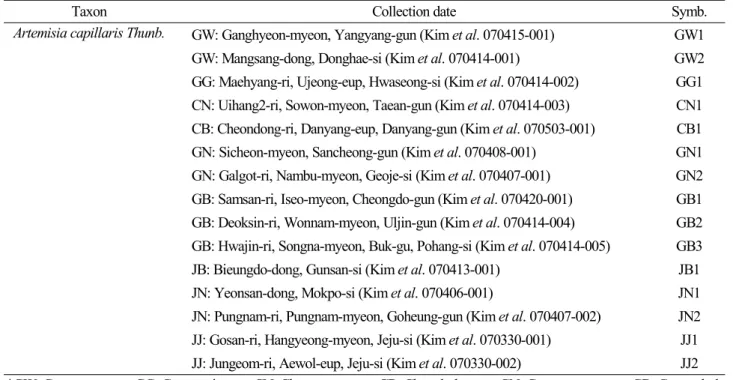
Table 1. Materials and collection data of Artemisia capillaris
Taxon Collection date Symb.
Artemisia capillaris Thunb. GW: Ganghyeon-myeon, Yangyang-gun (Kim et al. 070415-001) GW1 GW: Mangsang-dong, Donghae-si (Kim et al. 070414-001) GW2 GG: Maehyang-ri, Ujeong-eup, Hwaseong-si (Kim et al. 070414-002) GG1 CN: Uihang2-ri, Sowon-myeon, Taean-gun (Kim et al. 070414-003) CN1 CB: Cheondong-ri, Danyang-eup, Danyang-gun (Kim et al. 070503-001) CB1 GN: Sicheon-myeon, Sancheong-gun (Kim et al. 070408-001) GN1 GN: Galgot-ri, Nambu-myeon, Geoje-si (Kim et al. 070407-001) GN2 GB: Samsan-ri, Iseo-myeon, Cheongdo-gun (Kim et al. 070420-001) GB1 GB: Deoksin-ri, Wonnam-myeon, Uljin-gun (Kim et al. 070414-004) GB2 GB: Hwajin-ri, Songna-myeon, Buk-gu, Pohang-si (Kim et al. 070414-005) GB3 JB: Bieungdo-dong, Gunsan-si (Kim et al. 070413-001) JB1 JN: Yeonsan-dong, Mokpo-si (Kim et al. 070406-001) JN1 JN: Pungnam-ri, Pungnam-myeon, Goheung-gun (Kim et al. 070407-002) JN2 JJ: Gosan-ri, Hangyeong-myeon, Jeju-si (Kim et al. 070330-001) JJ1 JJ: Jungeom-ri, Aewol-eup, Jeju-si (Kim et al. 070330-002) JJ2
*GW: Gangwon prov., GG: Gyeonggi prov., CN: Chungnam prov., CB: Chungbuk prov., GN: Gyeongnam prov., GB: Gyeongbuk prov., JB: Jeonbuk prov., JN: Jeonnam prov., JJ: Jeju prov.
There are many molecular genetic protocols to classify the low level taxa such as interspecific, intergeneric levels and forms besides of cultivation environment and morphological characters (Park et al., 2005). Especially RAPD and AFLP are very useful to trace the origin on especially low level taxa.
Also RAPD method overcomes many of the technical limita- tions of RFLP and has been used in many genetic analyses with very small amount of sample concentration including popula- tion genetics studies(Williams et al., 1990) It showed consis- tent results and merits even in various growing stages of samples and even in the variants from huge environmental differences.
Generally ‘Sook’ which designates several species of Artemisia is traditionally used as local name instead of scientific name, and mixed plants from unknown species of Artemisia are used because of difficult identification when they prepared the samples for folk medicine. And the taxa of Artemisia show huge variations according to the growth conditions and envi- ronments from cross-fertilization mechanism. The investigation to establish the identification system among inter- and infra- specific taxa of Artemisia has been needed (Park et al., 2005).
Therefore, this study was performed to determine the genetic diversity of A. capillaris Thunb. by distributions and
habitats in Korea. And we conducted RAPD analyses of 15 regional populations, and we discussed the genetic variations and relationships among the taxa by RAPD data.
Materials and Methods
Plant Materials
The plant materials used in this study and their collection data are given in Table 1. They were collected from March to May in 2007 from 15 regional populations in South Korea.
Leaves used as sources of DNA were collected from natural populations. And the voucher specimens were deposited in TUT. All plant materials were kept in vinyl zipper bag with silica-gel until returned to the laboratory and stored at -70℃
in the laboratory until use.
DNA extraction and PCR for RAPD
Total genomic DNA was extracted from fresh leaf tissue pulverized in liquid nitrogen using the 2X CTAB buffer (Doyle and Doyle, 1987). DNA samples were stored at -20℃ until use.
Randomly amplified polymorphic DNA in each genomic DNA was amplified by 35 cycles with No. 1-200 oligo primers
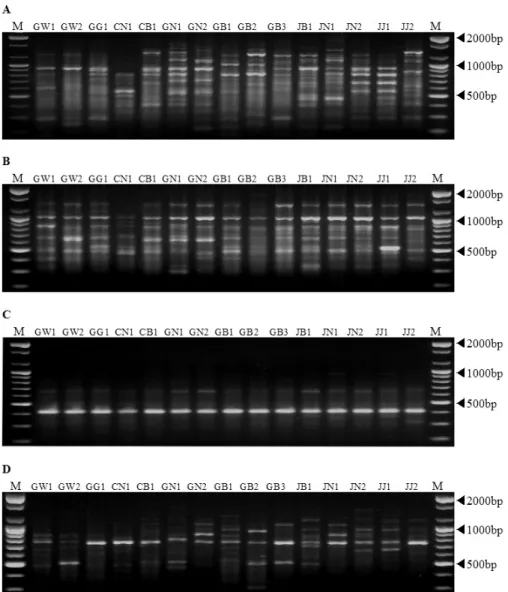
Fig. 1. RAPD electrophoresis profiles for Artemisia capillaris.
(M: molecular markers; A, primer No. 101; B, primer No. 105; C, primer No. 125; D, primer No. 155).
by NAPS (Univ. of British Columbia). Amplifications were perfomed in 25 μl reactions containing 10-50 ng DNA, 200 μ M dNTP (equimolar), 0.5 units AmpliTaq DNA polymerase (Perkin & Elmer, Cetus), 10 mM Tris-HCl, pH 8.3, 50 mM KCl, 1.5 mM MgCl2, 0.001% gelatin, and primers at 1.0 μM.
Before the PCR cycles, PCR mixture was predenatured at 9 2℃ for 3 minutes. The PCR cycle consisted of 30 seconds at 95℃ for denaturation, 30 seconds at 50℃ for annealing, and 1 minutes at 72℃ for extension. After 35 cycles the PCR reactions were incubated at 72℃ for 7 minutes to complete final extension. After the useful primers were screened, we conducted 3 times repetitive reactions with same primers to confirm their availability. Agarose gel electrophoresis were
employed to check the amplified DNA products by 1.5% agarose gel with 10-4% EtBr. And the correct band positions were deter- mined with 1D-PCR program by Universal Software (AAB, 2000) and photographed (Fig. 1)
Data Analysis
Each RAPD band was assigned a number and treated as a unit character coded as 0(absent) or 1(present) by the operational taxonomic units (OTUs), and the data matrix was conducted.
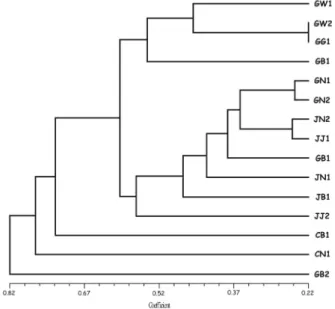
The genetic variations were calculated by Nei and Li’s genetic distance (1979) with NTSYS program (Applied Biostatistics, 2000, v2.1). The UPGMA phenogram was produced by the RAPD results and it was used to investigate the relationships
Fig. 2. UPGMA phenogram of 15 populations of Artemisia capillaris based on RAPD analysis.
Table 2. The code and sequences of primer analysed, total number of bands and fragment size which were used for Artemisia capillaris Primer Sequnence(5’→3’) polymorphic bands monomorphic bands Total no. of bands Fragment size range (bp)
101 GCG GCT GGA G 13 13 300-1600
105 CTC GGG TGG G 7 1 8 300-1500
125 GCG GTT GAG G 2 1 3 400-1000
147 GTG CGT CCT C 11 11 300-1400
149 AGC AGC GTG G 14 14 300-1600
155 CTG GCG GCT G 10 1 11 300-1500
157 CGT GGG CAG G 12 12 400-1600
Total 57 3 72
Mean/primer 9.9 0.4 10.3
among OTUs (Fig. 2).
Results and Discussion
We conducted to select the proper primers after screening PCR reactions with 200 primers. And we investigated the reproducibility of selected primers by 3 times repetitive reaction. The considered RAPD markers from 15 OTUs which showed consistent amplification were found between 300bp 1600bp. Total 72 scorable markers from 7 primers were applied to generate the genetic matrix, and 69 bands were poly- morphic and only 3 bands were monomorphic. This result showed the highly related genetic similarity among the taxa
of A. capillaris (Fig. 1). We found 3-16 polymorphic bands according to primers and the average number of polymorphic bands was 10 (Table 2). The genetic dissimilarity matrix by Nei’s genetic distance (1972) and UPGMA phenogram were produced from the data matrix (Table 3, Fig. 2).
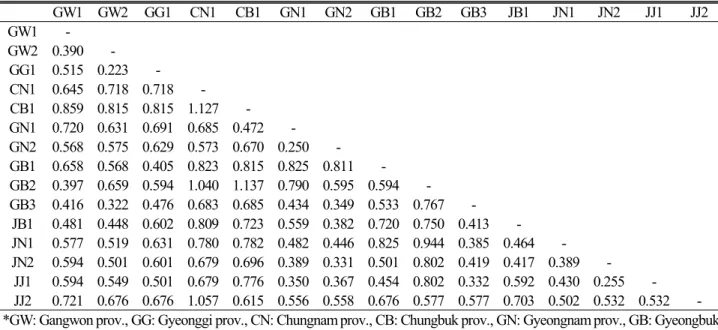
Fifteen populations of A. capillaris showed various genetic differences ranging from 0.223 to 1.137, and it was 0.223-0.250 between the nearest distributed populations and 0.390-0.532 between regionally isolated populations (Table 3). Based on the UPGMA phenogram, two big groups were clustered as southern area group and middle area group. The closest OTUs were GW2 and GG1 in middle area group, and GB1 from southern area group was clustered with OTUs in middle area group. In the southern area group, GN1 and GN2 from Gyeong- nam Province were clustered firstly, and populations from Jeonbuk Prov. and Jeju Prov. with GB3 formed a big cluster with CB1 and CB2 (Fig. 2, Table 3).
A. capillaris showed various genetic diversity without any relations of geographical isolation and habitat similarity based on RAPD analyses. This result supported partly the previous data which showed the morphological variations of leaves by the distributional regions and habitat environments (Rho and Seo, 1993). Park et al. (2005) classified Artemisia mixture collections into 5 groups by morphology and RAPD, but there was no obvious evidence or suggestion for identifi- cation of Artemisia. The reason is supposed as follows : A.
capillaris and related species including A. feddei, A. argyi, and A. princeps var. orientalis showed similar patterns in mor- phology, and the collection numbers were very different by taxa.
And especially leaf variations among the above Artemisia
Table 3. Genetic dissimilarity matrix of Artemisia capillaris by Nei’s (1972) based on RAPD analysis
GW1 GW2 GG1 CN1 CB1 GN1 GN2 GB1 GB2 GB3 JB1 JN1 JN2 JJ1 JJ2
GW1 -
GW2 0.390 - GG1 0.515 0.223 - CN1 0.645 0.718 0.718 - CB1 0.859 0.815 0.815 1.127 - GN1 0.720 0.631 0.691 0.685 0.472 - GN2 0.568 0.575 0.629 0.573 0.670 0.250 - GB1 0.658 0.568 0.405 0.823 0.815 0.825 0.811 - GB2 0.397 0.659 0.594 1.040 1.137 0.790 0.595 0.594 - GB3 0.416 0.322 0.476 0.683 0.685 0.434 0.349 0.533 0.767 -
JB1 0.481 0.448 0.602 0.809 0.723 0.559 0.382 0.720 0.750 0.413 - JN1 0.577 0.519 0.631 0.780 0.782 0.482 0.446 0.825 0.944 0.385 0.464 - JN2 0.594 0.501 0.601 0.679 0.696 0.389 0.331 0.501 0.802 0.419 0.417 0.389 -
JJ1 0.594 0.549 0.501 0.679 0.776 0.350 0.367 0.454 0.802 0.332 0.592 0.430 0.255 - JJ2 0.721 0.676 0.676 1.057 0.615 0.556 0.558 0.676 0.577 0.577 0.703 0.502 0.532 0.532 -
*GW: Gangwon prov., GG: Gyeonggi prov., CN: Chungnam prov., CB: Chungbuk prov., GN: Gyeongnam prov., GB: Gyeongbuk prov., JB: Jeonbuk prov., JN: Jeonnam prov., JJ: Jeju prov.
complex and even within the same species were extremely various. And there was no clear criteria to identify the mixture collections even they suggested the independent differentiation process of gene pool among the populations of Artemisia sp.
This study showed the high genetic diversity of A. capillaris and various genetic distances and patterns among the popu- lations. Various range of genetic diversity would be the results of the adaptation to different environment. It showed the similar diverse patterns of leaf and inflorescense variations as well as genetic diversity of A. capillaris. RAPD data was useful to define the genetic variations and relationships of A.
capillaris.
Acknowledgements
This work was supported by the RIC program of MKE (Ministry of Knowledge Economy) in Daejeon University
Literature Cited
Ahn, B.M. 2000. What is In-Jin-Sook? Artemisia capillaris, Artemisia iwayomogi, and Artemisia annua, The Korean Journal of Hepatology. 16(4): 548-551. (in Korean)
Cho, Y.H and M.H Chiang. (2001). Research papers : Essential Oil Composition and Antibacterial Activity of Artemisia
capillaries, Artemisia argyi, and Artemisia princeps. Kor. J.
Intl. Agri. 13(4): 313-320. (in Korean)
Choi, S.R., I.O. Ju, D.H. You, Y.E. Song, I. Jang and J. Ryu. 2007.
Changes of Major Components and Growth Characteristics According to Harvesting Times of Artemisia capillaris Thun- berg. Kor. J. Medicinal Crop Sci. 15(3): 189-193 (in Korean) Choi, S.R., D.H. You, I.O. Ju, I. Jang, J.Y. Kim, C.B. Park and
J. Ryu. 2008a. Changes of Pharmacological Components and Growth Characteristics According to Cultivation Years of Artemisia capillaris Thunb. Kor. J. Medicinal Crop Sci. 16(1):
57-61. (in Korean)
Choi, S.R., D.H. You, J.Y. Kim, C.B. Park, J. Ryu, D.H. Kim and J.S. Eun. 2008b. Antioxidant and Antimicrobial Activities of Artemisia capillaris Thunberg. Kor. J. Medicinal Crop Sci.
16(2): 112-117. (in Korean)
Doyle, J.J. and J.L. Doyle. 1987. A rapid DNA isolation methods for small quantities of fresh tissues. Phytochemical Bulletin.
17: 144-163.
Jung, T.H. 1956. Korean Flora. vol. II. Shinjisa, Seoul. (in Korean)
Kil, B.S. 1999. Allelopathic Effects of Artemisia capillaris on the Selected Species. Korean J. Ecol. 22(1): 59-63. (in Korean) Kim, J.K. 1992. Illustrated natural drugs encyclopedia. Namsan-
dang, Seoul. Pp. 64-79. (in Korean)
Lee, M.K., G.P. Choi, L.H. Ryu, G.Y. Lee, C.Y. Yu and H.Y.
Lee. 2004. Enhanced Immune Activity and Cytotoxicity if Artemisia capillaris Thunb. Extracts against Human Cell
Lines. Kor. J. Medicinal Crop Sci. 12(1): 36-42. (in Korean) Lee, S.B. 1996. Hepatoproteinactive effect of polysaccaride
fraction from Artemisia iwayomogi in rat. Sungkyunkwan Univ. Ph. D. Dissertation.
Lee, T.B. 1980. Illustrated Flora of Korea. Hyangmunsa, Seoul.
Pp. 755. (in Korean).
Lim, J.R., B.K. Choo, C.B. Park, D.H. Kim, J.S. Choi and Y.G.
Choi. 2004. Germination and Growth Characteristics in Different Sowing Date of Artemisia capillaris Thunb. Kor. J.
Medicinal Crop Sci. 12(4): 295-299. (in Korean)
Lim, S.N. 1992. Studies on the biological activities of Mugwort (Artemisia asiatica Nakai) Leaves. Yonsei Univ. Master thesis.
Mata, R., G. Delgado and A.R. De Vivar. 1985. Sesquiterpene lactones of Artemisia klotzchiana. Phytochemistry. 24: 1515- 1519.
Nei, M. 1972. Genetic distance between populations. Amer.
Natur. 106: 283-292.
Ohwi, J. 1984. Flora of Japan. 2nd printing, Smithsonian Inst.
Washinton, D.C.
Park, S.K., B.H. Chung, H.S. Kim and Y.G. Cho. 2005. Class-
fication of Artemisia spp. Collections Based on Morphological Characters and RAPD Analysis. Kor. J. Medicinal Crop Sci.
13(6): 278-286. (in Korean)
Rho, T.H and G.S. Seo. 1993. Growth Characteristics and Che- mical Components in Local Collections of Artemisia sp. Kor.
J. Medicinal Crop Sci. 1(2): 171-177. (in Korean)
Seo, K.S and K.W. Yun. 2008. Antioxidant Activities of Extracts from Artemisia capillaris Thunb. and Artemisia iwayomogi Kitam. used as Injin. Kor. J. Plant Res. 21(4): 292-298. (in Korean)
Song, K.W. 1996. Phytochemical study of polysaccaride fraction from Artemisia species. Sungkyunkwan Univ. Master thesis.
Williams, J., A. Kubelik, J. Rafalski and S. Tingey. 1990. DNA polymorphisms amplified by arbitary primers are useful as genetic markers. Nucleic Acids Research 18: 6231-6239.
Wu, T.S., Z.J. Tsang, P.L. Wu, F.W. Lin, C.Y. Li, C.M. Teng and K.H. Lee. 2001. New constituents and antiplatelet aggregation and anti-HIV principles of Artemisia capillaris. Bioorganic
& Medicinal Chemistry. 9: 77-83.
Yook, C.S. 1977. Medicinal Plants, Jinmyung Publishing Co.
Pp. 293-298. (in Korean)
(Received 25 March 2009 ; Accepted 23 June 2009)