초등과학영재의 정서지능과 성취목표지향성이 진로성숙도에 미치는 영향
임현지․최선영† (청솔초등학교)․(경인교육대학교)†
The Effects of Emotional Intelligence and Achievement Goal Orientation on Career Maturity of the Elementary Scientific Gifted Students
Lim, Hyeon-Ji
․Choi, Sun Young†(Chungsol Elementary School)․(Gyeongin National University of Education)
†ABSTRACT
The purpose of this study was to identify the influence of emotional intelligence and achievement goal orientation on career maturity for elementary scientific gifted students. For this purpose, emotional intelligence test, achievement goal orientation measure and career maturity test were used. Sample of the study was consisted of 107 science gifted students and 98 general students in Y City, Gyeonggi Province. The results of this study were as follows. First, scientific gifted students showed higher score than general students, whereas general students had highest score in type of avoidance goal orientation of achievement goal orientation. Also, scientific gifted students showed highest score in mastery goal orientation of those. Second, the correlation between emotional intelligence and career maturity of scientific gifted students showed significantly positive score in almost all the subelements. As a result of conducting a regression analysis on the influence of emotional intelligence on career maturity of scientific gifted students, job planning and self-understanding of career maturity were impacted by emotional intelligence, whereas independence was low influence by emotional intelligence. Third, for the correlation between achievement goal orientation and career maturity of scientific gifted students, mastery goal orientation of achievement goal orientation had positive relationship in almost all the subelements, whereas mastery avoidance goal orientation and performance-avoidance goal orientation had negative correlation. Also, as a result of conducting a regression analysis on the influence of achievement goal orientation on career maturity of scientific gifted students, achievement goal orientation had influence on all the subelements of career maturity.
Key words : emotional intelligence, achievement goal orientation, career maturity, the elementary scientific gifted student
본 논문은 임현지의 2016년도 석사학위 논문에서 발췌 정리하였음.
2016.7.5
(접수), 2016.7.29(1심통과), 2016.8.20(2심통과), 2016.8.25(최종통과)E-mail: [email protected]
(최선영)I.
서 론과학영재는 우리나라의 21C 미래과학기술 도약 을 책임질 리더로서, 이들이 사회에 나아가 그들의 역량을 충분히 발휘할 수 있도록 개인의 진로를 고 려한 영재교육 방향을 정립하는 것은 매우 중요한 일이다. 최근 우리나라 영재교육은 개인의 잠재력
을 발현하고, 다양한 꿈․끼를 계발할 수 있도록 지원하는 것을 중요한 교육 방향으로 내세우고, 영 재들의 진로교육에 점차 무게를 두고 있다(Ministry of Education, 2013).
진로교육이 학생들의 진로 성장을 적절히 돕기
위해서는 개인의 진로발달 시기에 맞게 적시에 진
로지도가 이뤄져야 한다(Chung et al., 2011). 특히
과학영재들은 일반학생과 다른 지적, 인성적, 환경 적 특성들로 인해 진로발달에도 그들만의 고유한 특성을 보이며, 이를 고려한 교육적 개입이 요구된 다(Hwang et al., 2010). 또한 시기적인 측면에서 초 등학교 단계는 미래의 학업 및 직업적 성취의 기초 를 형성하고, 성인 진로발달의 모체가 되는 중요한 성장기로(Lee et al., 2006), 초등시기의 과학영재가 어느 정도로 진로발달에 대해 준비가 되어 있는지 구체적으로 살필 필요가 있다. 진로발달에 대한 준 비 정도는 진로성숙 수준, 즉 진로성숙도(Career Maturity)를 통해 알 수 있으며(Super, 1957), 진로성 숙도란 진로발달 과정에서 자신과 직업 세계를 이 해하고, 진로를 계획하고, 합리적으로 선택하는 진 로 의식 및 행동에 대한 준비 정도를 말한다(Hoyt, 1977; Super, 1953). 초등과학영재가 그들의 역량에 적합한 진로성취를 이루기 위해서는 높은 진로성 숙도가 전제되어야 하는 만큼, 초등과학영재의 진 로성숙에 관여하는 요소가 일반학생과 어떻게 다 른 특수성을 가지고 있는지 살펴볼 필요가 있다.
진로에 관여하는 영재의 특성에 대해 언급한 여 러 연구들은 영재의 진로에 대한 관점을 인지적 측 면이 아닌 영재의 개인 내적 측면에 무게를 두고 있다. Kim(2003)은 영재가 개인의 적성과 흥미를 진로선택의 첫 번째 기준으로 여기고, 흥미와 성격, 능력에 대한 신념과 포부를 살필 수 있는 기회가 중요함을 언급했으며, Yang & Han(2010)은 영재에 대한 진로교육이 그들의 능력을 인식하고, 흥미를 이해하며, 가능성 범위에 노출되도록 도움을 줄 수 있어야 한다고 하였다. 특히 초등학생의 진로발달 시기는 적성과 흥미를 바탕으로 직업세계를 이해 하는 시기로 진로교육에서 진로에 대한 개인의 내 적 측면이 강조되고, 자신의 적성과 흥미 등의 개 인 내적 측면을 스스로 파악하기 위해서는 진로에 대한 정서적 민감성이 필요하다(Yang & Han, 2010).
이러한 정서적 민감성과 정서활용은 정서 자체와 는 달리, 정서를 점검하고 조절하는 메타 정서 영 역인 정서지능(Mayer & Salovey, 1993)과 관련이 있 다. 정서지능(Emotional Intelligence)이란 자신과 타 인의 감정과 정서를 점검하고, 그것들의 차이를 변 별하며, 문제를 생각하고 행동하는데 있어 정서적 으로 영향을 주는 요인으로, 다양한 문제 상황 속 에서 발생할 수 있는 자신과 타인의 정서를 능숙하 게 처리하고, 대인 관계 문제에 그것을 적용하여
적응적이고 효과적인 해결 방법을 찾아내는 능력 을 말한다(Moon & Gwag, 2005; Mayer & Salovey, 1990). 이러한 정서지능은 영재성을 설명해주는 정 의적 요소 중 하나로(Yu & Han, 2011), 초등영재의 정서지능이 어떤 형태로 진로성숙도에 영향을 미 치는지 파악할 필요가 있다.
아울러 영재 진로 발달의 최종 목적지는 영재를 자아실현 및 사회 발전에 도움이 되는 전문가로 성장 시키는 것이다(Lee & Choi, 2014). 바람직한 성장을 위해서는 영재가 그들의 영재성에 적합한 직업 성취 에 대하여 적절한 동기를 가지고 있는지 살펴야하며, 개인의 성취동기를 알아보기 위한 틀로는 성취목표 지 향성이 있다(Ames 1992; Elliot 1999; Urdan, 1997). 따라 서 영재들이 영재성을 발현할 수 있는 직업을 성취 하는 것을 진로 교육의 목표로 삼고, 그들이 진로 성 취에 대한 적절한 동기를 가지고 있는지, 성취목표지 향성과 진로에 대한 관련성을 알아볼 필요가 있다.
이와 같이 진로 교육에서 학생의 진로 성숙에 관 여하는 변인 연구로서 정서지능과 성취목표지향성 과 관련된 연구를 살펴보면, Jung & Kim(2010)의 연구에서는 정서가 인지적 과정을 통해 진로 관련 행동에 영향력을 미치는 변인임을 언급하였고, Kim
& Sohn(2014) 은 초등학생의 진로성숙과 목표지향 성 요인의 연관성을 분석하였다. 이러한 연구결과 들은 진로교육에서 학생의 진로성숙에 관여하는 변인 연구로서 정서지능과 성취목표지향성이 점차 중요한 비중을 차지하게 되었음을 의미한다. 그러 나 이러한 진로 관련 선행 연구들은 대부분 일반학 생을 대상으로 이루어지고 있으며, 초등과학 영재 의 진로에 관여하는 직접적인 특성을 살피기는 미 흡한 실정이다. 또한 과학영재의 진로에 있어서, 이 공계 이탈 현상과 같이 그들의 적성이나 흥미와 같 은 정서 및 동기 요인이 진로 성숙에 반영되지 못 하는 진로교육 문제의 기초 연구로서 영재성과 진 로성숙 특성의 관계를 분석할 필요가 있다.
따라서 이 연구는 초등과학영재의 정서지능과 성 취목표지향성이 진로성숙도에 미치는 영향을 분석 하는 것으로써 이를 통해 그들의 올바른 진로 지도 에 기초 자료로 활용될 수 있을 것이다.
II.
연구내용 및 방법1. 연구대상
이 연구는 경기도 Y시 소재 6개 초등학교 영재 학급의 과학영재학생 6학년 107명, 2개 초등학교 6 학년 일반학생 98명을 연구대상으로 하였다.
2. 검사도구
1) 정서지능 검사 도구
이 연구에서는 Lee(2012a)가 초등학생의 인지 수 준에 맞게 재구성한 정서지능 검사 도구를 이용하 였다. 이 검사도구는 Mayer & Salovey(1997)의 정서 지능 모형에 입각해 Moon(1997)이 개발한 것을 재 구성한 것이다. 이 검사 도구는 5개 하위 영역, 즉 정서인식 및 표현능력, 감정이입 능력, 정서의 사고 촉진 능력, 정서지식의 활용 능력, 정서조절 능력으 로 구분되어 있으며, 각 하위 영역별로 8개 문항씩 총 40개의 문항으로 구성되어 있다. 문항 반응 형 식은 Likert 5점 척도를 사용하였으며, 점수가 높을 수록 정서지능이 높은 것을 의미한다. 이 연구에서 의 신뢰도는 정서인식은 .669, 감정이입은 .711, 정 서의 사고촉진은 .767, 정서지식 활용은 .715, 정서 조절은 .736으로 나타났다.
2) 성취목표지향성 척도
이 연구에서는 성취목표지향성 검사를 위해 Park
& Lee(2005)가 개발한 것을 이용하였다. 성취목표 지향성 척도는 숙달접근지향성 9문항, 숙달회피지 향성 5문항, 수행접근지향성 7문항, 수행회피지향 성 5문항으로 모두 4요인 총 26문항으로 구성되어 있다. 문항 반응 형식은 자신에 대한 생각이나 느 낌, 행동과 일치하는 정도에 따라 ‘확실히 아니다’
의 1점부터 ‘확실히 그렇다’의 6점 사이에 응답하
Domain
M (SD)
t p
Gifted student (n=107)
General student (n=98)
Emotional recognition․expression 3.75 (.57) 3.43 (.51) 4.148 .000***
Empathy 3.87 (.54) 3.38 (.66) 5.701 .000***
Promotes thinking 3.74 (.61) 3.44 (.61) 3.432 .001**
Emotional knowledge utilization 3.43 (.66) 3.39 (.68) 0.425 .671
Emotional regulation 3.60 (.65) 3.17 (.63) 4.786 .000***
Total 3.68 (.36) 3.36 (.45) 5.456 .000***
**
p<.01,
***p<.001
Table 1. A comparison of emotional intelligence between scientific gifted student and general student
는 6단계의 Likert 식으로 구성되어 있다. 각 척도에 따라 점수가 높을수록 해당 요인의 성취목표지향 성이 높은 것을 의미한다. 이 연구에서 실시된 검 사도구의 신뢰도는 숙달접근목표지향성 .887, 숙달 회피목표지향성 .772, 수행접근목표지향성 .903, 수 행회피목표지향성 .853으로 나타났다.
3) 진로성숙도 검사
진로성숙도 검사를 위해 사용된 도구는 Chung et al.(2011)이 개발한 것을 사용하였다. 진로성숙도의 하 위 요인에 따라 계획성 7문항, 개인이해 6문항, 일 에 대한 태도 5문항, 독립심 4문항의 총 22문항으로 구성되었다. 문항 반응 형식은 Likert 5점 척도를 사 용하였으며, 점수가 높을수록 진로성숙도가 높은 것 을 의미한다. 이 연구에서의 신뢰도는 계획성 .853, 자 기이해 .640, 일에 대한 태도 .690, 독립심 .895이었다.
3. 자료 처리 방법
이 연구에서 검사한 각 변인 요소 간에 의미를 SPSS/WIN 22.0 통계 프로그램으로 분석하였다.
III.
결과 및 논의1. 초등과학영재와 일반학생의 정서지능, 성 취목표지향성, 진로성숙도의 비교
1) 초등과학영재와 일반학생의 정서지능 비교
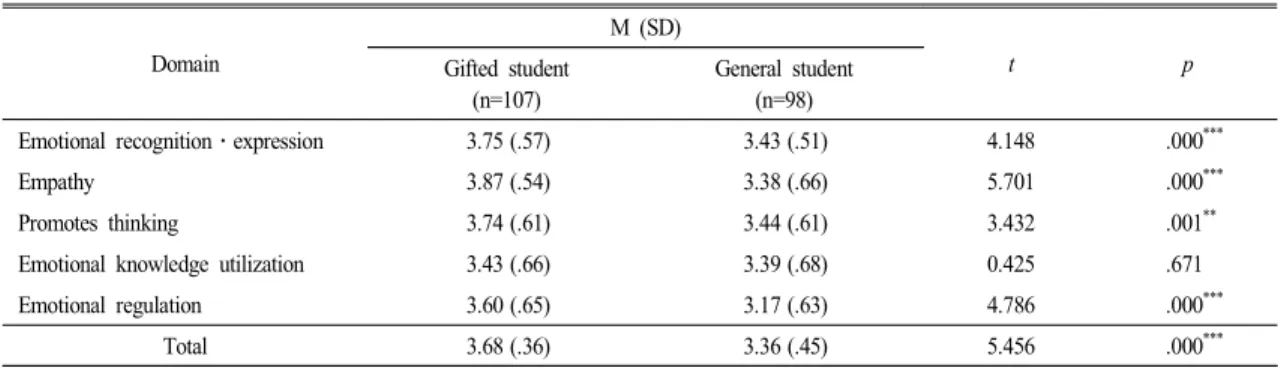
초등과학영재와 일반학생의 정서지능을 비교한
결과는 Table 1과 같다. 정서지능의 모든 하위요소
별 평균은 초등과학 영재학생이 일반학생보다 높
았으며, 전체 평균 점수 또한 통계적으로 유의한
차이가 있었다(p<.001). 하위요소별로 비교하면, 정 서지식의 활용을 제외한 모든 요소에서 초등과학 영재학생이 일반학생 간에 통계적으로 유의한 차 이를 보였다(p<.01, p<.001).
이와 같은 결과는 정서지능의 대부분 하위요소 에서 영재학생과 일반학생이 유의한 차이를 보인 다는 선행 연구(Park & Yu, 2014; Yeo & Paek, 2007;
Lee, 2012b; Lee & Ryu, 2014)와 유사하다. 이 연구 에서는 초등과학 영재학생이 일반학생에 비해 감 정이입 영역에서 통계적으로 유의미한 차이로 높 은 점수를 보였으나, Kim et al.(2012)의 영재 정서 지능 하위요소 중 감정이입의 점수가 가장 낮다는 연구와 상반되는 결과를 보였다. 감정이입 요소는 정서지능의 상위개념이라고 보기에는 어려운데, 이 는 Yeo & Paek(2007)의 연구에서 일반학생은 감정 이입 점수가 가장 높고, 영재는 정서지식 활용 등 의 정서지능의 상위 개념 요소에 더 발달해 있다는 연구와도 다소 일치하지 않는 결과이다.
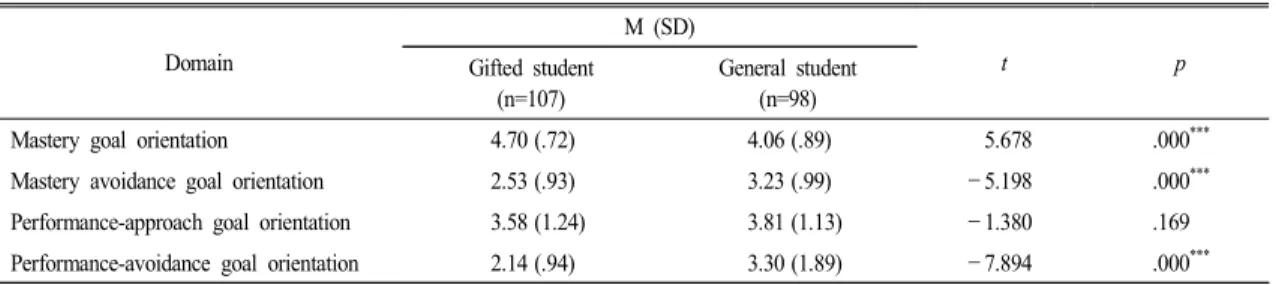
2) 초등과학영재와 일반학생의 성취목표지향성 비교 초등과학영재와 일반학생의 성취목표지향성을 비 교한 결과는 Table 2와 같다. 성취목표지향성의 유
Domain
M (SD)
t p
Gifted student (n=107)
General student (n=98)
Mastery goal orientation 4.70 (.72) 4.06 (.89) 5.678 .000***
Mastery avoidance goal orientation 2.53 (.93) 3.23 (.99) -5.198 .000***
Performance-approach goal orientation 3.58 (1.24) 3.81 (1.13) -1.380 .169
Performance-avoidance goal orientation 2.14 (.94) 3.30 (1.89) -7.894 .000***
***
p<.001
Table 2. A comparison of achievement goal orientation between scientific gifted student and general student
Domain
M (SD)
t p
Gifted student (n=107)
General student (n=98)
Job planning 3.82 (.75) 3.65 (.81) 1.543 .126
Self-understanding 3.86 (.59) 3.92 (.77) -.624 .534
Attitude toward work 4.20 (.61) 3.58 (.65) 7.038 .000***
Independence 4.44 (.70) 3.81 (.87) 5.685 .000***
Total 4.08 (.50) 3.74 (.58) 4.471 .000***
***
p<.001
Table 3. A comparison of career maturity between scientific gifted student and general student
형별 비교에서 초등과학영재학생은 숙달접근목표 지향성에서만 일반학생보다 높았고, 이는 통계적으 로 유의한 차이가 있었으나(p<.001), 숙달회피목표 지향성(p<.001), 수행접근 지향성(p>.05) 그리고 수 행회피지향성(p<.001)에서는 오히려 일반학생에 비 해 낮은 점수를 보였음을 알 수 있다.
이는 Song & Jung(2013)의 연구에서 초등과학 영 재학생이 일반학생에 비해 성취목표지향성 하위 유형 모든 부분에서 유의하게 높은 차이를 보인다 는 결과와는 다소 다른 양상을 보이고 있으나, 초 등과학 영재학생이 일반학생보다 숙달접근 목표에 서는 높은 점수를, 회피목표에서는 낮은 점수를 보 인다는 Na(2010)의 연구와도 일치하는 경향을 보였 다. 이 연구에서는 초등과학 영재학생과 일반학생 의 성취목표지향성을 비교한 기존의 연구들처럼 초등과학 영재학생의 목표 의식에 대해 비교적 일 관된 결과를 보이며, 초등과학 영재학생들은 과제 를 지향하는 방법이나 생각에 있어서 숙달접근 관 련 긍정적 동기에 대한 의식이 분명히 있으며, 회 피동기와는 거리가 멀다는 것을 알 수 있게 해준다.
3) 초등과학영재와 일반학생의 진로성숙도 비교
초등과학영재와 일반학생의 진로성숙도를 비교 한 결과는 Table 3과 같다. 전체적으로 초등과학 영 재학생의 진로성숙도 평균은 일반학생보다 높았으 며, 통계적으로 유의한 차이가 있었다(p<.001). 하 위요소별 결과를 비교해 보면, 초등과학 영재학생 이 계획성(p>.05), 일에 대한 태도 및 독립심은 일반 학생보다 높은 수준을 보였으나(p<.001), 개인이해 에 대한 점수의 경우 일반학생보다 낮았으며, 이는 통계적으로 유의한 차이를 보이지 않았다.
진로성숙도 전체 점수가 초등과학 영재학생이 일 반학생에 비하여 높은 것은 기존의 연구 결과와 유 사한 맥락으로 보인다(Kang, 2013; Kim, 2014; An, 2012; Yoo et al., 2006; Lee, 2012b; Im, 2014). 그러 나 이들 연구 대부분은 진로성숙도 하위 요소들 모 두에서 초등과학 영재학생이 일반학생보다 높은 점수를 보이는 것으로 나타났다.
2. 초등과학영재의 정서지능이 진로성숙도 에 미치는 영향
1) 정서지능과 진로성숙도의 상관관계
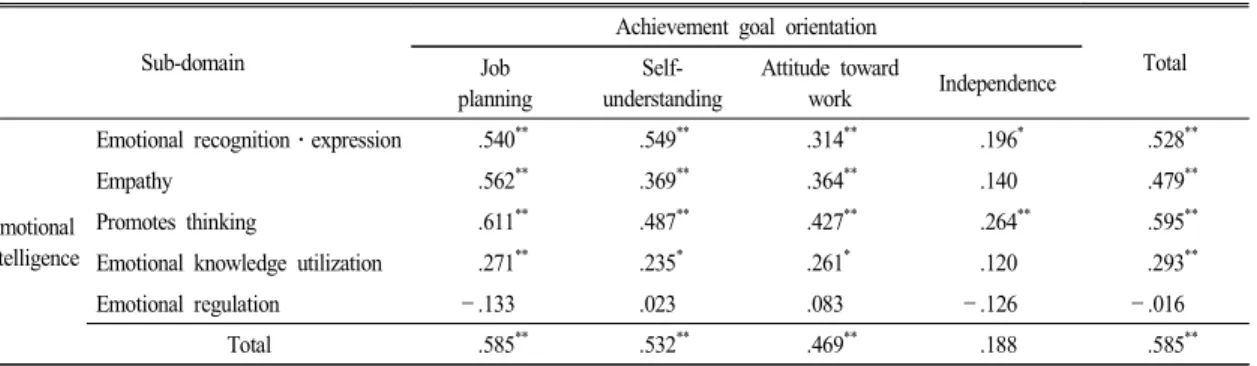
초등과학영재의 정서지능 하위요소와 진로성숙도 하위요소 간 상관관계분석 결과는 Table 4와 같다.
초등과학영재의 정서지능 중 정서조절과 진로성 숙도의 독립심 일부를 제외한 모든 하위요소에서 상호 정적 상관관계를 보였다. 초등과학영재의 정 서지능은 진로성숙도와 정적으로 유의미한 상관관 계가 있으며, 이는 통계적으로 유의미한 차이가 있 었다(r=.585, p<.01), 정서지능 총점은 진로성숙의 하위요소인 계획성(r=.585, p<.01), 개인이해(r=.532,
p<.01), 일에 대한 태도(r=.469, p<.01) 순으로 관련
Sub-domain
Achievement goal orientation
Total Job
planning
Self- understanding
Attitude toward
work Independence
Emotional intelligence
Emotional recognition․expression .540** .549** .314** .196* .528**
Empathy .562** .369** .364** .140 .479**
Promotes thinking .611** .487** .427** .264** .595**
Emotional knowledge utilization .271** .235* .261* .120 .293**
Emotional regulation -.133 .023 .083 -.126 -.016
Total .585** .532** .469** .188 .585**
*
p<.05,
**p<.01
Table 4. Correlation of emotional intelligence and career maturity of scientific gifted students
성이 높은 것으로 나타났고, 독립심과는 상관이 낮 음을 알 수 있었다. 또한 진로성숙도 총점은 정서지 능의 하위요소인 정서의 사고촉진(r=.595, p<.01), 정 서인식 및 표현(r=.528, p<.01), 감정이입(r=.479, p<.01), 정서지식의 활용(r=.293, p<.01)의 순으로 관련성이 높은 것으로 나타났다. 이 중 상관관계가 가장 높게 나타난 요소는 정서지능의 사고촉진과 진로성숙도 의 계획성이고, 반면에 정서지능의 정서지식의 활 용과 정서조절은 진로성숙도의 모든 요소와 상관이 낮았음을 알 수 있다. 진로성숙도의 독립성은 정서 지능의 하위요소와 상관이 낮음을 알 수 있다.
2) 정서지능이 진로성숙도에 미치는 영향 초등과학영재의 정서지능이 진로성숙도 하위요 소에 미치는 영향을 알아보기 위해 회귀분석을 실 시한 결과는 Table 5와 같다. 초등과학영재의 진로 성숙도의 하위요소인 계획성에 대한 정서지능의 요인의 설명력은 45.2%이었다. 정서지능 하위 요소 들의 설명력은 정서의 사고촉진(β=.374, p<.01), 감 정이입(β=.278, p<.01), 정서인식 및 표현(β=.204,
p<.05) 순이며, 정서지식의 활용이나 정서조절은 계
획성을 유의하게 설명해주지 않는 것으로 나타났다.
초등과학영재의 진로성숙도의 하위요소인 개인 이해에 대하여 정서지능의 요인의 설명력은 31.4%
이었다(Table 6). 개인이해에 대한 정서지능 요인들 의 설명력은 정서인식 및 표현(β=.369, p<.01), 정서 의 사고촉진(β=.251, p<.05) 순이며, 정서지식의 활 용이나 정서조절, 감정이입은 개인이해를 유의하게 설명해주지 않는 것으로 나타났다.
초등과학영재의 진로성숙도의 하위요소인 일에
대한 태도에 대하여 정서지능의 요인의 설명력은
Domain Unstandardized coefficient Standardized
coefficient
t p
B SE β
Invariable .109 .599 .183 .855
Emotional recognition․expression .270 .126 .204 2.159 .034*
Empathy .388 .124 .278 3.129 .002**
Promotes thinking .462 .134 .374 3.447 .001**
Emotional knowledge utilization -.096 .099 -.084 -.969 .335
Emotional regulation -.055 .087 -.084 -.627 .523
R
2=.478 (Adjusted R2=.452), F=18.486 (p=.000***)*
p<.05,
**p<.01
Table 5. Regression analysis of emotional intelligence to job planning of scientific gifted student
Domain Unstandardized coefficient Standardized
coefficient
t p
B SE β
Invariable 1.053 .531 1.979 .051
Emotional recognition․expression .387 .111 .369 3.482 .001**
Empathy .076 .109 .068 .690 .491
Promotes thinking .245 .119 .251 2.060 .042*
Emotional knowledge utilization -.022 .088 -.024 -.245 .812
Emotional regulation .063 .077 .068 .813 .422
R
2=.346 (Adjusted R2=.314), F=10.686 (p=.000***)*
p<.05,
**p<.01
Table 6. Regression analysis of emotional intelligence to self-understanding of scientific gifted student
Domain Unstandardized coefficient Standardized
coefficient
t p
B SE β
Invariable 1.276 .589 2.165 .033*
Emotional recognition․expression -.001 .124 -.001 -.008 .994
Empathy .230 .122 .201 1.889 .062
Promotes thinking .314 .132 .312 2.374 .019*
Emotional knowledge utilization .071 .098 .076 .729 .468
Emotional regulation .174 .086 .184 2.029 .045*
R
2=.241 (Adjusted R2=.204), F=6.427 (p=.000***)*
p<.05
Table 7. Regression analysis of emotional intelligence to attitude toward work of scientific gifted student
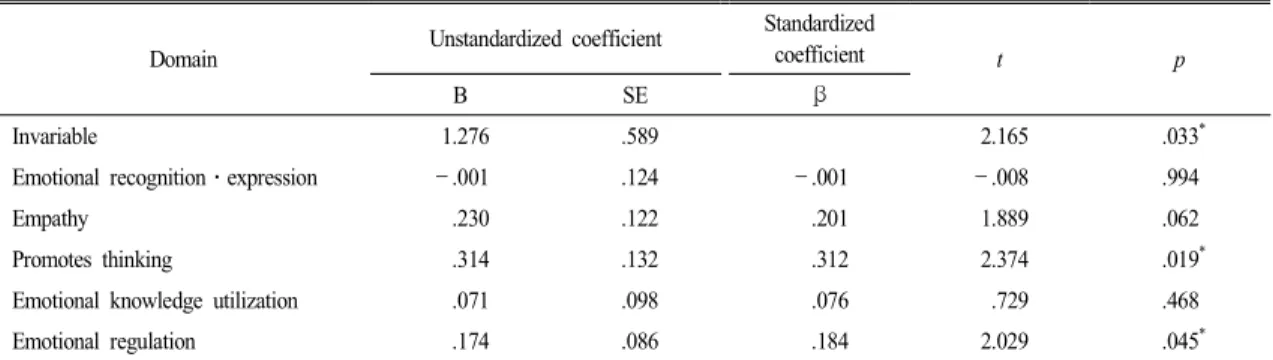
20.4%이었다(Table 7). 일에 대한 태도에 대한 정서 지능 요인들의 설명력은 정서의 사고촉진(β=.312,
p<.05), 정서조절(β=.184, p<.05) 순이며, 정서인식
및 표현, 감정이입, 정서지식의 활용은 유의하게 설 명해주지 않았다.
초등과학영재의 진로성숙도의 하위요소인 독립
심에 대하여 정서지능의 요인의 설명력은 3.7%로
매우 낮았고, 정서지능 전체 하위 요소들은 독립
심을 유의하게 설명해주지 않는 것으로 나타났다
(Table 8).
Domain Unstandardized coefficient Standardized
coefficient
t p
B SE β
Invariable 3.748 .741 5.059 .000***
Emotional recognition․expression .102 .155 .082 .656 .513
Empathy -.039 .153 -.030 -.256 .799
Promotes thinking .278 .166 .241 1.670 .098
Emotional knowledge utilization -.055 .123 -.051 -.447 .656
Emotional regulation -.106 .108 -.098 -.987 .326
R
2=.082 (Adjusted R2=.037), F=1.805***
p<.001
Table 8. Regression analysis of emotional intelligence to independence of scientific gifted student
3. 초등과학영재의 성취목표지향성이 진로 성숙도에 미치는 영향
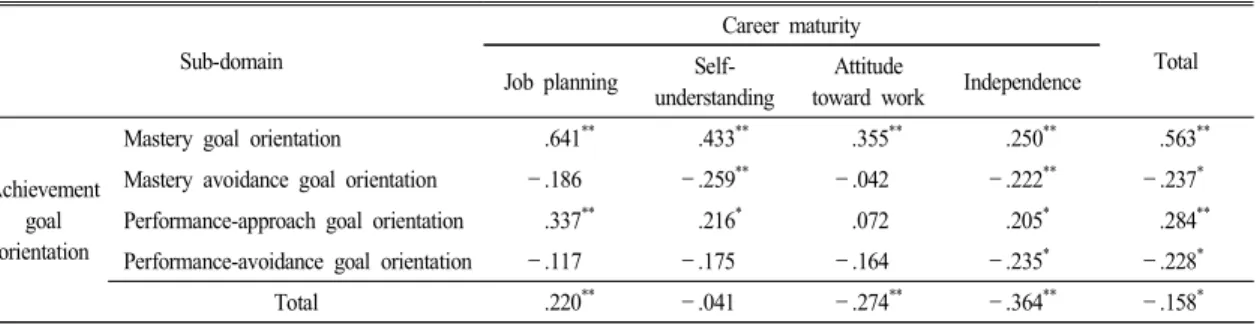
1) 성취목표지향성과 진로성숙도의 상관관계 초등과학영재의 성취목표지향성 하위요소와 진 로성숙도 하위요소 간 상관관계분석 결과는 Table 9와 같다. 초등과학영재의 진로성숙도 총점은 성 취목표지향성 중 숙달접근지향성(r=.563, p<.01), 수 행접근지향성(r=.284, p<.01)과 정적 상관관계를 보 였으며, 숙달회피지향성(r=-.237, p<.05), 수행회 피지향성(r=-.228, p<.05)과는 부적 상관관계를 보 였다. 하위요소별 상관을 구체적으로 살펴보면, 숙 달접근지향성은 진로성숙도의 모든 하위요소와 정 적으로 높은 상관관계를 나타냈으며(p<.01), 수행 접근지향성은 일에 대한 태도와도 상관이 있었으 나, 다른 요소와는 낮은 상관을 보였다. 숙달회피 지향성은 진로성숙도의 요소들과 부적 상관관계를 보였으며, 수행회피지향성 또한 부적 상관관계로 나타났다.
Sub-domain
Career maturity
Total Job planning Self-
understanding
Attitude
toward work Independence
Achievement goal orientation
Mastery goal orientation .641** .433** .355** .250** .563**
Mastery avoidance goal orientation -.186 -.259** -.042 -.222** -.237*
Performance-approach goal orientation .337** .216* .072 .205* .284**
Performance-avoidance goal orientation -.117 -.175 -.164 -.235* -.228*
Total .220** -.041 -.274** -.364** -.158*
*
p<.05,
**p<.01
Table 9. Correlation achievement goal orientation and career maturity of scientific gifted student
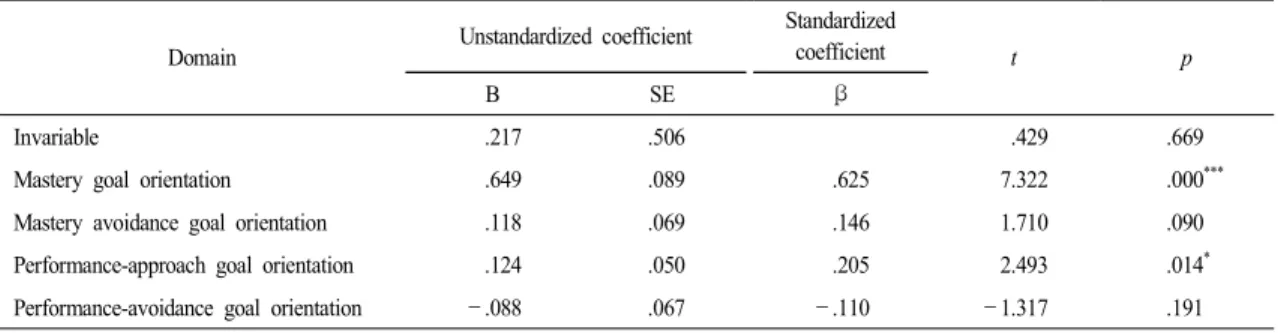
2) 성취목표지향성이 진로성숙도에 미치는 영향 초등과학영재의 성취목표지향성이 진로성숙도 하 위요소에 미치는 영향을 알아보기 위해 회귀분석 을 실시한 결과는 Table 10과 같다.
초등과학영재의 진로성숙도의 하위요소인 계획 성에 대한 성취목표지향성의 요인의 설명력은 43.4%
이었다. 계획성에 대한 성취목표지향성 하위유형의 설명력은 숙달접근지향성(β=.625, p<.001), 수행접 근지향성(β=.205, p<.05) 순이며, 숙달회피지향성과 수행회피지향성은 계획성을 유의하게 설명해주지 않는 것으로 나타났다.
초등과학영재의 진로성숙도의 하위요소인 개인이 해에 대한 성취목표지향성의 요인의 설명력은 18.8%
이었다(Table 11). 개인이해에 대한 성취목표지향성 하위유형의 설명력은 숙달접근지향성(β=.343, p<.01) 이 유일하였으며, 나머지 유형은 개인이해를 유의 하게 설명해주지 않는 것으로 나타났다.
초등과학영재의 진로성숙도의 하위요소인 일에
대한 태도에 대한 성취목표지향성의 요인에 대한
Domain Unstandardized coefficient Standardized
coefficient
t p
B SE β
Invariable .217 .506 .429 .669
Mastery goal orientation .649 .089 .625 7.322 .000***
Mastery avoidance goal orientation .118 .069 .146 1.710 .090
Performance-approach goal orientation .124 .050 .205 2.493 .014*
Performance-avoidance goal orientation -.088 .067 -.110 -1.317 .191
R
2=.455 (Adjusted R2=.434), F=21.310 (p=.000***)*
p<.05,
***p<.001
Table 10. Regression analysis of achievement goal orientation to job planning of scientific gifted student
Domain Unstandardized coefficient Standardized
coefficient
t p
B SE β
Invariable 2.541 .480 5.293 .000***
Mastery goal orientation .281 .084 .343 3.348 .001**
Mastery avoidance goal orientation -.029 .065 -.046 -.447 .656
Performance-approach goal orientation .074 .047 .154 1.566 .121
Performance-avoidance goal orientation -.089 .063 -.142 -1.414 .160
R
2=.218 (Adjusted R2=.188), F=7.119 (p=.000***)**
p<.01,
***p<.001
Table 11. Regression analysis of achievement goal orientation to self-understanding of scientific gifted student
Domain Unstandardized coefficient Standardized
coefficient
t p
B SE β
Invariable 2.470 .513 4.819 .000***
Mastery goal orientation .341 .090 .402 3.799 .000***
Mastery avoidance goal orientation .125 .070 .190 1.795 .076
Performance-approach goal orientation .011 .051 .022 .217 .829
Performance-avoidance goal orientation -.104 .067 -.160 -1.542 .126
R
2=.163 (Adjusted R2=.130), F=4.953 (p=.001**)***
p<.001
Table 12. Regression analysis of achievement goal orientation to attitude toward work of scientific gifted student
설명력은 13.0%이었다(Table 12). 일에 대한 태도 관련 성취목표지향성 하위유형의 설명력은 숙달접 근지향성(β=.402, p<.001)이 유일하였으며, 나머지 유 형은 일에 대한 태도를 유의하게 설명해주지 않는 것으로 나타났다.
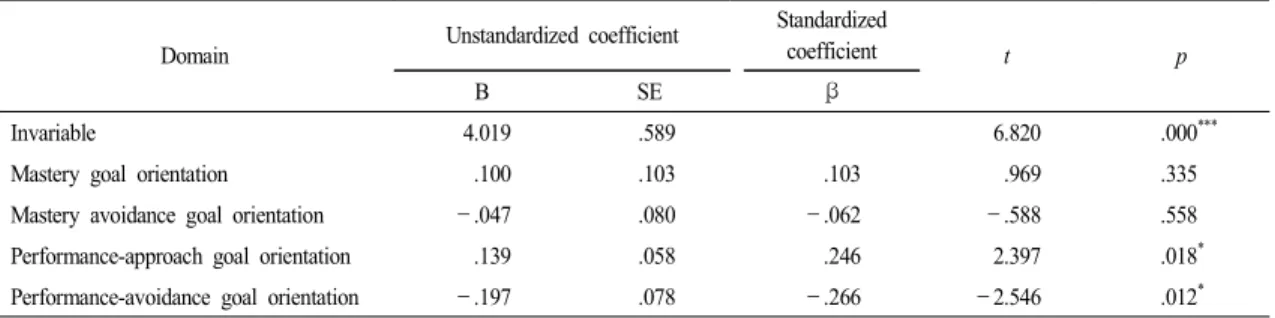
초등과학영재의 진로성숙도의 하위요소인 독립
심에 대한 설명력은 11.9%이었다(Table 13). 독립심
대한 성취목표지향성 하위유형의 설명력은 수행회
피지향성(β=-.266, p<.05), 수행접근지향성(β=.246,
p<.05) 순이며, 숙달접근지향성과 숙달회피지향성은
독립심을 유의하게 설명해주지 않는 것으로 나타
났다.
Domain Unstandardized coefficient Standardized
coefficient
t p
B SE β
Invariable 4.019 .589 6.820 .000***
Mastery goal orientation .100 .103 .103 .969 .335
Mastery avoidance goal orientation -.047 .080 -.062 -.588 .558
Performance-approach goal orientation .139 .058 .246 2.397 .018*
Performance-avoidance goal orientation -.197 .078 -.266 -2.546 .012*
R
2=.152 (Adjusted =.119), F=4.586 (p=.002**)*
p<.05,
***p<.001
Table 13. Regression analysis of achievement goal orientation to independence of scientific gifted student
IV.
결론 및 제언이 연구는 초등과학영재의 정서지능과 성취목표 지향성이 진로성숙도에 어떠한 영향을 미치는지 알아보고자 하였다. 이에 대한 결과를 간단히 요약 하면 다음과 같다.
첫째, 초등과학영재와 일반학생의 정서지능, 성 취목표지향성, 진로성숙도를 비교한 결과, 초등과 학영재의 정서지능과 진로성숙도는 일반학생보다 높았으며, 성취목표지향성에서는 일반학생이 회피 지향 유형에서, 영재학생은 숙달접근목표지향성 유 형에서 높은 점수를 보였다.
둘째, 초등과학영재의 정서지능과 진로성숙도는 거의 모든 하위 요소 간에 정적 상관관계를 나타냈 고, 회귀분석 결과 정서지능은 진로성숙도의 독립 심 영역을 제외한 계획성, 개인이해, 일에 대한 태 도에 모두 영향을 미쳤다.
셋째, 초등과학영재의 성취목표지향성 중 숙달 접근지향성은 진로성숙도 모든 하위 요소에 비교 적 높은 정적 상관관계를 보였으며, 숙달회피지향 성, 수행회피지향성은 부적 상관관계를 나타냈다.
회귀분석 결과 성취목표지향성은 진로성숙도의 대 부분의 영역에 어느 정도 영향을 미쳤다.
위의 결과로 볼 때, 초등과학영재는 일반학생보 다 높은 정서지능과 진로성숙도를 보이며, 초등과 학영재의 정서지능과 진로성숙도 요소간에 상관이 높았고, 성취목표지향성의 요소에서는 숙달접근지 향성은 정적상관이 있었으나 숙달회피지향성과 수 행회피지향성은 진로성숙도와 부적 상관이 있음을 알았다. 그러므로 초등과학영재 진로교육에서는 영 재가 과학적 진로에 대해 스스로의 정서를 확인하
고 사고를 촉진하며 정서적으로 메타인지 능력을 발휘 할 수 있는 기회를 제공할 필요가 있다.
참고문헌