• 검색 결과가 없습니다.

Research Trends on Burnout among Social Workers in South Korea

N/A
N/A
Protected

Academic year: 2021

Share "Research Trends on Burnout among Social Workers in South Korea"

Copied!
10
0
0

로드 중.... (전체 텍스트 보기)

전체 글

(1)

1. Introduction

Burnout is a common phenomenon that can be observed in a wide range of occupations. The term was first used by Freudenberger in 1974. He observed a

syndrome of emotional depletion, loss of motivation, and lowered work commitment among volunteers of a free clinic in New York. He called it burnout, borrowing a concept that was originally referred to debilitating impacts of chronic drug abuse. Around that

Research Trends on Burnout among Social Workers in South Korea

Hyun-Jung Lee

1*

, Youngeun Kim

2

1

Professor, Dep. Of Social Welfare, Baekseok University

2

Professor, Dep. of Christian Studies, Baekseok University

국내 사회복지사 소진 관련 연구 동향

이현정1*, 김영은2

1백석대학교 사회복지학부 교수, 2백석대학교 기독교학부 교수

Abstract This study aim to identify the trends of existing scholarly research on the issue of burnout among social workers in South Korea. For this purpose, 50 domestic articles that are registered(or nominated to be) in the National Research Foundation of Korea between 1995 and November 2016 were reviewed. Content analysis was conducted with regard to the subjects of research, research themes, and the methodologies used. The findings showed that the subjects were mainly social workers providing services in private than in public settings. Major themes of the research included examining risk or protective factors, consequences of burnout, mechanisms of burnout, mediating effects of burnout on certain relationships, and subjective experience of social workers' burnout. As for methodologies used, quantitative approach was predominant. Findings of this study suggested research effort to extend scope of research subjects and methodology. Testifying more burnout-related factors would contribute to the future research as well.

The results of the study will provide academic implications for future research in this field.

Key Words : Burnout, Emotional exhaustion, Social worker, Research trend, South Korea

요 약 본 연구는 국내 사회복지사의 소진에 관한 연구 동향을 살펴보고 추후 이 분야의 연구 방향을 제시하고자 하였다.

1996년에서 2016년 사이에 국내학술 DB에 게재된 사회복지사의 소진에 관한 연구 50편을 대상으로 연구 대상, 연구 주제, 연구방법론의 측면에서 내용분석을 시도하였다. 연구 결과, 공적 기관보다는 민간 사회복지기관에 종사하는 사회복지사를 대상으로 한 연구가 주를 이루었다. 연구의 주제로는 소진관련 위험 및 보호 요인, 소진의 결과, 소진의 기제, 소진의 매개 효과 탐색 등이 있었고, 사회복지사의 주관적인 소진경험에 관한 연구도 있었다. 연구방법론 측면에서는 양적연구가 대부 분을 차지하고 있는 것으로 나타났다. 본 연구는 사회복지사의 소진에 관한 연구의 주제나 연구방법론이 보다 다양화되어 야 할 필요를 시사한다. 본 연구 결과는 국내 사회복지사 소진 관련 연구의 추후 연구 방향을 제시하는 학문적 함의를 가질 것이다.

주제어 : 소진, 정서적 고갈, 사회복지사, 연구 동향, 국내

*Corresponding Author : Hyun-Jung Lee([email protected]) Received September 13, 2018

Accepted November 20, 2018

Revised November 2, 2018 Published November 28, 2018

(2)

time, a social psychologist, Maslach has also found similar symptoms among human services workers she interviewed for her research[1]. Since then the concept of burnout began to receive attention in research area in the United States, and later the interests and research devotion in this concept has spread internationally.

Over the years, various definitions of burnout were suggested among researchers. However, the most prominent concept of burnout so far is the one that Maslach and Jackson proposed. They attempted to conceptualize burnout as a multidimensional construct with three key dimensions; (1) emotional exhaustion (2) depersonalization, and (3) decreased personal accomplishment[2]. The dimension of emotional exhaustion includes feelings of being overextended and depleted of one’s emotional and physical resources.

This dimension, which captures an individual’s emotional aspect is considered as the central component of burnout. The dimension of depersonalization, which includes feelings of cynicism and detachment from the job, describes how an individual relates to their work.

An individual can become cynical and develop detached attitude toward work, followed by emotional exhaustion. Finally, the dimension of reduced personal accomplishment represents the self-evaluation aspect of burnout and includes feelings of inefficacy and a lack of productivity at work. With regard to the process of development of depersonalization, research shows mixed findings. Some research suggests that the drop in efficacy can be proceeded by experiences of emotional exhaustion and depersonalization. Others claim that it can develop not in sequence but in parallel with other two dimensions[2].

The concept of burnout has been expanded over time. An alternative theoretical model of burnout was proposed by burnout researchers, which attempted to integrate individual and situational factors. This model emphasized match and mismatch between individuals and their job and proposed that an individual’s experiences in six domains of work environment are

critically related to burnout: work overload, limited control, inadequate reward, break down of community, lack of fairness, and value conflict[3]. In this model, good alignments between an individual and these six domains of job are expected to facilitate their engagement with job whereas poor alignments may lead to burnout. Recently, burnout scholars attempted to adopt a perspective that defines burnout phenomenon not in a negative terms but a positive term. They consider burnout as erosion of a positive psychological state[4], such as lack of vigor, vitality, and engagement.

Burnout research demonstrates its significant effects at multiple levels. At an organizational level, burnout has been associated with absenteeism, decreased job performance, reduced client dissatisfaction, lower organizational commitment and high turnover. At an interpersonal level, conflictual relationships with their co-workers has been reported among individuals who are experiencing burnout. At personal level, burnout is found to influence an individual’s physical as well as mental health negatively. Those who are emotionally exhausted could be vulnerable to stress-related physical symptoms as well as mental dysfunction such as anxiety, depression, and lowered self-esteem1.

Given the heavy toll of burnout on individuals and organization, burnout research has endeavored to investigate factors that are related to burnout.

Individual factors such as demographic variables, personality characteristics, and attitudes toward work have been studied. Studies have found that age, marital status, and the level of education were associated burnout. Individuals who are younger than older, single than married, and have higher than lower level of education are found to be more susceptible to burnout.

Personality characteristics that are associated with

burnout were studied as well. Studies report that

individuals who have an external than internal locus of

control tend to experience burnout. Lower self-esteem

and passive and defensive way of coping style were

also associated with the higher rate of burnout.

(3)

Research on the Big Five personality dimension has found that burnout is linked to the dimension of neuroticism, which includes anxiety, depression, self-consciousness, vulnerability, and hostility[1,4].

Although the phenomenon of burnout is nowadays prevalent in many different work settings, it is more pertain to human services area, especially social work field. Social work in general involves providing appropriate means and resources for individuals as well as supporting them emotionally. This caring work for people in needs can be physically and emotionally quite intensive. It is common that social workers are exposed to work overload, difficult service recipients, and limited resources. They are often required to handle more demands than the amount of the personal or organizational resources given at a time. In these conditions, their passion and devotion could quickly erode and are likely to turn into burnout. It is reported that the working conditions of social workers in South Korea are also often less than ideal, experiences of burnout among social workers are quite common. The high job turnover rate of social workers in Korea reflects the inadequate working environment[5].

Research reported that the quality care for social workers was not systemized, and social workers tended to suffer from high level of ambiguity and limited resources.

In South Korea, research interest in social workers’

burnout was first emerged in 1995, but the issue of burnout has begun to receive more attention in early 2000. Research on Korean social workers explored various factors that were associated with burnout. For instance, organizational factors such as job stress, personal factors such as, codependency, ego-resilience, emotional intelligence, personality, the level of differentiation of the self, and individuals’ different expectation about job were studied. A number of studies have also focused on the relationship between burnout and turnover intention. However, research that provides systematic reviews of the previous studies in the area of burnout has been in rarity. There was a

study that conducted meta-analysis on burnout[6], but its scope was limited to the variables that influences on burnout. Thus, studies that provide a more comprehensive overview of burnout research is needed.

For this reason, this study attempted to analyze past research that are related to burnout. It would be beneficial in terms of providing directions and guidance for future research endeavors as well as effective prevention and interventions of burnout.

2. Research Methods

This article aims to provide an overview of previous studies on social workers’ burnout in Korea and explore future research directions in this field. For this end, content analysis was selected as research method.

Content analysis method has been used for objectively and systematically categorizing and quantitatively describing materials and for investigating and analyzing general trends in the literature[7]. Although meta analysis which can be used in exploratory study, content analysis has the advantage in that it can draw larger inferences about the filed and presents a direction for future research by counting, describing, and categorizing aspects of articles[8].

For data selection, this article reviewed domestic articles that are registered (or nominated to be) in the National Research Foundation of Korea between 1995 and November 2016. The words “burnout” and “social work” were entered as search words. As a result, the total of 50 articles were chosen.

With regard to selecting category for analysis, this study referred to the categories used in trend studies[9,10] in similar fields. As a result, subjects of research, research themes, and the methodologies used were chosen and the articles selected were analyzed in terms of these 3 categories.

In terms of reliability of category elicitation results,

inter-corder reliability among 2 authors were 90% in

research themes, 92% in research subjects and 96% in

(4)

methodologies.

3. Results and Discussion

A total of 50 studies were found through computerized searches. Using content analysis, results of analysis of these studies are presented in terms of subjects of research, research themes, and research methodology in the following.

In terms of research subjects, subjects used in majority of these studies analyzed were social workers.

Particularly, research in this area has been carried out with two groups of social work practitioners: social workers delivering services in public and private settings. Categorizing social workers into two groups (public vs private) in the current study was drawn from that of previous studies[11,12] dealing with the subject of burnout among social workers. This categorization is commonly selected in this field because there are differences in roles, status, and compensation in many respects between the two groups[12]. Referring to the aforementioned studies above, public social workers in the current study are defined as those working in government administrative system and being responsible for public assistance and the delivery of welfare services. Private social workers are defined as those working in various social work settings and living facilities other than government.

A majority of studies(38, 74.5%) were conducted with social workers in private settings (e. g., social welfare centers, mental health centers, medical hospitals, school-based agencies, trauma-related agencies). Especially, social workers working in social welfare centers were subjects that most frequently studied. 13 studies(25.5%) conducted with social workers in public contexts (social welfare government officials). Table 1 includes frequencies and percentages of research conducted with social workers in public and private settings by period. First of all, it shows studies in the area of social workers' burnout were expanded

significantly since 2010(78.4%). It also reveals that studies that involved subjects in public settings were very scarce before 2010(15.4%), and has increased dramatically since 2010(84.6%). On the other hand, burnout of social workers in private settings has been researched more consistently in comparison.

Table 1. Research subjects by period Year

Subject 1995-1999 2000-2009 2010-2016 total public 1(7.7%) 1(7.7%) 11(84.6%) 13(25.5%) private 1(2.6%) 8(21.1%) 29(76.3%) 38(74.5%) total 2(3.9%) 9(17.7%) 40(78.4%) 51(100%)

*duplicate coding(research that includes subjects in both public and private settings was coded in duplication)

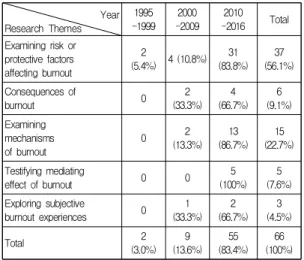
Second, in terms of research themes, the current study identified themes of these studies and categorized research themes into 5 categories: examining factors contributing or mitigating burnout of social workers, consequences of burnout, mechanisms of burnout process, mediating effect of burnout on certain other relationships, and subjective burnout experiences of social workers. Table 2 shows the result of analyzing research themes by period.

First of all, examining risk or protective factors was the research theme that most frequently appeared in this area of research(37, 56.1%). The study result also showed that research dealing with this theme had been ongoing and particularly active since 2010. Factors affecting burnout were identified at personal[13-19], organizational[13,14,19,20] and environmental[21] levels.

Some studies reviewed were done to explore which

personal factors affected burnout of social workers. For

example, Ha and Kim[13] identified that such personal

characteristics as worker’s self-esteem and

self-efficacy affected burnout of social workers. Hong

and Seo[14] also examined the effects of elderly care

facility social workers’ personal tendencies (emotional

empathy, cognitive empathy, external attribution, and

internal attribution) on their burnout. They divided the

concept of burnout into 3 dimensions: emotional

(5)

burnout, low personal achievement, and depersonalization about clients. They found that among these personal tendencies, cognitive empathy and internal attribution affected negatively on low personal achievement while external attribution affected positively on emotional burnout and depersonalization about clients. Other studies found relationship between co-dependency[15], ego-resilience[16], emotional intelligence and personality[17], and level of self-differentiation[18] and burnout.

Studies in this area tapped into organizational factors such as role conflict, role ambiguity, role overload, adequacy of the reward/compensation system, job demand, and level of autonomy[13,14,19,20]. For instance, based on survey data gathered from 214 social workers delivering services in multicultural family centers, Choi and Chang[20] explored effects of organization-related work characteristics on burnout.

They found that work load and satisfaction with supervisor affected burnout of social workers.

Research in this area also suggested that factors at environmental level are related to burnout of social workers. For example, Park and Min[21] tested relationships between community environment characteristics (e.g., tie between residents, community disorder) and burnout. Their study results showed that tie between residents had a negative effect on burnout while community disorder in the community had a positive effect on burnout. That is, survey respondents who perceived a higher tie between residents and the lower level of community disorder in the community in which they are working, demonstrated a lower level of burnout. Results of this study implied that community-related factors play a role in burnout among social workers and need to be considered in research in this area.

Along with research effort to identify risk factors at personal, organizational, and environmental levels, some studies explored protective factors against burnout. In a study by Ju[22], protective factors against burnout of social workers in elementary, middle, and

high schools were investigated. Results of the study showed that the values and beliefs of work and personal resources for professional competence were those factors mitigating burnout. Kim[23] also conducted research to identify protective factors against burnout among social workers working in hospice and palliative care settings. Such factors as professionality (e.g., self-regulation, job vocation, and autonomy), social support (e.g., various forms of support from supervisor, family, and peers), and supervision (e.g., educational, administrative, or emotional interaction between supervisor and supervisee) were tested. Results indicated that social support from supervisor was a significant protective factor against physical and emotional burnout.

Second, consequences of burnout were explored in several studies(6, 9.1%). Research on this topic first appeared in 2004 and since then there have been few but continuous studies. Burnout was found to affect social workers’ mental (e.g., emotional fatigue, anxiety, depression) or physical (physical fatigue, problem with sleeping) health[23] and turnover[24]. A study focusing on medical social workers by Kang[24], for example, demonstrated that burnout affected medical social workers’ decision to leave the professional field.

Third, examining mechanisms of burnout process was

another research theme in this area of inquiry(15,

22.9%). Before 2010, there was little research interest in

this subject, but it has been actively dealt with since

2010. Aforementioned studies demonstrated moderating

effects of sex-role attitude[15] or spiritual

well-being[16] on the relationship between certain

variables (e.g., codependency, ego-resilience) and

burnout. A few other studies were also conducted for

this purpose. For example, Park[25]'s study which

examined effects of job stress of public social workers

on their burnout found moderating effect of job stress

coping style of the social workers. More specifically,

social support seeking, one of the dimensions of the job

stress coping styles, was found to moderate the

relationship between job stress and burnout. Park and

(6)

Yoon[26] explored impacts of job characteristics (e.g., role conflict, workload, secondary traumatic stress, and self-efficacy) on burnout of social workers delivering services to trauma survivors, with focus on testing mediating effects of these job characteristics on burnout. Study results showed that among the job characteristics, secondary traumatic stress was found to have mediating effect. With the aim of better understanding burnout process, Lee[27]’s earlier study intended to test relationship among 8 job-related stressors (role ambiguity, role overload, difficulties in solving problems of clients, conflict with the clients, lack of support from the supervisor, closed communication pattern, bureaucracy, and lack of accountability), 4 mediators (job stress, professional role performance, abiding by the agency policy and partiality in service delivery), and 4 dimensions of burnout (physical exhaustion, psychological exhaustion, depersonalization, and personal accomplishment).

According to study results, job stress, the mediating variable of the emotional path to burnout, increased professional role performance and the abiding by agency policy, and finally increased burnout.

Professional self-efficacy, the mediating variable of the cognitive pathway to burnout, was found to decrease burnout when the level of the professional role performance was high and abiding by agency policy and partiality in service delivery were low. In addition, Kim[28] found moderating effect of CEO’s servant leadership and perceived value of work on the relationship between client-related stressors and burnout of social workers and Kim et al.[29] showed that resilience mediated the relationship between burnout risk and burnout among social workers working in community welfare centers.

Fourth, exploring whether burnout plays a role as mediator on certain relationships was another theme of research interest(5, 7.6%). For example, in a study[20]

exploring impacts of work characteristics and burnout on turnover intention of social workers delivering services in multicultural settings, burnout was found to

mediate the relationship between work load intensity and worker’s turnover intention. Another study[30] was conducted to identify relationships among job-related tension, burnout, and turnover intentions on social workers working in public and private sectors. Study results demonstrated partial mediating effect of burnout on the relationship between job-related tension and turnover intentions. In terms of analysis by period, the study result showed that there was no study conducted on this topic before 2010 and there have been few studies on this subject since 2011.

Lastly, some studies attempted to explore social worker’s subjective burnout experience through qualitative research approach(3, 4.5%). For instance, Choi[31] explored burnout experience of 10 public social workers in depth. According to the analysis of in depth interviews, the final structure factors were as follows;

‘trauma from relations with the client’, ‘tension from the overflow and changes of work execution’, ‘exhaustion from the indifference and irrational treatment of the organization’, ‘limitations and dilemma of working within the public social welfare system’, ‘limitation from inability to demonstrate expertise’,

‘psychological/physical burnout’, ‘symptom presentation in family’, ‘losing the first intention’. ‘difficulty in further pursuit of work’, and ‘endurance by finding worth and offsetting’. Jang[32] tried to provide the process and structure of burnout experience from social workers’ inner perspectives. Burnout experience of social workers in medical setting was also explored in another study[33]. Based on data through intensive interviews with 9 social workers, the results of the study described the definition of burnout, process and risk factors of burnout from those workers’ views.

Compared to other research themes, there are only

three studies on this theme(4.5%) and this research

theme is the least accomplished in numbers. However,

study result showed that research interest had

increased in recent years.

(7)

Table 2. Research themes by period Year

Research Themes

1995 -1999

2000 -2009

2010 -2016 Total Examining risk or

protective factors affecting burnout

2

(5.4%) 4 (10.8%) 31 (83.8%)

37 (56.1%)

Consequences of

burnout 0 2

(33.3%) 4 (66.7%)

6 (9.1%) Examining

mechanisms of burnout

0 2

(13.3%) 13 (86.7%)

15 (22.7%)

Testifying mediating

effect of burnout 0 0 5

(100%) 5 (7.6%) Exploring subjective

burnout experiences 0 1

(33.3%) 2 (66.7%)

3 (4.5%)

Total 2

(3.0%) 9 (13.6%)

55 (83.4%)

66 (100%)

*duplicate coding(Studies that cover more than one research theme at the same time were coded in duplication)

Third, in terms of research methodology, majority of studies adopted quantitative approaches. Out of 50 studies, 46 studies(92%) used quantitative methodology such as T-test, ANOVA, or regression analysis. Some studies[20,30] used these methodologies in order to examine more sophisticated relationships (e.g., moderating or mediating effect, and identifying path to variables of interests) among measurement variables.

Only few studies(6%) used qualitative methodology such as grounded theory or phenomenological methodology to explore subjective experiences of burnout. Only one study(2%) used mixed methodology.

Table 3 shows that while quantitative methodology has been used even before 2010, and its use has markedly increased since 2010(80.4%). However, the use of qualitative methodology has been very scarce throughout years.

Table 3. Research methodology by period Year

Method

1995 -1999

2000 -2009

2010

-2016 total

quantitative 2(4.4%) 7(15.2%) 37(80.4%) 46(92%) qualitative 0(0%) 1(33.3%) 2(66.7%) 3(6%)

mixed 0(0%) 1(100%) 0(0%) 1(2%)

total 2(4%) 9(18%) 39(78%) 50(100%)

4. Conclusion

The current study reviewed research articles in the area of social workers' burnout for the purpose of examining research trends. Based on the results of the analysis, several issues were emerged. First, while there has been a few research attempts to investigate burnout phenomenon of particular groups of social workers at different settings (i.e., social welfare agencies for elderly, multi-cultural, trauma survivors, or medical social welfare centers), most studies took social workers at different settings as a single group without taking into consideration of their potential differences. In fact, the similar limitations were found in burnout research of other helping professions such as nursing or counseling, and the need for more specifed studies were suggested[34,35]. Given the situations, two things could be suggested for future research. First, more studies that focus on specified groups of social workers(i.e, different work setting, work responsibilities, years of work experience) would be needed to elucidate their unique experiences and challenges related to burnout.

Second, more comparative research between different groups of social workers would be beneficial as well to objectively estimate the severity or level of burnout of a particular groups. These efforts would be helpful in order to bring out more complex nature of burnout phenomenon and develop more effective customized burnout prevention and intervention approaches and programs.

Third, although various factors affecting burnout

were examined in social workers' burnout research,

studies mostly focused on the work-related issues and

organizational factors than personal characteristics or

broader environmental factors. Future studies in this

area need to pay more attention to diverse personal and

environmental factors related burnout. In addition, it

was found that while a majority of studies focused on

risk factors of burnout, protective factors of burnout

was rarely researched. More research endeavor to

(8)

identify various protective factors of burnout would be necessary in order to understand more comprehensive mechanisms of burnout and develop more effective prevention and intervention programs for burnout.

Fourth, in terms of research methodology, the current study revealed that quantitative methodology has been heavily employed in research of social workers' burnout. Given the limitations of quantitative methodology in capturing detailed subjective experiences of burnout, more studies that utilize qualitative methodology would be needed to complement the limitations of quantitative research methods. In fact, those qualitative research included in this study revealed richer and complex nature of burnout more effectively. They demonstrated that burnout phenomenon are brought out by multiple factors interacting simultaneously. For instance, Jang[32]'s study using grounded theory revealed the structure of burnout and how factors at different dimensions were interacting with each other in the process that leads to burnout. Choi[31]'s and Jang[32]'s studies also called attention to severe and pervasive impact of burnout at different levels(i.e., physical and mental health, family, professional). However, since subjects of these studies were limited to social work government officials, future studies should tap into more diverse groups of social workers to explore their different subjective experiences of burnout. For instance, more specified research with different groups of social workers depending on nature of work, work settings, or job positions is suggested.

This study revealed that a lack of research endeavor in the areas of program development and evaluations of burnout prevention and interventions. Research[31, 32]

pointed that social workers tended to cope with burnout mostly at an individual level without more systemic intercession. Research on prevention and intervention programs could facilitate systemic interventions in this area.

Lastly, despite of the importance of issues of burnout, there were a relative lack of studies that

analyzed comprehensive research trends of burnout.

Similar phenomenon was found in other related helping professional fields such as nursing and counseling.

This study seems to have its value in that it provided an overall scope of burnout research and thus be able to guide directions for future research in this area.

However, this study mainly took a look at the journal articles and were not able to include dissertations in its range. Therefore, future research should try to broaden the scope of research for more comprehensive review.

REFERENCES

[1] Maslach, W. B. Schaufeli & L. P. Leiter. (2001). Job Burnout. Annual Review of Psychology, 52, 397-422.

[2] C. Maslach C & S. E. Jackson. (1981). The Measurement of Experienced Burnout. Journal of Occupational Behavior, 2, 99-113.

[3] C. Maslach, L. P. Leiter & S. E. Jackson. (2012). Making a Significant Difference with Burnout Intervention:

Research and Practitioner Collaboration. Journal of Organizational Behavior, 33, 296-300.

[4] W. B. Schaufeli, L. P. Leiter & C. Maslach. (2009).

Burnout: 35 Years of Research and Practice. Career Development International, 14(3), 204-220.

[5] M. H. Lee. (2004). Burnout Process Model of Social Workers: Analysis of the Paths from the Job-related Stressors, Job-stress and Professional Self-efficacy to Burnout, Korean Journal of Social Welfare, 56(4), 5-34.

[6] H. E. Nam, H. M. Jin & J. W. Baik. (2015). Meta Analysis of Social Worker’s Factor of Burnout. Journal of the Korea Academia-Industrial Cooperation Society, 16(2), 1045-1053.

[7] A. D. Smith. (1982). Another Look at Content Analysis:

An essay review. Social Work Research and Abstracts, 18(4), 5-10.

[8] K. Krippendorr. (1980). Content Analysis: An Introduction to it methodology. New Burry Park, CA:

Sage Publications.

[9] J. H. Kim. (2014). Exploring Trends and Future Directions of Teacher-Related Research in Multicultural Education. Multicultural Education Studies, 7(4), 81-100.

[10] M. J. Kim & K. E. Kim. (2018). An Analysis of

Multicultural Acceptance Research Trends in Korea.

(9)

Multicultural Education Studies, 11(1), 1-27.

[11] S. Y. Hwang & K. S. Park. (2007). Determinants for the Burn-out of Social Welfare Government Officials:

Personal Characteristics, Work Environment Characteristics and Professionalism. Social Welfare Policy, 30, 339-369.

[12] J. H. Seomun & S. K. Sun. (2011). A Study on the Professionalism and Burn-out of Social- Welfare Officials: Group Differences between Social-Welfare and Non-Social-Welfare Professionals. Journal of Korean Social Welfare Administration, 13(33), 227-251.

[13] S. C. Ha & S. H. Kim. (2011). Factors Affecting on Burnout of Employees in Social Welfare Organizations.

Journal of the Korean Academy of Health and Welfare for Elderly, 3 (2), 119-141.

[14] S. J. Hong & S. B. Seo. (2011). The Effects of Elderly Care Facility Social Workers’ Work Environment and Personal Tendencies on Their Exhaustion. Korean Journal of Social Welfare Studies, 42(4), 187-216.

[15] G. H. Jang, K. A. Yoon & W. C. Shim. (2016). A Study on the Level of Codependency among Social Work Related Professionals and its Effect on their Burnout:

Focusing on the Moderating Effects of Sex-Role Attitude. Korean Journal of Social Welfare Studies,47(1), 29-56.

[16] M. S. Baek & M. S. Chung. (2014). Effects of Ego-Resilience on Burnout of Workers at Social Welfare Facilities: Testing Moderating Effects of Spiritual Well-Being. Korean Journal of Social Welfare Research, 42, 27-49.

[17] E. S. Oh & J. Ha. (2013). The Effects of Social Worker’s Emotional Intelligence and Personality on Psychological Burnout. Journal of Social Science, 29(1), 213-229.

[18] M. J. Lee & Y. S. Choi. (2012). The Effect of Social Workers’ Self-Differentiation on Burnout. Korean Journal of Family Welfare, 17(4), 173-197.

[19] G. W. Nam & H. J. Lee. (2015). Factors Affecting Burnout of Social Work Public Officials. The Journal of Korea Society for Wellness, 10(1), 89-102.

[20] S. Y. Choi & H. S. Chang. (2012). A Study on the Relationship Among Work Characteristics, Burnout, and Turnover Intention of Social Workers Working in Multicultural Family Centers. Journal of Community Welfare, 12(1), 297-318.

[21] Y. S. Park & S. Y. Min. (2016). The Effect of Perceived Community Environment on Burnout for Social Workers: Focusing on the Directors of Community Children Center. Journal of Critical Social Policy, 52,

256-288.

[22] S. J. Ju. (2015). A Study on the Risk and Protective Factors of Burn-out of Social Workers in Schools.

Journal of School Social Work, 32, 53-85.

[23] Y. S. Kim. (2010). The Korean Social Workers’ Burn-out Factors and Personal Traits in the Hospice and Palliative Care. Korean Journal of Hospice and Palliative Care, 13(3), 161-168.

[24] H. G. Kang. (2011). A Study on the Effect of Medical Social Worker’s Turn-Over by Their Burn-out:

Focusing on the Mediating Effect of Social Worker’s Empowerment. Journal of Social Sciences, 26(2), 1-23.

[25] J. J. Park. (2015). The Impact of Job Stress on Burnout among Public Social Workers in South Korea: The Moderating Effect of Coping Style. Journal of Transactional Analysis & Counseling, 5(1), 35-54.

[26] Y. M. Park &, H. M, Yoon. (2011). Influences of Role Conflict, Workload, Secondary Traumatic Stress and Self-efficacy on Burnout of Social Workers Working with Trauma Survivors. Korean Journal of Child Welfare, 36(0), 289-322.

[27] M. S. Lee. (2004). Burnout Process Model of Social Workers: Analysis of the Paths from the Job-related Stressors, Job-stress and Professional Self-efficacy to Burnout. Korean Journal of Social Welfare, 56(4), 5-34.

[28] H. C. Kim. (2016). The Effects of the Client-Related Stressor on the Burnout of Social Workers: Focus on the Moderating Effect of CEO’s Servant Leadership and Perceived Value of Work. Journal of Korean Social Welfare Administration, 18(3), 1-28.

[29] N. S. Kim, H. E. Nam & H. M. Jin (2014). The Effect of Burnout and its Mediating Effect of Burnout Resilience: about Workers in Community Welfare Centers. Journal of Critical Social Policy, 45, 98-124.

[30] H. J. Sung & H. S. Gweon. (2013). A Comparative Study on the Relationship among Job-Related Tension, Burnout, and Turnover Intentions between Public and Private Social Workers. Journal of Social Science, 24(3), 361-383.

[31] J. S. Choi. (2014). Phenomenological Study on the Burnout Experience of Public Social Worker. Korean Journal of Social Welfare Studies, 45(4), 201-240.

[32] E. S. Jang. (2013). A Qualitative Study on the Burnout of Social Welfare Officials. Journal of Social Science, 24(4), 155-193.

[33] M. M. Choi & J. H. Hyun. (2006). A Qualitative Study on Burnout of Social Workers in Medical Setting.

Journal of Korean Social Welfare Administration, 8(1),

(10)

1-38.

[34] K. J. June & S. W. Byun. (2009). Nurse's Burnout Research Throughout the Past 10 Years in Korea. The Journal of Korean Nursing Administration Academic Society, 15(3), 305-313.

[35] A. R. Yun & N. W. Chung. (2011). A Review of Counselor's Burnout. The Korean Journal of Counseling and Psychotherapy, 23(2), 231-256.

이 현 정(Hyun-Jung Lee) [정회원]

․1999년 12월 : 美일리노이 주립대 사회사업학(사회사업학석사)

․2007년 12월 : 美일리노이 주립대 사회사업학(사회사업학박사)

․2009년 3월 ∼ 현재 : 백석대학교 사회복지학부 교수

․관심분야 : 사회복지실천, 여성복지

․E-Mail : [email protected]

김 영 은(Youngeun Kim) [정회원]

․1999년 12월 : 美트리니티대학교 (Trinity University) 상담심리학 석사)

․2006년 8월 : 美휘튼대학교

(Wheaton College) 임상심리학박사

․2009년 3월 ~ 현재 : 백석대학교 기독교학부 교수

․관심분야 : 정신분석적 심리치료, 대상관계 심리치료, 상담기술훈련, 청소년상담

․E-Mail : [email protected]

수치

Table  1.  Research  subjects  by  period  Year
Table  2.  Research  themes  by  period Year Research Themes 1995 -1999 2000 -2009 2010 -2016 Total Examining risk or protective factors affecting burnout 2 (5.4%) 4 (10.8%) 31 (83.8%) 37 (56.1%) Consequences of burnout 0 2 (33.3%) 4 (66.7%) 6 (9.1%) Exami

참조

관련 문서