A Comparative Study of Potential Job Candidates’ Perceptions of an AI Recruiter and a Human Recruiter
Jihyun Min, Sinae Kim, Yonguk Park, Young Woo Sohn
*Department of Psychology, Yonsei University
인공지능 인사담당자와 인간 인사담당자에 대한 잠재적 입사지원자들의 인식 비교 연구
민지현, 김시내, 박용욱, 손영우*
연세대학교 심리학과
Abstract Artificial intelligence (AI) is already being utilized in certain personnel selection processes in organizations;
AI will eventually make even final decisions for personnel selection. The present study investigated potential job candidates’ perceptions of an AI recruiter by comparing the selection procedures carried out by an AI recruiter to those carried out by a human recruiter. For this study college students in South Korea were recruited. They were each shown one of two recruitment scenarios (human recruiter vs. AI recruiter; between-subject design) followed by questionnaires measuring their satisfaction with the selection procedures and procedural justice, their trust in the recruiter, and their belief in a just world. Results show that potential job candidates were more satisfied with the selection procedures used by the AI recruiter than the human recruiter; they perceived the procedures as fairer than those used by the human recruiter. In addition, potential job candidates’ trust in the AI recruiter was significantly higher than their trust in the human recruiter. This study also explored whether potential job candidates’ perceptions of the AI and human recruiter were contingent upon their beliefs in a just world. The present study suggests a direction for future research.
Key Words :Human-AI Interaction, Selection, Procedural Justice, Trust, Belief in a Just World
요 약 최근 들어 인공지능이 인사선발 업무에서 활용되고 있으며, 인공지능이 인사선발 결정을 할 것으로 예측되고 있다.
본 연구에서는 인간이 채용하는 절차와 인공지능이 채용하는 절차를 비교하여 인공지능 인사담당자에 대한 잠재적 입사지 원자들의 인식을 파악하였다. 대한민국의 대학생들을 대상으로 연구를 진행하였으며, 집단 간 설계(between-group design) 방식으로 2가지 시나리오(인간 인사담당자 vs 인공지능 인사담당자)를 제시하고 채용 절차에 대한 만족도, 절차공정성, 인 사담당자에 대한 신뢰, 그리고 정당세상믿음을 측정하였다. 그 결과 잠재적 입사지원자들은 인공지능이 채용하는 절차를 인간이 채용하는 절차보다 더 만족했고, 더 공정하다고 인식하였으며, 인공지능 인사담당자를 인간 인사담당자보다 더 신 뢰하였다. 또한 세상이 정당하다고 믿는 정도에 따라 인간과 인공지능에 대한 인식에 차이가 있는 것으로 나타났다. 본 연구의 결과를 토대로 향후 연구 방향성을 제시하였다.
주제어 : 인간-인공지능 상호작용, 선발, 절차적 공정성, 신뢰, 정당세상믿음
*Corresponding Author : Young Woo Sohn ([email protected]) Received March 7, 2018
Accepted May 20, 2018
Revised April 26, 2018 Published May 28, 2018
1. Introduction
Since the new millennium AI has proven itself an effective tool in human resources for pairing individuals to roles and for managing personnel resources optimally at low cost [1]. An AI robot developed by the NEC Corporation can classify candidates after examining their applications and conduct interviews;
the robot also plays the role of recruiter and recommends the most suitable applicants for jobs [2].
The AI robot “Pepper”, which was introduced for use in a selection task at Softbank in 2017, received favorable notices from recruiters after effectively selecting the candidates most suitable for the company [3]. Through recent advances in technology, AI now surpasses humans in the ability to analyze personality and emotions; its cognitive abilities are also superior [4-5]. Thus, AI’s scope in the personnel-selection field will continue to expand, and in the future AI will even make final selection decisions [3]. It is therefore essential that we understand job applicants’ perceptions of the use of AI in the recruiting process. Even though AI and robots are being actively studied [6-9] there is a lack of research on the perceptions of AI in the recruiting process.
Specifically, it has not been verified whether job applicants are satisfied with the selection processes used by AI, or whether they perceive the selection of personnel by AI as being as fair as selection by humans. In addition, whether applicants put greater trust in AI than in humans has not been examined.
Previous studies have compared people’s perceptions of humans to people’s perceptions of AI or robots [10-13]. Those studies show conflicting results. Some of them suggest that people perceive AI as they perceive humans [10-11]; for instance, in terms of source credibility, communication competence, and interactional intentions, there was no difference of perception between AI bot Twitter agents and human Twitter agents [10]. However, other studies suggest that people differ in perceiving humans and AI [12-13].
For example, a study showed that people’s responses to robot greetings were different from their responses to human greetings, and the same study showed that people perceived robots as different things from humans [13]. The present study explored potential job candidates’ perceptions of an AI recruiter by having them compare its selection procedures with those carried out by a human recruiter.
Previous studies suggest that potential job applicants’ perceptions of AI and humans may differ [14-17]. For example, humans are sometimes regarded as inconsistent in their evaluations; in fact, evaluators tend to remember well and favorably applicants whom they have reviewed most recently, and similar bias has been observed in music competitions and sporting events [14-16]. On the other hand, evidence shows that people generally believe automated systems, such as AI, to be accurate and free of error, and that people tend to rely on automated systems based on this belief [17]. Also, a well-designed AI should operate according to a consistent evaluation system and is very unlikely to be affected by external pressure or conflicts of interest. Thus, this study predicted that potential job candidates would perceive the procedures used by an AI as more satisfactory and fairer than those used by a human; also, this study predicted that potential job candidates would have greater trust in the AI recruiter.
This study examined potential job candidates’
perceptions of the interactions between a job applicant and a human recruiter or an AI recruiter. In previous studies, it has been shown that people’s genders, traits, and beliefs influence their interpersonal interactions and even their interactions with a computer, robot, or AI [18-27]. Among these factors, this study paid particular attention to individuals’ beliefs. Specifically, one purpose of the study was to understand whether a potential job applicant’s degree of belief that the world is just would influence his or her perception of the selection process as carried out by a human or by the AI.
Previous studies have shown that individuals’
attitudes about others differ according to their degrees of believing that the world is just [23-25]. In particular, one’s degree of belief that he or she has been treated justly in the world is closely related to his or her level of trust in other people [24-27]. Those who do not believe that the world is just have little trust in other people, and are cynical and aggressive [23-25]. Based on these studies, potential job candidates’ perceptions of a human recruiter and an AI recruiter may differ according to their particular levels of belief that they have been treated justly in the world. For instance, potential job applicants who believe that the world is not just should have lower trust in the human recruiter than potential job applicants who believe the world is just. However, since the AI should be able to carry out consistent evaluations impartially, the potential job applicant who does not believe that the world is just may perceive the AI as more trustworthy than the human recruiter.
In this regard, the present study predicted that potential job applicants who believed that the world was not just would perceive the personnel selection procedure as carried out by the AI as being more satisfactory and more just than the procedure as carried out by a human. The study also predicted that, for these applicants, the AI recruiter would be perceived as more trustworthy.
The study aimed to identify the differences in perceptions of recruiter type (human vs. AI) by comparing both satisfaction with the selection process and perception of procedural justice in the selection process. The study also aimed to compare potential job applicants’ trust in a human recruiter with their trust in an AI recruiter. Furthermore, this study examined the moderating effect of the potential job candidate’s belief in a just world on the relationship between recruiter type (human vs. AI) and his or her satisfaction with the selection process, perception of the procedural justice of the selection process, and trust in the recruiter.
2. Research method
2.1 Participants
This study targeted students attending colleges in South Korea who were potential job applicants. A survey firm and online survey system were used for data collection. The survey firm contacted a variety of colleges and departments to recruit participants. The firm sent links to the survey to participants. Clicking on the link led to another page that contained the informed consent form, which participants signed. The purpose of the study and the research procedures were explained in the survey, and participants were informed that survey results would be treated as confidential and anonymous. Participants took approximately 10–15 minutes to complete the survey. After completing the survey, participants could obtain their compensation, provided by the survey firm. After eliminating 9 respondents who were insincere about wanting to participate, the final sample contained 191 participants (101 males and 90 females). The average age was 22.5 years (SD = 1.87), and the majority were in their senior (45%) or junior year (25.7%).
2.2 Research design
The experimental scenario was explained to participants, who answered a questionnaire survey in a between-group design. The study used two scenarios under two conditions. In the first, a human recruiter conducted personnel selection; in the second, an AI recruiter performed personnel selection. Participants were randomly assigned to one of the two scenarios, and viewed that scenario individually through their personal computers. Prior to viewing the scenario simulation, participants completed a survey in which they provided demographic information and rated their degree of belief in a just world. After watching the scenario simulation, participants completed a survey in which they rated their satisfaction with and perception of procedural justice in the selection process, as well as their trust in the recruiter. The study was approved by
the institutional review board.
2.2.1 Scenario Stimulus
The human recruiter scenario and the AI recruiter scenario are included in Appendices 1 and 2. The scenarios simulate the process of personnel selection, from application to final decision. Suggested content and dialogue are the same in both scenarios. The human recruiter and the AI recruiter were chosen and prepared to exhibit the same level of experience and ability. In addition, in the interview evaluation part of the scenarios, a job applicant were given the chance to speak to the recruiter. If there had been no content on which to base the perceptions of justice in the short scenarios, participants might have answered the question about the justice of the scenario by relying on their own prejudices or experiences. Accordingly, relevant dialogue was inserted. Previous studies have shown that expressing one’s opinion or intention while evaluating a decision process is an effective method of enhancing one’s judgment in the perception of justice;
this use of “voice” has served as stimulus for perceiving justice in several studies [28-30]. Therefore, this experiment allowed participants (potential job applicants) to judge the degree of justice based on the situation suggested in the scenario by inserting “voice”
stimulus.
2.3 Measures
For measurement of participants’ satisfaction with the selection process, perception of procedural justice in the selection process, and trust in the recruiter, professional translators translated the original scales that are listed in the remainder of this section.
Following translation, two students in the psychology doctoral program and one professor of psychology reviewed the validity of the sentences, and created adapted forms of the scales. These versions were compared to the originals after translation by a Korean-English bilingual. After confirming adequate similarity, a final adapted form was settled upon.
2.3.1 Belief in a just world
The Procedural and Distributive Just World Belief Scale (PDJWBS) [31] was developed by Lucas, Zhdanova, and Alexander (2011) to estimate the degree of an individual’s belief that the world is just. The Korean version of the scale, validated by Kim, Kim, Park, and Kim (K-BJWS; 2017) was used for this study [32]. Since this study focused on the perception of procedural justice in the personnel selection process, one factor from the K-BJWS—the Procedural Justice-Self (PJ-self) factor—was used. It consisted of four items designed to assess the individual’s beliefs about the procedural justice of the world. Each item was ranked using a seven-point Likert scale ranging from 1 (Totally disagree) to 7 (Totally agree). The higher the total score, the higher the individual’s belief in the procedural justice of the world. The four items were “I feel that people generally use methods that are fair in their evaluations of others”, “I am generally subjected to processes that are fair.”, "People usually use fair procedures in dealing with me." and
"Regardless of the specific outcomes I receive, I am generally subjected to fair procedures." The Cronbach’s alpha of the K-BJWS(PJ-self) was .83 in the original validation of the Korean version of the scale [32], and was found to be .83 in this study.
2.3.2 Satisfaction
To measure satisfaction with the selection process, the Satisfaction Scale developed by Macan, Avedon, Paese, and Smith (1994) was adapted. It consisted of two items and used a five-point Likert scale ranging from 1 (Totally disagree) to 5 (Totally agree). The higher the score, the greater the individual’s satisfaction with the selection process. The two itmes were “In general, I am satisfied with the application process.”, "So far, participation in the application process has been a positive experience." The Cronbach’s alpha of the items in the original version of the scale was .83 [33] and was found to be .77 in this study.
2.3.3 Procedural justice
In order to measure perceptions of procedural justice with regard to the selection process, seven procedural justice factor items from the Organizational Justice Measure [34] were adapted. The validity and reliability of this scale was confirmed [34]. It consisted of seven items ranked on a five-point Likert scale ranging from 1 (Totally disagree) to 5 (Totally agree). The higher the score, the higher the individual’s satisfaction with the procedural justice of the application process. The seven items were “Have you been able to express your views and feelings during those procedures?”, “Have you had influence over the (outcome) arrived at by those procedures?”, "Have those procedures been applied consistently?", "Have those procedures been free of bias?", "Have those procedures been based on accurate information?", "Have you been able to appeal the (outcome) arrived at by those procedures?", "Have those procedures upheld ethical and moral standards?"
The Cronbach’s alpha of the items in the original scale was .78 [34], and was found to be .75 in this study.
2.3.4 Trust in the recruiter
A form of the trust scale developed by Merritt (2011) was adapted to measure trust in the recruiter.
The validity and reliability of the scale was verified [35]. It consisted of six items ranked on a five-point Likert scale ranging from 1 (Totally disagree) to 5 (Totally agree). The higher the score, the higher the individual’s trust in the recruiter. The six items were "I believe the recruiter is a competent performer.", “I trust the recruiter”, "I have confidence in the advice given by the recruiter.", "I can depend on the recruiter.", “I can rely on the recruiter to behave in consistent ways.” and
"I can rely on the recruiter to do its best every time"
The Cronbach’s alpha of the items in the original scale was .78 [35] and was found to be .90 in this study.
2.4 Data analysis
Data were analyzed using SPSS 24.0. First, the descriptive statistics and correlations of variables were
analyzed. Independent two-sample t-tests were conducted to identify any differences in the levels of satisfaction, perceptions of procedural justice, and trust in the recruiter between the group that viewed the scenario in which the human recruiter conducted the selection procedure and the group that viewed the scenario in which the AI recruiter conducted the selection procedure. Lastly, by using the hierarchical regression method suggested by Aiken, West, and Reno(1991) [36], the moderating effect of a participant’s belief in a just world on the relationship between the recruiter type (human vs. AI) and the participant’s reported satisfaction, perception of procedural justice in the selection, and trust in the recruiter was analyzed.
3. Research results
3.1 Correlations and descriptive statistics of main variables
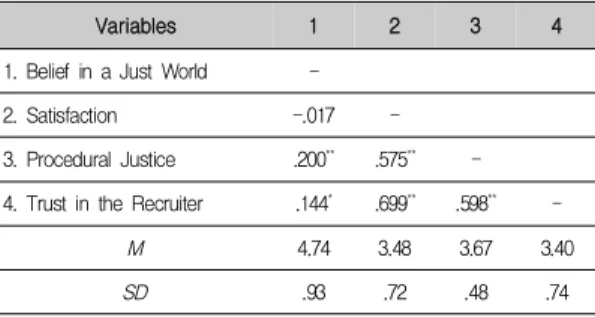
Correlations between the variables used in this study and the descriptive statistics are shown in Table 1. Belief in a just world was significantly positively related to perception of procedural justice in the selection process and trust in the recruiter (r = .144 ~ .200). Perception of procedural justice in the selection process was significantly positively related to satisfaction and trust in the recruiter (r = .575 ∼ .699).
Variables 1 2 3 4
1. Belief in a Just World -
2. Satisfaction -.017 -
3. Procedural Justice .200** .575** - 4. Trust in the Recruiter .144* .699** .598** -
M 4.74 3.48 3.67 3.40
SD .93 .72 .48 .74
* ρ < .05, ** ρ < .01
Table 1. Correlations and descriptive statistics of main variables
3.2 Differences in perceptions of a human recruiter and an AI recruiter in a recruiting situation
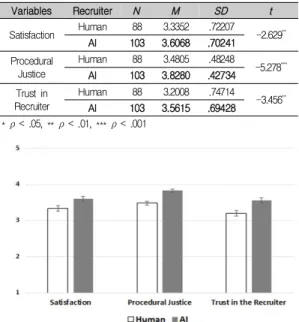
Results from analyzing the differences in satisfaction, perceptions of procedural justice, and levels of trust in the recruiter between the group that viewed the AI recruiter scenario and the group that viewed the human recruiter scenario are shown in Table 1 and Fig. 1. The levels of satisfaction, t(189) = -2.629,ρ< .01, and perceived procedural justice, t(189)
= -5.278, ρ < .001, for the AI recruiter were significantly higher than those for the human recruiter.
Moreover, the level of trust in the AI recruiter was significantly higher than in the human recruiter, t(189)
= -3.456,ρ< .01. The results suggest that potential job applicants were more satisfied with and perceived the selection procedures as fairer when carried by the AI recruiter than when carried by a human. Furthermore, potential job applicants had greater trust in the AI than the human recruiter.
Variables Recruiter N M SD t
Satisfaction Human 88 3.3352 .72207
-2.629**
AI 103 3.6068 .70241
Procedural Justice
Human 88 3.4805 .48248
-5.278***
AI 103 3.8280 .42734
Trust in Recruiter
Human 88 3.2008 .74714
-3.456**
AI 103 3.5615 .69428
* ρ < .05, ** ρ < .01, *** ρ < .001
Table 2. Results of t-test and descriptive statistics for Satisfaction, Procedural Justice, and Trust in the Recruiter by Recruiter Type
Fig. 1. Mean of satisfaction, procedural justice, and trust in the recruiter for the Human and AI recruiters. Error bars indicate standard errors of the mean.
3.3 Moderating effect of belief in a just world on the relationship between the recruiter (human vs. AI) and satisfaction, perception of procedural justice, and trust in the recruiter
To identify whether belief in a just world moderates the relationship between the recruiter type (human vs.
AI; independent variable) and that participant’s satisfaction in the selection process, perception of procedural justice, and trust in the recruiter (dependent variables), hierarchical regression analysis using the method of Aiken, West, and Reno [36] was conducted.
In Step 1 the control variable (gender) was inserted.
In Step 2, recruiter type (human vs. AI) and mean-centered belief in a just world (PJself) were inserted. In Step 3, the interaction term of mean-centered belief in a just world (PJself) and recruiter type were inserted.
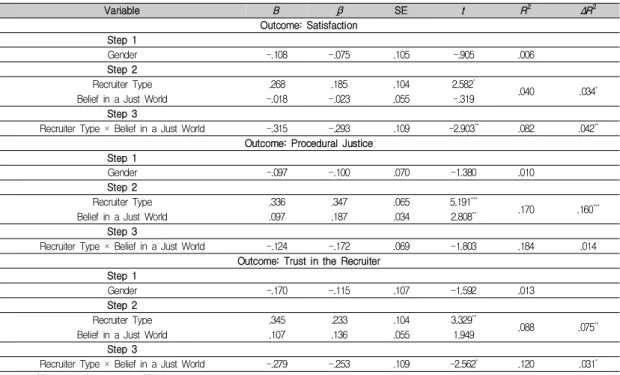
Results showed that belief in a just world (PJself) significantly moderated the relationship between recruiter type and satisfaction with the selection procedures (ΔR2=.042, β = -.293 p < .01); belief in a just world (PJself) marginally significantly moderated the relationship between recruiter type and perceptions of procedural justice (ΔR2= .014.,β= -.172, p = .73);
belief in a just world significantly moderated the relationship between recruiter type and trust in the recruiter (ΔR2=.031,β = -.253, p < .05).
The results suggest that the levels of satisfaction with the selection procedures and trust in the recruiter by type of recruiter(human vs. AI) differed according to the potential job applicant’s belief that the world is fair in terms of procedure. Results of the analysis of these moderating effects are shown in Table 3 and Fig.
2-4 with two lines(High BJW/Low BJW) representing belief in a just world scores 1SD above the mean, and 1SD below the mean.
As shown in Fig. 2, belief in a just world moderated the relationship between recruiter type and satisfaction with selection procedures. The group that had less belief in a just world was more satisfied with the selection procedures performed by the AI than the
Variable B β SE t R2 ΔR2 Outcome: Satisfaction
Step 1
Gender -.108 -.075 .105 -.905 .006
Step 2
Recruiter Type .268 .185 .104 2.582*
.040 .034*
Belief in a Just World -.018 -.023 .055 -.319
Step 3
Recruiter Type × Belief in a Just World -.315 -.293 .109 -2.903** .082 .042**
Outcome: Procedural Justice Step 1
Gender -.097 -.100 .070 -1.380 .010
Step 2
Recruiter Type .336 .347 .065 5.191***
.170 .160***
Belief in a Just World .097 .187 .034 2.808**
Step 3
Recruiter Type × Belief in a Just World -.124 -.172 .069 -1.803 .184 .014
Outcome: Trust in the Recruiter Step 1
Gender -.170 -.115 .107 -1.592 .013
Step 2
Recruiter Type .345 .233 .104 3.329**
.088 .075**
Belief in a Just World .107 .136 .055 1.949
Step 3
Recruiter Type × Belief in a Just World -.279 -.253 .109 -2.562* .120 .031*
* ρ < .05, ** ρ < .01, *** ρ < .001
Table 3. Hierarchical regression analyses of Belief in a Just World as a moderator of the relationship between recruiter type and satisfaction, procedural justice, and trust in the recruiter
group with greater belief in a just world. In addition, the group with less belief in a just world was less satisfied with the selection procedures performed by a human than the group with greater belief in a just world.
The moderating effect shown in Fig. 3 was marginally significant. Compared to the group with greater belief in a just world, the group with less belief in a just world perceived the selection procedures as carried out by a human as less fair. In similar comparison, Fig. 4 shows that the group with less belief in a just world also had less trust in the human recruiter.
The graphs of Fig. 2-4 show similar general trends.
The group with less belief in a just world was more satisfied with and perceived as fairer the selection procedures carried out by the AI; also, that group had greater trust in the AI recruiter than the human recruiter. On the other hand, the group with greater belief in a just world was less influenced by recruiter type (human vs. AI).
Fig. 2. Belief in a Just World as a moderator in the relationship between Recruiter Type and Satisfaction
Fig. 3. Belief in a Just World as a moderator in the relationship between Recruiter Type and Procedural Justice
Fig. 4. Belief in a Just World as a moderator in the relationship between Recruiter Type and Trust in the Recruiter
4. Discussion
This study has several implications. First, potential job applicants are likely to perceive a selection process conducted by an AI as more satisfactory and more just than the same process conducted by a human, and this implies that potential job applicants have a positive perception of selection procedures performed by an AI.
The two scenarios used in this study equally controlled for the experience and ability of both the human and AI recruiter, and suggested a fair selection process.
Nonetheless, there were significant differences between perceptions of the human and the AI. These results imply that potential job applicants' perceptions of the replacement of a human recruiter with an AI recruiter are possibly positive.
Second, this study shows that, for people who perceive the world as less fair, there is a tendency to believe that AI will make fairer evaluations, and to trust in its evaluations; and for these people there is also less satisfaction with procedures conducted by humans, along with perceptions of unjust and unworthy behavior. It implies that if the world becomes more unfair, job applicants may trust an AI recruiter then a Human recruiter.
However, the study has limitations. First, the optimal sample for studying perceptions of and reactions to candidate selection would be actual job applicants; instead, the study used potential job applicants. In addition, since the AI recruiter has not yet been developed for real-life application, simulated
scenarios were used. Thus, study results will need to be replicated using more realistic experimental methods.
To overcome these limitations, we make several proposals for future research. First, it is required to proceed into video stimulation, which is generally more realistic than scenario stimulation and increases the immersion of research participants. In former studies, video stimulations have been used to study the perceptions of AI [37-38], and they produced results similar to those of real experimental stimulation in terms of robot interaction research [39]. Second, according to previous studies, evaluation results may affect perceptions of procedural justice [40-42]; for instance, when feedback is positive, people tend to perceive the process as fair and accurate [42]. Thus, future studies might aim to investigate whether the perceptions of selection procedures carried out by an AI or a human are subject to change after presentation of the selection results.
5. Conclusions
This study identified the different perceptions of potential job candidates regarding human recruiters carrying out selection procedures and AI recruiters carrying out the same procedures. Results showed that potential job applicants were more satisfied with the selection procedures and perceived them as fairer when they were conducted by the AI recruiter than when they were conducted by a human. Furthermore, potential job applicants had greater trust in the AI than the human recruiter.
In this study, a participant’s level of satisfaction with the selection procedures and the participant’s trust in the recruiter by type of recruiter (human vs. AI) was influenced by the participant’s belief that the world was fair in terms of procedure. The group that believed that the world was not fair had lower satisfaction with selection procedures conducted by humans, and had less trust in the human recruiter than the group that believed the world was fair.
Submission of application
‘Ji-hoon’ applies for the marketing division of Company A.
<‘Ji-hoon’ fills out the application and submits it to Company A.>
Human recruiter of A company
The following human recruiter from Company A evaluates the applicants.
The human recruiter has reviewed 8,000 applicants to date. The turnover rate and resignation rate of the employees recruited so far has been less than 10%, and no lawsuit has been filed or complaints received from the applicants.
Document screening (Application screening)
The human recruiter reviews the application of ‘Ji-hoon’.
<‘Ji-hoon’ passes the document screening and is classified as the interviewee.>
Interview
‘Ji-hoon’ sits facing the human recruiter during the interview.
Human recruiter: Hello. Be relaxed during the interview. Let’s start the interview.
Human recruiter: Why have you applied for the marketing division?
Ji-hoon: A company is exporting various products overseas as a global enterprise. While I was majoring in business administration, I developed an interest in marketing, so I focused on accumulating knowledge related to marketing. I applied to Company A because I think my knowledge related to marketing can be helpful to the company in increasing its market share of the foreign market.
Human recruiter: You said that you studied marketing. How would you define marketing?
Ji-hoon: Marketing is delivering the value created by enterprises to customers and the society.
<Omission>
Human recruiter: Thank you for your effort. You may leave now.
Ji-hoon: Oh. Can I make one last statement?
Human recruiter: You may.
Ji-hoon: I forgot to say one thing. I won an award in a food marketing contest. This experience is suited to the marketing job position.
Human recruiter: Well understood. You may leave now.
Selection result The human recruiter makes the final decision on ‘Ji-hoon’ after analyzing results from the application evaluation and the interview evaluation.
Appendix 1.
Submission of application
‘Ji-hoon’ applies for the marketing division of Company A.
<‘Ji-hoon’ fills out the application and submits it to Company A.>
AI recruiter of A company
The following AI recruiter from Company A evaluates the applicant.
The AI recruiter has reviewed 8,000 applicants to date. The turnover rate and resignation rate of the employees recruited so far has been less than 10%, and no lawsuit has been filed or complaints received from the applicants.
Document screening (Application screening)
The AI recruiter reviews the application of ‘Ji-hoon’.
<‘Ji-hoon’ passes the document screening and is classified as the interviewee.>
Interview
During the interview, ‘Ji-hoon’ sits in front of computer with the AI program installed. The AI recruiter converses with ‘Ji-hoon’ by observing his facial expressions and voice via a web camera and audio equipment.
AI recruiter: Hello. Be relaxed during the interview. Let’s start the interview.
AI recruiter: Why have you applied for the marketing division?
Ji-hoon: Company A is exporting various products overseas as a global enterprise. While I was majoring in business administration, I developed an interest in marketing, so I focused on accumulating knowledge related to marketing. I applied to Company A because I think my knowledge related to marketing can be helpful for the company in increasing its share of the foreign market.
AI recruiter: You said that you studied marketing. How would you define marketing?
Ji-hoon: Marketing is delivering the value created by enterprises to customers and the society.
<Omission>
AI recruiter: Thank you for your effort. You may leave now.
Ji-hoon: Oh. Can I say one last thing?
AI recruiter: You may.
Ji-hoon I forgot to say one thing. I won an award in a food marketing contest. This experience is suited to the marketing job position.
AI recruiter: Well understood. You may leave now.
Selection result The AI recruiter makes the final decision on ‘Ji-hoon’ after analyzing results from the application evaluation and the interview evaluation.
Appendix 2.
REFERENCES
[1] A. S. Kay. (2000). Recruiters embrace the Internet.
Informationweek, 778, 72-72.
[2] W. Choi. (2017, July 10). [Worldreport] How do Japan’s AI evaluate job applicants? . SBS News. Retrieved fromhttp://news.sbs.co.kr/news/endPage.do?news_id=N1 004287424&plink=ORI&cooper=NAVER#openPrintPopup [3] Weeklytechreport (2017). IITP. 43-44.
[4] Bartlett, M. S., Littlewort, G. C., Frank, M. G., & Lee, K.
(2014). Automatic decoding of facial movements reveals deceptive pain expressions. Current Biology, 24(7), 738-743. doi: 10.1016/j.cub.2014.02.009
[5] Youyou, W., Kosinski, M., & Stillwell, D. (2015).
Computer-based personality judgments are more accurate than those made by humans. Proceedings of the National Academy of Sciences, 112(4), 1036-1040.
DOI: 10.1073/pnas.1418680112
[6] D. Brougham & J. Haar. (2017). Smart Technology, Artificial Intelligence, Robotics, and Algorithms (STARA): Employees’ perceptions of our future workplace. Journal of Management & Organization, 1-19. doi: 10.1017/jmo.2016.55
[7] M. Yoon, J. Lee & J. Baek. (2016). Topophilia convergence science education for enhancing learning capabilities in the age of artificial intelligence based on the case of challenge match lee sedol and AlphaGo.
Journal of the Korea Convergence Society, 7(4), 123-131. doi: 10.15207/JKCS.2016.7.4.123
[8] D. Kim, H. Kwon & J. Lim. (2017). Measures to minimize the side effects of the increased use of Artificial Intelligence Robo-Advisor. Journal of the Korea Convergence Society, 8(10), 67-73. doi:
10.15207/JKCS.2017.8.10.067
[9] K. C. Shin & J. Han. (2017). Qualitative exploration on children's interactions in telepresence robot assisted language learning. Journal of the Korea Convergence Society, 8(3), 177-184. doi: 10.15207/JKCS.2017.8.3.177 [10] C. Edwards, A. Edwards, P. R. Spence & A. K. Shelton.
(2014). Is that a bot running the social media feed?
Testing the differences in perceptions of communication quality for a human agent and a bot agent on Twitter.
Computers in Human Behavior, 33, 372-376. doi:
10.1016/j.chb.2013.08.013
[11] C. Nass & Y. Moon. (2000). Machines and mindlessness:
Social responses to computers. Journal of social issues, 56(1), 81-103. DOI: 10.1111/0022-4537.00153
[12] C. Nass & K. M. Lee. (2001). Does computer-synthesized
speech manifest personality? Experimental tests of recognition, similarity-attraction, and consistency- attraction. Journal of experimental psychology: applied, 7(3), 171. DOI: 10.1037/1076-898X.7.3.171
[13] T. Kanda, T. Miyashita, T. Osada, Y. Haikawa & H.
Ishiguro. (2008). Analysis of humanoid appearances in human-robot interaction. IEEE Transactions on Robotics, 24(3), 725-735. DOI: 10.1109/TRO.2008.921566 [14] H. Glejser & B. Heyndels. (2001). Efficiency and inefficiency in the ranking in competitions: The case of the Queen Elisabeth Music Contest. Journal of cultural Economics, 25(2), 109-129. doi: 10.1023/A:1007659804416 [15] J. L. Farr. (1973). Response requirements and primacy-recency effects in a simulated selection interview. Journal of Applied Psychology, 57(3), 228.
doi: 10.1037/h0034708
[16] L. Page, & K. Page. (2010). Last shall be first: A field study of biases in sequential performance evaluation on the Idol series. Journal of Economic Behavior &Organization, 73(2), 186-198.
doi: 10.1016/j.jebo.2009.08.012
[17] M. T. Dzindolet, S. A. Peterson, R. A. Pomranky, L. G.
Pierce & H. P. Beck. (2003). The role of trust in automation reliance. International journal of human-computer studies, 58(6), 697-718.
doi: 10.1016/S1071-5819(03)00038-7
[18] W. Wood & S. J. Karten. (1986). Sex differences in interaction style as a product of perceived sex differences in competence. Journal of personality and social psychology, 50(2), 341.
doi: 10.1037/0022-3514.50.2.341
[19] B. Tay, Y. Jung & T. Park. (2014). When stereotypes meet robots: the double-edge sword of robot gender and personality in human-robot interaction. Computers in Human Behavior, 38, 75-84.
doi: 10.1016/j.chb.2014.05.014
[20] M. L. Walters, K. Dautenhahn, R. Te Boekhorst, K. L.
Koay, C. Kaouri, S. Woods & I. Werry. (2005). The influence of subjects' personality traits on personal spatial zones in a human-robot interaction experiment.
In Robot and Human Interactive Communication, 2005.
ROMAN 2005. IEEE International Workshop on (pp.
347-352). IEEE. doi: 10.1109/ROMAN.2005.1513803 [21] K. A. Hoff & M. Bashir. (2015). Trust in automation:
Integrating empirical evidence on factors that influence trust. Human Factors, 57(3), 407-434.
doi: 10.1177/0018720814547570
[22] J. Tomaka & J. Blascovich. (1994). Effects of justice
beliefs on cognitive appraisal of and subjective physiological, and behavioral responses to potential stress. Journal of Personality and Social Psychology, 67(4), 732. doi: 10.1037/0022-3514.67.4.732
[23] C. T. Liang & A. Borders. (2012). Beliefs in an unjust world mediate the associations between perceived ethnic discrimination and psychological functioning.
Personality and Individual Differences, 53(4), 528-533.
doi: 10.1016/j.paid.2012.04.022
[24] M. Zuckerman & K. C. Gerbasi. (1977). Belief in a just world and trust. Journal of Research in Personality, 11(3), 306-317. doi: 10.1016/0092-6566(77)90039-3 [25] L. Bègue. (2002). Beliefs in justice and faith in people:
Just world, religiosity and interpersonal trust.
Personality and Individual Differences, 32(3), 375-382.
doi: 10.1016/S0191-8869(00)00224-5
[26] I. M. Lipkus & V. L. Bissonnette. (1996). Relationships among belief in a just world, willingness to accommodate, and marital well-being. Personality and Social Psychology Bulletin, 22(10), 1043-1056.
doi: 10.1177/01461672962210008
[27] Z. Rubin & L. A. Peplau. (1975). Who believes in a just world?. Journal of social issues, 31(3), 65-89. doi:
10.1111/j.1540-4560.1975.tb00997.x
[28] D, De Cremer & T. R. Tyler. (2007). The effects of trust in authority and procedural fairness on cooperation.
Journal of Applied Psychology, 92(3), 639. doi:
10.1037/0021-9010.92.3.639
[29] R. Folger. (1977). Distributive and procedural justice:
Combined impact of voice and improvement on experienced inequity. Journal of personality and social psychology, 35(2), 108. doi: 10.1037/0022-3514.35.2.108 [30] K. Van den Bos. (1999). What are we talking about
when we talk about no-voice procedures? On the psychology of the fair outcome effect. Journal of Experimental social psychology, 35(6), 560-577. doi:
10.1006/jesp.1999.1393
[31] T. Lucas, T, L. Zhdanova & S. Alexander. (2011).
Procedural and distributive justice beliefs for self and others: Assessment of a four-factor individual differences model. Journal of Individual Differences, 32(1), 14. doi: 10.1027/1614-0001/a000032
[32] E. Kim, E, D. Kim., H. Park, S. Kim & J. Kim. (2017).
Validation of the Korean Version of the Belief in a Just World Scale (K-BJWS). The Korean Journal of Counseling and Psychotherapy, 29(3), 689-710. doi:
10.23844/kjcp.2017.08.29.3.689
[33] T. H. Macan, M. J. Avedon, M. Paese, & D. E. Smith.
(1994). The effects of applicants' reactions to cognitive ability tests and an assessment center. Personnel Psychology, 47(4), 715-738.
doi: 10.1111/j.1744-6570.1994.tb01573.x
[34] J. A. Colquitt. (2001). On the dimensionality of organizational justice: a construct validation of a measure. Journal of applied psychology, 86(3), 386. doi:
10.1037/0021-9010.86.3.386
[35] S. M. Merritt. (2011). Affective processes in human–
automation interactions. Human Factors, 53(4), 356-370.
doi: 10.1177/0018720811411912
[36] L. S. Aiken, S. G. West & R. R. Reno. (1991). Multiple regression: Testing and interpreting interactions. Sage.
[37] H. R. Arkes, V. A. Shaffer & M. A. Medow. (2008). The influence of a physician's use of a diagnostic decision aid on the malpractice verdicts of mock jurors. Medical Decision Making, 28(2), 201-208. doi:
10.1177/0272989X07313280
[38] E. Park, K. J. Kim & A. P. Del Pobil. (2011). The effects of a robot instructor’s positive vs. negative feedbacks on attraction and acceptance towards the robot in classroom. In International Conference on Social Robotics (pp. 135-141). Springer, Berlin, Heidelberg. doi:
10.1007/978-3-642-25504-5_14
[39] S. Woods, M. Walters, K. L. Koay & K. Dautenhahn.
(2006, March). Comparing human robot interaction scenarios using live and video based methods: towards a novel methodological approach. In Advanced Motion Control, 2006. 9th IEEE International Workshop on (pp.
750-755). IEEE. doi: 10.1109/AMC.2006.1631754 [40] Landy, F. J., Barnes-Farrell, J. L., & Cleveland, J. N.
(1980). Perceived fairness and accuracy of performance evaluation: A follow-up. Journal of Applied Psychology, 65(3), 355. doi: 10.1037/0021-9010.65.3.355
[41] T. N. Bauer, C. P. Jr. Maertz, M. R. Dolen & M. A.
Campion. (1998). Longitudinal assessment of applicant reactions to employment testing and test outcome feedback. Journal of applied Psychology, 83(6), 892. doi:
10.1037/0021-9010.83.6.892
[42] C. P. Maertz, D. C. Mosley. T. N. Bauer, R. A.
Posthuma & M. A. Campion. (2004). Do procedural justice perceptions in a selection testing context predict applicant attraction and intention toward the organization?. Journal of Applied Social Psychology, 34(1), 125-145. doi: 10.1111/j.1559-1816.2004.tb02540.x
민 지 현(Jihyun Min) [학생회원]
▪2016년 8월 : 한동대학교 (상담심 리학 학사)
▪2016년 9월 ~ 현재 : 연세대학교 심리학과 석사과정
▪관심분야 : 인간-인공지능 상호작 용, 선발, 공정성
▪E-Mail : [email protected]
김 시 내(Sinae Kim) [정회원]
▪1996년 8월 : 서울대학교 (계산통 계학과 학사)
▪2014년 9월 ~ 현재 : 연세대학교 심리학과 석박통합과정
▪관심분야 : 직업전환, 은퇴, 인간- 인공지능 상호작용
▪E-Mail : [email protected]
박 용 욱(Yonguk Park) [정회원]
▪2014년 9월 ~ 2017년 2월 : 연세대 학교 심리학과 (심리학 석사)
▪2017년 3월 ~ 현재 : 연세대학교 심리학과 박사과정
▪관심분야 : 인간-인공지능 상호작 용, 산업심리학, 조직심리학
▪E-Mail : [email protected]
손 영 우(Young Woo Sohn) [정회원]
▪1999년 8월 : University of Illinois at Urbana-Champaign (심리학 박 사)
▪1999년 8월 ~ 2002년 1월
University of Connecticut at Storrs 심리학과 교수
▪2002년 3월 ~ 현재 : 연세대학교 심리학과 교수
▪관심분야 : 소명, 전문성 개발, 직무 동기
▪E-Mail : [email protected]