* Corresponding Author: [email protected]
+ This work is supported by the 2019 Open R&D Program of Korea Electric Power Corporation (KEPCO)(No. R17XH02) and by Ministry of Trade, Industry and Energy(MOTIE) and Korea Institute for Advancement of Technology (KIAT) of the Republic of Korea under Grant (No. N0001083).
+ This paper was prepared based on the first author’s master thesis in Ajou University
Manuscript received June 27, 2019 / revised August 20, 2019 / accepted August 21, 2019
1) 아주대학교 산업공학과, 제1저자 2) 아주대학교 산업공학과, 제2저자 3) 아주대학교 산업공학과, 제3저자 4) 아주대학교 산업공학과, 제4저자 5) 아주대학교 산업공학과, 교신저자
1. Introduction
1.1 Background and Purpose
Today, the global energy market is unstable due to the uncertainty of energy supply. Of the fossil fuels that have been used by more than 86% of the world's energy demand, the problem of depletion and rising prices has come true, and coal is rich in reserves, but there are
수증기 플라즈마를 이용한 DME 개질의 최적화 방안 연구
+
(Optimization of DME Reforming using Steam Plasma)
정 경 수1), 채 우 리2), 채 호 근3), 정 명 석4), 이 주 연5)*
(Kyeongsoo Jung, U-Ri Chae, Ho Keun Chae, Myeong-Sug Chung, and Joo-Yeoun Lee)
요 약 오늘날 세계 에너지 시장에서는 친환경 에너지의 중요성이 대두되고 있다. 수소 에너지는 미래의 청정에너지원이며 무공해 에너지원 중 하나이다. 특히 수소를 이용한 연료전지 방식은 재생에 너지의 유연성을 높여주고 장기간 에너지 저장 및 변환이 가능해서 화석 자원의 사용에 따른 환경문 제와 자원의 고갈로 인한 에너지 문제를 동시에 해결할 수 있는 방안으로 판단된다. 본 연구의 목적 은 플라즈마를 이용하여 효율적으로 수소를 생산하는 방안으로, 온도에 따른 개질반응과 수율을 확인 하여 DME(Di Methyl Ether)개질의 최적화 방안을 연구하는데 있다. 연구 방법은 2.45 GHz의 전자파 플라즈마 토치를 사용하여 청정 연료인 DME를 개질하여 수소를 생산하고. 저온 조건(T3 = 1100℃), 저온 과산소 조건(T3 = 1100℃), 고온 조건(T3 = 1376℃)에서 가스화 분석을 진행하였다. 저온 가스화 분석을 통해 1100℃ 근처에서는 불안정한 개질 반응으로 인해 메탄이 발생하는 현상을 확인하였고, 저온 과산소 가스화 분석은 저온 가스화 분석과 비교하였을 때 수소는 적으나 이산화탄소는 많은 것 을 확인할 수 있었다. 고온에서의 가스화 분석을 통해 1200℃ 이상에서는 메탄이 발생하지 않았고 약 1150℃ 부터 메탄이 발생하는 것을 알 수 있었다. 결론적으로 개질반응시 온도가 높을수록 수소의 비 율이 높아지나 CO 비율은 증가하는 것을 볼 수 있었다. 그러나, 가스화기의 구조적인 문제로 인해 열 손실과 개질의 문제가 발생함을 확인하였다. 향후 연구의 발전 방향으로는, 가스화기 개선을 통해 불 완전한 연소를 줄여 높은 수율의 수소를 얻고 일산화탄소, 메탄과 같은 기체의 발생을 낮출 필요성이 있는 것으로 판단된다. 본 연구에서 제안하는 DME를 수증기 플라즈마 개질하여 수소를 생산하는 최 적화 방안이, 향후 친환경, 신재생 에너지를 생산하는데 의미있는 기여를 할 수 있을 것으로 기대한다.
핵심주제어: 플라즈마 개질, DME(Di Methyl Ether) 개질, 수소생산
environmental problems such as greenhouse gas and pollutant emissions. This causes global warming and environmental pollution, which is one of the world's energy policies (Noh, 2013).
Nuclear power which accounts for a high proportion of energy supply, such as fossil fuels, has been highlighted by the Chernobyl accident in Russia and the Fukushima accident in Japan, and the nuclear policy has been reviewed internationally.
De-fossil · De-nuclear Fuel research are needed.
Hydrogen energy technology increases the flexibility of renewable energy and can be stored and converted for a long time, so it is regarded as the only alternative that can solve the environmental problems caused by the use of fossil resources and the energy problems caused by the depletion of resources simultaneously (John, 1999). In the case of future clean
technology, the detailed manufacturing technology is divided into electrolysis hydrogen production by alternative energy, hydrolysis hydrogen production using photocatalyst, biological hydrolysis hydrogen production, and hydrogen production by low temperature thermochemical cycle (Lee et al, 1995).
This study focused on the production of hydrogen using DME(Di Methyl Ether). DME is an ether compound in which one oxygen molecule and two methane groups are bonded. The molecular weight is 46.07. DME is a fuel that can be produced from various energy sources such as natural gas, coal, and biomass, and can generate electricity for home-commercial (LPG) and automotive (Diesel) by replacing fossil fuel with alternative combustion. Since combustion shows low efficiency, it is possible to produce fuel cell Abstract In today's global energy market, the importance of green energy is emerging.
Hydrogen energy is the future clean energy source and one of the pollution-free energy sources.
In particular, the fuel cell method using hydrogen enhances the flexibility of renewable energy and enables energy storage and conversion for a long time. Therefore, it is considered to be a solution that can solve environmental problems caused by the use of fossil resources and energy problems caused by exhaustion of resources simultaneously. The purpose of this study is to efficiently produce hydrogen using plasma, and to study the optimization of DME reforming by checking the reforming reaction and yield according to temperature. The research method uses a 2.45 GHz electromagnetic plasma torch to produce hydrogen by reforming DME(Di Methyl Ether), a clean fuel. Gasification analysis was performed under low temperature conditions (T3 = 1100°C), low temperature peroxygen conditions (T3 = 1100°C), and high temperature conditions (T3 = 1376°C). The low temperature gasification analysis showed that methane is generated due to unstable reforming reaction near 1100℃. The low temperature peroxygen gasification analysis showed less hydrogen but more carbon dioxide than the low temperature gasification analysis.
Gasification analysis at high temperature indicated that methane was generated from about 1150°C, but it was not generated above 1200°C. In conclusion, the higher the temperature during the reforming reaction, the higher the proportion of hydrogen, but the higher the proportion of CO. However, it was confirmed that the problem of heat loss and reforming occurred due to the structural problem of the gasifier. In future developments, there is a need to reduce incomplete combustion by improving gasifiers to obtain high yields of hydrogen and to reduce the generation of gases such as carbon monoxide and methane. The optimization plan to produce hydrogen by steam plasma reforming of DME proposed in this study is expected to make a meaningful contribution to producing eco-friendly and renewable energy in the future.
Keywords: Plasma reforming, DME(Di Methyl Ether) reforming, Hydrogen production
more efficiently and economically by producing hydrogen (Park et al, 2013).
The reforming of the DME mainly uses steam reforming, autothermal reforming, and plasma reforming. Steam reforming involves the risk of coking, which leads to catalyst damage and blockage of the reactor due to carbon deposits on the catalyst. Autothermal reforming requires expensive palladium catalysts and high emissions from and throughout the process. There is a problem of pollution. On the other hand, plasma reforming technology has advantages such as safe heat supply and ensuring the ease of reforming reaction. Although various studies have been conducted in relation to the existing plasma and its importance and value have also been mentioned (Kim et al, 2001; Ryu et al, 2006; Yi and Lee, 2013), patents related to plasma reforming technology have fewer applications compared with steam reforming and autothermal reforming, and it is difficult to establish a completed technology. Conventional arc plasma has a disadvantage that the life of the electrode is short because the arc electrode is vulnerable to moisture, so the plasma torch that has high efficiency and stable operation can be used.
Therefore, the study of producing hydrogen by DME reforming using water vapor electromagnetic wave plasma torch is expected to secure the original patent and economical effect, technical commercialization and ripple effect in unstable energy market.
1.2 Procedure
This study is composed of five chapters. In Chapter 1, the unstable status of the energy market and the value of the steam plasma torch were identified, and the background, purpose, research method, composition, and direction of the thesis selection were presented. Chapter 2 summarizes the theoretical background of the electromagnetic plasma torch and DME steam reforming. Chapter 3 explains the experimental
conditions and experimental procedures. Chapter 4 presents data analysis and results for each experiment. Chapter 5 presents conclusions through analysis of the experimental results and explains future research directions.
2. Literature Review
2.1 Electromagnetic Wave Plasma Troch
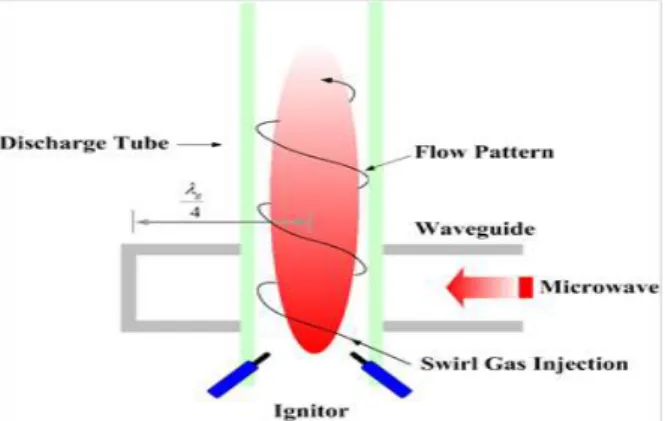
According to the theory of the electromagnetic torch, when the magnetron is powered as shown in Fig. 1, electromagnetic waves of 2.45 GHz are generated and the electromagnetic waves propagate through the waveguide. One end of the waveguide is blocked to allow electromagnetic waves to be reflected and the membrane drills a hole at a quarter wavelength from the end. The torch occurs best when the diameter of the quartz tube is about 3 cm. If you ignite using an ignition device while sending gas to make a torch, an electromagnetic torch is generated. The heating of the plasma torch flame results in an internal temperature of 6,000 degrees Celsius (Galvita et al. 2001; Kim et al, 2003).
Fig. 1 Microwave Plasma Torch
The microwave plasma device consists of a magnetron, an isolator, a directional coupler, a stub tuner, and a waveguide, as shown in Fig. 1. The
magnetron uses the signal from the microwave power supply to generate electromagnetic waves, and the circulator absorbs the reflected waves. Care should be taken that failure to absorb the reflected waves can lead to poor efficiency and damage to the magnetron. In a microwave plasma apparatus, a stub tuner adjusts the wavelengths of incident and reflected waves to match impedance to increase the efficiency of the electromagnetic waves output from the magnetron. Optimal conditions are set for each power so that more than 99% of electromagnetic waves can be used (Uhm, 2008).
2.2 DME Steam Reforming
DME is a colorless gas at room temperature and atmospheric pressure. Gas density is heavier than air and has high solubility for many compounds. In addition, hydrogen energy produced through DME is chemically and thermally stable, has a suitable vapor pressure, and has been identified as an alternative energy (Lee et al, 2001, Galyita, et al, 2001; Pyo, 2010).
DME can be produced from various energy sources such as natural gas, coal and biomass, and can be used for home-commercial (LPG replacement) and automotive (replacement diesel) generation by replacing combustion with fossil fuels. The physical properties are similar to LPG and propane, so they can be stored and transported in the same way. The calorific value is higher than methane and no sulfur content, making it a suitable fuel for ULEV environmental regulations (Park et al, 2009). In addition, reforming is a multi source-multi purpose fuel that can be used for fuel cells.
When the DME is steam reforming, the following reaction occurs as equation (1).
3 3 3 2 2 2 6 2
CH OCH + H O® CO + H (1)
The enthalpy and entropy of the equation show that the DME has an enthalpy of –184.1 kJ / mole and an entropy of 266.4 J / mole / K.
The enthalpy of water vapor is -241.8 kJ / mole and the entropy is 188.7 J / mole / K. The enthalpy of carbon dioxide is -393.5 kJ / mole and the entropy is 213.6 J / mole / K. Using this information, the enthalpy change due to the above reaction is calculated as ΔH = 122.5kJ / mole and the entropy change is calculated as ΔS
= 378.3J / mole / K. Therefore, the temperature for the above reaction to occur is calculated at T
= ΔH / △ S and calculated as T = 323.8K or 51
℃. However, water must be at least 100 ℃ because it vaporizes at 100 ℃ at 1 atmosphere.
The energy required for the endothermic reaction of the DME steam reforming is procured by a steam plasma torch. That is, 122.5 kJ of energy is required to reform 1 mole of DME and 6 moles of hydrogen are generated. When 6 moles of hydrogen oxidize to produce water vapor, an energy of 6 × 241.8 = 1451 kJ is produced.
3. Methods
As shown in Table 1, the large framework of the experiment was aimed at 75% hydrogen yield for DME reforming. The results were analyzed for each temperature, and the analysis was carried out according to gas generation.
Gasification Analysis
→
- Theory: 75% hydrogen, 25% carbon dioxide, - Comparison of the results of reforming by
temperature
- Comparison of results with oxygen (reduced heat loss)
- Results: Comparison of theory and reformed gas analysis
Table 1 Outline of Experiment
In the detailed experimental method of this study, gasification analysis experiment is to set temperature and oxygen as variables and examine the results through gas analyzer. The temperature was set to low temperature (1100
℃) and high temperature (1376 ℃), and more oxygen was injected to reduce the temperature drop inside the gasifier, and the result was examined.
4. Results
4.1 Low Temperature Gasification Analysis
In the case of low temperature gasification analysis, as shown in Fig. 2, the temperature dropped to about 40 ℃ and hardly dropped for 30 minutes.
Fig. 2 Graph of Temperature Change with Time of Low Temperature Gasification Analysis (T3)
In Fig. 3, the density of hydrogen is approximately 50%, CO 25%, 18% and methane 2.5%. The generation of methane is due to the low temperature of the gasifier, which leads to incomplete combustion and thus no complete gasification.
Fig. 3 Low Temperature Gasification Analysis Emission Density
This analysis shows that when the DME 10 LPM is used for oxidation, the output from the DME 1 LPM is 1 kW, so that about 10 kW of DME oxidation energy enters and the temperature is dropping, which is a big heat loss.
4.2 Low Temperature and Oxygen Gasification Analysis
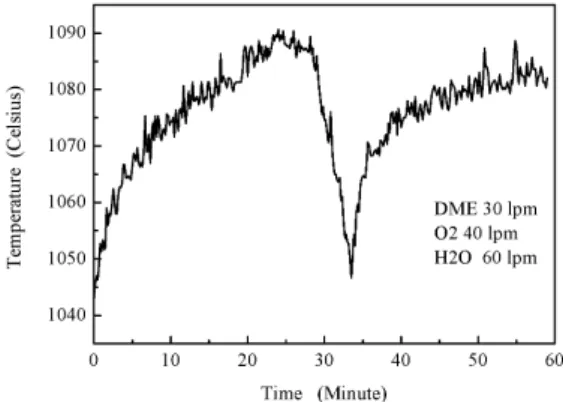
As shown in Fig. 4, the temperature did not change significantly over the 1 hour period and tended to rise, but after 30 minutes, the temperature suddenly dropped.
Fig. 4 Over-oxygen Gasification Analysis Graph of Temperature Change with Time
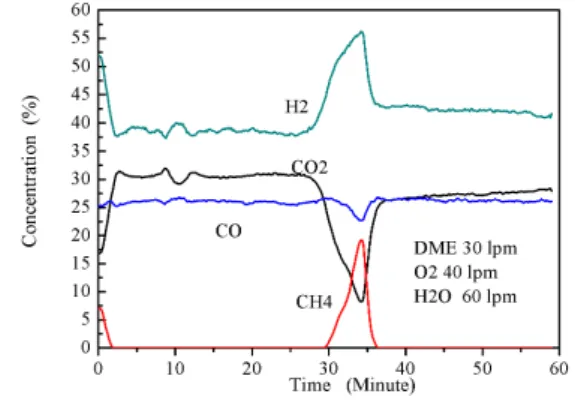
In Fig. 5, the hydrogen density is approximately 40-45%, CO 25%, 25-30% and methane 0%. However, after about 30 minutes, the gas reaction changes dramatically. The reason for this can be presumed to be the occurrence of special events such as changes in the amount of gas or flow in the gasifier as shown in the time-temperature graph. As shown in the graph above, in the oxygen-rich condition, compared to the experiment 1, less hydrogen and more carbon dioxide can be seen. This can be seen as a low hydrogen density because a lot of DME is burned by oxygen.
Fig. 5 Over-oxygen Gasification Analysis Exhaust Gas Density
4.3 High Temperature Gasification Analysis
Fig. 6 shows a decrease of about 100 ℃ for 30 minutes. In Fig. 7, we can see that the density of hydrogen is about 55%, CO is 29%, and is 14%. The singularity in this graph is methane, which can be produced after 10 minutes. The temperature of the zero methane point is about 1160 ℃, and perfect gasification starts from about 1200 ℃. That is, it can be seen that methane is generated when the temperature inside the gasifier drops below 1200 ℃.
Fig. 6 Graph of Temperature Change with Time of High Temperature Gasification Analysis
Fig. 7 High Temperature Gasification Analysis Emission Density
5. Conclusion
This study focused on the production of hydrogen by steam plasma reforming DME to overcome the unstable energy market. DME's plasma reforming has a relatively small share of patent applications compared to steam reforming and autothermal reforming, but it has begun to attract attention as economics such as safe heat supply of plasma reforming and guarantee of reforming reaction ease are emerging.
Low temperature gasification analysis began reforming at around 1100 ℃ based on T3. As a result of the reaction, the density of
hydrogen is about 50% and the density of methane is about 2.5%. The low temperature gasification analysis showed that methane is generated due to incomplete combustion below 1100 ℃.
The low temperature peroxygen gasification analysis began reforming at around 1100 ℃ based on T3. The peroxygen condition was tested to reduce the internal temperature of the gasifier. Although methane was not produced, it was about 30% compared to the low temperature gasification analysis because DME burned a lot of DME with oxygen instead of reforming reaction. It occurred a lot and the density of hydrogen was 40 ~ 45% so it was not worth considering.
The high temperature gasification analysis began reforming at around 1376 ℃ based on T3. As a result of the reaction, the density of hydrogen is about 55% and the density of methane is about 0-5%. That is, it was confirmed that more hydrogen is distributed at high temperature. The high temperature gasification analysis shows that methane is not generated at 1200 ℃, but methane is generated as the temperature is lowered to about 1160 ℃ after 10 minutes after the reaction. Therefore, the temperature of 1200 ℃ or more can be completely burned to produce hydrogen by plasma reforming, and it can be seen that no methane is generated.
As a result of gasification analysis, the higher the temperature, the higher the yield of hydrogen. However, if you look at the theory of DME and steam reforming reaction, the ratio of hydrogen should be 75% and the ratio of carbon dioxide should be 25%, but the ratio of hydrogen is low. In addition, the ratio of CO represents 25-30% in each experiment, which is a problem to be considered when using a fuel cell as a PEM. This converts CO to water using water shift. The current CO
appears to be due to the internal temperature of the gasifier heated by the plasma temperature, not directly by the plasma when the DME decomposes. Therefore, it is necessary to redesign the injected part of the plasma and the DME.
The redesign of the gasifier closes the location of the electromagnetic plasma torch and the DME inlet so that the DME can be modified by direct steam plasma. Water vapor plasma torch flames have high levels of OH that can help water shift in the conversion of CO to . Thus, the complete reaction of the DME reforming may increase the yield of hydrogen and reduce the amount of methane produced. It is also expected to reduce the temperature of the gasifier without preheating, and more experiments will have to be carried out to find the optimum conditions for the gas (DME,) and temperature injected from the redesigned gasifier.
References
Galvita, V. V., Semin, G. L., Belyaev, V. D., Yurieva, T. M., and Sobyanin, V. A. (2001).
Production of hydrogen from dimethyl ether, Applied Catalysis A: General, 216(1-2), 85-90.
John. N. A. (1999). The Multiple Roles for Catalysis in the Production of H2, Applied Catalysis A: General, 176(2). 159-176
Kim, I. S., Jang, I. H. and Son, Y. H. (2001).
The Study on Characteristics of a-C:H Films Deposited by ECR Plasma, J ournal of Korea Industrial Information systems Society, 2001(5), 224-231.
Kim, J. H., Hong, Y. C., Kim, H. S. and Uhm, H. S. (2003). Simple Microwave Plasma Source at Atmospheric Pressure, Journal of Korean Physics Society, 42, 876-879.
Lee, S. H., Choi, J. W., Kim, J. W. and Sim, K. S. (2001). Research Papers: Hydrogen Production from DME Steam Reforming Reaction, J ournal of the Korean Hydrogen Energy Society, 12(4). 293-305.
Lee, S. J., Yi, H. S. and Kim, E. S. (1995).
Combustion Characteristics of Intake Port Injection Type Hydrogen Fueled Engine, International Journal of Hydrogen Energy, 20(4), 317-322.
Noh, D. W. (2013). GHG Mitigation Potential and Price Compatability of Hydrogen Energy, Regional Development Research Institute, 45(2), 1-19.
Park, C. H., Kim, K. S., Jun, J. W., Cho, S. Y.
and Lee, Y. K. (2009). Thermodynamic Analysis of DME Steam Reforming for Hydrogen Production, J ournal of the Korean Industrial and Engineering Chemistry, 20(2), 186-190.
Park, S. H., Jang, S. Y., Oh, S. Y., Han, J. S., Cha, M. H., Byeon, M. J., Park, J. H., Jin, S.
W. and Ha, D. M. (2013). Investigation of Combustion Properties of DME, Proceedings of 2013 Korean Institute of Gas Conference, Nov. pp. 65-65, Jeju, Korea.
Pyo, Y. D. (2010). The Status of DME Vehicle Technology, Journal of the Korea Society of Automotive Engineers, 32(4), 45-52.
Ryu, J. T., Ikuno, T., Honda. S., Katayama, M.
and Oura, K. (2006). Electric Device Character and Fabrication of Advanced Thin Film including Nano Particles, Journal of the Korea Industrial Information Systems Research, 11(4), 66-71.
Uhm, H. S. (2008). Pure Water Vapour Torch Generator generated by Electromagnetic Waves and Hydrogen Generating Device using the Same, Patent Application No.
10-08564695.
Yi, K. H. and Lee, D.S. (2013). Cost Effective Plasma Display Panel TV Driving System
with an Address Misfiring Compensation Circuit, J ournal of the Korea Industrial Information Systems Research, 18(3), 1-8.
정 경 수 (Kyeongsoo Jung)
∙아주대학교 기계공학과 공학사
∙아주대학교 산업공학과 공학석사
∙관심분야 : 전자파 플라즈마, 기계공학
채 우 리 (U-Ri Chae)
∙한국복지대학교 보건학사
∙아주대학교 산업공학과 석박통합과정
∙관심분야 : 융합기술연구, 직업병·
직업성 질환, 데이터분석
채 호 근 (Ho Keun Chae)
∙아주대학교 산업공학과 박사과정
∙관심분야 : 융합기술, AI, 가상 현실(VR)
정 명 석 (Myeong-Sug Chung)
∙정회원
∙아주대학교 산업공학과 공학박사
∙아주대학교 산업공학과 연구교수
∙관심분야 : 융합기술, 데이터분석, 인공지능(AI)
이 주 연 (Joo-Yeoun Lee)
∙정회원
∙인하대학교 경영대학 경영학박사
∙아주대학교 산업공학과 교수
∙관심분야 : 융합기술, 비즈니스 인텔리전스