https://doi.org/10.9724/kfcs.2017.33.1.28
전분을 첨가한 글루텐 프리 쌀 파스타의 텍스처 특성
정진혁 ․ 윤혜현1†
경희대학교 대학원 조리외식경영학과, 1경희대학교 조리·서비스경영학과
Textural Properties of Gluten-free Rice Pasta Prepared Employing Various Starches
Jin Hyuck Jung ․ Hye Hyun Yoon1†
Department of Culinary Science and Food Service Management, Graduate School of Kyung Hee University, Seoul 02447, Korea
1Department Culinary Arts and Food Service Management, Kyung Hee University, Seoul 02447, Korea
Abstract
Purpose: This study was conducted to understand the factors that affect the texture of gluten-free rice pasta prepared buckwheat, mung bean, and acorn starches and to compare textural properties of samples 100% semolina. Methods: The moisture content, weight and water absorption test investigated and texture profile analysis measured by texture analyzer. Results: 100% semolina sample`s value was lower than gluten-free rice pasta moisture content, weight and water absorption test. moisture content weight was in pasta with mung bean starchin pasta with buckwheat starch. Texture profile analysis showed that increasing amount of buckwheat, mung bean, and acorn starches increased hardness, chewiness, cohesiveness and springiness, and decreased adhesiveness of gluten free rice pasta. Conclusion:
This study suggested that adding buckwheat, mungbean and acorn starches could improve texture properties of gluten-free rice pasta.
Key words: gluten-free rice pasta, buckwheat starch, mungbean starch, acorn starch, textural properties
†
Corresponding author: Hye Hyun Yoon, Department of Culinary Arts and Food Service Management, Kyung Hee University, Kyungheedae-ro, Dongdaemoon-gu, Seoul 02447, Korea
ORCID: http://orcid.org/0000-0001-9809-2377
Tel: +82-2-961-9403, Fax: +82-2-964-9557, E-mail: [email protected]
© 2017 Korean Society of Food and Cookery Science
This is an Open Access article distributed under the terms of the Creative Commons Attribution Non-Commercial License (http://creative-commons.org/lice
Ⅰ.
서 론파스타는 밀가루 또는 세몰리나를 물과 함께 반죽하여 만든 이탈리아의 대표적인 면 요리이다(Kill R & Turnbull K 2008). 곡류를 이용하여 제조한 식품들 가운데 재료의 선택과 제조 방법에 있어 가장 간단한 식품중 하나로 꼽 을 수 있으며, 대중성과 편리성으로 인해 전 세계적으로 널리 사랑받고 있다(De noni I & Pagani MA 2010).
파스타의 전반적인 품질특성에 있어 텍스처는 가장 중 요한 평가 요소이다. 일찍이 평가 방법에 관한 다양한 선 행연구가 이루어졌는데(Voisey PW 등 1978, Cole ME 1991, D'egidio MG & Nardi S 1996, Smewing J 1997) 대 표적인 측정항목으로는 탄력성, 단단한 정도, 표면 끈적 임, 수분 흡수율, 조리 손실률 등이 있다(Manser J 1981).
글루텐 프리 식품은 보리, 밀 등의 곡류에 존재하는 불 용성 단백질인 글루텐(gluten)이라는 성분에 알러지 반응 을 보이는 특정 소비자들을 위한 식품을 말한다. 최근 글
루텐 프리 식품이 건강에 좋다거나 다이어트에 좋다는 인식이 확산되면서 이에 대한 수요가 글루텐 알러지 환 자들의 숫자와 상관없이 늘어나고 있다. 따라서 파스타를 비롯한 다양한 글루텐 프리 식품에 관한 많은 연구가 필 요한 실정이다(Gallagher E 2009).
밀가루로 제조한 파스타의 경우 조리 과정 중 글루텐 망상구조가 형성되어 전분 입자를 가두어 놓게 되지만 (Resmini P & Pagani MA 1983), 글루텐 프리 파스타는 글루텐 부재로 인해 조리 과정 중 전분이 조리 수에 용출 되어 부착성이 높고 끈적거리는 단점이 나타나게 된다 (Hager AS 등 2013). 따라서 글루텐 프리 파스타에 관한 연구는 텍스처 특성에 있어 밀로 제조한 제품과의 차이 를 줄이는 것이 가장 큰 관건이라 할 수 있다.
글루텐 프리 파스타의 재료로 가장 많이 이용되고 있 는 것은 쌀이다(Kim BK 등 2011, Marti A & Pagani MA 2013).
밀가루로 만든 파스타의 품질은 글루텐과 전분, 두 가
지 모두에 영향을 받으나(Miskelly DM 1996) 쌀에는 글 루텐이 결여되어 있으므로 쌀을 주재료로 한 글루텐 프 리 파스타의 품질은 전적으로 전분의 이화학적 특성에 의해 좌우된다고 할 수 있다. 좋은 제면 적성을 나타내는 쌀 품종은, 높은 아밀로오스 함량, 낮은 호화온도, 호화 후 팽윤된 전분입자와 수용성 아밀로오스에 의한 연속상 망상구조의 강한 겔 특성을 갖고 있는데(Seo HI 등 2011), 이러한 특징들은 우리나라 고유의 전통 조리법인 묵에 사용되는 메밀, 녹두 그리고 도토리 전분의 특성과 유사성을 갖고 있다(Chung KM & Lee WJ 1997, Kim HS
& Ahn SY 1997, Cho SA & Kim SK 2000).
메밀(Fagopyrum esculentum Moench)은 일년생 초본으 로 사면체 모양의 열매이다(Marshall HG & Pomeranz Y 1982). 일찍이 이탈리아 등지에서 파스타를 만드는데 사 용되어왔으며(Chillo S 등 2008), 우리나라 식품으로는 막 국수와 냉면이 있다(Lee SY 등 1991). 메밀가루는 밀가루 와 달리 글루텐 단백질이 함유되어 있지 않아 점성과 탄 력성이 약하나 수용성 단백질인 알부민(albumin)과 글로 불린(globulin)이 상당량 함유되어 있다(Park CH 등 2012).
이러한 단백질은 물에 녹으면 점성이 생기고, 메밀가루에 이음성을 부여하게 되는데 전분이 호화하며 생기는 점성 이 이음효과를 나타내는 것과 같은 원리라 할 수 있다 (Kim BR 등 1999).
녹두(Phaseolus radiatus)는 호화 후 냉각한 후에 투명 한 겔을 형성하는 것으로 알려져 있으며, 특히 탄력성이 매우 높고 부드러운 풍미와 같은 장점으로 인해 묵, 국수, 고물, 죽 그리고 과편 등의 재료에 널리 이용되어 왔다.
이는 거피한 녹두를 물로 추출하여 얻은 앙금으로 제조 되고 이러한 앙금은 전분으로 이루어져 있다(Cho SA &
Kim SK 2000, Park SJ 등 2012). 또한 강한 겔의 안정성 과 호화 후 팽윤 전분 입자의 독특한 특징으로 인해 녹두 묵 뿐만 아니라(Kim AK 등 1995) 제면 적성에도 적합한 식품으로 국수 제조에 매우 우수한 가공성을 가진다고 알려져 있다(Lii CY & Chang SM 1981).
도토리(Quecus acutissima Carruthers)는 약 70%가 전분 으로 이루어져 기근이 발생할 때마다 중요한 구황식품으 로 사용되었고(Yang KH 등 2012) 우리나라에서는 예로 부터 밥, 묵, 술, 수제비, 죽, 떡, 다식 등의 재료로 이용되 어왔다(Yoon SJ & Lee MY 2006). 특히 최근에는 식물성 폴리페놀인 tannin과 항산화계 물질이 다량 함유되어있는 장점을 활용한 기능성 식품 연구개발이 활발히 이루어지 고 있다(Shim TH 등 2004).
따라서 본 연구는 멥쌀을 주재료로 제조한 글루텐 프 리 쌀 파스타의 텍스처 단점을 보완하기 위해 높은 아밀 로오스 함량, 낮은 호화온도, 강한 겔의 특성을 갖고 있 는 메밀, 녹두, 도토리 전분을 첨가하여 글루텐 프리 쌀 파스타를 제조하고 이에 따른 텍스처 특성 변화를 구체
적으로 살펴보았다. 또한, 이를 통해 전분의 첨가에 따른 글루텐 프리 쌀 파스타의 구체적인 텍스처 특성을 규명 하여 향후 글루텐 프리 식품 연구의 새로운 메뉴개발 자 료로 제시하고자 한다.
Ⅱ.
재료 및 방법 1. 실험재료글루텐 프리 쌀 파스타 제조에 사용할 쌀가루는 쌀가 루, (주)대두식품(군산, 대한민국) 박력 쌀가루를 이용하 였으며 메밀전분(메밀 100%, 화미식품, 봉평, 대한민국) 과 녹두전분(녹두 100%, 화미식품, 중국산), 도토리 전분 (도토리 100%, 화미식품, 중국산)은 일괄적으로 구매하여 사용하였다. 잔탄검(xanthan gum 100%, SoleGraells. S.A.
Barcelona, Spain)은 회사 홈페이지를 통해 구매하였고 대 조군으로 사용할 세몰리나(semolina 100%, Decceco, Fara S. Martino, Italy)와 올리브오일(extra virgin olive oil 100%, Decceco, Fara S. Martino, Italy)은 이탈리아 수입 산, 소금은 국내산 정제염(한주소금 100%, 동성, 신안, 대 한민국)을 사용하였다.
2. 시료 제조
메밀, 녹두, 도토리 전분, 소금은 40 mesh체(Scandicrafts, Camarillo, CA, USA)에 내려 준비하고 사용되는 모든 재료 는 전자저울(CP3202S, Sartorius Co., Goettingen, Germany) 에 측량하여 실험재료로 이용하였다. 세몰리나 100%로 제조한 일반적인 파스타를 실험 대조군으로 이용하였고, 총 5차례 예비실험을 실시하였으며, 압출 방식으로 글루 텐 프리 파스타를 제조한 선행 연구를 토대로 배합 비율 을 정하였다(Kahlon TS & Chiu MCM 2015).
세몰리나 대조군을 설정하고, 멥쌀가루 500 g을 기준 으로 메밀, 녹두, 도토리 전분을 50 g씩 첨가량을 증가하 여 10%, 20%, 30% 비율로 계량하였으며, 멥쌀가루는 500 g에 차감된 값으로 계산하여 90%, 80%, 70%의 비율 로 첨가 하였다. 5 g의 정제염과 25 g의 잔탄검은 대조군 및 실험군 시료에 첨가하여 총 11가지 시료의 계량을 완 료 하였다. 반죽 배합기(vertical type mixer, N-5, Hobart, Triy, OH, USA)를 이용하여 모든 재료를 믹싱볼에 투입 한 뒤, 500 g 기준 300 mL의 물을 넣어주었고 1분 30초 간 혼합하여 반죽을 제조하였다. 글루텐 프리 파스타의 선행연구에 따르면 진공 상태 속에서 가해지는 강한 압 력과 스크류를 통과해 디스크 밖을 빠져나오는 강한 팽 윤력으로 인해 압출방식의 파스타가 훨씬 더 견고한 파스 타를 제조할 수 있다 보고하였다(Wang N 등 1999, Chillo S 등 2010, Marti A & Pagani MA 등 2013) 따라서 본 연 구도 완성된 반죽을 압출타입 파스타 제조기(extruder pasta
machine D-35, La parmigiana Co., Fidenza, Italy)에 넣어 스크류를 통과 시킨 다음, 부착된 지름 6 mm, 두께 1.5 mm의 마케로치니 디스크로 빠져나오는 파스타를 45 mm 길이로 잘라 제조하였다(Hildebrand C & Kenedy J 2010).
완성된 시료는 상온에서 2시간 건조 과정을 거친 뒤 4°C 냉장고(NRT-150R, Lassele Co., Ansan, Korea)에 보관 하 였다.
파스타 조리는 시료 50 g을 500 mL의 끓는 물 100°C 에 넣어 세몰리나 대조군은 4분, 전분을 첨가한 쌀 파스 타 시료는 2분간 삶은 다음 건져내어, 2 g의 올리브유를 뿌려 버무려 준 뒤, 실온에서 1분간 냉각하였다. 조리된 파스타는 즉시 본 실험의 시료로 사용하였다.
3. 실험 방법 1) 수분 함량
주 재료인 쌀가루와 메밀, 녹두, 도토리 가루 1 g을 시 료 판에 최대한 얇게 펴서 측정하였다. 메밀, 녹두, 도토 리가루를 첨가하여 제조한 글루텐 프리 쌀 파스타는 시 료별로 각각 1 g씩 생면과 숙면을 고르고 얇게 펴서 할로 겐 수분측정기(Moisture Analyzer, MB-45, Ohaus Co., Nanikon, Switzland)에 넣고 각각 3회 반복 측정하여 그 평균값을 구하였다.
2) 중량 및 수분 흡수율
글루텐 프리 쌀 파스타의 조리실험은 건면 50 g을 1000 mL의 끓는 증류수에 넣고 2분간 삶은 후 냉수로 30 초간 냉각하여 파스타를 제조하였으며, 종이타올(Kimtech pure paper towel, Yuhan kimberly, Seoul, Korea)로 파스타 표면의 수분을 제거 한 후 중량을 측정하였다. 각 시료는 3회 반복 측정하였다.
수분 흡수율은 다음 식에 의해 구하였다.
Water absorption (%)
조리후파스타의중량g 조리전파스타의중량g × 조리전파스타의중량g
3) 기계적 texture 측정
시료의 texture 측정은 texture analyzer(TA-XT Express, Stable Micro Systems. Ltd, Godalming, UK)를 사용하여 경도(hardness), 부착성(adhesiveness), 탄력성(springiness), 씹힘성(cohesiveness), 응집성(cohensiveness) 총 5가지 항 목에 대한 측정을 실시하였다. 측정은 HDP/PFS(Pasta Firmness/stickiness. Rig)로 3회 반복 측정하여 평균값과 표준편차를 구하였다. 실험에 사용한 texture analyzer의 측정조건은 pro-test speed, test speed, post-speed 1.0(mm/s), distance 4.0(mm), time 5.0(s), trigger force 1.0(g)이다.
4. 통계처리
모든 실험은 3회 반복 측정하여 그 결과를 SPSS Statistics (ver. 18.0, SPSS Inc., Chicago, IL, USA)를 이용하여 분 석하였다. 시료간의 유의성 검정은 one-way ANOVA를 이용하여 분석하였으며, p<0.05 수준에서 Duncan의 다중 범위검정(Duncan`s multiple range test)를 실시하여 각 시 료간의 통계 유의성을 검증하였다.
Ⅲ.
결과 및 고찰 1. 수분 함량본 연구에 사용한 쌀가루의 수분 함량은 13.81%, 메밀, 녹두, 도토리 전분은 각각 11.52%, 14.20%, 15.38%, 대조 군으로 사용한 세몰리나는 10.82%였다. 메밀, 녹두, 도토 리 전분을 첨가한 글루텐 프리 쌀 파스타의 수분함량 측 정 결과는 Table 1과 같다.
Schoenlechner R 등(2010)에 따르면 파스타 반죽의 수 분 함량은 파스타 품질을 좌우하는 주된 요인으로, 수분 함량이 지나치게 높을 경우 경도성은 낮아지고 부착성은 증가하며, 수분함량이 너무 낮을 경우 부착성은 감소하지 만, 표면 균열과 함께 잘 부서진다고 보고하였다.
조리 전 수분 측정값은 세몰리나 대조군(20.70%)이 가 장 낮게 나타났으며, 가장 높은 수분 함량을 나타낸 시료 는 도토리 전분을 30% 첨가한 AC30(36.38%)과 20% 첨 가한 AC20(36.34%)이었다.
메밀 전분 첨가량이 증가할수록 수분 함량은 낮아졌으 며, 녹두 전분과 도토리 전분 첨가량이 증가할수록 수분 함량은 증가하였다. 이는 도토리 전분의 수분 함량 값이 메밀, 녹두 전분에 비해 높다는 선행연구와 일치하는 경 향을 나타낸다(Cho SA & Kim SK 2000).
조리 후 수분 측정값 역시 조리전과 비슷한 양상을 나 타내었는데, 세몰리나 대조군이 36.86%로 가장 낮게 나 타났고, 메밀 전분 첨가량이 증가할수록 수분 함량은 낮 아지는 결과를 나타내었으며, 녹두 전분의 첨가는 수분함 량을 증가 시켰다. 도토리 전분을 첨가한 시료들은 조리 전, 첨가량이 증가할수록 수분 함량은 높아지는 경향을 나타내었으나, 조리 후에는 첨가량이 증가할수록 수분 함 량은 낮아져서 조리 전과 후, 각각 상반되는 결과를 나타 내었다.
2. 중량 및 수분 흡수율
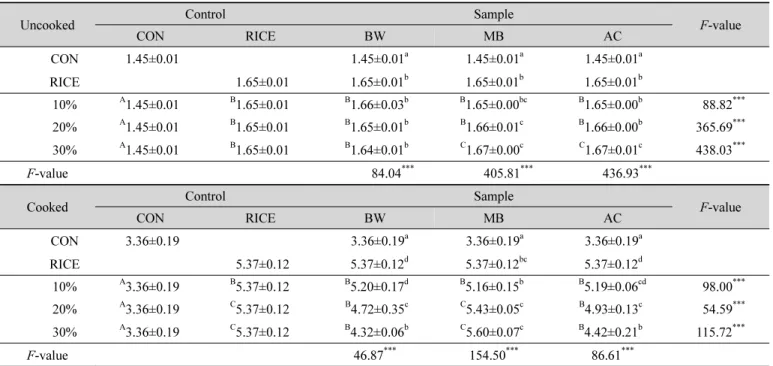
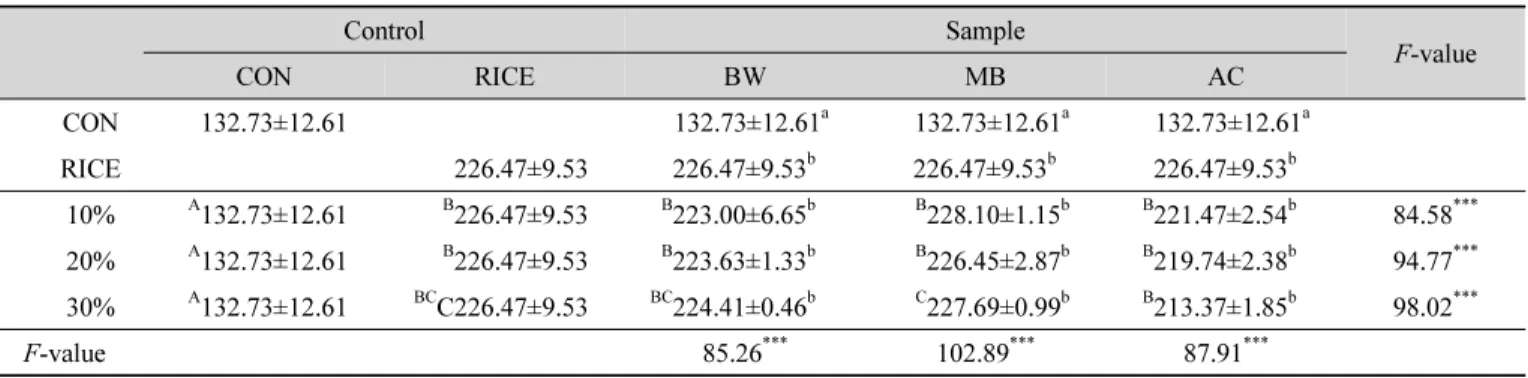
메밀, 녹두, 도토리 전분을 첨가한 글루텐 프리 쌀 파스 타의 중량 및 수분흡수율 측정 결과는 Table 2, 3과 같다.
조리 전 중량 값은 세몰리나 대조군이 1.45 g으로 가장 낮았고 녹두, 도토리 전분 첨가량이 증가 할수록 중량은 높아졌다. 조리 후 중량 값도 대조군이 3.36 g으로 가장
Uncooked Control Sample
F-value
CON RICE BW MB AC
CON 20.70±0.95 20.70±0.95
ad20.70±0.95
ad20.70±0.95
aRICE 35.25±0.85 35.25±0.85
dd35.25±0.85
bd35.25±0.85
c10%
A20.70±0.95
BC35.25±0.85
CD35.16±0.33
cd B34.36±0.91
bd B34.91±0.65
b137.16
***20%
A20.70±0.95
B35.25±0.85
B34.52±1.05
cd B34.88±0.85
bc B36.34±0.26
c83.18
***30%
A20.70±0.95
C35.25±0.85
B33.11±0.77
bd D36.24±0.12
cd D36.38±0.31
d189.163
***F-value 202.96
***153.74
***78.12
***Cooked Control Sample
F-value
CON RICE BW MB AC
CON 36.86±1.40 36.86±1.40
ad36.86±1.40
ad36.86±1.40
aRICE 58.24±1.15 58.24±1.15
e58.24±1.15
dd58.24±1.15
d10%
A36.86±1.40
D58.24±1.15
C55.66±0.59
dd B50.63±0.59
bd CD57.50±1.27
d209.94
***20%
A36.86±1.40
D58.24±1.15
B52.31±0.95
cd C55.32±2.08
cd B51.26±1.29
c100.60
***30%
A36.86±1.40
C58.24±1.15
B47.72±0.94
bd C59.05±0.91
dd B48.75±1.38
b178.80
***F-value 196.45
***141.03
***132.25
***CON: pasta made with semolina; RICE: pasta made with rice flour; BW: gluten-free rice pasta samples with added buckwheat starch;
MB: gluten-free rice pasta samples with added mungbean starch; AC: gluten-free rice pasta samples with added acorn starch.
Mean±SD.
***p<0.001.
a-e
Means in a column by different superscripts are significantly different at 5% significance level by Duncan's multiple range test.
A-D
Means in a row by different superscripts are significantly different at 5% significance level by Duncan's multiple range test.
Table 1. Moisture contents of gluten free rice pasta samples with added buckwheat, mungbean and acorn starches
(Unit: %)
Uncooked Control Sample
F-value
CON RICE BW MB AC
CON 1.45±0.01 1.45±0.01
a1.45±0.01
ac1.45±0.01
acRICE 1.65±0.01 1.65±0.01
b1.65±0.01
bc1.65±0.01
bc10%
A1.45±0.01
B1.65±0.01
B1.66±0.03
b B1.65±0.00
bc B1.65±0.00
bc088.82
***20%
A1.45±0.01
B1.65±0.01
B1.65±0.01
b B1.66±0.01
cc B1.66±0.00
bc365.69
***30%
A1.45±0.01
B1.65±0.01
B1.64±0.01
b C1.67±0.00
cc C1.67±0.01
cc438.03
***F-value 84.04
***405.81
***436.93
***Cooked Control Sample
F-value
CON RICE BW MB AC
CON 3.36±0.19 3.36±0.19
a3.36±0.19
ac3.36±0.19
acRICE 5.37±0.12 5.37±0.12
d5.37±0.12
bc5.37±0.12
dc10%
A3.36±0.19
B5.37±0.12
B5.20±0.17
d B5.16±0.15
bc B5.19±0.06
cd098.00
***20%
A3.36±0.19
C5.37±0.12
B4.72±0.35
c C5.43±0.05
cc B4.93±0.13
cc054.59
***30%
A3.36±0.19
C5.37±0.12
B4.32±0.06
b C5.60±0.07
cc B4.42±0.21
bc115.72
***F-value 46.87
***154.50
***86.61
***CON: pasta made with semolina; RICE: pasta made with rice flour; BW: gluten-free rice pasta samples with added buckwheat starch;
MB: gluten-free rice pasta samples with added mungbean starch; AC: gluten-free rice pasta samples with added acorn starch.
Mean±SD.
***p<0.001.
a-d
Means in a column by different superscripts are significantly different at 5% significance level by Duncan's multiple range test.
A-C
Means in a row by different superscripts are significantly different at 5% significance level by Duncan's multiple range test.
Table 2. Weight of gluten free rice pasta samples with added buckwheat, mungbean and acorn starches
(g)
Control Sample
F-value
CON RICE BW MB AC
CON 132.73±12.61 132.73±12.61
a132.73±12.61
a132.73±12.61
aRICE 226.47±9.53 226.47±9.53
b0 226.47±9.53
b0 226.47±9.53
b0
10%
A132.73±12.61
B226.47±9.53
B223.00±6.65
b0
B228.10±1.15
b B221.47±2.54
b0 84.58
***20%
A132.73±12.61
B226.47±9.53
B223.63±1.33
b0
B226.45±2.87
b B219.74±2.38
b0 94.77
***30%
A132.73±12.61
BCC226.47±9.53
BC224.41±0.46
b0
C227.69±0.99
b B213.37±1.85
b0 98.02
***F-value 85.26
***102.89
***87.91
***CON: pasta made with semolina; RICE: pasta made with rice flour; BW: gluten-free rice pasta samples with added buckwheat starch;
MB: gluten-free rice pasta samples with added mungbean starch; AC: gluten-free rice pasta samples with added acorn starch.
Mean±SD.
***p<0.001.
a-b
Means in a column by different superscripts are significantly different at 5% significance level by Duncan's multiple range test.
A-C
Means in a row by different superscripts are significantly different at 5% significance level by Duncan's multiple range test.
Table 3. Water absorption of gluten free rice pasta samples with added buckwheat, mungbean and acorn starches
(Unit: %)
낮게 나타났고, 녹두 전분 첨가량이 증가할수록 높아졌으며, 메밀, 도토리 전분 첨가량이 증가할수록 낮아졌다. 모 든 글루텐 프리 쌀 파스타 실험군은 세몰리나 대조군에 비해 높은 중량을 나타내었는데, 쌀가루의 경우 물과 친 화력이 큰 불용성 식이섬유 함량이 높고 수분 결합력이 크기 때문에 반죽의 제조 및 조리 과정 중 밀가루에 비해 더 많은 수분과 결합하여 중량이 증가한 것으로 사료된 다(Baik SJ & Kim HS 2001).
수분 흡수율 측정 결과, 모든 글루텐 프리 실험군에 비 해 세몰리나 대조군(132.73%)이 두 배 정도 낮은 수분 흡 수율을 나타내었다. Holliger A(1963)의 선행연구에 따르 면 단백질 함량이 적은 스파게티 면에서 흡수율이 높고, 단백질 함량이 높은 스파게티 면에서 흡수율이 낮았다 보고하였으며, 이는 강한 단백질 망상구조의 형성이 전분 입자들 사이로 수분이 침투하는 것을 방해하여 발생하는 현상으로(Sözer N & Kaya A 2003) 본 실험도 글루텐 망 상구조의 부재로 인해 모든 실험군의 수분 흡수율이 높아 진 것으로 사료된다. 실험군간 비교에서는 AC30(213.37%) 이 가장 낮은 수분 흡수율을 나타났으며, 녹두전분을 30%
첨가한 MB30이 가장 높은 값(227.69%)을 나타내었다.
3. 조리 전 기계적 텍스처 측정
메밀, 녹두, 도토리 전분을 첨가한 글루텐 프리 쌀 파 스타의 기계적 텍스처 측정은 조리 전과 후로 나뉘어 실 시되었다.
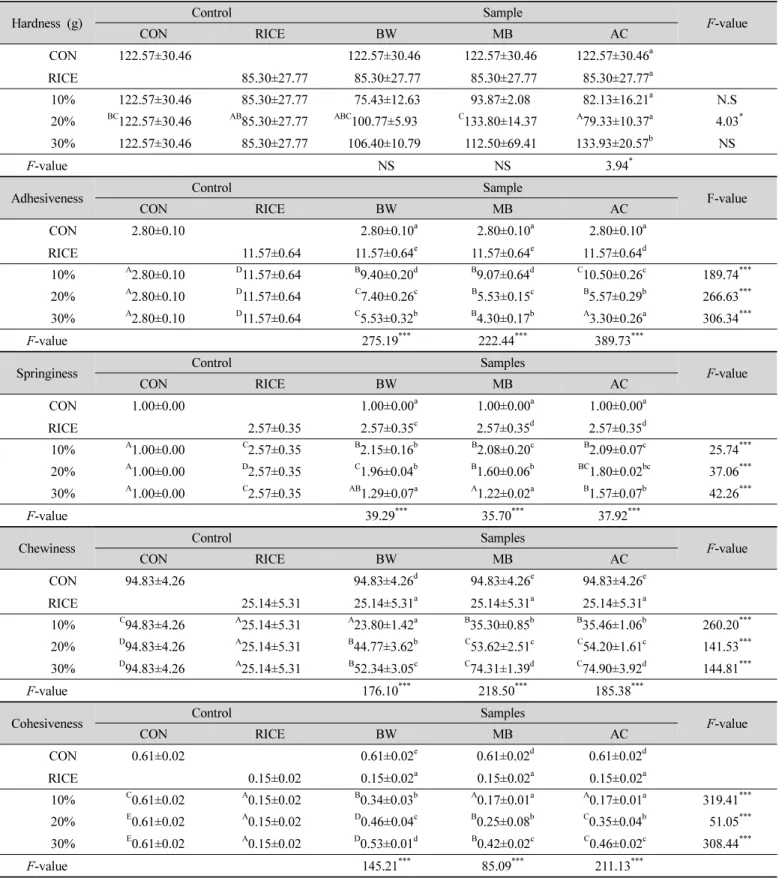
조리 전 측정 결과는 Table 4와 같으며, 경도를 제외한 모 든 시료에 있어 유의적인 차이를 나타내었다(p<0.001).
경도는 도토리 전분의 첨가로 증가되었고 20% 첨가군 간 비교에 있어 녹두전분을 첨가한 시료가 가장 높은 값 을 나타내며 유의적 차이를 나타내었으나, 다른 비교에
있어 유의적 차이는 나타나지 않았다.
부착성과 탄력성은 대조군이 가장 낮았고 RICE가 가 장 높았으며 전분 첨가량이 증가할수록 높아졌다. 쌀가루 의 함량이 높을수록 부착성이 높아지는 실험 결과는 슈 퍼자미 분말의 첨가량이 증가할수록 생면 파스타의 부착 성이 증가했던 Noh JS & Park KH(2013)의 연구와도 일 치하는 경향을 나타내었다.
씹힘성과 응집성은 대조군이 가장 높았고, RICE가 가장 낮았으며 3가지 전분의 첨가량이 증가할수록 높아 졌다. 30% 실험군 간 비교에서는 MB30과 AC30에서 높은 씹힘성을 나타내었고, BW30은 높은 응집성을 나 타내었다.
4. 조리 후 기계적 텍스처 측정
조리 후 메밀, 녹두, 도토리 전분을 첨가한 글루텐 프 리 쌀 파스타의 텍스처 측정 결과는 Table 5와 같다.
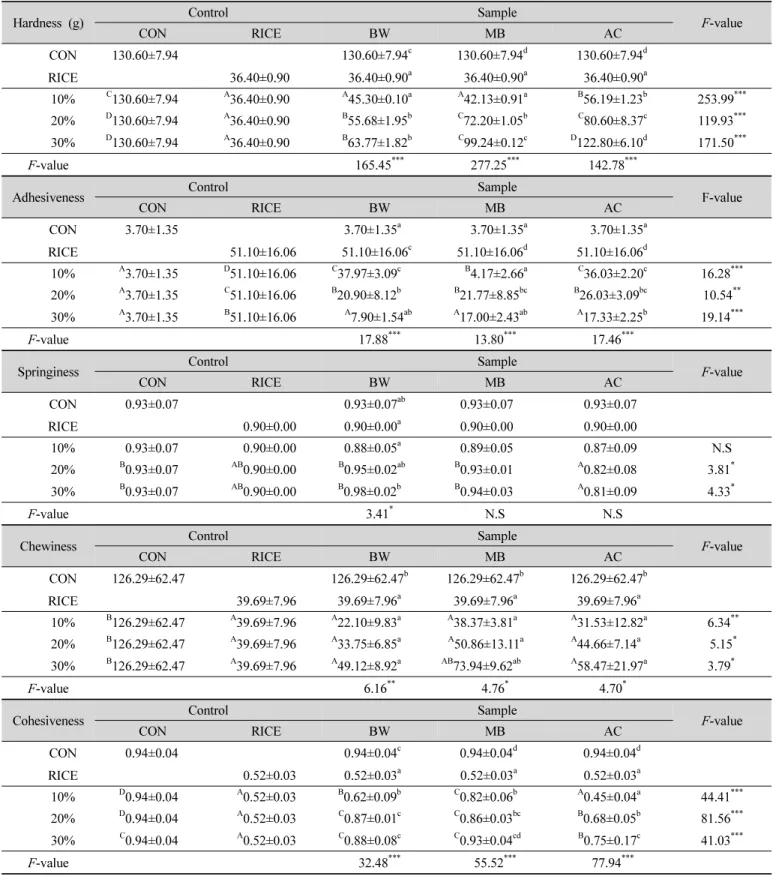
경도는 대조군이 가장 높았으고, RICE가 가장 낮았으 며, 전분의 첨가량이 증가할수록 경도는 높아졌다. AC30 은 122.80 g으로 실험군 집단에서 가장 높은 값을 기록하 여 도토리 전분의 첨가로 경도를 크게 높일 수 있음을 확 인하였다.
부착성은 대조군이 가장 낮았고, RICE는 가장 높은 값 을 나타내었다. 조리 전과 후, 부착성의 변화를 살펴보면 세몰리나 대조군(2.80 mm→3.70 mm)에 비해 RICE는 조 리 후 4배 이상 부착성이 증가(11.57 mm→51.10 mm)하 였는데, 조리 후 급격하게 높아지는 부착성은 글루텐 프 리 쌀 파스타의 가장 큰 단점이라 할 수 있다(Giménez MA 등 2015). 그러나 본 실험 결과 메밀, 녹두, 도토리 전분을 첨가할수록 부착성은 낮아지는 결과를 나타내어 전분의 첨가가 부착성이 높아지는 단점을 보완 할 수 있
Hardness (g) Control Sample
F-value
CON RICE BW MB AC
CON 122.57±30.46 122.57±30.46
a122.57±30.46
a122.57±30.46
adRICE 85.30±27.77 85.30±27.77
a85.30±27.77
a85.30±27.77
ad10% 122.57±30.46 85.30±27.77 75.43±12.63
a93.87±2.080
a82.13±16.21
adN.S 20%
BC122.57±30.46
AB85.30±27.77
ABC100.77±5.930
C133.80±14.37
a A79.33±10.37
ad004.03
***30% 122.57±30.46 85.30±27.77 106.40±10.79
a112.50±69.41
a133.93±20.57
bdNS
F-value NS NS 3.94
*Adhesiveness Control Sample
F-value
CON RICE BW MB AC
CON 2.80±0.100 2.80±0.10
a0 2.80±0.10
a0 2.80±0.10
a0
dRICE 11.57±0.640 11.57±0.64
e0 11.57±0.64
e0 11.57±0.64
d0
d10%
A2.80±0.100
D11.57±0.640
B9.40±0.20
d0
B9.07±0.64
d0
C10.50±0.26
c0
d189.74
***20%
A2.80±0.100
D11.57±0.640
C7.40±0.26
c0
B5.53±0.15
c0
B5.57±0.29
b0
d266.63
***30%
A2.80±0.100
D11.57±0.640
C5.53±0.32
b0
B4.30±0.17
b0
A3.30±0.26
a0
d306.34
***F-value 275.19
***222.44
***389.73
***Springiness Control Samples
F-value
CON RICE BW MB AC
CON 1.00±0.000 1.00±0.00
a0 1.00±0.00
a0 1.00±0.00
a0
dRICE 2.57±0.350 2.57±0.35
c0 2.57±0.35
d0 2.57±0.35
d0
d10%
A1.00±0.000
C2.57±0.350
B2.15±0.16
b0
B2.08±0.20
c0
B2.09±0.07
c0
d025.74
***20%
A1.00±0.000
D2.57±0.350
C1.96±0.04
b0
B1.60±0.06
b0
BC1.80±0.02
bc0 037.06
***30%
A1.00±0.000
C2.57±0.350
AB1.29±0.07
a0
A1.22±0.02
a0
B1.57±0.07
b0
d042.26
***F-value 39.29
***35.70
***37.92
***Chewiness Control Samples
F-value
CON RICE BW MB AC
CON 94.83±4.260 94.83±4.26
d0 94.83±4.26
e0 94.83±4.26
e0
dRICE 25.14±5.310 25.14±5.31
a0 25.14±5.31
a0 25.14±5.31
a0
d10%
C94.83±4.260
A25.14±5.310
A23.80±1.42
a0
B35.30±0.85
b0
B35.46±1.06
b0
d260.20
***20%
D94.83±4.260
A25.14±5.310
B44.77±3.62
b0
C53.62±2.51
c0
C54.20±1.61
c0
d141.53
***30%
D94.83±4.260
A25.14±5.310
B52.34±3.05
c0
C74.31±1.39
d0
C74.90±3.92
d0
d144.81
***F-value 176.10
***218.50
***185.38
***Cohesiveness Control Samples
F-value
CON RICE BW MB AC
CON 0.61±0.020 0.61±0.02
e0 0.61±0.02
d0 0.61±0.02
d0
dRICE 0.15±0.020 0.15±0.02
a0 0.15±0.02
a0 0.15±0.02
a0
d10%
C0.61±0.020
A0.15±0.020
B0.34±0.03
b0
A0.17±0.01
a0
A0.17±0.01
a0
d319.41
***20%
E0.61±0.020
A0.15±0.020
D0.46±0.04
c0
B0.25±0.08
b0
C0.35±0.04
b0
d051.05
***30%
E0.61±0.020
A0.15±0.020
D0.53±0.01
d0
B0.42±0.02
c0
C0.46±0.02
c0
d308.44
***F-value 145.21
***85.09
***211.13
***CON: pasta made with semolina; RICE: pasta made with rice flour; BW: gluten-free rice pasta samples with added buckwheat starch;
MB: gluten-free rice pasta samples with added mungbean starch; AC: gluten-free rice pasta samples with added acorn starch.
Mean±SD.
***p<0.001,
*p<0.05.
a-e
Means in a column by different superscripts are significantly different at 5% significance level by Duncan's multiple range test.
A-E
Means in a row by different superscripts are significantly different at 5% significance level by Duncan's multiple range test.
Table 4. Textural properties of uncooked gluten free rice pasta samples with added buckwheat, mungbean and acorn starches
Hardness (g) Control Sample
F-value
CON RICE BW MB AC
CON 130.60±7.940 130.60±7.94
c130.60±7.94
d130.60±7.94
dRICE 36.40±0.900 36.40±0.90
a36.40±0.90
a36.40±0.90
a10%
C130.60±7.940
A36.40±0.900
A45.30±0.10
a A42.13±0.91
a B56.19±1.23
b253.99
***20%
D130.60±7.940
A36.40±0.900
B55.68±1.95
b C72.20±1.05
b C80.60±8.37
c119.93
***30%
D130.60±7.940
A36.40±0.900
B63.77±1.82
b C99.24±0.12
c D122.80±6.10
d171.50
***F-value 165.45
***277.25
***142.78
***Adhesiveness Control Sample
F-value
CON RICE BW MB AC
CON 3.70±1.350 3.70±1.35
ab0 3.70±1.35
a3.70±1.35
aRICE 51.10±16.06 51.10±16.06
c51.10±16.06
d51.10±16.06
d10%
A3.70±1.350
D51.10±16.06
C37.97±3.09
cb0
B4.17±2.66
a C36.03±2.20
c16.28
***20%
A3.70±1.350
C51.10±16.06
B20.90±8.12
bb0
B21.77±8.85
bc B26.03±3.09
bc10.54
**30%
A3.70±1.350
B51.10±16.06
A7.90±1.54
ab A17.00±2.43
ab A17.33±2.25
b19.14
***F-value 17.88
***13.80
***17.46
***Springiness Control Sample
F-value
CON RICE BW MB AC
CON 0.93±0.070 0.93±0.07
ab0 0.93±0.07
cc0 0.93±0.070
cRICE 0.90±0.00 0.90±0.00
ab0 0.90±0.00
cc0 0.90±0.000
c10% 0.93±0.070 0.90±0.00 0.88±0.05
ab0 0.89±0.05
cc0 0.87±0.090
cN.S
20%
B0.93±0.070
AB0.90±0.00
B0.95±0.02
ab0
B0.93±0.01
cc0
A0.82±0.080
c03.81
***30%
B0.93±0.070
AB0.90±0.00
B0.98±0.02
bb0
B0.94±0.03
cc0
A0.81±0.090
c04.33
***F-value 3.41
*N.S N.S
Chewiness Control Sample
F-value
CON RICE BW MB AC
CON 126.29±62.47 126.29±62.47
bc126.29±62.47
bc126.29±62.47
bRICE 39.69±7.96 39.69±7.96
ab0 39.69±7.96
a0
c39.69±7.96
a0
10%
B126.29±62.47
A39.69±7.96
A22.10±9.83
ab0
A38.37±3.81
a0
c A31.53±12.82
a06.34
***20%
B126.29±62.47
A39.69±7.96
A33.75±6.85
ab0
A50.86±13.11
ac A44.66±7.14
a0 05.15
**30%
B126.29±62.47
A39.69±7.96
A49.12±8.92
ab0
AB73.94±9.62
ab0
A58.47±21.97
a03.79
***F-value 6.16
**4.76
*4.70
*Cohesiveness Control Sample
F-value
CON RICE BW MB AC
CON 0.94±0.040 0.94±0.04
cb0 0.94±0.04
d0
c0.94±0.04
d0
RICE 0.52±0.03 0.52±0.03
ab0 0.52±0.03
a0
c0.52±0.03
a0
10%
D0.94±0.040
A0.52±0.03
B0.62±0.09
bb0
C0.82±0.06
b0
c A0.45±0.04
a0 44.41
***20%
D0.94±0.040
A0.52±0.03
C0.87±0.01
cb0
C0.86±0.03
bc0
B0.68±0.05
b0 81.56
***30%
C0.94±0.040
A0.52±0.03
C0.88±0.08
cb0
C0.93±0.04
cd0
B0.75±0.17
c0 41.03
***F-value 32.48
***55.52
***77.94
***CON: pasta made with semolina; RICE: pasta made with rice flour; BW: gluten-free rice pasta samples with added buckwheat starch;
MB: gluten-free rice pasta samples with added mungbean starch; AC: gluten-free rice pasta samples with added acorn starch.
Mean±SD.
***p<0.001,
**p<0.01
*p<0.05.
a-d
Means in a column by different superscripts are significantly different at 5% significance level by Duncan's multiple range test.
A-D
Means in a row by different superscripts are significantly different at 5% significance level by Duncan's multiple range test.
Table 5. Textural properties of cooked gluten free rice pasta samples with added buckwheat, mungbean and acorn starches
음을 확인하였다.
탄력성은 BW30(0.98 mm)이 가장 높았고 AC30(0.81 mm)이 가장 낮았으며 메밀과 녹두 전분의 첨가는 유의 적인 차이를 나타내지 않았다.
씹힘성은 조리 전 측정결과와 같이 전분의 첨가량이 증가할수록 높아지는 경향을 나타내었으며 실험군 집단 에서는 MB30(73.94 mm)이 가장 높은 값을 나타내었다.
응집성은 RICE(0.52 mm)가 가장 낮았고 대조군(0.94 mm)이 가장 높았으며 전분의 첨가량이 증가할수록 응집 성은 높아졌다. 30% 첨가 집단 간 비교에서 MB30은 0.93 mm을 나타내어 대조군과 유의적 차이를 나타내지 않았 으므로 녹두 전분의 첨가는 응집성을 크게 향상 시킬 수 있을 것으로 사료된다.
Ⅳ.
요약 및 결론본 연구에서는 글루텐 프리 쌀 파스타의 텍스처 특성 향상을 위해 높은 아밀로오스 함량, 낮은 호화온도, 겔화 가 가능하다는 특징을 갖고 있는 묵 재료들인 녹두(MB), 메밀(BW), 도토리(AC) 전분을 각각 10%, 20%, 30%를 첨가하여 파스타를 제조하고, 이에 대한 특성을 분석하였 다. 조리 전과 후 수분 함량에 있어 대조군이 가장 낮았 고, 모든 실험군은 유의적으로 높은 값을 나타내었다. 메 밀 전분의 첨가량이 증가할수록 수분함량은 낮아졌고, 녹 두 전분 첨가량이 증가할수록 수분 함량은 높아졌다. 도 토리 전분은 조리 전 측정에 있어 함량이 증가할수록 높 아졌으나, 조리 후에는 반대로 낮아졌다. 중량 및 수분 흡수율은 세몰리나 대조군이 모든 실험군에 비해 가장 낮았고 메밀, 녹두, 도토리 전분의 첨가로 중량은 증가하 였다. 조리 후 중량은 녹두 전분 첨가로 증가하였고 메밀, 도토리 전분의 첨가로 감소하였다. 기계적 텍스처 측정 결과 메밀, 녹두, 도토리 전분의 첨가로 경도, 씹힘성, 응 집성, 탄력성은 높아졌고, 부착성은 낮아졌다. 첨가량이 증가할수록 메밀은 탄력성을, 녹두는 씹힘성과 응집성을, 도토리 전분은 경도를 크게 증가시켰다. 본 실험 결과 글 루텐 프리 쌀 파스타에 메밀, 녹두 그리고 도토리 전분을 첨가하여 쌀 파스타의 텍스처 단점이 보완되었다. 본 실 험은 멥쌀을 주 재료로 제조한 글루텐 프리 쌀 파스타의 텍스처 단점을 보완하기 위해 메밀, 녹두, 도토리 전분을 첨가하여 나타나는 텍스처 특성을 기계적 측정을 통해 연구한 논문이다. 그러나 파스타 제조 시 각 시료의 첨가 되는 수분 함량을 조절하지 않아 절대적인 값에 대한 실 험이 아닌 상대적인 특성을 비교한 실험이라는 것이 그 한계성이라 지적할 수 있다. 파스타의 수분 함량은 텍스 처 뿐만 아니라 다양한 특성에 영향을 미치며 향후 파스 타의 첨가되는 수분 함량에 따른 텍스처 특성에 관한 확 장된 연구가 나오기를 기대한다.
본 연구를 통해 향후 글루텐 프리 식품 연구 및 제조 에 활용될 수 있는 전분과 쌀에 대한 특성들을 조사할 수 있었고 앞으로 이에 대한 연구 개발의 좋은 기초 자료로 활용되기를 기대한다.
Conflict of Interest
No potential conflict of interest relevant to this article was supported.