Corresponding author: Minji Je
College of Nursing, Pusan National University, 49 Busandaehak-ro, Mulgeum-eup, Yangsan 50612, Korea.
Tel: +82-51-510-8352, Fax: +82-51-510-8308, E-mail: [email protected]
- 이 성과는 2017년도 정부(과학기술정보통신부)의 재원으로 한국연구재단의 지원을 받아 수행된 연구임(No. 2017R1C1B5018220).
- This work was supported by the National Research Foundation of Korea(NRF) grant funded by the Korea government(MSIT) (No. 2017R1C1B5018220).
Received: Jul 27, 2017 / Revised: Nov 7, 2017 / Accepted: Nov 8, 2017
This is an open access article distributed under the terms of the Creative Commons Attribution Non-Commercial License (http://creativecommons.org/licenses/
by-nc/3.0), which permits unrestricted non-commercial use, distribution, and reproduction in any medium, provided the original work is properly cited.
학령기 아동의 성교육에 대한 통합적 고찰
이 재 영1 · 제 민 지2
경성대학교 간호학과1, 부산대학교 간호학과2
Integrative Review of Sex Education for School Age Children
Jaeyoung Lee1 · Minji Je2
1Department of Nursing Science, Kyungsung University, 2College of Nursing, Pusan National University
ABSTRACT
Purpose: This study is an integrative review to analyze articles about sex education for school age children in Korean journals. This study explored the year, methods, major variables and key findings of previous studies.
Methods: Five electronic databases and eleven journals of nursing in Korean language were searched to find stud- ies done until 2017. 75 papers published from 1995 to 2017 were selected (43 were survey studies and 32 were intervention studies). Results: Among the intervention studies, there was no Randomized Controlled Trial (RCT) study. Most intervention studies were conducted to change sexual knowledge and sexual attitudes. Among the survey studies, Q methodology and content analysis were used. The subjects' sexual knowledge and sexual con- sciousness were measured low in some studies. The sex education for school age children was composed of elementary school students' perception, understanding and needs related to sex. In addition, sex education was carried out to improve students’ informational aspects such as sexual knowledge, prevention of sexual violence and secondary sexual character as well as emotional aspects such as sexual attitude. However, research on sex- ual consciousness, sexual values and sexual identity was insufficient. Conclusion: In order to develop an effective sex education program for school age children, it is necessary to consider the degree of their perception, under- standing and needs and reflect both the social and cultural aspects as well as the informational and emotional aspects.
Key Words: Child, Sex education, Review
서 론
1. 연구의 필요성
학령기 아동은 6세부터 12세이며[1] 학령기 아동에게 제공 되는 보건교육은 건강에 대한 올바른 지식, 태도 및 행위를 형
성하도록 이끌어준다[2]. 이를 통하여 생애 건강관리의 기반 을 마련할 수 있으며, 개인을 비롯한 가족과 사회에 큰 파급효 과를 가진다[3]. 성교육은 학령기 아동에게 제공되는 보건교 육 중 가장 높은 중요도를 가지는데[4] 학령기 아동은 이차 성 징과 사춘기가 시작되면서 이성과 신체에 대한 관심은 높아지 나, 인지적 발달의 미성숙으로 인하여 각종 성 관련 범죄나 학
대의 대상이 될 가능성이 증가하기 때문이다[5]. 또한 최근 아 동의 성적 성숙은 조기화되고 있으나[6] 스마트폰이나 인터넷 과 같은 대중 매체의 발달로 무분별하면서도 자극적인 성에 대 한 정보가 급격하게 확산되고 있어[7] 성에 관련된 교육적 관 심이 더욱더 요구된다.
학령기 아동 대상 성교육 선행연구들은 주로 성교육 실태나 [8] 요구도 분석을 시행하거나[4] 성지식 ․ 성태도 ․ 성의식 등의 조사[9,10] 및 성교육 중재[2,11]를 위주로 시행되었다. 학령기 아동의 성교육에 대한 관심이 증가하면서 관련 연구가 꾸준히 수행되고 있으나, 향후 올바른 성교육으로 나아가고 이들을 대상으로 성에 대한 발달수준 등을 확인하고 대상자에게 적합 한 성교육을 시행할 수 있도록 선행연구 분석을 통해 성교육 방법, 주제 및 내용 등의 전반적인 검토가 요구되며, 심층적인 후속연구가 시행되어야 한다[8]. 그러나 현재 양적 증가와 더 불어 수반되어야 하는 통합적 관점에서의 연구 동향을 파악한 연구는 찾아보기 힘들다[5].
아동을 대상으로 한 성교육 연구분석은 연령별 특성이 뚜렷 하기 때문에 발달단계별로 시행되어야 하는데, 기존 연구는 청소년[12] 또는 유아만을[13] 대상으로 시행되었다. 국외 연 구에서는 학교기반 성교육 제공을 통한 성지식, 성학대 예방, 금욕행동(abstinent behavior) 등 주요 변수의 효과를 메타분 석으로 파악한 연구들이 보고되었다[5,14,15].
학령기 아동을 위한 올바른 성교육을 제공하기 위해서는 기 존의 연구를 취합하여 포괄적으로 고찰하는 것이 필수적이며, 이를 위해서는 현재까지 수행된 학령기 아동 성교육에 대한 통 합적 고찰을 통하여 장기간 연구의 추이를 파악하고, 후속 연 구를 위한 방향을 모색하는 것이 필요하다. 이를 위하여 본 연 구는 국내 학술지에 게재된 학령기 아동을 대상으로 한 성교 육 연구를 고찰함으로써 기존의 학령기 아동 성교육 중재의 내용과 방법을 파악하고, 그 효과성을 체계적으로 분석하고자 한다.
통합적 고찰은 Whittemore와 Knafl [16]가 제시한 연구방 법으로 체계적 고찰보다 확장된 연구방법이며 특정한 연구에 국한되지 않고 다양한 연구를 포함하여 분석할 수 있는 방법이 다. 이를 통해 고찰하고자 하는 연구주제에 대해 체계적으로 분석할 수 있으며 여러 가지 요인을 통합적으로 확인할 수 있 어 다양한 연구분야에서 활용되고 있다[17,18]. 통합적 고찰은 연구문제를 명확히 규명한 후 검색 전략을 활용하여 문헌을 검 색하고, 문헌을 비교 ․ 분석하여 각각의 연구결과가 가지는 의 미를 종합한 포괄적인 결론을 도출하게 하는데, 이러한 단계 를 거치면서 고찰하고자 한 현상에 대해 깊은 이해를 할 수 있
다[16].
학령기 아동을 대상으로 올바르고 효과적인 성교육을 시행 하는 것은 다음 세대의 초석인 아동의 성건강관리에 중요한 영 역이다. 성교육은 사회 ․ 환경적 변화를 반영하여 올바른 방향 으로 나아가야 하며[4], 효율적 교육방안을 모색하기 위해서 는 성교육 및 성건강과 관련된 개념을 일련의 과정을 통하여 분석한 통합적 고찰을 수행하는 것이 필요하다[16,17]. 따라서 본 연구는 국내 학술지에 발표된 학령기 아동 대상 성교육 연 구를 고찰함으로써 추후 학령기 아동의 발달단계에 적합한 맞 춤형 성교육 프로그램의 개발과 적용의 기초자료를 제시하고 자 한다.
2. 연구목적
본 연구는 국내에서 보고된 학령기 아동의 성교육 연구를 분석 및 평가함으로써 학령기 아동의 성건강을 증진시킬 수 있 는 효과적인 성교육 중재 프로그램 개발을 위한 기초자료를 제 공하고자 한다.
연 구 방 법 1. 연구설계
본 연구는 학령기 아동을 대상으로 한 성교육에 대한 국내 연구를 Whittemore와 Knafl [16]의 통합적 고찰 방법으로 분 석한 조사연구이다.
2. 연구절차
본 연구는 Whittemore와 Knafl [16]가 제시한 통합적 고찰 방법에 따라 5단계로 진행되었다. 첫 번째 단계는 연구문제를 규명하는 단계(problem identification stage)로 연구자가 관 심을 가지고 고찰하고자 하는 문제를 명확히 하는 단계이다.
연구에 대한 개념, 대상자 및 건강 관련 문제를 선정하여 분석 하고자 하는 문헌의 적절한 연구 유형이나 자료 추출을 위한 올바른 프레임을 결정할 수 있다. 이에 따라 연구문제로 학령 기 아동을 대상으로 한 성교육을 통합적으로 고찰하는 것을 선 정하였다. 두 번째 단계는 문헌검색 단계(literature search stage)로 체계적인 문헌 검색전략을 수립하여 첫 단계에서 규 명한 연구문제에 알맞은 자료를 찾아내는 단계이다. 본 연구 에서는 명확한 문헌검색 전략을 수립한 후에 불완전하고 편향
된 검색을 지양하고자, 사전 조사를 통하여[12,13] 포괄적인 개념을 도출할 수 있는 주요용어(key word)를 선정하였다. 또 한 연구주제에 대한 모든 관련 문헌을 검토하는 것이 바람직하 기 때문에, 다양한 학술검색데이터베이스를 이용하였고 학술 지를 수기검색(hand searching)하여 조사하였다. 세 번째 단 계는 자료평가 단계(data evaluation stage)로 문헌검색을 통 하여 찾아낸 초기 문헌들을 평가하는 단계로서, 다양한 방법 론의 연구들을 통합적으로 고찰하였다. 본 연구에서는 조사연 구와 중재연구를 포괄하여 문헌을 검토하였으며, 조사연구와 중재연구를 포괄하여 문헌을 검토하였으며, 방법론적인 측면 과 이론적인 측면을 고려하여 대상 문헌을 선정하였다. 네 번 째 단계는 자료분석 단계(data analysis stage)로 문헌에서 자 료를 추출하였으며, 통합적 측면에서 비교, 분석하는 것으로, 고수준으로 추상화(abstraction)된 새로운 개념을 도출하는 것이다. 본 연구에서는 연구자들이 관련 문헌을 반복적으로 파악하면서 자료를 추출해내었으며, 정기적 회의를 통한 의견 조율로 합의점을 도출하였다. 다섯 번째 단계는 프레젠테이션 단계(presentation stage)로 통합적 고찰의 결과를 종합적으 로 나타내는 단계이며, 본 연구에서는 연구자가 관련 문헌을 면밀히 분석한 표를 결과에 제시하였다.
1) 자료수집
분석대상 연구자료의 검색기간은 2017년 5월 8일부터 2017 년 5월 16일까지 총 9일이었으며, 분석기간은 2017년 5월 17 일부터 2017년 8월 18일까지 이다. 현재까지 시행된 국내 성교 육 연구를 포괄적으로 파악하기 위하여 문헌자료의 출판기간 은 제한하지 않았으며 심사위원의 심사를 거쳐 게재된 국내 학 술지 논문을 기준으로 검색을 시행하였다. 자료검색에 이용된 국내 학술검색데이터베이스는 한국교육학술정보원(RISS), 국가과학기술정보센터(NDSL), 한국의학논문데이터베이스 (KMbase), 한국학술지인용색인(KCI) 및 국회도서관을 이용 하였으며, 학술지는 한국간호과학회지와 8개 간호학 분과 학 회지, 모자보건학회지와 부모자녀건강학회지를 검토하였다.
문헌검색은 연구자 2인이 각자 학술검색데이터베이스에 는 주요용어를 사용하여 시행하였으며, 주요용어(key word) 는 ‘초등학교’, ‘초등학생’, ‘학령기’, ‘성교육’, ‘월경교육’, ‘몽 정교육’, ‘성지식’, ‘성태도’, ‘성의식’, ‘성희롱’, ‘성폭력’, ‘성 가치관’, ‘성적자율성’, ‘피임’이었다[8-11]. 학술지의 경우 대 부분 검색기능이 원활하지 않아 창간호부터 2017년 4월까지 게재된 논문 전수를 검토하였다. 또한 국내 학령기 아동 대상 성교육 연구동향을 파악하고자 연도제한을 두지 않고 검색
을 시행하였으며, 2017년 4월까지 발표된 연구를 대상으로 하였다.
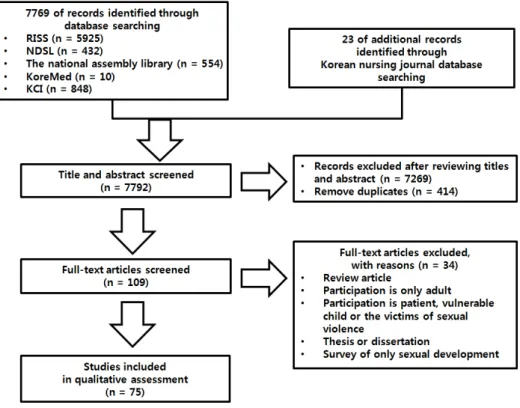
상기 과정을 바탕으로 학술검색데이터베이스 7,769편과 학 술지 23편이 검색되었다. 1차 검토에서는 7792편의 논문의 제 목과 초록을 검토하여 선정기준에 부합하지 않은 7269편과 중 복된 문헌 414편을 제외하였다. 2차 검토에서는 109편 논문의 원본을 검토하였으며, 연구대상이 성인이거나 종설인 연구 등 34편을 제외하여 최종적으로 75편의 논문을 선정하였다. 모든 단계는 평가자 2인에 의하여 독립적으로 진행된 뒤, 결과를 취합 하였으며, 전 과정에 걸쳐하여 수차례 회의를 통하여 합의점을 도출하였고 연구자간 이견이 있는 경우는 없었다(Figure 1).
2) 자료의 질평가
본 연구에서는 연구목적에 부합한 자료의 질평가를 시행하 기 위하여 수집된 자료를 분석하기 이전에 수차례 연구진 회의 를 통해 엄격한 선정기준과 제외기준을 수립하였다. 그리고 심도 깊은 논의를 하여 이를 자료에 적용하였고 일정한 심사를 거쳐 학술지에 게재된 논문만을 대상으로 평가를 시행하였다.
자료의 질 평가를 시행한 연구자들은 아동을 다년간 간호한 임 상 경력을 보유하고 있으며, 통합적 고찰 연구를 비롯하여 아 동의 성성숙에 대한 연구를 수행한 경험이 있다[17,19]. 자료 의 구체적인 선정기준과 제외기준은 다음과 같다.
(1) 선정기준
국내 학술지에 출판된 논문
학령기 아동을 대상으로 한 연구
심사위원의 심사를 거쳐 게재된 학술지 논문
한국어로 작성된 연구
(2) 제외 기준
종설(review article) 등 이차자료분석연구
환아 혹은 취약계층 학령기 아동을 대상으로 한 연구
성폭력 피해 아동을 대상으로 한 연구
학위 논문
아동의 성적발달 상태만 조사한 연구
질평가에 선정된 연구는 출판연도, 연구설계, 대상자, 연구 방법, 주요 변수 등을 구분하여 엑셀파일에 입력한 뒤 분석하 였고, 논문에 대한 질 평가를 시행하였다. 분석대상 논문들은 연구주제가 명료하며 연구목적, 방법, 절차가 명확하고, 의미 있는 연구결과를 나타낸 논문을 선정하였으며, 그 결과 75편 의 연구 모두 적절하다고 판단되어 최종적으로 75편의 논문을
Figure 1. Search strategy for identifying articles for literature review.
확정하여 분석하였다(Figure 1).
(3) 자료분석
연구자들은 각자 모든 논문을 읽고 분석하였으며, 매주 2~3회, 2~3시간씩 총 10회의 정기적인 연구회를 통하여 수집 된 모든 문헌을 검토하고, 합의점을 도출하였다. 방대한 양의 자료를 파악하기 위하여 자료를 축소하는 과정을 거쳤으며, 단순 ․ 추상 ․ 초점 ․ 구조화된 자료(simplify, abstract, focus, and organize data)를 추출하기 위하여 연구논문에 대한 매 트릭스를 Table 1~3으로 제시하였다. 신뢰할 수 있고 논리적 으로 타당한 코딩 절차를 거쳤으며, 방법론적 정확성을 보장 하기 위하여 노력을 기울였고, 통합적 고찰을 위한 추상적 개 념화와 선정된 문헌의 문제, 변수, 특성에 대한 체계적 비교를 수행하였다.
연 구 결 과
1. 학령기 아동 대상 성교육 관련 연구의 특성
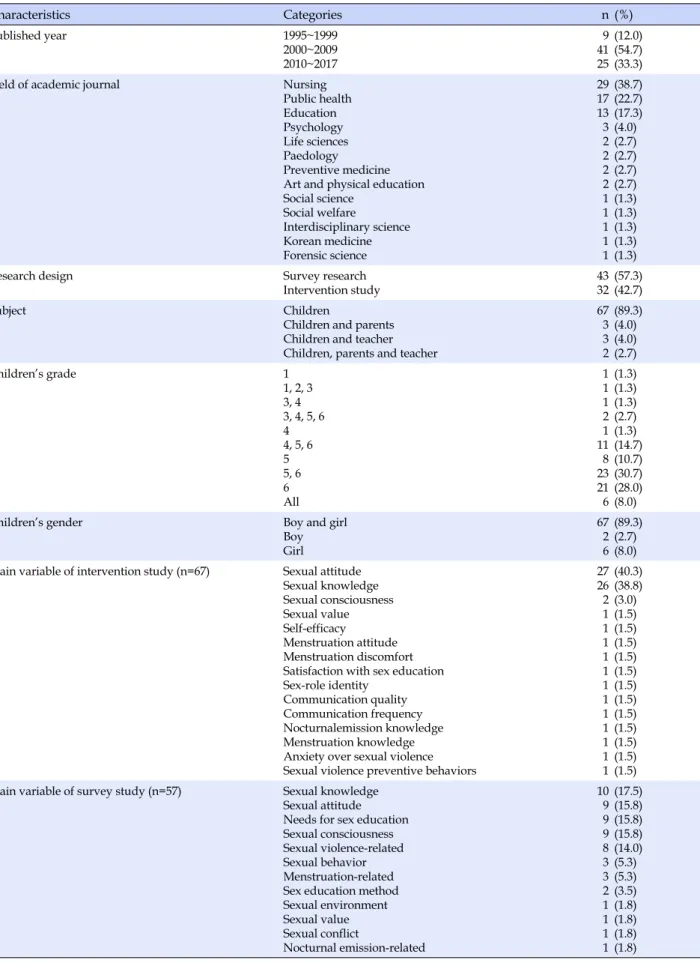
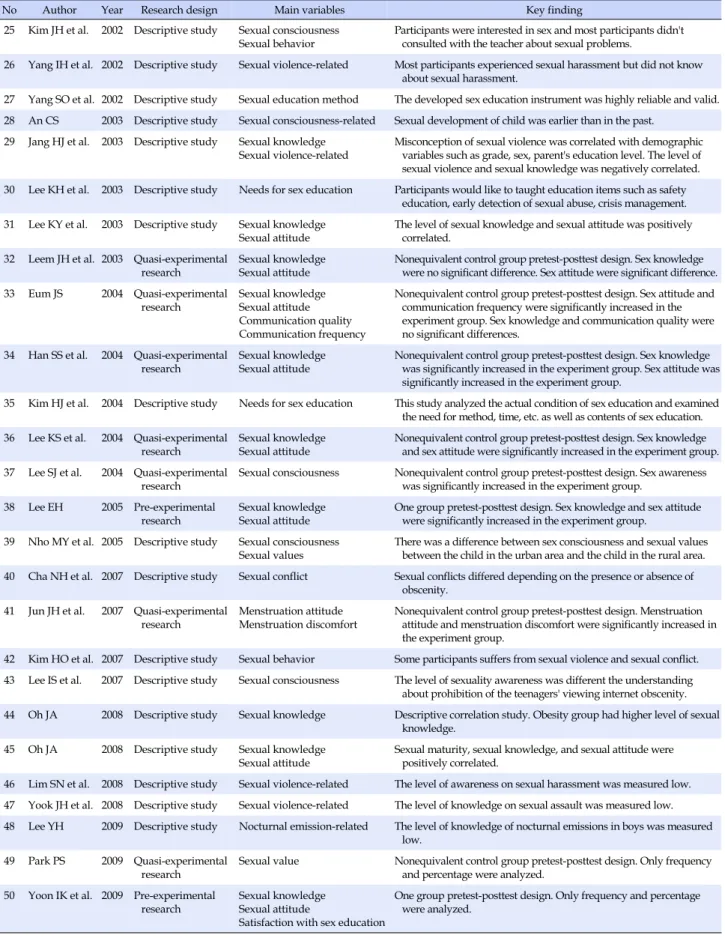
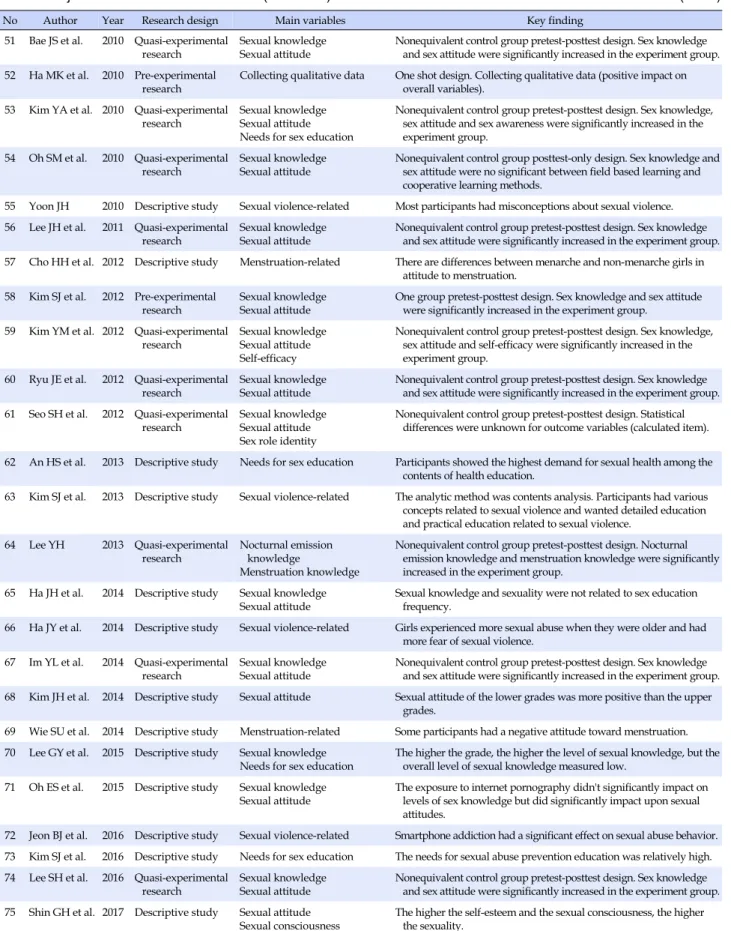
학령기 아동 대상 성교육 관련 연구의 특성은 Table 1과 같 다. 발표 연도별로 분류하였을 때, 1995년부터 1999년까지 9
편(12.0%), 2000년부터 2009년까지 41편(54.7%), 2010년부 터 2017년까지 25편(33.3%)이 보고되었다. 게재된 학술지의 학문 분야는 간호학이 38.7%로 가장 많았고, 보건학 22.4%, 교 육학 17.3% 순이었다. 이외에 심리학, 생활과학, 아동학, 예방 의학, 예술체육학, 사회과학, 사회복지학, 복합학, 한의학, 수사 과학 등이 있었다. 연구설계는 조사연구가 57.3%, 중재연구가 42.7%였다. 연구참여자는 아동만 단독으로 시행된 경우가 89.3% 아동의 학년은 5 ․ 6학년인 경우가 69.4%로 가장 많았다.
아동의 성별은 남녀 모두 조사한 연구가 89.3%였다. 연구의 주 요변수는 중재연구의 경우 성지식(40.3%)과 성태도(38.8%), 성의식(3.0%), 성가치(1.5%), 자기효능감(1.5%) 등이었으며 조 사연구의 주요변수는 성지식(17.5%), 성태도(15.8%), 성교육 요구도(15.8%), 성의식(15.8%), 성폭력(14.0%) 등이었다.
2. 학령기 아동 대상 성교육 관련 중재연구의 특성
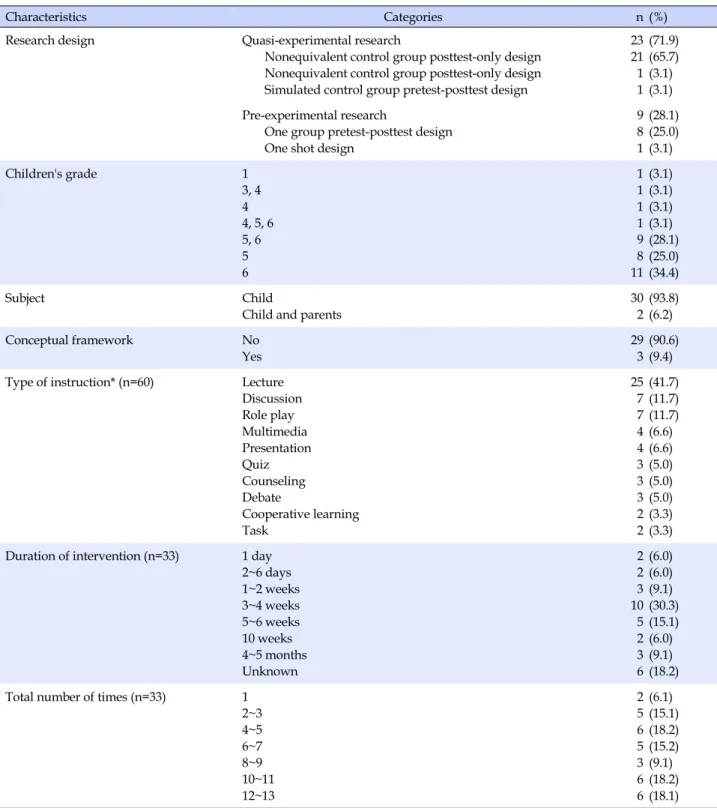
학령기 아동을 대상으로 한 성교육 관련 중재연구의 특성 은 Table 2와 같다. 연구설계는 유사실험설계 71.9%, 원시실 험설계 28.1%였다. 아동의 학년은 5 ․ 6학년인 경우 87.5%, 연 구참여자는 아동 단독인 경우가 93.8%로 가장 많았으며, 개념 적 기틀을 보유한 경우는 9.4%에 불과하였다. 교수법은 강의
Table 1. Characteristics of Studies (N=75)
Characteristics Categories n (%)
Published year 1995~1999
2000~2009 2010~2017
9 41 25
(12.0) (54.7) (33.3)
Field of academic journal Nursing
Public health Education Psychology Life sciences Paedology
Preventive medicine Art and physical education Social science
Social welfare
Interdisciplinary science Korean medicine Forensic science
29 17 13 3 2 2 2 2 1 1 1 1 1
(38.7) (22.7) (17.3) (4.0) (2.7) (2.7) (2.7) (2.7) (1.3) (1.3) (1.3) (1.3) (1.3)
Research design Survey research
Intervention study 43
32(57.3) (42.7)
Subject Children
Children and parents Children and teacher Children, parents and teacher
67 3 3 2
(89.3) (4.0) (4.0) (2.7)
Children’s grade 1
1, 2, 3 3, 4 3, 4, 5, 6 4 4, 5, 6 5 5, 6 6 All
1 1 1 2 1 11 8 23 21 6
(1.3) (1.3) (1.3) (2.7) (1.3) (14.7) (10.7) (30.7) (28.0) (8.0)
Children’s gender Boy and girl
Boy Girl
67 2 6
(89.3) (2.7) (8.0) Main variable of intervention study (n=67) Sexual attitude
Sexual knowledge Sexual consciousness Sexual value Self-efficacy
Menstruation attitude Menstruation discomfort Satisfaction with sex education Sex-role identity
Communication quality Communication frequency Nocturnalemission knowledge Menstruation knowledge Anxiety over sexual violence Sexual violence preventive behaviors
27 26 2 1 1 1 1 1 1 1 1 1 1 1 1
(40.3) (38.8) (3.0) (1.5) (1.5) (1.5) (1.5) (1.5) (1.5) (1.5) (1.5) (1.5) (1.5) (1.5) (1.5) Main variable of survey study (n=57) Sexual knowledge
Sexual attitude Needs for sex education Sexual consciousness Sexual violence-related Sexual behavior Menstruation-related Sex education method Sexual environment Sexual value Sexual conflict
Nocturnal emission-related
10 9 9 9 8 3 3 2 1 1 1 1
(17.5) (15.8) (15.8) (15.8) (14.0) (5.3) (5.3) (3.5) (1.8) (1.8) (1.8) (1.8)
Table 2. Characteristics of Intervention Studies (N=32)
Characteristics Categories n (%)
Research design Quasi-experimental research
Nonequivalent control group posttest-only design Nonequivalent control group posttest-only design Simulated control group pretest-posttest design
23 21 1 1
(71.9) (65.7) (3.1) (3.1) Pre-experimental research
One group pretest-posttest design One shot design
9 8 1
(28.1) (25.0) (3.1)
Children's grade 1
3, 4 4 4, 5, 6 5, 6 5 6
1 1 1 1 9 8 11
(3.1) (3.1) (3.1) (3.1) (28.1) (25.0) (34.4)
Subject Child
Child and parents
30 2
(93.8) (6.2)
Conceptual framework No
Yes
29 3
(90.6) (9.4) Type of instruction* (n=60) Lecture
Discussion Role play Multimedia Presentation Quiz Counseling Debate
Cooperative learning Task
25 7 7 4 4 3 3 3 2 2
(41.7) (11.7) (11.7) (6.6) (6.6) (5.0) (5.0) (5.0) (3.3) (3.3) Duration of intervention (n=33) 1 day
2~6 days 1~2 weeks 3~4 weeks 5~6 weeks 10 weeks 4~5 months Unknown
2 2 3 10 5 2 3 6
(6.0) (6.0) (9.1) (30.3) (15.1) (6.0) (9.1) (18.2) Total number of times (n=33) 1
2~3 4~5 6~7 8~9 10~11 12~13
2 5 6 5 3 6 6
(6.1) (15.1) (18.2) (15.2) (9.1) (18.2) (18.1)
* Includes more than once.
(41.7%), 토의(11.7%), 역할극(11.7%)이 다수를 차지하였으 며, 중재의 기간은 1일부터 5개월까지, 중재회기는 1회기부터 13회기까지 다양한 분포를 나타내었다.
3. 학령기 아동 대상 성교육 관련 연구의 주요 결과
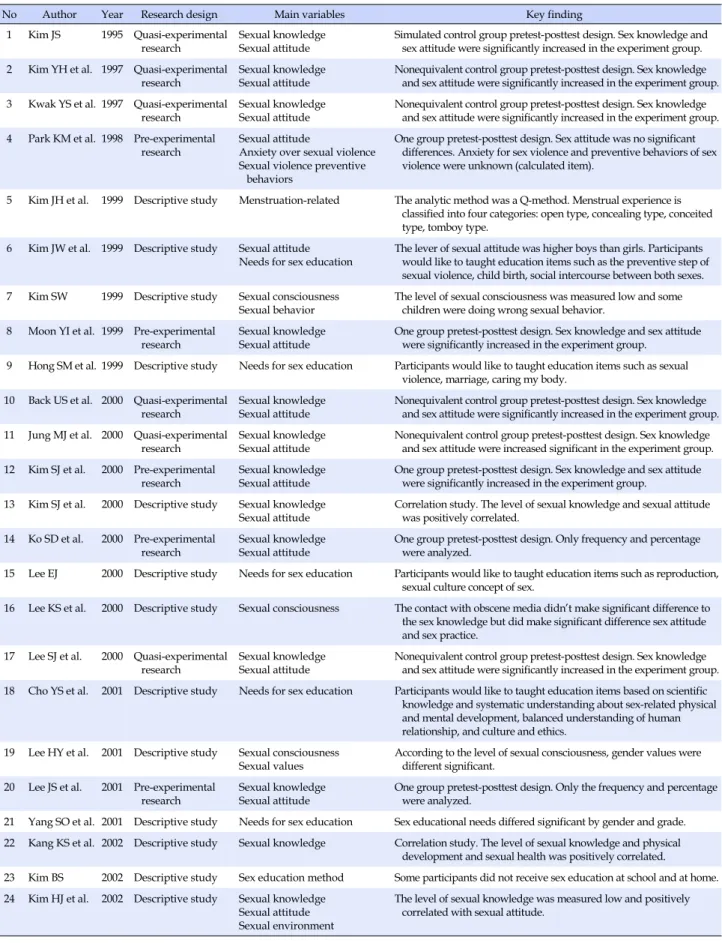
학령기 아동을 대상으로 한 성교육 관련 연구의 주요결과 를 분석한 내용은 Table 3과 같다. 분석 결과 중재 연구 중 Randomized Controlled Trial (RCT) 연구는 없었으며 대부 분의 연구가 성지식과 성태도의 변화를 목적으로 중재를 시행 하였고 성지식과 성태도가 유의하게 증가됨이 확인되었다. 조
Table 3. Major Outcomes of Selected Studies (N=75)
No Author Year Research design Main variables Key finding
1 Kim JS 1995 Quasi-experimental research
Sexual knowledge Sexual attitude
Simulated control group pretest-posttest design. Sex knowledge and sex attitude were significantly increased in the experiment group.
2 Kim YH et al. 1997 Quasi-experimental
research Sexual knowledge
Sexual attitude Nonequivalent control group pretest-posttest design. Sex knowledge and sex attitude were significantly increased in the experiment group.
3 Kwak YS et al. 1997 Quasi-experimental research
Sexual knowledge Sexual attitude
Nonequivalent control group pretest-posttest design. Sex knowledge and sex attitude were significantly increased in the experiment group.
4 Park KM et al. 1998 Pre-experimental research
Sexual attitude
Anxiety over sexual violence Sexual violence preventive
behaviors
One group pretest-posttest design. Sex attitude was no significant differences. Anxiety for sex violence and preventive behaviors of sex violence were unknown (calculated item).
5 Kim JH et al. 1999 Descriptive study Menstruation-related The analytic method was a Q-method. Menstrual experience is classified into four categories: open type, concealing type, conceited type, tomboy type.
6 Kim JW et al. 1999 Descriptive study Sexual attitude
Needs for sex education The lever of sexual attitude was higher boys than girls. Participants would like to taught education items such as the preventive step of sexual violence, child birth, social intercourse between both sexes.
7 Kim SW 1999 Descriptive study Sexual consciousness Sexual behavior
The level of sexual consciousness was measured low and some children were doing wrong sexual behavior.
8 Moon YI et al. 1999 Pre-experimental
research Sexual knowledge
Sexual attitude One group pretest-posttest design. Sex knowledge and sex attitude were significantly increased in the experiment group.
9 Hong SM et al. 1999 Descriptive study Needs for sex education Participants would like to taught education items such as sexual violence, marriage, caring my body.
10 Back US et al. 2000 Quasi-experimental
research Sexual knowledge
Sexual attitude Nonequivalent control group pretest-posttest design. Sex knowledge and sex attitude were significantly increased in the experiment group.
11 Jung MJ et al. 2000 Quasi-experimental
research Sexual knowledge
Sexual attitude Nonequivalent control group pretest-posttest design. Sex knowledge and sex attitude were increased significant in the experiment group.
12 Kim SJ et al. 2000 Pre-experimental research
Sexual knowledge Sexual attitude
One group pretest-posttest design. Sex knowledge and sex attitude were significantly increased in the experiment group.
13 Kim SJ et al. 2000 Descriptive study Sexual knowledge
Sexual attitude Correlation study. The level of sexual knowledge and sexual attitude was positively correlated.
14 Ko SD et al. 2000 Pre-experimental
research Sexual knowledge
Sexual attitude One group pretest-posttest design. Only frequency and percentage were analyzed.
15 Lee EJ 2000 Descriptive study Needs for sex education Participants would like to taught education items such as reproduction, sexual culture concept of sex.
16 Lee KS et al. 2000 Descriptive study Sexual consciousness The contact with obscene media didn’t make significant difference to the sex knowledge but did make significant difference sex attitude and sex practice.
17 Lee SJ et al. 2000 Quasi-experimental research
Sexual knowledge Sexual attitude
Nonequivalent control group pretest-posttest design. Sex knowledge and sex attitude were significantly increased in the experiment group.
18 Cho YS et al. 2001 Descriptive study Needs for sex education Participants would like to taught education items based on scientific knowledge and systematic understanding about sex-related physical and mental development, balanced understanding of human relationship, and culture and ethics.
19 Lee HY et al. 2001 Descriptive study Sexual consciousness Sexual values
According to the level of sexual consciousness, gender values were different significant.
20 Lee JS et al. 2001 Pre-experimental
research Sexual knowledge
Sexual attitude One group pretest-posttest design. Only the frequency and percentage were analyzed.
21 Yang SO et al. 2001 Descriptive study Needs for sex education Sex educational needs differed significant by gender and grade.
22 Kang KS et al. 2002 Descriptive study Sexual knowledge Correlation study. The level of sexual knowledge and physical development and sexual health was positively correlated.
23 Kim BS 2002 Descriptive study Sex education method Some participants did not receive sex education at school and at home.
24 Kim HJ et al. 2002 Descriptive study Sexual knowledge Sexual attitude Sexual environment
The level of sexual knowledge was measured low and positively correlated with sexual attitude.
Table 3. Major Outcomes of Selected Studies (Continued) (N=75)
No Author Year Research design Main variables Key finding
25 Kim JH et al. 2002 Descriptive study Sexual consciousness Sexual behavior
Participants were interested in sex and most participants didn't consulted with the teacher about sexual problems.
26 Yang IH et al. 2002 Descriptive study Sexual violence-related Most participants experienced sexual harassment but did not know about sexual harassment.
27 Yang SO et al. 2002 Descriptive study Sexual education method The developed sex education instrument was highly reliable and valid.
28 An CS 2003 Descriptive study Sexual consciousness-related Sexual development of child was earlier than in the past.
29 Jang HJ et al. 2003 Descriptive study Sexual knowledge
Sexual violence-related Misconception of sexual violence was correlated with demographic variables such as grade, sex, parent's education level. The level of sexual violence and sexual knowledge was negatively correlated.
30 Lee KH et al. 2003 Descriptive study Needs for sex education Participants would like to taught education items such as safety education, early detection of sexual abuse, crisis management.
31 Lee KY et al. 2003 Descriptive study Sexual knowledge
Sexual attitude The level of sexual knowledge and sexual attitude was positively correlated.
32 Leem JH et al. 2003 Quasi-experimental research
Sexual knowledge Sexual attitude
Nonequivalent control group pretest-posttest design. Sex knowledge were no significant difference. Sex attitude were significant difference.
33 Eum JS 2004 Quasi-experimental
research Sexual knowledge Sexual attitude Communication quality Communication frequency
Nonequivalent control group pretest-posttest design. Sex attitude and communication frequency were significantly increased in the experiment group. Sex knowledge and communication quality were no significant differences.
34 Han SS et al. 2004 Quasi-experimental research
Sexual knowledge Sexual attitude
Nonequivalent control group pretest-posttest design. Sex knowledge was significantly increased in the experiment group. Sex attitude was significantly increased in the experiment group.
35 Kim HJ et al. 2004 Descriptive study Needs for sex education This study analyzed the actual condition of sex education and examined the need for method, time, etc. as well as contents of sex education.
36 Lee KS et al. 2004 Quasi-experimental research
Sexual knowledge Sexual attitude
Nonequivalent control group pretest-posttest design. Sex knowledge and sex attitude were significantly increased in the experiment group.
37 Lee SJ et al. 2004 Quasi-experimental
research Sexual consciousness Nonequivalent control group pretest-posttest design. Sex awareness was significantly increased in the experiment group.
38 Lee EH 2005 Pre-experimental
research Sexual knowledge
Sexual attitude One group pretest-posttest design. Sex knowledge and sex attitude were significantly increased in the experiment group.
39 Nho MY et al. 2005 Descriptive study Sexual consciousness Sexual values
There was a difference between sex consciousness and sexual values between the child in the urban area and the child in the rural area.
40 Cha NH et al. 2007 Descriptive study Sexual conflict Sexual conflicts differed depending on the presence or absence of obscenity.
41 Jun JH et al. 2007 Quasi-experimental
research Menstruation attitude
Menstruation discomfort Nonequivalent control group pretest-posttest design. Menstruation attitude and menstruation discomfort were significantly increased in the experiment group.
42 Kim HO et al. 2007 Descriptive study Sexual behavior Some participants suffers from sexual violence and sexual conflict.
43 Lee IS et al. 2007 Descriptive study Sexual consciousness The level of sexuality awareness was different the understanding about prohibition of the teenagers' viewing internet obscenity.
44 Oh JA 2008 Descriptive study Sexual knowledge Descriptive correlation study. Obesity group had higher level of sexual knowledge.
45 Oh JA 2008 Descriptive study Sexual knowledge Sexual attitude
Sexual maturity, sexual knowledge, and sexual attitude were positively correlated.
46 Lim SN et al. 2008 Descriptive study Sexual violence-related The level of awareness on sexual harassment was measured low.
47 Yook JH et al. 2008 Descriptive study Sexual violence-related The level of knowledge on sexual assault was measured low.
48 Lee YH 2009 Descriptive study Nocturnal emission-related The level of knowledge of nocturnal emissions in boys was measured low.
49 Park PS 2009 Quasi-experimental
research Sexual value Nonequivalent control group pretest-posttest design. Only frequency and percentage were analyzed.
50 Yoon IK et al. 2009 Pre-experimental research
Sexual knowledge Sexual attitude
Satisfaction with sex education
One group pretest-posttest design. Only frequency and percentage were analyzed.
Table 3. Major Outcomes of Selected Studies (Continued) (N=75)
No Author Year Research design Main variables Key finding
51 Bae JS et al. 2010 Quasi-experimental research
Sexual knowledge Sexual attitude
Nonequivalent control group pretest-posttest design. Sex knowledge and sex attitude were significantly increased in the experiment group.
52 Ha MK et al. 2010 Pre-experimental
research Collecting qualitative data One shot design. Collecting qualitative data (positive impact on overall variables).
53 Kim YA et al. 2010 Quasi-experimental research
Sexual knowledge Sexual attitude Needs for sex education
Nonequivalent control group pretest-posttest design. Sex knowledge, sex attitude and sex awareness were significantly increased in the experiment group.
54 Oh SM et al. 2010 Quasi-experimental
research Sexual knowledge
Sexual attitude Nonequivalent control group posttest-only design. Sex knowledge and sex attitude were no significant between field based learning and cooperative learning methods.
55 Yoon JH 2010 Descriptive study Sexual violence-related Most participants had misconceptions about sexual violence.
56 Lee JH et al. 2011 Quasi-experimental
research Sexual knowledge
Sexual attitude Nonequivalent control group pretest-posttest design. Sex knowledge and sex attitude were significantly increased in the experiment group.
57 Cho HH et al. 2012 Descriptive study Menstruation-related There are differences between menarche and non-menarche girls in attitude to menstruation.
58 Kim SJ et al. 2012 Pre-experimental research
Sexual knowledge Sexual attitude
One group pretest-posttest design. Sex knowledge and sex attitude were significantly increased in the experiment group.
59 Kim YM et al. 2012 Quasi-experimental
research Sexual knowledge Sexual attitude Self-efficacy
Nonequivalent control group pretest-posttest design. Sex knowledge, sex attitude and self-efficacy were significantly increased in the experiment group.
60 Ryu JE et al. 2012 Quasi-experimental
research Sexual knowledge
Sexual attitude Nonequivalent control group pretest-posttest design. Sex knowledge and sex attitude were significantly increased in the experiment group.
61 Seo SH et al. 2012 Quasi-experimental
research Sexual knowledge Sexual attitude Sex role identity
Nonequivalent control group pretest-posttest design. Statistical differences were unknown for outcome variables (calculated item).
62 An HS et al. 2013 Descriptive study Needs for sex education Participants showed the highest demand for sexual health among the contents of health education.
63 Kim SJ et al. 2013 Descriptive study Sexual violence-related The analytic method was contents analysis. Participants had various concepts related to sexual violence and wanted detailed education and practical education related to sexual violence.
64 Lee YH 2013 Quasi-experimental
research Nocturnal emission knowledge
Menstruation knowledge
Nonequivalent control group pretest-posttest design. Nocturnal emission knowledge and menstruation knowledge were significantly increased in the experiment group.
65 Ha JH et al. 2014 Descriptive study Sexual knowledge
Sexual attitude Sexual knowledge and sexuality were not related to sex education frequency.
66 Ha JY et al. 2014 Descriptive study Sexual violence-related Girls experienced more sexual abuse when they were older and had more fear of sexual violence.
67 Im YL et al. 2014 Quasi-experimental research
Sexual knowledge Sexual attitude
Nonequivalent control group pretest-posttest design. Sex knowledge and sex attitude were significantly increased in the experiment group.
68 Kim JH et al. 2014 Descriptive study Sexual attitude Sexual attitude of the lower grades was more positive than the upper grades.
69 Wie SU et al. 2014 Descriptive study Menstruation-related Some participants had a negative attitude toward menstruation.
70 Lee GY et al. 2015 Descriptive study Sexual knowledge Needs for sex education
The higher the grade, the higher the level of sexual knowledge, but the overall level of sexual knowledge measured low.
71 Oh ES et al. 2015 Descriptive study Sexual knowledge Sexual attitude
The exposure to internet pornography didn't significantly impact on levels of sex knowledge but did significantly impact upon sexual attitudes.
72 Jeon BJ et al. 2016 Descriptive study Sexual violence-related Smartphone addiction had a significant effect on sexual abuse behavior.
73 Kim SJ et al. 2016 Descriptive study Needs for sex education The needs for sexual abuse prevention education was relatively high.
74 Lee SH et al. 2016 Quasi-experimental
research Sexual knowledge
Sexual attitude Nonequivalent control group pretest-posttest design. Sex knowledge and sex attitude were significantly increased in the experiment group.
75 Shin GH et al. 2017 Descriptive study Sexual attitude Sexual consciousness
The higher the self-esteem and the sexual consciousness, the higher the sexuality.
사연구의 경우 Q 방법론이나 내용분석방법을 이용해 연구자 료를 분석한 연구가 일부 있었으며 몇몇의 연구에서 대상자들 의 성지식과 성의식 수준이 낮은 것으로 측정되었다. 그리고 부적절한 성행동을 하거나 성폭력에 대한 지식과 의식 수준이 낮게 측정된 연구도 있었다.
논 의
학령기에 형성된 성에 대한 지식과 성적 가치관은 청소년기 와 성인기의 성행동과 성건강에 영향을 미치게 되어 학령기에 시행되는 성교육은 매우 중요하다[1]. 특히, 아동들의 성적 성 숙이 조기화되고 텔레비전이나 인터넷과 같은 매체를 통해 올 바르지 못한 성 정보에 무분별하게 노출되는 상황에서 초등학 생의 올바른 성교육에 대한 요구는 더욱 커지고 있다. 본 연구 는 학령기 아동을 대상으로 시행된 성교육 관련 국내 연구를 통합적으로 고찰하였으며, 이에 대한 결과를 중심으로 논의하 는 것을 통하여 추후 학령기 아동을 대상으로 한 성건강 증진 간호중재의 방향을 모색하고자 한다.
본 연구에서 통합적 고찰의 지침에 따라 국내 학령기 아동 을 대상으로 한 성교육 연구를 조사하였다. 그 결과, 선정된 문 헌은 총 75편이었으며, 1990년부터 현재까지 학령기 아동의 성에 대한 연구가 꾸준히 이루어지고 있음을 알 수 있었다. 국 내의 성교육은 성에 대한 개방적인 풍조가 형성되고 이에 따라 아동의 성교육에 대한 사회적 요구가 증가하며 80년대부터 학 교를 중심으로 시작되었다[20]. 본 연구의 결과와 같이 현재까 지 다양한 형태로 학령기 아동을 위한 성교육이 시행되고 있으 나 성교육의 실효성에 대해서는 많은 논란이 있다[27]. 특히, 학교 성교육을 체계화하기 위해 교육부에서 개발한 ‘학교 성교 육 표준안’은 부정확한 내용으로 많은 논란을 불러일으키고 있 으며 아동의 요구와 사회의 변화를 반영하지 못하고 있다는 지 적이 일고 있다[21]. 그러므로 추후 시행되는 학령기 아동의 성 교육은 아동의 발달 수준과 그에 따른 요구를 체계적으로 파악 하여 시대적 변화를 반영하는 것이 필요하며 성에 대한 정확한 내용과 효과적인 방법을 활용하여 시행하는 것이 필요하다.
본 연구에서 최종적으로 분석대상으로 선정된 문헌 중 중재 연구는 42.7%였는데, 유아 대상 성교육 연구분석에서 중재연 구의 비율 31.7%와 비교하면 약간 상회했다[13]. 그러나 무작 위대조군연구는 단 한편도 없었으며, 대부분 유사실험연구로 시행됨을 확인할 수 있었다. 학령기 아동 대상 성교육 연구를 분석한 논문은 찾아보기 힘들어 수평적 비교는 어렵지만, 국 내 청소년 대상 한 성교육 중재를 분석한 연구에서도 총 19편
중 무작위대조군연구는 단 1편(5.3%)에 불과하였다[12]. 간호 중재의 효과를 파악하여 근거기반실무의 바탕을 마련하기 위 해서는 엄격한 연구설계를 적용하는 것이 필요하므로, 추후 연구에서는 학령기 아동에게 제공되는 성교육 중재의 연구설 계를 무작위대조군연구로 구성하는 것이 필요하며 이를 통하 여 연구결과의 객관성과 질적 수준을 보장할 수 있을 것이다.
본 연구에서 연구대상자는 후기 학령기인 초등학교 고학년 에게 집중되어있는 것을 확인할 수 있었다. 최근 아동의 성 성 숙과 성관계 시작 연령은 빨라지고 있으며[6, 22], 인터넷의 보 급으로 인해 낮은 연령의 아동들도 원하지 않더라도 쉽게 성 에 대한 정보와 음란물에 노출되며, 각종 성범죄의 대상이 될 가능성이 높다[7]. 이는 초등학교 고학년뿐만 아니라 저학년 에게도 적극적인 성교육이 필요하며 올바른 성지식을 습득하 여 추후 발생할 수 있는 다양한 성문제를 예방하는 것이 필요 함을 시사한다. 실제 성교육을 위한 다수의 가이드라인에서도 유아 혹은 학령전기부터 성교육을 실시해야 함을 권고하고 있 다[23,24]. Sexuality Information and Education Council of the United States (SIECUS)에서는 성교육을 제공받는 대상 자를 1~4단계로 구분하여 1단계 초기 학령기, 2단계 후기 학령 기, 3단계 중학생, 4단계 고등학생으로 분류하고 초기 학령기 부터 고등학생이 될 때까지 지속적이며 체계적인 교육이 제공 되어야 함을 강조하고 있다[23]. 본 연구결과에서는 초기 학령 기를 대상으로 한 선행연구가 다소 미흡한 경향이 나타나므로, 향후 연구에서는 초등학교 저학년을 대상으로 성에 대한 지식 정도와 인식, 행태 등을 파악하고 이를 반영한 성교육 프로그 램과 자료의 개발이 시행되어야 할 것이다. 후기 학령기의 경 우에는 기존의 연구를 바탕으로 성에 대하여 변화하는 사회 ․ 문화적 양상을 파악하거나, 효과적인 중재방안 마련을 위한 실제적 연구를 수행하는 것이 바람직하겠다.
본 연구를 통해 파악된 학령기 아동의 성교육 관련 연구는 청소년의 성교육 중재를 분석한 선행연구의 결과[12]와 유사 하게 성지식과 성태도를 중심으로 시행되었으며 아동의 정서 적, 심리적 측면을 반영하고 변화시킬 수 있는 성의식, 성 가치 관, 성정체감 등에 대한 연구가 일부 이루어졌다[28,29]. 그러 나 아동의 성을 둘러싼 사회적 관계나 미디어 등 사회 ․ 문화적 요소를 고려한 연구는 부족하였으며 성과 관련한 연구의 변수 중 정서적 측면의 변수들을 연구자 마다 다르게 정의되고 있어 결과를 도출하는데 어려움이 있었다. 특히 성의식은 성에 대 한 전반적인 인식을 의미하므로, 성에 대한 감정, 생각, 지식 등 을 포함한 개념으로 정의되어진다[9]. 단독적인 측정변수로 조사 혹은 중재하는 연구가 있는가하면[25], 성지식과 성태도,
성가치관을 측정한 뒤 성의식이라 정의내리기도 하였다[11, 26]. 그러므로 성교육 중재 전 연구자가 향상시키고자 하는 정 서적 측면의 변수들의 개념을 명확히 규정하는 것이 필요하 며, 이는 향후 일관된 결과 축적과 활용에 많은 도움이 될 것이 다. 또한 정서적 측면의 요소들은 성교육의 지식적 측면뿐만 아니라, 성과 관련된 사회 ․ 문화적 요소들을 함께 고려되어질 때 올바른 변화가 이루어지므로[3,9,23] 이를 모두 고려한 포 괄적인 성교육이 필히 시행되어야 할 것이다.
국외의 경우 성에 대한 긍정적인 가치관을 형성하고 추후의 성과 관련한 올바른 결정을 할 수 있도록 성 건강 증진을 위한 지식적 측면의 교육뿐만 아니라 정서적 측면과 사회 ․ 문화적 측면을 모두 고려한 포괄적인 성교육이 시행되고 있다[3,23].
프랑스와 네덜란드와 같은 유럽의 여러 나라에서는 신체적 발 달을 이해하는 것뿐만 아니라 성과 관련한 정서적 발달을 돕기 위해 생물학적 지식과 함께 심리적, 사회적, 문화적 측면을 통 합한 성교육을 실시할 것을 국가정책의 일환으로 시행하고 있 다[3]. 그리고 미국의 경우도 임신과 피임에 대한 교육뿐만 아 니라 성적 다양성과 성적 자기 결정권, 사회와 미디어가 성적 가치관에 미치는 영향 등 다양한 주제로 성교육을 시행하여 아 동의 올바른 성 발달을 돕고 있다[23].
학령기 아동을 대상으로 시행된 성교육 연구를 통합적으로 고찰한 결과, 학령기 아동의 성에 대한 인식, 이해 및 요구를 조 사하고 이를 바탕으로 성교육이 구성되고 있음을 확인할 수 있 었다. 또한 학령기 아동의 성교육은 주로 성지식, 성폭력 예방, 이차성징 등 정보적 측면에 치중되어 시행되고 있었으며 성태 도를 증진시키기 위한 교육 또한 다수 시행되고 있었으나 성의 식, 성가치관, 성정체감 등 정서적 측면을 증진시키기 위한 교 육은 부족하였다. 향후 학령기 아동을 대상으로 한 올바른 성 교육을 위해서는 아동의 성에 대한 인식, 이해 및 요구를 파악 하는 것이 선행되어야 하며, 성건강과 관련된 지식을 제공하 는 것뿐만 아니라 성에 대하여 긍정적인 인식을 가질 수 있도 록 정서적 측면도 함께 고려되어야 한다. 이와 더불어 성에 대 한 사회 ․ 문화 ․ 시대적 변화를 함께 반영하여야 하며, 아동의 발달단계에 적합하도록 맞춤식 교육을 개발하는 것이 필요함 을 제언하는 바이다.
결 론
본 연구는 사회 ․ 환경적 변화를 반영한 학령기 아동의 성교 육 방향을 제시하고, 교육적 방안을 모색하기 위하여 국내 학 술지에 발표된 학령기 아동 대상 성교육 연구를 고찰하여, 이
들에게 시행된 성교육 연구동향을 분석하고 결과를 통합하기 위하여 현재까지 출판된 75편의 논문을 대상으로 통합적 고찰 을 시행하였다. 그 결과, 초등학생의 성에 대한 인식, 이해 및 요구를 바탕으로 성교육이 구성되고 있음을 확인할 수 있었 다. 또한 초등학생의 성교육은 성지식, 성폭력 예방, 이차성징 등 정보적 측면과 성태도를 향상시키기 위한 교육이 주를 이루 었으며 성의식, 성가치관, 성정체감 등 정서적 측면을 증진시 키기 위한 연구는 일부 시행되었다는 것을 확인하였으며, 향 후 이러한 구성요소와 함께 사회적, 문화적 측면을 다각적으 로 반영한 중재 프로그램의 개발과 효과 검정이 필요하다.
이해관계
The authors declared no conflict of interest.
REFERENCES
1. Hockenberry MJ, Wilson D, Rodgers CC. Wong's essentials of pediatric nursing E-book. 10th ed. USA: Elsevier Health Scien- ces; 2016. p. 429-500.
2. Im YL, Park KM. Effects of sexuality education coaching pro- gram on sex-related knowledge and attitude among elementary school students. Journal Korean Academy Nursing. 2014;44(1):
31-40. https://doi.org/10.4040/jkan.2014.44.1.31
3. Parker R, Wellings K, Lazarus JV. Sexuality education in Euro- pe: An overview of current policies. Sex Education. 2009;9(3):
227-242. https://doi.org/ 10.1080/14681810903059060 4. An HS, Kim KL, Lim YM. An analysis on the requirements of the
contents of elementary school health education in teachers, pa- rents and students. The Korean Journal of Elementary Physical Education. 2013;18(4):51-61.
5. Zwi K, Woolfenden S, Wheeler DM, O'brien T, Tait P, Williams K. School-based education programmes for the prevention of child sexual abuse. Cochrane Database of Systematic Reviews.
2007;18(3):1-180. https://doi.org/10.4073/csr.2007.5
6. Toppari J, Juul A. Trends in puberty timing in humans and en- vironmental modifiers. Molecular and Cellular Endocrinology.
2010;324(1):39-44.
https://doi.org/10.1016/j.mce.2010.03.011
7. Sabina C, Wolak J, Finkelhor D. The nature and dynamics of in- ternet pornography exposure for youth. Cyberpsychology &
Behavior. 2008;11(6):691-693.
https://doi.org/10.1089/cpb.2007.0179
8. Lee JH. An analysis of school sex education across school grades using importance performance analysis (IPA). Journal of Lear- ner-Centered Curriculum and Instruction. 2014;14(7):49-75.
9. Lee IS, Kim HS, Cho JY. Viewing internet obscenity and sex- uality awareness of elementary school students. Journal of Ko-
rean Social of School Health. 2007;20(2):35-46.
10. Oh E-S, Choi J-A. Exposure to internet pornography and the ef- fect upon levels of sexual knowledge and sexual attitudes in children. Korean Journal of Child Studies. 2015;36(3):93-113.
https://doi.org/10.5723/kjcs.2015.36.3.93.
11. Lee JH, Yu HK, Cho YS. The development of a parents-involved group counseling program to improve sexual-consciousness of elementary school students in higher grade. The Korea Journal of Youth Counseling. 2011;19(2):47-64.
12. Bae JA, Kang SJ, Park H. Evaluating the sex education programs for Korean adolescents: A systematic review. Health & Nursing.
2017;29(1):53-64.
13. Woo MJ. An analysis of research trends in early childhood sex education. Journal of Early Childhood Education. 2011;31(3):
83-99. https://doi.org/10.18023/kjece.2011.31.3.004
14. Song EY, Pruitt B, McNamara J, Colwell B. A meta analysis ex- amining effects of school sexuality education programs on ado- lescents' sexual knowledge, 1960-1997. Journal of School Health.
2000;70(10):413-416.
https://doi.org/10.1111/j.1746-1561.2000.tb07230.x
15. Silva M. The effectiveness of school-based sex education pro- grams in the promotion of abstinent behavior: A meta-analysis.
Health Education Research. 2002;17(4):471-481.
https://doi.org/10.1093/her/17.4.471
16. Whittemore R, Knafl K. The integrative review: Updated method- ology. Journal of Advanced Nursing. 2005;52(5):546-553.
https://doi.org/10.1111/j.1365-2648.2005.03621.x
17. Son H, Je M, Lee B. Integrative review on cultural competence of nurse. Korean Journal of Culture and Arts Education Studies.
2014;9(4):25-47. https://doi.org/10.15815/kjcaes.2014.9.4.25 18. Benzies K, Mychasiuk R. Fostering family resiliency: A review
of the key protective factors. Child & Family Social Work. 2009;
14(1):103-114. https://doi.org/10.1111/j.1365-2206.2008.00586.x 19. Lee J. Effect of early menarche on sexual experience among
Korean high school girls. Child Health Nursing Research. 2017;
23(2):137-146. https://doi.org/10.4094/chnr.2017.23.2.137 20. Ministry of Education. School sex education standard. 1st ed.
Seoul: Ministry of Education; 2015. p. 1-33.
21. Korea Teachers & Education worker's Union. 2017 Report of gender equality perception of middle and high school and teach- er discussion in Korea. Sexual Perception Report. Seoul: Korea Teachers & Education Worker's Union; 2017 July. Report No.:
none.
22. Ministry of Education, Ministry of Health and Welfare, Korea Centers for Disease Control and Prevention. The twelfth Korea youth risk behavior web-based survey 2016 report. Youth Risk Behavior Report. Cheongju: Korea Centers for Disease Control and Prevention; 2016 December. Report No.: 11-1460736-000038- 10.
23. Sexuality Information and Education Council of the United States [SIECUS]. Guidelines for comprehensive sexuality edu- cation. 3rd ed. NY: National guidelines task force; 2004. p. 1- 112.
24. United Nations Educational, Scientific and Cultural Organisa- tion. International technical guidance on sexuality education:
An evidence-informed approach for schools, teachers and health educators. Paris: UNESCO; 2009 December. Report No.: None 25. Lee SJ, Ko MJ. A study on the effects of sex education group
counseling program on the sex consciousness of elementary schoolers. The Korean Journal of Sport. 2004;2(2):207-220.
26. Ha MK, Ryu SH. Developing a sexual consciousness of higher grade of elementary school students using sex education project approach applied to the cycles of symbolization. The Journal of Yeolin Education. 2010;18(2):261-289.
27. Lopez LM, Bernholc A, Chen M, Tolley EE. School-based inter- ventions for improving contraceptive use in adolescents. The Cochrane Database of Systematic Reviews. 2016;29(6):1-75.
https://doi.org/10.1002/14651858.CD012249
28. Lee HY, Park YS. A study on consciousness & value of sexuality of elementary school children. The Journal of Korean Society for School Health Education. 2001;2(1):53-65.
29. Park PS. Fostering healthy sexual values in elementary school students through Maum meditation. Journal of Human Com- pletion. 2009;1:213-249.
Appendix: The List of Selected Articles
A1. Kim JS. The effects of sex education on the primary schooler's knowledge and attitude about sex. Korean Journal of Women Health Nursing. 1995;1(2):174-190.
A2. Kim YH, Lee MH. An effect of sex education for knowledge and attitude toward sex in elementary school students. The Journal of Korean Academic Society of Nursing Education.
1997;7:49-59.
A3. Kwak YS, Kim KS. The effects of sexuality education program for 5th and 6th grade elementary school children. Journal of Human Ecology. 1997;7:49-59.
A4. Park KM, Kwon YS. A study on the effect of sex education pro- gram on sex attitude and prevention of sexual violence in ele- mentary students. Keimyung Journal of Nursing Science.
1998;2(1):1-13.
A5. Kim JH, Chung YK, Kim KH, Chung HK. Subjective research on the menstrual experiences of elementary girl students -5th and 6th grade elementary girl students-. The Journal of the Korean Society of School Health. 1999;12(2):263-280.
A6. Kim JW, Koh HJ. A study on the sexual attitudes and the need for sex education in primary school students and their parents.
Journal of The Korean Society of Maternal and Child Health.
1999;3(2):197-208.
A7. Kim SW. A study on Korean elementary pupils' sexuality con- sciousness, sexual behavior and problems. The Journal of Cur- riculum and Evaluation. 1999;2(1):317-360.
A8. Moon YI, Park ES, Park HR. The effects of sex education on the knowledge and attitude toward sex in sixth grade elementary school students. Child Health Nursing Research. 1999;5(1):27- 37.
A9. Hong SM. Investigation of the needs of teachers and students on the contents of sex education in elementary school. Journal of Korean Academy of Community Health Nursing. 1999;10 (2):494-507.
A10. Back US, Park YS. The effect of sex education using multi- media program - focusing on elementary school sixth-grade-.
The Journal of Korean Society for School Health Education.
2000;1(1):83-93.
A11. Jung MJ, Song HJ. A study of development & effect sex educa- tion programs for grade five and six students of elementary schools. Journal of Human Ecology. 2000;1(2):133-151.
A12. Kim SJ, Yang SO, Jeong GH. Change of the sexual knowledge and sexual attitude of the primary school children through sexual education program. Child Health Nursing Research.
2000;6(3):316-328.
A13. Kim SJ, Kim SS, Yang SO, Jeong GH, Hong SB, Yeom MJ.
Sexual knowledge and sexual attitude in elementary school students. Child Health Nursing Research. 2000;6(2):168-198.
A14. Ko SD, Kim EJ, Park SS. A study on the changes of the sex
knowledge and attitude by sex education in primary school children. Korean Public Health Research. 2000;26(2):223-235.
A15. Lee EJ. The needs for sex knowledge in the late schooler. Child Health Nursing Research. 2000;6(2):167-185.
A16. Lee KS, Park YS. The effect of obscene media on elementary school student's sex consciousness. The Journal of Korean So- ciety for School Health Education. 2000;1(1):119-130.
A17. Lee SJ, Lee CS. The effect of sex education on sex knowledge and attitude of primary school students. Chonnam Journal of Nursing Sciences. 2000;5(1):29-46.
A18. Cho YS, Kim JH, Lee KS, Lee HJ. A study on the needs of ele- mentary sexuality education for the upper grades. Korean Journal of Woman Psychology. 2001;6(3):87-105.
A19. Lee HY, Park YS. A study on consciousness & value of sex- uality of elementary school children. The Journal of Korean Society for School Health Education. 2001;2(1):53-65.
A20. Lee JS, Lee SS, Ahn KD, Lee BK. Changes in knowledge and at- titude about sex after sex education program in higher grade students of elementary school. Soonchunhyang Journal of Industrial Medicine. 2001;7(1):67-79.
A21. Yang SO, Jeong GH, Han YR. Analysis of needs for sexual education in primary school children. Child Health Nursing Research. 2001;7(1):67-79.
A22. Kang KS, Lee KY. A study on elementary school pupil's know- ledge on sex. Journal of Education & Culture. 2002;8:1-29.
A23. Kim BS. A study on the sex-related learning and sex education in senior primary school students. Gongju Communication Arts College Collection of Dissertations. 2002;9:301-318.
A24. Kim HJ, Park YH. Sexual knowledge, sexual attitude and sex- ual environment of elementary school students. Education Theory and Practice. 2002;12(2):447-476.
A25. Kim JH, An CS, Sim MO, Jo DS. A study on sexual awariness and behavior of elementary school students. Journal of Hu- manities and Social Science Education. 2002;5:53-79.
A26. Yang IH, Chun JH. Cognition and experience about sexual harassment in elementary school students. The Journal of the Korean Society of School Health. 2002;15(2):233-248.
A27. Yang SO, Jeong GH, Kim SJ, Lee QY, Baek SS. Development and application of evaluation tool for sexuality education in elementary school. Child Health Nursing Research. 2002;8(3):
334-343.
A28. An CS. A study on the sexual development and sexual adjust- ment of elementary school children. Journal of Education Re- search. 2003;20:71-128.
A29. Jang HJ, Park KM. Elementary school high grade students' perceptions of sexual violence. Journal of Korean Academy of Community Health Nursing. 2003;14(1):45-54.
A30. Lee KH, Lee JH, Bae JY, Kim IO. Development of the educa-