https://doi.org/10.4094/chnr.2020.26.2.309
CHNR
만성질환을 가진 학령기 아동 ․ 청소년의 학교 건강관리에 대한 인식: 통합적 문헌고찰
엄 주 연1, 최 미 영2
1부경대학교 간호학과 조교수, 2충북대학교 간호학과 부교수
Perceptions of School Health Care among School-aged Children and Adolescents with Chronic Disease: An Integrative Review
Ju-Yeon Uhm1, Mi-Young Choi2
1Assistant Professor, Department of Nursing, Pukyong National University, Busan; 2Associate Professor, Department of Nursing Science, Chungbuk National University, Cheongju, Korea
Purpose: The purpose of this integrative review was to synthesize previous research on perceptions of school health care among school-aged children and adolescents with chronic diseases. Methods: This study was performed in accordance with Whittemore and Knafl's stages of an integrative review (problem identification, literature search, data evaluation, data analysis, and presentation of the results). Four databases (PubMed, CINAHL, Embase, and Web of Science) were used to retrieve relevant articles. Results: Eighteen articles were included in this review. We identified five thematic categories: peer-related issues, a safe school environment, self-perception of an existing disease, self-management, and a supportive school environment. Conclusion:
It is necessary to establish a school health care system with a supportive environment for children and adolescents with chronic diseases.
Key words: Child; Adolescent; Self-management; Chronic disease; Schools
서 론
1. 연구의 필요성
의학기술의 발달로 인해 조기발견이 가능해지고, 환경과 생활 양식의 변화가 진행되면서 당뇨병, 천식, 아토피 피부염, 소아암 등 만성질환을 가진 학령기 아동 및 청소년의 수가 증가하고 있다. 국 내 아동의 당뇨병 유병률은 2015년 5,338명으로 매년 5.6%의 증가 를 보이고 있으며[1], 10만 명당 3.19명의 아동이 당뇨병에 이환되 는 것으로 알려져 있다[2]. 2016년 국민보험공단 통계에 따르면, 천 식과 아토피 피부염으로 진료 받은 12세 아동은 각각 528천명, 474 천명으로 천식 진단 대상자의 35%, 아토피 피부염 진단 대상자의 48.6%가 12세 이하 아동이다[3]. 소아암 역시 국내 연간 1,000명 이 Corresponding author Mi-Young Choi
https://orcid.org/0000-0002-9564-4161
Department of Nursing Science, Chungbuk National University, 1 Chundae-ro, Seowon-gu, Cheongju 28644, Korea
TEL +82-43-249-1798 FAX +82-43-266-1710 E-MAIL [email protected]
*이 논문은 부경대학교 자율창의학술연구비(2019년)에 의하여 연구되었음.
*This work was supported by a Research Grant of Pukyong National University (2019)
Key words 아동, 청소년, 자기관리, 만성질환, 학교
Received Feb 18, 2020 Revised Mar 27, 2020 Accepted Apr 6, 2020
This is an Open Access article distributed under the terms of the Creative Commons Attribution Non- Commercial License (http://creativecommons.org/licenses/by-nc/4.0/) which permits unrestricted non- commercial use, distribution, and reproduction in any medium, provided the original work is properly cited.
상의 아동이 새롭게 암으로 진단받고 있으며, 이는 10만 명당 매년 약 14.3명에 해당한다[4]. 이러한 만성질환을 가진 아동의 성인까 지의 생존율은 90% 이상이지만, 만성질환으로 인한 증상 이외에 투약과 치료과정과 관련하여 성장과 발달 지연, 사회적 고립 및 정 신심리문제 발현의 위험이 있다[5]. 만성질환을 가진 아동은 학교 생활을 하는 데에 질병이 없는 아동과 비교해 자존감과 행복지수 가 낮으며[6,7], 우울, 불안, 위험 행동, 사회적 고립 등 심리적 문제 [8] 및 자살 충동[9]을 일으키기도 쉽다. 또한 만성질환 청소년은 만 성질환이 없는 청소년보다 학교에서의 따돌림 경험이 빈번한 것으 로 보고되고 있다[10]. 이러한 심리적 고충은 학교에서 대부분의 시간을 보내는 만성질환을 가진 학령기 아동 및 청소년의 자기조 절 능력 및 건강관리 행위와 직결되는 부분이다[11].
이러한 만성질환 아동 및 청소년의 안녕을 위해 자율감, 자신감, 타인과의 관계성[12] 외에 학교에서의 지지를 포함한 사회적 지지 가 중요한 것으로 나타났다[13]. 무엇보다 학령기 아동 및 청소년 이 낮 동안의 대부분의 시간을 학교에서 보내기 때문에 학교에서 의 경험은 만성질환 아동의 질병관리에 중요하다고 할 수 있다 [14]. 그러나 학교가 만성질환 아동에게는 하나의 큰 스트레스원이 되기도 하며[15], 학교기능과 관련하여 낮은 삶의 질을 보고하는 연구도 있다[16].
만성질환 아동의 증가 추세와 만성질환 아동 부모의 요구와 보 건교사의 인슐린 주사법안, 응급상황에서 보건교사의 글루카곤 및 에피펜 주사 법안이 제안되는 등 만성질환에 대한 학교건강관 리에 대한 사회적 요구가 증가하고 있다[17]. 이와 같이 만성질환 을 가진 학령기 아동 및 청소년에 대해 증가하는 건강요구에 따라 아동 및 청소년 중심의 학교건강관리가 필요하지만, 아동과 청소 년이 인식하는 학교 건강관리에 대한 고찰 및 중재 프로그램에 대 한 연구는 제한적이다. 따라서 만성질환을 가진 학령기 아동 및 청 소년의 인식이 반영된 효과적인 중재 프로그램 개발이 절실하다.
이에 본 연구는 만성질환을 가진 아동 및 청소년의 요구 및 인식을 반영하는 학교 건강관리 프로그램 개발을 위한 기초자료로써 만성 질환을 가진 아동과 청소년의 학교 건강관리에 대한 인식을 통합 적으로 고찰하고자 한다.
2. 연구 목적
본 연구의 목적은 학교 건강관리에 대한 만성질환 아동 ․ 청소년 의 인식을 선행 연구의 통합적 고찰을 통해 분석함으로써, 만성질 환을 가진 아동 및 청소년을 위한 학교 프로그램 개발의 기초자료 를 제공하고자 함이다.
연 구 방 법 1. 연구 절차
본 연구는 Whittemore와 Knafl [18]이 제시한 통합적 문헌고찰 의 5단계인 문제인식, 문헌검색, 자료평가, 자료 분석, 자료제시의 5단계로 수행하였다. 첫 번째 단계는 문제인식을 통하여 연구자가 고찰하고자 하는 현상과 연구의 목적을 분명하게 나타나도록 하는 것이다. 두 번째 단계는 선정한 주제에 적합한 모든 자료를 단계적 으로 찾아내는 문헌검색 단계이다. 세 번째 단계는 자료 평가 단계 로 연구의 질 평가 도구를 사용하여 선정한 논문에 대한 질 평가를 수행하였다. 네 번째 단계는 자료 분석 단계로 본 연구에서 도출된 질문에 따라 기존의 원 자료를 편견없이 분석하고, 의미를 종합하 는 과정을 거쳤다. 다섯 번째 단계는 자료 제시 단계로 분석한 자료 를 표로 제시하였다.
1) 1단계: 문제 인식
첫 번째 단계는 연구자가 고찰하고자 하는 현상과 연구의 목적을 분명하게 나타내기 위한 문제인식 단계로, 연구 문제는 ‘만성질환을 가진 학령기 아동 ․ 청소년이 인식하는 학교 건강관리의 속성은 무엇 인가?’이다. 선행문헌에 만성질환은 “chronic disease”, “chronic condition”, “chronic illness”로 사용되며, 1년에 1회 이상 병원방 문을 포함하여 예방접종이나 투약으로 완치되거나 사라지지 않는 건강문제를 의미한다[19]. 교사와 보조교사에 의한 케어를 받고 있 는 도움반 학생은 제외하고 보건교사에 의해 요양호 아동(만성질 환을 가지고 있거나 신체가 허약해 학교교육 활동 중 건강상 문제 가 발생할 가능성이 있어 특별한 주의가 필요한 아동[20]으로 관리 되고 있는 아동)을 포함하고자 하였다. 본 연구에서 만성질환 학령 기 아동 및 청소년이란 천식, 당뇨 및 선천성 심질환, 혈액성 질환 등으로 진단받고 정기적 병원진료, 투약(기관지 확장제, 인슐린, 이뇨제 등) 및 자가조절을 필요로 하며, 초, 중, 고교의 일반 학급에 재학 중인 아동으로 만 6세 이상 18세 이하의 연령 범위로 정의하 였다.
2) 2단계: 문헌검색
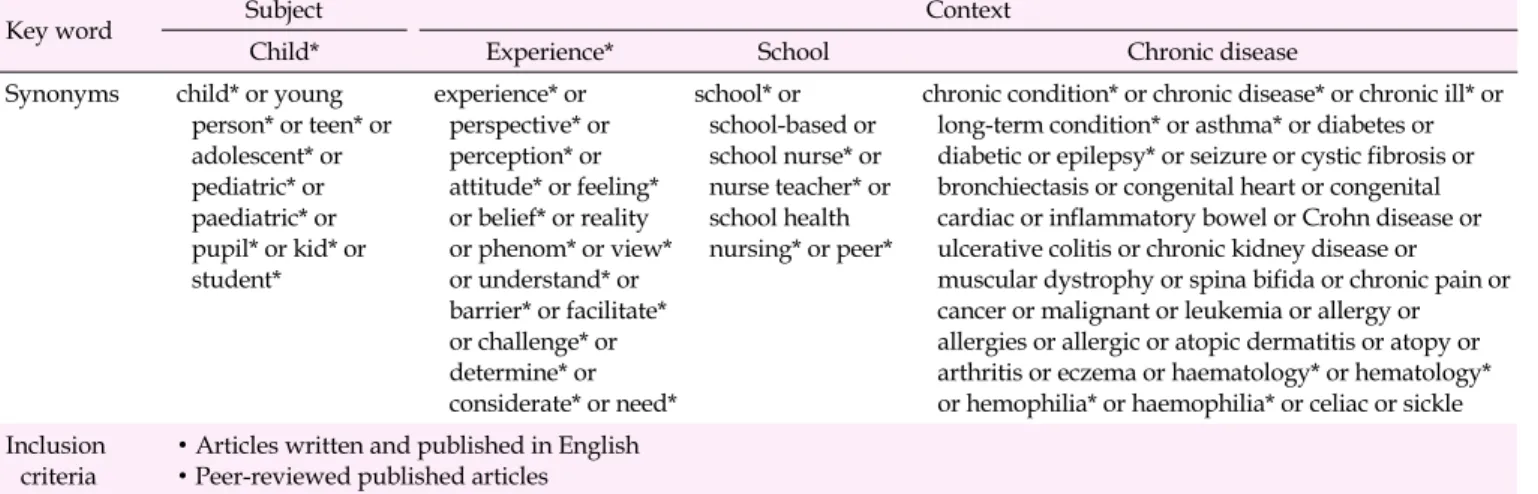
연구 목적에 맞는 문헌고찰을 위해 만성질환(chronic disease), 아동과 청소년(child and adolescent), 인식(perception), 학교 (school)에 대한 4개의 핵심용어와 유사어를 이용하였으며(Table 1), 검색하는 논문의 출판연도는 지난 10년간의 인식을 알기 위해 2008년부터 2018년 11월까지 발표된 논문을 대상으로 하였다. 검색 당시 국내 데이터베이스 RISS, KISS, NDSL에서 검색된 연구는 0건
Table 1. Search Strategy
Key word Subject Context
Child* Experience* School Chronic disease
Synonyms child* or young person* or teen* or adolescent* or pediatric* or paediatric* or pupil* or kid* or student*
experience* or perspective* or perception* or attitude* or feeling*
or belief* or reality or phenom* or view*
or understand* or barrier* or facilitate*
or challenge* or determine* or considerate* or need*
school* or school-based or school nurse* or nurse teacher* or school health nursing* or peer*
chronic condition* or chronic disease* or chronic ill* or long-term condition* or asthma* or diabetes or diabetic or epilepsy* or seizure or cystic fibrosis or bronchiectasis or congenital heart or congenital cardiac or inflammatory bowel or Crohn disease or ulcerative colitis or chronic kidney disease or muscular dystrophy or spina bifida or chronic pain or cancer or malignant or leukemia or allergy or allergies or allergic or atopic dermatitis or atopy or arthritis or eczema or haematology* or hematology*
or hemophilia* or haemophilia* or celiac or sickle Inclusion
criteria
∙ Articles written and published in English
∙ Peer-reviewed published articles
∙ Articles analyzing the school health care experiences of school-aged children and adolescents with chronic disease
∙ In-press articles Exclusion
criteria
∙ Articles that did not include children/school-aged participants
∙ Articles that did not analyze participants with chronic disease
∙ Articles that did not deal with health care experiences at school
∙ Articles involving hospitalized children, technically dependent children, or children with physical disabilities
∙ Master's theses and doctoral dissertations, letters to the editor, conference presentation papers
∙ Descriptive research, review research, and intervention research
이었으며, 국외 데이터베이스는 PubMed, Cumulative Index to Nursing and Allied Health Literature (CINAHL), Embase, Web of Science (WOS)를 이용하여 고찰하였다.
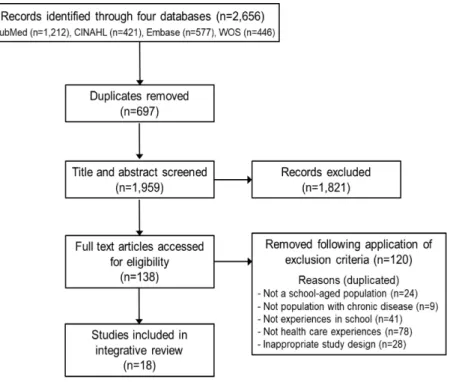
문헌의 선정기준과 제외기준은 다음과 같다. 선정기준은 1) 영 어로 작성된 논문, 2) 동료심사를 거친 학술지 논문, 3) 만성질환 을 가진 아동 및 청소년을 대상으로 학교 건강관리에 대한 인식 이나 경험을 조사한 논문, 4) 출판 중 논문이다. 제외기준은 1) 학령기 아동 ․ 청소년 이외의 연령을 대상으로 한 연구, 2) 만성 질환을 가진 아동 대상자가 아닌 논문, 3) 학교 건강관리 경험이 아닌 연구, 4) 입원한 아동, 의료기기 의존이 필요하거나 신체적 장애를 가진 아동을 대상으로 한 논문, 5) 석 ․ 박사 학위논문, 편 집자 편지, 학술대회 발표논문, 6) 서술적 연구, 고찰연구, 중재 연구로 하였다. 검색된 문헌은 선정 및 제외기준에 따라 선택하 였고, PRISMA flow diagram [21]을 작성하였으며, 서지 프로그 램인 EndNote를 활용하였다. 두명의 연구자가 총 2,656개의 문 헌을 검색하였고, 중복된 문헌 697개를 제외하고 1,959개 논문의 제목과 초록을 고찰하였다. 기준에 부합하는 138개 논문의 본문을 확인하였고, 학령기가 아닌 경우(n=24), 만성질환이 아닌 경우 (n=9), 학교에서의 인식이 아닌 경우(n=41), 건강관리에 대한 인 식이 아닌 경우(n=78), 연구 설계가 조사나 탐색연구가 아닌 경우 (n=28)를 제외하고 주제와 적합한 18개 논문이 최종 선택되었다 (Figure 1).
3) 3단계: 자료 평가
선행된 질적연구와 양적연구의 타당도를 결정하기 위해 비평적 평가를 시행하였다. 질적연구는 Joanna Briggs Institute (JBI)의 질적연구에 대한 비평적 평가 점검표를, 양적연구는 횡단적 단면 연구를 위한 양적연구에 대한 비평적 평가 점검표를 각각 적용하 여 평가하였다[22]. 연구자 2명이 독립적으로 질 평가 체크리스트 (질적연구 평가 10개 항목, 양적연구 평가 8개 항목, 혼합연구는 질 적연구 평가와 양적연구 평가의 모든 항목인 18개 항목)를 작성하 였다. 질 평가를 실시한 결과, 108항목 중 6항목이 일치하지 않아 (연구자 간 질 평가 일치율 94.4%), 불일치가 되는 항목(양적연구 3 편에서 연구자의 문화적 또는 이론적 진술, 연구자에 대한 연구의 영향 등)에 대해서는 서로 충분한 논의를 거친 후 합의를 하였다.
선정한 18편의 논문 모두 질 평가 기준을 충족하였다.
4) 4단계: 자료 분석
선정한 논문으로부터 자료를 추출하고 합성하기 위해 구조화된 자료 추출 형식을 엑셀 파일의 시트를 이용하여 연구자, 연구 설계, 대상자의 질환, 연구 목적, 사용한 측정도구, 국가, 대상자 수, 대상 자 연령, 주요결과 등을 연대기적으로 기술하였다. 연구자 간 코딩 한 자료에 대해 주제와 하위주제를 도출하기 위해 메모를 활용하 였으며, 정기적인 전자메일 교신과 연구 모임을 통한 수시 회의를 통해 논문의 핵심결과, 주제 및 하위주제 합성에 대한 비교와 대조 를 반복하여 합의를 도출하였다.
Figure 1. PRISMA flow diagram showing the search process.
5) 5단계: 자료 제시
두 연구자가 연구결과를 반복적으로 읽으며 변수와 주제 간 관계 성을 확인하고 표와 차트를 이용하여 자료를 제시하여 주제의 패턴 을 확인하였다. 패턴 확인을 위해 집락화, 대조와 비교, 부분과 전체, 공통성·특이성을 분석하였다. 저자 간 패턴에 대한 합의를 이룬 후 주제와 하위주제를 도출하였다. 주제와 하위주제 관계에 대한 적절 성과 주제의 하위주제에 대한 포괄성을 확인하였다. 통찰력을 통해 주제와 하위주제가 원 자료를 타당하게 제시하였는지 재검토하고 결론을 도출하였다.
연 구 결 과 1. 연구 대상 논문의 특성
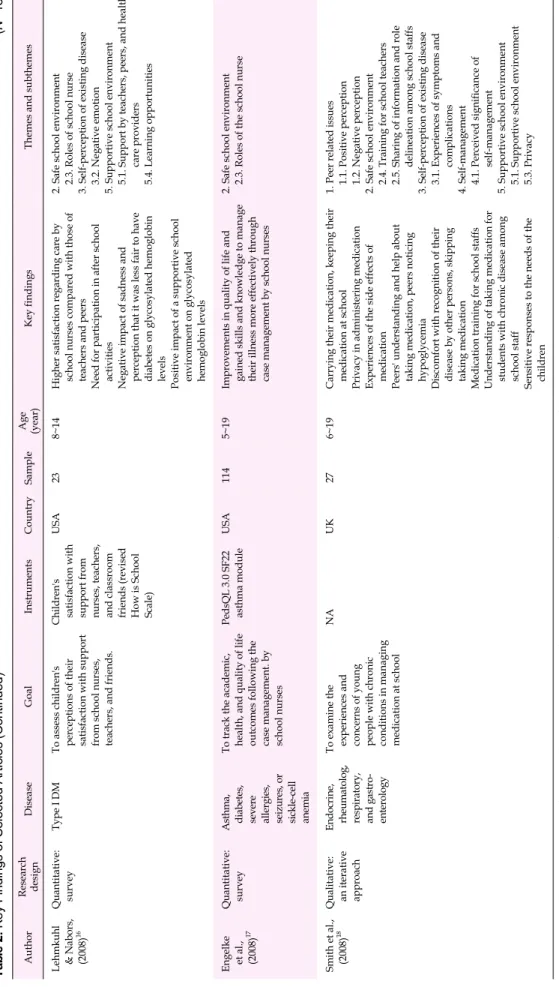
만성질환을 가진 학령기 아동과 청소년이 인식하는 학교 건강 관리 연구 총 18편의 특성을 분석한 결과는 Table 2와 같다. 연구가 진행된 국가는 미국이 9편(50.0%)으로 가장 많았고, 그 외 대만, 스 웨덴, 브라질, 스페인, 영국에서 발표되었다. 연구 설계를 살펴보면, 양적연구가 9편(50.0%), 질적연구가 8편(44.4%), 혼합연구가 1편 (5.6%)이었다. 대상 아동 및 청소년의 만성질환의 종류로는 1형 당 뇨병 아동의 인식에 대한 연구가 11편(61.1%)으로 가장 많았으며, 천식 4편(22.2%), 다양한 질환을 포함한 경우가 2편(11.1%), 혈액 성 질환(sickle cell disease)이 1편(5.6%)이었다.
2. 만성질환을 가진 학령기 아동 ․ 청소년이 인식하는 학교 건강관리의 속성
만성질환을 가진 학령기 아동과 청소년이 인식하는 학교 건강관 리의 속성은 교우와의 관계(peer-related issues), 안전한 학교환경 (safe school environment), 질병 인식(self-perception of an existing disease), 자가간호(self-management), 지지적 학교환경(supportive school environment) 다섯가지 주제로 도출되었다(Table 3).
1) 교우와의 관계
만성질환을 가진 학령기 아동 ․ 청소년의 학교 건강관리에 대한 인식으로는 교우와의 관계가 속성으로 확인되었다. 교우의 긍정 적 역할은 5편(Appendix 1. 1-3,13,18)에서 확인되었고, 교우의 부 정적인 역할은 7편(Appendix 1. 1-4,14,15,18)에서 확인되었다.
교우관계에 대한 대처는 1편(Appendix 1. 9)의 연구에서 확인되 었다. 교우가 아동 및 청소년이 앓는 만성질환에 대해 관심을 가져 주고 공감하는 것이 학교생활 경험을 긍정적으로 인식하는 데에 촉진요인이 되기도 하였다. 그러나 교우가 자신의 만성질환에 대 한 호기심을 갖는 것에 두려움을 지니고, 교우와의 의사소통에 어 려움을 인식하기도 하였다. 교우와 더 편안한 관계를 지속하기 위 한 방법을 스스로 모색하기도 하였다.
Table 2. Key Findings of Selected Articles(N=18) AuthorResearch designDiseaseGoalInstrumentsCountrySampleAge (year)Key findingsThemes and subthemes Yang et al., (2018)1Qualitative: thematic analysis
Type I DMTo describe perceptions of adolescents with T1DM regarding the responses of their peers to their diabetes self-management in school settings NATaiwan1012~17Peers sought knowledge about diabetes in school Peers had curiosity, enthusiasm, and fearfulness regarding diabetes management in school Peers isolated adolescents with diabetes and bullied them in school
1. Peer-related issues 1.1. Positive perception 1.2. Negative perception Naman et al., (2018)2
Mixed-method s: grounded theory and survey AsthmaTo explore students' experiences with asthma care and perceptions of facilitators and barriers to care at school Self-made: an informal questionnaire about asthma care practices, perceptions toward school asthma management USA158~11 Concerns about asthma management (37.5%) Negative impact of chronic disease on peer relationships(50%) Unhelpful school nurses Support of school staff and peers, self-confidence, and self-efficacy, perception for normal as facilitators in asthma management Unsupportive school staff and peers and ineffective use of inhalers as barriers for asthma management
1. Peer-related issues 1.1. Positive perception 1.2. Negative perception 2. Safe school environment 2.3. Roles of the school nurse 3. Self-perception of existing disease 3.3. Challenges of an existing disease 4. Self-management 4.3. Conducting self-management 5. Supportive school environment 5.1. Support by teachers, peers, and health care providers Haridasa et al., (2018)3
Qualitative: grounded theory Sickle cell diseaseTo identify the perceptions of children with sickle cell disease in the school environment
NAUSA14Mean 8.18 Difficulties in communication with peers and teachers Limited school activities due to their physical condition Administrative support for existing disease management Making up missed learning opportunities Conducting self-management Need to improve peers' awareness of the disease
1. Peer-related issues 1.1. Positive perception 1.2. Negative perception 2. Safe school environment 2.6. Administrative support 3. Self-perception of existing disease 3.3. Challenges of an existing disease 4. Self-management 4.3. Conducting self-management 5. Supportive school environment 5.4. Learning opportunities Sparapani et al., (2017)4
Qualitative: content analysis Type I DMTo analyze the experiences of children with T1DM in self-managing the disease at school NABrazil197~12 Ineffective information-sharing for children's health among school teachers Lack of knowledge of diabetes among teachers and peers Feeling support from school staff, peers, and medical staff
1. Peer related issues 1.2. Negative perception 2. Safe school environment 2.4. Training for school teachers 2.5. Sharing of information and role delineation among school staff 5. Supportive school environment 5.1. Support by teachers, peers, and health care providers DM=Diabetes mellitus; T1DM=Type 1 diabetes mellitus; NA=Not applicable; USA=United States of America; UK=United Kingdom.
Table 2. Key Findings of Selected Articles(Continued) (N=18) AuthorResearch designDiseaseGoalInstrumentsCountrySample Age (yKey findingsThemes and subthemes ear) Ottosson et al., 5(2017)
Quantitative: surveyType I DMTo investigate whether children and adolescents with type 1 diabetes would report a higher quality of support in diabetes self-care Self-made: an informal questionnaire about attitudes to diabetes care in school Swedenn=317 (2008), n=570 (2015) 6~12Lack of confidence in managing hypoglycemia among school staff(41%) Discomfort in taking medication(12%) Discrimination on the basis of a medical condition(14%) Experiences of hypoglycemia at least once a week(84%)
2. Safe school environment 2.1. Safe and convenient environment for medication and testing 2.4. Training for school teachers 3. Self-perception of existing disease 3.1. Experiences of symptoms and complications 5. Supportive school environment 5.1. Discrimination on the basis of a medical condition Walker & Reznik, (2014)6
QualitativeAsthmaTo explore children's perceptions of the impact of in-school asthma management on physical activity NAUSA238~10Experiences of asthma symptoms Methods to control asthma and to prevent asthma during in-school physical activity Limited accessibility to asthma medication Others' negative attitudes about use of the medication
2. Safe school environment 2.1. Safe and convenient environment for medication and testing 3. Self-perception of existing disease 3.1. Experiences of symptoms and complications 3.3. Challenges of an existing disease 4. Self-management 4.3. Conducting self-management Sarnblad et al., (2014)7
Quantitative: surveyType I DMTo investigate attitudes to diabetes care in school reported by children with type I diabetes, their parents, and their diabetes teams Self-made: an informal questionnaire about attitudes to diabetes care in school Sweden3177~15Fear of hypoglycemia during class(18%) Association between experiences of hypoglycemia and glycosylated hemoglobin Unsatisfactory multidisciplinary management in school(18%) 2. Safe school environment 2.5. Sharing of information and role delineation among school staff 3. Self-perception of existing disease 3.1. Experiences of symptoms and complications Blaakman et al., (2014)8
Qualitative: content analysis
AsthmaTo understand urban teens' experiences with asthma management, preventive medication adherence, and participation in a school-based intervention NAUSA2812~15Awareness of the importance of medication adherence Having trouble remembering to take medications Barriers to medication adherence: other priorities such as social issues than taking medication Facilitators of medication adherence: good relationships with school nurses Existing facilitators and barriers to medication adherence in school
4. Self-management 4.1. Perceived significance of self-management 4.2. Challenges and facilitators for self-management Wang, Brown, & Honer, (2013)9
Qualitative: hermeneutical phenomen- ological approach Type I DMTo investigate school-based lived experiences
NATaiwan1412~17The point of distinction from peers Disguising their disease due to misunderstanding of the disease and immature response of peers Temptation of high-calorie foods Ineffective school health nursing care Awareness of the importance of self-management
1. Peer-related issues 1.3. Coping with peer-related issues 2. Safe school environment 2.3. Roles of the school nurse 3. Self-perception of existing disease 3.3. Challenges of an existing disease 4. Self-management 4.1. Perceived significance of self-management 4.2. Challenges and facilitators for self-management DM=Diabetes mellitus; T1DM=Type 1 diabetes mellitus; NA=Not applicable; USA=United States of America; UK=United Kingdom.