소나무 낙엽층 화염높이 산정식에 관한 연구
Study on Flame Height Equation for the Pinus densiflora
Surface Fuel Bed
김동현
Dong-Hyun Kim
국립산림과학원산림방재연구과
(2009. 4. 27.
접수/2009. 12. 11.
채택)
요 약
산불에서의화염높이산정은복사열전달에의한수평또는수직적화염확산을예측하는데있어매우중 요한부분이다
.
화염특성중화염높이는빛을수반하는화염(the luminous flame)
의평균높이로확인할수있다
.
본연구에서는외부풍속과경사등으로인한화염높이가변화될수있는조건을제외한산림내지표연소물질
(surface fuel)
인소나무낙엽층(fuel bed)
에대한화염높이관측실험과열량분석계을이용하여 발열량
(Heat Release Rate)
측정실험과 수치해석을통해 지표연소물질에 대한 화염높이 산출식H
f= 0.027(
')
2/3을도출하였다.
실험값과개발산정식,
기존Heskestad
15)식과의적용값비교결과,
소나무낙엽의경우
,
실험값과개발산정식적용값의표준오차는0.08,
실험값과기존Heskestad
식의표준오차는
0.23
으로개발산정식의정확성이높은것으로나타났다.
ABSTRACT
Flame height calculation in a forest fire is a crucial part of predicting horizontal or vertical flame spread flared by radiation heat transfer. Flame height, which is one of the flame characteristics, can be estimated by the average height of luminous flame. This research relied on flame height observa- tion test on
P. densiflorasurface fuel bed, which are surface combustibles in a forest, and calorimeter to measure Heat Release Rate, thus produced H
f= 0.027(
')
2/3, flame height calculation equation for surface fuel. The research did not take into consideration such conditions as external velocity, slope and other variables that could affect flame height. According to comparison among experiment results, calculation results of the above formula and those of existing Heskestad formula (1998), it was found that standard error in fallen pine needles between experimental results and calculation results of the above formula amounts to 0.08, whereas standard error in same plant between experimental results and calculation results of existing Heskestad formula
15)amounts to 0.23.
Key words :
Forest fire, Surface fire, Flame height,
Pinus densiflora, Surface fuel bed
1. 서 론
대부분 고체 형태의 연료들은 연소시 화염을 통해 열 에너지를 방출한다
.
화염을 통해 방출되는 열유속(Heat flux)
에의해 미연소연료(virgin fuel)
가열분해 되면서 착화온도에 도달하면화염이착화되는 과정을 통해화염확산이이루어진다.
이는산불확산에있어서 도산림내연료물질들의연소로발생된화염이지표화(surface fire),
수관화(crown fire)
의형태로열전달메커 니즘에 의해 화염전파가 이루어진다.
산불에 대한 화 염의특성은수차례조사되었다.
5-8,11,12)화염길이(Flame
length)
는 지표화에서 수관부로 연소,
확산되는 과정을예측하는데 유용하다
.
화염길이 예측모델은BEHAVE
모델에사용되는경험적상관관계
,
화재역학상관관계5,6) 그리고일반적인화재역학에서해석한화염높이산정을 위한수치해석 상관관계14)가제시된바 있다.
산불확산 에있어지표화화염의높이를예측,
추정하는것은육 안또는화염온도측정을통한실험적방법과수치해석Q·
Q·
E-mail: [email protected]
을통한화염확산예측식을구하는방법이있다
.
본연 구에서는무풍,
평지조건에서열적두께가얇은소나무낙엽층에대한화염높이측정실험과수치해석을통한 화염높이산정식을도출하여상호비교
,
검토하였다.
2. 이론적 배경
산불확산에있어화염의높이는연료의특성과바람
,
경사에의해달라진다
.
일반적으로무풍-
평지(no wind,
no slope)
조건에서의화염높이와화염길이는같지만경사와바람에의해화염높이는화염길이보다작은값을 가진다
.
여기서바람또는경사에 의해화염이 지표연 소물질과보다 가까워짐으로써복사열전달율이 높아 지게되어보다빠른확산이이루어진다.
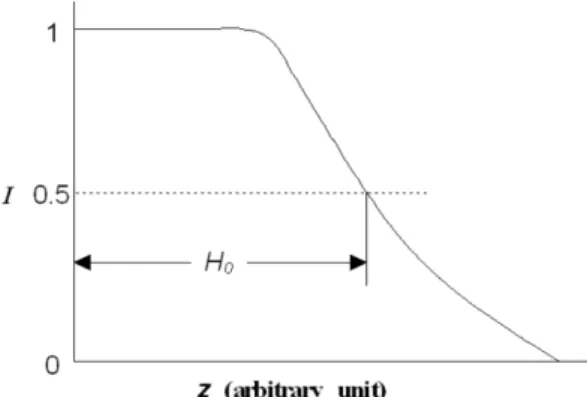
따라서화염 의높이산정은산불확산예측등산불의위험성을평 가하는데중요하다. Figure 1
은평균화염높이H
0를정 의한 것으로 발화원 상부거리에 대한 화염의 간헐성(intermittency)
I에 대한 변화가 개략적으로 제시되어있다
.
평균화염높이
H
0는간헐성 I값이0.5
로떨어지는발 화원 상부의 거리이다.
간헐성 측정결과에 따른 평균 화염높이와 객관적인판정결과는육안관찰을 통해평 균으로 구한 화염높이와 상당히 일치한다.
10) 본 연구 에서는 무풍,
평지조건에서 열적두께가 얇은 지표층 낙엽에대한화염높이측정실험을통해화염의간헐성 이0.5
로떨어지는화염높이측정결과와수치해석을통 해얻은산정식 값그리고 기존연구되어진화염높이 예측식을통해상호비교하였다.
2.1가시화염의평균높이산정
가시화염의평균높이는육안관측
(visual observation)
을통해 측정할 수있다
.
발화원 상부거리에대한 화염 간헐성 I가
0.5
의값을 가지는 평균화염높이를 측 정하였다.
본연구에서는 실험을 통해 얻은 화염높이를구하는 기준으로 간헐성이
0.5
로 떨어지는발화원 상부로부터의거리를측정한기존연구결과4)에서제시 된 결과와 비교하였다.
이 실험은Surface fuel bed
의 각연료밀도별가시화염의높이를비디오카메라를이 용하여 측정한 것이다.
실험에 의한 육안관측평균화 염높이측정결과값은Table 1
과같다.
2.2열방출률산정
화염의 높이는 발화원의 종류에 따라
HRR(Heat
Release Rate, kW)
에의해달라지며연소직경,
연료밀 도등의 물리적 변수들에 따라 달라진다.
연소물질의(HRR, kW)
의산정은식(1)
과같이계산된다.
여기 서질량감소율( , kg/s)
은식(2)
에의해계산된다.
HRR(kW) =
∆h
c× MLR (1)
여기서
,
∆h
c는열용량(the effective heat of combustion, kJ/kg), MLR
는중량감소속도(the mass loss rate, kg/s)
이다
.
(2)
여기서
,
ρ는연료밀도(fuel density, kg/m
3), 1
은단위 연소면적(m
2),
δ는 연료깊이(fuel depth, m), t
b는 연소 시간(burning time, sec)
이다.
2.3화염높이산정모델
산불에있어서수치해석을통한화염높이산정에관 한 연구는 무풍
,
평지 상태에서이루어져 있지 않다.
화염높이 예측을 위해 일반적으로 바람이 불지 않는 조건에서의액체또는고체가연물질의수평면화재에 대한 화염높이산정은
McCaffrey,
15)Heskestad
14)에의Q· m·
m· =
ρ×1
×δt
b---
Figure 1.
Average height of the flame and a change in flame intermittency
I.
Table 1.
Flame Height of
P. densiflorain Each Fuel Density by Visual Measurement
Fuel density (kg/m
3)
Diameter (m) 9.6 15.9 22.2 31.8
0.2 0.63 0.70 0.71 0.74
0.3 0.70 0.81 0.88 0.91
0.4 0.74 0.88 1.08 1.05
0.5 0.70 0.98 1.18 1.05
해식
(3)
과같이제시되었다.
H = 0.23
2/5−1.02D (3)
여기서
,
은 열방출률(Heat Release Rate), D
는연 소직경(Burning Length)
이다.
평지상태의풍속조건에서의산불에대한화염높이는
Albini,
5)Nelson
6)등에의해실험과함께질량,
에너지 보존방정식으로부터관계식개발등으로연구된바있 다. Albini
5)는1-D fires
에서의화염높이추정식을H
∝I
B/U
로제시하였고Nelson
6)은이식을바탕으로식(4)
와같이제시하였다
.
하지만이식의경우에는풍속이0
인무풍상태의경우화염의높이를산정하기어렵다. (4)
여기서
, I
B는Byram’s Fire Intensity(kW/), a
는1/360, U
는풍속(m/s)
이다.
3. 화염높이 산정 수치해석
3.1열방출률의산정
봄철건조한 소나무 낙엽에대해식
(1)
과(2)
에필 요한변수값연료깊이(
δ, m)
는평균지표층낙엽층두 께0.1m,
연소시간(t
b, sec)
는40sec,
소나무 낙엽의열용량
(
∆h
c, kJ/kg)
는각각10,381
을적용하였다.
2,3)그결 과각밀도별연료감소량(Mass Loss Rate, (kg/s)
와발 열량(Heat Release Rate, kW)
결과값은Table 2
와같다.
1)3.2소나무낙엽화염높이산정식도출
지표화연소물질의 연소시발생되는 화염높이산정 을위하여본연구에서는
J.G. Quintiere
방정식을이용 하여수치해석하였다.
평균화염높이에대한무차원화염비
(Dimensionless Flame Ratio, z/Z
**)
는Quintiere
와Grove
12)에의해얻어진Figure 2
로부터 식(5)
와같이 제시할수있다.
(5)
여기서평균화염높이
(Z
f, m)
산출식은식(6)
으로부터 식(7)
과같이도출할 수있다.
Q·
Q·
H = aI --- U
BH = z Z
**--- = 3
Table 2.
MLR & HRR of
P. densiflorain Each Fuel Density
Fuel Density (kg/m
3) 9.6 15.9 22.2 31.8 MLR (kg/s) 0.024 0.040 0.056 0.080
HRR (kW) 249.1 412.7 576.2 825.3 Remark: Fuel Moisture Content (%) is 15 ± 2
Figure 2.
Dimensionless temperature vs. height for the infinite line, X
r= 30%.
(6)
(7)
여기서
,
ρc는표준공기밀도(standard air density, kg/
m
3), c
p는 일반대기압 비열(Specific heat of air at constant pressure, kJ/kg
·K), T
0는초기온도(Temperature, K), g
는중력가속도(Gravity acceleration, m/s
2)
이다.
식(7)
에서 각변수값은Table 3
에제시된 값을대입하였고초기온도는실온상태의
293K
를대입하였다.
그결과
,
식(8)
과같이소나무 낙엽연소시 화염높이 산출 식을도출하였다.
H
f= Z
f= 0.027( ')
2/3(8)
4. 결과 및 고찰
소나무 낙엽층의화염높이산정식의정확성 평가를
위해여러밀도별화염높이를상호비교하였다
.
기실험연구4)된화염높이 관측값과
Heskestad
화염높이산출식
(3),
그리고Quintiere
12) 화염높이관계정의 이론 을이용하여수치해석한화염높이산출식(8)
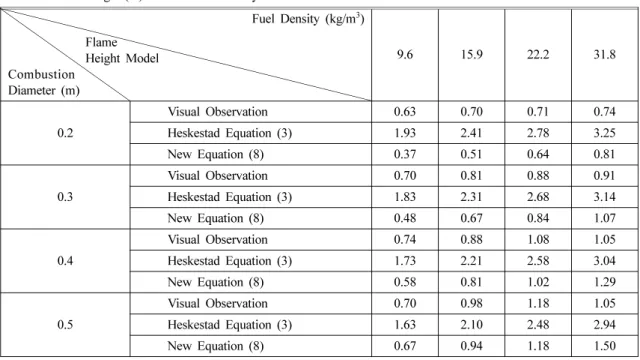
에적용 한소나무낙엽층화염높이는Table 4
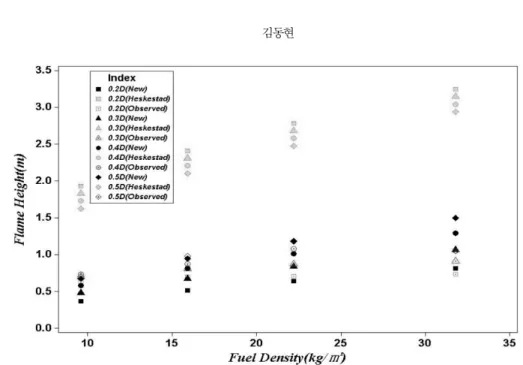
와같고Figure 3
에서보이는바와같이각밀도별
,
연소직경별화염높 이에서 가시화염관측값과수치해석화염높이산출식 에의한 값의분포가 가까움을 알수있다.
가시화염을기준으로
Heskestad
산출식과 새로운 도출식에대해오차통계 분석한결과
,
각조건별오차평균값은각각
1.58m, 0.07m
이고표준오차는각각0.23, 0.09
로나 타나개발 산정식의정확성이보다 높은것으로 나타 났다(Table 5).
5. 결 론
산불에서의초기 확산으로이어지는 지표화에대해 우리나라대표침엽수종인소나무낙엽층연료를대상
으로
J.G. Quintiere
의 무한선속에서의 화염의 무차원온도
vs
높이 관계정의를 이용하여 수치해석을 통한Z
**= Q·'
ρc
c
pT
0g ---
⎝ ⎠
⎜ ⎟
⎛ ⎞2/3
Z
f= 3Z
**= 3 Q·'
ρc
c
pT
0g ---
⎝ ⎠
⎜ ⎟
⎛ ⎞2/3
Q·
Table 3.
Flame Height of
P. densiflorain Each Fuel Density by Heskestad Eq. (3) Factors Density
(
ρc, kg/) Specific Heat
(c
p, kJ/kg
·K) Initial Temperature
(T
0, K) Gravitational Acceleration
(g, m/sec
2) Combustion Diameter (D, m)
Value 1.2045
1)1.01 293 9.81 0.3
Remark: 1) Standard Air Density
Table 4.
Flame Height (m) in Each Fuel Density and Combustion Diameter Fuel Density (kg/m
3) Flame
Height Model Combustion
Diameter (m)
9.6 15.9 22.2 31.8
0.2 Visual Observation 0.63 0.70 0.71 0.74
Heskestad Equation (3) 1.93 2.41 2.78 3.25
New Equation (8) 0.37 0.51 0.64 0.81
0.3 Visual Observation 0.70 0.81 0.88 0.91
Heskestad Equation (3) 1.83 2.31 2.68 3.14
New Equation (8) 0.48 0.67 0.84 1.07
0.4 Visual Observation 0.74 0.88 1.08 1.05
Heskestad Equation (3) 1.73 2.21 2.58 3.04
New Equation (8) 0.58 0.81 1.02 1.29
0.5 Visual Observation 0.70 0.98 1.18 1.05
Heskestad Equation (3) 1.63 2.10 2.48 2.94
New Equation (8) 0.67 0.94 1.18 1.50
화염높이산출식
(8)
을도출하였다.
이식에의해산출 된소나무 낙엽층의화염의높이에 대해가시화염관 측값과Heskestad(1998)
식에적용한산출값과상호비 교하였다.
그결과,
다음과같은결론을제시코자한다.
1)
가시화염 관측값에 대한 개발 산정식 적용값,
Heskestad
식의 화염높이의 평균 오차는 각각0.06m,
1.58m
로나타나개발산정식이Heskestad
식에대비해 약26
배의화염높이값의차이를나타내었다.
2)
화염높이의 정확성을 나타내는표준오차에 있어 서도 가시화염 관측값에 대한 개발 산정식 적용값, Heskestad
식의화염높이의평균오차는각각0.08, 0.24
로분석되어 개발산정식의 정확성이높은것으로 나 타났다
.
향후
,
이식을 이용하여복사열전달에 의한 산불의 화염높이 및화염확산해석 등에활용할수있을 것으 로사료된다.
참고문헌
1.
김장환,
김응식,
박형주,
이명보,
김동현, “
지표화연 료의열량분석에관한실험방법연구”,
한국화재소방 학회논문지, Vol.22, No.3, pp.258-264 (2008).
Table 5.
Flame Height (m) in Each Fuel Density and Combustion Diameter Statistics Analysis
Combustion Diameter (m) The Mean
Error The Standard
Error The Standard
Deviation Dispersion
Visual Observation
& New Equation (8)
0.2 0.1107 0.0747 0.1493 0.0223
0.3 0.0595 0.0806 0.1612 0.0260
0.4 0.0102 0.0860 0.1721 0.0296
0.5 0.0940 0.1180 0.2350 0.0550
The Mean 0.06 0.08 0.16 0.03
Visual Observation
& Heskestad Equation (3)
0.2 1.900 0.237 0.515 0.266
0.3 1.668 0.176 0.467 0.218
0.4 1.454 0.273 0.416 0.173
0.5 1.308 0.267 0.415 0.173
The Mean 1.58 0.24 0.45 0.21
Figure 3.
Compare of
P. densifloraflame height on Table 5.
2.
김동현,
이명보,
강영호,
이시영, “
지표물질착화성실 험을통한발화위험성분석”,
한국방재학회학술발표 대회논문집, pp.379-384(2006).
3.
박형주,
김응식,
김장환,
김동현, “
복사열을이용한소나무와굴참나무낙엽의연소특성분석
”,
한국화재소 방학회논문지, Vol.21, No.3, pp.33-41(2007).
4.
김동현,
田中哮義,
이명보,
김광일, “
낙엽층화염높이산정에관한연구
”, 2009
년도춘계학술논문발표회논문집