Geosciences Journal
Vol. 12, No. 3, p. 205−213, September 2008 DOI 10.1007/s12303-008-0021-x
ⓒ The Association of Korean Geoscience Societies and Springer 2008
Spatio-temporal variation of pH and ionic concentrations in precipitation:
interaction between two contrasting stationary sources affecting air quality
ABSTRACT: Meteorological and geological factors affecting the pH and ionic concentrations of precipitation were investigated from Jecheon City, Korea. The air quality of the study area is affected by two contrasting stationary sources: 1) a coal-fired power plant to the east-northeast and 2) limestone quarries and cement-manufacturing factories to the east to south-southeast of Jecheon. The temporal change of rainwater chemistry is affected by the interaction between acidic gases and alkaline substances from the above two sources. Accordingly, rainwater pH at a city center widely varies from 4.9 to 8.3. Acidic gases from the power plant are likely to acidify the rainwater pH. As the prevailing wind direction during rainfall events shifted to ENE–SSE, rainwater pH at the city center rapidly increased to >6.5 (up to 7.8). Concomi- tantly, ionic concentrations (esp., Ca, K, and Na) increased sharply, especially when winds are brown from SE, probably due to major influences of particles coming from limestone quarries. The enrich- ment factor analyses of acidity and cations also indicate that the acidic components in precipitation are mostly neutralized by lime- stone particles. In addition, rainwater chemistry showed a spatial variation as a function of the direction and distance from the above two sources. Our results demonstrate a good example of competing roles between the anthropogenic acidic source and the geologic alka- line source.
Key words: rainwater chemistry, Jecheon, Korea, acid and alkaline rains, geologic alkaline source, anthropogenic acidic source 1. INTRODUCTION
Many researchers reported that precipitation chemistry is controlled by the combined effect of various environmental factors such as meteorological conditions, emission and transport of pollutants, topography, and seawater level change (e.g., Asman et al., 1981; Weijer and Vugts, 1990; Rogora et al., 2004; Zhang and Liu, 2004). The natural (unpolluted) rain water is supposed to attain the pH of 5.6 due to the equilibrium dissolution of atmospheric CO2 (Özsoy and
Saydam, 2000). However, the actual pH is different from 5.6 because of reactions between coexisting acidic and alkaline constituents in the atmosphere. In particular, sulfur and nitrogen oxides emitted from the combustion of fossil fuels are converted into acidic forms (sulfuric and nitric acids) by the reactions with various atmospheric oxidants.
In contrast, a number of alkaline materials can also be intro- duced into air in the forms of CaCO3 and NH3 (Al-Momani and Ataman, 1995; Alastuey et al., 1999; Gülsoy et al., 1999; Özsoy and Saydam, 2000; Norman et al., 2001; Flues et al., 2002; Arsene et al., 2007; Zhang et al., 2007). Espe- cially, CaCO3 particles from soil dust neutralize the pH of precipitation (e.g., Hontoria et al., 2003).
Acid rain has been of important concern worldwide for the last two decades due to its adverse impacts on fresh- water and other ecosystems (e.g., Al-Momani and Ataman, 1995; Heuer et al., 2000; Seto et al., 2000; de Mello and de Almeida, 2004; Rogora et al., 2004; Zhang et al., 2007).
Acid rains in Korea have been extensively studied since early 1980s, with the major focuses on the influence of non- point sources and the long-range transport of pollutants (Kang et al., 1996; Lee and Chung, 1996; Lee et al., 1996;
Na and Chung, 1997; Lee et al., 2000; Park et al., 2000;
Park and Lee, 2002; Kim and Chung, 2007). Chae et al.
(2004a) recently evaluated the relative roles of urban atmo- spheric pollution (especially emission of acidic pollutants) and chemical weathering (i.e., geologic process) on the chemistry of first-order, remote streams in east of Seoul, based on the statistical interpretation and mass balance modeling.
To date, only a few studies were conducted to measure the effect of regional or local geology on precipitation chemistry. In this respect, our study was initiated to exam- ine the relative effects of the acidic gas emission and the geologic feature on precipitation chemistry because these Byoung-Young Choi
Seong-Taek Yun*
Gyu-Il Yeom Ki-Hyun Kim Kyoung-Ho Kim Yong-Kwon Koh
}Department of Earth and Environmental Sciences and the Environmental Geosphere Research Lab (EGRL), Korea University, Seoul 136-701, Korea
Dansung Middle School, Danyang, Choongbuk 395-862, Korea
Department of Earth and Environmental Sciences, Sejong University, Seoul 143-747, Korea Department of Earth and Environmental Sciences and the Environmental Geosphere Research Lab (EGRL), Korea University, Seoul 136-701, Korea
High-Level Nuclear Wasted Disposal Research Center, Korea Atomic Energy Research Institute, Daejeon 305-356, Korea
*Corresponding author: [email protected]
two contrasting sources generally exist on different lithol- ogies. In our study, the temporal and spatial changes of rainwater chemistry were carefully examined in relation to sampling localities and meteorological parameters. The major goal of this study is to evaluate the factors affecting rain- water chemistry in a small urbanized area with contrasting point sources on different geologic setting.
2. MATERIALS AND METHODS 2.1. Site Description
The target area of our study is located in the Jecheon (JC) City (37°07'60''N, 128°12'57''N), which is situated on an inland basin in the central part of South Korea (Fig. 1). The location of the city is far away from the coasts (at least more than 140 km). Hence, the effect of sea-salt on the rain- water chemistry is negligible. The basin has the topographic elevations around 300 m above the sea level and is sur- rounded by mountains (the heights of about 500–900 m).
Thus, the central part of JC city is generally flat and its geology is characterized by the highly weathered zone of Mesozoic granites (mainly, biotite granite). The granites intruded Precambrian granitic gneiss and Paleozoic lime-
stones. The northern part of the city is bounded by high mountains of granitic gneiss, while the east and the south- east parts are bounded by NNW–SSE-trending limestone mountain ranges. Limestone mines are common in those moun- tains. There are two large cement-manufacturing plants with an annual production of more than 4.5 million tons along the NW-SE-trending valley to Danyang (DY) at 15 km SSE from the city center (Fig. 1). Thus, carbonate aerosols are expected to be common in the air around the cement fac- tories and limestone quarries.
In contrast, a coal-fired power plant with a maximum electricity generation capacity of 400 MW is located in the Yeongweol (YW) City that is located about 20 km to the ENE of JC (Fig. 1). Air quality data around YW show the elevated levels of sulfur and nitrogen oxides because of the power plant. The emitted sulfur and nitrogen gases from the power plant are expected to move to the northern part of JC long the valley (Fig. 1). Therefore, the precipitation in JC is dominantly affected by two point sources: aerosols gener- ated from limestone mines and cement factories and gases emitted from the power plant.
2.2. Sample Collection and Analysis
Rainwater samples were collected with wet deposition samplers (45.5 cm diameter and 35.0 cm height) installed 1 m above the ground level. It should be noted that the pro- tocols of our sampling and analysis were changed period- ically between 1995 and 1998. During January through December of 1995 pH measurements (n=94) were per- formed at hourly intervals during rainfall events at the city center site (K in Fig. 1) to investigate the relationships between acidity and meteorological parameters (i.e., hourly- based concentrations of SO2 and NO2 in air, the prevailing wind direction during the precipitation event, and the amount of precipitation). During June of 1998, rainwater sampling was performed for two days at the same site (K) to examine the temporal variations of pH and ionic concentrations dur- ing a precipitation event. Additional rainwater sampling were carried out at nine monitoring sites along two transects (Fig. 1) from JC to DY (5 sites of A–E) and from JC to YW (4 sites of a–d); it was intended to investigate the spatial variation of rainwater chemistry as a function of distance from the two major point sources.
The pH was immediately measured as soon as the rain- water was collected in the samples using the portable pH meter (Hach sension™1). Samples for chemical analysis were filtered through 0.45 µm membrane filters and kept at 4 ºC until the analysis. Cation samples were acidified by adding a few drops of concentrated HNO3. The concentra- tion of bicarbonate in some samples with sufficient volumes was determined using the acid titration method. All bottles for samples were soaked in diluted acid, washed with deionized waters several times, and were washed again Fig. 1. A simplified topographic map of the study area in central
part of South Korea, showing the localities of rainwater sampling (‘A’ to ‘E’ and ‘a’ to ‘d’ along the two transects) and two station- ary sources of air quality change. Locations of Jecheon (JC), Yeo- ngweol (YW), and Danyang (DY) are also shown.
prior to sampling with the filtrates. Chemical analysis was performed within two days after the sampling at the Center for Mineral Resources Research (CMR) in Korea Univer- sity. Cations such as Na, K, Mg, and Ca were analyzed using ICP–AES (Perkin Elmer 3000XL), while anions (F, Cl, NO3, and SO4) using ion chromatography (Dionex DX–
120). Blanks, replicates, and spikes were run routinely to assure the precision and accuracy of chemical analysis. The precision and accuracy of analysis were typically better than ±5%.
During the sampling campaigns, basic meteorological parameters such as air temperature, prevailing wind direc- tion, and wind speed were measured at the meteorological station in JC. The concentrations of airborne pollutants (e.g., NO2 and SO2) were measured on hourly bases from the JC Branch of the Korean Air Pollution Monitoring Network.
3. RESULTS AND DISCUSSIONS
3.1. General Causes for the Temporal Change of Rainwa- ter pH
To explain the major factors affecting the rainwater pH, a factor analysis was conducted for a total of 94 rainwater samples collected during the first round of survey at the city center (site K). The input variables were the pH values, meteorological parameters (i.e., wind direction, wind speed, and the cumulative amount of precipitation) and the hourly- based concentrations of NO2 and SO2 in air. The factor analysis is useful to divide a complex data set into several clusters (components) by creating one or more new vari- ables (e.g., Chae et al., 2004b, 2006; Chang et al., 2005).
Based on the factor analysis, two components with the eigenvalues greater than unity (C1 and C2) were extracted.
The C1 and C2 components can account for 31% and 29%
of total variance, respectively; both comprise the dominant
fraction of the variance. The computed component loadings of each variable are graphically shown for both components in Figure 2. In the case of C1, NO2 and wind velocity are intimately clustered with the loading values above 0.5, indi- cating that the concentration of NO2 (as a major acidic gas) is related with the wind velocity. In case of C2, a negative correlation is observed between pH and the amount of pre- cipitation. In other words, the pH of rainwater (as a whole) tends to decrease with the increase of rainfall amount. A similar pattern also appeared in the relationship between the Fig. 2. A two-dimensional plot of the factor loadings for some
variables with potential effects on rainwater pH.
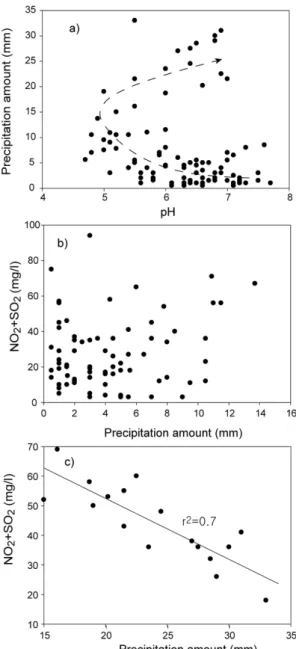
Fig. 3. The relationships between rainwater pH and meteorological data in 1995. a) Relationship between rainwater pH and the cumu- lated precipitation amount (i.e., the sum of hourly-based measure- ments for each rainfall episode); b) relationships between the hourly-based concentrations of acidic gases (NO2 + SO2) and rain- fall amounts when the rainfall amount for a rainfall event is less than 15 mm; and c) the same as above but larger than 15 mm.
rainwater pH and the amount of cumulative precipitation from 94 measurements (Fig. 3a). When the cumulative rain- fall is small (< 15 mm or 10 mm, representing the most case of our measurements), alkaline rains (pH > 7) are predom- inantly encountered when the cumulated rainfall amount is less than < 10 mm (Fig. 3a). In an analogue to this obser- vation, Ahmed et al. (1990) reported that wash-out pro- cesses of alkaline substances can lead to a rapid neutralization of the precipitation acidity during the downward passage of raindrops from a cloud base. As the rainfall amount increases, the wash-out of alkaline materials (such as CaCO3) seems to be completed very rapidly.
Interestingly, Figure 3a also shows that pH tends to increase (approximately from 5 to < 7) with the increasing rainfall as the precipitation exceeds 15 mm (covers 18 out of all 94 measurement data). This result can be ascribed to the decreasing concentrations of acidic components in the air due to the wash-out effect increasing with precipitation amount. To examine the wash-outs of acidic gases during precipitation, the concentrations of acidic gases (NO2 + SO2) were plotted against rainfall amount (Figs. 3b and 3c).
When the rainfall amount is less than 15 mm, acidic gas concentrations were not significantly correlated with the precipitation amount (Fig. 3b). As the rainfall becomes heavy (> 15 mm), the concentrations tend to decrease remarkably (Fig. 3c), reflecting the wash-out effect for the acidic gases.
In summary, the relation between rainwater pH and rainfall amount (Fig. 3a) can be explained by the switching roles of two contrasting sources (i.e., acidic gases and alkaline sub- stances). In the low rainfall period covering about 90% of our measurements (n=94), the rainwater pH is largely determined by rapid removal (wash-out) of alkaline substances (likely limestone particles); this results in an increase of pH. In con- trast, when the rainfall amount is large (> 15 mm), the rain- water pH seems to be affected mainly by the decreasing concentrations of acidic gases through wash-out.
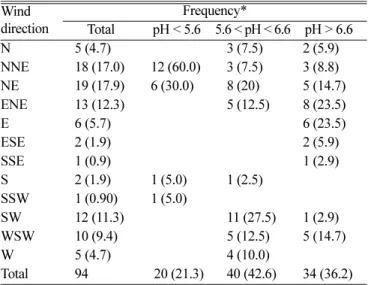
The change of rainwater pH was then evaluated in con- junction with the prevailing wind direction in light of the fact that the location and geologic background are distinct between two contrasting pollution sources (i.e., a coal-burn- ing power plant at ENE of JC and the cement quarries and factories at E to SSE). For this, we made an assumption that the prevailing wind measured at the city center represents the direction of the short-range movement and source of major substances in rainwater. Hence, our rainwater mea- surements (n=94) were divided into 12 major groups based on the prevailing wind direction during the rainfall event (Table 1). For example, the N group represents the samples collected while the winds blew from the north sector. The data assessed in line show that prevailing wind directions during rainfall events in JC are in the order of NE > NNE
> ENE >> SW > WSW > E (Table 1; Fig. 4a).
Based on the topography of JC, it should be noted that NE and NNE winds, the most frequent ones (about 35%),
generally blow to JC along the valley between JC and YW (see Fig. 1). The winds blowing from the SSE to S of JC are relatively rare (only 2.8% of total rainfall events). The 42.6% of the rainfall measurements showed pH from 5.6 to 6.6, 36.2% showed pH > 6.6, and the rest showed pH < 5.6.
According to this analysis, the predominant portion (about 90%) of acidic pH (< 5.6) generally fell within the NNE–NE sector (Fig. 4b). This result clearly indicates that acidic gases from a coal-burning power plant can play a major role to generate acidic rains in JC. We consider that the valley in the northeast of JC (see Fig. 1) facilitate a short-range trans- port of acidic gases originated from a coal-burning power plant at YW. However, rainfalls in the NNE–NE sector show a relatively wide pH from < 5.6 to > 6.6 (Table 1), possibly resulting from the variability in the contribution of acidic gases to the neutralization process by limestone aerosols.
On the other hand, rainfalls with the pH values between 5.6 and 6.6 are dominated in the SW and NE sectors (Fig.
4c). In addition, rainfalls with high pH (above 6.6) mainly occurred (about 47%) in the ENE–E sector (Fig. 4d).
Although alkaline mineral particles near limestone quarries can play an important role to form alkaline rains in JC, the role of limestone particles directly from large cement fac- tories at SSE of JC seems to be less significant. This result can be explained partly by the very low frequency (e.g., < 3%) of the winds from SSE–S directions. In summary, our pH data from 94 rainfall measurements in 1995 indicate that the rainwater pH in JC is temporally affected by the dis- solution (wash-out) reactions of two interactive processes;
i.e., 1) acidic anthropogenic gases from a coal-fired plant and 2) alkaline geogenic particles of limestone origin. To confirm this explanation, we additionally performed the chemical analysis of ionic concentrations for the rainwater samples through time.
Table 1. Frequency analyses of rainfall measurement data with the prevailing wind direction at the city center of Jecheon, Korea Wind
direction
Frequency*
Total pH < 5.6 5.6 < pH < 6.6 pH > 6.6
N 5 (4.7) 3 (7.5) 2 (5.9)
NNE 18 (17.0) 12 (60.0) 3 (7.5) 3 (8.8)
NE 19 (17.9) 6 (30.0) 8 (20) 5 (14.7)
ENE 13 (12.3) 5 (12.5) 8 (23.5)
E 6 (5.7) 6 (23.5)
ESE 2 (1.9) 2 (5.9)
SSE 1 (0.9) 1 (2.9)
S 2 (1.9) 1 (5.0) 1 (2.5)
SSW 1 (0.90) 1 (5.0)
SW 12 (11.3) 11 (27.5) 1 (2.9)
WSW 10 (9.4) 5 (12.5) 5 (14.7)
W 5 (4.7) 4 (10.0)
Total 94 20 (21.3) 40 (42.6) 34 (36.2)
*Numbers in parenthesis indicate the percentage
3.2. Spatio-Temporal Change of Rainwater Chemistry 3.2.1. Temporal variation of pH and ionic concentrations
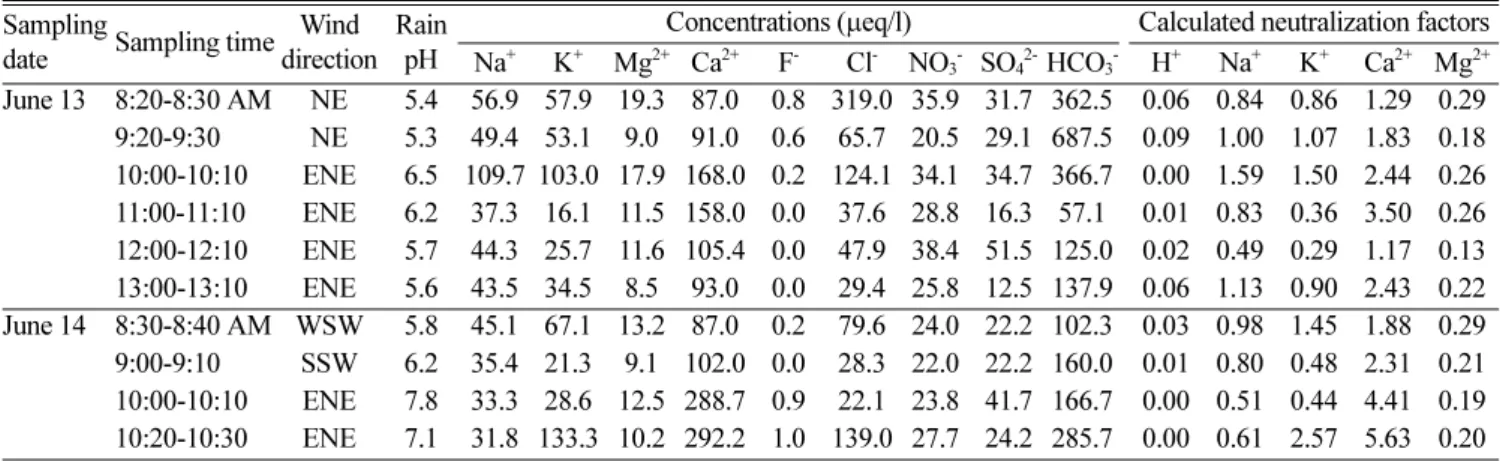
Table 2 shows the result of chemical analyses on rain- water samples from the city center (site K in Fig. 1). On June 13 of 1998, rainwater showed the lowest pH (5.3–5.4) during the initial rainfall episode, when northeasterly wind prevailed. As the prevailing winds successively changed from NE to ENE, the rainwater pH values rapidly increased to 6.5. Concomitantly, the concentrations of dissolved cat-
ions (especially, Ca, K, and Na) increased by about two times. In particular, Ca concentration increased from 87–91 to 168 µeq/l (Table 2). As the precipitation continued, the pH and ionic concentrations of rainwater decreased consis- tently. This observation is similar to that inferred from the relationship between the pH and the precipitation amount (Fig. 3). It thus indicates that alkaline geogenic aerosols are rapidly washed out during the precipitation.
The rainwater pH on June 14 increased from 5.8–6.2 to 7.8, as the prevailing wind direction changed from WSW Fig. 4. Wind rose diagram showing the prevailing wind directions for total rainfall measurements (in a) and those for the specified measurements with the rainwater pH of < 5.6 (in b), 5.6 to 6.6 (in c), and > 6.6 (in d).
Table 2. Temporal variations in the meteorological and chemical composition data; the neutralization factors are calculated for a rainfall event (June 1998) at the city center of Jecheon, Korea
Sampling
date Sampling time Wind direction
Rain pH
Concentrations (µeq/l) Calculated neutralization factors Na+ K+ Mg2+ Ca2+ F- Cl- NO3- SO42-HCO3- H+ Na+ K+ Ca2+ Mg2+
June 13 8:20-8:30 AM NE 5.4 56.9 57.9 19.3 87.0 0.8 319.0 35.9 31.7 362.5 0.06 0.84 0.86 1.29 0.29 9:20-9:30 NE 5.3 49.4 53.1 9.0 91.0 0.6 65.7 20.5 29.1 687.5 0.09 1.00 1.07 1.83 0.18 10:00-10:10 ENE 6.5 109.7 103.0 17.9 168.0 0.2 124.1 34.1 34.7 366.7 0.00 1.59 1.50 2.44 0.26 11:00-11:10 ENE 6.2 37.3 16.1 11.5 158.0 0.0 37.6 28.8 16.3 57.1 0.01 0.83 0.36 3.50 0.26 12:00-12:10 ENE 5.7 44.3 25.7 11.6 105.4 0.0 47.9 38.4 51.5 125.0 0.02 0.49 0.29 1.17 0.13 13:00-13:10 ENE 5.6 43.5 34.5 8.5 93.0 0.0 29.4 25.8 12.5 137.9 0.06 1.13 0.90 2.43 0.22 June 14 8:30-8:40 AM WSW 5.8 45.1 67.1 13.2 87.0 0.2 79.6 24.0 22.2 102.3 0.03 0.98 1.45 1.88 0.29 9:00-9:10 SSW 6.2 35.4 21.3 9.1 102.0 0.0 28.3 22.0 22.2 160.0 0.01 0.80 0.48 2.31 0.21 10:00-10:10 ENE 7.8 33.3 28.6 12.5 288.7 0.9 22.1 23.8 41.7 166.7 0.00 0.51 0.44 4.41 0.19 10:20-10:30 ENE 7.1 31.8 133.3 10.2 292.2 1.0 139.0 27.7 24.2 285.7 0.00 0.61 2.57 5.63 0.20
(and SSW) to ENE. Concomitantly, the concentration of Ca2+ significantly increased from 87–102 to 289 µeq/l (Table 2). Therefore, our observations of rainfall chem- istry over two days provide a line of evidence that the contribution from limestone quarries and cement factories becomes significant as the prevailing wind direction is shifted toward ENE.
To quantitatively evaluate the role of alkaline geogenic materials, we calculated the neutralization factors for the acidity (EFa) and cations (EFc) using rainwater chemistry data (Table 2). These factors were obtained from the fol-
lowing equations (Possanzini et al., 1988; Balasubramanian et al., 2001; Arsene et al., 2007):
EFa=(H+)/(SO42- + NO3-) EFc=(X)/(SO42- + NO3-)
where the concentrations are expressed in equivalents (µeq/
l) and X represents the cation of interest.
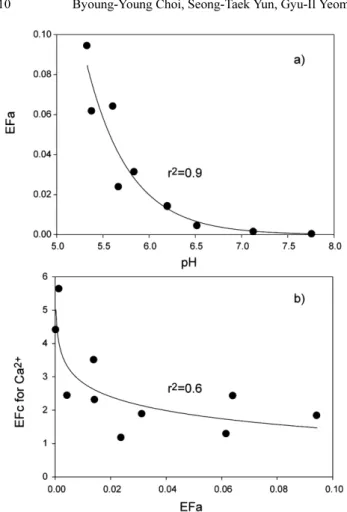
If the acidity generated by H2SO4 and HNO3 (i.e., two major acidic components) cannot be neutralized in rain, the EFa value approaches the unity. However, the calculated EFa values for our rainwater samples are very low (below 0.09; Table 2). The EFc values were the highest for Ca2+
(1.17 to 5.63). In addition, the EFa values showed a strong inverse correlation with both pH and the EFc value for Ca2+
(Fig. 5). These results explain that most of the anthropo- genically formed acidic components (largely from a coal- fire power plant) in JC rainwater are effectively and rapidly neutralized by Ca2+ from a geologic source (i.e., limestone particles).
3.2.2. Spatial variation of pH and ionic concentrations To examine the spatial variation of rainwater chemistry in relation to the distance from two contrasting point sources, rainwater samples were collected simultaneously at several sites (n=9) along two transects. The results are summarized in Table 3 (for the transect from JC to YW) and Table 4 (for the transect from JC to DY) and are graphically shown in Figure 6. The pH of rainwater samples tended to decrease steadily toward YW from JC, and showed the lowest value (6.17) near a coal-fired power plant (Table 3; left column in Fig. 6). On the contrary, the pH of rainwater samples along the transect from JC to DY gradually increased toward DY.
In this case, the highest value (6.88) was obtained near the cement-manufacturing plants (Table 4; right column in Fig.
6). These observations provide additional evidence that the precipitation chemistry is strongly affected by the two types of stationary sources.
Our explanation on spatial controls of rainwater pH can also be confirmed by the spatial variation of ionic concen- trations. For the samples (n=5) between JC and YW, the concentrations of cations (Na+, Ca2+, K+, and Mg2+) decreased progressively toward YW, while those of NO3- and SO42-
tended to increase (see the left column in Fig. 6). On the Fig. 5. Changes of the calculated enrichment factors for the acidity
(EFa) (in a) and Ca2+ (EFc for Ca2+) (in b) for rainwater samples from 9 monitoring sites along the transects ‘A’ to ‘E’ and ‘a’ to ‘d’
(see Fig. 1 for localities).
Table 3. Summary of the precipitation chemistry (June 1998) along the transect from JC to YW Sampling
site*
Distance (km)**
Rainwater pH
Concentrations (µeq/l)
Na+ K+ Mg2+ Ca2+ F- Cl- NO3- SO42- HCO3-
a 9.5 6.53 347.0 145.5 36.2 227.7 0.2 56.8 23.4 54.7 N.D.
b 11.5 6.40 200.2 140.1 56.4 344.3 1.0 94.9 30.3 48.4 N.D.
c 19 6.31 141.5 66.3 15.1 147.9 55.8 175.4 22.1 62.0 N.D.
d 23 6.17 72.9 41.6 21.8 118.1 61.0 135.2 61.3 65.8 N.D.
*See Fig. 1 for localities
**Distance from the city center of JC N.D. = not determined
other hand, rainwater samples (n=4) collected along the transect between JC and DY showed the weakly increasing trends in Ca2+ and HCO3- toward DY (see the right column in Fig. 6). We consider that the irregular variations in the transect between JC and DY are likely caused by the wide- spread limestone sources along the transect (see Fig. 1).
Nevertheless, the prevalence of Ca2+ and HCO3- among dis- solved ions in samples between JC and DY indicates the significant role of limestone dissolution in the observed rainwater chemistry. The spatial variations of pH and ionic concentrations along the two transects strongly support that the rainwater chemistry in and around JC is regulated by two contrasting stationary sources.
4. CONCLUSIONS
The precipitation chemistry during 1995 to 1998 in and around JC was carefully examined by considering contam- inant sources and wind directions. The two major stationary point sources around JC are 1) the coal-fired power plant at ENE of JC and 2) limestone quarries and cement factories at E to SSE. Our results confirm that the temporal variation of the pH and ionic components in rainwater is regulated by their relative roles. Their counteracting roles are affected fairly sensitively by the prevailing wind direction during the rainfall. In addition, the pH and ionic concentration of the rain vary progressively as a function of the distance and Table 4. Summary of the precipitation chemistry (June 1998) along the transect from JC to DY
Sampling site*
Distance (km)**
Rainwater pH
Concentrations (µeq/l)
Na+ K+ Mg2+ Ca2+ F- Cl- NO3- SO42- HCO3-
A 2.25 6.56 89.8 66.8 71.4 291.6 0.2 82.8 27.5 17.7 190.8
B 6.5 6.61 70.4 70.1 166.9 572.3 0.4 77.7 20.1 17.3 313.9
C 8.75 6.6 93.2 130.5 99.4 407.6 0.0 115.4 16.7 42.4 291.2
D 10.75 6.74 111.1 83.5 63.4 292.0 0.2 90.3 24.6 24.4 325.9
E 13.75 6.88 125.9 151.9 74.4 383.4 0.7 148.7 27.1 22.8 351.8
*See Fig. 1 for localities
**Distance from the city center of JC
Fig. 6. Spatial changes in the rainwater chemistry along the transects ‘A’ to ‘E’
and ‘a’ to ‘d’ (see Fig. 1 for localities).
direction from two contrasting sources. Our results show a good example that both meteorological and geological con- ditions exert significant influences on airborne pollution and the associated precipitation chemistry.
ACKNOWLEDGMENTS: This work was supported by the Envi- ronmental Geosphere Research Lab (EGRL) of Korea University which was funded from Korea Research Foundation (KRF). We thank many colleagues who helped us for the collection and analysis of field samples. Many constructive comments by Dr. B. Mayer (University of Calgary), Dr. M. Cho (journal editor), Dr. K. Kim (Kunsan National University), and an anonymous journal reviewer substantially improved this manuscript.
REFERENCES
Ahmed, A.F.M, Singh, R.P., and Elmubarak, A.H., 1990, Chemistry of atmospheric precipitation at the western Arabian Gulf Coast.
Atmospheric Environment, 24A, 2927–2934.
Al-Momani, I.F. and Ataman, O.Y., 1995, Chemical composition of precipitation near an industrial area at Izmir, Turkey. Atmospheric Environment, 29, 1131–1143.
Alastuey, A., Querol, X., Chaves, A., Ruiz, C.R., Carratala, A., and Lopez-Soler, A., 1999, Bulk deposition in a rural area located around a large coal-fired power station, Northeast Spain. Envi- ronmental Pollution, 106, 359–367.
Arsene, C., Olariu, R.I., and Mihalopoulos, N., 2007, Chemical com- position of rainwater in the northeastern Romania, Iasi region (2003–2006). Atmospheric Environment, 41, 9452–9467.
Asman, W.A.H., Slanina, J., and Baard, J.H., 1981, Meteorological interpretation of the chemical composition of rain-water at one measuring site. Water, Air, and Soil Pollution, 16, 159–175.
Balasubramanian, R., Victor, T., and Chun, N., 2001, Chemical and statistical analysis of precipitation in Singapore. Water, Air, and Soil Pollution, 130, 451–456.
Chae, G.T., Yun, S.T., Kim, K.H., Lee, P.K., and Choi, B.Y., 2004a, Atmospheric versus lithogenic contribution to the composition of first- and second-order stream waters in Seoul and its vicinity.
Environment International, 30, 73–85.
Chae, G.T., Kim, K., Yun, S.T., Kim, K.H., Kim, S.O., Choi, B.Y., Kim, H.S., and Rhee, C.W., 2004b, Hydrogeochemistry of allu- vial groundwaters in an agricultural area of Korea: an implication for groundwater contamination susceptibility. Chemosphere, 55, 369–378.
Chae, G.T., Yun, S.T., Kim, K., and Mayer, B., 2006, Hydrogeochem- istry of sodium-bicarbonate type bedrock groundwater in the Pocheon spa area, South Korea: water-rock interaction and hydrologic mixing. Journal of Hydrology, 321, 326–343.
Chang, C.T., Lin, T.C., and Hsueh, M.L., 2005, Characterizing pre- cipitation chemistry in Changhua, central Taiwan using weather conditions and multivariate analysis. Water, Air, and Soil Pollu- tion, 165, 61–75.
de Mello, W.Z. and de Almeida, M.D., 2004, Rainwater chemistry at the summit and southern flank of the Itatiaia massif, Southeastern Brazil. Environmental Pollution, 129, 63–68.
Duysings, J.J.H.M., Verstraten, J.M., Bruijnzeel, L., and Bouten, W., 1985, Relationships between precipitation chemistry and some meteorological parameters in the Netherlands: a statistical eval- uation. Water, Air, and Soil Pollution, 28, 213–225.
Flues, M., Hama, P., Lemes, M.J.L., Dantas, E.S.K., and Fornaro, A.,
2002, Evaluation of the rainwater acidity of a rural region due to a coal-fired power plant in Brazil. Atmospheric Environment, 36, 2397–2404.
Gülsoy, G., Tayanç, M., and Ertürk, F., 1999, Chemical analyses of the major ions in the precipitation of Istanbul, Turkey. Environ- mental Pollution, 105, 273–280.
Harrison, R.M. and Plo, C.A., 1983, Major ion composition and chemical associations of inorganic atmospheric aerosols. Envi- ronmental Science & Technology, 17, 169–174.
Heuer, K., Tonnessen, K.A., and Ingersill, G.P., 2000, Comparison of precipitation chemistry in the central Rocky Mountains, Colo- rado, USA. Atmospheric Environment, 34, 1713–1722.
Hontoria, C., Saa, A., Almorox, J., Cuadra, L., Sanchez, A., and Gasco, J.M., 2003, The chemical composition of precipitation in Madrid.
Water, Air, and Soil Pollution, 146, 35–54.
Kang, G.U., Lee, J.H., and Kim, H.K., 1996, Interpretation of ana- lytical data of ion components in precipitation, Seoul. Journal of Korea Air Pollution Research (J. KAPRA), 12, 323–332.
Kim, H.S. and Chung, Y.S., 2007, Large-scale transport of air pol- lutants in the East Asian region: satellite and ground observa- tions. Journal of Korean Earth Science Society, 28, 123–135.
Lee, B.K., Hong, S.H., and Lee, D.S., 2000, Chemical composition of precipitation and wet deposition of major ions on the Korean Peninsula. Atmospheric Environment, 34, 563–575.
Lee, K.J. and Chung, Y.S., 1996, Acidity analysis of precipitation occurred at Woongchon, Choongnam. Journal of Korea Air Pol- lution Research (J. KAPRA), 12, 179–187.
Lee, S.I., Kim, S.H., Cho, K.C., and Kim, H.K., 1996, A study on the ionic components of rain water in Samchok-City area. Journal of Korea Air Pollution Research (J. KAPRA), 12, 23–28.
Na, C.K. and Chung, J.I., 1997, Chemical composition of rainwater in Chonju-city, Korea. Journal of Korea Air Pollution Research (J. KAPRA), 13, 371–381.
Neal, C., 2002, Interception and attenuation of atmospheric pol- lution in a lowland ash forested site, Old Pond Close, Northamptonshire, UK. Science of the Total Environment, 282-283, 99–119.
Norman, M., Das, S.N., Pillai, A.G., Granat, L., and Rodhe, H., 2001, Influence of air mass trajectories on the chemical composition of precipitation in India. Atmospheric Environment, 35, 4223–4235.
Özsoy, T. and Saydam, A.C., 2000, Acidic and alkaline precipitation in the Cilician Basin, north-eastern Mediterranean Sea. Science of the Total Environment, 253, 93–109.
Park, S.U. and Lee, Y.H., 2002, Spatial distribution of wet deposition of nitrogen in South Korea. Atmospheric Environment, 36, 619–
628.
Park, S.U., In, H.J., Kim, S.W., and Lee, Y.H., 2000, Estimation of sulfur deposition in South Korea. Atmospheric Environment, 34, 3259–3569.
Possanzini, M., Buttini, P., and Dipalo, V., 1988, Characterization of a rural area in terms of dry and wet deposition. Science of the Total Environment, 74, 111–120.
Rogora, M., Mosello, R., and Marchetto, A., 2004, Long-term trends in the chemistry of atmospheric deposition in northwestern Italy:
the role of increasing dust deposition. Tellus, 56, 426–434.
Sequeira, R. and Lai, C.C., 1998, Small-scale spatial variability in the representative ionic composition of rainwater within urban Hong Kong. Atmospheric Environment, 32, 133–144.
Seto, S., Oohara, M., and Ikeda, Y., 2000, Analysis of precipitation chemistry at a rural site in Hiroshima Prefecture, Japan. Atmo- spheric Environment, 34, 621–628.
Tuncer, B., Bayar, B., Yesilyurt, C., and Tuncel, G., 2001, Ionic com- position of precipitation at the central Anatolia. Atmospheric Environment, 35, 5989–6002.
Weijers, E.P. and Vugts, H.F., 1990, An observational study on pre- cipitation chemistry data as a function of surface wind direction.
Water, Air, and Soil Pollution, 52, 115–132.
Zhang, J. and Liu, C.Q., 2004, Major and rare earth elements in rain- waters from Japan and East China Sea: natural and anthropo-
genic sources. Chemical Geology, 209, 315–326.
Zhang, M., Wang, S., Wu, F., Yuan, X., and Zhang, Y., 2007, Chem- ical compositions of wet precipitation and anthropogenic influ- ences at a developing urban site in southeastern China. Atmospheric Research, 84, 311–322.
Manuscript received February 5, 2008 Manuscript accepted August 4, 2008