DOI 10.17480/psk.2016.60.5.250
F4 인삼배당체의 면역 보조 효과
한 용 문#
동덕여자대학교 약학대학 면역 · 미생물학교실
(Received July 25, 2016; Revised August 26, 2016; Accepted September 1, 2016)
Immunoadjuvant Effect of Ginsenoside F4
Yongmoon Han#
Department of Immuno Microbiology, College of Pharmacy Dongduk Women's University, Seoul 136-714, Korea
Abstract — There have been many attempts to treat candidal infections by immunological approaches. One attempt is to find a certain adjuvant that induces a protective antibody in host. Previously, we have reported that MAb B6.1, specific for β-1,2 mannotriose located on the Candida albicans cell wall (CACW), protects mice against disseminated candidiasis and vaginal infection. However, the isolation of such an epitope is very costly and requires tremendous amount of time. Thus, this led us to find a simple way to obtain a compound that induces protective antibody. For this purpose, we focused on the discovery of immuoadjuvants capable of inducing protective antibodies. In the present study, we tested whether ginsenoside F4 from Red Ginseng has immunoadjuvant activity against fungal infection. Data displayed that a formulae of CACW com- bined with F4 (CACW/F4) enhanced production of anti-C. albicans antibody in mice. Analyses by IgG isotyping showed that the formulae suppressed IgG1 (Th2-immunity polarized) but enhanced IgG2b (Th1-immunity polarized), thus resulting in a Th1 immune response. This effect was assessed in a murine model of disseminated candidiasis due to C. albicans. The assesment displayed that the formulae enhanced resistance of mice against the candidiasis, whereas CACW alone was not protective. Overall, F4 has immunoadjuvant activity that provokes the induction of protective antibody in mice through a possible mechanism that enhances Th1 immunity in mice.
Keywords □ ginsenoside F4, Candida albicans, immunoadjuvant, IgG isotyping, disseminated candidiasis
1980년대 후반부터 T-helper 1(Th1)와 T-helper 2(Th2)의 항 상성(homeostasis) 조절에 의한 질환치료 가능성이 언급되기 시 작해서1,2) 최근에는 Th173,4)과 Treg(regulatory T cell; CD4+ CD25+cell)5,6)같은 새로운 종류의 T-조력세포 등에 대해서 많은 연구가 진행되고 있다. 이들 면역세포는 상호간에 견제와 협조 를 통해서 환자의 면역력 항상성 유지에 관여하는 것으로 알려 져 있다.1-6)이들 세포간의 관계는 매우 복잡하지만, 한 가지 분 명한 것은 이 항상성 유지에 문제가 생기면 숙주에게는 병적 상 태에 있는 것으로 간주 할 수 있다. 이 경우는 질환발생 시 Th1
대 Th2의 정상적인 항상성이 무너진 경우에 해당되므로 이런 비 정상적인 상태를 원래의 상태로 복귀시키면 질환의 치료가 가능 하다는 개념이다.
조력세포(T-helper lymphocyte; CD4+T cell)는 면역계에서 거의 중추적 역할을 담당하고 있다고 해도 과언이 아니다. 이 면 역세포는 적절한 신호와 MHC(Major Histocompatability)를 통 해 제시되는 항원의 자극에 따라서 Th1(= Type 1 immunity)과 Th2(= Type 2 immunity) 유효세포로 분화가 된다.7,8) Th1 또는 Th2로 분화된 유효세포는 각 면역성에 따라 분비하는 cytokine 의 종류가 달라서 이를 근거로 하여 cytokine profile의 개념이 설정되었고9), 이를 근거로 하여 면역반응의 Type을 구분할 수가 있다. 그래서 Th2 면역성은 체액성 면역(Humoral Immunity)에 주로 가담하고 Th1 면역성은 세포매개성면역(Cell-Mediated Immunity)을 유도한다.10-12) Th1와 Th2의 면역유도성을 구분하 는 방법으로 IgG-isotyping이 있으며 사람보다는 생쥐의 IgG
#
Corresponding Author Yongmoon Han
Departments of ImmunoMicrobiology, College of Pharmacy, Dong- duk Women’s University, Seoul 02748, Korea
Tel.: 02-940-4521 Fax.: 02-940-4195
E-mail: [email protected]
Short Report
종설subclass를 기준으로 해서 평가하는데, IgG1(Th2 지향성) 대 IgG2b(또는 IgG2a: Th1 지향성)의 비율의 수치가 클수록 Th2 면역성이 우세하게 발현된 것으로 평가하고 비율의 수치가 낮을 수록 Th1 면역유도성이 더 우세한 것으로 평가한다.13-15) [주: 만 약, IgG2b 대 IgG1로 비교한다면 반대로 평가하면 됨.]
본 연구실에서는 약용식물에서 획득되는 성분들의 면역조절효 과 여부를 수 년 동안 연구를 진행 중에 있다. 본 연구실의 기연구 결과의 대표적인 예를 들면, Rg17)및 Rd16)인삼배당체, daucosterol 은8)면역기능항진작용에 의한 항진균효과가 있고, chlorogenic acid,17) lonicerin18) 그리고감초성분인 18β-glycyrrhetic acid 등은 면역조절력효과에 의해서 감염성 관절염에 치료효과가 있음을 보 고하였다.19)
병원성 세균과 진균(예: Candida albicans)은 인체에 침입하여 감염을 일으켰을 때,Th1 면역성에 비해서 Th2가 우세한 면역 성을 유발하여 감염을 악화시키는 경향이 있어서 항체의 무용론 이 제시된 적도 있었다.4,7,8)하지만, 지난 30 여 년 동안 본 연 구자 동료연구자들은 C. albicans 세포벽 부위의 특정 epitope을 항원으로 유도된 항체는 항진균효과가 있다는 실험결과를 보고
하였고,20-22)현재는 진균기인성 감염에 대한 항체요법의 가능성
은 점차 정설로 되어가고 있다.그러나, 보호효과가 있는 항체를 생체(예: 생쥐) 내에서 유도하기 위해 필요한 항원의 분리는 까 다롭고 막대한 비용이 필요한 단점이 있다. 이에, Th1 면역성이 있는 IgG2a 또는 IgG2b의 IgG isotype을 유도하는 면역조절력 이 있는 면역보조제의 발견은 매우 고무적일 것이다.
본 연구에서는 상기의 연구배경을 바탕으로 F4 인삼배당체 (Fig. 1)의 면역조절을 통한 면역보조제효과를 검색하였다. 면역 유도성 분석은 IgG-isotyping방법을 사용하였으며, 항진균효과의 검색은 전신성 캔디다증(disseminated candidiasis) 동물모델을 사용하여 검색하였다. 현재까지 알려진 F4 인삼배당체의 다른 약 리작용으로는 apoptosis 유도에 의한 항암효과23)와 연골퇴화 방 지효과24)가 있다.
실험재료 및 방법
실험동물
6~7 주령의 BALB/c 암컷생쥐(중앙실험동물)를 사용하였으며 이 생쥐들은 동물실 환경에서 1주일간 적응시킨 후 실험에 사용 하였다. 사육기간 동안은 멸균된 filter-top cage에서 멸균된 사 료와 물을 자유롭게 먹게 하였으며 동물관리는 본 대학교 동물 관리규정과 동물사용윤리위원회 승인[동덕동물201406-01]에 따 라 사용하였다.
균주와 배양조건
C. albicans는 CA-1 균주를 사용하였고,17,19,22,25)실험직전에
37oC에서 GYEP(Glucose-Yeast Extract Peptone) 액체배지에서 24 시간 간격으로 3회 배양한 후 효모형태의 세포를 원심분리법 으로 수집하여 멸균된 인산완충용액(DPBS; pH 7.4; 4oC)으로 3 회 이상 세척하여 사용하였다. 실험에 필요한 세포수효는 hemocytometer(Gibco, USA)를 사용하여 측정하였다.
F4 인삼배당체(Ginsenoside F4)
F4 인삼배당체는 서울대학교 약학대학 천연물연구소 김영식 교수님으로 부터 기증받아 본 연구에 사용하였다. 본 인삼배당 체는 한국산 홍삼(Red Ginseng)에서 mrthylene chloride – methanol – water – isopropanol(6:6:4:1, v/v) 용매를 사용하여 high-speed counter-current chromatography(HSCCC) 방법으로 추 출 분리하였다.27)본 배당체의 순도는 HPLC-ELSD(evaporative light scattering detection)을 사용하여 분석하였으며 순도는 95%
이상으로 평가되었다.27) F4 인삼배당체는 Dammarane 계열의 속 하는 protopanaxtriol 종류의 인삼배당체로서 탄소 6번 위치에 glucose-rhamnose로 연결되어 있다(Fig. 1).27,28)본 인삼배당체 는 실험에 사용하기 전에 endotoxin 오염여부를 상업용 내독소 검색 kit(Sigma)을 사용하여 내독소 오염유무를 확인 한 후 사용 하였다.
C. albians cell wall extract(CACW)의 분리
C. albians의 세포벽분리는 본 연구실의 기연구에서 사용한 방 법을 사용하였다9,22,26)이 방법을 간략히 기술하면 다음과 같다.
GYEP 액체배지에 배양한 C. albicans 세포를 수집한 후 disodium EDTA와 trisodium EDTA로 연속 처리하고 β-mercaptoethanol를
Fig. 1 − Chemical structure of ginsenoside F4, a protopanaxdiol,
isolated from the Korean Red Ginseng. In the structure,
glucose (Glc) and rhamnose (Rha) are attached to C-6
position.
첨가해서 30분 동안 처리한 다음에 수집한 상등액을 투석막 (membrane cut-off = 12,000 Da)에 넣고 멸균된 탈이온수에 대 하여 투석하였다. 투석이 완료되면 투석막 내부에 잔류한 물질 을 동결건조기로 분말화하여서 desiccator안에 저장보관하며 실 험에 사용하였다.
F4 인삼배당체의 면역보조제 효과 및 면역유도성 검색 F4 인삼배당체의 면역보조제 효과(예: 항체생성의 증가)와 면 역유도성(예: Th1/Th2 balance 검색)을 조사하기 위해서 본 연 구실의 기 연구에서 개발한 백신제조방법과 접종일정을 사용하
였다.19,20,24,25)이 방법을 간략히 기술하면 다음과 같다. F4 인삼
배당체 2 mg과 CACW 0.2 mg을 1 ml DPBS가 담긴 5 ml 용량 의 플라스틱용기(Sigma)에 넣고 혼합한 후, 이 혼합액에 IFA (Incomplete Freund's Adjuvant, Sigma) 1 ml를 첨가해서 유화제 형태의 백신제형을 제조하였다(= CACW/F4). 그리고 대조군으 로는 F4를 첨가하지 않고 0.2 mg의 CACW만으로 제조한 제형을 사용하였다(= CACW). 또 다른 음성대조군으로는 생쥐에게 희석 액(DPBS)만을 주입한 생쥐그룹을 사용하였다. 접종일정은 각 생쥐 (BALB/c strain)에 본 백신제형 0.2 ml를 복강내(intraperitoneally:
i.p.)로 1차 접종(Day 1)을 하고 3주 후에 이 생쥐들에게 동일용량 과 동일한 접종경로로 2차 접종(Day 22)을 하였다. 2차 접종 일 주일 후에 생쥐의 꼬리동맥에서 채혈하여 혈청을 수집 분리하였 다. 수집한 혈청에 대한 항 CACW항체의 생성여부와 생성량의 비교는 CACW(2 μg/well)로 코팅한 96-well 평면 plate(Falcon) 에서 ELISA 방법으로 검색하였다.8,20,25) ELISA 검색 시, 수집 된 혈청을 1:100으로 희석하여 CACW으로 coating된 well에 첨 가하고 일정시간 37oC 5%-CO2배양기에서 배양한 후에 DPBS 으로 세척하고 poly Ig's 항체(secondary antibody)를 첨가한 다 음에 동일한 배양조건에서 배양한 다음에 DPBS로 세척한다. 여 기에 OPD용액을 첨가하고 30분 동안 실온에서 배양한 후, 황산 을 투여해서 반응을 정지시키고 microplate reader (Bio-Lab, USA)를 사용하여 발색정도를 측정해서 실험군과 대조군간의 항 체생성 정도를 비교하였다.
F4 인삼배당체의 Th1 대 Th2 면역유도성검색은 수집된 항체 를 이용하여 상업용 IgG-isotyping kit(Sigma: ISO-2)을 구입하 여 제조사의 가이드라인에 따라 생성반응정도를 흡광도로 측정 비교하였다. 측정된 결과로 IgG1과 IgG2b의 생성비율을 계산 분 석하여 Th1- 또는 Th2-type의 면역반응 발현성을 평가하였다.
[CACW/F4] 제형의 효능검색
상기에 기술한 방법으로 제조된 [CACW/F4]제형의 효능을 검 색하기 위해서 본 연구실의 기연구에서 사용한 방법을 활용하여 평가하였다.19,24)이 시험방법은 상기에 기술한 바와 같이 생쥐들 을 [CACW/F4]그룹, [CACW]그룹, [DPBS]그룹으로 나누어서,
상기에 기술한 것과 같이 면역접종을 2회 실시하고, 2차 면역접 종 7일 후에 이들 생쥐 모두에게 C. albicans (5×10⁵ yeast cell/
mouse)를 꼬리정맥을 통해서 감염시킨다. 그 후, 실험군과 대조 군의 평균생존시간(mean survival times: MST)을 관측 비교하 여 전신성 캔디다증(disseminated candidiasis)에 대한 효과를 평 가하였다.
통계 − 실험결과는 평균±표준오차(Mean±S.E.)로 계산하였 으며 유의성 검증은 Student's t-test를 사용하여 값이 5% 미만 일 때에 유의성이 있는 것으로 판정하였다. 생존율의 유의성은 Kaplan-Meier 방법(New Statics for Windows; SPSS, Chicago, USA)을 사용하여 판정하였다.
실험결과 및 고찰
F4 인삼배당체의 항체생성의 증진효과
실험결과, 두 제형(CACW/F4와 CACW) 모두가 항 캔디다항 체를 유도 생성하는 반면에 DPBS을 투여 받은 음성대조군에서 는 항체가 유도되지 않았다(Fig. 2). CACW/F4로 면역된 생쥐에 서 생성된 항체의 생성정도를 나타내는 흡광도 수치(value)는
Fig. 2 − CACW/F4 formulae enhances production of anti-Candida albican antisera in mice. Mice (BALB/c strain) were immunized intrperitoneally (i.p.) with CACW/F4 or CACW, respectively. Mice given diluent (DPBS) by the same route were used as a negative control. They received respective formulae twice at days 1 and 22. Seven days after the last immunization, these animals were bled from the tail for determinaton of antibody induction. These data indicate that F4 may exert immunoregulatory activity with CACW in mice.
**P < 0.05. CACW: Candida albicans cell wall: F4;
ginsenoside F4. Error bar, S.E. Each group contained 5 mice.
CACW만으로 생성된 항체에 비해 거의 1.8배 높게 측정되었다 (P < 0.01) (Fig. 2). 이 결과를 고찰해 볼 때, F4 인삼배당체는 CACW의 면역성을 증진하는 면역보조제의 효과가 있는 것으로 평가가 되었지만, 이 항체가 C. albicans 감염에 보호효과가 있 는지의 여부는 이 실험결과만으로는 알 수가 없다. 그래서 항체 의 C. albicans 감염에 대한 효능을 검색하기 위해서 C. albicans 기인성 전신성 캔디다증(disseminated candidiasis)에 대한 CACW/F4 제형의 효과를 검색하였다.
F4의 면약반응 유도성 효과
수집된 혈청을 활용하여 IgG1과 IgG2b의 생성정도를 측정하 여 Th1 또는 Th2의 면역반응 우세성(dominance)의 여부를 검 색하였다. 분석결과, IgG1의 경우에, 대조군(CACW) 제형이 CACW/F4 제형 보다 거의 20% 정도 더 많이 생성되었다(Fig.
3A). 하지만, IgG2b의 경우에는 오히려 CACW/F4 제형이 대조 군(CACW) 제형에 비해서 대략 6.5% 더 많이 생성을 유도하였 다(Fig. 3B). 이 결과를 수학적으로 계산하여 분석해 보면, CACW 항원에 F4 배당체를 첨가하면 Th2 type의 면역유도성을 나타내 는 IgG1의 생성은 억제되고, Th1 면역반응을 나타내는 IgG2b의 생성이 증가한 것으로 측정되었다. 이 결과를 정리한 Table I을 보면, F4를 첨가하지 않은 CACW 제형의 Th2/Th1 비율이 1.33 인데 반하여, CACW/F4 제형에서의 비율은 1.02로 산출되었다.
양 비율간의 차이는 통계학적으로 유의성이 있다(P < 0.05). 이 분석을 통해서 인삼배당체 F4는 Th2 면역반응을 Th1 면역반응
쪽으로 이전(Shift) 시킬 수 있는 면역조절력이 있는 것으로 평 가되었다.
CACW/F4 제형의 전신성 캔디다증에 대한 효과
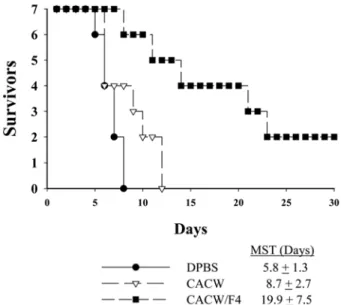
F4 인삼배당체 제형이 생쥐체내에서 Th1 type의 항체를 유도 한다는 결과를 근거로 하여, 이 제형의 항진균효과를 전신성 캔 디다증 동물모델을 사용하여 조사하였다. 실험결과, 30일 동안의 관측기간 동안에 세 그룹 중에서 CACW/F4로 면역된 생쥐들의 평균생존시간이 대략 19.9일로 음성대조군 생쥐들의 평균생존시 간(5.8일)보다 14일 더 연장되었으며(P < 0.05), 관측기간 동안에
Fig. 3 − IgG isotyping displays that CACW/F4 suppresses IgG1 whereas the same fromulae enhances IgG2b when compared with CACW formulae. Antisera isolated from the animals treated as described in Fig. 2 were detected for IgG1 (Th2- immunity polarized) and IgG2b (Th1-immunity polarized), respectively. Data showed that ginsenoside F4 could shift Th2 immunity into Th1 immune response ( P < 0.05), which is beneficial for treating mice against C. albicans infections.
[Synopsis of this mathematical analysis is listed in Table I.]
CACW; Candida albicans cell wall: F4; ginsenoside F4. Error bar, S.E. Each group contained 5 mice.
Table I − Ginsenoside F4 induces dominant Th2 type immune response.
Averages of: Ratio of
Treatments [IgG1] IgG2b] [IgG1]/[IgG2b]
CACW
*0.64 0.48 1.33
CACW/F4
+0.53 0.52 1.02
*
C. albicans cell wall;
+Ginsenoside F4
Fig. 4 − CACW/F4 formulae enhances resistance of mice against disseminated candidiasis. Mice immunized, i.v.,with CACW/
F4 were challenged, i.p., with live C. albicans. Control mice were given CACW or DPBS only before the challenge, ant their survival times were measured during an observation period of 30 days. Data showed that CACW/F4-immunized mice survived longer than control animal groups that received DPBS(a negative control) against the disease ( P <
0.05). Although mice given CACW also induced ant-C.
albicans antisera, these animals were not protected. The
protection may be polarization of Th2 immunity into Th1
immunity by ginsenoside F4. CACW; Candida albicans cell
wall: F4; ginsenoside F4: MST; mean sutvival times. Each
group contained 7 mice.
7마리 중에서 2마리는 생존하였다(Fig. 4). 반면에 CACW 제형 으로 처리된 생쥐들은 관측기간 12일 째에 모두 사멸하였으며, 평균생존시간은 음성대조군의 생존시간 보다는 대략 3일정도 연 장(평균생존시간=8.7일)되었지만 그 차이는 매우 통계적으로 유 의성은 없다(Fig. 4). 이 실험결과를 고찰하면, CACW 제형도 항 체를 생성하지만 이 항체는 보호효과가 없는 반면에, F4가 함유 된 CACW/F4 제형으로 면역된 생쥐의 체내에서는 F4의 면역조 절반응에 의해서 Th1 type의 면역반응을 유도하여 보호효과를 발현하는 것으로 사료된다.
결 론
본 연구에서는 F4인삼배당체의 면역보조제 효능에 관해서 조 사하였다. 이 연구를 위해서 항원으로 C. albicans 세포벽물질 (CACW)에 F4를 첨가한 제형을 동물에 접종하여 유도되는 항체 생성의 증진여부와 항체에 대한 IgG isotyping 방법을 검색하여 Th2/Th1 비율에 의한 면역우세성을 분석 평가하였다. 분석된 면 역우세성의 효능을 평가하기 위해서 전신성 캔디다증 동물모델 을 사용하였다. 산출된 모든 결과를 요약했을 때, CACW/F4 백 신제형은 F4를 첨가하지 제형보다 BALB/c 생쥐에서 항체생성 을 증진시켰으며, IgG isotyping 방법에 의하면, 생쥐의 IgG에는 Th1 면역반응에 우세한 항체의 비율이 Th2 지향성 항체보다 높 게 평가되었다. 이 결과는 고무적이어서 이 항체의 효능에 대해 서 본 연구실의 기 연구에서 활용하여 특성이 규정된 전신성 캔 디다증 모델을 사용하여 조사하였는데, CACW/F4 제형으로 면 역된 생쥐그룹이 대조군들에 비해서 생존시간이 연장되었다. 하 지만, CACW는 거의 보호효과를 발현하지 못했다. 결론적으로 F4의 도움이 없이 CACW만으로 면역된 생쥐에서도 비록 항체 는 유도 생성이 되었지만, C. albicans 감염에 대해서는 거의 효 과가 없었다. 아마도 항체생성량이 적어서 보호효과가 없다고 할 수도 있지만, Th1 지향성을 발현하는 IgG2b 생성량을 상호비교 해보면 거의 동일한 수준의 IgG2b 항체가 생성되었으므로 상기 의 추론에 설득력은 없어 보인다. 이에, F4 인삼배당체는 캔디다 증에 보효효과를 발현하는 항체를 유도하는 면역보조제효능이 있는 것으로 평가가 된다. 또한, 이 정보를 통해서 기존의 진균 백신 개발에서 특정 항원분리를 때문에 고가의 비용을 사용하지 않고도 F4 인삼배당체와 같은 면역보조제를 활용해서 보호효과 가 있는 항체생성을 유도할 가능성이 있기 때문에 진균백신 개 발에 도움을 제공할 것으로 사료된다.
감사의 말씀
본 연구를 위해 F4 인삼배당체를 증정해주신 김영식 교수님(서 울대학교 약학대학 천연물연구소)께 감사드립니다.
References
1) Mosmann, T. R. and Sad, S. : The expanding universe of T-cell subsets: Th1, Th2 and more. Immunol. Today 17, 138 (1996).
2) Abbas A. K. 1., Murphy, K. M., and Sher A. : Functional diversity of helper lymphocytes. Nature 383, 787 (1996).
3) Hirahara, K. and Nakayama, T. : CD4+ T-cell subsets in inflammatory diseases: beyond the Th1/Th2 paradigm. Int.
Immunol. 4, 163 (2016).
4) Kidd, P. : Th1/Th2 balance: the hypothesis, its limitations, and implications for health and disease. Altern. Med. Rev. 8, 223 (2003).
5) Groux, H., O'Garra, A., Bigler, M., Rouleau, M., Antonenko. S., de Vries J. E., and Roncarolo, M. G. : A CD4+ T-cell subset inhibits antigen-specific T-cell responses and prevents colitis.
Nature 389, 737 (1997).
6) Singh, V. K., Mehrotra, S., and Agarwal, S. S. : The paradigm of Th1 and Th2 cytokines: its relevance to autoimmunity and allergy. Immunol. Res. 20, 147 (1999). Review.
7) Lee, J. H. and Han, Y. : Ginsenoside Rg1 helps mice resist to disseminated candidiasis by Th1 type differentiation of CD4+
T cell. Int. Immunopharm. 6, 1424 (2006).
8) Lee, J. H., Lee, J. Y., Park, J. H., Jung, H. S., Kim, J. S., Kang, S. S., Kim, Y. S., and Han, Y. : Immunoregulatory activity by daucosterol, a beta-sitosterol glycoside, induces protective Th1 immune response against disseminated Candidiasis in mice. Vaccine 25, 3834 (2007).
9) MacLeod, M. K., McKee, A., Crawford, F., White, J., Kappler.
J., and Marrack, P. : CD4 memory T cells divide poorly in response to antigen because of their cytokineprofile. Proc.
Natl. Acad. Sci. (USA). 23, 14521 (2008).
10) Chen, G. H., McNamara, D. A., Hernandez, Y., Huffnagle, G.
B., Toews, G. B., and Olszewski, M. A. : Inheritance of immune polarization patterns is linked to resistance versus susceptibility to Cryptococcus neoformans in a mouse model.
Infect. Immun. 76, 2379 (2008).
11) Weaver, C. T., Hatton, R. D., Mangan, P. R., and Harrington, L.
E. : IL-17 family cytokines and the expanding diversity of effector T cell lineages. Annu. Rev. Immunol. 25, 821 (2007).
12) Corthay, A. : A three-cell model for activation of naïve T helper cells. Scand. J. Immunol. 64, 93 (2006).
13) Fahey, J. L, Wunderlich, J., and Mishell, R. : The immunoglobulins of mice four major classes of immunoglobulins: 7s gamma-2-, 7s gamma-1-, gamma-1a (beta-2a)-, and 18s gamma-1m-globulins. J.
Exp. Med. 120, 223 (1964).
14) Eivazi, S., Majidi, J., Aghebati Maleki L., Abdolalizadeh, J., Yousefi, M., Ahmadi, M., Dadashi, S., Moradi, Z., and Zolali, E. : Production and Purification of a Polyclonal Antibody Against Purified Mouse IgG2b in Rabbits Towards Designing Mouse
Monoclonal Isotyping Kits. Adv. Pharm. Bull. 5, 109 (2015).
15) Marcovina, S., Cremonesi, L., Price, P. J, McDougal, J. S. : Production and immunochemical study of monoclonal antibodies directed against human low density lipoprotein. Dev. Biol. Stand.
57, 399 (1984).
16) Han, Y. and Rhew, K. Y. : Ginsenoside Rd induces protective anti-Candida albicans antibody through immunological adjuvant activity. Int. Immunopharmacol. 3, 651 (2013).
17) Lee, J. H., Park, J. H., Kim, Y. S. and Han, Y. : Chlorogenic acid, a polyphenolic compound, treats mice with septic arthritis caused by Candida albicans. Int. Immunopharmacol. 8, 1681 (2008).
18) Lee, J. H. and Han, Y. : Antiarthritic effect of lonicerin on Candida albicans arthritis in mice. Arch. Pharm. Res. 34, 853 (2011).
19) Kim, J, Joo, I., Kim, H., and Han, Y. : 18β-glycyrrhetinic acid induces immunological adjuvant activity of Th1 against Candida albicans surface mannan extract. Phytomedicine 20, 951 (2013).
20) Han, Y. and Cutler, J. E. : Antibody response that protects against disseminated candidiasis. Infect. Immun. 63, 2714 (1995).
21) Han, Y., Riesselman, M. H., and Cutler, J. E. : Protection against candidiasis by an immunoglobulin G3 (IgG3) monoclonal antibody specific for the same mannotriose as an IgM protective antibody. Infect. Immun. 68, 1649 (2000).
22) Han, Y., Kozel, T. R., Zhang, M. X., MacGill, R. S., Carroll, M.
C., and Cutler, J. E. : Complement is essential for protection by an IgM and an IgG3 monoclonal antibody against experimental,
hematogenously disseminated candidiasis. J. Immunol. 167, 1550 (2001).
23) Lee, J. H., Lim H., Shehzad, O., Kim, Y. S., and Kim, H. P. : Ginsenosides from Korean red ginseng inhibit matrix metalloproteinase-13 expression in articular chondrocytes and prevent cartilage degradation. Eur. J. Pharmacol. 724, 145 (2014).
24) Chen, B., Shen, Y. P., Zhang, D. F., Cheng, J., and Jia, X. B. : The apoptosis-inducing effect of ginsenoside F4 from steamed notoginseng on human lymphocytoma JK cells. Nat. Prod. Res.
27, 2351 (2013).
25) Han, Y., Kanbe, T. K., Cherniak, R., and Cutler, J. E. : Biochemical characterization of Candida albicans epitopes that can elicit protective and nonprotective antibodies. Infect.
Immun. 65, 4100 (1997).
26) Han, Y., Morrison, R. P., and Cutler, J. E. : A vaccine and monoclonal antibodies that enhance mouse resistance to Candida albicans vaginal infection. Infect. Immun. 66, 5771 (1998).
27) Ha, Y. W., Lim, S. S., Ha, I. J.., Na, Y.-C., Seo, J.-J. Shin, H., Son, S. H., and Kim, Y. S. : Preparative isolation of four ginsenosides from Korean red ginseng (steam-treated Panax ginseng C. A.
Meyer), by high-speed counter-current chromatography coupled with evaporative light scattering detection. J. Chromatogra. A.
1151, 37 (2007).
28) Park, J. D., Rhee, D. K., and Lee Y. H. : Biological activities and chemistry of saponins from Panax ginseng C. A. Meyer.
Phytochem. Rev. 4, 159 (2005).