DOI 10.17480/psk.2015.59.6.259
전신성 캔디다증에 대한 산사자 추출물과 Fluconazole의 병용요법에 의한 항진균 상승효과
한 용 문#
동덕여자대학교 약학대학 면역 · 미생물학교실
(Received September 24, 2015; Revised October 27, 2015; Accepted October 28, 2015)
Synergistic Antifungal Activity against Disseminated Candidiasis by Combination Therapy of Crataegi Fructus Extract and Fluconazole
Yongmoon Han#
Department of ImmunoMicrobiology, College of Pharmacy, Dongduk Women’s University, Seoul 136-714, Korea
Abstract — In recent, there are increasing reports about pharmacological activities of Crataegi Fructus which has been used for many centuries as medicinal and food sources in East Asia. However, its antifungal efficacy needs to be inves- tigated. Thus, in the current study, we determined synergistic antifungal activity of the Crataegi Fructus extract (CFE) when combined with fluconazole (FLC) against disseminated candidiasis due to Candida albicans. This fungus is one of the most problematic fungal pathogens. Data resulting from a microdilution susceptibility test showed that CFE had a dose-dependent antifungal activity. When the extract was combined with FLC, the activity was synergistic. For example, the antifungal activ- ity by the combination of CFE at 20μg/ml plus FLC at 0.1 μg/ml was 4 times more effective than antifungal activity by FLC alone at the same concentration (P<0.05). In the murine model of disseminated candidiasis, the combination therapy poten- tiated resistance of mice, resulting in 80% of C. albicans-infected animals surviving the entire period of 40 days observation, whereas mice given CFE alone or FLC alone all died with 17 and 23 days, respectively, although they survived longer than the untreated control animals (P<0.05). The CFE’s antifungal activity seemed to be related to the blockage of hyphal pro- duction of C. albicans yeast cells. In summary, CFE has a synergistic antifungal activity, which can be produced by combining CFE with FLC. Thus, our data strongly indicate that CFE may be a potential candidate as an antifungal agent for com- bination therapy.
Keywords □ Crataegi Fructus extract, Candida albicans, fluconazole, combination therapy, disseminated candidiasis, syn- ergistic antifungal activity
최근에 면역력 결핍성 질환자와 아울러 암환자 발생의 증가로 인하여 감염성 병원균에 의한 문제가 많이 대두되고 있다. 세균 감염증 뿐만 아니라 진균 감염증으로 인한 문제도 매우 심각한 실정이다.1-3) 하지만, 진균 감염증 치료용 항생물질의 종류는 세 균감염 치료에 사용하는 항생제에 비해서 종류가 다양하지 못할 뿐만 아니라 부작용도 많아서 새로운 항진균제의 개발과 기존의 항진균제를 활용하는 치료요법의 고안이 필요하다.
병원성 진균 중에서 가장 많은 문제를 유발하는 진균으로는 Candida albicans를 손꼽을 수가 있는데, 최근에는 항진균제에 내 성이 있는 C. albicans 균주의 출현으로 인해 이 진균에 의한 감 염율이 증가 추세에 있다.4,5) C. albicans는 다형태성(polymorphic) 진균으로 세균과 진균을 합친 전체 원내감염균 중에서는 4위를 차지하고 원내감염성 진균 중에서는 C. albicans가 1위를 차지하 는데, 이 진균은 당뇨증과 같은 소모성 질환자와 암환자들에게 는 매우 치명적이다.1,6-8) C. albicans는 건강한 여성에게도 질감 염을 유발하는데, 전 세계 여성의 70% 이상이 일생에 한번 이상 은 C. albicans 기인성 질감염 때문에 고통을 받는다는 보고가
있다.9,10)이 진균은 균사(hyphae)를 생성할 수가 있어서 인체 내
거의 모든 장기에 침투가 가능해서 감염증을 악화시키기도 한다.
이런 까닭에 C. albicans의 균사생성의 능력은 매우 중요한 병원
#
Corresponding Author Yongmoon Han
Department of ImmunoMicrobiology, College of Pharmacy, Dong- duk Women’s University, Seoul 136-714, Korea
Tel.: 02-940-4521 Fax.: 02-940-4195
E-mail: [email protected]
Short Report
종설성 인자(virulence factor)로 간주되고 있다.1,4,5)그래서, 항진균 제 개발에서 균사억제는 항진균활성의 중요한 요소로 인식되고 있다. 다양한 종류의 캔디다 감염증에 적용하는 항진균제로는 polyene 계열의 amphotericin B와 azole 계열의 fluconazole (FLC), ketoconazole 등으로 크게 양대구분을 해서 진균증에 적 용을 하고 있지만,11)최근에는 이들 모든 약물에 내성이 있는 균 주의 출현과 부작용7,8)때문에 새로운 항진균제의 개발과 함께 진균백신의 개발, 약물용량의 감소와 상승효과의 발현을 위해 병 용요법(combination therapy) 등의 새로운 요법의 고안에 많은 연구가 집중되고 있다. 이에, 본 연구실에서는 지난 15여 년 동 안, 다양한 종류의 약용식물 추출물 및 단일성분들을 대상으로 하여 이들 성분 중에서 C. albicans에 대한 항진균활성이 있는 성분의 규명, 이들 성분과 기존의 항진균제를 혼용하는 소위 병 용요법을 통한 항균력 증진에 대한 연구를 수행하고 있다. 이런 연구목적을 위해 기초검색과정을 통해서 산사자(Crataegi Fructus) 를 선정하였다.
산사자는 장미과(Rosaceae)에 속하는 산사나무(Crataegus pinnatifida)의 열매로서, 구형 또는 난형이며 적갈색을 띠고 있 다. 성숙한 열매는 식용과 약용으로 사용하기도 한다. 한방에서는 위장의 기능을 돕는 위조정제 또는 소화촉진제로 주로 사용하고 있고, 그 이외도 산사자는 다양한 약리활성이 있다. 대표적 약리 활성으로는, 내피세포 의존성 혈관이완활성,12) 고지혈증 개선 및 항우울증 효과,13)항산화효과,14,15)항염증효과,16)간보호효과,17) 항암효과,18,19)트롬빈 저해활성작용,20)그리고 항균활성21-25)등 이 있다. 본 연구의 목적은 산사자의 항균활성에 관한 것이므로, 이 분야에 관한 문헌을 정리해보면 다음과 같다. 2002년에 산사 자의 항세균 활성이 보고된 후,21) 2010년에는 더 다양한 종류의 세균에 대한 항세균활성 연구조사,22,24) 그리고 항생제 다제내성 이 있는 세균들(예: 녹농균)에 대한 항균효과에 관련한 보고와22) 본 연구실의 기 연구결과25)등을 통해서 산사자의 항세균효과 에 관한 데이터가 획득되었다. 그 후 2013년에는 산사자로부터 분리된 catechin과 epicatechin의 단일성분에 의한 MRSA (methicillin-resistant Staphylococcus aureus) 세균주에 대한 항세 균효과가 보고되기도 했다.23)하지만, 산사자의 항진균활성에 관 해서는 연구결과가 거의 전무한 형편으로, 지금까지는 2010년에 발표된 산사자의 추출물이 C. albicans의 증식을 억제한다는 보 고가 거의 유일한 것으로 사료된다.22)하지만, 아직까지 구체적 으로 산사자의 어떤 성분이 항진균활성에 관여하는지는 알려진 바가 없다. 문헌조사에 의하면, 산사자에는 다양한 성분이 함유 되어 있는 것으로 여겨진다. 산사자의 주요성분으로는 triterpenoid 계열의 ursolic acid, corosolic acid, euscapic acid, crataegolic acid 등이 있고, flavonoid 성분에 속하는 quercetin, kaempferol 과 항산화효과가 보고된 chlorogenic acid, caffeic acid, gallic acid, pyrogallol 및 procatechuic acid 등의 폴리페놀성
(polyphenolic) 성분 등이 있다.22,26)본 연구를 위한 산사자의 선 정에 상기 문헌자료를 활용하였다.
이에, 본 연구에서는 산사자 추출물의 항진균 상승효과의 여 부를 조사하였다. 이 연구를 위해서 임상에서 캔디다 감염증에 주로 적용하는 azole 계열의 FLC와 산사자 추출물의 병용요법 에 의한 항진균 상승효과를 In-vitro 실험조건에서 먼저 검색하 고, C. albicans 기인성 전신성 캔디다증(disseminated candidiasis) 동물모델에서 그 상승효과의 발현여부를 검색하였다. 아울러, 산 사자의 항진균 작용기전을 연구 조사하였다.
실험재료 및 방법
C. albicans 균주 및 배양조건
C. albicans 균주는 본 연구실의 기존 연구27-29)에서 그 특성이 규명된 CA-1 균주를 사용하였으며, 균주배양은 GYEP(Glucose- Yeast Extract Peptone) 액체배지에서 37oC를 유지하며 24시간 씩 세 번 계대 배양한 후 사용하였다. 균주는 원심분리법으로 수 집하여 멸균된 인산 완충용액(Dulbecco’s Phosphate Buffered Saline solution: DPBS, Sigma, St. Louis, MO, USA)으로 3회 반복 세척한 다음에 사용하였으며, 균수는 hemocytometer (Sigma)를 이용하여 계수하고 원하는 균의 수효를 DPBS로 희석 하여 준비하였다.
실험동물
실험에 사용된 생쥐는 6~7주령의 BALB/c 암컷 생쥐(Charles River Lab, NY, USA)를 구입하여 본 실험에 사용하였다. 이들 생쥐에게는 멸균된 사료(Central Lab, Animal Inc. Seoul, Korea) 및 물을 제공하였으며, 생쥐들이 사료와 물을 자유롭게 먹도록 하였다. 이들 생쥐는 실험하기 직전 1주일간 본 동물실 환경에 적응시킨 후 사용하였다. 사육실의 환경은 온도 20±2oC, 상대습도는 50±10%로 유지하고 조명은 12시간 간격으로 주야 를 조절하였다. 동물관리는 동덕여자대학교 동물관리규정과 동 물사용윤리위원회 승인[IRB: 동덕동물201403-02]에 따라 사용하 였다.
산사자 추출물(Crataegi Fructus Extract: CFE)
산사자[Omni Herb, 대구] 서울 경동시장에서 구입하였으며, 본 제품의 진의 여부 및 품질 등은 이종현 박사(동덕여대 약학 과 생약학 및 천연의약품 담당교수)가 검증하였다. 추출은 20 g 의 산사자에 무수 메탄올(99.5%) 150 ml를 첨가한 후, 가온 추 출방법을 통해 60분씩 3회 추출한 후 원심분리 방법으로 잔사와 추출액을 분리하여 추출액을 수집한 다음에 건조하여 제조하였 다. 실험에 사용할 CFE는 일정량의 CFE에 DPBS를 가하여 용 해한 후에 여과멸균(pore size=0.45 µm)하여 준비하였다.
In-vitro 항균활성 및 상승효과 검색
본 검색을 위해 본 연구실의 기연구에서 사용한 액체배지희석 감수성 시험법을 적용하였다.27,29)이 방법을 간략히 기술하면 다 음과 같다.96 well plate에 RPMI 1640(RPMI) 배양액으로 희석 한 C. albicans 균주를 각 well에 100 µl씩 접종한 후, 동일한 배 양액으로 일정용량으로 희석한 CFE를 지정된 well에 첨가한 뒤 37oC-5% CO2배양기(Vision Scientific Co, Korea)에서 배양하 였다. 본 시험에 사용한 CFE 농도는 각각 20, 40, 80 µg/ml이었 다. 48시간 배양 후, 각 well의 배양액을 100 µl씩 수거하여 계 대희석으로 1/1000 희석한 한 다음에 각 100 µl를 취하여 GYEPA 고형배지에 pour plating 방법으로 접종하였다. 이 plate를 동일 한 배양조건에서 24시간 배양한 뒤 배지표면에 형성된 CFU (colony forming unit) 수효를 계측하여 대조군의 경우와 비교하 여 CFE의 항진균활성 정도를 측정하였다.
다른 실험에서는 고정된 용량의 CFE에 다양한 용량의 fluconazole(대웅제약)을 각각 혼합한 후 상기에 기술한 동일한 실험법에 따라 이행하여 두 약물의 병용에 의한 상승효과 여부 를 측정하였다.
전신성 캔디다증(Disseminated candidiasis)에서 CFE의 항진균 상승효과검색
In-vitro 감수성 시험결과에 근거로 하여 본 연구실의 기연구 에서 규명한 전신성 캔디다증 동물모델27,30,31,33)을 사용하여 CFE 의 항진균 상승효과를 조사하였다. 이 실험에서 25×105cells/ml 농도로 준비된 C. albicans를 200 µl씩 모든 생쥐(20마리)에게 꼬 리정맥으로 주사하여 전신감염 시켰다. 약물투여 한 시간 후, 생 쥐 네 그룹으로 분할한 후, CFE 단독(1 mg/kg of body weight/
mouse), FLC 단독(0.1 mg/kg of body weight/mouse), 또는 CFE(0.5 mg/kg of body weight/mouse)와 FLC(0.05 mg/kg of body weight/mouse) 혼합하여 지정된 그룹의 생쥐들에게 복강 으로 주사하였고 나머지 그룹은 음성대조군으로 사용하기 위해 두 약물대신에 오직 희석액만을 동일한 경로로 주사하였다. 그 리고, 병용투여의 경우에는 각 약물의 사용농도가 단독투여 경 우에 사용한 농도의 50% 의 농도로 반감하여 혼합한 후 사용하 였다. 각 생쥐군은 지정된 약물들을 2일에 한 번씩 3회 복강 내 로 투여하였다. 생쥐들의 생존율은 일정기간 동안 관측하여 각 생쥐군 마다 평균생존시간(Mean survival Time±S.E.: MST)을 산출하였다.
균사생성(hyphal formation)의 억제효과 검색
이 실험은 본 연구실의 기 연구에서 규명한 방법31)을 사용 하였다. 효모형태의 C. albicans(1×10⁶cells/ml) 배양액을 microcentrifuge tube에 분주한 후, RPMI 배지에 정상 생쥐의 혈청농도가 최종 10%가 되도록 첨가하고 CFE(최종농도: 20 µg/
ml 또는 40 µg/ml)를 투여하였다. 하지만, 음성대조군에는 CFE 를 첨가하지 않았다. 모든 tube를 90분 동안 37oC-5% CO2 배 양기에서 배양시킨 후, hemocytometer를 이용하여 현미경하에 서 효모형태 또는 균사(hyphae)를 형성한 C. albicans 수효를 구 분하여 각각 측정하였다. 이 실험에서 가성균사(pseudohyphae) 도 균사로 간주하여 평가하였다.
통계
모든 실험결과는 평균±표준오차로 계산하였으며 각 군 간의 유의성 검증은 Student’s t-test를 사용하였다. P 값이 5% 미만 일 경우에는 통계적 유의성이 있는 것으로 판정하였다. 생존율 의 통계적 유의성은 Kaplan-Meier Test 방법(Systat 7.0; New Statistics of Windows; SPSS, U.S.A.)으로 평가하였다.
실험결과 및 고찰
CFE의 항진균 효과
산사자의 항진균 상승효과를 조사하기 위해 먼저, In-vitro 실험조건에서 CFE와 FLC의 항진균 활성을 각각 검색하였다.
실험결과, CFE는 농도 의존적으로 항진균 활성이 측정되었다 (Fig. 1). 음성대조군의 CFU 생성 값어치를 100%로 기준 했 을 때, CFE 농도가 20, 40, 그리고 80 µg/ml인 경우에 각각 약 23.4%, 65%, 94%의 C. albicans의 성장이 억제되었다(Fig.
Fig. 1 − CFE (Crataegi Fructus Extract) has an antifungal activity as
determined by the broth microdilution method. The
activity was in a dose-dependent matter. For instance, CFE
reduced the CFU values by approx. 23.4% and 94% (#) at a
dose of 20 µg/ml and 80 µg/ml, respectively, when compared
to the CFU values of control (
*P<0.05 ,
**P<0.01).
1). 이때 각 실험군과 음성대조군과 수치 차이는 통계학적으로 유의성이 있었다(P<0.05). 동일한 방법으로 FLC의 항진균 활 성을 조사한 결과에서도 FLC도 농도 의존적으로 항진균활성 을 발현하였다(Fig. 2). 두 약물간의 항진균활성의 비교를 용량 에 기준하여 비교했을 때, FLC가 CFE에 비견해서 항진균활 성이 월등히 우수한 것으로 분석되었다. 즉, FLC는 0.4 µg/ml 농도에서 C. albicans의 성장을 98% 억제하였고, 이 억제의 정 도는 80 µg/ml 농도의 CFE에서 발현되는 억제수준과 비슷하 여 용량비교 측면에서 200배의 차이가 발생하였기 때문이다 (Fig. 2).
CFE의 항진균 상승효과
두 실험결과를 바탕으로 하여 CFE의 항진균 상승효과를 검색 하였다. 이 실험에서는 50% 정도의 항진균효과를 발현하는 CFE 의 농도(20 µg/ml)에 다양한 농도의 FLC를 각각 혼합한 후, 항 진균의 활성정도를 조사하였다(Fig. 1 참조). 실험결과를 고찰해 보면, FLC를 0.1 µg/ml 농도에서 단독으로 사용했을 경우에 비 해 CFE와 혼합 병용했을 때는 약 81.3%의 C. albicans의 성장 이 억제되었다(Fig. 3). 이때의 실험군과 대조군의 차이는 통계적 으로 유의성이 있었다(P<0.05). 이 억제효과의 정도는 0.4 µg FLC/ml 농도에서 단독으로 사용했을 때의 발현된 항진균의 활 성에 거의 버금가는 수준으로 평가되었다(Fig. 3).
CFE와 FLC의 병용에 의한 전신성 캔디다증에 대한 항진균 효과
C. albicans로 생쥐를 감염시킨 후, CFE와 FLC의 병용에 의 한 항진균활성의 여부를 검색 하였다. 40일간의 관측결과, CFE 또는 FLC를 투여 받지 못한 음성대조생쥐군과 CFE 단독, FLC 단독, 또는 CFE와 FLC의 함께 투여 받은 생쥐군의 평균생존시 간은 각각 5.8±0.6일, 11.0±2.1일, 16.0±2.8일, 35.8±5.2일로 관찰되었다(Fig. 4). 이 결과를 분석해볼 때, CFE 또는 FLC를 투여 받은 각 생쥐그룹의 평균생존시간은 음성대조군의 평균생 존시간에 비해서 5일과 10일 이상 연장되었지만(P<0.05), 이들 각 그룹의 생쥐들은 관측 17일과 23일째 모두 사멸하였다(Fig.
4). 하지만 병용요법을 투여 받은 생쥐그룹은(*) 관측종결시각인 40일째 까지 다섯 마리 중 네 마리가 생존하였다(Fig. 4). 이 결 과를 고찰해볼 때, 병용요법에 사용한 FLC의 용량이 단독투여 에 사용한 FLC 용량의 1/2에 불과했지만 CFE와 혼합되었을 경
Fig. 2 − Fluconazole (FLC) confirms to be an effective antifungal
drug. The antifungal activity of FLC was estimated using the identical microdilution method as the one used in the experiment. As expected, FLC inhibits C. albicans growth in a dose-dependent manner. Difference between the control and experimental groups was statistically significant (
*P<
0.001).
Fig. 3 − The combination of CFE and fluconazole (FLC) has a synergistic effect. When combined with 0.1 FLC µg/ml, the CFU value of C. albicans growth decreased by 81.3% as compared to the CFU value of the control containing no CFE (P<0.05). The inhibitory level was almost equivalent to the inhibitory level of FLC at 0.4 µg/ml without CFE.
Thus, the combination potentiated app. 4 times more antifungal activity than FLC. In addition, a similar pattern was observed at a higher concentration of FLC at 0.4 µg/
ml, which resulted in nearly nonexistent C. albicans
growth. Note that differences between the uncombined-
and the combined-groups were all statistically significant
(
*P<0.05,
**P<0.01).
우에는 항진균활성이 상승됨을 알 수가 있었다.
균사형성(hyphal formation) 억제활성
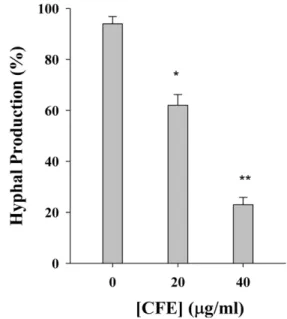
CFE의 항진균 활성의 작용기전을 조사하기 위해 C. albicans 의 주요 병원성인자 중의 하나인 균사생성에 대한 CFE의 작용 을 조사하였다. 실험결과, 음성대조군에 비교해서 20 µg/ml 농도 의 CFE로 처리한 경우에 34%의 균사생성이 억제되었으며, CFE 의 농도가 증가함에 따라 균사생성에 대한 억제율도 역시 증가 하였다(P<0.05)(Fig. 5). 일예를 들면, 40 µg/ml의 CFE 농도에 서는(*), 76%의 균사생성이 억제되었다(P<0.05)(Fig. 5). 이 결 과를 통해서 균사생성 억제가 CFE의 항진균 활성에 관여함을 알 수가 있었다.
결 론
본 연구에서는 C. albicans에 대한 산사자의 메탄올 추출물 (CFE)의 항진균활성에 관해 연구하였다. 먼저, CFE의 항진균활 성을 확인하고, CFE와 기존의 항진균제(예: FLC)와의 병용요법 의 가능성, 그리고 항진균 상승효과를 In-vitro 이외에도 C.
albicans 기인성 전신성 캔디다증 동물모델에서 조사하였다. 아 울러, 이 항진균활성의 작용기전을 조사하였다.
먼저 CFE의 항진균활성을 확인한 후, CFE의 항진균 상승효 과를 조사하였다. In-vitro 상에서 0.1 µg/ml 농도의 FLC 단독에 서의 항진균효과가 CFE의 존재 하에서는 거의 4배에 달하는 항 진균활성이 측정되어 CFE와 FLC의 병용요법에 의한 항진균 상 승효과가 최초로 확인되었다. 이 병용요법의 효능은 C. albicans 기인성 전신성 캔디다증 동물모델에서도 입증이 되었다. 일예로, CFE(1 mg/kg of body weight)의 단독요법이나 FLC(0.1 mg/kg of body weight) 단독요법 보다는 이들 약물의 1/2씩 각각 혼합 한 병용요법(0.5 mg CFE/kg of body weight plus 0.05 mg FLC/kg of body weight)이 훨씬 유효한 항진균활성을 발현하였 고, 이 경우에 생쥐의 생존율이 80%에 이른다는 점이 매우 고무 적이라고 사료된다. 이 결과를 분석해 보면, 병용요법에 의한 상 승효과 덕분에 FLC의 투여용량의 감소가 가능하고 결과적으로 는 FLC로 기인하는 신장 및 간장 독성과 특히 신생아에게 상피 독성으로 인한 괴사성용해(necroysis) 등의 부작용34,35)도 최소화 할 수 있을 것이다. 그러므로 궁극적으로는 FLC의 상용투여용 량을 낮추면서도 오히려 약물의 효능(efficacy)도 증진 시킬 수가 있어서 약물의 안전성 확보가 더 용이하리라 추정된다.
이와 같이 FLC의 상승효과를 유도하는 CFE의 항진균활성은 C. albicans의 균사생성을 차단과 밀접한 관계가 있다고 평가되 어진다. 즉, C. albicans가 인체에 침투하는 과정에서 균사의 신 장(elongation)은 체내의 장기 내부로 침입을 용이하게 해두겠지
Fig. 4 − The combination of CFE and fluconazole (FLC) potentiates
resistance against disseminated candidiasis caused by C.
albicans in mice. The C. albicans-infected mice given CFE or FLC survived app. 6- and 10-days longer, respectively, than the non-treated control mice during the period of 40- day observation ( P<0.05). However, they all died within 17 and 23 days. In contrast, the mice that received the combination therapy (*) survived app. 30 days longer and 4 out of 5 mice survived until the end of the observation period. This indicates that the combination therapy is synergistically effective against the disseminated disease.
Each group contained five mice.
Fig. 5 − CFE blocks hyphal production of the yeast form of C.
albicans. CFE treatment reduced hyphal production. There were app. 35%- or 76%- reduction of hyphal production by CFE at 20 µg/ml and 40 µg/ml, respectively when compared to that of CFE-untreated control C. albicans (
*P<0.05,
**
P<0.01).
만, 반대로 CFE에 의해 균사의 생성이 차단되면 이는 감염확산 의 실패를 의미하게 되는 것이므로 환자의 입장에서는 치유 가 능성의 기대가 높아질 수 있기 때문이다. 이 이외에도 CFE의 또 다른 항진균의 작용기전도 고려해볼 수 있다. 이를 위해서는 산 사자의 어떤 성분이 항진균활성에 관여하는지를 먼저 규명하여 야 할 것이다. 그렇게 되면, 효율성이 더 높은 항진균물질의 개 발이 쉬울 것이기 때문이다. 서론에서 이미 언급하였듯이, CFE 에는 다양한 성분이 함유되어 있는데 그 중에 chlorogenic acid 가 있다.22,23,32)그런데, 본 연구실의 기연구의 결과에 의하면 chlorogenic acid는 항진균활성이 있음을 알 수가 있다.33)이를 통해서 산사자 CFE의 항진균활성이 chlorogenic acid에 의한 것 으로 유추해볼 수 있다. 하지만, 산사자의 제 3의 성분이 항진균 활성에 관여함을 배제할 수는 없다. 사실, chlorogenic acid과 기 존의 항진균제와의 병용에 의한 상승효과는 CFE에 비해서 낮다 (our unpublished data). 그렇다고 하더라도 제 3의 성분규명에 대한 지속적인 연구가 필요하다고 여겨진다.
결론적으로, 본 연구에서 규명한 CEF 자체의 항진균활성은 FLC의 활성과 비교하면 효율성이(effectiveness)가 현저하게 떨 어진다. 그 이유는 동일한 효능을 위해 용량적으로는 거의 200 배의 차이가 있기 때문이다. 그래서 효율성에 문제가 있다고 생 각을 할 수 있겠지만, 기존의 항진균제와의 병용요법을 통해서 부작용과 내성의 감소를 고려한다면 더 큰 의미가 있을 것으로 사료된다. 달리 말해서, 효능은 높으나 부작용도 많은 기존의 항 진균제와 병용요법에 의한 용량감소를 통해서 부작용을 감소시 킬 수 있다면 이는 기존 항진균제의 효능을 더 극대화 수 있을 것으로 여겨진다. 본 연구의 결과를 요약하면, C. albicans의 균 사생성의 억제효과가 있는 CFE의 항진균활성에 의해서 FLC의 항진균 상승효과의 가능성을 제시하였다. 이 연구결과는 최초의 보고로 사료된다.
References
1) Bodey, G. P. : The emergence of fungi as major hospital pathogens. J. Hosp. Infect. 11, 411 (1988).
2) Arturo, C. : Antibodies and fungi: an evolving paradigm with opportunities for the development of new antifungal therapies and vaccines. Rev. Iberoam. Micol. 14, 2 (1997).
3) Baselski, V. S., Robison, M. K., Pifer, L. W. and Woods, D. R. : Rapid detection of Pneumocystis carinii in bronchoalveolar lavage samples by using cellufluor staining. J. Clin. Microbiol.
28, 393 (1990).
4) Lee, K. K., Maccallum, D. M., Jacobsen, M. D., Walker, L. A., Odds, F. C., Gow, N. A. and Munro, C. A. : Elevated cell wall chitin in Candida albicans confers echinocandin resistance in vivo. Antimicrob. Agents Chemother. 56, 208 (2012).
5) Angiolella, L., Stringaro, A. R., De Bernardis, F., Posteraro, B., Bonito, M., Toccacieli, L., Torosantucci, A., Colone, M., Sanguinetti, M., Cassone, A. and Palamara, A. T. : Increase of virulence and its phenotypic traits in drug-resistant strains of Candida albicans. Antimicrob. Agents Chemother. 52, 927 (2008).
6) Schaberg, D. R., Culver, D. H. and Gaynes, R. P. : Major trends in the microbial etiology of nosocomial infection. Am. J. Med.
16, 72S (1991).
7) Edwards, J. E. : Invasive Candida infections: evolution of a fungal pathogen. N. Engl. J. Med. 324, 1060 (1991).
8) Gow, N. A., Brown, A. J. and Odds, F. C. : Fungal morphogenesis and host invasion. Curr. Opin. Microbiol. 5, 366 (2002).
9) Sobel, J. D. : Epidemiology and pathogenesis of recurrent vulvovaginal candidiasis. Am. J. Obstet. Gynecol. 152, 924 (1985).
10) Sobel, J. D. : Pathogenesis and epidemiology of vulvovaginal candidiasis. Ann. N. Y. Acad. Sci. 544, 547 (1988).
11) Odds, F. C., Brown, A. J. and Gow, N. A. : Antifungal agents:
mechanisms of action. Trends Microbiol. 11, 272 (2003).
12) Bae, M. H. and Kim, H. H. : Mechanism of Crataegi Fructus extract induced endothelium-dependent vasorelaxation in rabbit carotid artery. Kor. J. Herbology 18, 169 (2003).
13) Hong, S. S., Hwang, J. S., Lee, S. A., Han, X. H., Ro, J. S. and Lee, K. S. : Inhibitors of monoamine oxidase activity from the fruits of Crataegus pinnatifida Bunge. Kor. J. Pharmacogn. 33, 285 (2002).
14) An, B. J., Kang, B. Y. and Lee, J. T. : Development of cosmetic material from Korean Crataegi Fructus extract. Kor. J.
Herbology 17, 39 (2002).
15) Lin, H. H., Charles, A. L., Hsieh, C. W., Lee, Y. C. and Ciou, J. Y. : Antioxidant effects of 14 Chinese traditional medicinal herbs against human low-density lipoprotein oxidation. J.
Tradit. Complement Med. 5, 51 (2014).
16) Kao, E. S., Wang, C. J., Lin, W. L., Yin, Y. F., Wang, C. P. and Tseng. T. H. : Anti-inflammatory potential of flavonoid contents from dried fruit of Crataegus pinnatifida in vitro and in vivo. J. Agric. Food. Chem. 53, 430 (2005).
17) Seo, B. I. : Preventive effects of water extracts from on Crataegi Fructus on hyperlipiderma and liver damage induced by alcohol. Kor. J. Herbology 20, 35 (2005).
18) Ahn, K. S., Hahm, M. S., Park, E. J., Lee, H. K. and Kim, I. H. : Corosolic acid isolated from the fruit of Crataegus pinnatifida var. psilosa is a protein kinase C inhibitor as well as a cytotoxic agent. Planta Med. 64, 468 (1998).
19) Chan, A. S., Yip, E. C., Yung, L. Y., Pang, H., Luk, S. C., Pang, S. F. and Wong, Y. H. : Immuno-regulatory effects of CKBM on the activities of mitogen-activated protein kinases and the
release of cytokines in THP-1 monocytic cells. Biol. Pharm.
Bull. 28, 1645 (2005).
20) Ryu, H. Y., Kim, Y. K., Kwun, I. S., Kwan, C. S., Jin, I. N. and Sohn, H. Y. : Thrombin inhibition activity of fructus extract of Crataegus pinnatifida Bunge. J. Life Sci. 17, 535 (2007).
21) Choi, O. K., Kim, Y., Cho, G. S. and Sung, C. K. : Screening for antimicrobial activity from korean plants. Kor. J. Food. Nutr. 15, 301 (2002).
22) Ryu, H. Y., Park, S. J., Lee, B. H. and Sohn, H. Y. : Antimicrobial activity of fruit of Crataegus pinnatifida Bunge against multidrug resistant pathogenic Pseudomonas aeruginosa and Candida sp. Kor. J. Micobiol. Biotechnol. 38, 77 (2010).
23) Qin, R,. Xiao, K., Li, B., Jiang, W., Peng, W., Zheng, J. and Zhou, H. : The combination of catechin and epicatechin callate from Fructus Crataegi potentiates beta-lactam antibiotics against methicillin-resistant staphylococcus aureus (MRSA) in vitro and in vivo. Int. J. Mol. Sci. 14, 1802 (2013)
24) Yu, Y. E., Park, E. Y., Jung, D. H., Byun, S. H. and Kim, S. C. : Antibacterial activity of oriental medicinal herb extracts against skin pathogens. J. Life Sci. 20, 1143 (2010).
25) Kim, J., Park, Y. J., Park, K. D., Jung, B., Choi, M. Y. and Han, Y. : Antimicrobial activities of Crataegi Frucutus methanol extract. Dongduk Yakhak Res. 14, 33 (2010).
26) Park, S. W., Yook, C. S. and Lew, H. K. : Chemical components from the fruits of Crataegus pinnatifida var. psilosa. Kor. J.
Pharmacogn. 25, 328 (1994).
27) Han, Y. and Cutler, J. E. : Antibody response that protects against disseminated candidiasis. Infect. Immun. 63, 2714 (1995).
28) Han, Y., Morrison, R. P. and Cutler, J. E. : A vaccine and monoclonal antibodies that enhance mouse resistance to
Candida albicans vaginal infection. Infect. Immun. 66, 5771 (1998).
29) Lee, J. H., Lee, J. Y., Park, J. H., Jung, H. S., Kim, J. S., Kang, S. S., Kim, Y. S. and Han, Y. : Immunoregulatory activity by daucosterol, a β-sitosterol glycoside, induces protective Th1 immune response against disseminated candidiasis in mice.
Vaccine 25, 3834 (2007).
30) Han, Y. and Lee, J. H. : Berberine synergy with amphotericin B against disseminated candidiasis in mice. Biol. Pharm. Bull.
28, 541 (2005).
31) Han, Y. : Synergic anticandidal effect of epigallocatechin-O- gallate combined with amphotericin B in a murine model of disseminated candidiasis and its anticandidal mechanism. Biol.
Pharm. Bull. 30, 1693 (2007).
32) Yin, F., Li, L., Chen, Y., Lu, T., Li, W., Cai, B. and Yin, W. : Quality control of processed Crataegi Fructus and its medicinal parts by ultra high performance liquid chromatography with electrospray ionization tandem mass spectrometry. J. Sep. Sci.
38, 2630 (2015).
33) Lee, J. H., Park, J. H., Kim, Y. S. and Han, Y. : Chlorogenic acid, a polyphenolic compound, treats mice with septic arthritis caused by Candida albicans. Int. Immunopharmacol. 8, 1681 (2008).
34) Islam, S., Singer, M. and Kulhanjian J. A. : Toxic epidermal necrolysis in a neonate receiving fluconazole. J. Perinatol. 34, 792 (2014).
35) Egunsola, O., Adefurin, A., Fakis, A., Jacqz-Aigrain, E., Choonara, I. and Sammons, H. : Safety of fluconazole in paediatrics: a systematic review. Eur. J. Clin. Pharmacol. 69, 1211 (2013).