Tuberc Respir Dis 2011;70:1-9
CopyrightⒸ2011. The Korean Academy of Tuberculosis and Respiratory Diseases. All rights reserved.
지역사회획득 폐렴
부산대학교 의학전문대학원 내과학교실 이민기
Community Acquired Pneumonia
Min Ki Lee, M.D.
Department of Internal Medicine, Pusan National University School of Medicine, Busan, Korea
Community-acquired pneumonia (CAP) is a major cause of morbidity, of mortality, and of expenditure of medical resources. The etiology and antimicrobial susceptibility of CAP pathogens can differ by country. Treatment guidelines need to reflect the needs of individual countries based on pathogen susceptibility studies. Recent treatment guidelines for CAP in Korea were published by the Joint Committee of the Korean Academy of Tuberculosis and Respiratory Diseases, the Korean Society for Chemotherapy, and the Korean Society of Infectious Diseases. In this article, the etiologies, diagnoses, treatments for CAP will be reviewed and compared to the recent published Korean guidelines for CAP treatment.
Key Words: Pneumonia, Community-Acquired
Address for correspondence: Min Ki Lee, M.D.
Department of Internal Medicine, Pusan National University School of Medicine, 1-10, Ami-dong 1-ga, Seo-gu, Busan 602-739, Korea
Phone: 82-51-240-7216, Fax: 82-51-254-3127 E-mail: [email protected]
Received: Dec. 26, 2010 Accepted: Dec. 26, 2010
서 론
지역사회획득 폐렴은 감염성 질환 중 가장 흔한 사망원 인 중의 하나이다. 국내 10대 사망원인 중 감염으로 인한 사망 중 1위에 해당되며, 항생제치료에도 불구하고 사망 률이 12∼14%에 이른다. 향후 노인인구의 증가로 인해 폐렴 유병률과 이로 인한 사망률은 증가 추세를 보일 것으 로 예상된다.
2007년에 미국 Infectious Disease Society of America/
American Thoracic Society (IDSA/ATS)에서 지침이 발표 된 바 있으며1, 국내에서는 호흡기학회에서 2005년에 폐 렴지침이 출간되었고, 최근 2009년에 지역사회획득 폐렴 의 치료지침 권고안이 발표되었다2.
폐렴의 원인균 분포는 나라에 따라 차이가 있으며 특히
항생제 내성 실태도 다르기 때문에 국내 연구자료를 토대 로 한국형 치료지침이 절대적으로 필요한 상황이나 근거 자료가 될 국내 연구성과가 미흡한 실정이다. 향후 연구 가 활성화 되면 우리나라 실정에 맞는 좋은 치료지침이 완성될 것으로 생각된다.
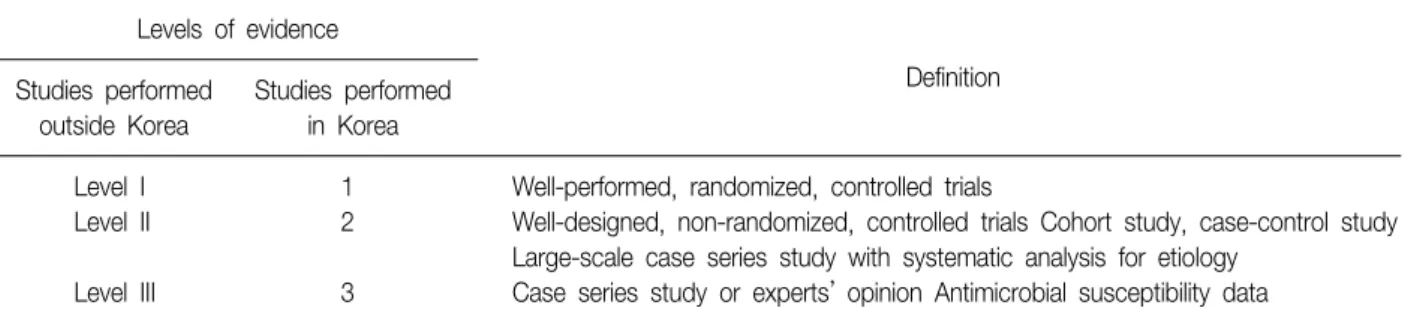
본 원고는 최근 국내 치료지침 권고안을 바탕으로 하여 지역사회획득 폐렴의 진단과 치료 등에 대해 전반적으로 살펴보고자 하며, 권고안에 사용된 등급은 3가지로 나누 되 외국 연구논문인 경우는 level I∼III, 국내 연구논문인 경우는 1∼3등급으로 표시하였다(Table 1). 지역사회획 득 폐렴은 18세 이상의 한국인에게서 발생한 폐렴으로 면 역저하환자는 대상에서 제외하였다.
국내 지역사회획득 폐렴의 원인균
국내 지역사회획득 폐렴의 원인균은 다양한데 대체로 다른 나라와 비슷한 분포를 보인다1. 세균성 폐렴 중 S.
pneumoniae가 가장 중요한 원인균으로 보고에 따라 27
∼44%를 차지한다. 중요한 호흡기 병원균인 Hemophilus 나 Moraxella는 기저폐질환이 있는 환자에서 흔히 폐렴을 일으키는데, 국내자료에서는 보고에 따라 크게 차이가 난
Table 1. Grading levels of evidence Levels of evidence
Definition Studies performed
outside Korea
Studies performed in Korea
Level I 1 Well-performed, randomized, controlled trials
Level II 2 Well-designed, non-randomized, controlled trials Cohort study, case-control study Large-scale case series study with systematic analysis for etiology
Level III 3 Case series study or experts’ opinion Antimicrobial susceptibility data
Table 2. Etiologies according to severity
Place for treatment Etiology*
Outpatient S. pneumoniae, M. pneumoniae, H. influenzae, C. pneumoniae, respiratory viruses
Hospitalization S. pneumoniae, M. pneumoniae, C. pneumoniae, H. influenzae, Legionella spp., respiratory viruses Intensive care unit E. coli, P. aeruginosa, Enterobacter, H. influenzae, Legionella spp.
*Others: M. tuberculosis, Orientia tsutsugamushi, Leptospira.
Table 3. Etiologies according to the risk factors
Risk factors Common etiology
Heavy alcohol drinking S. pneumoniae, oral anaerobes, Gram-negatives including K.
pneumoniae, M. tuberculosis
COPD±smoking H. influenzae, P. aeruginosa, Leionella spp. S. pneumoniae,
M.catarrhalis, C. pneumoniae Structural lung diseases such as bronchiectasis P. aeruginosa, B. cepacia, S. aureus
Aspiration Enterobacteriaceae, Anaerobes
Bronchial obstruction Anaerobes, S. pneumoniae, H. influenzae, S. aureus
Influenza season S. pneumoniae, S. aureus, H. influenzae
Occurring in autumn, rash with eschar Orientia tsutsugamushi
Intravenous drug abuser S. aureus, Anaerobes, M. tuberculosis, S. pneumoniae Exposure to air conditioning of building for last 2 weeks Legionella spp.
Exposure to birds C. pneumoniae
다.
S. aureus도 비교적 흔한 원인균으로서 인플루엔자 유 행 뒤에 흔히 발생한다. 국내 자료에서 K. pneumoniae와 Pseudomonas 등 그람음성균의 비율이 비교적 높은데 이 는 대부분 국내연구가 3차 대학병원에서 수행되어서 만성 호흡기질환으로 병원에 자주 입원하는 환자가 연구에 많 이 포함되었기 때문으로 생각된다. 두 가지 이상의 미생 물에 의한 혼합감염도 드물지 않다는 것이 국내외 연구를 통해 보고된 바 있으며, 여기에는 비정형 폐렴 원인균과의 혼합감염도 포함된다. 환자의 중증도나 위험인자에 따른 원인균 분포에 관한 연구는 국내 연구자료가 거의 없어 미국의 가이드라인을 참조하였다(Tables 2, 3)1.
비정형 폐렴의 원인 미생물
국내 보고는 매우 적은 편이며, Mycoplasma 폐렴은 6.3∼9.2%를 차지하고 있으며, C. pneumoniae는 7.3∼
13.2%, Legionella는 0∼5.3%로 보고되었다. 특히 Legionella는 중환자실 입원이 필요한 중등도 이상의 폐렴 에서 다른 비정형 폐렴균에 비해 더 흔한 원인균이었다3. 바이러스에 대한 원인을 살펴보면 지역사회획득 폐렴의 10.1%에서 바이러스가 분리되었으며 A형 인플루엔자 (5%), 파라인 플루엔자, 아데노 바이러스, respiratory syn- cytial virus의 빈도로 분리되었다. 드문 원인으로서 SARS 바이러스나 H5N1형 조류 인플루엔자 바이러스도 원인으
로 고려할 필요가 있다(3등급).
기타 미생물로는 M. tuberculosis, nontuberculous my- cobacteria, Orientia tsutsugamushi, Leptospira, Coxiella burnetti 등을 생각할 수 있다. 특히 국내 결핵의 유병률은 2006년 보고자료에 따르면 인구 10만 명 당 92명으로 아 직 높은 편이며4, 지역사회획득 폐렴의 원인 중 하나로 결 핵의 가능성을 항상 고려해야 할 것이다. 항생제치료에 대한 반응이 느리거나, 당뇨병, 만성 폐쇄성 폐질환, 만성 신질환, 스테로이드 장기복용과 같은 기저질환 동반 시 폐렴의 원인으로 결핵 가능성을 고려하여야 한다. 그리고 결핵에 의한 폐렴은 전형적인 세균성 폐렴 또는 비정형 폐렴 형태로의 발생이 모두 가능하다는 점을 유념하여야 한다. 최근 사용이 늘고 있는 fluoroquinolone의 사용은 결핵의 진단을 지연시킬 가능성이 있어 결핵을 배제할 수 없는 경우라면 경험적 치료에서 1차 치료제로 그 선택을 피하는 것이 바람직하다.
원인균의 진단
1. 외래환자에서 원인균 진단을 위한 방법
외래환자의 경우 원인균 진단을 위한 검사가 필수적인 것은 아니다(level III-3 등급). 항생제 내성이 의심되거나 일반적 경험적 항생제 투여로 치료가 어려운 세균이 의심 되면 객담 그람염색과 배양 검사를 시행할 수 있으며, 폐 결핵이 의심될 경우 객담 항산성 염색과 결핵균 배양 검사 를 시행한다(level III-3 등급).
레지오넬라증이나 인플루엔자 등이 의심되는 경우에도 진단을 위한 검사 시행이 권장된다.
2. 입원환자에서 원인균 진단을 위한 적절한 방법 항생제 투여 전에 혈액 배양검사와 객담 그람 염색 및 배양검사를 임상적 적응이 되는 모든 폐렴환자에서 시행 하는 것이 좋다(level I-3 등급). 항생제투여 전에 배출된 객담으로 검사하여야 하며, 객담이 적절히 배출되고, 수 집, 이동, 처리할 수 있는 경우에 실시한다(level II-3 등 급). 중증 지역사회획득 폐렴 환자의 경우 혈액 배양검사 와 legionella, S. pneumoniae에 대한 소변항원 검사, 객 담 배양 검사가 시행되어야 한다(level II-2 등급).
3. 혈액배양검사
혈액배양검사는 반드시 항생제 투여 전에 시행되어야 하며 균 검출률은 5∼14% 정도이다. 중증 지역사회획득
폐렴에서는 반드시 시행되어야 한다.
4. 호흡기 검체의 도말 및 배양검사
입원하는 모든 지역사회획득 폐렴환자에서 객담도말 및 배양검사를 시행한다. 적절한 검사를 위한 기준을 만 족해야 하며, 유도 객담검사는 결핵균과 폐포자충 검출에 유용하다(level II-3 등급). 후향적 연구에 의하면 중증 폐 렴환자에서 정확한 원인균을 밝혀도 생존율의 차이가 없 다고 보고하고 있지만, 중증 폐렴환자의 일부에서는 정확 한 조기 진단이 바람직하다(level III-3 등급).
5. 배양검사의 해석
호흡기 검체 배양의 결과는 상재균이나 오염된 균의 가 능성 때문에 해석에 주의를 요한다.
6. 기타배양검사
흉수와 관절액, 뇌척수액등 다른 부위의 감염이 의심되 면 해당부위의 그람 염색과 배양을 시행한다.
7. 항원검사
S. pneumoniae와 legionella 폐렴 진단을 위한 소변항 원 검사는 결과를 신속히 알 수 있고, 항생제를 사용한 후에 검사해도 진단율이 높은 장점이 있다. 단점은 고비 용과 항생제 감수성 검사를 할 수 없다는 점이다(level II-2 등급).
8. 혈청검사
Chlamydia, Mycoplasma, Legionella pneumophila가 아닌 기타 Legionella 등의 비정형 폐렴균의 진단은 급성 기 및 회복기의 혈청검사를 통해서 가능하다(level II-2 등 급). 초기 진단에는 대개 유용하지 않기 때문에 임상적으 로 의심되는 경우에 시행하며 후향적 확진과 역학적 연구 에 이용될 수 있다.
9. 기타 검사
PCR, 단클론 항체, DNA 탐색자 등을 이용한 진단적 검사가 개발되고 있지만 통상적 사용은 고려되고 있지 않 다. 바이러스 배양은 통상적으로 사용되지는 않으나 인플 루엔자가 유행하는 계절에 항원을 신속히 진단하는 검사 는 약제 사용여부 결정에 도움이 된다.
Table 4. Criteria for admission: pneumonia severity index (PSI) score
Factor Score
Patient age, age in yr
Male Age
Female Age-10
Nursing home resident +10
Coexisting illness*
Neoplastic disease +30
Liver disease +20
Congestive cardiac failure +10
Cerebrovascular disease +10
Chronic renal disease +10
Signs on examination
Acutely altered mental state† +20
Respiratory rate ≥30/min +20
Systolic blood pressure <90 mm Hg +15 Temperature <35oC or ≥40oC +15
Pulse rate ≥125/min +10
Results of investigations
Arterial pH <7.35 +30
BUN ≥30 mg/dL +20
Serum sodium <130 mEq/L +20
Serum glucose >250 mg/dL +10
Hb <9 g/dL (Hematocrit <30%) +10
PaO2 <60 mm Hg (SaO2 <90%) at room air +10 Pleural effusion on chest X-ray +10
*Coexisting illness (Neoplastic disease: within one year, exclud- ing cutaneous basal cell carcinoma or cutaneous squamous cell carcinoma; Liver disease: clinical or histological liver cirrhosis or chronic active hepatitis; Congestive cardiac failure: diagnosed by history, physical examination or laboratory findings;
Cerebrovascular disease: clinical stroke or confirmed cases by CT or MRI). †Atlered mental state: disorientation to person, place and time; or recently decreased level of consciousness.
주요 원인균의 항생제 내성 실태 1. 국내 S. pneumoniae의 항생제 내성
국내에서 분리되는 S. pneumoniae의 penicillin 내성률 은 매우 높은 것으로 잘 알려져 왔으며 이전의 감수성 판 정기준에 따른 내성률 조사에서는 중등도 내성 또는 내성 을 보이는 경우가 64.5∼91.3%였다. 하지만 이런 경우에 도 폐렴의 임상성적이 penicillin 내성과 연관성이 별로 없 다는 전문가의 의견에 따라서 미국 CLSI의 감수성 판정기 준이 2008년 1월 개정되었다. 개정된 기준에 따르면 MIC
≤2.0 μg/mL일 때 감수성, MIC 4.0 μg/mL일 때 중등 도 내성, MIC ≥8.0 μg/mL일 때 내성으로 보고된다. 개 정된 기준에 따라 분석한 경우 내성률은 0%, 중등도 내성 25.8%였고, MIC90은 4 μg/mL였다5.
Amoxicillin/clavuanic acid의 경우 내성률 9.7%, 중등 도 내성 6.5%였으며, cefuroxime은 내성률 61.3%, 중등도 내성 3.2%였다5. Macrolide에 대한 내성은 62.0∼87.6%
로 보고되었다. Fluoroquinolone의 경우 아직 내성률이 높지 않지만 점차 상승추세에 있는데, ciprofloxacin 12.6%, levofloxacin 2.2∼3.0%, moxifloxacin 0∼1.7%
정도를 보이고 있다6,7.
2. 국내 Hemophilus nfluenzae의 항생제 내성 중등도 내성 또는 내성률이 ampicillin 58.1%, amox- icillin/clavulanic acid 13.5%, cefuroxime 9.2%, cefaclor 41%, levofloxacin 1.3% 등으로 보고되었다8.
3. 기타
국내에서 Mycoplasma pneumoniae의 항생제 감수성 연구보고는 많은 편이며, 최근 일본에서는 macrolide 내 성률이 14.4%로 내성이 증가하고 있음을 보고한 바 있 다9.
국내에서도 지역사회 획득 S. aureus 감염에서 MRSA의 비중이 증가하고 있기는 하나 지역사회획득 폐렴에서 MRSA의 역할에 대해서는 아직 연구된 바가 없으며 향후 이에 대한 연구가 필요할 것으로 생각된다.
입원치료 여부의 결정 1. 배경
지역사회획득 폐렴이 진단된 후의 진료에서 중요한 것 은 입원여부의 결정이다. 처음에 외래치료하다가 입원하
는 폐렴의 경우 사망률이 더 높고, 중증환자가 처음에 중 환자실로 입원하지 않는 경우에 사망률이 더 높다고 보고 되었다.
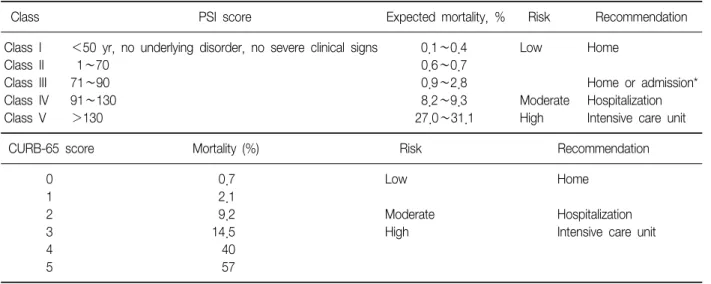
따라서 환자의 중증도나 사망위험도에 따라 적절하게 외래치료 혹은 입원치료를 결정하여야 한다. 따라서 객관 적인 지표에 의한 입원여부의 결정이 필요하며 현재까지 가장 널리 알려진 지표는 Pneumonia Severity Index (PSI)와 CURB-65이다.
2. 폐렴 중증지표: PSI와 CURB-65
PSI는 Pneumonia Patient Outcome Research Team (PORT) 연구에서 나온 자료를 분석하여 만든 점수체계이
Table 5. Expected mortality, risk, and recommended place for treatment according to PSI
Class PSI score Expected mortality, % Risk Recommendation
Class I <50 yr, no underlying disorder, no severe clinical signs 0.1∼0.4 Low Home
Class II 1∼70 0.6∼0.7
Class III 71∼90 0.9∼2.8 Home or admission*
Class IV 91∼130 8.2∼9.3 Moderate Hospitalization
Class V >130 27.0∼31.1 High Intensive care unit
CURB-65 score Mortality (%) Risk Recommendation
0 0.7 Low Home
1 2.1
2 9.2 Moderate Hospitalization
3 14.5 High Intensive care unit
4 40
5 57
*Hospitalization for a short term or treatment at observation unit.
PSI: pneumonia severity index.
Table 6. CURB-65, mortality, risk, and recommended place for treatment
Clinical factor C (Confusion)
U (Blood urea): >19 mg/dL R (Respiratory rate): ≥30/min
B (Blood pressure): Systolic pressure ≤90 mm Hg or diastolic pressure ≤60 mm Hg
65: ≥65 yr
다(Tables 4, 5)10. PSI기준은 사망위험도에 따라 환자를 5단계로 구분하며 각 군의 예측사망률은 Table 3과 같다.
PSI 1∼2군은 외래치료가 권고되며, 3군은 단기간 입원 혹은 외래치료와 입원치료의 중간단계를 취하며, 4∼5군 은 입원치료가 권고된다. 나이의 영향이 너무 크다는 단 점이 있으며, 동맥혈 산소포화도 <90%이거나 PaO2
<60 mm Hg인 경우에는 PSI와 상관없이 입원을 권고하 는 것이 유용하다고 보고되었다11.
CURB-65는 영국흉부학회에서 제시한 폐렴 중증도 지 표이다(Table 6)12. 이 지표는 1,068명의 환자를 대상으로 한 다변량 분석으로 사망률을 증가시키는 요인 5가지가 제시되었다. CURB-65에서 ‘U’ (blood urea)항목을 제외 한 점수 체계가 CRB-65이다.
현재까지 PSI기준과 CURB-65를 비교한 무작위연구가 없었으므로 어느 기준이 더 우수한지는 명확하지 않다.
PSI기준은 20개 항목을 계산해야 하므로 실제 임상적용이 불편한 반면 CURB-65는 5항목(0∼5점)으로 이루어져 있 어서 쉽게 임상적용이 용이하다는 장점이 있다.
3. 임상적 판단
객관적 점수체계를 이용하더라도 환자의 입원 필요성 에 대해 완벽하게 올바른 결정을 내리기는 어렵고 의료진 의 ‘임상적 판단’이 매우 중요하다. 이 점수 체계는 시간 경과에 따른 변화를 반영하지 못하고 단지 한 시점에서의 자료에만 의존하므로 그 정확성이 떨어질 수 있다. 폐렴 이 기저질환을 악화시켜 입원이 필요하게 될 수도 있는데 CURB-65 점수는 기저질환은 전혀 고려의 대상이 되지 않 는다.
점수체계에 의해서는 저 위험군이지만 임상적 판단에 의해서 입원이 필요하다고 판정되는 경우는 크게 다음의 4가지로 분류할 수 있다: 1) 폐렴의 합병증 자체; 2) 기저 질환의 악화; 3) 경구복용을 못하거나 외래간호를 받기 어 려운 상황; 4) 점수체계상으로 여러 항목이 고위험군의 기 준에 약간씩 못 미쳐서 저위험군으로 판정된 경우이다.
4. 중환자실 입원의 결정
PSI 5군이나 CURB-65 3∼5점에 해당되는 환자는 중환 자실 입원을 고려할 수 있다. 후향적 연구에 의하면 이 점수 체계의 민감도는 높지만 특이도는 낮았다(중환자실 에 입원하지 않아도 되는 환자를 입원이 필요한 상태로
Table 7. Criteria for severe pneumonia Major criteria (2)
Invasive mechanical ventilation
Requiring vasopressors due to septic shock Minor criteria (9)
Respiratory rate ≥30/min PaO2/FiO2 ratio ≤250
Multilobar pneumonia in chest X-ray
Decreased level of consciousness/disorientation BUN ≥20 mg/dL
WBC <4,000/mm3 Platelet <100,000/mm3 Core temperature <36oC
Hypotension requiring aggressive fluid therapy Criteria for admission to intensive care unit One major or more
Three minor or more
판정하였다)13. 2007년 미국흉부학회/감염학회 지역사회 획득 폐렴 지침에서는 수정된 미국흉부학회 기준과 CURB 를 통합하여 새로운 기준을 제시한바 있다(Table 7)1. 그 러나 아직 이 기준의 타당성은 검증된 바 없다.
5. 초기 경험적 치료 시 항생제의 선택 1) 외래에서의 경험적 항생제
① ß-lactam±macrolide (경구) (level I-3 등급) Amoxicillin 또는 amoxicillin-clavulanate, cefpodox- ime, cefditoren (level II-3등급)±azithromycin, clari- thromycin, erythromycin, roxithromycin (3등급) 또는
② Respiratory fluoroquinolone (경구) (level I-3 등급) Gemifloxacin, levofloxacin, moxifloxacin
입원을 요하지 않는 환자에서의 경험적 항생제는 ß- lactam 단독 또는 ß-lactam과 macrolide의 병용, 또는 respiratory fluoroquinolone 사용이 권장된다. 입원을 요 하지 않는 환자에서 macrolide나 tetracycline 단독요법은 S. pneumoniae의 높은 내성률 때문에 권장되지 않는다.
단, 비정형 폐렴균을 표적으로 병용하는 경우에는 macro- lide대신 doxycycline을 투여할 수 있다(level II-3 등급).
입원을 요하지 않는 경증의 지역사회획득 폐렴의 치료 에 있어 비정형 폐렴의 원인균을 표적으로 하는 항생제를 사용하여야 하는가에 대한 논란이 있다. 국내에서 연구가 더 필요하지만 본 지침에서는 ß-lactam 단독요법을 권고 안에 포함하였다.
Cefuroxime의 경우 국내 분리 S. pneumoniae의 내성 률이 상당히 높아서 권고안에서 제외되었다.
결핵을 배제할 수 없는 경우에는 fluoroquinolone의 경 험적 사용을 피할 것을 권장한다. Levofloxacin 750 mg 1일 1회 5일 요법은 우수한 효과가 보고되면서 폐렴치료 의 표준용법으로 자리를 잡았다14. Gemifolxacin의 경우 에도 5일 요법의 치료효과가 7일 요법과 비교하여 떨어지 지 않는다는 최근 보고가 있었다15.
2) 일반 병동으로 입원하는 경우의 경험적 항생제 (1) P. aeruginosa 감염이 의심되지 않는 경우 ① ß-lactam+macrolide (level I-3 등급)
Cefotaxime, ceftriaxone, Ampicillin/sulbactam, or amoxicillin/clavulanate+azithromycin, clarithromycin, erythromycin, or roxithromycin
또는
② Respiratory fluoroquinolone (level I-3 등급) Gemifloxacin (경구), levofloxacin, moxifloxacin (주사 또는 경구)
3) 중환자실로 입원하는 경우의 경험적 항생제 (1) P. aeruginosa 감염이 의심되지 않는 경우 ① ß-lactam+azithromycin (levelI I-3 등급) Cefotaxime, ceftriaxone, Ampicillin/sulbactam, or amoxicillin/clavulanate+azithromycin (주사 혹은 경구) 또는
② ß-lactam+fluoroquinolone (level I-3 등급) Cefotaxime, ceftriaxone, Ampicillin/sulbactam, or amoxicillin/clavulanate+Gemifloxacin (경구), levoflox- acin, moxifloxacin (주사 또는 경구)
페니실린 과민반응이 있는 경우에는 호흡기 fluoro- quinolone+aztreonam의 사용이 권장된다.
중환자실로 입원하는 중증 지역사회획득 폐렴의 경우 에는 fluoroquinolone 단독요법은 권고안에 포함되지 않 았고 병용요법을 권고하였다.
(2) P. aeruginosa 감염이 의심되는 경우의 경험적 항생 제
① Antipenumococcal, antipseudomonal ß-lactam (cefepime, pipracillin/tazobactam, imipenem, mer- openem)+ciprofloxacin 혹은 levofloxacin (750 mg/d) 또는
② Antipenumococcal, antipseudomonal ß-lactam+
aminoglycoside+azithromycin 또는
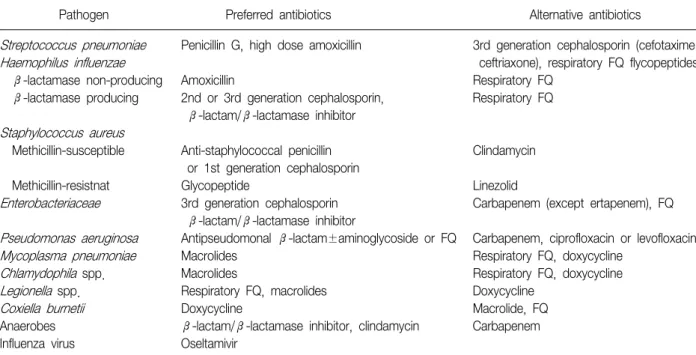
Table 8. Recommended antimicrobial therapy according to etiologic microorganism
Pathogen Preferred antibiotics Alternative antibiotics
Streptococcus pneumoniae Penicillin G, high dose amoxicillin 3rd generation cephalosporin (cefotaxime,
Haemophilus influenzae ceftriaxone), respiratory FQ flycopeptides
ß-lactamase non-producing Amoxicillin Respiratory FQ
ß-lactamase producing 2nd or 3rd generation cephalosporin, Respiratory FQ ß-lactam/ß-lactamase inhibitor
Staphylococcus aureus
Methicillin-susceptible Anti-staphylococcal penicillin Clindamycin or 1st generation cephalosporin
Methicillin-resistnat Glycopeptide Linezolid
Enterobacteriaceae 3rd generation cephalosporin Carbapenem (except ertapenem), FQ ß-lactam/ß-lactamase inhibitor
Pseudomonas aeruginosa Antipseudomonal ß-lactam±aminoglycoside or FQ Carbapenem, ciprofloxacin or levofloxacin
Mycoplasma pneumoniae Macrolides Respiratory FQ, doxycycline
Chlamydophila spp. Macrolides Respiratory FQ, doxycycline
Legionella spp. Respiratory FQ, macrolides Doxycycline
Coxiella burnetii Doxycycline Macrolide, FQ
Anaerobes ß-lactam/ß-lactamase inhibitor, clindamycin Carbapenem
Influenza virus Oseltamivir FQ: fluoroquinolone.
③ Antipenumococcal, antipseudomonal ß-lactam+
aminoglycoside+antipneumococcal fluoroquinolone (gemifloxacin, levofloxacin, moxifloxacin) (level III-3 등 급)
음주, 기관지 확장증 등 폐의 구조적 질환, 반복되는 COPD 악화로 인해 항생제와 스테로이드를 자주 투여해 온 병력, 최근 3개월 이내 항생제 투여 기왕력 등이 있는 경우에는 Pseudomonas에 의한 폐렴 가능성을 생각해야 한다. Pseudomonas의 항생제에 대한 내성이 다양할 수 있기 때문에 초기 경험적 치료에서는 이 세균에 대한 항균 력이 우수한 항생제를 2개 이상 병용하되 일단 원인균 동 정 및 감수성 보고가 되면 이를 토대로 하여 항생제를 재 조정해주어야 한다16.
6. 원인균에 따른 적절한 항생제
1) 항생제에 따른 적절한 용량 및 용법: 지역사회획득 폐렴의 원인 미생물이 의미 있는 미생물학적 검사방법을 통해 확인되는 경우 이를 표적으로 하는 권장 항생제로 바꾸도록 한다(level III-3 등급)1.
권장되는 항생제는 Table 8과 같다. 항생제 용법은 간 및 신 기능에 따라 조정될 수 있다.
2) 적절한 치료기간: 통상적으로 항생제는 7∼10일 투 여하지만 원인 미생물, 환자상태, 항생제의 종류, 치료에
대한 반응, 동반질환 및 폐렴합병증 유무 등에 따라 달라 질 수 있다(level II-3 등급). 일반적으로 적어도 5일 이상 치료하며(level I-3 등급), 치료종료를 위해서는 48∼72시 간 동안 발열이 없어야 하고, 치료종료 전 임상징후 중 1개 이상이 남아있으면 안 된다(level II-3 등급). 균혈증을 동반한 S. aureus 폐렴, 폐 외 장기의 감염이 동반된 폐렴, 초기치료에 효과적이지 않았을 경우 등에서는 단기치료 로 불충분할 수가 있다. 또한, 공동을 형성했거나 조직괴 사 징후가 있는 경우는 장기간 치료가 필요할 수 있다.
Legionella 폐렴은 적어도 14일 이상 치료한다.
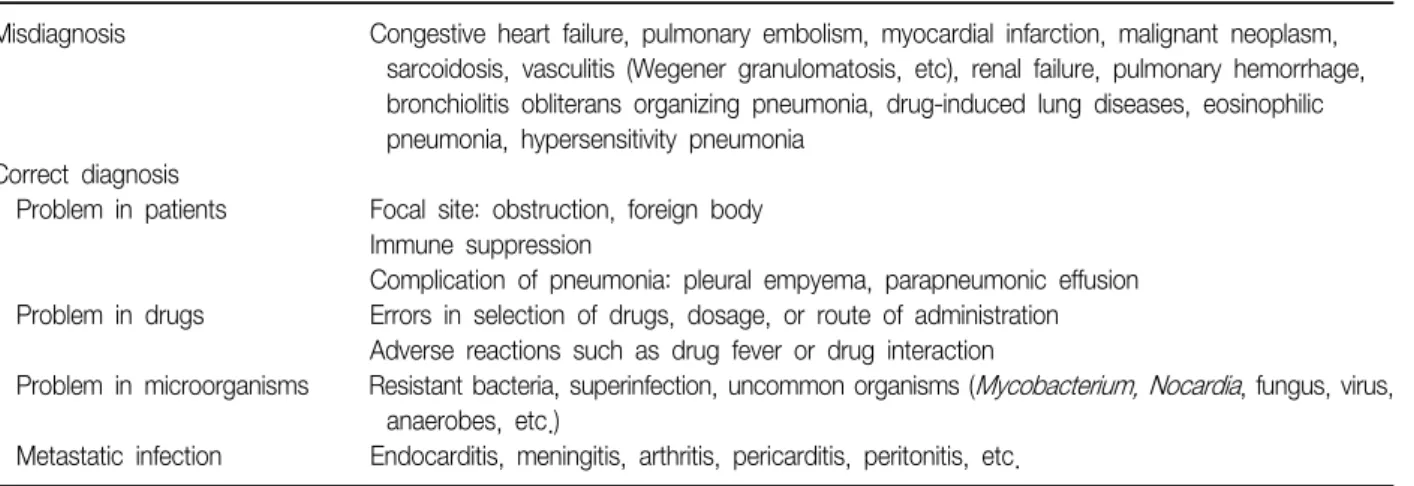
3) 치료에 반응하지 않는 폐렴의 원인: 병원에 입원하는 지역사회획득 폐렴환자의 6∼15%는 초기 항생제에 반응 하지 않는다. 일반적으로 치료에 반응하지 않는 환자의 사망률은 치료에 반응하는 환자에 비해 7배 높다고 알려 져 있다17. 항생제 치료에도 불구하고 임상적으로 호전되 지 않는 경우 Table 9와 같은 원인을 고려한다. ‘치료에 반응하지 않는 폐렴’이란 항생제 치료에도 불구하고 임상 적 반응이 부적절한 상황으로 정의하지만 명확하지 않은 경우가 있을 수 있다.
7. 경구치료 및 퇴원시점
환자가 중환자실에 입실한 중증 폐렴환자가 아니라면 임상적 호전을 보이면서, 혈역학적으로 안정되고, 정상적
Table 10. Checklist for decision of discharge Clinically stable state
Body temperature ≤37.8oC Pulse rate ≤100 per minute Respiratory rate ≤24 per minute Systolic pressure ≥90 mm Hg SaO2 ≥90% at room air PaO2 ≥60 mm Hg Possible oral intake
Normal level of consciousness
Need for treatment of other underlying diseases Need for other diagnostic tests
Social circumstances for patient care Table 9. Causes of pneumonia with no response to antimicrobial therapy
Misdiagnosis Congestive heart failure, pulmonary embolism, myocardial infarction, malignant neoplasm, sarcoidosis, vasculitis (Wegener granulomatosis, etc), renal failure, pulmonary hemorrhage, bronchiolitis obliterans organizing pneumonia, drug-induced lung diseases, eosinophilic pneumonia, hypersensitivity pneumonia
Correct diagnosis
Problem in patients Focal site: obstruction, foreign body Immune suppression
Complication of pneumonia: pleural empyema, parapneumonic effusion Problem in drugs Errors in selection of drugs, dosage, or route of administration
Adverse reactions such as drug fever or drug interaction
Problem in microorganisms Resistant bacteria, superinfection, uncommon organisms (Mycobacterium, Nocardia, fungus, virus, anaerobes, etc.)
Metastatic infection Endocarditis, meningitis, arthritis, pericarditis, peritonitis, etc.
인 경구섭취 및 소화기능을 보이면 경구치료로 전환이 가 능하다. 경구치료로 전환하는 기준은 1) 기침 및 호흡곤란 의 호전; 2) 해열: 8시간 동안 체온 <37.8oC 유지; 3) 혈 액검사에서 백혈구 수의 정상화; 4) 충분한 경구섭취량 및 정상적인 위장관 흡수 기능이다(level II-3 등급).
일반적으로 경구용 항생제는 주사로 사용된 항생제와 동일한 제제, 만일 동일한 제제가 없다면 같은 계열의 약 의 사용이 권장된다(level III-3 등급).
퇴원은 환자가 임상적으로 안정되어 경구치료가 가능 하고, 기저질환에 대한 치료가 필요 없고, 진단적 검사가 필요 없으며, 환자를 돌볼 수 있는 사회적 환경이 된다면 고려할 수 있다(Table 10) (level II-3 등급). 최근 발표된 전향적 연구에서는 퇴원 시 임상적 안정상태를 만족시키 지 못하는 조건들의 수가 많을수록 환자의 30일 사망률이 높아짐을 보고하였고, 특히 발열 여부가 예후와 가장 연관 성이 높다고 하였다. 여러 동반질환이 있는 노년층에서 퇴원시점을 결정할 때에는 조기 재활치료를 포함한 추가 적인 조치가 필요한지를 평가하는 것이 좋다.
8. 완치 판정을 위한 적절한 검사 및 추적검사 기간 1) 완치 판정을 위한 적절한 검사방법: 완치 판정을 위 한 적절한 검사방법은 임상증상과 진찰소견이 폐렴 이전 범위로의 호전이 있으며 흉부 X-선 음영이 소실되거나 호 전되었을 때를 완치라고 정의할 수 있다(level II-3 등급).
2) 재방문 시점: 대부분 지역사회획득 폐렴 환자의 경우 는 7일에서 10일 정도의 치료기간임을 고려할 때 외래환 자의 경우는 임상적인 소견에 따라 재방문 시점을 정하고 입원 후 퇴원환자의 경우는 퇴원 후 7일 이내에 재방문을 권유하는 것이 바람직하다(level II-3 등급). 만성기도 질
환이나 고령의 환자에서는 장기간 재방문 및 추적관찰이 필요할 것으로 판단된다.
호흡기 증상은 보통 14일 정도면 폐렴전의 상태로 호전 되고 전반적인 삶의 지표는 최대 6개월 정도 지나야 증상 전의 상태로 회복된다는 보고가 있다18. 흉부 X-선의 이상 소견은 폐렴의 임상소견보다 훨씬 더 서서히 호전되며 40 세 이상의 흡연자에서는 폐렴의 완치를 확인하기 위해 치 료시작 후 약 7∼12주까지도 추적검사를 해야 하는 경우 도 있으며 폐렴환자의 임상양상과 흉부 방사선 소견이 일 치하지 않은 경우 흉부 전산화 단층촬영이나 기관지 내시 경 등의 검사가 필요할 수 있다. 중증 지역사회획득 폐렴 의 경우는 한 달 이상의 추적관찰이 필요하다19. 9. 예방접종 및 금연교육
지역사회획득 폐렴의 위험성이 높은 사람에서 폐렴구 균과 인플루엔자 예방접종의 적응증이 되는 경우 해당 백 신으로 예방접종을 시행한다. 모든 흡연자는 금연하도록
교육한다.
참 고 문 헌
1. Mandell LA, Wunderink RG, Anzueto A, Bartlett JG, Campbell GD, Dean NC, et al. Infectious Diseases Society of America/American Thoracic Society con- sensus guidelines on the management of commun- ity-acquired pneumonia in adults. Clin Infect Dis 2007;44:S27-72.
2. Song JH, Jung KS, Kang MW, Kim DJ, Pai H, Seo JY, et al. Treatment guidelines for community-acquired pneumonia in Korea: an evidence-based Approach to appropriate antimicrobial therapy. Tuberc Respir Dis 2009;67:281-302.
3. Sohn JW, Park SC, Choi YH, Woo HJ, Cho YK, Lee JS, et al. Atypical pathogens as etiologic agents in hos- pitalized patients with community-acquired pneumonia in Korea: a prospective multi-center study. J Korean Med Sci 2006;21:602-7.
4. Lew WJ, Lee EG, Bai JY, Kim HJ, Bai GH, Ahn DI, et al. An Internet-based surveillance system for tuber- culosis in Korea. Int J Tuberc Lung Dis 2006;10:1241-7.
5. Song JH, Jung SI, Ko KS, Kim NY, Son JS, Chang HH, et al. High prevalence of antimicrobial resistance among clinical Streptococcus pneumoniae isolates in Asia (an ANSORP study). Antimicrob Agents Chemo- ther 2004;48:2101-7.
6. Shin JH, Jung HJ, Kim HR, Jeong J, Jeong SH, Kim S, et al. Prevalence, characteristics, and molecular epi- demiology of macrolide and fluoroquinolone resistance in clinical isolates of Streptococcus pneumoniae at five tertiary-care hospitals in Korea. Antimicrob Agents Chemother 2007;51:2625-7.
7. Song JH, Oh WS, Kang CI, Chung DR, Peck KR, Ko KS, et al. Epidemiology and clinical outcomes of com- munity-acquired pneumonia in adult patients in Asian countries: a prospective study by the Asian network for surveillance of resistant pathogens. Int J Antimicrob Agents 2008;31:107-14.
8. Kim IS, Ki CS, Kim S, Oh WS, Peck KR, Song JH, et al. Diversity of ampicillin resistance genes and anti- microbial susceptibility patterns in Haemophilus influ- enzae strains isolated in Korea. Antimicrob Agents Chemother 2007;51:453-60.
9. Morozumi M, Iwata S, Hasegawa K, Chiba N, Takayanagi R, Matsubara K, et al. Increased macrolide resistance of Mycoplasma pneumoniae in pediatric pa- tients with community-acquired pneumonia. Antimi-
crob Agents Chemother 2008;52:348-50.
10. Fine MJ, Hough LJ, Medsger AR, Li YH, Ricci EM, Singer DE, et al. The hospital admission decision for patients with community-acquired pneumonia. Results from the pneumonia Patient Outcomes Research Team cohort study. Arch Intern Med 1997;157:36-44.
11. Yealy DM, Auble TE, Stone RA, Lave JR, Meehan TP, Graff LG, et al. Effect of increasing the intensity of im- plementing pneumonia guidelines: a randomized, con- trolled trial. Ann Intern Med 2005;143:881-94.
12. Lim WS, van der Eerden MM, Laing R, Boersma WG, Karalus N, Town GI, et al. Defining community ac- quired pneumonia severity on presentation to hospital:
an international derivation and validation study.
Thorax 2003;58:377-82.
13. Angus DC, Marrie TJ, Obrosky DS, Clermont G, Dremsizov TT, Coley C, et al. Severe community-ac- quired pneumonia: use of intensive care services and evaluation of American and British Thoracic Society Diagnostic criteria. Am J Respir Crit Care Med 2002;
166:717-23.
14. File TM Jr, Milkovich G, Tennenberg AM, Xiang JX, Khashab MM, Zadeikis N. Clinical implications of 750 mg, 5-day levofloxacin for the treatment of commun- ity-acquired pneumonia. Curr Med Res Opin 2004;20:
1473-81.
15. File TM Jr, Mandell LA, Tillotson G, Kostov K, Georgiev O. Gemifloxacin once daily for 5 days versus 7 days for the treatment of community-acquired pneumonia:
a randomized, multicentre, double-blind study. J Anti- microb Chemother 2007;60:112-20.
16. Arancibia F, Bauer TT, Ewig S, Mensa J, Gonzalez J, Niederman MS, et al. Community-acquired pneumonia due to gram-negative bacteria and pseudomonas aeru- ginosa: incidence, risk, and prognosis. Arch Intern Med 2002;162:1849-58.
17. Celis R, Torres A, Gatell JM, Almela M, Rodríguez-Roisin R, Agustí-Vidal A. Nosocomial pneumonia. A multi- variate analysis of risk and prognosis. Chest 1988;93:
318-24.
18. El Moussaoui R, Opmeer BC, de Borgie CA, Nieuwkerk P, Bossuyt PM, Speelman P, et al. Long-term symptom recovery and health-related quality of life in patients with mild-to-moderate-severe community-acquired pneumonia. Chest 2006;130:1165-72.
19. Bruns AH, Oosterheert JJ, Prokop M, Lammers JW, Hak E, Hoepelman AI. Patterns of resolution of chest radio- graph abnormalities in adults hospitalized with severe community-acquired pneumonia. Clin Infect Dis 2007;
45:983-91.