• 검색 결과가 없습니다.

Exploring Factors of Consumer's Impulsive Buying Behavior in Mobile Social Commerce

N/A
N/A
Protected

Academic year: 2021

Share "Exploring Factors of Consumer's Impulsive Buying Behavior in Mobile Social Commerce"

Copied!
13
0
0

로드 중.... (전체 텍스트 보기)

전체 글

(1)

Exploring Factors of Consumer’s Impulsive Buying Behavior in Mobile Social Commerce

Jung-Keun Moon

1

, Na-Yeon Kwak

2

, Choong C. Lee

3*

1

Halla Holdings,

2

Doctoral student, Graduate School of Information, Yonsei University

3

Professor, Graduate School of Information, Yonsei University

모바일 소셜커머스 이용자의 충동구매에 영향을 미치는 요인

문정근1, 곽나연2, 이중정3*

1한라홀딩스, 2연세대학교 정보대학원 박사과정, 3연세대학교 정보대학원 교수

Abstract Mobile social commerce is one of the fastest growing distribution channels in recent years. Therefore, it is important to understand customer's buying behavior in mobile social commerce in order to continuously grow in the competitive mobile social commerce market. To achieve the purpose of this study is to investigate how impulsive buying behaviors are applied in mobile shopping and how factors affect impulse purchasing in online shopping. In order to verify the hypothesis, we surveyed the customers who have experiences of using mobile social commerce and analyzed 280 valid data by Smart PLS 3.0. As a result, it was confirmed that consumers' innovation and purchasing experience influenced impulse purchase in mobile social commerce, and scarcity messages among information attributes affect impulse buying. Through this study, impulsive buying behavior which is a frequently analyzed variable in an online shopping context will be extended to the mobile shopping context. and it will provide practical implications for customer strategy establishment in mobile social commerce market.

Key Words : Mobile social commerce, Customer behavior, Impulsive buying, Personal traits, Information attributes

요 약 모바일 소셜커머스는 최근 모바일 쇼핑의 빠른 확산 중에서도 가장 빠르게 성장하는 유통채널이다. 따라서 경쟁이 심화되는 모바일 소셜커머스 시장에서 지속적으로 성장하기 위해 모바일 소셜커머스에서의 고객 구매행동에 대한 이해가 중요하다. 이에 본 연구는 모바일 소셜커머스 시장에서 소비자 태도 실증을 위해 온라인 쇼핑에서 고객 행동 관련 연구에서 다수 활용된 충동구매(Impulsive buying behavior)가 모바일 쇼핑에서 어떻게 적용되며, 충동구매에 영향을 미치는 요인이 무엇인지 확인했다. 연구는 모바일 소셜커머스 경험자를 대상으로 진행한 설문 중 총 280부의 데이터를 Smart PLS 3.0을 통해 분석하여 진행했다. 결과적으로 개인적 특성 중 소비자의 혁신성과 구매경험이 모바일 소셜커머스에서 충동구매에 영향을 미치고, 제공되는 정보의 속성 중 희소성메세지가 충동구매에 영향을 미치는 것을 확인했다. 본 연구를 통해 기존 온라인 쇼핑에서 많이 활용된 고객 행동 관련 변수인 충동구매를 모바일 쇼핑으로 확장하여 살펴보았다는데 이론적 시사점 이 있으며, 실무적으로 모바일 소셜커머스 시장에서의 고객 전략 수립에 유효한 시사점을 제공할 것이다.

주제어 : 모바일 소셜커머스, 소비자 행동, 충동구매, 개인적 특성, 제공정보 특성

*Corresponding Author : Choong C. Lee([email protected]) Received December 12, 2018

Accepted February 20, 2019

Revised January 29, 2019 Published February 28, 2019
(2)

1. Introduction

With the development of IT technology and the spread of mobile devices, the mobile commerce market has expanded rapidly. According to Statistics Korea report (2018), Domestic Online shopping market size of Korea has grown more than doubled from 38.5 trillion in 2013 to 80 trillion won in 2018[1]. In addition, the proportion of mobile shopping in online shopping is growing from 17% in 2013 to 61.2% in 2017. Thus, the importance of mobile commerce is escalating. Social commerce accounts for a large portion of the mobile commerce market. 72% of social commerce users use mobile channel, which is higher than that of the Open market (37%) and SSM's online mall users (28%) [2].

With the continuing growth of social commerce market, competition between social commerce companies and existing online marketplaces is becoming more competitive.

These environments arouse higher marketing expense and therefore, it has become more important to understand customer and their purchasing behavior in social commerce environments for set new market strategy.

There are several types of social commerce such as Group-Buy, Flash Sale, Social Shopping, Purchase Sharing, Personal Shopper and Deal of the day[3].

Among these sales type, deal of the day and flash sale is suitable for mobile commerce. Unlike the open market, which provides many product information, it restricts the kinds of products that are provided, so it can alleviate the inconvenience of using the small screen of the mobile device.

One of the features of social commerce is immediate interactions between buyers and vendors. Consumers in social commerce make a purchasing decision in very short moments. Therefore, the social commerce market needs to focus on the critical factor of purchasing determination such as Impulsive buying behavior (IBB)[4].

Many studies have shown that there is a difference in shopping behavior between online and mobile

environments[49]. Many researches have been conducted about impulsive buying behavior in online and offline marketplaces. However, only a few researches about factors cause impulsive buying behavior in mobile environments had been studied.

Therefore, it is necessary that impulse purchase-related research in mobile environments.

Also, most previous researches focused only factors affecting impulsive buying behavior. While no previous researches have been conducted to see the moderating effect of shopping trigger such as advertisement, recommendation from friends to impulsive buying. We assess that depending on the stimuli of social commerce use, the effect of their antecedents of impulsive buying behavior would be significantly varied. In other words, the stimuli of social commerce use can be a critical factor to determine the real motivator of Impulsive buying. To sum up, stimuli of information can trigger impulsive buying.

We reviewed personal factors and market environment factors related to impulsive buying behavior. This study will focus on those factors to buy impulsively. Therefore, the purposes of this study are as follows: First, the study aims to investigate the antecedent of impulsive buying behavior in mobile social commerce. Second, the study analyzes to see the causal differences between different reasons for mobile social commerce customer’s stimuli. Identifying the factors which related to impulsive buying behavior in mobile social commerce is a major contribution of this research. The finding of this research will help practitioners design the effective marketing strategy.

2. Research Background 2.1 Social commerce

Social commerce and social shopping are forms of

Internet-based “social media” that allow people to

actively participate in the marketing and selling of

products and services in online marketplaces and

(3)

communities[5]. Social commerce was first introduced by Yahoo 2005, after Groupon was founded in 2008, social commerce based on group purchase boomed and had great success worldwide. Social commerce is an estimated $9 billion dollar industry in 2012 that expected to more than triple by 2015[6]. To get a huge markdown or group rate of product or service, social commerce users are required to attract more and more people for group buying rate. Hence, social commerce users initiatively attract people or acquaintances by social networks or other ways[7]. And in this progress consumer share more information about product or rates by electronic Word-Of-Mouth (e-WOM) base on SNS (Social Network Service). Thus shared information about products or services induces consumer’s purchase intention [8].

Social commerce is in the context of e-commerce.

However, some of the following characteristics can be distinguished social commerce from e-commerce [9].

Harnessing collective intelligence : Almost entirely, the competitive advantage of social commerce sites lies from the critical mass of buyers and sellers. The key to market dominance is network effects from user contributions.

Ÿ An architecture of participation : Social commerce sites leverage algorithmic data management and customer-self service to reach out to the entire Web, that is, to the long tail and not just the head, to the edges and not just to the center, so to speak.

Ÿ Viral marketing : Social commerce relies on word-of-mouth marketing. This is done when customers promote a product or service by telling others about their positive experience with it. As a result, branded communities can form longer lasting customer relationship and deeper affinity.

Ÿ Market disruption : A good candidate for a market disrupter would be any business which makes a huge profit margin off its customers.

Social commerce is about arguing on the

consensus and creating something new of the difference.

What differentiates social commerce from an ordinary e-commerce are the social elements involved.

Trusted environment where friends, family and acquaintances dynamically contribute content to the referral and sale of goods and services through positive and negative feedback, reviews, ratings and testimonials regarding their experiences past & present [10].

Social commerce related research has been conducted in a variety of ways, including research related to consumer personal traits[22-25], purchase decision making process[48,50,51], and information characteristics which provided from site [33-40,53]so on.

2.2 Impulsive Buying Behavior

Studies on impulsive buying behavior have been conducted in marketing research since the 1950s[11].

Impulsive buying defined as “unplanned buying’-that is, it describes any purchase which a shopper makes but has not planned in advance shown as below (see Table 1). Particularly a study by Kollat & Willett,[12]

described impulse purchasing is truly representing an impulsive choice by shoppers or is the purchase of mere unplanned.

Early marketing literature defined impulse buying in a simple way as unplanned purchasing[13] and was redefined as “Consumer experiences a sudden, often powerful and persistent urge to buy something immediately[14]. Also, impulse buyers are claimed to have unreflective thinking, which is prompted by physical proximity to the desired product, dominated by emotional attraction to it, and absorbed by the promise of immediate gratification[15]. According to researches taken a very keen interest in impulse buying[13-15].

Impulse buying of the shopper is influenced by a

number of factors which could be either related to

internal Stimuli, external stimuli and situational and

product-related factors. However, the earlier studies

only the purchases were investigated and not the

(4)

consumers and also not considered SNS environment.

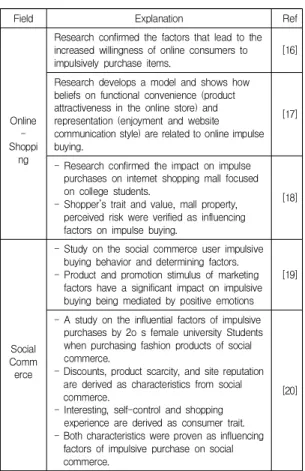
Also, while online shopping is mainstream in recent years, researches on determinants of impulsive buying and consumer characteristics were conducted.

Field Explanation Ref

Online - Shoppi

ng

Research confirmed the factors that lead to the increased willingness of online consumers to impulsively purchase items.

[16]

Research develops a model and shows how beliefs on functional convenience (product attractiveness in the online store) and representation (enjoyment and website communication style) are related to online impulse buying.

[17]

- Research confirmed the impact on impulse purchases on internet shopping mall focused on college students.

- Shopper’s trait and value, mall property, perceived risk were verified as influencing factors on impulse buying.

[18]

Social Comm erce

- Study on the social commerce user impulsive buying behavior and determining factors.

- Product and promotion stimulus of marketing factors have a significant impact on impulsive buying being mediated by positive emotions

[19]

- A study on the influential factors of impulsive purchases by 2o s female university Students when purchasing fashion products of social commerce.

- Discounts, product scarcity, and site reputation are derived as characteristics from social commerce.

- Interesting, self-control and shopping experience are derived as consumer trait.

- Both characteristics were proven as influencing factors of impulsive purchase on social commerce.

[20]

Table 1. Literature review on online impulsive buying behavior

3. Research Model and Hypotheses Development

3.1 Research Model

As previously discussed, Fig. 1 illustrates our proposed research model, which consists of six constructs derived from related researches. The six constructs of interest, which serve as predictors in our model, are: and personal trait consisting of innovativeness and purchase experience, Informational

attributes of Social commerce consisting of word of mouth, app reputation and scarcity message. Our study posits direct effects driven from the six constructs to impulsive buying as dependent variables and examines the moderating effect of shopping trigger to the dependent variable in this study.

Fig. 1. Research model

3.2 Hypotheses Development 3.2.1 Personal Trait (1) Innovativeness

Innovativeness is defined as someone who rapidly accepts new product or service than others. When consumers buying a new product, consumers who have high innovativeness tend to take risks of new products and purchase new items[21]. A study on internet shopping behavior[22], was proved innovativeness of consumer trait positive impact on purchase intention on online commerce. And Bae & U [21] was proved innovativeness of consumer trait positive impact on impulsive buying on online commerce. Therefore, consumer, which has high innovativeness, tends to perceive low risk of new products. According to this assumption, potential of impulsive buying will increase Based on the previous studies, also innovativeness of consumer will significant impact on impulsive buying in social commerce, which based on the online commerce.

H1: Personal innovativeness of social commerce’

user will have a positive (+) impact on the impulsive buying of social commerce.

(2) Purchase experience

(5)

Purchase experience is a whole process, that consumers navigate or find a product by visiting an online shopping mall and actually buy products or service. A study on impulsive buying and Stimulus factors on TV home-shopping[23], group who has purchase experience tends to buy impulsively. On other study[24], purchase experience significantly impact on purchase intention on internet shopping, being mediated by consumer loyalty and trust. Also purchase experience reduces perceived risk of online shopping, at the same time, consumer’s purchase intention is enhanced[25]. Summarizing the above prior studies, also in social commerce, purchase experience tends to reduce risk of new product of online, it can lead consumer to buy items or service impulsively.

H2: Purchase experience of social commerce’ user will have a positive (+) impact on the impulsive buying of social commerce.

3.2.2 Informational attributes of Social Commerce (1) Word of mouth

Word of Mouth (WOM) that has a large impact on the purchasing decisions has been studied through previous studies[26,27]. According to the previous study, WOM has the greatest impact on purchase of household and food, and effect of WOM was four times more than personal selling, 7 times than newspaper advertisement, and double than radio advertisement[28].

Also in online commerce studies, effect of WOM was proven through the following studies. Consumer’s review is one of kind of WOM in online shopping situation, it is useful information to others[29]. In particular, a comparative study between traditional marketing activities and WOM, they proposed that

“word-of-mouth communication is a critical factor of firms seeking to acquire new customers and that WOM can have larger and longer lasting effects than traditional marketing activity.”[30]. Furthermore, the importance of WOM and an online impulsive buying model, classifying influencing factors of e-WOM[31].

Also, online review and comment are an element of e-WOM and characterized impulsive buying as stimulus factor[32]. According to the above previous studies, we assume that in social commerce business based on e-commerce, WOM is significant factor deriving consumer’s impulsive buying.

H3: Word-of-Mouth will have a positive (+) impact on the impulsive buying of social commerce.

(2) Scarcity message

Differences between existing online shopping and social commerce are that they selling product or service on limited time and quantities. This situation and scarcity messages of limited time and quantities feel consumer scarcity or urgency. It derives consumer’s impulsive buying. Scarcity adds the value of product and service satisfied consumer even after the purchase impulsively[33.34]. A way, which notifies the limited quantities of consumer, delivers scarcity messages to consumer and it fixes a value of products or services[35,36]. Scarcity messages in social commerce raise to purchase intention through emotional pressure by limited numbers[37]. Therefore, we hypothesize that the scarcity message in social commerce will have an effect on impulsive buying.

H4: Scarcity Message will have a positive (+) impact on the impulsive buying of social commerce.

(3) App reputation

Reputation has been defined as “the perceptual that

people have of something, based on past behavior or

experience”[38]. Prior studies reported that reputation

is one of the significant factors affecting consumer’s

purchase behavior. Also, reputation in the online

environment is more important than the offline

environment, because consumers cannot directly

experience the goods or service before they purchase in

online environment[39]. It means reputation can reduce

(6)

the uncertainty of purchase. In the online shopping context, site reputation is a significant antecedent of consumer’s purchase[40]. Site reputation for social commerce has a significant impact on purchase satisfaction[41].

In this study, thus we suppose that consumer feels the uncertainty of intangible and non-substantive on the mobile commerce. In mobile shopping context, customers use mobile shopping app instead of shopping mall site. From this point of view, we formulate the following hypothesis to verify significant impact on impulsive buying in social commerce.

H5: App reputation will have a positive (+) impact on the impulsive buying of social commerce.

3.2.3 Shopping trigger

On a research of current usage of social commerce[2], 49.85% of social commerce users mainly obtain information through window shopping, advertising is 38.4 and 25.8% is receive information via SMS or call or instant messages from acquaintances.

But Above all, 70.6% of social commerce user purchased products or service on social commerce along a recommendation of acquaintances. On a study on relationship between are commendation of acquaintance and purchase intention, the Group who has a high frequency of recommendation of colleague, has impact on spread of WOM and purchase intent[42].

Therefore, based on current research and statistical data, we assume that Promotion, Recommendation of an acquaintance and willingness of window shopping is the trigger of customer's shopping intention in the social commerce context. we hypothesize that there are differences between the shopping trigger. This leads to the following hypothesis

H6 (a): The positive impact of the personal trait on impulsive buying will differ according to each shopping trigger

H6 (b): The positive impact of Characteristics of

social commerce on impulsive buying will differ according to each shopping trigger

4. Research Methodology 4.1 Data collection

To test the structural model, we limited the target for the survey that had experience in social commerce shopping. Also, we set a unit of analysis as individual level. The sample is collected from Open survey (http://www.opensurvey.co.kr), one of the biggest mobile market research firms in South Korea. This firm possesses more than 350 thousand panels. We randomly sent e-mails with a URL link to 1,766 panels.

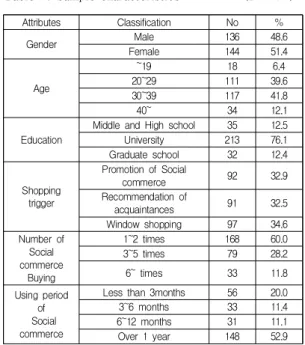
A total of 300 responses were collected and we separated them to 3 groups by shopping trigger. In total, 20responses were judged as invalid. Finally, valid 280 responses were coded for statistical analysis.

Table 2 shows the characteristics of samples.

Attributes Classification No %

Gender Male 136 48.6

Female 144 51.4

Age

~19 18 6.4

20~29 111 39.6

30~39 117 41.8

40~ 34 12.1

Education

Middle and High school 35 12.5

University 213 76.1

Graduate school 32 12.4

Shopping trigger

Promotion of Social

commerce 92 32.9

Recommendation of

acquaintances 91 32.5

Window shopping 97 34.6

Number of Social commerce

Buying

1~2 times 168 60.0

3~5 times 79 28.2

6~ times 33 11.8

Using period of Social commerce

Less than 3months 56 20.0

3~6 months 33 11.4

6~12 months 31 11.1

Over 1 year 148 52.9

Table 2. Sample characteristics (N=280)

Among the 280 respondents, 136(48.6%) were male

and 144(51.4%) were female. They were generally

young (129(46%) were below 20, 117(42%) were 21 to

(7)

30 years old, 34(12%) were to over 40). All the respondents were well educated as mostly undergraduate and graduate students. They were generally familiar with social commerce, with 154(55%) of them having used social commerce for over one time per month on the average.

4.2 Measures

All of the measurements used in the present study were adapted from previous researches and relative literature. Some of the measurement items were modified to fit the context of this research. Most of the construct were translated from English to Korean.

Table 3 shows the operational definition, Survey items and their references. All measurements were recorded on a seven-point Likert scale (1 = strongly

disagree, 3 = moderately agree and 5 = strongly agree). 5. Analysis and Result 5.1 Model analysis

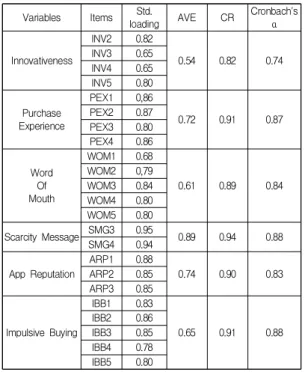
The measurement model was checked using a confirmatory factor analysis in order to test for the reliability and the validity of the constructs by using PLS. Table 4 summarizes the results of the measurement model. The standardized loadings of each of the measurement items underlying a construct are shown with their composite reliability and the average variance extracted. These loadings indicate that the measurement model performed well. The cross-loading matrix is provided in Table 5, which indicates that both strong convergent validity and discriminate validity exist on the measurement model[44]. The composite reliability and AVE of each latent variable used in this study is provided in Table 4. All composite reliabilities are higher than 0.80 and the AVE is higher than 0.50.

These results support that the measurement model has strong convergent validity. Secondly, we tested discriminant validity by comparing the AVE of each construct with the variance shared with other constructs (squared correlations)[45]. Furthermore, Table 5 shows the ratio of the square root of the AVE of each latent variable over the correlations between this variable with respect to all the other variables. The

Construct Survey items Ref

Innovativene ss

INV1 I am very interested in information about new products.

[43]

INV2 I prefer new products rather than quality.

INV3 I tend to use a new product well.

INV4 I tend to easily adapt to new features.

INV5 I mainly buying new product at social commerce.

Purchase Experience

PEX1 I often buy products from the social commerce.

[25]

PEX2 Compared to others, I do social commerce shopping frequently.

PEX3 I have a lot of information about social commerce shopping.

PEX4 I am familiar with the shopping at social commerce.

Word-Of-M outh

WOM1 When I read positive review about product, I also think positively.

[19]

WOM2 I have more positive image about Recommended products than others.

WOM3 I want to buy popular products.

WOM4 When I choose a product, sometimes I refer to others opinion.

WOM5 When I choose a product, sometimes I refer to others behavior.

Scarcity Message

SMG1 Social commerce site which I mainly use shows limited quantity of product.

[19]

SMG Social commerce site which I mainly use shows limited period of buying.

SMG3 When I see the message “almost sold out” in social commerce, I want to buy.

SMG4 When I realize the deadline of sale, I want to buy.

Table 3. Survey items of research construct

App Reputation

ARP1 Social commerce app which I mainly use is credible.

[41]

ARP2 Social commerce app which I mainly use is keep a promise with customer well.

ARP3 The overall reputation of social commerce app which I mainly use is pretty good.

ARP4 Social commerce app which I mainly use is well-known.

Impulsive Buying

IBB1 Sometimes I do unplanned shopping through social commerce.

[19]

IBB2 Sometimes I buy unexpected product through social commerce.

IBB3

When I do shopping in social commerce, Sometimes I buy products or service extemporary.

IBB4

When I do shopping in social commerce, I buy products or service without much thought.

IBB5

When I do shopping in social commerce,

sometimes I tend to buy undesired

products.

(8)

reliability of the collected data was examined using Cronbach’s α values and composite reliability. All factors were greater than 0.7 and, thus, the data set is considered reliable (see Table 4). In Table 5, the diagonal elements are correlations between each construct with its measure, which is the square root of AVE. The off-diagonal elements are correlations between the constructs. Each construct is more highly correlated with its own measure than with any of the other constructs. This indicates that strong discriminate validity exists among the constructs[44,52].

Variables Items Std.

loading AVE CR Cronbach's α

Innovativeness

INV2 0.82

0.54 0.82 0.74

INV3 0.65 INV4 0.65 INV5 0.80

Purchase Experience

PEX1 0,86

0.72 0.91 0.87

PEX2 0.87

PEX3 0.80

PEX4 0.86

Word Of Mouth

WOM1 0.68

0.61 0.89 0.84

WOM2 0,79

WOM3 0.84

WOM4 0.80

WOM5 0.80

Scarcity Message SMG3 0.95

0.89 0.94 0.88

SMG4 0.94

App Reputation

ARP1 0.88

0.74 0.90 0.83

ARP2 0.85

ARP3 0.85

Impulsive Buying

IBB1 0.83

0.65 0.91 0.88

IBB2 0.86 IBB3 0.85 IBB4 0.78 IBB5 0.80

Table 4. Reliability and Convergent validity

PEX IBB INV SMG ARP WOM

PEX 0.72

IBB 0.59 0.65

INV 0.44 0.42 0.54

SMG 0.49 0.49 0.24 0.89

ARP 0.48 0.29 0.23 0.43 0.74

WOM 0.44 0.38 0.22 0.51 0.51 0.61

*Diagonal values(Bold) are squared root value of AVE on each concept

Table 5. Discriminant validity and Correlation

Finally, we used Smart PLS to test hypotheses and in our data analysis was to examine the path significance and magnitude of each of our hypothesized effects and the explanatory power(R

2

value) of the proposed model.

5.2 Hypothesis Testing (Direct effect) Given the sample used in this study, a strict significance level of 0.001 and 0.01 was used for all statistical tests. The explanatory power of the research model can be evaluated by looking at the R

2

value of the final dependent construct. As shown in Fig 2 and Table 6, Innovativeness and Purchase experience and Scarcity Message value have significant relation with impulsive buying. In addition, the R

2

value of 0.44 is shown the explanatory power on the research model2.

And we segment shopping trigger 3 groups (Social commerce’s promotion, Recommendation of acquaintance and Purpose of window shopping) to test the moderating effect of impulsive buying

Fig. 2. Path coefficient

H Path β t-value Result Sig

1 INV→IBB 0.201 2.984 Accept **

2 PEX→IBB 0.392 5.587 Accept ***

3 WOM→IBB 0.108 1.389 n.s -

4 SMG→IBB 0.245 4.190 Accept ***

5 ARP→IBB -0.082 1.464 n.s -

*: p < 0.05, **: p<0.01, ***: p<0.001 ns: non-significant at the 0.05 level Table 6. Path coefficient

5.3 Multi Group Analysis (Moderating effect)

In order to validate the moderating effect of

shopping trigger, the equation for testing the difference

(9)

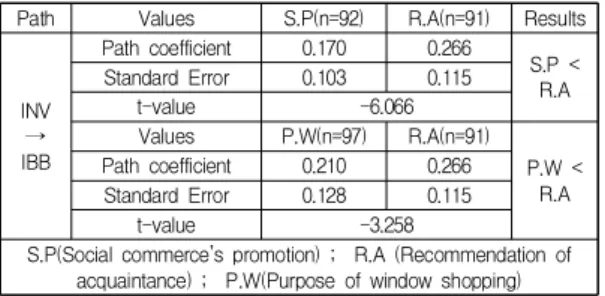
between path coefficients is used[44]. The total of 280 samples was divided into three groups depending on 3 different motives (Social Commerce promotion, Recommendation of acquaintance and window shopping).

The result is as follows. As you can find in Table 7, 8 and 9, the path of personal trait and characteristics of social commerce to impulsive buying showed the significant difference for analysis among shopping trigger. Other causal paths showed differences in their path coefficients, but not statistically significant.

Path Values S.P(n=92) R.A(n=91) Results

INV

→ IBB

Path coefficient 0.170 0.266

S.P <

Standard Error 0.103 0.115 R.A

t-value -6.066

Values P.W(n=97) R.A(n=91) P.W <

R.A Path coefficient 0.210 0.266 Standard Error 0.128 0.115

t-value -3.258

S.P(Social commerce’s promotion) ; R.A (Recommendation of acquaintance) ; P.W(Purpose of window shopping) Table 7. Comparison of path coefficients : Innovativeness

Path Values S.P(n=92) R.A(n=91) Results

SMG

→ IBB

Path coefficient 0.313 0.341

n.s.

Standard Error 0.086 0.136

t-value -1.722

Values P.W(n=97) R.A(n=91)

P.W < R.A Path coefficient 0.053 0.341

Standard Error 0.092 0.130

t-value -17.625

Values P.W(n=97) S.P(n=92)

P.W < S.P Path coefficient 0.053 0.313

Standard Error 0.092 0.086

t-value -20.088

Table 8. Comparison of path coefficients : Scarcity message

Path Values S.P(n=92) R.A(n=91) Result

PEX

→ IBB

Path coefficient 0.464 0.358

S.P > R.A Standard Error 0.141 0.136

t-value 5.181

Values P.W(n=97) R.A(n=91) Path coefficient 0.331 0.358 ns Standard Error 0.127 0.136

t-value -1.407

Values P.W(n=97) S.P(n=92)

P.W < S.P Path coefficient 0.331 0.464

Standard Error 0.127 0.141

t-value -6.816

Table 9. Comparison of path coefficients : Purchase experience

6. Conclusion and Implication

The purpose of this research is to identify the antecedents of the influencing impulse buying behavior in social commerce and differences among shopping trigger. In this study, to find out what factors affect impulse buying of social commerce, and to see the moderating effect of the motive of social commerce, the shopping trigger behind social commerce use was divided into three groups and compared among comparison groups. Through this research, results can provide valuable marketing information on competitive advantage to social commerce company under recent extreme competition. For this study, we reviewed previous studies on impulse buying and online impulsive buying behavior, the factors that influence impulsive buying were selected to verifying the hypothesis. And the moderating effect of each shopping trigger group was verified. By identifying influencing factors and the differences, the findings may be useful in rearranging their marketing strategies for each target market to efficiently induce consumer purchases.

Additionally, results of moderating effect of comparison group also give a guideline of market strategy and academically, comparative study of shopping trigger on impulsive buying have contributed to social commerce study and identify influencing factors on impulsive buying on social commerce domain is meaningful.

The results of this study are detailed as follows.

First, the innovativeness of consumer characteristics

has a positive impact on impulse buying. And result

that the among the three comparison groups,

acquaintance recommendation group has more positive

impact on the relationship between innovativeness and

impulsive buying than sales promotion, window

shopping groups was found. Because consumer, who

has personal trait of high innovativeness, has a wide

range of acceptable risk and takes shorter time for

decision making[46]. so this characteristic of

innovativeness seem to have a significant impact on

impulsive buying and especially risk purchasing

(10)

inexperience new product seem to be reduced by acquaintance recommendation. Second, purchase experience have a positive impact on impulse buying.

And result that the among the three comparison groups, the group, who access to social commerce by social commerce promotion, has more positive impact on the relationship between purchase experience and impulsive buying than other comparison groups was found. It is thought that much more purchase experience reduce the perceived risk of purchasing products[47], and it can lead to impulsive buying.

Third, Scarcity message of social commerce have a positive impact on impulse buying. And the result of comparing each group shows that the among the three comparison groups, window shopping has more positive impact on the relationship between innovativeness and impulsive buying than acquaintance recommendation groups The scarcity message about time limited sale, a limited quantity will increase the impulsive buying of the consumer. However, Hypothesis 4, which group related to window shopping was only rejected. It seems to window shopping groups have a prearranged-plan for purchase before the access. It seems to window shopping groups have a prearrange-plan for purchase before the access.

Theoretical implications of this study are following.

First, Mobile social commerce market has been spreading rapidly, but its characteristics are different between existing online social commerce market.

Therefore, it is necessary to conduct a study on mobile context. Thus, this study have a significance that identified factors affecting impulsive buying behaviors of social commerce users in mobile context. Second, it is turned out through the inter-group analysis that the effect of personal traits and information attributes on impulsive buying behaviors could be different by shopping trigger so it have been identified as important factor

As a practical implication of this study, new marketing strategy based on SNS and strategy for segmentalized shopping trigger rather than

indiscriminate online advertisement will be required.

Practical implications of this study are as below First, as a marketing strategy, recommendation promotion plan based on acquaintances is necessary for the consumer who has high innovativeness. Also, when marketers lunch new or trendy products of social commerce, to set a successful target marketing plan, marketers need to segment their potential consumer into different groups based on personal trait and shopping trigger. Second, providing differentiated scarcity message to consumers depending on the shopping trigger is considered necessary.

There are the following limitations for this study:

First, extended studies about the factors influencing the characteristics at the consumer purchase are required. Individual impulsiveness, hedonic traits or individual circumstance (budget or time limit) might be affect to impulsive buying. Second, influencing factor of impulsive buying of social commerce can be varied from the goods or services they purchase. Unlike traditional online shopping, social commerce sells a variety of items or services, including local restaurants, recreational facilities, tours and cultural goods. In each category, which provides with social commerce, it would be worthwhile to compare the factors of impulse buying.

REFERENCES

[1] Statistics Korea, 2018.

[2] J. K. Koo. (2015). Market condition and future tasks of social commerce. KIET Industrial economic, 49, 34-42.

[3] Y. H. Kim. (2011). Market trends and Policy issues of Social commerce. ICT & Media Policy, 23(11), 41-63.

[4] B. S. Kim. (2013). The Effects of Perceived Crowding and Consumers’ Shopping Patterns on Impulsive Buying in a Social Commerce Environment. The Journal of Internet Electronic Commerce Research, 13(2), 237-256.

[5] A. T. Stephen & O. Toubia. (2010). Deriving Value from Social Commerce Networks, Journal of Marketing Research”, 47(2), 215-228.

DOI : 10.1509/jmkr.47.2.215

(11)

[6] M. Anderson, J. Sims, J. Price & J. Brusa. (2011).

Turning Like to Buy Social Media Emerges as a Commerce Channel: Booz & Company.

[7] C. Kim. (2010). Case study on overseas promotion and outlook of Social commerce. Digieco, 1-14.

[8] Y. I. Gong. (2010). Market trends and forecast of Daily Deal Service. ICT & Media Policy, 22(18), 65-74.

[9] T. O'Reilly. (2005.09.30), What is Web 2.0?

http://www.oreillynet.com/pub/a/orilly/tim/news/

2005/09/30/what-is-web-20.html

[10] Stratmann J. (2010). Social commerce – the future of e-commerce? Fresh Networks.

http://www.freshnetworks.com/blog/2010/07/social- commerce-futures-commerce

[11] H. Stern. (1962). The significance of impulse buying today. The Journal of Marketing, 59-62.

[12] Kollat, D. T., & Willett, R. P. (1967). Customer impulse purchasing behavior. Journal of marketing research, 21-31.

[13] C. J. Cobb & W. D. Hoyer. (1986). Planned versus impulsive behavior, Journal of Retailing, 62(4), 384-409.

[14] Rook, Dennis W. & Hoch, Stephen J. (1985). Consuming Impulse, Advance in Consumer Research, 12, 23-27.

[15] Hoch, S. J. & Loewenstein, G. F. (1991) Time-Inconsistent Preferences and Consumer Self-Control. Journal of Consumer Research, 17, 492-507. DOI : 10.1086/208573

[16] S. A. Jeffrey& R. Hodge. (2007). Factors influencing impulse buying during an online purchase. Electronic Commerce Research, 7, 367-379. DOI : 10.1007/s10660-007-9011-8

[17] Tibert Verhagen & Willemijn van Dolen. (2011). The influence of online store beliefs on consumer online impulse buying: A model and empirical application.

Information & Management, 48, 320-327 DOI : 10.1016/j.im.2011.08.001

[18] J. S. Park & J. M. Lee. (2008). A Study on Affecting Factors of Impulsiveness Buying in the Internet Shopping Mall : Focus on Moderating of Browsing.

Journal of Digital Convergence, 6(1), 93-104.

[19] G. Y. Kim, Y. H. Chang, S. M. Lee & Y. C. Park (2012).

Determinants of Consumers` Impulsive Buying Behavior: Focus on Users of Social Commerce. Entrue Journal of Information Technology, 11(3), 71-88.

[20] S. J. Lee & S. Y. Shin. (2013). A Study on the Influential Factors of Impulsive Purchases by Female University Students in their 20`s when Purchasing Fashion Products in Social Commerce. Fashion & Textile

Research Journal, 15(5), 743-752.

[21] L. H. Bae & U. L. H. (2003). The Impacts of Browsing on Buying Impulsiveness in Internet Shopping Malls.

Korean Management Review, 32(5), 1235-1263.

[22] C. Park. (2000). The internet navigation value and internet shopping behavior. Korean Marketing Review, 15(1), 143-162.

[23] S. M. Jeong & K. H. Seon, (2004). The Relationship between Impulsive Buying Stimulus and Buying Experience in Cable TV Home Shopping. Family and Environment Research, 42(3), 105-118.

[24] H. G. Choi, J. M. Park & D. Y. Lee. (2007). A Study on the Influence of Customer Values on the Purchase Intention in Internet Shopping Mall. The Journal of Business Education, 17, 423-445.

[25] J. A. Ahn, (2008). Perceived Risk of Internet shopping mall brand consumers according to purchasing experience and the effect of perceived risk on information search and purchasing intension. Journal of Communication Science, 8(10), 161-194

[26] Brown, J. J. & Peter H. Reingen, P. H. (1987). Social Ties and Word-of-Mouth Referral Behavior, Journal of Consumer Research, 14(3), 350-362. DOI : 10.1086/209118

[27] Richins, Marsha & Root-Shaffer, Teri. (1988). The role of involvement and opinion leadership in consumer word-of-mouth: An implicit model made explicit.

Advances in Consumer Research. 15. 32-36.

[28] Katz, E. & Lazarsfeld, P. F. (1955). Personal Influence, Glencoe, IL: Free Press.

[29] Chevalier, J. A. & Mayzlin, D. (2006). The Effect of Word of Mouth on Sales: Online Book Reviews, Journal of Marketing Research, 43(3), 345-354.  DOI : 10.1509/jmkr.43.3.345

[30] Trusov, M., Bucklin, R. E. & Pauwels, K. (2009). Effects of word-of-mouth versus traditional marketing: findings from an internet social networking site. Journal of marketing, 73(5), 90-102. DOI :10.1509/jmkg.73.5.90 [31] Kaisheng, Z. (2010). Online Buying Impulsiveness and

Word-of-Mouth Online in the E-Marketing Age: A Theoretical Model Approach. Paper presented at the Management of e-Commerce and e-Government (ICMeCG), 2010 Fourth International Conference on.

[32] Åberg, A, & Kurdieh, N. (2013). Impulse buying online:

a visual, comparative enquiry into two mediums of grocery.

[33] J. S. Park, J. M. Lee. (2008). A Study on Affecting

Factors of Impulsiveness Buying in the Internet

(12)

Shopping Mall : Focus on Moderating of Browsing.

Journal of Digital Convergence, 6(1), 93-104.

[34] Y. S. Cho. (2014). A study on the Determinants of Impulsive Purchase Expenditure in Internet Shopping.

The e-Business Studies, 15(3), 433-450.

[35] Cialdini, R. B. (1985). Influence: Science and practice.

Glenview, IL: Scott, Foreman.

[36] Lynn, M. (1991). Scarcity Effects on Value: A Quantitative Review of the Commodity Theory Literature, Psychology and Marketing, 8(1), 43-57. DOI : 10.1002/mar.4220080105

[37] S. J. Choi. (2016). The Influence of Scarcity Message on Customers Perceived Value, Satisfaction, and Repurchase Intention in the Context of Group-Buying Social Commerce. Journal of Information Technology Applications & Management, 23(1), 97-117. DOI : 10.21219/jitam.2016.23.1.097

[38] Gotsi, M. & Wilson, A. M. (2001). Corporate reputation:

seeking a definition. Corporate communications: An international journal, 6(1), 24-30.

DOI :10.1108/13563280110381189

[39] Luo, W. & Chung, Q. B. (2010). Retailer reputation and online pricing strategy. Journal of Computer Information Systems, 50(4), 50-56. 

DOI :10.1080/08874417.2010.11645430

[40] C. Park, & T. M. Lee. (2009). Information direction, website reputation and eWOM effect: A moderating role of product type. Journal of Business research, 62(1), 61-67.

DOI : 10.1016/j.jbusres.2007.11.017

[41] H. J. Cho, S. J. Shin & J. G. Song. (2012). A study on the Influential factors of consumer satisfaction in social commerce, Journal of the Korean Society of Management Information System, 12(1), 102-110.

[42] S. W. Shin & J. H. Kim. (2013). The Effects of Reply Valence, Consensus and Friend’s Recommendation on the Word-of-Mouth Diffusion and Purchase Intention within the Context of Social Network Service The e-Business Studies, 14(5), 3-32.

[43] Y. T. Lim, (2013), An Effect of On-line Consumers’

Characteristics on Impulse Buying and Planned Purchasing Behavior. The Journal of Internet Electronic Commerce Research, 13(3), 257-273.

[44] Chin, W. W. (1998). The Partial Least Squares Approach to Structural Equation Modeling, Marcoulides, G A. (ed.), Modern Methods for Business Research, Lawrence Erlbaum, Mahway, NJ, USA.

[45] Fornell, C. & Larcker, D. F. (1981). Evaluating structural

equation models with unobservable variables and measurement error. Journal of Marketing Research, 18(1), 39-50. DOI : 10.2307/3151312

[46] Mittelstadt, R. A., Grossbart, S. L., Curtis, W. W. &

Devere, S. P. (1976). Optimal Stimulation Level and the Adoption Decision Process, Journal of Consumer Research, 3, 84-100.

DOI : 10.1086/208655

[47] Y. Yun & S. W. Baeg. (2003). Perceived Risks and Consumer Characteristics on Internet Shopping. The Korean Journal of Consumer and Advertising Psychology, 4(2), 73-103.

[48] Zhang, K. Z. & Benyoucef, M. (2016). Consumer behavior in social commerce: A literature review.

Decision Support Systems, 86, 95-108. DOI : 10.1016/j.dss.2016.04.001

[49] D. W. Lee, T. Y. Kang & D. H. Park. (2014). The Research on PC-based Versus Mobile Device-based Shopping Behavior Depending on Consumer Purchase Decision Process: Focusing on Task-Technology Fit Theory. Entrue Journal of Information Technology, 13(3), 107-121.

[50] Liang, T. P. & Lai, H. J. (2002). Effect of store design on consumer purchases: an empirical study of on-line bookstores. Information & Management, 39(6), 431-444.

DOI : 10.1016/S0378-7206(01)00129-X

[51] Cheng Shuang, K. R. Lee & S. J. Lee. (2017). Study on Chinese Repurchase Intention of Group-buying Social Commerce : The Moderating Role of Shopping Habit.

Journal of the Korea Convergence Society, 8(2), 169-181. DOI : 10.15207/JKCS.2017.8.2.169

[52] W. J Lee. (2017). Factors on the Satisfaction of Korean Medical Tour Convergence Services of Chinese College Students. Journal of the Korea Convergence Society, 8(2), 53-62. DOI : 10.15207/JKCS.2017.8.2.053 [53] S. S. Shin, M. Y. Shin, Y. S. Jeong & J. H. Lee. (2015).

An Investigation of Social Commerce Service Quality on

Consumer's Satisfaction, Journal of Convergence for

Information Technology, 5(2), 27-32.

(13)

문 정 근(Moon, Jung Keun) [정회원]

․2000년 2월 : 서울대학교 임산공학 과 (학사)

․2014년 2월 : 연세대학교 정보대학 원 (석사)

․2000년 5월 ~ 2006년 6월 : LG CNS

․2006년 7월 ~ 2010년 2월 : 만도

․2010년 3월 ~ 2012년 2월 : 코오롱 베니트

․2012년 3월 ~ 현재 : 한라홀딩스

․관심분야 : 유통, 마케팅

․E-Mail : [email protected]

곽 나 연(Kwak, Na Yeon) [정회원]

․2010년 2월 : 한국외국어대학교 경 영대학원(마케팅 석사)

․2010년 11월 ~ 2013년 10월 : 오 픈타이드

․2015년 3월 ~ 현재 : 연세대학교 정보대학원 박사과정

․관심분야 : 디지털비즈니스

․E-Mail : [email protected]

이 중 정(Choong C, Lee) [정회원]

․1993년 9월 : University of South Carolina MIS(Ph.D)

․1993년 2월 ~ 2000년 5월 : Salisbury State University 부교 수

․2000년 9월 ~ 현재 : 연세대학교 정보대학원 교수

․관심분야 : IT performance, It evaluation measurement,

․E-Mail : [email protected]

수치

Fig.  1.  Research  model
Table 2 shows the characteristics of samples.
Table 3 shows the operational definition, Survey items and their references. All measurements were recorded on a seven-point Likert scale (1 = strongly
Table  4.  Reliability  and  Convergent  validity
+2

참조

관련 문서

First, it was found that some factors of internet fashion shopping mall design quality had significant positive influences on the qualities of relationship to users such

In this Thesis, an empirical study on the Influence of Consumer's Preferences and Satisfaction on Purchase Intention of Korean Automobile in Vietnamese Consumers

The purpose of this study was to investigate the impact of social capital and positive psychology capital on the will of start-up according to experience

근래에 연구되는 격자형 모델은 각 경계범위에서 각기 다른 변수의 영향을 정확 하게 산출하지 못하고 있으나 , 수용모델링을 병행하는 경우 높은 정확도를 추정할

Discussions on electronic commerce became more activated when WTO Members adopted the Declaration on Global Electronic Commerce on 20 May 1998 at the 2nd Ministerial

Among the sub-factors of self-esteem, positive, male was higher than female, and on the contrary, negative In this study, females were higher than males,

This is because infants in the experimental group had statistically significant higher scores on the subcategories of social-emotional behavior, i.e.,

In order to extract the factors of brand personality, prior literature review in the fields of consumer behavior theory and psychology was performed. The