- 709 -
Changes of Bioactive Compounds and Antioxidant Activities in Korean Green Tea ( Camellia sinensis ) with Different Harvesting Periods
Seong-Koo Kang and Mi-Yae Shon1†
Department of Food Science and Technology, Sunchon National University, Suncheon 540-742, Korea
1
Department of Food and Nutrition, Gyeongsang National University, Jinju 660-701, Korea
국산 녹차의 채취시기별 활성물질 및 항산화능 변화
강성구․손미예1†
순천대학교 식품공학과, 1†경상대학교 식품영양학과
Abstract
Korean green tea has been claimed to have health-promoting effects, which may be related to the antioxidant activity in vitro. Korean green teas (Woojeon, WJ ; Sejak, SJ ; Jungjak, JJ ; Daejak, DJ) were subjected to different harvested times and yet little research has examined their bioactive compounds. To assess the effect of this different harvested times on nutritional and health-related properties such as Korean green tea polyphenols, flavonoids, theanine and free amino acids, antioxidant activities and radical scavenging activities were determined. Total polyphenols in JJ (37.16 mg/g) was higher than in other products (WJ, 19.55 ; SJ 24.65 ; DJ, 23.28 mg/g). Contents of flavonol and flavone glycosides were the highest at DJ (350.83 mg%) as compared to WJ (220.81), SJ (256.88) and JJ (270.36 mg%). Contents of theanine and total free amino acids were the highest at WJ (14.11, 23.62 mg/g, respectively), but decreased thereafter. Antioxidant activities were higher in JJ and DJ, using the linoleic acid peroxidation, DPPH and ABTS free radical-scavenging activities. However, WJ and SJ had less active antioxidant activity and free radical-scavenging activity. Reducing powers were increased depend on the concentration of extracts. Antioxidant activity and free radical-scavenging activity of JJ and DJ seemed to relate with total polyphenol and flavonoid contents.
Key words:green tea, polyphenol, flavonoid, antioxidant activity
Introduction
1)
Tea is an infusion of dried leaves of Camellia sinensis, and can be classified into the four type’s green tea (Woojeon, Sejak, Jungjak and Daejak) in Korea depending on the period of harvesting of the leaves. Green tea is derived from leaves, which were exposed, to dry heat in order to inactivate oxidative enzymes. Green tea has gained much interest because of the increasing number of reports on beneficial health effects including antioxidative and anticarcinogenic properties (1). Green tea has been well known as bioactive
†Corresponding author. E-mail:[email protected], Phone:82-55-761-8417, Fax:82-55-761-8417
drink due to its high content of catechins (2).
Several reports have shown a linkage between the consumption of green tea and a lower risk of atherosclerosis (3,4). Antioxidative constituents of green tea such as tea catechins were shown to prevent peroxidation of plasma lipoproteins (5,6). In particular, (−)-epigallocatechin-3-gallate (EGCG) and (−)-epigallo catechin (EGC) were reported to inhibit LDL oxidation in vitro by scavenging oxygen radicals and chelating metal ions which act as catalysts of lipid oxidation (7,8). Biological and clinical studies have provided various lines of evidence in the past decade that free radical-induced oxidative damage of cell membranes and proteins might play a causative role in aging and several
degenerative diseases and that antioxidants, such as α -tocopherol (vitamin E) and ascorbic acid (vitamin C), might have beneficial effects in protecting against these diseases (9,10) Therefore, inhibition of free radical-induced oxidative damage by supplementation of antioxidants has become an attractive therapeutic strategy for reducing the risk of these diseases (11,12). A recent review summarized effects of tea polyphenols on signal transduction pathways related to cancer chemoprevention (13). The desirable putative therapeutic properties of green tea polyphenols have also been considered to depend on their antioxidant properties (14). The antioxidant activities of green tea polyphenols depend significantly on the structure of the molecules, the initiation conditions and the microenvironment of the reaction medium (15). In Korea, the production of wild green tea was limited, limited information is available on the effect of green tea harvesting periods on polyphenols and flavonoids content and composition. Furthermore, no report is available on the polyphenols and flavonoids content at very varying length of green tea harvesting periods.
The objective of this study was to investigate the changes and antioxidant activities of polyphenols and flavonoids during different harvesting periods for the purposes of maximizing the nutraceutical benefits of green tea consumption.
Materials and Methods
Chemicals
(−)-Gallocatechin (GC), (−)-epigallocatechin (EGC), (−)-gallocatechin gallate (GCG) and (−)-epigallocatechin gallate (EGCG), quercetin, kaempherol, luteolin, apigenine, theanine, linoleic acid, potassium phosphate, potassium ferricyanide, ferric chloride and l-ascorbic acid, 2, 2-diphenyl –picrylhydrazyl (DPPH), 2, 2-azinobis (3-ethylbenzothiazoline- 6-sulfonate) (ABTS) were purchased from Sigma Chemical Co. (St. Louis, MO, USA). All other solvents / chemicals used were of analytical grade and purchased from Sigma- Aldrich Co. (St Louis, MO).
Preparation of green tea and extracts
Four type’s Korean green tea samples (Woojeon, Sejak, Jungjak and Daejak) were harvested in the period of 2005 and were cultivated at Hadong (Gyeongnam, Korea).
Woojeon, Sejak, Jungjak and Daejak were subjected to different harvested periods : Woojeon is products for first
harvest time from April 1 to 15, Sejak for second harvest time from April 16 to 30, Jungjak for third harvest time from May 1 to 15 and Daejak for fourth harvest time from May 16 to 30. The dry powders of green tea samples were extracted with methanol and used after dissolving in water or in methanol for antioxidant activity assay.
Determination of polyphenols
Ground sample (1 g) was added to 15 mL boiled water, heated on a water-bath at 80℃ for 20 min. After cooling and filtering, solutions was filtered with 0.2 micrometer membrane filter and analyzed by HPLC . The polyphenols concentration were then measured by HPLC (Shimadzu LC-10AD, Japan) with a reverse phase C-18 column (octadesylsilane, 4.6 mm, 25 cm) and the UV detector operating at 280 nm. The analysis was performed according to Arabbi et al. (16), with some modifications.
Determination of flavonoids
Ground sample (1 g) was added to 10 mL methanol and extracted for 12 hr. After centrifuging and filtering, methanol solutions was filtered with 0.2 micrometer membrane filter and analyzed by HPLC. The flavonoids concentration were then measured by HPLC (Shimadzu LC-10AD, Japan) with a reverse phase C-18 column (octadesylsilane, 4.6 mm, 25 cm) and the UV detector operating at 370 nm. The analysis was performed according to Wang et al. (17), with some modifications.
Determination of free amino acids
One gram of the tea sample was added to 50 mL boiled water in water bath at 80℃ for 1 hr. After 1 hr, 1 g of 5-sulfosalicylic acid dehydrate was added to sample solutions at 4℃ for 2 hr. After centrifuging and extracting, 2 mL of Li-citrate buffer was added to extracts. Extracts solutions were filtered with 0.2 micrometer membrane filter and analyzed by HPLC (Biochrom 20., Pharmacia Co.) with anion exchange column (4.6 mm, 200 mm) and the detector operating at 440 nm and 570 nm.
DPPH assay
The scavenging activity of methanol extracts on DPPH radicals was measured according to the method of Yoshida et al. (18). Ethanolic solutions of DPPH (10-4M) and methanol extracts solutions were mixed so that the final mass ratios were extracts : DPPH. = 5.5 : 1 and reference compound : DPPH = 0.5 : 1. The samples were incubated for 15 min
in the dark at 30℃ and the decrease in absorbance at 517 nm was measured against ethanol using a spectrophotometer.
Ethanol was used to zero the spectrophotometer. Blank sample contain the same amount of ethanol and DPPH was prepared and measured daily, stored in a flask covered and kept in the dark at 4℃ between the measurements.
ABTS assay
This assay is based on the inhibition of the absorbance of the radical cation of 2, 2’-azinobis (3-ethylbenzothiazoline 6-sulfonate ; ABTS) which has characteristic long wavelength absorption spectrum showing maxima at 734 nm by tested antioxidant (19). ABTS was dissolved in water to a 7 mM concentration. ABTS radical cation was produced by reacting ABTS stock solution with 2.45 mM potassium persulfate and allowing the mixture to stand in the dark at room temperature.
For the study ABTS+ solution was diluted with phosphate buffer saline pH 7.4 (PBS) to an absorbance of 0.7 (0.02) at 734 nm and equilibrated at 30℃. After addition of 2.0 mL of diluted ABTS solution to 20 μL of biological sample, or BHA standard, the reaction mixture was incubated for 6 min in a glass cuvette at 30℃. The decrease in absorbance at 734 nm was determined exactly at 6 min after initial mixing for all samples was measured daily. All measurements were performed in four repetitions. The percentage inhibition of ABTS by the sample was calculated according to the formula : % Inhibition = [(AC(0)-AA(t))/ AC(0)] 100 where AC(0) is the absorbance of the control at t=0 min ; and AA(t) is the absorbance of antioxidant at t=6 min. The antioxidant solution reduces the radical cation to ABTS, which reduces the color.
The extent of decolorization is calculated as percentage reduction of absorbance, and this is determined as a function of concentration. The activity of each antioxidant was determined at five concentrations.
Antioxidant activity in linoleic acid emulsion system
The inhibition of linoleic acid peroxidation was measured by the method of Mitsuda et al. (20). Linoleic acid emulsion was prepared by adding equal amount of linoleic acid and tween 20, followed by serially dilution to a final concentration of 0.02 M with sodium phosphate buffer (0.2 M, pH 7.0) and homogenization. A 0.02 mL aliquot of each extracts was mixed with 2.5 mL linoleic acid emulsion and 2 mL sodium phosphate buffer and the mixture was incubated at 37℃ for 24 hr. Finally, 4 mL ethanol solution (75%), 0.1 mL ammonium thiocyanate and 0.08 mL ferrous chloride (0.02
M in 5.0% HCl) were added to 0.08 mL reaction mixture.
After 3 min, the absorbance of the mixture at 500 nm was measured by a spectrophotometer (Hitachi U-2000). The inhibition ratio was calculated as follows : Inhibition ratio (%) = [1-(As-Ab)/ (Ac-Ab)] × 100, where As, Ab and Ac
represented absorbances measured for sample, blank and control, respectively.
Reducing power activity
The reducing power of extracts were determined by the method of Yen and Duh (21). Different concentrations of extracts were mixed with 2.5 mL of phosphate buffer (200 mM, pH 6.6) and 2.5 mL of 1% potassium ferricyanide. The mixtures were incubated for 20 min at 50℃. After incubation, 2.5 mL of 10% trichloroacetic acid were added to the mixtures, followed by centrifugation at 650×g for 10 min.
The upper layer (5 mL) was mixed with 5 mL of distilled water and 1 mL of 0.1% ferric chloride and the absorbance of the resultant solution were measured at 700 nm.
Statistical analysis
Each experiment was performed in triplicate and repeated twice. The results were expressed as means±SD using Microsoft Excel software. Statistical comparisons were made by ANOVA procedure followed by a Duncan’s multiple range tests, p<0.05 were considered significantly different.
Results and Discussions
Contents of polyphenol, flavonoid, theanine and free amino acid in Woojeon, Sejak, Jungjak and Daejak increased depend on harvesting times. The highest contents of polyphenol were Jungjak, while polyphenol contents were particularly low in Woojeon (Table 1). The contents of catechin in Jungjak are 6.71 mg/g, while EGC, GCG, EGCG and CG were 7.04, 6.45, 11.13 and 3.11 mg/g, respectively. The contents of catechin in Woojeon are 3.98 mg/g, while EGC, GCG, EGCG and CG were 44.22, 3.45, 5.57 and 0.65 mg/g, respectively.
Therefore considerable variability in the contents of polyphenol was observed and contents of polyphenol between the Woojeon, Sejak, Jungjak and Daejak were greatly different. Contents of flavonoid were increased on harvesting times. The highest contents of flavonoid were Daejak.
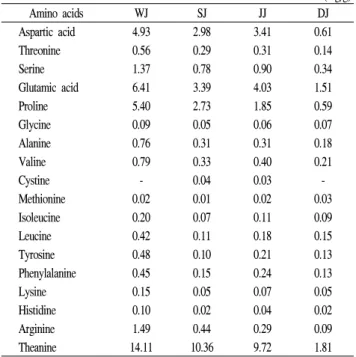
Contents of flavonoid between the Woojeon, Sejak and Jungjak were not greatly different (Table 2). Contents of theanine and free amino acid were decreased on harvesting times (Table 3). Also, a characterization of
Table 1. Changes in polyphenols contents of green tea on different harvesting time
(mg/g)
Catechins WJ SJ JJ DJ
(−)-Epigallocatechin(EGC) 4.22±0.03 3.57±0.06 7.04±0.04 4.37±0.02 (−)-Gallocatechingallate(GCG) 3.45±0.05 4.05±0.04 6.45±0.06 3.55±0.03 (+)-Catechin 3.98±0.02 7.01±0.02 6.71±0.03 6.09±0.05 Catechol 1.68±0.04 2.85±0.06 2.72±0.06 2.68±0.04 (−)-Epigallocatechingallate(EGCG) 5.57±0.03 6.38±0.04 11.13±0.07 5.97±0.03 (−)-Catechingallate(CG) 0.65±0.06 0.79±0.01 3.11±0.02 0.62±0.01 Results are means±SD of three measurements.
WJ (Woojeon) : green tea for first harvest time from April 1 to 15.
SJ (Sejak) : green tea for second harvest time from April 16 to 30.
JJ (Jungjak) : green tea for third harvest time from May 1 to 15.
DJ (Daejak) : green tea for fourth harvest time from May 16 to 30.
Table 2. Changes in flavonoids contents of green tea on different harvesting time
(mg%)
WJ SJ JJ DJ
Flavonol glycoside
Myricetin 3.97±0.06 - - -
Quercetin 121.30±1.48 165.29±1.54 160.31±1.16 185.38±2.51 Kaempherol 18.67±0.53 22.01±1.12 26.32±1.14 50.12±1.06 Flavone
glycoside
Luteolin 16.83±0.76 35.30±0.43 37.67±0.56 52.02±1.03 Apigenine 60.04±1.05 34.28±0.42 46.06±1.07 63.31±0.56 Results are means±SD of three measurements.
WJ, SJ, JJ, DJ : refer to Table 1.
Table 3. Changes in free amino acids and theanine contents of green tea on different harvesting time
(mg/g)
Amino acids WJ SJ JJ DJ
Aspartic acid 4.93 2.98 3.41 0.61
Threonine 0.56 0.29 0.31 0.14
Serine 1.37 0.78 0.90 0.34
Glutamic acid 6.41 3.39 4.03 1.51
Proline 5.40 2.73 1.85 0.59
Glycine 0.09 0.05 0.06 0.07
Alanine 0.76 0.31 0.31 0.18
Valine 0.79 0.33 0.40 0.21
Cystine - 0.04 0.03 -
Methionine 0.02 0.01 0.02 0.03
Isoleucine 0.20 0.07 0.11 0.09
Leucine 0.42 0.11 0.18 0.15
Tyrosine 0.48 0.10 0.21 0.13
Phenylalanine 0.45 0.15 0.24 0.13
Lysine 0.15 0.05 0.07 0.05
Histidine 0.10 0.02 0.04 0.02
Arginine 1.49 0.44 0.29 0.09
Theanine 14.11 10.36 9.72 1.81
WJ, SJ, JJ, DJ : refer to Table 1.
Woojeon, Sejak, Jungjak and Daejak in accordance with polyphenol contents and antioxidant activity was clearly established in Fig. 1, 2, 3 and 4. The DPPH values for investigated in green tea varied in a range between 60.9 and 96.9 % (Fig.1). DPPH radical scavenging activity increased proportionally to the polyphenol content. In the ABTS test, green tea extracts were able to inhibit the radical ABTS.
Jungjak and Daejak extracts showed radical scavenging activity with 88% and 78% of 500 μg (Fig. 2). Fig. 3 shows the antioxidant activity of Woojeon, Sejak, Jungjak and Daejak as measured by the inhibiting of linoleic acid peroxidation. Woojeon, Sejak, Jungjak and Daejak as well as BHA or L-ascorbic acid itself, were found to give the antioxidant activity of 47%, 40%, 54%, 65.2%, 63% and 76%
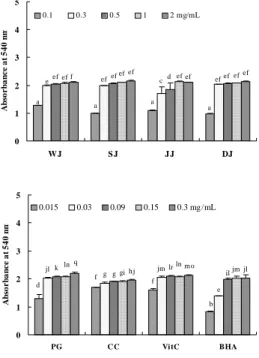
at 500 μg/mL concentration, respectively. Fig. 4 show the reducing power of the Woojeon, Sejak, Jungjak and Daejak using the potassium ferricyanide reduction method. At concentration of 500 μg/mL, the extract showed absorbances of 1.27, 1.63, 1.84 and 1.8, respectively. The L-ascorbic acid, reference compound, exhibited the high reducing activity of 2.1 at 150 μg/mL. Flavonoids and phenolic acids are the most predominant compounds of green tea. These compounds have radical scavenging activity and antioxidant activity. Woojeon, Sejak, Jungjak and Daejak extracts also showed radical scavengers and antioxidant activity. The green tea extracts had phenolic hydroxyl groups
b a b
qc dd gg a bcd ee gg cd ffg g cd ed fe g
0 5 0 1 0 0 1 5 0
W J S J J J D J
Antioxidant acivity (%
0 .1 0 .3 0 .5 1 2 m g / m L
a
g
c
b e
f h f
c
f f h f h
d
f f h f h
f f h h ef
0 5 0 1 0 0 1 5 0
V i tC P G C C B H A
Antioxidant acivity (%
0 .0 1 5 0 .0 3 0 .0 9 0 .1 5 0 .3 m g / m L
Fig. 1. Free radical scavenging activities of green tea as determined by the DPPH method.
Results are means±SD of three measurements. Values with different superscripts within the all column and row are significantly different at p<0.05 by Duncan's multiple range test.
PG : propyl gallate, CC : catechol, BHA : butylated hydroxy anisole.
WJ, SJ, JJ, DJ : refer to Table 1.
abacacbcbc acacacbcbc acbcbccc acacacbca
0 50 100 150
WJ S J JJ DJ
Scavenging activity (%)
0.1 0.3 0.5 1 2 mg/mL
c de
ce
f g
g
g
b g
fg
g
cd
fg g g
e g
g
0 50 100 150
VitC PG CC BHA
Scavenging activity (%)
0.015 0.03 0.09 0.15 0.3 mg/mL
Fig. 2. ABTS radical scavenging activities of green tea.
Results are means±SD of three measurements. Values with different superscripts within the all column and row are significantly different at p<0.05 by Duncan's multiple range test.
PG : propyl gallate, CC : catechol, BHA : butylated hydroxy anisole.
WJ, SJ, JJ, DJ : refer to Table 1.
jk jk
gi hi
ki gi
eg fh
gi
dg ad
cf
fh dg
be ac
be cf
a ab
0 20 40 60 80 100 120
WJ S J JJ DJ
Scavenging activity (%)
0.1 0.3 0.5 1 2 mg/mL
cd h i
bd
a
gh ik
bc
a
hi jl
ef
ab
hi k m
hi
bd
m n n k i
fg
0 20 40 60 80 100 120
PG CC VitC BHA
Scavenging activity (%)
0.015 0.03
0.09 0.15
0.3 mg/mL
Fig. 3. Antioxidant activities of green tea in the linoleic acid emulsion system using the thiocyanate method.
Results are expressed as means±SD of three measurements. Values with different superscripts within the all column and row are significantly different at p<0.05 by Duncan's multiple range test.
PG : propyl gallate, CC : catechol, BHA : butylated hydroxy anisole.
WJ, SJ, JJ, DJ : refer to Table 1.
a a a
a
eefeff efefefef cd ef efefef
ef ef
0 1 2 3 4 5
W J S J J J DJ
Absorbance at 540 nm
0.1 0.3 0.5 1 2 mg/mL
b f f
d e
g jm
jl lr il
k g ln jm
gi
ln m o jl
hj q
0 1 2 3 4 5
PG CC VitC BHA
Absorbance at 540 nm
0.015 0.03 0.09 0.15 0.3 mg/mL
Fig. 4. Reducing powers of green tea.
Results are expressed as means±SD of three measurements. Values with different superscripts within the all column and row are significantly different at p<0.05 by Duncan's multiple range test.
PG : propyl gallate, CC : catechol, BHA : butylated hydroxy anisole.
WJ, SJ, JJ, DJ : refer to Table 1.
and have been recognized to function as electron or hydrogen donors (22). The role of antioxidants has attracted much interest with respect to their protective effect against free radical damage that may be the cause of many diseases including cancer (23). The antioxidative effect of green tea extract is mainly due to the phenolic components, some flavonoid compounds have been reported to show alkylperoxyl radical scavenging activity thus reducing radical-mediated pathogenesis, e.g. carcinogenesis (24).
요 약
국산 녹차의 채취시기별 주요 화학성분과 항산화 특성을 평가하기 위하여 폴리페놀, 플라보노이드, 데아닌, 유리아 미노산 함량과 항산화 및 라디칼 소거능에 대하여 조사하였 다. 총 폴리페놀 함량은 중작 37.16 ㎎/g로 가장 높았으며, 다음으로 세작 24.65 mg/g, 대작 23.28 mg/g, 우전 19.55 mg/g 순이었으며, 총 플라보노이드는 대작이 350.83 mg%
으로 중작 270.36 mg%, 세작 256.88 mg%, 우전 220.81 mg%에 비하여 비교적 높았다. Theanine과 총 유리아미노 산은 우전에서 각각 14.11 mg/g, 23.62 mg/g으로 가장 높았 으며, 이후에 나오는 녹차는 그 함량이 점진적으로 감소되 었다. 또한 수확시기에 따른 항산화능을 linoleic acid
peroxidation, DPPH 및 ABTS 자유라디칼 소거능으로 조사 한 결과, 녹차 중 중작이나 대작에서는 높았지만, 우전과 세작은 항산화 활성과 자유라디칼 소거능이 거의 없었고, 그 환원력은 농도 의존적으로 증가하였다. 이상의 결과로 부터 중작과 대작의 항산화능과 자유라디칼 소거능은 총 폴리페놀과 총 플라보노이드 함량에 관련되는 것으로 판단 된다.
Acknowledgement
This study was supported by Technology Development Program of the Ministry of Agriculture and Forestry, Republic of Korea.
References
1. Shon, M.Y., Kim, S.H., Nam, S.H., Park, S.K. and Sung, N.J. (2004) Antioxidant activity of Korean green and fermented tea extracts. J. Life Sci., 14, 920-924 2. Ohe, T., Marutani, K. and Nakase, S. (2001) Catechins
are not major compounds responsible for anti-genotoxic effects of tea extracts against nitroarenes. Mutation Research, 496, 75-81
3. Stensvold, I., Tverdal, A., Solvoll, K. and Foss, O.P.
(1992) Tea consumption. Relationship to cholesterol, blood pressure, and coronary and total mortality. Prev.
Med., 21, 546-553
4. Kono, S., Shinchi, K., Ikeda, N., Yanai, F. and Imanishi, K. (1992) Green tea consumption and serum lipid profiles : A cross sectional study in Northern Kyushu, Japan.
Preventive Medicine, 21, 526-531
5. Yang, T.T.C. and Koo, K.M.L. (2000) Inhibitory effect of Chinese green tea on endothelial cell induced LDL oxidation. Atheroscleorosis, 148, 67-83
6. Higdon, J.V. and Frei, B. (2003) Tea catechins and polyphenols : Health effects, metabolism and antioxidant functions. Critical Reviews Food Sci. Nutr., 43, 89-143 7. Terao, J., Piskula, M. and Yao, Q. (1994) Protective effect
of epicatechin, epicatechin gallate, and quercetin on lipid peroxidation in phospholipid bilayers. Archives Biochem.
Biophy., 308, 278-284
8. Riemersma, R.A., Carruthers, K.F. and Elton, R.A. (2001) Plasma ascorbic acid and risk of heart disease and cancer.
Lancet, 357, 2136-2137
9. Barnham, K.J., Masters, C.L. and Bush, A.I. (2004)
Neurodegenerative diseases and oxidative stress. Nature Reviews Drug Discovery, 3, 205-214
10. Cooke, M.S., Evans, M.D., Dizdaroglu, M. and Lunec, J. (2003) Oxidative DNA damage: mechanism, mutation and disease. FASEB J., 17, 1195-1214
11. Brash, D.E. and Harve, P.A. (2002) New careers for antioxidants. Proceedings of the National Academy of Sciences of the United States of America, 99, 13969-13971
12. Surh, Y.J. (2003) Cancer chemoprevention with dietary phytochemicals. Nature Reviews Cancer, 3, 768-780 13. Hou, Z., Lambert, J.D., Chin, K.V. and Yang, C.S. (2004)
Effects of tea polyphenols on signal transduction pathways related to cancer chemoprevention. Mutation Research, 555, 3-19
14. Mitscher, L.A., Jung, M., Shankel, D., Dou, J.H., Steele, L. and Pillai, S.P. (1997) Chemoprotection : a review of the potential therapeutic antioxidant properties of green tea (Camellia sinensis) and certain of its constituents.
Medicinal Research Reviews, 17, 327-365
15. Zhou, B., Wu, L.M. and Liu, Z.L. (2005) Evidence for α-tocopherol regeneration of green tea polyphenols in SDS micelles. Free Radical Biol. Med., 38, 78-84 16. Arabbi, P.R., Genovese, M.I. and Lajolo, F.M. (2004)
Flavonoids in vegetable foods commonly consumed in Brazil and estimated ingestion by the Brazilian population. J. Agric. Food Chem., 52, 1124-1131 17. Wang, H., Provan, G.J. and Helliwell, K. 2003. HPLC
determination of catechins in tea leaves and tea extracts using relative respones factors. Food Chemistry, 81, 307-312
18. Yoshida, T.K., Mori, T., Okumura, I., Uehara, K.
Komagoe, Y. and Fuijita, T. (1989) Studies on inhibition mechanism of autoxidation by tannins and flavonoids.
Chem. Pharm. Bull., 37, 1919-1921
19. Re, R., Pellegrini, N., Pannala, A., Yang, M. and Rice-Evans, C. (1999) Antioxidant activity applying an improved ABTS radical cation decolorization assay. Free Radical Biol. Med., 26, 1231-1237
20. Mitsuda, H., Yasumoto, K. and Iwami, K. (1996) Antioxidative action of indole compounds during the autoxidation of linoleic acid. Eiyo to Shokur, 19, 210-214 21. Yen, G.C. and Duh, P.D. (1993) Antioxidative properties
of methanolic extracts from peanut hulls. J. American Oil Chemist's Society, 70, 383-386
22. Shahidi, F. and Wanasundara, P.K. (1992) Phenolic antioxidants. Critical Review Food Sci. Nutr., 32, 67-103
23. Nakama, T., Yamada, M., Osawa, T. and Kawakishi, S. (1993) Suppression of active oxygen-induced cytotoxicity of flavonoids. Biochem. Pharmacol., 45, 265-267 24. Pietta, P. and Simonetti, P. (1999) Dietary flavonoids
and interaction with physiologic antioxidants. In: Packer, L., Hiramatsu, M., Yoshikawa, T. : Antioxidant food supplements in human health. Academic Press, San Diego, California. p.283-308
(접수 2007년 8월 2일, 채택 2007년 11월 16일)