• 검색 결과가 없습니다.

The Influence of Organizational Communication Recognized by Irregular Workers on Job Satisfaction and Organizational Commitment

N/A
N/A
Protected

Academic year: 2021

Share "The Influence of Organizational Communication Recognized by Irregular Workers on Job Satisfaction and Organizational Commitment"

Copied!
11
0
0

로드 중.... (전체 텍스트 보기)

전체 글

(1)

The Influence of Organizational Communication Recognized by Irregular Workers on Job Satisfaction and Organizational

Commitment

Jae Won Choi 1 , Seok Kee Lee 2* , Sungyong Chun 3

1

Doctoral Student, Dept. of Smart Convergence Consulting, Hansung University

2

Professor, Dept. of Computer Engineering, Hansung University

3

Associate professor, Dept. of Business Administration, Dankook University

비정규직이 인식한 조직커뮤니케이션이 직무만족과 조직몰입에 미치는 영향

최재원 1 , 이석기 2* , 천성용 3

1

한성대학교 스마트융합컨설팅학과 박사과정,

2

한성대학교 컴퓨터공학부 교수,

3

단국대학교 경영학부 부교수

Abstract Irregular workers, which have recently caused various socio-economic issues and conflicts, generally have low loyalty to the organization and job satisfaction due to anxiety about employment.

As a way to improve this, this study attempted to analyze the effect of organizational communication satisfaction of irregular workers on job satisfaction and organizational commitment. Among the 7th Human Capital Companies panel survey data, irregular workers survey data were collected and analyzed using the structural equation model analysis. The results were as follows: First, it was analyzed that organizational communication recognized by irregular workers had a positive(+) effect on job satisfaction and organizational commitment. Second, it was analyzed that job satisfaction had a positive(+) effect on organizational commitment. Third, it was analyzed that job satisfaction plays a mediating role in the relationship between communication satisfaction and organizational commitment.

This study is significant in that it expanded the research subject to irregular workers from the existing service industry-oriented research, and that it included more diverse industries. The results of this study suggest that mission and vision sharing and communication activation system are needed to improve organizational effectiveness of irregular workers.

Key Words : Irregular Workers, Organizational Communication, Job Satisfaction, Organizational Commitment, Human Resource Management

요 약 최근 다양한 사회경제적 이슈 및 갈등을 야기하고 있는 비정규직은 대체로 고용에 대한 불안감으로 인해 조직에 대한 충성도나 직무만족도가 낮을 수밖에 없는데, 이를 개선하기 위한 방안으로 본 연구는 비정규직의 조직커뮤니케이 션 만족도가 직무만족과 조직몰입에 미치는 영향을 분석하고자 하였다. 제 7차 인적자본기업 패널조사 자료 중 비정규 직 설문데이터를 구조방정식 모형분석 등을 활용하여 분석하는 방식으로 연구를 진행하였으며, 연구결과는 다음과 같 다. 첫째, 비정규직이 인식한 조직커뮤니케이션은 직무만족과 조직몰입에 정(+)의 영향을 미치는 것으로 분석되었다.

둘째, 비정규직의 직무만족은 조직몰입에 정(+)의 영향을 미치는 것으로 분석되었다. 셋째, 비정규직의 커뮤니케이션 만족과 조직몰입의 관계에 있어서 직무만족이 매개작용을 하고 있는 것으로 분석되었다. 본 연구는 기존의 서비스업 위주의 연구에서 연구대상을 비정규직으로 확대하였으며, 보다 다양한 업종을 아울렀다는데 의의가 있다. 본 연구의 결과는 비정규직의 조직유효성 향상을 위해 미션 및 비젼 공유, 커뮤니케이션 활성화 제도가 필요함을 시사하고 있다.

주제어 : 비정규직, 조직커뮤니케이션, 직무만족, 조직몰입, 인적자원관리

*This research was financially supported by Hansung University.

*Corresponding Author : Seok Kee Lee([email protected]) Received April 22, 2021

Accepted August 20, 2021

Revised August 9, 2021

Published August 28, 2021

(2)

1. Introduction

According to the results of the 「2019 Economic Activity Census Supplementary Survey by Work Type」by the National Statistical Office, the proportion of irregular workers among all wage workers this year reached 36.4%, the highest since 36.6% in March 2007. However, conflict with regular workers is occurring within corporate organizations due to unequal treatment and discrimination against irregular workers, which adversely affects organizational effectiveness. This conflict between regular and irregular workers in corporate organizations is further pointed out as a factor causing problems in the overall social economy. However, the proportion of irregular workers is expected to gradually increase due to factors such as the rapidly changing economic environment, industrial structure, and implementation of corporate employment flexibility strategies. In order to achieve the goals pursued by a company, it is impossible without communication between management and members, communication between internal organizations, communication and cooperation between members.In order to solve the problem of irregular workers who are in charge of various fields, from a long-term perspective, it is necessary to convert to regular workers, reorganize the wage system, and expand the application of social insurance qualifications. The top priority is to communicate smoothly with them. Existing studies related to the relationship between organizational communication and organizational effectiveness have shown that the more active organizational communication, the more positive (+) effect on organizational effectiveness [1-3]. However, since most of the studies are targeting service workers and regular workers, it was judged that the research needs to be expanded. Therefore, this study aims to investigate the impact of organizational communication perceived by them on job

satisfaction and organizational commitment to irregular workers in a wider variety of industries such as manufacturing, financial, and non-financial industries. Through this, it is intended to provide empirical basic data useful for establishing an effective human resource management framework and HR strategy for achieving corporate goals by enhancing job satisfaction and organizational commitment of irregular workers and further verifying their impact relationship.

2. Theoretical Background and Prior Research

2.1 Irregular Workers

There is no clear internationally agreed standard for the definition of non-regular workers, and it can be seen as a residual concept of regular workers as opposed to regular workers. In Korea, after the financial crisis, there has been a continuous debate over the concept and scope of non-regular workers. Accordingly, in July 2002, the special committee for non-regular workers of the labor/management/government committee decided on the concept and scope of non-regular workers through an agreement between labor, management, and government. According to this agreement, the concept of non-regular workers was defined as 'temporary workers (fixed-term workers)', 'part-time workers (part-time workers)', and 'workers engaged in the form of dispatch/service/call (non-standard workers)'.

Vulnerable workers were defined as those who were unstable and in need of social protection because they were unable to benefit from protection under the Labor Standards Act or various social insurances [4].

2.2 Organizational Communication

The concept of communication can generally

(3)

be viewed as a process of exchanging information such as thoughts and feelings with each other. Communication is never done alone, it is about sharing with someone.

In addition, an organization can be defined as a hierarchical group of two or more people with a common goal and that exists for a certain period of time while interacting with the external environment [5]. Based on these concepts and definitions, organizational communication can be defined as two or more individuals exchanging messages through various means in order to form and maintain a series of activities for a common goal. Or it can be defined as sharing messages, ideas, attitudes, etc. through advanced technologies or various means of information transfer between managers, employees, and colleagues in the organizational structure [6].

The function of organizational communication is first, the function of delivering information to individuals, groups, or organizations, Second, the function of promoting motivation of members, Third, the function of coordinating and controlling the behavior of members, Fourth, the individual emotions of members can be summarized as expressions and functions to satisfy personal needs [7].

2.3 Job Satisfaction

The reason that various studies on job satisfaction have been continued for a long time is that, depending on whether or not employees are satisfied in various aspects related to their job and job performance, they may have positive or negative emotions toward the organization.

This is because these emotions affect organizational performance. Locke (1976) defined job satisfaction as 'a happy or positive emotional state as a result of the evaluation of job experience' [8]. In the study of Cho Sang-Eun(2011), job satisfaction was defined as a state of pleasant emotional and emotional satisfaction obtained

from the evaluation of the job itself and the job environment according to the level of individual values, attitudes, values, needs, and beliefs. This affects job performance, and it is defined as an emotional expression that expresses the degree of satisfaction of employees with working conditions related to their job, such as the job itself, wages, promotion opportunities, colleagues, superiors, and working conditions.[9]. In addition, Lee In-suk(2017) defined it as an emotional and emotional satisfaction state obtained from an evaluation of the work environment according to beliefs, attitudes, and desires[10]. In a study by Yang Jong-hyeon and Jang Dong-min (2019), who analyzed the factors of job satisfaction for irregular workers, it was found that the higher the factors related to environmental unfairness, status unfairness, and job instability, the lower the job satisfaction [11].

2.4 Organizational Commitment

Organizational commitment can also be classified as psychological performance among the evaluation indicators of organizational effectiveness, such as job satisfaction.

Organizational commitment is a psychological

attachment to an organization to which one

belongs, and can be defined as the degree to

which members of an organization are willing to

identify themselves with the organization and to

commit to that organization. In the present era,

where talent is attracting attention as the most

important asset of a company, the more

immersed in work and organization, the more

profit creation and productivity of the company

can be increased[12]. Lim Young-shin (2013) said

that through this research on organizational

commitment and organizational communication,

organizational communication has a positive (+)

effect on organizational commitment, and in

particular, formal communication has a positive

(+) effect on organizational commitment[13]. In a

(4)

study by Jin-Young Han (2012), which analyzed the difference in organizational commitment between regular and irregular employees in hotel companies, it was found that irregular employees showed less interest in workplace issues than regular employees [14].

2.5 Prior research on the relationship between variables

2.5.1 The relationship between organizational communication and job satisfaction

In the study of Lee Jeong-jeong(2014), it was found that the more active organizational communication, the more positive there is a positive(+) effect on job satisfaction. It was also found that upward/downward/horizontal/informal communication, a detailed factor of organizational communication, had a positive(+) effect on job satisfaction[15]. In the study of hotel members, it was found that among the satisfaction of organizational communication, communication environment, personal performance feedback, organizational outlook, and quality of media had a significant positive(+) effect on job satisfaction.

It was found that communication with supervisors, within departments, between departments, and between colleagues did not have a significant effect[16].

2.5.2 The relationship between job satisfaction and organizational commitment

In a study conducted by Lee Yong-tak(2014) targeting members of social enterprises, it was found that job satisfaction had a significant positive(+) effect on organizational commitment[17].

In a study by Cho Kyung-hee(2013) on airline flight attendants, job satisfaction was found to have a significant positive(+) effect on organizational commitment[18]. The study of Lee Byung-rok (2021) also confirmed that job satisfaction had a significant positive effect on organizational commitment[19].

2.5.3 The relationship between organizational communication and organizational commitment

It was found that the more active organizational communication, the more positive there is a positive(+) effect on organizational commitment. In addition, upward/downward/horizontal/informal communication, a detailed factor of organizational communication, also had a positive(+) effect on organizational commitment. It is said that the positive activation of organizational communication and improvement of the satisfaction level of communication among members helps to strengthen the organizational commitment and increase the efficiency of the organization through this positive attitude[20].

2.6 Research differentiation

This study expanded the research target industries from the existing service industry and regular workers-centered research to various industries such as manufacturing, finance, and non-financial industries, and revealed the structural relationship between communication, job satisfaction, and organizational commitment for irregular workers. In addition, the mediating effect of job satisfaction in the relationship between communication and organizational commitment of irregular workers was empirically verified.

3. Research design and method

3.1 Research model and hypothesis

Based on previous studies, this study attempted

to investigate the effect of organizational

communication on organizational commitment

through job satisfaction in irregular workers. To

achieve the purpose of the study Figure 1, the

research model and hypothesis were established.

(5)

H2

H3 H1

Organizational Commitment Job

Satisfaction

Organizational Communication

H4

Fig. 1. Research Model

H1. Organizational communication satisfaction perceived by irregular workers will have a positive(+) effect on job satisfaction.

H2. Job satisfaction perceived by irregular workers will have a positive(+) effect on organizational commitment.

H3. Organizational communication recognized by irregular workers will have a positive(+) effect on organizational commitment.

H4. Job satisfaction will play a mediating role in the relationship between organizational communication and organizational commitment.

3.2 Research data and target

In order to confirm the impact of the level of organizational communication satisfaction recognized by irregular workers on job satisfaction and organizational immersion, this study conducted empirical analysis using the 7th

data of the Human Capital Enterprise Panel Survey organized by the Korea Vocational Ability Development Institute (hereinafter ‘KRIVET’). The data is provided only for academic purposes on the KRIVET website. The Human Capital Enterprises Panel is an official national statistical data conducted to understand the qualitative and quantitative level of human resources possessed by Korean companies and the process and contents of accumulating human resources within the company. Since it was first conducted under the supervision of KRIVET in 2005, it has been conducted as a mid- to long-term panel survey that tracks the same target company every two years. Subject to the research were team leaders, team members, production workers, and service team members, excluding managers and executives of enterprises, regardless of industry and size. A total of 10,005 worker surveys were used for analysis.

3.3 Operational definition and measurement of variables

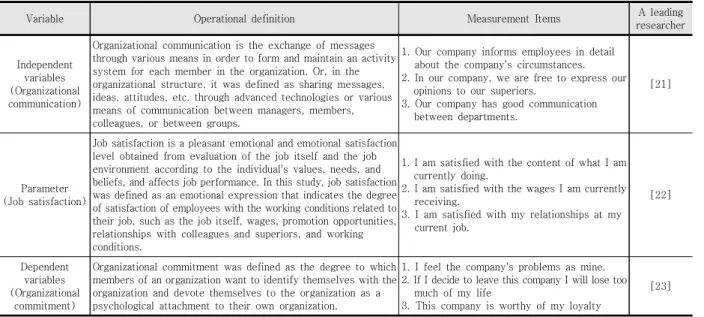
Table 1 shows the operational definition of variables and measurement tools.

Variable Operational definition Measurement Items A leading

researcher

Independent variables (Organizational communication)

Organizational communication is the exchange of messages through various means in order to form and maintain an activity system for each member in the organization. Or, in the organizational structure, it was defined as sharing messages, ideas, attitudes, etc. through advanced technologies or various means of communication between managers, members, colleagues, or between groups.

1. Our company informs employees in detail about the company's circumstances.

2. In our company, we are free to express our opinions to our superiors.

3. Our company has good communication between departments.

[21]

Parameter (Job satisfaction)

Job satisfaction is a pleasant emotional and emotional satisfaction level obtained from evaluation of the job itself and the job environment according to the individual's values, needs, and beliefs, and affects job performance. In this study, job satisfaction was defined as an emotional expression that indicates the degree of satisfaction of employees with the working conditions related to their job, such as the job itself, wages, promotion opportunities, relationships with colleagues and superiors, and working conditions.

1. I am satisfied with the content of what I am currently doing.

2. I am satisfied with the wages I am currently receiving.

3. I am satisfied with my relationships at my current job.

[22]

Dependent variables (Organizational

commitment)

Organizational commitment was defined as the degree to which members of an organization want to identify themselves with the organization and devote themselves to the organization as a psychological attachment to their own organization.

1. I feel the company's problems as mine.

2. If I decide to leave this company I will lose too much of my life

3. This company is worthy of my loyalty

[23]

Table 1. Operational Definition and Measurement

(6)

4. Results

4.1 Sample characteristics

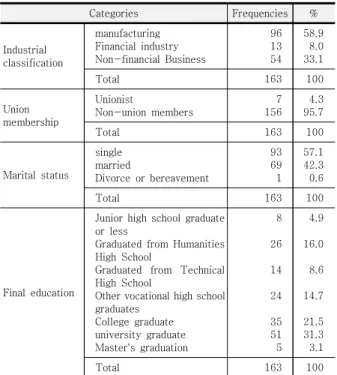
The distribution of the respondents' industry classification was 96 (58.9%) in manufacturing, 13 (8%) in finance, and 54 (33.1%) in non-financial industries. Other characteristics of the sample are as shown in Table 2.

Categories Frequencies %

Industrial classification

manufacturing Financial industry Non-financial Business

96 13 54

58.9 8.0 33.1

Total 163 100

Union membership

Unionist

Non-union members

7 156

4.3 95.7

Total 163 100

Marital status

single married

Divorce or bereavement

93 69 1

57.1 42.3 0.6

Total 163 100

Final education

Junior high school graduate or less

Graduated from Humanities High School

Graduated from Technical High School

Other vocational high school graduates

College graduate university graduate Master's graduation

8

26

14

24

35 51 5

4.9

16.0

8.6

14.7

21.5 31.3 3.1

Total 163 100

Table 2. The Characteristics of Samples

4.2 Feasibility and reliability analysis Prior to the hypothesis test, a feasibility and reliability analysis were conducted for all items.

To simplify factor extraction and factor loading, principal component analysis and orthogonal transformation were used, and the eigenvalue was 1.0 or higher, and the factor loading was 0.4 or higher. There were no factors removed during the factor analysis, and the total variance explained was found to be 71.72%.

Variables were named as organizational communication, job satisfaction, and organizational commitment, and reliability analysis was conducted on these. Each factor appeared to be a reliable level, and all items were used, and the

Cronbach'α coefficient value of each variable was distributed between .742 to .831, and the details are as shown in Table 3.

Measurement

Items OCN JS OCT Cα

OCN2 OCN3 OCN1

.864 .800 .779

.831

JS1 JS3 JS2

.843 .818 .658

.793

OCT3 OCT2 OCT1

.776 .762 .661

.742

OV V%

AV%

2.332 25.91 25.91

2.154 23.93 48.84

1.970 21.89 71.72

※ Refer to Table 1 for details of measurement items.

Annotation1) OCN : Organizational Communication Annotation2) JS : Job Satisfaction

Annotation3) OCT : Organizational Commitment Annotation4) OV : Original Value

Annotation5) V% : Variance %

Annotation6) AV% : Accumulation Variance %

Table 3. Exploratory Factor Analysis and Reliability Test

4.3 Measurement model analysis 4.3.1 Convergent validity analysis

Before conducting the hypothesis test, a confirmatory factor analysis was performed to remove items that hinder single-dimensionality.

CMIN/DF(<3.0), RMR(<0.05), GFI·CFI·NFI·IFI(>0.9),

AGFI(>0.8), and RMSEA(<0.1) values were used to

test the fit of the data. In order to generate the

high fit presented in the final question, the

process of removing one by one was repeatedly

performed based on the SMC (Squared Multiple

Correlation) value, an index used to determine

how much the measured variable explains the

latent variable. As a result of analyzing after

removing job satisfaction 2 and organizational

commitment 1 as shown in Table 3, it was found

that all fitness indices satisfies the standard

values. All standardized regression coefficients

were 0.7 or more, CR was 0.7 or more, and AVE

It was confirmed that there was no problem with

the concentration validity of more than 0.5.

(7)

Measurement

variables RW

S R W

SE CR

A V E

S M C

OCN 1 2 3

.952 1.164 1.000

.720 .898 .763

.051 .042 .047

.869 .690 .518 .806 .583

JS 1

3

1.000 .927

.844 .859

.044

.037 .900 .818 .713 .738

OCT 2

3

1.142 1.000

.772 .778

.063

.048 .804 .673 .596 .606

Goodness of fit - measurement model

<Initial model>

Chi-Square=39.358, df=24, p=.000, CMIN/DF=1.640, GFI=.950, AGFI=.907, CFI=

.976, NFI=.942, IFI=.976, RMR=.033, RMSEA=.063

<Final model>

Chi-Square=17.035, df=11, p=.000, CMIN/DF=1.549, GFI=.972, AGFI=.929, CFI=.988, NFI=.968, IFI=.988, RMR=.018, RMSEA=.058

Annotation1) RW : Regression Weights

Annotation2) SRW : Standardized Regression Weights Annotation3) SE : Standard Error

Annotation4) CR : Construct Reliability Annotation5) AVE : Average variance Extracted Annotation6) SMC : Squared Multiple Correlation

Table 4. Confirmatory Factor Analysis and Goodness of Fit of Measurement Model

4.3.2 Discriminant validity analysis

After analyzing the measurement model, the discriminant validity of the model was evaluated.

As a result of the analysis, it was found that the squared value of the correlation coefficient between all variables did not exceed the AVE value, thus securing discriminant validity, and the results are as shown in Table 5.

Latent variable OCN JS OCT

OCN .690

JS .581

(.338) .818

OCT .663

(.440)

.677

(.458) .673

Annotation1) Diagonal dark part is AVE value

Annotation2) ( ) Is the squared value of the correlation coefficient.

Table 5. Validity assessment results of the measurement model

4.4 Structural model analysis

4.4.1 Result of analysis of irregular workers The degree of fit of the structural model was found to be satisfactory as χ2=17.035 (p<.001),

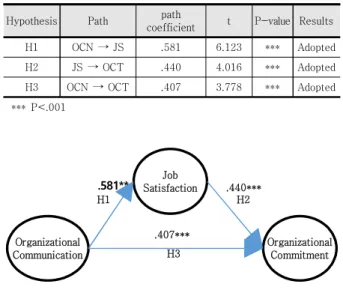
TLI=.977, CFI=.988, and RMSEA=.058. As a result of structural model analysis, the organizational communication satisfaction perceived by irregular workers in hypothesis 1 was found to have a positive (+) significant effect on job satisfaction, thus supporting the hypothesis (β

=.581, p<.001). Job satisfaction perceived by irregular workers in Hypothesis 2 was supported by showing that it had a positive (+) significant effect on organizational commitment (β=.440, p<.001). On the other hand, the satisfaction of organizational communication recognized by irregular workers in Hypothesis 3 was found to have a positive (+) significant effect on organizational commitment, thus supporting the hypothesis (β=.407, p<.001).

The analysis results are as shown in Table 6, and if represented as a figure, they are as shown in Figure 2.

Hypothesis Path path

coefficient t P-value Results

H1 OCN → JS .581 6.123 *** Adopted

H2 JS → OCT .440 4.016 *** Adopted

H3 OCN → OCT .407 3.778 *** Adopted

*** P<.001

Table 6. Hypothesis test results

H2

H3 H1

Organizational Commitment Job

Satisfaction

Organizational Communication

.581**

*

.440***

.407***

Fig. 2. Structural Path

4.4.2 Comparison result with regular workers

The results of this study and those of regular

workers, who account for most of the research

data, were compared. For the analysis of regular

workers, the same analysis method as for

non-regular workers was used. Comparative

analysis results are shown in Table 7.

(8)

4.5. Mediated effect analysis

4.5.1 Result of analysis of irregular workers In the relationship between organizational communication and organizational commitment by the bootstrapping method, it was verified whether the mediating effect of job satisfaction.

As a result of the analysis, it was confirmed that job satisfaction has a partial mediating effect in the relationship between organizational communication and organizational commitment in hypothesis 4, and the hypothesis was supported.

The analysis results are shown in Table 8.

Hypot

hesis Path Indirect

effect P-val

ue Results H4 OCN → JS → OCT .256 .002 Adopted

Table 8. Mediated effect analysis results

4.5.2 Comparison result with regular workers To compare the mediating effect analysis results of irregular workers with regular workers, the same analysis method was used to analyze regular workers. The comparative analysis results are shown in Table 9.

5. Conclusions

5.1 Summary and Implications of the Study

The purpose of this study is to find out that smooth communication with irregular workers within the organization is an important influence factor to improve organizational effectiveness, and thus seek a human resource management plan for irregular workers. The test results of the hypothesis proposed in this study and the implications are as follows. First, it was analyzed that the satisfaction of organizational communication (management, upper and lower, and between departments) recognized by irregular workers had a positive (+) effect on job satisfaction. It can be interpreted that the presentation and sharing of the clear mission and vision of the management for irregular workers, and smooth exchange of opinions and cooperation between top and bottom and between departments have a positive effect on job satisfaction. Second, it was analyzed that job satisfaction perceived by irregular workers had a positive (+) effect on organizational commitment.

In order to increase the organizational commitment of irregular workers, job satisfaction should be improved. Third, it was analyzed that organizational communication recognized by irregular workers had a positive (+) effect on organizational commitment. It can be seen that smooth communication activities are necessary to increase the organizational commitment of irregular workers. Fourth, it was confirmed that

Hypoth

esis Path

Irregular workers Regular workers

path

coefficient t P-value Results path

coefficient t P-value Results

H1 OCN → JS .581 6.123 *** Adopted .645 45.294 *** Adopted

H2 JS → OCT .440 4.016 *** Adopted .607 29.147 *** Adopted

H3 OCN → OCT .407 3.778 *** Adopted .209 11.950 *** Adopted

*** P<.001

Table 7. Comparison of analysis results for irregular and regular workers

Hypothesis Path Irregular workers Regular workers

Indirect effect P-value Results Indirect effect P-value Results

H4 OCN → JS → OCT .256 .002 Adopted .392 .004 Adopted

Table 9. Comparison of mediating effect analysis results

(9)

job satisfaction has a partial mediating effect in the relationship between organizational communication satisfaction and organizational commitment of irregular workers. Fifth, as a result of comparing irregular workers with regular workers, it was analyzed that all hypotheses were adopted for regular workers as well. This is the result of confirming once again that organizational communication has a significant effect on job satisfaction and organizational commitment regardless of employment type.

Looking at the analysis results in detail, the path coefficients of all hypotheses except for hypothesis 3 showed that regular workers showed relatively higher path coefficients than irregular workers. The path coefficient between organizational communication and organizational commitment was found to be much higher for irregular workers than for regular workers. This result means that the influence of organizational communication on activities to enhance organizational commitment is higher for irregular workers than for regular workers.

Therefore, it is necessary for companies to actively utilize organizational communication in promoting the improvement of organizational commitment of irregular workers. These results are consistent with the results of Insuk Lee's(2017) study of regular workers, and show that irregular workers also need smooth communication activities like regular workers in order to improve job satisfaction and organizational commitment. In order to improve job satisfaction for irregular workers, it implies that the management should always share the company's circumstances, avoid disconnection from regular workers within the organization, and conduct communication activities through a unified channel. Since job satisfaction improved through smooth organizational communication activities can act as an important factor in improving organizational commitment, the results of this study can be used as the basis for

establishing a human resource management system that encompasses both regular and irregular workers. I would like to approach the implications of this study from both academic and practical perspectives. From an academic point of view, the academic discussion on the study of irregular workers was expanded by analyzing the effect of organizational communication on organizational effectiveness in irregular workers, which had relatively insufficient research compared to regular workers. In addition, it is significant that the research targets have been expanded to manufacturing, financial, and non-financial industries, compared to existing studies that have been focused on the service industry.

From a practical point of view, it provided a basis for establishing the relationship between the effectiveness of organizational communication, job satisfaction, and organizational commitment to irregular workers playing roles in various industries.

Looking at this from the manager's point of view, it is necessary to introduce a variety of systems to share the company's mission and vision, and to facilitate organizational communication activities. In addition, from the perspective of members of the organization, it is necessary to create a cooperative atmosphere through information sharing among members without distinction between regular and irregular workers, and voluntarily promote communication through informal organizational activities.

5.2 Limitations of the study

The limitations of this study are: First, there is a limitation in applying to general companies because the subject of the study is data extracted from a panel survey of human capital companies.

In addition, there is a limit to the empirical

analysis due to the limitations of the items on

the variables to be measured in the panel survey

itself.

(10)

Second, the preceding variables that influence organizational effectiveness, such as job satisfaction and organizational commitment, were studied only in organizational communication, so a study on various factors such as leadership, education and training, and organizational culture should be conducted. Third, the actual management performance of a company due to organizational commitment has not been studied.

Additionally, it is necessary to examine the relationship between organizational commitment and actual management performance.

REFERENCES

[1] I. S. Lee. (2017). The Effect of Communication Satisfaction and Self-directed Learning on Organizational Effectiveness. - Focused on the Mediating Effect of Small Business Manager Coaching Behavior. Doctoral dissertation. Hoseo University, Seoul.

[2] J. M. Kim. (2015). A Study on the Effect of Organizational Communication Saticfaction on Organizational Effectiveness. Master’s thesis. Soongsil University, Seoul.

[3] J. J. Li. (2014). The Effect of the Organizational Communication on Job Satisfaction and Organizational Commitment – Test on the moderating effect of Organizational Trust. Master’s thesis. Hanbat University, Daejeon.

[4] Irregular Workers[Internet]. Easy to Find, Pratical Law Ministry of Government Legislation.

http://www.easylaw.go.kr

[5] Stephen. P. R. (2005). Essential of organizational behavior. New York : Free Press

[6] Lewis. P. V. (1987). Organizational communication:

The essence of effective management. New York : John Wiley & Sons.

[7] Y. S. Lim. (2013). The effect of organizational type on organizational commitment – with emphasis on moderating effect of self-leadership. Master’s thesis.

Hanyang University, Seoul.

[8] Locke, E. A. (1976). The Nature and Causes of Job Satisfaction. Handbook of Industrial and Organizational Psychology, 1, 1297-1343.

[9] S. E. Cho. (2010). A Study on the Influence of the Customer Orientation and Job Satisfaction as a Result of the Consultant’s Emotional Exhaustion at the Call Center. Doctoral dissertation. Hoseo University, Seoul.

[10] I. S. Lee. (2017). The Effect of Communication Satisfaction and Self-directed Learning on Organizational Effectiveness. - Focused on the Mediating Effect of Small Business Manager Coaching Behavior. Doctoral dissertation. Hoseo University, Seoul.

[11] J. H. Yang & D. M. Chang. (2019). Association between Discrimination and Job Satisfaction among Non-regular Office Workers in Hospitals. Journal of Digital Convergence, 17(5), 249-256.

[12] C. W. Park. (2017). The Effects of Creative Integration Firm Talent and Labor-Management Partnership on the Organizational Commitment and Non-financial Aptitude of ICT SMEs. Journal of the Korean Entrepreneurship Socieity, 12(4), 77-96.

DOI : 10.24878/tkes.2017.12.4.077

[13] Y. S. Lim. (2013). The effect of organizational type on organizational commitment – with emphasis on moderating effect of self-leadership. Master’s thesis.

Hanyang University, Seoul.

[14] J. Y. Han. (2012). Comparison between Regular Workers and Contingent Workers of Organizational Commitment and Job Satisfaction in Hotel Industry.

Journal of Digital Convergence, 10(11), 503-513.

[15] J. J. Li. (2014). The Effect of the Organizational Communication on Job Satisfaction and Organizational Commitment – Test on the moderating effect of Organizational Trust. Master’s thesis. Hanbat University, Daejeon.

[16] S. J. Park. (2016). A Study organizational informal communication effects on organizational commitment and job satisfaction by hotel industry. Tourism Research, 41(1), 85-103.

[17] Y. T. Lee. (2014) The Impact of Psychological Capital on Job Satisfaction and Organizational Commitment Among Employees of Social Enterprises, Management and Information Studies, 33(49), 1-16.

[18] K. H. Cho. (2013). The Study of Interdependent Relations among Airlines` Flight Attendants` Personal type, Emotional Intelligence, Job Satisfaction, and Organizational Commitment. Tourism Research, 38(2), 145-165.

[19] B. R. Lee. (2021). The Mediating Effect of the Job Satisfaction between the Relationship of Empowerment and Organizational Immersion of Professionals in Community Rehabilitation Facilities.

Journal of Digital Convergence, 19(7), 391-396.

[20] J. J. Li. (2014). The Effect of the Organizational Communication on Job Satisfaction and Organizational Commitment – Test on the moderating effect of Organizational Trust. Master’s thesis. Hanbat University, Daejeon.

[21] Lewis. P. V. (1987). Organizational communication:

The essence of effective management. New York : John Wiley & Sons.

[22] S. E. Cho. (2010). A Study on the Influence of the

(11)

Customer Orientation and Job Satisfaction as a Result of the Consultant’s Emotional Exhaustion at the Call Center. Doctoral dissertation. Hoseo University, Seoul.

[23] C. W. Park. (2017). The Effects of Creative Integration Firm Talent and Labor-Management Partnership on the Organizational Commitment and Non-financial Aptitude of ICT SMEs. Journal of the Korean Entrepreneurship Socieity, 12(4), 77-96.

DOI : 10.24878/tkes.2017.12.4.077

최 재 원(Jae-Won Choi) [정회원]

· 2010년 2월 : 아주대학교 경영대학원 (경영학석사)

· 2021년 6월 ~ 현재 : 한성대학교 스 마트융합컨설팅학과 수료

· 관심분야 : 인사·조직, 컨설팅

· E-Mail : [email protected]

이 석 기(Seok Kee Lee) [정회원]

· 2009년 8월 : 한국과학기술원 경영공 학(공학박사)

· 2012년 3월 ~ 현재 : 한성대학교 컴 퓨터공학부 교수

· 관심분야 : 데이터마이닝, 빅데이터, 컨설팅

· E-Mail : [email protected]

천 성 용(Sungyong Chun) [정회원]

· 2007년 8월 : 한국과학기술원 경영공 학(공학박사)

· 2009년 9월 ~ 현재 : 단국대학교 경 영학부 부교수

· 관심분야 : 디지털마케팅, 하이테크마 케팅, 금융마케팅

· E-Mail : [email protected]

수치

Table  1  shows  the  operational  definition  of  variables  and  measurement  tools.
Table 3. Exploratory Factor Analysis and Reliability Test
Table 5. Validity assessment results of the measurement  model
Table  8.  Mediated  effect  analysis  results

참조

관련 문서

Purpose: The study was to investigate the organizational culture of middle and small sized hospital workers on organizational effectiveness and controlling effect of

In this regard, this study analyzes the effect of the job characteristics and work environment of workers with physical disabilities on job satisfaction

This research further enriches the previous research on the influencing factors of employee organizational commitment and OCB, which help Chinese companies

Therefore, A lot of native English-speaking teachers have come to Korea to teach English.. The purpose of this study is to assess the job satisfaction of

The purpose of this study was to analyze the relations between the leader-member exchange relationship, job satisfaction, and organizational citizenship behavior of sports

The purpose of this study is to find out the factors to be considered to allow people with disabilities to work stably and propose the direction of

The purpose of this study is to analyze the effects of sports marketing strategy fit on organizational attitude and organizational citizenship behavior

The purpose of this study is to analyze the influence of dance leaders' inst ructional behavior patterns on participants' desire to participate and