서 론
남한강수계는 총 유로연장 375 km, 유역면적 12,577 km2인 한강의 2대 지류로 강원도 삼척시의 대덕산에서 발원하여, 충주호와 팔당호로 유입되는 주요 상수원이 다. 또한 국내에서 두 번째로 큰 충주호가 위치하여 홍 수 및 갈수기에 수문조절을 통하여 남한강 하류의 유량 및 이화학적 수질 변화에 직접적인 영향을 미치며(Han
and An, 2008), 최근에는 남한강 인근 수계에서 배출되 는 생활하수 및 축산폐수 등이 퇴적되면서 이화학적 수 질오염 및 수체의 부영양화 현상을 야기시키고 있다 (Oh et al., 2009).
한강수계는 생태계 현황조사 및 수계관리를 목적으로 어류를 포함한 다양한 생물상 조사가 진행되어 왔다. 한 강수계를 대상으로 한 어류의 군집수준에 대한 연구는 수계중심으로 이루어져 왔으며, 동강 및 평창강을 중심 으로 남한강 상류수계 조사 외에 개방산 유역조사, 치악 산 계류조사, 동강 및 원주천 연구 등이 수행되어 왔다 (Lee et al., 2007). 이러한 연구들은 주로 종래의 생물종 분포특성, 군집 및 개체군의 종다양도, 밀도분석 및 이 화학적인 수질평가들로 인위적 또는 자연적으로 발생되
─ 100 ─
남한강수계의 하천차수별 어류군집 분포 특성
이승현・이황구・박상정1・이수형1・최준길*
상지대학교 생명과학과, 1국립환경과학원
Distribution Characteristics of Fish Community to Stream Order in Namhan River Watershed. Lee, Seung-Hyun, Hwang-Goo Lee, Sang-Jeong Park1, Soo-Hyung Lee1and Jun-Kil Choi * (Department of Biological Science, Sangji University, Wonju 220-702, Korea; 1National Institute of Environmental Research, Incheon 404-708, Korea)
Abstract For this study, we collected fishes of seven times at the 51 sites by stream orders (2-6) from November 2007 to September 2010. In the results, 55 species belonging 12 families were collected. And there were one species (1.8%) of Natural monument, 6 species (10.9%) of endangered and 22 species (40.0%) of Korea endemic. Dominant species was Zacco koreanus and subdominant species was Zacco platypus in whole. Stream orders (2-6) increased with increasing species, diversity (H′), evenness (EI), richness (RI), tolerant (TS), omnivore (OS) and decreasing individual, dominance (DI), sensitive (SS) insectivore (IS), total IBI score. Principal component analysis results showed location of variable (species, individual, community index, relative abundance of tolerant, sensitive, omnivore, insectivore species) and each site changes in up- stream and down-stream changes in their distribution. Correlation analysis showed significant differences between stream orders (2-6) and variable (species: Sp, diversity index: H′, omnivore species: OS, stream depth: SD, stream width: SW and water temperature: WT).
Key words: stream order, principal component analysis, tolerance guild, trophic guild, correlation analysis
Manuscript received 12 May 2013, revised 20 August 2013, revision accepted 31 October 2013
* Corresponding author: Tel: +82-33-730-0434, Fax: +82-33-730-0434, E-mail: [email protected]
ⓒ The Korean Society of Limnology. All rights reserved.
This is an open-access article distributed under the terms of the Creative Commons Attribution Non-Commercial License (http://creativecommons.org/licenses/by-nc/3.0/), which permits unrestricted non-commercial use, distribution, and reproduction in any medium, provide the original work is properly cited.
ISSN: 2288-1115 (Print), 2288-1123 (Online)
는 특이 사항에 따른 연구들이 진행되었다. 또한 남한강 수계의 어류 개체군 수준에 대한 연구로는 연준모치 (Phoxinus phoxinus)의 생식실태 (Song et al., 2002)와 꾸구리 (Gobiobotia macrocephala)의 식성 (Choi et al., 2004)에 대한 연구가 진행되었다.
현재 미국을 비롯한 캐나다, 영국, 호주, 일본, 독일, 프 랑스 등에서는 어류를 이용한 생물학적 수질평가기법을 도입하여 수환경 종합평가에 크게 기여하고 있으며, 이 를 잘 활용하고 있다(Moon et al., 2010). 어류를 이용한 생물학적 평가기법은 미국에서 1981년 IBI (Index of Biotic integrity)의 개념이 도입된 이래, IBI 수정작업이 이루어졌으며, 1986년 12개 주 정부에서 실행하여 1991 년에는 35개 이상의 주 정부에서 채택되어 하천 평가에 실효를 거두고 있다 (Yeom et al., 2000). 한편, 국내에서 는 2000년대부터 생물통합지수인 IBI (Index of Biotic integrity)모델을 기반으로 우리나라 하천의 특성에 맞게 이를 수정 및 보완하여 하천들에 적용하고 있는 실정이 다 (An and Kim, 2005). 이러한 어류를 이용한 IBI 모델 평가는 어류의 분포양상 및 환경 스트레스에 의한 반응 을 정량화하여 (Karr, 1981; Yoder and Smith, 1999) 대 상수계 또는 하천의 생태 건강성을 평가하고, 어류의 분 포특성을 파악하는데 용이하게 사용되었다. 하천차수에 따른 하천 생태의 구조적, 기능적 연구는 과거 Strahler (1957)에 의해 활발히 진행되었으며, 최근에는 하천차수 에 따른 수계의 생물상, 하천규모, 고도 등 다양한 자료 를 이용한 생물과의 상호관계 연구가 진행되어 왔다 (Platts, 1979; Barila et al., 1981; Beecher et al., 1988;
Sullivan and Watiz, 2009; Morgan and Cushman, 2009;
Yan et al., 2011).
본 연구에서는 강원도와 충청북도에 걸친 남한강 상 류수계의 51개 지점을 대상으로 2차에서 6차까지 하천 차수 (Stream order)에 따라 구분하여 어류군집의 분포 특성을 분석하고, 생태 건강성을 평가하고자 한다. 또한 하천차수에 따른 어류군집의 분포 특성 파악을 위한 IBI모델의 활용과 주성분 분석을 통한 다변량 변수 분 석으로 정량화에 기준하여 향후 하천차수에 따른 어류 군집 연구의 기초자료로 제공하고자 수행하였다.
재료 및 방법
1. 조사기간
조사기간은 2007년 11월~2010년 9월까지 총 7회에 걸쳐 조사하였다.
1차조사는 2007년 11월, 2차와 3차조사는 2008년 6 월과 9월, 4차와 5차조사는 2009년 5월과 9월, 6차와 7 차조사는 2010년 5월과 9월에 실시하였다.
2. 조사지점
조사지점은 수생태 건강성 조사 및 평가 (Ministry of Environment, 2006)에 의거하여 2차하천 10개 지점, 3차 하천 16개 지점, 4차하천 11개 지점, 5차하천 11개 지점, 6차하천 3개 지점 등 총 51개의 지점을 선정하였으며, 하천차수에 따라 2007년부터 2010년까지 지속적으로 조사된 지점의 선정을 위하여 각 하천차수의 지점수가 다르게 선정되었다(Fig. 1, Table 1). 하천차수는 Strahler (1957)의 방법을 따라 1 : 25,000의 축척지도와 국가수 자원관리종합정보시스템 (http://www.wamis.go.kr)을 이 용하여 하천차수를 구분하였다.
3. 조사방법
남한강수계에서의 어류채집은 각 조사지점에서 정량 조사를 위하여 투망 (7×7 mm)과 족대 (4×4 mm)를 각 각 12회, 30분간 실시하였다. 채집된 어류는 현장에서 동정 및 개체수 파악 후 대부분 방류하였고, 일부 세밀 한 동정을 요하는 개체만 10% Formalin 용액으로 고정 Fig. 1. Location of study area in Namhan river watershed.
37′N
36′N
35′N
34′N 126′E 128′E 130′E
0 16.4 km
N
한 후 실험실로 운반하였다. 어류의 동정은 국내에서 발 표된 검색표 (Kim, 1997; Kim and Park, 2002; Kim et al., 2005)를 이용하였고, 분류체계는 Nelson (2006)을 따랐다.
4. 분석 방법
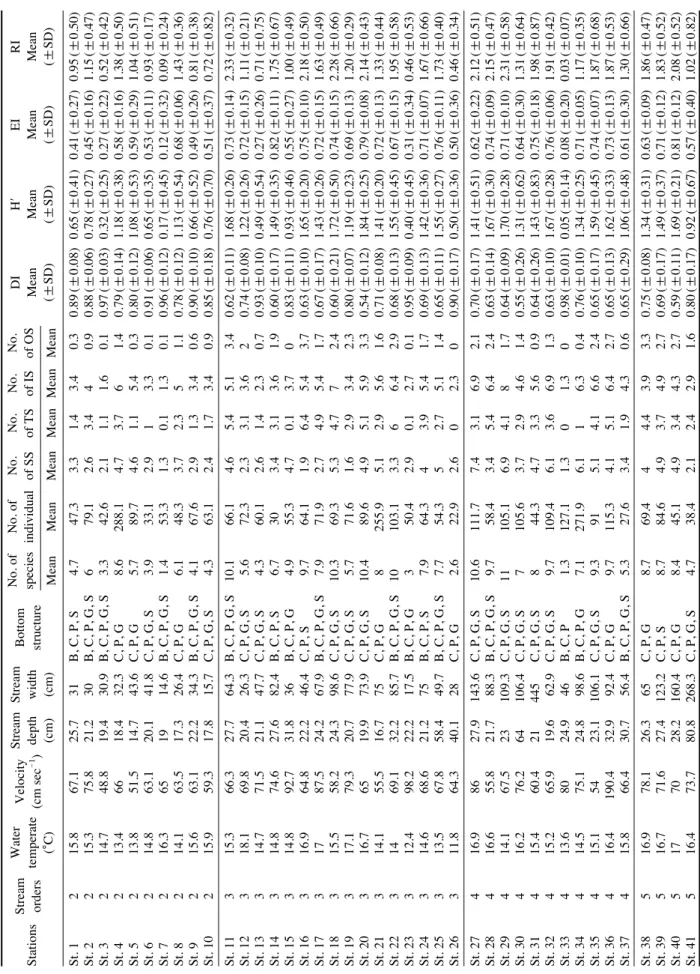
하천 수환경의 물리적∙이화학적 분석은 수생태 건강 성 조사 및 평가 (Ministry of Environment, 2006)를 참 고하였다. 어류의 군집분석은 우점도지수 (McNaughton, 1967), 다양도지수 (Shannon-Weaver, 1949), 균등도지수 (Pielou, 1966), 풍부도지수(Margalef, 1958)를 산출하여 분석하였다. 어류를 이용한 하천의 건강성 평가는 기존 에 보고된 Ahn et al. (2001)에 의해 국내 환경에 맞게 수정 및 보완된 생물통합지수(IBI)를 이용하였다. 8개의 메트릭을 이용하여 각 메트릭별로 ‘5’,‘3’,‘1’의 점수를 부여하고, 각 메트릭 값을 산정하여 청정상태(A; Excel- lent, 40~36), 양호상태 (B; Good, 35~26), 보통상태 (C;
Fair, 25~16), 불량상태 (D; Poor, 0~15)의 4개 등급으 로 구분하였다. 주성분 분석(Principal Components Ana- lysis)은 PC-ORD (Version 5)를 이용하여 Kaiser (1958, 1961)에 의거하여 분석하였다. 분석은 해당 지점에서 출 현한 종수, 개체수, 민감종수, 내성종수, 충식종수, 잡식종 수, 군집분석 지수를 이용하였으며, 2개의 요인 (Axis)을 선정하였다.
결 과
1. 어류상
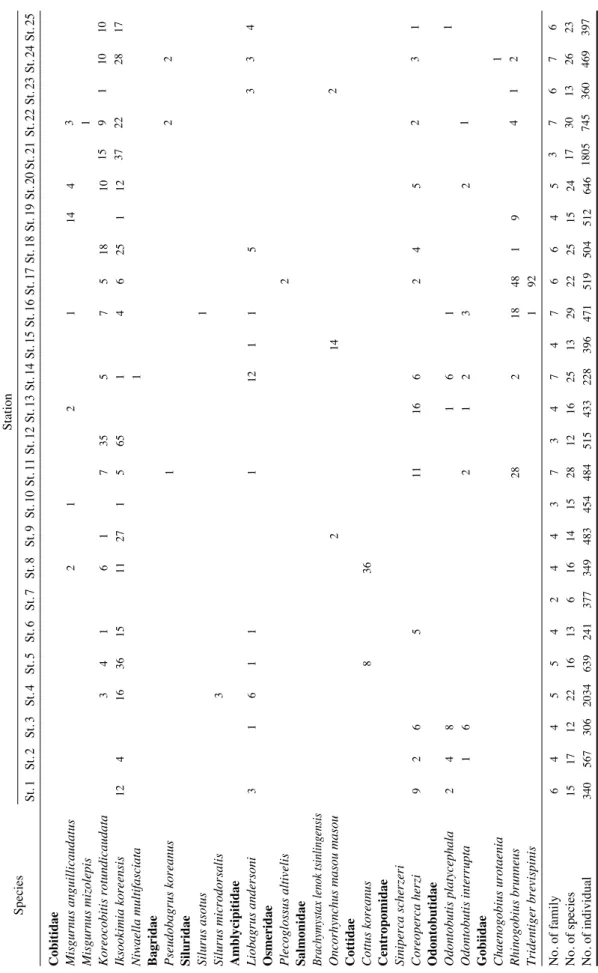
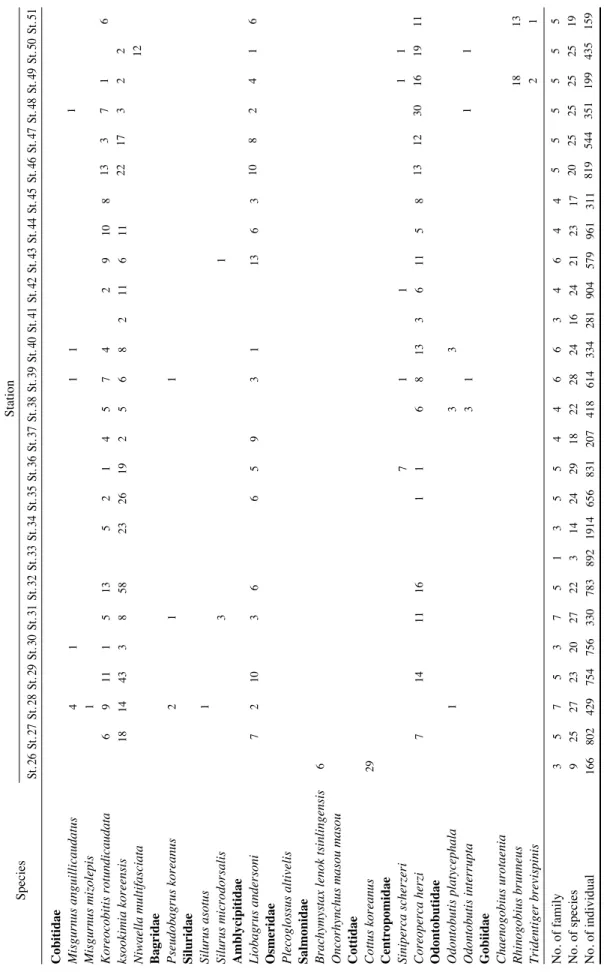
본 조사기간 동안 남한강수계에서 서식이 확인된 어 류는 총 12과 55종 28,628개체가 채집되었다(Table 2).
이중 잉어과(Cyprinidae) 어류가 33종(60.0%)으로 출현 종이 가장 높게 나타났으며, 미꾸리과 (Cobitidae) 5종 (9.1%), 망둑어과(Gobiidae) 3종(5.5%), 종개과(Balitori- dae), 메기과 (Siluridae), 연어과 (Salmonidae), 꺽지과 (Centropomidae), 동사리과 (Odontobutidae) 등이 각각 2종 (3.6%), 동자개과 (Bagridae), 퉁가리과 (Amblycipiti- dae), 바다빙어과 (Osmeridae), 둑중개과 (Cottidae) 어류 가 각각 1종 (1.8%)씩 출현하였다. 한편 상대풍부도가 가장 높게 나타난 어종은 참갈겨니 (Zacco koreanus)로 9,667개체 (33. 3%)를 차지하여 우점하였으며, 피라미 (Zacco platypus)가 4,697개체(16.2%), 버들치(Rhyncho- cypris oxycephalus)가 2,644개체 (9.1%), 돌고기 (Pung- Table 1. Location (GPS) of each station in Namhan river water-
shed.
Station GPS Station GPS
St. 1 36.0�44.0′52.70′′N St. 26 37.0�15.0′25.80′′N 127.0�54.0′2.80′′E 128.0�15.0′5.60′′E St. 2 36.0�40.0′ 31.33′′N St. 27 37.0�7.0′33.74′′N
127.0�51.0′44.62′′ E 128.0�33.0′8.80′′E St. 3 36.0�36.0′5.86′′N
St. 28 37.0�7.0′9.10′′N 127.0�50.0′1.40′′E 128.0�6.0′32.70′′E St. 4 37.0�20.0′25.00′′N St. 29 37.0�29.0′ 2.30′′N 128.0�58.0′11.00′′E 128.0�43.0′8.80′′E St. 5 37.0�22.0′9.05′′N St. 30 37.0�38.0′ 9.00′′N 128.0�43.0′9.04′′E 128.0�33.0′36.00′′E St. 6 37.0�40.0′12.60′′N
St. 31 37.0�26.0′26.00′′N 128.0�27.0′59.50′′E 128.0�38.0′57.00′′E St. 7 37.0�22.0′0.74′′N St. 32 37.0�22.0′25.00′′N
128.0�7.0′37.90′′E 128.0�40.0′16.00′′E St. 8 37.0�27.0′5.60′′N St. 33 37.0�13.0′38.60′′N
128.0�18.0′6.80′′E 128.0�47.0′50.10′′E St. 9 37.0�38.0′58.83′′N
St. 34 37.0�19.0′22.00′′N 128.0�19.0′41.30′′E 128.0�42.0′49.00′′E St. 10 37.0�30.0′55.50′′N St. 35 37.0�11.0′10.00′′N
128.0�14.0′21.00′′E 128.0�29.0′17.00′′E St. 11 36.0�40.0′46.82′′N St. 36 37.0�29.0′19.60′′N
127.0�48.0′11.02′′E 128.0�23.0′28.00′′E St. 12 36.0�51.0′1.60′′N
St. 37 37.0�24.0′44.40′′N 127.0�59.0′19.00′′E 128.0�9.0′20.00′′E St. 13 36.0�38.0′34.32′′N St. 38 36.0�36.0′55.00′′N 127.0�53.0′4.29′′E 127.0�42.0′7.00′′E St. 14 37.0�2.0′41.45′′N St. 39 37.0�10.0′17.00′′N 128.0�24.0′4.26′′E 128.0�27.0′20.00′′E St. 15 37.0�7.0′30.56′′N
St. 40 37.0�11.0′50.50′′N 128.0�46.0′25.02′′E 128.0�24.0′10.40′′E St. 16 37.0�0.0′30.81′′N St. 41 37.0�10.0′55.00′′N
128.0�20.0′5.80′′E 128.0�28.0′32.00′′E St. 17 36.0�55.0′51.74′′N St. 42 37.0�22.0′54.00′′N
128.0�20.0′8.20′′E 128.0�40.0′5.00′′E St. 18 37.0�7.0′56.80′′N
St. 43 37.0�22.0′44.00′′N 128.0�7.0′6.90′′E 128.0�39.0′33.00′′E St. 19 37.0�7.0′35.20′′N St. 44 37.0�22.0′4.00′′N
128.0�9.0′ 46.00′′E 128.0�37.0′10.0′′E St. 20 37.0�8.0′17.00′′N St. 45 37.0�12.0′25.00′′N 128.0�1.0′16.40′′E 128.0�30.0′38.00′′E St. 21 37.0�17.0′4.00′′N St. 46 37.0�28.0′24.00′′N
128.0�59.0′22.00′′E 128.0�43.0′46.00′′E St. 22 37.0�13.0′43.20′′N St. 47 37.0�27.0′25.00′′N
128.0�20.0′2.10′′E 128.0�40.0′42.00′′E St. 23 37.0�13.0′18.60′′N
St. 48 37.0�19.0′45.80′′N 128.0�13.0′38.10′′E 128.0�11.0′27.40′′E St. 24 37.0�34.0′20.00′′N St. 49 37.0�0.0′20.75′′N
128.0�24.0′7.00′′E 128.0�23.0′24.35′′E St. 25 37.0�25.0′55.60′′N St. 50 37.0�9.0′27.00′′N
128.0�10.0′56.70′′E 128.0�29.0′53.00′′E St. 51 37.0�2.0′19.27′′N
128.0�24.0′16.50′′E
Table 2.Fish fauna of each station in Namhan river watershed. SpeciesStation St.1St.2St.3St.4St.5St.6St.7St.8St.9St.10St.11St.12St.13St.14St.15St.16St.17St.18St.19St.20 Cyprinidae Carassius auratus3 1 11 1 6 111 Rhodeus pseudosericeus Rhodeus notatus12 Acheilognathus lanceolatus Acheilognathus signifer12 2 5 2 1 Acheilognathus yamatsutae4 3 4 1 1 Acheilognathus rhombeus Pseudorasbora parva1 1 Pungtungia herzi7 20 34 4 4 5 3 44 19 36 18 62 1 45 5 40 14 63 Pseudopungtungia tenuicorpa24 9 2 Coreoleuciscus splendidus11 8 24 35 24 30 1 9 1 3 4 14 5 33 30 51 Ladislabia taczanowskii Sarcocheilichthys variegatus wakiyae Sarcocheilichthys nigripinnis morii1 Gnathopogon strigatus8 Squalidus gracilis majimae1 10 88 Squalidus japonicus coreanus70 Squalidus chankaensis tsuchigae2 Hemibarbus labeo1 Hemibarbus longirostris10 35 3 4 16 9 14 3 13 3 7 Hemibarbus mylodon1 Pseudogobio esocinus50 3 4 6 1 10 9 21 3 23 12 89 19 Gobiobotia macrocephala Gobiobotia brevibarba Microphysogobio yaluensis4 53 3 2 38 Microphysogobio jeoni1 Microphysogobio longidorsalis8 250 10 2 7 6 26 61 Phoxinus phoxinus1 44 Rhynchocypris oxycephalus21 3 5 19 5 293 21 183 158 1 69 6 7 2 65 38 Rhynchocypris kumgangensis1 256 1 1 231 Zacco koreanus274 409 269 546 210 176 34 182 215 119 228 13 335 49 65 9 247 195 169 Zacco platypus12 13 2 1072 43 27 32 74 28 273 7 38 118 48 81 177 124 Opsarichthys uncirostris amurensis1 Balitoridae Orthrias nudus1 13 11 3 8 8 28 5 3 47 1 13 17 19 Lefua costata
St.21St.22St.23St.24St.25 4 2 15 43 14 13 2 19 2 26 96 27 1 1 7 2 5 28 14 14 2 5 33 3 8 11 6 1 58 36 8 20 330 182 1 5 4 293 2 14 612 214 3 80 175 465 259 167 41 60 14 50 2 12
Cobitidae Misgurnus anguillicaudatus2 1 2 1 14 4 Misgurnus mizolepis Koreocobitis rotundicaudata3 4 1 6 1 7 35 5 7 5 18 10 Iksookimia koreensis12 4 16 36 15 11 27 1 5 65 1 4 6 25 1 12 Niwaella multifasciata1 Bagridae Pseudobagrus koreanus1 Siluridae Silurus asotus1 Silurus microdorsalis3 Amblycipitidae Liobagrus andersoni3 1 6 1 1 1 12 1 1 5 Osmeridae Plecoglossus altivelis2 Salmonidae Brachymystax lenok tsinlingensis Oncorhynchus masou masou2 14 Cottidae Cottus koreanus8 36 Centropomidae Siniperca scherzeri Coreoperca herzi9 2 6 5 11 16 6 2 4 5 Odontobutidae Odontobutis platycephala2 4 8 1 6 1 Odontobutis interrupta1 6 2 1 2 3 2 Gobiidae Chaenogobius urotaenia Rhinogobius brunneus28 2 18 48 1 9 Tridentiger brevispinis1 92 No. of family6 4 4 5 5 4 2 4 4 3 7 3 4 7 4 7 6 6 4 5 No. of species15 17 12 22 16 13 6 16 14 15 28 12 16 25 13 29 22 25 15 24 No. of individual340 567 306 2034 639 241 377 349 483 454 484 515 433 228 396 471 519 504 512 646
Table 2.Continued. SpeciesStation St.1St.2St.3St.4St.5St.6St.7St.8St.9St.10St.11St.12St.13St.14St.15St.16St.17St.18St.19St.20St.21St.22St.23St.24St.25 3 1 15 9 1 10 10 37 22 28 17 22 3 3 4 2 2 3 1 1 1 1 4 1 2 3 7 6 7 6 17 30 13 26 23 1805 745 360 469 397
Table 2.Continued. SpeciesStation St.26St.27St.28St.29St.30St.31St.32St.33St.34St.35St.36St.37St.38St.39St.40St.41St.42St.43St.44St.45 Cyprinidae Carassius auratus2 17 10 Rhodeus pseudosericeus Rhodeus notatus Acheilognathus lanceolatus2 3 Acheilognathus signifer4 61 18 1 24 14 5 4 2 Acheilognathus yamatsutae4 5 10 11 156 8 2 11 57 Acheilognathus rhombeus1 1 Pseudorasbora parva1 Pungtungia herzi69 33 28 15 37 112 4 96 137 2 31 48 29 62 306 32 91 11 Pseudopungtungia tenuicorpa1 27 1 8 3 11 2 4 8 1 4 4 8 4 1 20 46 13 Coreoleuciscus splendidus36 13 39 30 11 29 49 34 9 22 94 33 8 20 1 38 Ladislabia taczanowskii24 3 Sarcocheilichthys variegatus wakiyae Sarcocheilichthys nigripinnis morii Gnathopogon strigatus Squalidus gracilis majimae2 7 2 7 1 3 56 12 Squalidus japonicus coreanus5 15 1 Squalidus chankaensis tsuchigae Hemibarbus labeo9 11 3 23 Hemibarbus longirostris4 14 21 64 17 19 8 21 2 1 1 5 53 20 146 Hemibarbus mylodon7 6 4 67 48 10 2 1 55 28 57 Pseudogobio esocinus11 39 1 14 10 1 8 17 8 2 4 3 6 5 6 9 Gobiobotia macrocephala1 1 Gobiobotia brevibarba6 3 8 2 17 11 14 12 Microphysogobio yaluensis23 11 4 12 50 65 14 72 20 6 21 36 10 Microphysogobio jeoni1 Microphysogobio longidorsalis31 9 39 33 49 124 3 1 3 29 6 22 9 19 78 3 Phoxinus phoxinus9 301 Rhynchocypris oxycephalus42 4 2 16 1 854 630 9 2 Rhynchocypris kumgangensis73 4 93 5 36 640 3 Zacco koreanus469 146 406 299 107 238 212 219 214 104 160 165 123 66 195 309 292 168 Zacco platypus38 98 87 93 25 47 50 217 4 52 38 45 45 143 79 60 21 Opsarichthys uncirostris amurensis Balitoridae Orthrias nudus9 2 10 32 2 1 34 15 2 1 1 4 5 Lefua costata3
St.46St.47St.48St.49St.50St.51 2 6 1 9 6 2 15 5 1 47 83 55 25 35 24 31 22 10 4 14 22 7 7 28 2 2 3 6 2 3 40 2 1 11 7 1 7 2 1 3 6 12 9 3 1 8 8 2 1 14 2 2 18 3 17 1 51 23 4 25 4 5 428 231 62 7 211 25 151 42 63 43 27 46 4 5 21
Cobitidae Misgurnus anguillicaudatus4 1 1 1 Misgurnus mizolepis1 Koreocobitis rotundicaudata6 9 11 1 5 13 5 2 1 4 5 7 4 2 9 10 8 ksookimia koreensis18 14 43 3 8 58 23 26 19 2 5 6 8 2 11 6 11 Niwaella multifasciata Bagridae Pseudobagrus koreanus2 1 1 Siluridae Silurus asotus1 Silurus microdorsalis3 1 Amblycipitidae Liobagrus andersoni7 2 10 3 6 6 5 9 3 1 13 6 3 Osmeridae Plecoglossus altivelis Salmonidae Brachymystax lenok tsinlingensis6 Oncorhynchus masou masou Cottidae Cottus koreanus29 Centropomidae Siniperca scherzeri7 1 1 Coreoperca herzi7 14 11 16 1 1 6 8 13 3 6 11 5 8 Odontobutidae Odontobutis platycephala1 3 3 Odontobutis interrupta3 1 Gobiidae Chaenogobius urotaenia Rhinogobius brunneus Tridentiger brevispinis No. of family3 5 7 5 3 7 5 1 3 5 5 4 4 6 6 3 4 6 4 4 No. of species9 25 27 23 20 27 22 3 14 24 29 18 22 28 24 16 24 21 23 17 No. of individual166 802 429 754 756 330 783 892 1914 656 831 207 418 614 334 281 904 579 961 311
Table 2.Continued. SpeciesStation St.26St.27St.28St.29St.30St.31St.32St.33St.34St.35St.36St.37St.38St.39St.40St.41St.42St.43St.44St.45St.46St.47St.48St.49St.50St.51 1 1337 16 22 17 3 2 2 12 10 8 2 4 1 6 1 1 13 12 30 16 19 11 1 1 18 13 2 1 5 5 5 5 5 5 20 25 25 25 25 19 819 544 351 199 435 159
tungia herzi)가 1,906개체 (6.6%), 금강모치 (Rhyncho- cypris kumgangensis)가 1,662개체 (5.7%) 등의 순으로 조사되었다 (Fig. 2). 본 연구 대상지역에서 천연기념물 제259호인 어름치 (Hemibarbus mylodon) 1종 (1.8%)과 환경부지정 멸종위기야생동물 2급으로 지정되어 있는 한강납줄개 (Rhodeus pseudosericeus), 묵납자루 (Achei- lognathus signifer), 가는돌고기 (Pseudopungtungia ten- uicorpa), 꾸구리 (Gobiobotia macrocephala), 돌상어 (Gobiobotia brevibarba), 열목어 (Brachymystax lenok) 등 총 6종 (10.9%)이 출현하였다. 한국고유종으로는 참 갈겨니, 금강모치, 새코미꾸리 (Koreocobitis rotundicau- data), 참종개 (Iksookimia koreensis), 퉁가리 (Liobagrus andersoni), 꺽지(Coreoperca herzi) 등 총 22종(40.0%) 이 확인되었으며, 국내 하천수계에서 나타나는 한국고유 종의 평균 출현빈도인 28.8% (Kim et al., 2005)보다 높 게 나타나 하천의 고유성이 잘 유지되는 것으로 조사되
었다. 본 연구에서 출현한 어류의 종과 개체수를 하천차 수별로 살펴보면, 하천차수가 증가할수록 종수는 증가하 는 경향이 나타나며, 개체수는 상대적으로 감소하는 경 향이 나타났다(Fig. 3).
2. 군집분석
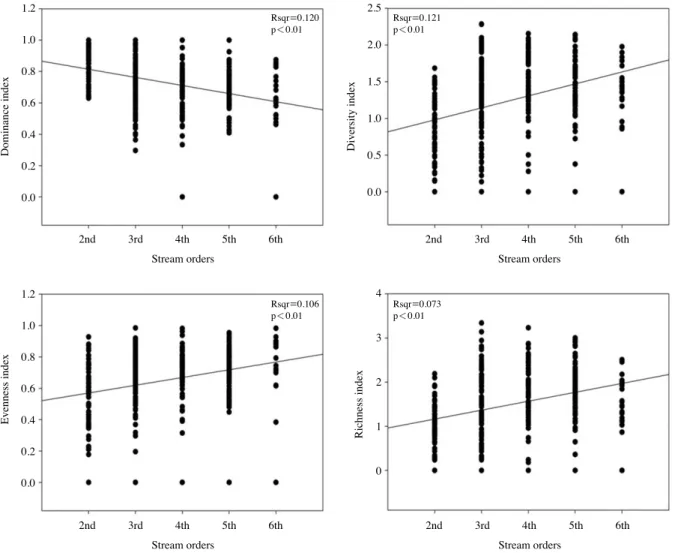
남한강수계의 어류 군집분석 결과는 다음과 같다 (Table 3, Fig. 4). 하천차수별 군집지수는 2차하천에서 우점도지수는 0.87 (±0.12), 다양도지수는 0.77 (±0.50), 균등도지수는 0.51 (±0.25), 종풍부도지수는 0.93 (±
0.54), 3차하천에서 우점도지수는 0.72 (±0.17), 다양도 지수는 1.30 (±0.51), 균등도지수는 0.68 (±0.18), 종풍 부도지수는 1.52 (±0.73), 4차하천에서 우점도지수는 0.68 (±0.20), 다양도지수는 1.36 (±0.61), 균등도지수 는 0.65 (±0.24), 종풍부도지수는 1.64 (±0.81), 5차하 천에서 우점도지수는 0.69 (±0.13), 다양도지수는 1.46 (±0.38), 균등도지수는 0.70 (±0.15), 종풍부도지수는 1.80 (±0.58), 6차하천에서 우점도지수는 0.63 (±0.20), 다양도지수는 1.37 (±0.44), 균등도지수는 0.76 (±0.22), 종풍부도지수는 1.53 (±0.58)로 분석되었다. 우점도지수 는 하천차수가 증가할수록 감소하고, 다양도지수, 균등도 지수, 종풍부도지수는 상대적으로 증가하는 경향을 나타 내었으며, 하천차수별 지점간 차이는 4차하천에서 가장 크고 5차하천에서 가장 낮은 것으로 분석되었다. 한편, 남한강수계를 구성하는 전 조사지점의 군집지수는 우점 도지수 0.73 (±0.18), 다양도지수 1.23 (±0.58), 균등도 지수 0.63 (±0.25), 종풍부도지수 1.48 (±0.76)로 분석 되어 전반적으로 비교적 불안정한 군집구조를 유지하고 있는 것으로 조사되었다.
0 10 20 30 40 50
Relative abundance (%) 33.9 15.8
8.9 7.0 5.2 3.8 3.5 2.1 2.1 2.0
15.8
Fig. 2. Relative abundance of collected fish in Namhan river watershed.
Z. koreanus Z. platypus R. oxycephalus P. herzi R. kumgangensis M. longidorsalis C. splendidus I. koreensis H. longirostris P. phoxinus Others
Fig. 3. Regression of species and individual with collected in Namhan river watershed.
16 14 12 10 8 6 4 2 0
2nd 3rd 4th 5th 6th
Stream orders
Rsqr==0.068 Rsqr==0.002 p⁄0.01 p==0.36
2nd 3rd 4th 5th 6th
Stream orders
1000
800
600
400
200
0
No. of species No. of individual
Fig. 4. Regression of fish community analysis in Namhan river watershed.
Fig. 5. Regression of comparison between relative abundance of sensitive and tolerant species in Namhan river watershed.
1.2
1.0
0.8
0.6
0.4
0.2
0.0
1.2
1.0
0.8
0.6
0.4
0.2
0.0
4
3
2
1
0 2.5
2.0
1.5
1.0
0.5
0.0
Rsqr==0.120 Rsqr==0.121
p⁄0.01 p⁄0.01
Rsqr==0.106 Rsqr==0.073
p⁄0.01 p⁄0.01
Dominance indexEvenness index Richness indexDiversity index
2nd 3rd 4th 5th 6th
Stream orders
2nd 3rd 4th 5th 6th
Stream orders
2nd 3rd 4th 5th 6th
Stream orders
2nd 3rd 4th 5th 6th
Stream orders
120
100
80
60
40
20
0
120
100
80
60
40
20
0
Sensitive species(%) Tolerant species(%)
2nd 3rd 4th 5th 6th
Stream orders
2nd 3rd 4th 5th 6th
Stream orders Rsqr==0.055 Rsqr==0.062
p⁄0.01 p⁄0.01
Table 3.Characteristic of stream fish and community analysis at each station in Namhan river watershed. Stream Water VelocityStream Stream Bottom No. of No. ofNo. No. No. No. DIH′EIRI Stationsorderstemperate(cm sec-1 )depthwidthstructurespeciesindividualof SSof TSof ISof OSMeanMeanMeanMean (�C)(cm)(cm)MeanMeanMeanMeanMeanMean(±SD)(±SD)(±SD)(±SD) St. 1215.867.125.731B, C, P, S4.747.33.31.43.40.30.89(±0.08)0.65(±0.41)0.41(±0.27)0.95(±0.50) St. 2215.375.821.230B, C, P, G, S679.12.63.440.90.88(±0.06)0.78(±0.27)0.45(±0.16)1.15(±0.47) St. 3214.748.819.430.9B, C, P, G, S3.342.62.11.11.60.10.97(±0.03)0.32(±0.25)0.27(±0.22)0.52(±0.42) St. 4213.46618.432.3C, P, G8.6288.14.73.761.40.79(±0.14)1.18(±0.38)0.58(±0.16)1.38(±0.50) St. 5213.851.514.743.6C, P, G5.789.74.61.15.40.30.80(±0.12)1.08(±0.53)0.59(±0.29)1.04(±0.51) St. 6214.863.120.141.8C, P, G, S3.933.12.913.30.10.91(±0.06)0.65(±0.35)0.53(±0.11)0.93(±0.17) St. 7216.3651914.6B, C, P, G, S1.453.31.30.11.30.10.96(±0.12)0.17(±0.45)0.12(±0.32)0.09(±0.24) St. 8214.163.517.326.4C, P, G6.148.33.72.351.10.78(±0.12)1.13(±0.54)0.68(±0.06)1.43(±0.36) St. 9215.663.122.234.3B, C, P, G, S4.167.62.91.33.40.60.90(±0.10)0.66(±0.52)0.49(±0.26)0.81(±0.38) St. 10215.959.317.815.7C, P, G, S4.363.12.41.73.40.90.85(±0.18)0.76(±0.70)0.51(±0.37)0.72(±0.82) St. 11315.366.327.764.3B, C, P, G, S10.166.14.65.45.13.40.62(±0.11)1.68(±0.26)0.73(±0.14)2.33(±0.32) St. 12318.169.820.426.3C, P, G, S5.672.32.33.13.620.74(±0.08)1.22(±0.26)0.72(±0.15)1.11(±0.21) St. 13314.771.521.147.7C, P, G, S4.360.12.61.42.30.70.93(±0.10)0.49(±0.54)0.27(±0.26)0.71(±0.75) St. 14314.874.627.682.4B, C, P, S6.7303.43.13.61.90.60(±0.17)1.49(±0.35)0.82(±0.11)1.75(±0.67) St. 15314.892.731.836B, C, P, G4.955.34.70.13.700.83(±0.11)0.93(±0.46)0.55(±0.27)1.00(±0.49) St. 16316.964.822.246.4C, P, S9.764.11.96.45.43.70.63(±0.10)1.65(±0.20)0.75(±0.10)2.18(±0.50) St. 1731787.524.267.9B, C, P, G, S7.971.92.74.95.41.70.67(±0.17)1.43(±0.26)0.72(±0.15)1.63(±0.49) St. 18315.558.224.398.6C, P, G, S10.369.35.34.772.40.60(±0.21)1.72(±0.50)0.74(±0.15)2.28(±0.66) St. 19317.179.320.777.9C, P, G, S5.771.61.62.93.42.30.80(±0.07)1.19(±0.23)0.69(±0.13)1.20(±0.29) St. 20316.76519.973.9C, P, G, S10.489.64.95.15.93.30.54(±0.12)1.84(±0.25)0.79(±0.08)2.14(±0.43) St. 21314.155.516.775C, P, G8255.95.12.95.61.60.71(±0.08)1.41(±0.20)0.72(±0.13)1.33(±0.44) St. 2231469.132.285.7B, C, P, G, S10103.13.366.42.90.68(±0.13)1.55(±0.45)0.67(±0.15)1.95(±0.58) St. 23312.498.222.217.5B, C, P, G350.42.90.12.70.10.95(±0.09)0.40(±0.45)0.31(±0.34)0.46(±0.53) St. 24314.668.621.275B, C, P, S7.964.343.95.41.70.69(±0.13)1.42(±0.36)0.71(±0.07)1.67(±0.66) St. 25313.567.858.449.7B, C, P, G, S7.754.352.75.11.40.65(±0.11)1.55(±0.27)0.76(±0.11)1.73(±0.40) St. 26311.864.340.128C, P, G2.622.92.602.300.90(±0.17)0.50(±0.36)0.50(±0.36)0.46(±0.34) St. 27416.98627.9143.6C, P, G, S10.6111.77.43.16.92.10.70(±0.17)1.41(±0.51)0.62(±0.22)2.12(±0.51) St. 28416.655.821.788.3B, C, P, G, S9.758.43.45.46.42.40.63(±0.14)1.67(±0.30)0.74(±0.09)2.15(±0.47) St. 29414.167.523109.3C, P, G, S11105.16.94.181.70.64(±0.09)1.70(±0.28)0.71(±0.10)2.31(±0.58) St. 30416.276.264106.4C, P, G, S7105.63.72.94.61.40.55(±0.26)1.31(±0.62)0.64(±0.30)1.31(±0.64) St. 31415.460.421445C, P, G, S844.34.73.35.60.90.64(±0.26)1.43(±0.83)0.75(±0.18)1.98(±0.87) St. 32415.265.919.662.9C, P, G, S9.7109.46.13.66.91.30.63(±0.10)1.67(±0.28)0.76(±0.06)1.91(±0.42) St. 33413.68024.946B, C, P1.3127.11.301.300.98(±0.01)0.05(±0.14)0.08(±0.20)0.03(±0.07) St. 34414.575.124.898.6B, C, P, G7.1271.96.116.30.40.76(±0.10)1.34(±0.25)0.71(±0.05)1.17(±0.35) St. 35415.15423.1106.1C, P, G, S9.3915.14.16.62.40.65(±0.17)1.59(±0.45)0.74(±0.07)1.87(±0.68) St. 36416.4190.432.992.4C, P, G9.7115.34.15.16.42.70.65(±0.13)1.62(±0.33)0.73(±0.13)1.87(±0.53) St. 37415.866.430.756.4B, C, P, G, S5.327.63.41.94.30.60.65(±0.29)1.06(±0.48)0.61(±0.30)1.30(±0.66) St. 38516.978.126.365C, P, G8.769.444.43.93.30.75(±0.08)1.34(±0.31)0.63(±0.09)1.86(±0.47) St. 39516.771.627.4123.2C, P, S8.784.64.93.74.92.70.69(±0.17)1.49(±0.37)0.71(±0.12)1.83(±0.52) St. 405177028.2160.4C, P, G8.445.14.93.44.32.70.59(±0.11)1.69(±0.21)0.81(±0.12)2.08(±0.52) St. 41516.473.780.8268.3C, P, G, S4.738.42.12.42.91.60.80(±0.17)0.92(±0.67)0.57(±0.40)1.02(±0.82)
Table 4. Correlation analysis with pearson’s in Namhan river watershed. #.Species#.IndividualH′SSTSIOWTWCSDSWBCPGS Orders0.353*-0.0630.457**0.2520.3090.1660.406**0.329*0.0840.458**0.688**-0.2040.1160.1360.056-0.068 #.Species�0.303*0.927**0.706**0.842**0.897**0.761**0.2330.0510.0010.341*-0.345*-0.2240.1330.369**0.195 #.Individual��0.1720.382**0.1140.432**0.045-0.2060.053-0.151-0.057-0.074-0.2690.2710.399**-0.162 *: p⁄0.05, **: p⁄0.01, H′: diversity, SS: sensitive species, TS: tolerance species, IS: insectivore species, OS: omnivore species, WT: water temperate, WC: water current, SD: stream depth, SW: stream width, B: boulder, C: cobble, P: pebble, S: sand Table 5.Correlation analysis with pearson’s at each stream order in Namhan river watershed. Orders#.IndividualH′SSTSIOWTWCSDSWBCPGS 2nd#.Species0.548**0.821**0.833**0.845**0.924**0.661**0.1900.146-0.0750.176-0.071-0.0120.277*0.120-0.202 #.Individual0.303*0.438**0.447**0.490**0.394**-0.147-0.149-0.135-0.015-0.065-0.1790.1020.341**-0.129 3rd#.Species0.301**0.829**0.591**0.850**0.898**0.793**0.167-0.227*-0.0250.260**-0.077-0.1340.0200.1530.069 #.Individual0.1580.290**0.190*0.330**0.168-0.023-0.216*-0.085-0.002-0.086-0.1740.203*0.274**-0.071 4th#.Species0.1690.843**0.840**0.810**0.943**0.707**0.334**-0.016-0.014-0.125-0.289*-0.0590.0680.1420.134 #.Individual0.0370.266*-0.0070.2060.066-0.181-0.0990.077-0.037-0.145-0.1100.1860.110-0.098 5th#.Species0.517**0.670**0.769**0.677**0.836**0.480**0.249*-0.137-0.275**-0.1220.2120.012-0.0940.112-0.150 #.Individual0.1570.2010.566**0.492**0.276*-0.099-0.288*0.0350.2160.012-0.220-0.0770.2220.054 6th#.Species0.742**0.685**0.805**0.618**0.901**0.720**-0.0190.311-0.1370.163-0.080-0.2480.2150.1430.088 #.Individual0.2310.776**0.2070.675**0.546*0.0070.1630.1100.427-0.008-0.167-0.050-0.0170.159 *: p⁄0.05, **: p⁄0.01, H′: diversity, SS: sensitive species, TS: tolerance species, IS: insectivore species, OS: omnivore species, WT: water temperate, WC: water current, SD: stream depth, SW: stream width, B: boulder, C: cobble, P: pebble, S: sand St. 42516.481.650.9250C, P, G, S8126.334.34.62.60.72(±0.10)1.42(±0.21)0.70(±0.10)1.49(±0.34) St. 4351675.331.4304.3C, P, G, S8.680.65.92.75.61.60.73(±0.10)1.40(±0.35)0.68(±0.14)1.86(±0.64) St. 44515.454.141.4187.9C, P, G, S10.1134.64.45.36.92.30.63(±0.10)1.62(±0.26)0.72(±0.10)1.92(±0.48) St. 45516.582.132.2186C, P, G, S6.442.64.91.63.420.74(±0.16)1.30(±0.45)0.70(±0.14)1.50(±0.71) St. 46514.551.218.3130C, P, G, S10114.96.33.76.71.60.70(±0.09)1.51(±0.25)0.66(±0.14)2.05(±0.30) St. 47514.281.334.6237.5C, P, G10.174.96.73.37.61.30.62(±0.08)1.70(±0.20)0.74(±0.06)2.12(±0.47) St. 4851765.632.9127.7C, P, G8.647.34.93.44.42.70.63(±0.12)1.62(±0.33)0.76(±0.16)2.04(±0.45) St. 49615.174.727.5173.4B, C, P, G, S6.325.62.343.31.70.51(±0.26)1.39(±0.67)0.72(±0.33)1.60(±0.88) St. 50617.249.742.5245C, P, G, S7.659.33.73.73.72.40.66(±0.14)1.44(±0.34)0.73(±0.18)1.61(±0.34) St. 51616.359.241.2151.1C, P, G520.71.43.42.91.40.73(±0.11)1.27(±0.26)0.82(±0.13)1.39(±0.45) SS: sensitive species, TS: tolerance species, IS: insectivore species, OS: omnivore species, DI: dominance index, H′: diversity index, EI: evenness index, RI: richness index
Table 3.Continued. Stream Water VelocityStream Stream Bottom No. of No. ofNo. No. No. No. DIH′EIRI Stationsorderstemperate(cm sec-1 )depthwidthstructurespeciesindividualof SSof TSof ISof OSMeanMeanMeanMean (�C)(cm)(cm)MeanMeanMeanMeanMeanMean(±SD)(±SD)(±SD)(±SD)
3. 내성도 및 섭식도
남한강수계에서 확인된 민감종 (Sensitive species)과 내성종 (Tolerant species)의 출현종수에 따른 내성특성 (Tolerance guild)은 2차하천에서 70.2% (±22.1%), 29.2% (±21.3%), 3차하천에서 55.9% (±28.1%), 40.6%
(±25.2%), 4차하천에서 63.7% (±21.5%), 34.6% (±
20.0%), 5차하천에서 55.5% (±22.1%), 42.4% (±17.6
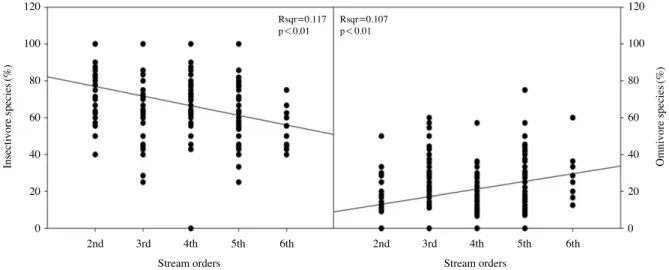
%), 6차하천에서 35.5% (±20.1%), 62.6% (±19.2%)로 분석되었다. 하천차수가 증가할수록 민감종은 감소하고, 내성종은 증가하는 경향이 나타나 서로 대조적인 모습 을 보였다 (Fig. 5). 또한 3차하천에서 지점간 민감종과 내성종의 차이가 가장 크게 나타났으며, 5차하천에서 차 이가 가장 낮게 나타났다. 남한강수계를 구성하는 전 조 사지점의 내성특성은 민감종 59.2% (±24.5%), 내성종 38.7% (±22.7%)로 민감종에서 더욱 우세한 것으로 분 석되었다. 충식종 (Insectivore species)과 잡식종 (Omni- vore species)의 출현종수에 따른 섭식특성 (Trophic guild)은 2차하천에서 79.5% (±19.4%), 9.8% (±12.8
%), 3차하천에서 66.8% (±16.6%), 22.2% (±15.3%), 4 차하천에서 73.4% (±16.6%), 15.6% (±11.8%), 5차하 천에서 60.2% (±15.1%), 26.7% (±14.6%), 6차하천에 서 52.9% (±10.6%), 29.9% (±12.3%)로 분석되었다.
내성도와 마찬가지로 하천차수가 증가할수록 충식종은 감소하고, 잡식종은 증가하는 경향을 나타내었다(Fig. 6).
또한 충식종은 2차하천에서 지점간 차이가 가장 크고, 6 차하천에서 가장 낮은 것으로 나타났으며, 잡식종은 3차 하천에서 가장 크고, 4차하천에서 가장 낮은 것으로 분 석되었다. 남한강수계를 구성하는 전 조사지점의 섭식특
성은 충식종이 68.5% (±18.2%), 잡식종이 19.8% (±
15.2%)로 충식종에서 우세하게 나타났다.
4. 하천 건강성(IBI) 평가
본 연구에서 출현한 어류를 이용한 하천차수별 건강성 평가 결과, IBI 종합 점수와 등급은 2차하천에서 25.3 (±3.8)으로 “양호상태”, 3차하천에서 24.9 (±4.6), 4차 하천에서 24.3 (±5.0), 5차하천에서 23.4 (±4.1), 6차하 천에서 21.6 (±4.7)으로 “보통상태”의 등급으로 확인되 었다 (Fig. 7). 또한 하천차수가 증가할수록 IBI 값이 감 소하는 경향을 보여 하류로 갈수록 물리∙화학적 영향 에 따른 교란이 증가하는 것으로 분석되었다. 한편, 4차 Fig. 6. Regression of comparison between relative abundance of insectivore and omnivore species in Namhan river watershed.
Fig. 7. Total IBI score at each stream order in Namhan river water- shed.
Total IBI scores
40
35
30
25
20
15
10
2nd 3rd 4th 5th 6th
Stream orders 120
100
80
60
40
20
0
Rsqr==0.117 Rsqr==0.107 p⁄0.01 p⁄0.01
2nd 3rd 4th 5th 6th
Stream orders
2nd 3rd 4th 5th 6th
Stream orders
120
100
80
60
40
20
0
Insectivore species(%) Omnivore species(%)
하천에서 지점간 차이가 가장 크고, 2차하천에서 가장 낮은 것으로 나타났으며, 남한강수계를 구성하는 전 조 사지점의 IBI는 24.3 (±4.5)으로 “보통상태”의 등급으 로 분석되었다.
5. 주성분 분석
남한강수계를 구성하는 51개 지점의 하천차수에 따른 주성분 분석결과, 선정된 2개의 요인은 각각 Axis 1 (69.9%; p⁄0.01)과 Axis 2 (14.6%; p==0.67)의 고유값으 로 분석되었다 (Fig. 8). Axis 1은 다양도지수 (H′)가 음 의 방향으로 상관성이 가장 높은 것으로 나타났으며, 이 와 대조적으로 우점도지수 (DI)는 양의 방향으로 상관 성이 가장 높은 것으로 분석되었다. Axis 2는 잡식종수 (OS, Omnivore species)가 음의 방향으로 상관성이 가 장 높게 나타났으며, 개체수 (Id, Individual)는 양의 방 향으로 상관성이 높게 나타났다. 결과적으로 Axis 2를 기준으로 양의 방향으로는 다양도지수가 낮고, 우점도지 수가 높으며, 잡식종수가 적고, 개체수가 비교적 높게 출현하는 산간계류 또는 자연성이 잘 보존되고 있는 지 점들로 구분 되었다. 한편, 음의 방향으로는 다양도지수 가 높고 우점도지수가 낮으며, 잡식종수가 많고 개체수 가 비교적 낮게 출현하는 지점들로 구분이 되었다.
6. 다변량 상관관계 분석
Pearson’s 상관관계 분석결과, 하천차수는 수온 (p⁄
0.05), 수심 (p⁄0.01), 유폭 (p⁄0.01) 등 물리적 수환경 과 상관성이 높은 것으로 나타났다. 또한 출현종과 개체 수는 유폭(p⁄0.05), boulder (p⁄0.05), gravel (p⁄0.01) 과 상관관계가 높게 나타났다 (Table 4). 하천차수별 출 현종수는 2~6차 하천에서 종다양도지수(p⁄0.01), 민감 종수 (p⁄0.01), 내성종수 (p⁄0.01), 충식종수 (p⁄0.01), 잡식종수(p⁄0.01)와 상관성이 높게 나타났으며, 개체수 는 각 하천차수에 따라 상관성이 차이가 나타났다. 또한 2차하천에서는 pebble (p⁄0.05), gravel (p⁄0.01), 3차 하천에서는 유속 (p⁄0.05), 유폭 (p⁄0.01), pebble (p⁄
0.05), gravel (p⁄0.01), 4차하천에서는 수온 (p⁄0.01), boulder (p⁄0.05), 5차하천에서는 수온 (p⁄0.05), 유속 (p⁄0.05), 수심 (p⁄0.01) 등 물리적 수환경과 상관성이 높게 나타났으며, 6차하천에서는 출현종과 개체수에 따 른 물리적 수환경과 상관성이 나타나지 않았다(Table 5).
고 찰
본 연구에서 어류를 이용한 남한강수계의 하천차수별 어류군집의 분포 특성 결과, 출현한 어류는 총 12과 55 Fig. 8. Principal component analysis with multivariable data in Namhan river watershed (Sp: species, Id: individual, SS: sensitive species, TS: tolerance species, IS: insectivore species, OS: omnivore species, DI: dominance index, H′: diversity index, EI:
evenness index, RI: richness index).
Up Stream
TS
Down Stream
Stream orders 2 3 4 56
Axis 1 3
1
-1
-3
-4 0 4 8
Axis 2
종 28,628개체로 확인되었다. 이 중 상대풍부도가 5%
이상인 어종은 참갈겨니, 피라미, 버들치, 돌고기, 금강모 치 등의 순으로 확인되었다(Fig. 2). 갈겨니는 하천의 중
∙상류역, 피라미는 하천 중∙하류에서 출현하는 분포 특성이 나타나며, 버들치는 산간계류의 수온이 낮은 물 이나 강의 상류역에 서식하는 특성이 나타나는 것으로 알려져 있다 (Moon et al., 2010). 그러나 본 연구에서는 갈겨니와 생태적 특성이 유사한 참갈겨니가 전체 출현 종 중 가장 풍부하게 출현하였으며, 2, 3, 5, 6차하천에서 는 피라미가 4차하천에서 버들치가 아우점하여 Strahler (1957) 방식에 따른 상류에서 하류로의 하천차수 구분이 본 연구의 남한강수계에서는 일치하지 않는 것으로 조 사되었다. 이는 하천차수의 구분은 동일하여도 하상공사, 골재채취 등의 인위적인 간섭과 유폭, 수심, 유속, 하상 구조의 차이 등과 같은 지역별 하천특이성이 작용한 결 과로 판단된다. 또한 각 지점의 종수와 개체수를 하천차 수에 따라 살펴보면 하천차수에 따른 구배가 나타났으며, 이는 채집방법의 정량화에 기준할 때, 본 연구의 5, 6차 하천의 조사지점들은 유폭, 수심, 유량 등 하천의 규모가 커짐에 따라 채집이 용이하지 않아 개체수가 감소하는 경향이 나타난 것으로 판단되며, 4차하천은 조사지점 인 근으로 유입되는 1~3차하천의 영향이 작용하였을 것으 로 사료된다 (Fig. 3). Lee et al. (2007)의 남한강 상류수 계, Moon et al. (2010)의 흑천수계, Lee et al. (2010)의 금강수계, Kim et al. (2012)의 회야강수계, Moon et al.
(2012)의 탐진강수계 등에서 조사구간을 하천차수에 따 라 구분하여 어류상과 분포를 조사하였으나 우리나라에 서 서식하는 어류의 분포 특성은 하천차수에 따라 명확 하게 일치하지 않는 것으로 판단되며, 추후 하천차수 구 별에 따른 Strahler (1957)의 하천차수 방법을 보완하여 국내 하천 현황에 맞는 어류 군집의 분포 특성을 정립 시켜야 할 필요성이 있다.
군집분석 결과 하천차수의 증가 또는 감소에 따른 우 점도, 다양도, 균등도, 종풍부도지수의 구배는 기존의 Moon et al. (2010)의 보고와 일치하는 것으로 나타났다.
따라서 어류의 다양성은 하천차수에 따라 상관성이 높 게 나타나며, 물리적 수환경이 어류의 분포와 관련성이 높은 것으로 알려져 있다(Barila et al., 1981; Beecher et al., 1988; Sullivan and Watiz, 2009). 본 연구에서도 하 천차수별 지점간 어류 분포의 차이 (±SD)는 조사지점 별 물리적 수환경 및 수변식생대의 분포 유무의 차이가 높게 작용한 것으로 판단된다.
남한강수계의 어류를 이용한 내성특성, 섭식특성 및 IBI 통합지수를 통한 분석결과, 하천차수의 증가 또는
감소에 따라 민감종, 내성종, 충식종, 잡식종, IBI 통합지 수의 구배는 기존 국내에서 발표된 문헌 (Moon et al., 2010, 2012)과 동일하게 나타나는 것으로 분석되었다.
IBI값의 감소는 내성종 어류의 증가를 초래한 결과이 며, 이는 수질과 물리적인 수환경의 변화 및 교란으로 하천차수가 높아짐에 따라 IBI 값의 감소를 초래 하는 것으로 판단된다. 한편 내성특성, 섭식특성 및 IBI 통합 지수의 하천차수별 지점 간의 차이는 하천차수가 동일 하여도 지점별 물리적 수환경에 따라 서식하는 어류상 의 차이로 생각되며, 4~6차의 경우 각 지점에 따라 수 변식생대의 발달 및 유폭, 수심, 유속의 차이가 영향을 미친 것으로 판단된다. 또한 본 연구의 분석결과 기존의 하천차수를 대상으로 보고된 문헌과는 부분적으로만 일 치하여 추후 보다 정밀한 연구와 지속적인 모니터링이 필요할 것으로 사료된다.
주성분 분석결과 각 조사지점들이 하천차수에 따라 뚜렷하게 구분되지 못하였는데, 이는 하천차수 구분에 따라 각 지점들의 수환경, 어류분포 특성 등이 뚜렷하지 못하기 때문이다. 이러한 비특이적 결과는 Axis 1, 2를 기준으로 인위적인 간섭에 따른 하천의 자연성이 높은 상류지점들과 하천의 자연성이 낮은 하류지점들로 구분 이 되며, 기존에 선행된 하천차수구분에 따른 연구와는 일치하지 않는다. 이는 하천차수구분은 동일하여도 각 지점들의 물리적 수환경 및 출현종의 차이가 비교적 높 기 때문이며, 국내 하천현황에 적합한 하천차수의 구분 에 관한 깊이 있는 연구가 필요하다. 한편, Sullivan and Watiz (2009)는 미소서식처의 물리적∙이화학적 수환경 등 다양한 자료를 바탕으로 주성분 분석을 실시하였고, 이러한 분석자료를 토대로 서식처 구분에 따른 생물종 의 분포 특성을 언급하였다. 하지만 본 연구의 조사자료 를 하천차수에 따른 생물종의 분포 구분을 실시한 결과 하천차수별 출현 유무의 차이만 확인할 수 있었으며, 보 다 더 구체적인 결론은 분석되지 못하였다. 이는 각 하 천차수 구분에 따라 출현한 어종의 차이가 뚜렷하지 못 하기 때문이며, 조사지점별 어류의 출현유무와 개체수 빈도는 이동통로, 피난처, 휴식처 등에 좌우되기 때문인 것으로 판단된다.
Pearson’s 상관관계 분석결과 하천차수의 구배에 따 라 출현한 어류의 종과 개체수, 물리적 수환경 등의 구 배는 어류의 다양성 및 하천의 물리적 수환경과 상관관 계가 높으며, 이 중 본 연구에서는 수온, 수심, 유폭의 구배가 하천차수 구분에 따라 영향을 미치는 것으로 분 석되었다(Table 2). 또한 하천차수별 출현종수와 개체수 는 2차하천에서 pebble과 gravel, 3차하천에서는 유속,
유폭, pebble, gravel, 4차하천에서는 수온, boulder, 5차 하천에서는 수온, 유속, 수심이 영향을 미치는 것으로 나타났다. 한편 6차에서는 상관관계로 분석된 값이 높 게 나타나지는 않았으나 유속, cobble, pebble이 미치는 영향이 큰 것으로 판단된다 (Table 3). 결과적으로 하천 차수별 물리적 수환경의 특성을 구분하는 요인들이 분 석되었으나 이는 본 연구 수계에서의 결과에 한정되며, 추후 보다 더 광범위하고 세밀한 연구가 필요할 것으로 사료된다.
남한강 수계의 51개 지점을 대상으로 하천차수에 따 라 어류상, 군집분석, 내성특성 및 섭식특성 분석, IBI 평 가, 주성분 분석을 실시한 결과, 하천차수에 따라 기존 에 보고된 문헌과 부분적으로 일치하였으나 남한강수계 의 특징은 뚜렷하게 구분되지 못하였다. 이는 본 연구의 조사지점들은 유폭, 수심, 유량 등의 물리적 수환경이 하천차수별로 비교적 유사하였기 때문이다. 따라서 본 연구결과를 바탕으로 우리나라 하천 실정에 맞는 적합 한 하천차수의 구분을 정립하는 것이 필요할 것으로 사 료된다.
적 요
본 연구는 2007년 11월부터 2010년 9월까지 2차 하 천부터 6차하천까지 하천 차수에 따라 총 51개의 지점 을 7회에 걸쳐 조사하였다. 채집된 어류는 총 12과 55 종이었으며, 전체 지점에서 참갈겨니 (Zacco koreanus) 가 우점하고, 피라미 (Zacco platypus)가 아우점 하였다.
또한 천연기념물 1종 (1.8%), 환경부지정 멸종위기야생 동물 2급 6종(10.9%), 한국고유종 22종(40.0%)이 확인 되었다. 하천차수가 2차하천에서 6차하천으로 증가할수 록 종수, 다양도지수, 균등도지수, 종풍부도지수, 내성종, 잡식종이 증가하며, 개체수, 우점도지수, 민감종, 충식종, IBI종합 지수는 감소하는 경향이 나타났다. 주성분 분석 결과 각 지점들의 분포양상은 종수, 개체수, 군집지수, 내성종, 민감종, 잡식종, 충식종에 따라 상류와 하류로 구분이 되었다. 다변량 상관관계 분석결과 하천차수와 다변수 (종수, 다양도지수, 잡식종, 하폭, 수심, 수온)는 유 의미한 양의 상관관계가 나타났다.
사 사
본 연구는 환경부 “수생태건강성 조사 및 평가 (2007
~2010)” 및 2012년도 상지대학교 교내연구비 지원에 의해 수행되었음.
REFERENCES
An, G.K., D.H. Yoem and S.K. Lee. 2001. Rapid bioassessments of Kap Stream using the index of biological integrity.
Korean Journal of Environmental Biology 19(4): 261-269.
An, G.K. and J.H. Kim. 2005. A diagnosis of ecological health using physical habitat assessment and multimetric fish model in Daejeon Stream. Korean Journal of Limnologi- cal Society 38(3): 361-371.
Barila, T.Y., R.D. Williams and J.R. Stauffer Jr, 1981. The influ- ence of stream order and selected stream bed parameters on fish diversity in Raystown Branch, Susquehanna River drainage, Pennsylvania. Journal of Applied Ecology, pp.
125-131.
Beecher, H.A., E.R. Dott and R.F. Fernau. 1988. Fish species richness and stream order in Washington State streams.
Environmental Biology of Fishes 22(3): 193-209.
Choi, J.S., Y.S. Jang, K.W. Lee and O.K. Kwon. 2004. Feeding habit of Gobiobotia macrocephala (Cyprinidae) from the Namhan River, Korea. Korean Journal of Ichthyology 16 (2): 165-172.
Han, J.H. and K.G. An. 2008. Water quality variation dynamics between artificial reservoir and the effected downstream watershed. Korean Journal of Limnological Society 41(3):
382-394.
Kaiser, H.F. 1958. The varimax criterion for analytic rotation in factor analysis. Psychometrika 23: 187-200.
Kaiser, H.F. 1961. A note on Guttman’s lower bound for the number of common factors. British Journal of Mathemati- cal and Statistical Psychology 14: 1-2.
Karr, J.R. 1981. Assessment of Biotic Integrity using Fish Com- munities. Fishieries 6: 21-27.
Kim, I.S. 1997. Illustrated encyclopedia of fauna & flora of Korean Vol. 37 Freshwater Fishes. Ministry of Education, pp. 518.
Kim, I.S. and J.Y. Park. 2002. Freshwater fishes of Korea. Kyo- hak Press Co., Seoul, pp. 465.
Kim, I.S., Y. Choi, C.L. Lee, Y.J. Lee, B.J. Kim and J.H. Kim.
2005. Illustrated book of Korean fishes. Kyohak Press Co., Seoul, pp. 512.
Kim, J.H., J.D. Yoon, H.B. Jo, K.H. Chang and M.H. Jang. 2012.
Stream Health Assessment on Hoeya River Basin and Other Streams Based on Fish Community and Land Use in the Surrounding Watersheds. Korean Journal of Limnol- ogical Society 45(4): 392-402.
Lee, J.H., Y.P. Hong and K.G. An. 2007. Multi-metric index assessment of fish model and comparative analysis of com- munity index with the health index the upstream watershed
of Southern Han River. Korean Journal of Limnological Society 40(2): 327-336.
Lee, S.H., J.H. Lee, J.H. Han and K.G. An. 2010. A study on the fish community and various guilds to stream order in Geum River Watershed. Korean Journal of Limnological Society 43(4): 503-512.
Margalef, R. (1958). Information theory in ecology. General Systems 3: 36-71.
McNaughton, S.J. 1967. Relationship among functional proper- ties of California Grassland. Nature 216: 114-168.
Ministry of Environment. 2006. The 3rd National Ecosystem Survey Guide. National Institute of Environmental Rese- arch, pp. 298.
Moon, W.K., D.Y. Bae, J.W. Seo and K.G. An. 2012. Fish dis- tribution and compositions along with altitude and longi- tudinal distance from the river mouth in the Tamjin River Basin, Korea. Journal of Korean Society on Water Envi- ronment 29(4): 512-522.
Moon, W.K., J.H. Han and K.G. An. 2010. Fish fauna and com- munity analysis in Heuck Stream Watershed. Korean Journal of Limnological Society 43(1): 69-81.
Morgan, R.P. and S.F. Cushman. 2009. Urbanization effects on stream fish assemblages in Maryland, USA. Journal of the North American Benthological Society 24(3): 643-655.
Nelson, J.S. 2006. Fishes of the World. Wiley, pp. 600 Oh, S.J., S.H. Woo, J. Hur, M.S. Jung and H.S. Shin. 2009.
Changes in dissolved organic matter composition in the Namhan River during a heavy rain event. Journal of Kor- ean Society on Water Quality 25(5): 697-703.
Pielou, E.C. 1966. The measurement of diversity in different types of biological collections. Journal of Theoretical Bio-
logy 13: 131-144.
Platts, W.S. 1979. Relationships among stream order, fish popu- lations, and aquatic geomorphology in an Idaho river drainage. Fisheries 4(2): 5-9.
Shannon, C.E. and W. Weaver. 1949. The mathematical theory of communication. University of Illinois Press, Urbana, pp. 233.
Song, H.B. and Y.M. Son. 2002. Maturity and reproductive eco- logy of the minnow, Phoxinus phoxinus (Cyprinidae) in the upper south Han River, Korea. Korean Journal of Ichthyology 14(4): 262-268.
Sullivan, S.M.P. and M.C. Waitzin. 2009. Stream-floodplain connectivity and fish assemblage diversity in the Cham- plain Valley, Vermont, U.S.A. Journal of Fish Biology 74: 1394-1418.
Strahler, A.N. 1957. Quantitative analysis of watershed geomor- phology. Transactions of the American Geophysical Union 38(6): 913-920.
Yan, Y., X. Xiang, L. Chu, Y. Zhan and C. Fu. 2011. Influences of local habitat and stream spatial position on fish assem- blages in a dammed watershed, the Qingyi Stream, China.
Ecology of Freshwater Fish 20(2): 199-208.
Yeom, D.H., K.G. An, Y.P. Hong and S.K. Lee. 2000. Assess- ment of an index biological integrity (IBI) using fish assem- blages in Keum-Ho River, Korea. Korean Journal of Envi- ronment Biology 18(2): 215-226.
Yoder, C.O. and M.A. Smith. 1999. Using fish assemblages in a state biological assessment and criteria program: essential concepts and considerations. Assessing the Sustainability and Biological Integrity of Water Resources Using Fish Communities, pp. 17-56.