─ 229 ─
ⓒ The Korean Society of Limnology. All rights reserved.
This is an open-access article distributed under the terms of the Creative Commons Attribution Non-Commercial License (http://creativecommons.org/licenses/by-nc/3.0/), which permits unrestricted non-commercial use, distribution, and reproduction in any medium, provide the original work is properly cited.
영산강·섬진강 수계 호소의 규모별 어류군집 특성
박상현1,2·김정희1,*·백승호1,3·최호승1,4·김대운1·고의정5·김현우6,*
1주식회사 에코리서치, 2목포대학교 해양수산자원학과, 3충북대학교 환경공학과, 4공주대학교 생명과학과,
5부산대학교 생명과학과, 6순천대학교 환경교육과
Characteristics of Fish Assemblage by Reservoir Size in Yeongsan·Seomjin River Watershed in Korea.
Sang-Hyeon Park1,2 (0000-0001-6036-8489), Jeong-Hui Kim1,*(0000-0003-2331-4232), Seung-Ho Baek1,3
(0000-0002-8280-8665), Ho-Seung Choi1,4 (0000-0002-9440-5871), Dae-Won Kim1 (0000-0001-5843-8900), Eui-Jeong Ko5 (0000-0002-6098-7877) and Hyun-Woo Kim6,*(0000-0003-3898-5864)(1EcoResearch Incorporated, Gongju 32588, Republic of Korea;
2Department of Marine Fisheries Resources, Mokpo National University, Mokpo 58554, Republic of Korea ; 3Department
of Environmental Engineering, Chungbuk National University, Cheongju 28644, Republic of Korea; 4Department of
Biological Sciences, Kongju National University, Gongju 32588, Republic of Korea; 5Department of Integrated Biological
Science, Pusan National University, Busan 46241, Republic of Korea; 6Department of Environmental Education,
Sunchon National University, Sunchon 57922, Republic of Korea)
Abstract In this study, the results of fish assemblage survey for 16 reservoirs in the Yeongsan·Seomjin-River
watershed were presented with fish assemblage characteristics analysis in relation to reservoir size. The survey method including number of sampling sites was followed the “Biomonitoring survey and assessment manual” of the Ministry of Environment/National Institute of Environmental Research(MOE/NIER), and the reservoirs were categorized as three size groups, small, medium or large reservoirs, based on the MOE/NIER as well. Total 13 family classified into 44 species were collected from 2018(7 reservoirs) to 2019(9 reservoirs), and the dominant and subdominant species were Hemiculter eigenmanni(Relative abundance, RA, 32.9%) and Lepomis
macrochirus(RA, 31.4%), respectively. As a result of the analysis in relation to the reservoir size, the average (±standard deviation) number of species of the small, medium and large reservoirs were 11±2.9, 14.3±2.1, 22.7±0.6, respectively, which showed positive correlation with the reservoir size. Total 6 fish assemblage characteristics(number of species, number of individuals, richness index, herbivorous fish ratio, carnivorous fish ratio, exotic fish ratio) showed significant differences between the each reservoir size groups(P<0.05). As a result of cluster analysis, 16 reservoirs were clustered into 5 groups with 60% similarity, and the each reservoirs seems to be clustered depends on the distance from each other, watershed and their historical geology rather than size. These results are baseline information for the understanding of fish assemblage in Korean reservoirs, important for establishing management policy of reservoirs in the Yeongsan·Seomjin-River watershed.
Key word: freshwater fish, fish community, NMDS, reservoir size, SIMPER
Manuscript received 21 August 2020, revised 7 September 2020, revision accepted 8 September 2020
* Corresponding author: Tel: +82-41-853-3018, Fax: +82-41-853-3019 E-mail: [email protected]
Tel: +82-61-750-3384, Fax: +82-61-750-3308 E-mail: [email protected]
ISSN: 2288-1115(Print), 2288-1123(Online)
서 론
생태계에 대한 이해는 사람과 자연의 역할을 이해하는 데 중요하며(Mertz et al., 2007), 생태계의 보전, 복원 및 이 해를 위해 생태계에 서식하는 생물에 대한 연구가 전 세계 적으로 수행되고 있다. 북미와 유럽의 경우 1960년대부터 방대한 연구를 통해 생태계 연구 자료를 축적하고 있으며 (Matthews, 1998), 미국 생태학회 기준으로 지난 100년간 2만 2천 건 이상의 생태학 관련 논문이 출판되었다(Kim et al., 2018). 다양한 생태계 중 담수생태계는 지리적, 구조적 특성에 따라 하천, 하구, 호소 등으로 구분된다(Wilson and Carpenter, 1999). 국내 담수생태계 조사는 수체의 유형에 따라 조사 방법을 달리한다(MOE/NIER, 2017). 어류는 담 수생태계에서 최상위 포식자이며, 지리적 특성과 서식환 경에 따라 어류군집이 달라지기 때문에(Moyle and Cech, 2000; Yoo et al., 2016; Choi et al., 2020), 수체 유형별 어 류군집이 다르게 나타난다(Hughes and Noss, 1992; Chonget al., 2010). 각 수체 유형별 적합한 조사를 통해 생태계 에 대한 이해와 더불어 정량적인 데이터를 생산할 필요가 있다. 다양한 수체 유형 중 국내 호소에 대한 어류군집 연구는 1970년대 이후 필요에 따라 간헐적으로 연구되었다(Yoon et al., 2006). 호소의 어류 연구는 대부분 대형 단일 호소 에 대한 어류상 및 군집구조에 편중되어 있다(Choi et al., 1997; Seong et al., 1997; Son et al., 1997; Kim et al., 2005;
Yoo et al., 2008; Park et al., 2013). 단일 호소 조사는 주로 상수원 또는 특수 목적으로 조성된 대형호를 중심으로 진 행되어 왔으며, 해당 호소에 대한 어류군집만을 주로 제시 하였다. 국외에서는 다양한 호소 간 비교 연구가 활성화 되어 있지만(Godinho et al., 1998; Irz et al., 2002; Daga et
al., 2019), 국내에서는 호소 간 연구가 부족하여 생태적 측 면의 이해 및 연구의 한계가 발생하고 있다. 하천의 경우 2008년부터 “하천 수생태 건강성 조사 및 평가” 사업을 통해 현재까지 동일한 방법(투망 10회, 족대 30분)으로 조사를 실시하여, 정량적 데이터를 생산하고 있 다(MOE/NIER, 2017). 반면 호소환경 조사는 연구 초기 에 연구자의 판단에 따라 조사 시기, 조사 횟수 및 조사 도 구가 선택적으로 적용되었다(MOE, 2001a, 2001b, 2009; Jang et al., 2006; An and Han, 2007; Ko et al., 2012). 이는 정량적 데이터 확보, 데이터 관리의 일관성 및 비교 분석 의 어려움에 대한 문제를 야기했다(MOE, 2001a, 2001b, 2009). 이에 따라 2001년에 한국의 호소환경 조사 기법 개 발에 관한 연구가 진행되었으며, 당해 연도에 호소환경 조 사지침이 발간되었다(MOE, 2001b). 이후 개정 과정을 통 해 2017년 환경부 “생물측정망 조사 및 평가지침”이 만들 어짐에 따라(MOE/NIER, 2017), 2018년부터 통일된 방법 으로 호소 조사가 시작되었다. 따라서 2018년 이후 진행된 호소환경조사 데이터를 활용한 정량적 분석이 가능하게 되었으며, 데이터 활용 측면에서의 효용성이 증가하였다. 호소는 크기, 형태에 따라서 서식처 특성이 다양하게 나타
Table 1.
Characteristics of fish assemblage of 16 reserv
oirs at Y eongsan · Seomjin Ri ver W atershed. Reserv oirs Total Biodi versity indices
Tolerance guild (indi
viduals %) T rophic guild (indi viduals %) Ed En Ex Name Abbre viation Surf ace area (km 2 ) Cate gories No. species No. indi viduals Dominance Di versity Ev enness Richness SS IS TS H I O C No. species Gaecho GC 0.6 Small 11 526 0.25 1.59 0.66 1.60 0 9.7 90.3 0 34.8 64.8 0.4 1 0 1 Gungok GG 0.6 Small 10 501 0.25 1.58 0.69 1.45 0 57.5 42.5 0 28.7 70.9 0.4 0 1 0 Hakpa HP 0.5 Small 9 719 0.42 1.19 0.54 1.22 0 11.3 88.7 0 70.4 23.8 5.8 0 0 2 Daedongje DDJ 1.1 Small 12 950 0.35 1.42 0.57 1.60 0 19.5 80.5 0 57.4 42.5 0.1 0 1 1 Daedongho DDH 1.2 Small 13 1,017 0.51 1.18 0.46 1.73 0 12.8 87.2 0 77.2 21.2 1.6 0 2 1 Bulg ap BG 2 Small 10 1,318 0.43 1.04 0.45 1.25 0 2.7 97.3 0 43.8 52.8 3.4 0 0 2 Suyang SY 1.7 Small 6 1,180 0.43 0.99 0.55 0.71 0 0 100 0 54.2 39.2 6.6 0 0 2 Odong OD 0.6 Small 10 427 0.19 1.82 0.79 1.49 0 56.2 43.8 0 26.7 73.1 0.2 0 0 0 Bosung BS 1.8 Small 17 964 0.17 2.16 0.76 2.33 0 27.4 72.6 0 28.5 68.3 3.2 0 1 3 Gw angju GJ 1.9 Small 12 908 0.36 1.48 0.60 1.61 0 12.2 87.8 0 63.1 26.5 10.4 0 1 2 Naju NJ 7.8 Meddle 15 1,620 0.32 1.55 0.57 1.89 0 14.2 85.8 0 57.5 38.7 3.8 0 1 3 Damyang DY 4.1 Meddle 12 871 0.21 1.77 0.71 1.62 0 21.0 79.0 0 46.0 53.8 0.2 0 1 2 Jangseong JS 6.9 Meddle 16 831 0.24 1.78 0.64 2.23 0 11.4 88.6 0 40.2 52.9 6.9 0 1 3 Y eongsan YS 88.8 Lar ge 23 2,999 0.28 1.87 0.60 2.75 0 21.3 78.7 0.9 23 56.3 19.8 1 1 3 Y eong am YA 61.8 Lar ge 22 3,076 0.24 1.99 0.64 2.61 0 18.7 81.3 3.2 25.3 49.6 21.9 1 0 3 Guemho GH 32.8 Lar ge 23 3,358 0.23 1.92 0.61 2.71 0 16.9 83.1 0.5 37.2 47.9 14.4 1 2 3 Total 44 21,265 -0 17.3 82.7 0.7 41.0 48.0 10.3 1 6 3 SS, sensiti
ve species; IS, intermediate species;
TS, tolerant species; H, herbi
vore species; I, insecti
vore species; O, omni
vore species; C, carni
vore species; Ed, endangered species; En, endemic species; Ex, e
xotic
나며, 이는 어류군집에 영향을 미친다(Hondzo and Stefan, 1996). 반면, 국내 호소의 어류군집은 방법의 차이로 인하 여 정량화된 자료를 제시하지 못하였으며, 이에 따라 환경 과 어류군집의 특성에 대한 연관성을 분석하는 시도가 이 루어지지 못했다. 본 연구는 국내 호소 조사의 기준이 되는 “생물 측정망 조사 및 평가 지침”에 따라 영산강·섬진강 수계 호소의 어 류군집을 조사하였다. 이를 통해 영산강·섬진강 수계에 포 함된 다양한 호소의 어류군집 특성을 이해하고, 호소의 규 모에 따른 어류군집의 차이를 확인하였다. 이러한 결과는 영산강·섬진강 수계 호소의 효율적인 관리를 위한 기초자 료로 활용될 수 있을 것이다.
재료 및 방법
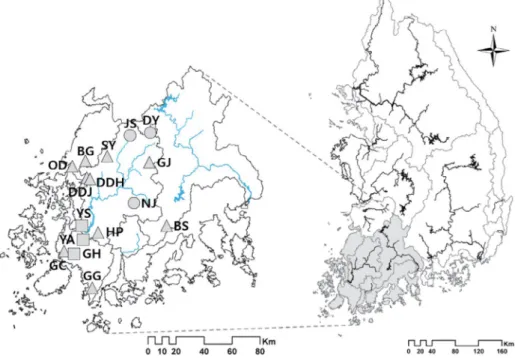
1. 조사대상 호소 및 현장조사 영산강·섬진강 수계에 위치한 16개 호소에서 어류조사 를 수행하였다(Fig. 1). 조사 지점으로 선정된 호소의 규모 는 수면적을 기준으로 0.5km2에서 88.8km2까지 다양하였 다. 호소 규모별 어류군집 비교 분석을 위해서 MOE/NIER (2017) 기준에 따라, 연구 대상 호소를 소형호(수면적 3 km2 미만; 개초제, 군곡제, 학파제, 대동제, 대동호, 불갑제, 수양제, 오동제, 보성강호, 광주호; Small Reservoir, SR), 중 형호(수면적 3km2 이상~30km2 미만; 나주호, 담양호, 장 성호; Medium Reservoir, MR), 대형호(수면적 30km2 이상; 영산호, 영암호, 금호호; Large Reservoir, LR)로 구분하였 다(Table 1). 호소의 어류군집을 파악하기 위해서 2018년(7개 호소) 과 2019년(9개 호소)에 홍수기 전(5~6월), 후(9~10월) 조 사를 실시하였다. 조사 방법은 환경부 “생물측정망 조사 및 평가 지침”의 호소 조사 방법에 따라, 규모별로 구분하 여(소형, 투망·족대 3개 지점, 자망 1개 지점; 중형, 투망· 족대 6개 지점, 자망 2개 지점; 대형, 투망·족대 8개 지점, 자망 3개 지점) 조사하였다(MOE/NIER, 2017). 투망(망 목, 7×7mm; 10회 이상 투척)과 족대(망목, 4×4mm; 30 분 이상 조사) 조사는 호소의 수변부에서 실시되었으며, 자 망(삼중망, 망목 40×40mm & 12×12mm, 12시간 이상 설치) 조사는 호소의 중앙부에서 선박을 활용하여 조사하 였다. 지점별 채집된 어류는 Kim and Kang(1993) 및 Kim and Park(2002)을 이용하여 동정하였으며, Nelson(2016) 의 분류체계를 따라 나열하였다. 2. 자료분석 호소의 어류군집 특성을 확인하기 위해 각 호소별 주요 요인(총 종수 및 개체수, 군집지수, 내성도 길드, 섭식 길 드, 고유종 종수 및 개체수, 외래종 종수 및 개체수)에 대한 분석을 실시하였다. 군집지수는 우점도(Simpson, 1949), 다양도(Shannon and Wiener, 1949), 균등도(Pielou, 1969) 및 풍부도(Margalef, 1958)를 산출하였다. 내성도 길드는 민감종, 중간종 및 내성종으로 구분하고, 섭식 길드는 초 식종, 충식종, 잡식종 및 육식종으로 구분하여, 각 길드에 포함되는 종의 개체수 비율을 산정하여 분석에 활용하였 다. 종별 내성도 길드와 섭식 길드의 구분은 MOE/NIER (2017)의 기준에 따라 이루어졌다. 호소의 규모에 따른 출현 종수의 변화 경향을 파악하 기 위해 조사 대상 호소의 수면적과 각 호소별 출현 종수 간 회귀분석을 실시하였다. MOE/NIER(2017) 기준에 따 라 구분된 호소의 규모(소형호, 중형호, 대형호)에 따른 어 류군집의 차이를 확인하기 위해서 어류군집의 주요 요인 에 대해서 Kruskal Wallis 분석을 실시하였다(SPSS 16, SPSS Inc., Chicago, IL, USA). 또한, SIMPER(similarity percentage) 분석을 통해서 호소 규모별 어류군집의 유사 도를 확인하였으며, 각 규모별 유사도에 기여하는 주요종 을 분석하였다(Primer 6, Primer-E Ltd. Plymouth, UK).영산강·섬진강 수계 호소의 어류군집 특성을 파악하기 위해서 NMDS(nonmetric multidimensional scaling) 분석 을 실시하여 호소별 군집 유사도를 확인하였다. NMDS 분 석은 similarity matrix의 지점들 간 최적의 관계를 나타낼 수 있는 two-dimensional ordination을 이용하였다(Field
et al., 1982). Similarity matrix는 호소별 채집된 개체수 를 square-root-transforming하고 각 pairwise assemblage 에 대한 Bray-Curtis similarity index를 산정하였다. Ordin-ation의 robustness는 stress value에 의해 표시되며, 범위 에 따라 <0.2(보통), <0.05(우수)로 해석된다(Clarke and Warwick, 1994). 또한 호소별 어류군집에 대한 cluster 분 석을 추가하여 유사한 군집을 가지고 있는 호소를 그룹화 하였다. NMDS와 cluster 분석은 모두 Primer 6(Primer-E Ltd. Plymouth, UK)를 이용하였다.
결 과
영산강·섬진강 수계 16개 호소에서 채집된 어종은 13 과 44종이다(Table 1). 치리(Hemiculter eigenmanni, relat-ive abundance, RA, 32.9 %)와 블루길(Lepomis macrochirus
RA: 31.4 %)이 우점종과 아우점종으로 확인되었으며, 6종 의 고유종(각시붕어 Rhodeus uyekii, 중고기
Sarcocheili-chthys nigripinnis morii, 긴몰개 Squalidus gracilis majimae, 참몰개 Squalidus chankaensis tsuchigae, 돌마자
Microphy-sogobio yaluensis, 얼록동사리 Odontobutis interrupta), 1종 의 법정보호종(백조어 Culter brevicauda, 멸종위기야생생 물II급), 3종의 외래종(떡붕어 Carassius cuvieri, 배스
Micr-opterus salmoides, 블루길 L. macrochirus) 서식이 확인되 었다. 영산강·섬진강 수계 호소의 내성도 길드 분석 결 과 내성종 개체수 비율이 82.7%로 높았으며, 민감종은 확 인되지 않았다. 섭식 길드 분석 결과, 잡식성종과 충식성 종의 개체수 비율이 각각 48.0%, 41.0%로 대부분을 차지 하였으며, 육식성종은 10.3%, 초식성종은 0.7%로 확인되 었다. 호소별 규모에 따른 어류군집 비교 분석에서 통계적으 로 유의한 차이(P<0.05)를 나타내는 항목은 총 6개 항 목(총 종수, 총 개체수, 풍부도, 초식성종 개체수 비율, 육 식성종 개체수 비율, 외래종 종수)이다(Table 2). 총 종수 (P=0.012)는 호소의 규모가 커질수록 증가하는 것으로 확인되었으며, 이는 호소의 수면적과 출현 종수의 상관관 계 분석에서도 동일한 경향을 확인할 수 있었다(Fig. 2). 총 개체수(P=0.029), 풍부도(P=0.010), 육식성종 개체 수 비율(P=0.031), 외래종수(P=0.018) 역시 호소의 규 모가 증가할수록 높게 나타났다. 초식성종의 개체수 비율 Table 2. Summary of fish assemblage characteristics of each reservoir size groups (average±standard deviation), and the result of Krus-kal-Wallis test.
Fish assemblage
Reservoir sizes
Total Kruskal-Wallis test (P value) Small Medium Large
Total No. species 11±2.9 14.3±2.1 22.7±0.6 14±5.3 0.012 No. individuals 851±299.1 1107.3±444.4 3144.3±189 1,382.6±960 0.029 Biodiversity indices Dominance 0.34±0.12 0.26±0.05 0.25±0.02 0.31±0.1 0.314 Diversity 1.45±0.36 1.7±0.13 1.93±0.06 1.58±0.36 0.058 Evenness 0.61±0.12 0.64±0.07 0.62±0.02 0.61±0.1 0.782 Richness 1.5±0.41 1.92±0.3 2.69±0.07 1.81±0.6 0.010 Tolerance guild (Individuals %) Sensitive species 0±0 0±0 0±0 0±0 1.000 Intermediate species 20.9±20.4 15.5±4.9 19±2.2 20.21±16.43 0.676 Tolerant species 79.1±20.4 84.5±4.9 81±2.2 79.79±16.43 0.676 Trophic guild (Individuals %) Herbivore species 0±0 0±0 1.5±1.5 0.31±0.84 0.001 Insectivore species 48.5±18.6 47.9±8.8 28.5±7.6 45.28±17.39 0.110 Omnivore species 48.3±20.4 48.5±8.5 51.3±4.4 47.83±16.21 0.980 Carnivore species 3.2±3.4 3.6±3.4 18.7±3.9 6.58±7.1 0.031
Endemic species No. species 0.6±0.7 1±0 1±1 0.8±0.7 0.481 No. individuals 11.2±19.7 35.3±6 6.3±8.5 15.8±19.1 0.074 Exotic species No. species 1.4±1 2.7±0.6 3±0 2±1.1 0.018 No. individuals 402.7±283.8 480±308.4 640.3±309.7 484.3±282.5 0.835
Fig. 2. Regression analysis of number of species by surface area of reservoirs. Number of species 25 20 15 10 5 0 0 20 40 60 80
Size of surface area of reservoirs(km2)
y=2.7118 In(x)+10.761 R2=0.772
(P=0.001) 차이는 대형호에서만 초식성종이 출현하여 나 타난 결과이다.
호소의 규모별 어류군집 유사도는 소형호 52.3%, 중형 호 69.1%, 대형호 79.7%로 확인되었다(Table 3). 호소 규
모별 유사도에 기여하는 주요종은 소형호에서 블루길(L.
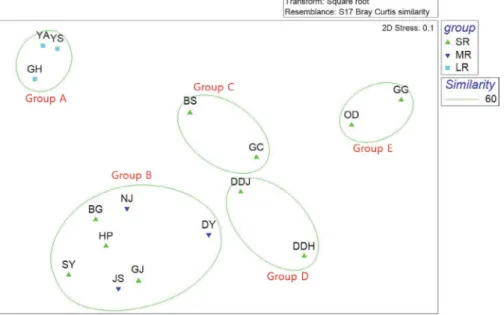
macrochirus, contribution %, 29.1%), 치리(H. eigenmanni, 18.5%) 등, 중형호에서 블루길(L. macrochirus, 26.0%), 치 리(H. eigenmanni, 24.1%) 등, 대형호에서 치리(H. eigenm anni, 23.8%), 블루길(L. macrochirus, 13.0%) 등으로 나타 났으며, 이에 따라 외래종인 블루길(L. macrochirus)이 영 산강·섬진강 수계 호소의 규모별 어류군집에 큰 영향을 미치고 있음을 확인하였다. 호소별 어류군집 유사도 분석 결과 16개 호소가 60% 유사도에서 5개 그룹으로 구분되었다(Fig. 3). 이는 지역 적으로 인근에 위치하여 유사한 어류군집을 가지는 그 룹(group A, group D), 동일 수계 내 위치하여 유사한 어 류군집을 가지는 그룹(group B), 호소의 발달 위치 및 환 경 유형이 유사한 그룹(group E)으로 구분되며, 일부 그룹 (group C)의 경우 수계, 환경 유형이 차이를 보여 정확한 원인을 추정하기 어렵다(Table 4, Fig. 4).
고 찰
영산강·섬진강 수계 16개 호소에서 채집된 종은 총 44 종으로 Chae et al.(2019)이 제시한 한반도 서식 담수어류 233종의 18.9%가 서식하고 있음을 확인하였다. 국내 어류 의 분포는 수계 특성을 반영하며, 이에 따라 수계별 서식 어종의 차이가 있다. Yoon et al.(2011, 2018)에 따르면, 영 산강·섬진강 수계 하천에 서식하는 어류는 모두 72종이 며, 이와 비교할 경우 동일 수계 하천에 서식하는 어류의 약 61%가 호소에서 서식하고 있음을 확인하였다. 다만, 영 산강·섬진강 수계 하천에 서식하는 어류 중 약 39%의 어 류가 호소에서 채집되지 않았는데, 이는 하천과 호소의 지 리적 특성과 수체 특성이 다르기 때문에(Hughes and Noss, 1992) 발생하는 어류군집의 차이로 판단된다. 본 연구에 서 16개 호소의 우점종은 치리(H. eigenmanni)와 블루길 (L. macrochirus) 등 정수 환경을 선호하는 종으로 나타났 다. 이는 Yoon et al.(2011)에서 제시한 동일 수계 하천의 우점종 피라미(Zacco platypus), 참갈겨니(Zacco koreanus) 와 다르게 나타났다. 이외에도 영산강·섬진강 수계의 하천 에서 총 23종의 고유종이 출현하여 고유종 비율이 31.9% 로 높게 나타났으나(Yoon et al., 2011), 본 연구 결과 호소 의 고유종 비율은 13.6%로 낮은 값을 나타냈다. 본 연구 에서 외래종은 떡붕어(C. cuvieri), 배스(M. salmoides), 블 루길(L. macrochirus)을 포함하는 3종이 출현하였으며, 이 는 Yoon et al.(2018)의 영산강·섬진강 하천 조사 결과에 서도 확인되었다. 다만, 수체의 환경이 다른 두 연구는 외 래종 출현 지점의 빈도에 있어서 차이를 보였으며, Yoon et al.(2018)의 하천 환경(떡붕어 C. cuvieri, 2.3%; 배스 M. Table 3. Fish assemblage similarity within the each reservoir size groups, and major contributing species by SIMPER analysis.Reservoir sizes Average similarity(%) Species Average abundance(%) Species contribution(%) Cumulative contribution(%) Small 52.3 Lepomis macrochirus 16.8 29.1 29.1 Hemiculter eigenmanni 11.6 18.5 47.6 Carassius auratus 8.3 16.4 64.1 Rhinogobius brunneus 4.5 7.8 71.8 Zacco platypus 5.8 7.2 79.0 Medium 69.1 Lepomis macrochirus 20.3 26.0 26.0 Hemiculter eigenmanni 17.6 24.1 50.1 Carassius auratus 9.6 11.8 61.9 Tridentiger brevispinis 7.8 8.6 70.4 Pseudogobio esocinus 5.7 7.5 77.9 Large 79.7 Hemiculter eigenmanni 37.0 23.8 23.8 Lepomis macrochirus 23.0 13.0 36.8 Culter brevicauda 14.1 8.9 45.7 Coilia nasus 16.1 8.9 54.6 Tridentiger brevispinis 14.0 7.4 62.0
salmoides, 25.4%; 블루길 L. macrochirus, 12.2%)과 비교하 여 본 연구의 호소 환경(떡붕어 C. cuvieri, 43.8%, 배스 M. salmoides, 62.5%, 블루길 L. macrochirus 87.5%)에서 외래 종 출현 지점의 비율이 더 높게 나타났다. 외래종의 유입은 자연 생태계에서 토착종의 개체 및 개체군 수준에서의 변 화를 유발하고 유전적 및 생태계 전반에 영향을 미치는 것 으로 연구되어 있다(Parker et al., 1999). 이러한 상황에서 출현 지점의 빈도 및 상대풍부도가 높게 나타나는 호소에 서 외래종과 고유종의 경쟁, 소형 어류 및 저서생물 포식 으로 인한 종 다양성 감소, 경제성 어종 감소와 같은 부정 적 영향이 더욱 크게 나타나고 있을 것으로 판단된다. 반 면, 현재까지 개발된 외래종 관리 방안(어구 포획, 인공 산 란장 설치, 산란장 파괴, 댐 수위 조작을 통한 수정란 제거) 에 대해서 뚜렷한 효과가 확인되지 않으며, 이러한 관리가 일부 대규모 호소에서만 이루어지고 있어서, 국내 호소에 전반적으로 발생하는 외래종 문제의 해결이 어려울 것으 로 판단된다. 다만, 아직까지도 일부 소형 호소에 대해서는 외래종이 출현하고 있지 않아서 이러한 호소에 대해서 외 래종의 유입을 선제적으로 막는 방법이 가장 효과적인 외 래종 관리 방법일 것으로 판단된다. 영산강·섬진강 수계 호소에서 내성종의 개체수 비율이 82.7%로 매우 높게 나 타났다. 내성종은 수질오염에도 불구하고, 종수 및 분포 범 위가 증가하는 어종으로(An and Lee, 2018), 물의 흐름이 정체되어 체류 시간이 증가하게 되어 오염이 강하게 나타 나는 호소의 특성을 반영하는 결과이다.
수체의 규모가 커질수록 채집될 수 있는 예상 종수와
개체수가 증가하는 것으로 많은 연구에서 보고하고 있다 (Eadie et al., 1986; Minns, 1989; Diana, 1995; Oberdoff et
al., 1995; MacArthur and Wilson, 2001). 영산강·섬진강 수 계 16개 호소 역시 수체의 규모가 커질수록 채집 종수 및 개체수가 증가하여 유사한 결과를 확인하였다. 소형호의 경우 평균 11종, 중형호는 평균 14종, 대형호는 평균 22종 의 어류가 서식하며, 이는 호소의 수면적을 활용한 회귀식 을(Fig. 2) 통해서 서식 어류의 종수을 대략적으로 예측할 수 있다. 반면, 본 연구는 환경부 “생물측정망 조사 및 평 가 지침”의 호소 조사 방법에 따라 조사가 이루어져 조사 방법이 투망, 족대, 자망으로 제한되어 있다. 모든 조사 도 구는 태생적으로 편향된 측면이 존재하며, 이에 따라 채집 되는 어류가 다르게 나타난다(Huse et al., 2000). 따라서, 동일지점에 대해서 어구의 다양성이 증가할 경우 채집되 는 어류의 다양성이 증가된다(Kim et al., 2020). 국내에서 어류 조사를 위해서 가장 많이 활용되는 어구는 투망, 족 대이며, 수심이 깊은 수환경에서 자망과 정치망이 선택적 으로 활용되고 있다. 국내 호소 조사는 인력, 조사 시간, 예 산에 대한 효율을 고려하여 정치망 조사가 포함되지 않고 있다. 정치망 조사는 시기적으로 우점종의 생물량 변이가 심하고, 어구 설치가 복잡하여 많은 시간과 노력이 요구되 며, 다양한 어종을 훼손 없이 안정적으로 채집 가능하다는 특징을 가지고 있다(Han and An, 2010). 이에 따라 정치망 조사가 추가될 경우 동일 호소 내 출현 종수 및 개체수가 현 방법의 결과와 비교하여 증가될 것으로 예상되며, 어류
군집 구조 역시 개체 비율(우점종, 내성도 길드, 섭식 길드
Fig. 3. Cluster analysis with 60% similarity line over NMDS analysis result(SR, small reservoir; MR, medium reservoir; LR, large reser-voir).
Table 4.
Information of each reserv
oir groups clustered by Cluster analysis
(60% similarity). NMDS Reservoir Infow stream Outflow route Group Name Abbreviation Surface area (km 2 ) Size categories Address W atershed Cartegories Name Upstream Sea A Yeongsan YS 88.8 Lar ge Samho-eup, Y eongam-gun, Jeollanam-do Yeongsan River National Stream Yeongsan River Sea Yeongam YA 61.8 Lar ge
Sani-myeon, Haenam-gun, Jeollanam-do Yeongsan River Local Stream Okcheon Stream Sea Guemho GH 32.8 Lar ge
Sani-myeon, Haenam-gun, Jeollanam-do Yeongsan River Local Stream Geumja Stream Sea B Hakpa HP 0.5 Small Seoho-myeon, Y eongam-gun, Jeollanam-do Yeongsan River Small Stream Non named Stream Yeongsan River Sea Bulgap BG 2 Small Bulgap-myeon, Y eonggwang-gun, Jeollanam-do Yeongsan River Local Stream Bulgap Stream Sea Suyang SY 1.7 Small
Samseo-myeon, Jangseong-gun, Jeollanam-do Yeongsan River Local Stream Samgye Stream Pyeongrim Stream Hwanglyong River Yeongsan River Sea Gwangju GJ 1.9 Small
Goseo-myeon, Damyang-gun, Jeollanam-do Yeongsan River Local Stream Jeungam Stream Yeongsan River Sea Naju NJ 7.8 Meddle
Dado-myeon, Naju-si, Jeollanam-do Yeongsan River Local Stream Bonghak Stream Daecho Stream Jiseok Stream Yeongsan River Sea Damyang DY 4.1 Meddle
Yong-myeon, Damyang-gun, Jeollanam-do Yeongsan River National Stream Yeongsan River Sea Jangseong JS 6.9 Meddle
Jangseong-eup, Jangseong-gun, Jeollanam-do Yeongsan River Local Stream Bugha Stream Hwanglyong River Yeongsan River Sea C Gaecho GC 0.6 Small
Hwawon-myeon, Haenam-gun, Jeollanam-do Yeongsan River Small Stream Non named Stream
Sea
Bosung
BS
1.8
Small
Gyeombaek-myeon, Boseong- gun, Jeollanam-do Seomjin Rvier National Stream Bosung River Seomjin Rvier Sea D Daedongje DDJ 1.1 Small
Daedong-myeon, Hampyeong- gun, Jeollanam-do Yeongsan River Local Stream Hampyeong Stream Yeongsan River Sea Daedongho DDH 1.2 Small
Daedong-myeon, Hampyeong- gun, Jeollanam-do Yeongsan River Local Stream Daedong Stream Hampyeong Stream Yeongsan River Sea E Gungok GG 0.6 Small
Songji-myeon, Haenam-gun, Jeollanam-do Yeongsan River Local Stream Songji Stream Sea Odong OD 0.6 Small Yeomsan-myeon, Y eonggwang-gun, Jeollanam-do Yeongsan River Local Stream Odong Stream Sea
등)과 관련된 항목에 있어서 일부 차이가 있을 것으로 판 단된다. 호소의 규모별 어류군집 유사도에 기여하는 주요 기여 종은 블루길(L. macrochirus)과 치리(H. eigenmanni)로 확 인되었다. 특히, 소형호와 중형호에서 외래종인 블루길(L. macro chirus)의 기여도가 높게 나타나, 국내 호소환경의 현 상태를 확인할 수 있었다. 블루길(L. macrochirus)은 환 경부고시 제 2019-185호에 의해 생태계교란야생생물로 지 정되어 있으며, 이미 많은 문헌에서 국내 호소환경에서 우 점적으로 서식함을 보고하였다(Byeon et al., 2008; Yoo et
al., 2008, 2009; Kim et al., 2011, 2013; Lee et al., 2014). 그동안 국내 외래종의 문제를 블루길(L. macrochirus) 보 다는 배스(M. salmoides)에 집중하여 연구를 진행하고, 관리 방안을 마련하는 노력을 진행하였으나, 실제로 호 소의 어류군집에 가장 큰 기여를 하는 종은 블루길(L. macrochirus)로 확인되었다. 따라서 향후 외래종에 대한 관리 전략 마련에 있어서는 배스(M. salmoides)와 함께 블 루길(L. mac rochirus)에 대한 연구가 동반되어야 할 것으 로 판단된다. 호소의 규모에 따른 차이를 보이는 어류군집 요인은 주 로 종수, 개체수와 관련된 항목(총 종수, 총 개체수, 풍부 도), 외래종과 관련된 항목(육식성종 개체수 비율, 외래종 수)으로 나타났다. 수체 규모에 따른 종수 및 개체수 증가 는 앞서 논의되었으며, 외래종의 경우 유입경로가 다양한 대형호에 보다 빨리 유입되며, 이에 따라 대형호의 외래종 수 및 개체수가 더 크게 나타난다. 반면, 호소별 어류군집 유사도는 호소의 규모보다는 지역적 거리, 기원 하천(수 계), 환경 특성 등의 영향을 받고 있는 것으로 확인되었다. 대형호로 구분되는 영암호, 금호호, 영산호가 79.7%의 군 집 유사도를 나타내어(Fig. 3 group A) 호소 규모에 따라 유사도가 높은 것으로 해석될 수 있으나, 실제로 본 3개 대 형호의 경우 영산강 하구 인근에 위치하고 있으며, 수로를 통해 서로 연결되어 있는 호소이다(Fig. 4 group A, Table
4). 또한, 대동호와 대동제 역시 두 호소 간 거리가 1km 이 내로 매우 인접하고 있다. 이처럼 두 그룹은 지역적으로 인근에 위치하여 어류군집의 유사도가 높게 나타나는 특 성을 가진다. 담양호, 나주호, 불갑제, 학파제, 수양제, 장성 호, 광주호는 지리적 위치가 차이가 있으며, 호소의 규모도 다양하다. 하지만, 불갑제를 제외한 대부분의 호소가 영산 강 본류에 유입되는 하천을 근원으로 하고 있으며(Fig. 4 Fig. 4. The location of 5 groups of reservoirs clustered with 60% similarity from cluster analysis.
group B, Table 4), 이러한 원인으로 어류군집 유사도가 높 게 나타남을 추측할 수 있다(Fig. 3 group B). 군곡제와 오 동제는 모두 바다로 직접 유입되는 소규모 하천에 건설된 호소로(Fig. 4 group E, Table 4) 그 규모(수면적 0.6km2)와 인근 환경이 유사하게 나타나며, 이에 따라 어류군집 유 사도가 높게 나타난다(Fig. 3. group E). 반면 보성강호와 개초제는 호소의 규모, 환경, 지역이 모두 차이가 있으나 (Fig. 4. group C, Table 4) 어류군집 유사도가 높게 나타나 고 있어(Fig. 3 group C), 뚜렷한 원인이 없이도 어류군집 유사도가 높게 나타나는 예외의 경우를 확인할 수 있다. 현재까지 국내 생물상 조사 및 관리에 대한 부분은 하 천을 중심으로 이루어지고 있으며, 하천의 생물상 조사 를 통해 종의 분포뿐만 아니라, 생물학적 건강성을 평가하 여 하천관리 정책에 활용하고 있다. 반면, 호소는 규모(국 내에 약 18,000여 개의 호소가 분포)에 비해 연구의 강도 가 매우 약하며, 실시되는 연구마저 단일 호소에 대한 생 물상 해석에 그치고 있는 실정이다. 본 연구는 MOE/NIER (2017)에서 제시되어 있는 조사방법을 활용하여, 투망, 족 대, 자망을 이용하여 영산강·섬진강 수계의 호소를 조사하 고 이를 바탕으로 호소의 어류군집을 분석하였다. 또한 정 량 조사 결과에 따른 호소 간 어류군집 비교뿐만 아니라, 호소의 규모에 따른 어류군집 구성 항목의 경향성을 파악 하고, 수계 내 포함되는 호소의 어류군집을 유사도에 따 라 그룹화하였다. 이러한 내용은 국내 호소의 어류군집 구 조 이해에 도움이 될 수 있으며, 특히 영산강·섬진강 수계 호소의 관리 및 정책 마련에 기초자료로 활용할 수 있을 것으로 판단된다. 추가로 국내 호소 조사가 2018년 이후 MOE/NIER(2017)의 조사방법에 따라 실시되고 있어, 타 수계 또는 전국적인 범위의 분석이 이루어질 경우 보다 대 표성 있는 결과를 제공할 수 있을 것이다. 이는 향후 호소 의 규모뿐만 아니라, 호소의 위치, 생산성, 오염원, 먹이원, 서식처 복합성 등과의 연관성을 분석할 수 있는 효과적인 자료로 이용될 수 있을 것이다.
적 요
본 연구는 영산강·섬진강 수계에 위치한 16개 호소에 대해서 어류군집을 조사하고 호소별, 호소 규모별 어류군 집 특성을 분석하였다. 조사 방법과 지점수는 환경부의 “생물측정망 조사 및 평가 지침”에 따라 이루어졌으며, 소 형호, 중형호, 대형호로 구분하여 어류군집을 비교 분석하 였다. 2018년(7개 호소)에서 2019년(9개 호소)에 이루어 진 조사에서 총 13과 44종의 어류가 채집되었으며, 우점종은 치리(Hemiculter eigenmanni, RA, 32.9%), 아우점종은 블루길(Lepomis macrochirus RA, 31.4%)로 나타났다. 호
소 규모에 따라 분석한 결과 소형호에서는 평균(±표준편 차) 11±2.9종이 채집되었으며, 중형호는 14.3±2.1종, 대 형호는 22.7±0.6종으로 호소의 규모가 커질수록 출현 종 수가 증가하는 양의 상관성을 나타냈다. 호소 규모별 어류 군집 요인은 총 6개 항목(총 종수, 총 개체수, 풍부도, 초식 성종 개체수 비율, 육식성종 개체수 비율, 외래종 종수)에 서 차이를 보였다(P<0.05). 호소별 어류군집 유사도 분석 결과 16개 호소가 60%의 유사도에서 5개 그룹으로 구분 되었으며, 군집 유사도는 호소의 규모보다는 호소 간 거리, 수계, 호소의 발달 위치 및 환경유형이 영향을 미치는 것 으로 나타났다. 본 연구는 국내 호소의 어류군집 구조 이 해에 도움이 될 수 있으며, 특히 영산강·섬진강 수계의 호 소 관리 및 정책 마련에 기초자료로 활용될 수 있을 것이 다. 저자정보 박상현(주식회사 에코리서치 선임연구원, 목포 대학교 해양수산자원학과 박사과정), 김정희(주식회사 에 코리서치 대표이사), 백승호(주식회사 에코리서치 선임연 구원, 충북대학교 환경공학과 박사과정), 최호승(주식회사 에코리서치 연구원, 공주대학교 생명과학과 석사과정), 김 대운(주식회사 에코리서치 연구원), 고의정(부산대학교 생 명과학과 박사과정), 김현우(순천대학교 환경교육과 교수) 저자기여도 개념설정: 김정희, 김현우, 조사 및 채집: 박상 현, 김정희, 백승호, 최호승, 김대운 자료분석: 박상현, 고의 정, 원고작성: 박상현 이해관계 본 연구에는 이해관계의 충돌 여지가 없습니다. 사사 본 연구는 영산강 섬진강 수계관리 위원회에서 시행 한 영산강 섬진강 수계 환경기초조사사업의 일환으로 수 행되었습니다.
REFERENCES
An, K.G. and J.H. Han. 2007. A development of multi-metric approach for ecological health assessments in lentic eco-system. Korean Journal of Limnological Society 40(1): 72-81.
An, K.G. and S.J. Lee. 2018. Ecological Health Assessments, Conservation and Management in Korea Using Fish Multi-Metric Model. Korean Journal of Ecology and En
vironment 51(1): 86-95.
fauna and community structure in lake Paldang and its inflows. Journal of Korean Society on Water Environment 24(2): 206-213.
Chae, B.S., H.B. Song and J.Y. Park. 2019. A field guide to the freshwater fishes of Korea. LG Evergreen Foundation, Seoul.
Choi, K.S, M.S. Han, D.W. Kang and M.H. Ko. 2020. Fish Community Characteristics in the Gyeongan Stream, a Tributary of the Han River Drainage System, Korea. Ko
rean Society of Environment and Ecology 34(2): 142-156.
Choi, S.S., H.B. Song and S.O. Hwang. 1997. Study on the fish community in the Daechong reservoir. Korean Journal of
Limnology 30(2): 155-166.
Chong, V.C., P.K.Y. Lee and C.M. Lau. 2010. Diversity, extinc-tion risk and conservaextinc-tion of Malaysian fishes. Journal of
Fish Biology 76(9): 2009-2066.
Clarke, K.R. and R.M. Warwick. 1994. Similarity-based testing for community pattern: the two-way layout with no repli-cation. Marine Biology 118(1): 167-176.
Daga, V.S., J.D. Olden, É.A. Gubiani, P.A. Piana, A.A. Padial and J.R. Vitule. 2019. Scale-dependent patterns of fish faunal homogenization in Neotropical reservoirs. Hydro
biologia 2019:1-14.
Diana, J.S. 1995. Biology and ecology of fishes. Biological sci-ences press, a division of Cooper publishing group. USA. pp. 390-391.
Eadie, J.M., T.A. Hurly, R.D. Montgomerie and K.L. Teather. 1986. Lakes and rivers as islands: species-area relation-ships in the fish faunas of Ontario. Environmental Biology
of Fishes 15(2): 81-89.
Field, J.G., K.R. Clarke and R.M. Warwick. 1982. A practical strategy for analysing multispecies distribution patterns.
Marine Ecology Progress Series 8: 37-52.
Godinho, F.N., M.T. Ferreira and M.I.P. Castro. 1998. Fish assemblage composition in relation to environmental gra-dients in Portuguese reservoirs. Aquatic Living Resources 11(5): 325-334.
Han, J.H. and K.G. An. 2010. Analysis of fish fauna by sam-pling gear as a preliminary survey for ecosystem health assessments in Jinyang Reservoir. Korean Journal of Iim
nology. 43(1): 103-116.
Hondzo, M. and H.G. Stefan. 1996. Dependence of water quality and fish habitat on lake morphometry and meteorology.
Journal of Water Resources Planning and Management
122(5): 364-373.
Hughes, R.M. and R.F. Noss. 1992. Biological diversity and bi-ological integrity: current concerns for lakes and streams.
Fisheries 17(3): 11-19.
Huse, I., S. Løkkeborg and A.V. Soldal. 2000. Relative selec-tivity in trawl, longline and gillnet fisheries for cod and haddock. ICES Journal of Marine Science 59: 1271-1282. Irz, P., A. Laurent, S. Messad, O. Pronier and C. Argillier. 2002.
Influence of site characteristics on fish community
pat-terns in French reservoirs. Ecology of Freshwater Fish 11(2): 123-136.
Jang, Y.S., K.Y. Lee, J.K. Choi, J.W. Seo and J.S. Choi. 2006. Sampling effects on fishing gears in the Hoengseong reservoir. Korean Journal of Limnological Society 39(2): 245-256.
Kim, C.H., W.O. Lee, J.K. Lee and K.E. Hong. 2005. The ich-thyofauna in Lake Cheongpyeong Korea. Korean Journal
of Ichthyology 17(2): 124-130.
Kim, H.M., J.H. Kil, E.H. Lee and K.G. An. 2013. Distribution Characteristics of Largemouth Bass(Micropterus sal
moides) as an Exotic Species, in Some Medium-to-Large
Size Korean Reservoirs and Physico-chemical Water Quality in the Habitats. Korean Journal of Ecology and
Environment 46(4): 541-550.
Kim, I.S. and E.J. Kang. 1993. Coloured fishes of Korea. Acad-emy Pub. Seoul.
Kim, I.S. and J.Y. Park. 2002. Freshwater fishes of Korea. Kyo Hak Sa, Seoul.
Kim, J.H., S.H. Park, S.H. Baek, M.H. Jang, H.J. Lee and J.D. Yoon. 2020. Does Different Performance of Sampling Gears(Cast Net versus Gill Net) Bring the Inappropriate Estimation of Freshwater Fish in a Large River?. Korean
Journal of Ecology and Environment 53(2): 156-164.
Kim, J.Y., G.J. Joo and Y. Do. 2018. Through 100 years of Eco-logical Society of America publications: development of ecological research topics and scientific collaborations.
Ecosphere 9(2): e02109.
Kim, S.K., Y.H. Kang, G.B. Hong, D.U. Yoo, H.Y. Suk, B.S. Chae, H.S. Kim and U.W. Hwang. 2011. Ichthyofauna and Community Structure from 21 Lakes in the Yeun-gnam Area including Gyeongsangbukdo and Gyeong-sangnam-do Provinces, Korea. Korean Journal of Ichthy
ology 23(4): 288-299.
Ko, D.G., J.H. Han and K.G. An. 2012. Length-Weight Rela-tions and condition factor(K) of Zacco platypus along trophic gradients in reservoir ecosystems. Korean Journal
of Limnological Society 45(2): 174-189.
Lee, E.H., K.H. Jang, D.I. Seo, J.Y. Choi, G.J. Joo, M. Kim, J.H. Shin, M.S. Son and G.S. Nam. 2014. The Characteristics of Fish Community and Food Web in Eutrophic Agricul-tural Reservoir, Jeondae. Korean Journal of Environmen
tal Biology 32(4): 319-326.
MacArthur, R.H. and E.O. Wilson. 2001. The theory of island biogeography(Vol. 1). Princeton university press. Margalef, D.R. 1958. Information theory in ecology. Interna
tional Journal of General Systems 3: 36-71
Matthews, W.J. 1998. Patterns in freshwater fish ecology, New York, NY: Chapman and Hall.
Minns, C.K. 1989. Factors affecting fish species richness in Ontario lakes. Transactions of the American Fisheries So
ciety 118(5): 533-545.
Konijnendijk. 2007. Ecosystem services and biodiversity in developing countries. Biodiversity and Conservation 16(10): 2729-2737.
MOE. 2001a. A study on the development of Korean reservoir environment research technique. Ministry of Environ-ment, Gwacheon.
MOE. 2001b. Survey manual of reservoir environment. Ministry of Environment, Gwacheon.
MOE. 2009. Revised survey manual of reservoir environment. Ministry of Environment, Gwacheon.
MOE/NIER. 2017. Biomonitoring survey and assessment man-ual. Ministry of Environment/National Institute of Envi-ronmental Research. Incheon.
Moyle, P.B. and J.J. Cech. 2000. Fishes: An introduction to ich-thyology. Prentice Hall. USA. 612pp.
Nelson, J.S. 2016. Fishes of the world. Wiley, New York. Oberdoff, T., J.F. Guégan and B. Hugueny. 1995. Global scale
patterns of fish species richness in rivers. Ecography 18(4): 345-352.
Park, S.H., J.W. Lee, J.H. Kim, S.H. Baek, J.D. Yoon, K.R. Choi and M.H. Jang. 2013. Fish Distribution and Salinity in the Saemangeum Reservoir. Korean Journal of Environmen
tal Biology 31(4): 411-418.
Parker, I.M., D. Simberloff, W.M. Lonsdale, K. Goodell, M. Wonham, P.M. Kareiva, M.H. Williamson, B. Von Holle, P.B. Moyle, J.E. Byers and L. Goldwasser. 1999. Impact: toward a framework for understanding the ecological ef-fects of invaders. Biological Invasions 1: 3-19.
Pielou, E.C. 1969. An introduction to mathematical ecology. An introduction to mathematical ecology.
Seong, C.N., K.S. Baik, J.H. Choi, H.W. Cho and J.H. Kim. 1997. Water quality and fish community in streamlets of Juam Reservoir. Korean Journal of Limnology 30(2): 107-118.
Shannon, C.E. and W. Wiener. 1949. The mathematical theory
of communication. University of Illinois press, Urbana. Simpson, E.H. 1949. Measurement of diversity. Nature 163
(4148): 688-688.
Son, Y.M., H.B. Song, H.K. Byeon and J.S. Choi. 1997. Study on the dynamics of fish community in the Lake Paldang.
Korean Journal of Ichthyology 9(1): 141-152.
Wilson, M.A. and S.R. Carpenter. 1999. Economic valuation of freshwater ecosystem services in the United States: 1971-1997. Ecological Applications 9(3): 772-783.
Yoo, D.G., G.S. Lee, G.Y. Kim, N.K. Kang, B.Y. Yi, Y.J. Kim, J.H. Chun and G.S. Kong. 2016. Seismic stratigraphy and depositional history of late Quaternary deposits in a tide-dominated setting: An example from the eastern Yel-low sea. Marine and Petroleum Geology 73: 212-227. Yoo, D.J., K.H. Han, S.H. Lee, H.S. Yim, J.H. Hwang, J.H. Lee
and K.W. Kang. 2008. Ichthyofauna collected from res-ervoirs in Pohang-si, Gyeongsangbuk-do. Journal of the
Korean Fisheries Society 41(5): 363-370.
Yoo, D.J., K.H. Han, H.S. Yim, W.I. Seo and S.H. Lee. 2009. Ichthyofauna from reservoirs in Gyeongju-si, Gyeong-sangbuk-do, Korea. Korean Journal of Ichthyology 21(1): 38-46.
Yoon, J.D., J.H. Kim, M.S. Byeon, H.J. Yang, J.Y. Park, J.H. Shim, H.B. Song, H. Yang and M.H. Jang. 2011. Distribu-tion patterns of fish communities with respect to environ-mental gradients in Korean streams. In Annales de Limnol
ogieInternational Journal of Limnology 47: 63-71.
Yoon, J.D., J.H. Kim, S.H. Park and M.H. Jang. 2018. The Dis-tribution and Diversity of Freshwater Fishes in Korean Peninsula. Korean Journal of Ecology and Environment 51(1): 71-85.
Yoon, J.D., M.H. Jang, M.C. Kim, G.S. Nam, S.J. Hwang and G.J. Joo. 2006. The characterization of fish communities in agricultural reservoirs. Korean Journal of Ecology and