Received: August 21, 2017 Revised: January 5, 2018 Accepted: March 22, 2018
OPEN ACCESS
HORTICULTURAL SCIENCE and TECHNOLOGY 36(4):542-551, 2018
URL: http://www.kjhst.org pISSN : 1226-8763 eISSN : 2465-8588
This is an Open Access article distributed under the terms of the Creative Commons Attribution Non-Commercial License which permits unrestricted non-commercial use, distribution, and reproduction in any medium, provided the original work is properly cited.
Copyrightⓒ2018 Korean Society for Horticultural Science.
This work was conducted during the research year of Chungbuk National University in 2017.
Comparison of Lettuce Growth under Continuous and Pulsed Irradiation Using Light-Emitting Diodes
Ki-Ho Son 1 , So-Ra Lee 2,3 , and Myung-Min Oh 2,3*
1
Department of Horticultural Science, Gyeongnam National University of Science and Technology, Jinju 52725, Korea
2
Division of Animal, Horticultural and Food Sciences, Chungbuk National University, Cheongju 28644, Korea
3
Brain Korea 21 Center for Bio-Resource Development, Chungbuk National University, Cheongju 28644, Korea
*Corresponding author: [email protected]
Abstract
We determined the effects of various frequencies of pulsed light-emitting diode (LED) irradiation on the growth characteristics of Lactuca sativa L. ‘Sunmang’. Seedlings were grown in a 20°C growth chamber with photosynthetic photon flux density (PPFD) of 253.67 µmol·m
-2·s
-1and a 12-h photoperiod for 18 days. The seedlings were then transplanted into pots containing a growing medium, followed by placement in growth chambers equipped with a combination of red (R), white (W), and blue (B) LEDs (R:W:B = 7:2:1) that provided pulsed irradiation at various frequencies (0.3, 1, 3, 10, and 30 kHz) at 75% duty ratio (PPFD 190 µmol·m
-2·s
-1). The control (continuous irradiation) was compared with the treatments 4 weeks after transplanting. Most growth parameters such as shoot fresh weight and leaf area under pulsed LEDs were similar to those of the control.
Treatments with lower frequencies (0.3, 1, and 3 kHz) were more effective for growth even though the light intensity was lower than that in the control. No significant difference was observed in the maximum quantum yield of PSII and photosynthetic rates between the treatments. Macronutrient (K, Ca, and Mg) levels were significantly higher under all treatments compared to the control. Light use efficiency was the highest under irradiation with 1 kHz pulsed LEDs. In conclusion, pulsed LEDs with 75% duty ratio and low frequencies did not show significant inhibition on plant growth, suggesting that pulsed LED irradiation technology has a potential to save energy consumption for producing crops in plant factories.
Additional key words: duty ratio, frequency, Lactuca sativa, light use efficiency, plant factory
Introduction
Light is a crucial factor in the life cycle of plants and its quality, quantity, and photoperiod affect
plant growth and development by influencing germination, phototropism, flowering, and photosynthesis
(Goto, 2003). Moreover, manipulation of light for cultivation is gaining importance with the recent
popularity of cultivation under controlled environments, such as plant factories, growth chambers,
and greenhouses. Lighting sources such as metal halide lamps, fluorescent lamps, and high pressure
sodium lamps have been used to determine the effects of light quality on production of commercial crops. However, these artificial light sources have disadvantages including a high cost, fixed quality, low photosynthetic active radiation, and low energy efficiency (Chang et al., 2012).
Recently, light-emitting diodes (LEDs) have increasingly been used to research the physiological responses of plants to light as well as for commercial production of horticultural crops. Initially, the major challenges for commercial plant cultivation using LEDs included its high cost and low lighting efficiency. However, recently rapid drop in LED prices have made them a competitive artificial lighting option. As of January 2017, the global average price of LEDs ranges from 7 to 8 dollars (LEDinside, 2017) and the LED photosynthetic photon flux density (PPFD) per watt has become superior to fluorescent lamps (Stutte, 2015). Moreover, LEDs have economic advantages including semi-permanent life span and a high energy conversion rate. Also, LEDs have functional advantages such as space use efficiency due to their small-size, and the possibility of adjusting the light spectrum by using different LED combinations (Yeh and Chung, 2009).
The use of LEDs also allows for the application of pulse irradiation to plants, with control of the frequencies and duty ratios of light (Loo et al., 2009). The pulse irradiation is generated by the pulse width modulation (PWM) method, which offers various frequencies and duties in lighting systems (Nozue et al., 2010). As the PWM using LEDs becomes increasingly advanced, reports suggest an effect on plant growth and development. For example, Tennessen et al. (1995) showed that the photosynthetic response to pulsed LED (light/dark, 198/2 ms) was better than that to continuous lighting in tomato plants. Moreover, fresh weight and photosynthetic activity of lettuce plants were increased by pulsed LEDs, suggesting that this could be an efficient lighting source for lettuce cultivation (Mori et al., 2002; Yoneda and Mori, 2004).
Senol et al. (2016) explored the effects of pulsed LED irradiation on the morphological and physiological response in greenhouse-cultivated carnations.
Pulsed LEDs of different wavelengths (red, blue, green, white) may significantly affect lettuce germination, hypocotyl length, fresh and dry weight, chlorophyll, and carotenoids. Pardo et al. (2016) reported that pulsed red light increased hypocotyl length and fresh weight, and pulsed blue light caused an accumulation of chlorophyll a, b, and carotenoids;
however, the results were not conclusive because the control (no-pulsed LED) wavelength used was only white.
Meanwhile, most of the earlier studies compared pulsed LEDs efficiencies with different duty ratios and continuous LEDs (control) under the same light intensity. In other words, the light quantum irradiated by continuous and pulsed LEDs was the same, which indicates that more electricity would be required in pulsed treatment than the control due to the characteristic of the pulse, i.e., intermittent irradiation. In horticulture, the ultimate goal of using pulsed LEDs is to save energy without growth inhibition rather than simply to explore the effect of pulsed irradiation on crop growth and development. Thus, this study aimed to determine the effects of pulsed irradiation using LEDs on lettuce growth and photosynthetic characteristics, and to explore the potential energy savings in lettuce cultivation. Our hypothesis was that pulsed irradiation using LEDs can induce similar growth as continuous irradiation by adjusting the frequency.
Materials and Methods
Plant Materials and Growing Conditions
Red leaf lettuce ( Lactuca sativa L. ‘Sunmang’) seeds were sown on a 105-plug tray containing horticultural growing
medium (Myung-Moon; Dongbu Hannong, Seoul, Korea), and placed in a growth chamber (DS-50CPH; Dasol
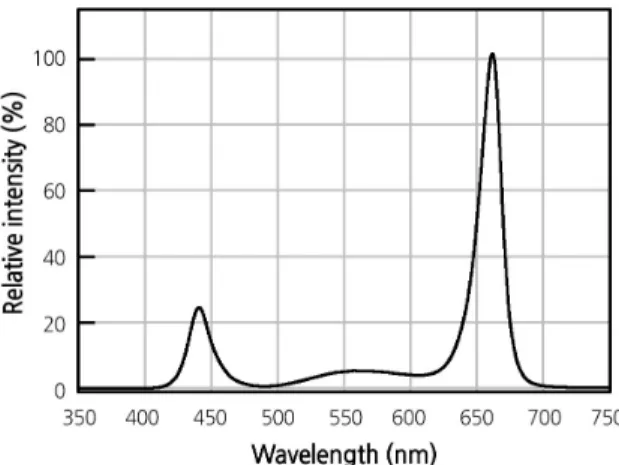
Scientific, Hwaseong, Korea). The environmental conditions were: 20°C air temperature, 60% relative humidity, and a 12 h (day 12h /night 12h) photoperiod. Lettuce seedlings were subjected to LED lighting which included a combination of red (R; 655 nm; Bright LED Electronics, Seoul, Korea), white [W; 456 nm (69%) + 558 nm (31%)], and blue (B; 456 nm) LED chips (Itswell, Incheon, Korea). The ratio of the R, W, and B LEDs based on the number of chips was 7:2:1 and the PPFD was approximately 246 µmol·m
-2·s
-1(Fig. 1) . Eighteen days after sowing, each lettuce seedling was transplanted into a pot (10.6 cm × 10.6 cm × 11.5 cm, L × W × H) containing the growing medium. For each treatment, 16 seedlings were placed in a tray (45 × 45 × 7 cm, L × W × H) and were treated with irradiation from pulsed LEDs for 4 weeks under the same growth conditions as described above. Pots, while in the tray, were sub-irrigated once a week in a nutrient solution (2 L) for lettuce (macro elements: NO
3-8.0, NH
4+2.0, H
2PO
4-2.0, K
+4.0, Ca
2+4.0, Mg
2+2.0, SO
42-2.0 me·L
-1, micro elements: Fe 3.0, B 0.3, Mn 1.5, Cu 0.08, Mo 0.02 mg·L
-1; with pH 5.5 and EC 1.16 dS·m
-1), and distilled water (2 L) was supplied at 2-3 day intervals.
Fig. 1. Relative spectral distribution for LEDs (R:W:B = 7:2:1) used in this study. Spectral scans were recorded at 25 cm from the lighting sources and at five points (center and four corners of each tray of pots) with a spectroradiometer.
Pulsed LEDs
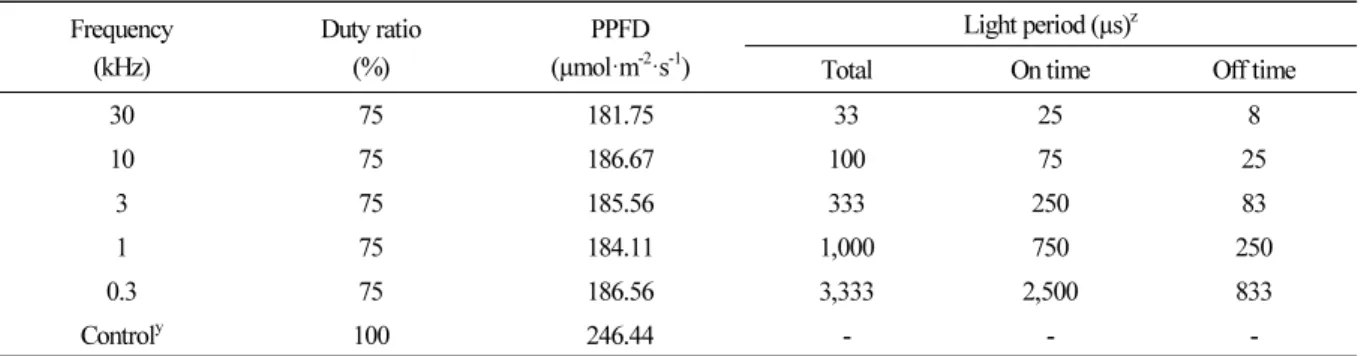
All LED lighting systems had a uniform ratio of R, W, and B as described above (i.e., R:W:B = 7:2:1). Pulsed irradiation of the LED lighting was applied using a PWM device (Biwon Tech, Cheonan, Korea) operated at different frequencies (0.3, 1, 3, 10, and 30 kHz) with 75% duty ratio (Table 1) . Frequency, duty ratio, and averaged PPFD are defined as:
Frequency = 1 / (T
L+ T
D) Duty ratio = T
L/ (T
L+ T
D)
Averaged PPFD = I
L× T
L/ (T
L+ T
D)
T
Land T
Dare the period time for light and dark, respectively, and I
Lis the PPFD in the light period. Continuous light was
used as a control. Each pot in the tray was systematically rearranged for even light distribution once a day.
Table 1. Photosynthetic photon flux density (PPFD) and light period of pulsed LED treatments Frequency
(kHz)
Duty ratio (%)
PPFD (µmol·m
-2·s
-1)
Light period (µs)
zTotal On time Off time
30 75 181.75 33 25 8
10 75 186.67 100 75 25
3 75 185.56 333 250 83
1 75 184.11 1,000 750 250
0.3 75 186.56 3,333 2,500 833
Control
y100 246.44 - - -
z
On/off time of lighting generated by LEDs (R:W:B = 7:2:1) within one second.
y
Continuous lighting.
Growth Characteristics
After 4 weeks of treatment, the shoot and the root weight (fresh and dried), leaf area, specific leaf weight (SLW), and chlorophyll content (SPAD) were measured. The fresh biomass was measured with an electronic scale (Si-234; Denver Instrument, NY, USA) and subsequently the shoots and roots were separately dried at 70°C in an oven (VS-120203;
Vision Scientific, Daejeon, Korea) for 3 d before measuring their dry weight. The leaf area and chlorophyll content were measured using a leaf area meter (LI-3000A; LI-COR, Lincoln, NE, USA) and a portable chlorophyll meter (SPAD-502;
Minolta, Osaka, Japan), respectively. SLW was calculated by dividing the shoot dry weight by the leaf area.
Photosynthetic Characteristics
From chlorophyll fluorescence emission, maximum fluorescence (F
m) and minimum fluorescence (F
o) were measured to determine the maximum quantum efficiency of photosystem II (PS II) of lettuce plants grown under different of pulsed LEDs frequencies. The maximum quantum efficiency of PSII (F
v/F
m, where F
vis the variable fluorescence) was calculated by the equation: F
v/F
m= (F
m-F
o)/F
m. Measurements of maximum quantum efficiency of PSII were recorded at 4 weeks after the onset of LED treatment using a chlorophyll fluorescence meter (PAM 2000; Walz, Effeltrich, Germany). For the 30-min dark adapted plants, the third fully expanded leaf from the top was taken to obtain F
v/F
m. Saturating light pulse (20 kHz) was applied at 1100 µmol·m
-2·s
-1for 0.8 s.
The net photosynthetic rate (Pn) was determined at 4 weeks after LED treatment. For this, the third fully expanded leaf from the top was measured using a portable photosynthesis system (LI-6400; LI-COR, Lincoln, NE, USA). The measurements were recorded from 10 a.m. to 1 p.m., and the leaf cuvette was maintained at 350 µmol·s
-1of flow rate, 400 µmol·mol
-1of CO
2level, 400 µmol·m
-2·s
-1of PPFD, at 20°C.
Mineral Contents
Mineral content was analyzed following a slightly modified wet digestion method as suggested by Havlin and
Soltanpour (1980). In brief, following the method described by Lee et al. (2015), approximately 0.1 g dried lettuce shoot
was analyzed with an ICP-OES spectrophotometer (Optima 7300 DV, Perkin Elmer, Waltham, MA, USA) for P, K, Ca,
Mg, S, Fe, Mn, Zn, and Cu. The macro and micro minerals contents were represented as milligrams (mg) and micrograms
( µ g) per g of dry weight, respectively.
Efficiency of Pulsed LEDs
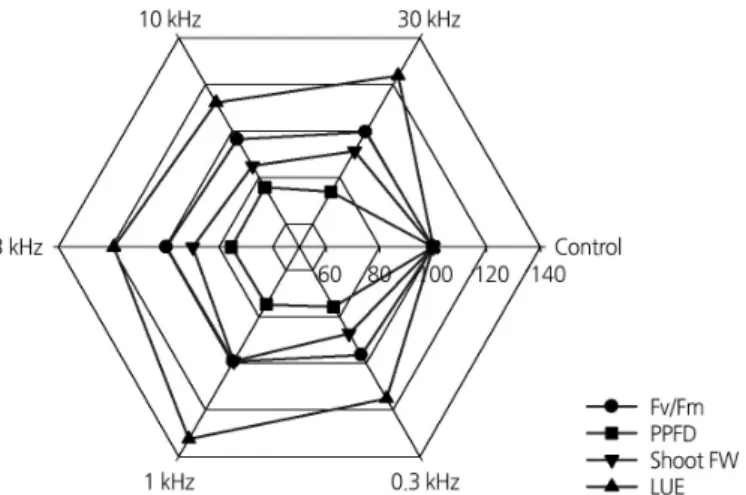
The light use efficiency (LUE) of the pulsed treatments, as compared to the control, was calculated by dividing the shoot fresh weight by the PPFD (g FW·PPFD
-1) after 4 weeks of treatment. The relative parameter level for each was expressed as a percentage of the control value.
Experimental Design and Statistical Analysis
The experiment was replicated twice for all treatments using a completely randomized design. Before the transplanting, 16 lettuce seedlings per treatment were randomized into 6 light treatments. All parameters were measured using 4 plants at 2 and 4 weeks. One-way analysis of variance (ANOVA) was performed using a statistical analysis software (SAS 9.2;
SAS Institute, Cary, NC, USA) with the GLM procedure. Mean difference comparison among different treatments was performed using Duncan’s multiple-range test at different levels.
Results and Discussion Pulsed Treatments
Duty ratio (percentage of on time from one light cycle) had a direct effect on the light intensity (PPFD) regardless of frequency (Table 1) . Lowering the duty ratio to 75% resulted in a light intensity reduction of 24-26%. Further, the frequency changed the lighting duration: as the frequency decreased, the duration of light-on and light-off periods within 1 s increased.
The R:W:B of 7:2:1, which was used in this study, was the most efficient ratio in terms of biomass accumulation as well as energy use efficiency in lettuce plants (Son et al., 2016; Fig. 1 ). In addition, the pulsed LED treatment saved electric energy, although PPFD for pulsed LEDs was relatively lower than that of the control as expected. According to Shimada and Taniguchi (2011), simultaneous pulsed irradiation with red and blue LEDs was more effective for improved growth and development than alternative pulsed irradiation with red and blue LEDs. Since the pulsed LED light quality also affects plant growth and development (Pardo et al., 2016), the same LED ratio was used to compare the lettuce growth as well as energy use efficiency between the pulsed treatments and control in this study.
Growth Characteristics
Growth of lettuce cultivated under pulsed irradiation for 4 weeks was influenced by the pulsed LED frequency (Table
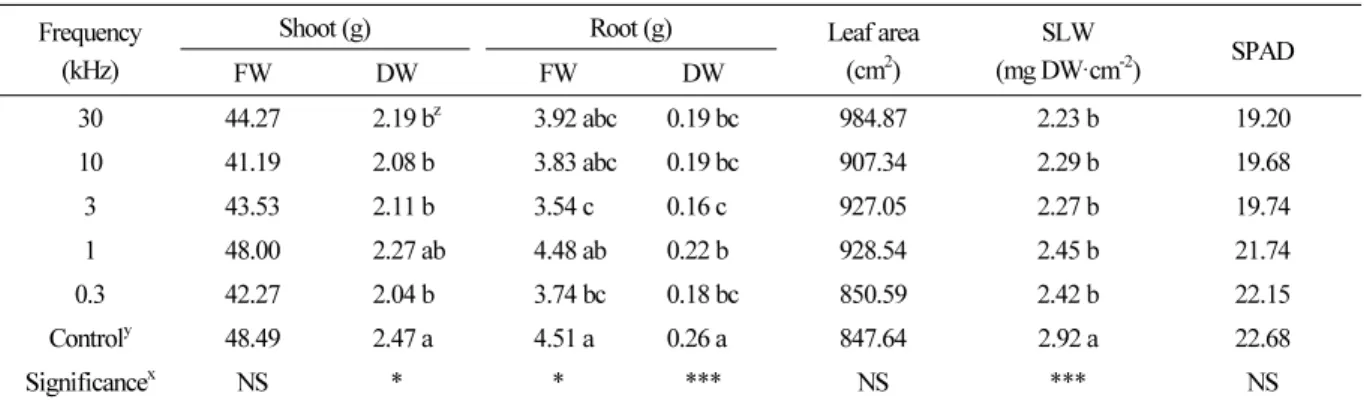
2) . Growth parameters, such as shoot dry weight, fresh and dry weight of roots, and SLW, showed higher values in the
control (continuous light). However, the shoot fresh weight was unaffected by pulsed treatments. Notably, at a frequency
of 1 kHz, plants showed no significant differences in shoot and root growth, except for root dry weights. Moreover, leaf
area in all pulsed LED treatments showed an increase compared with the control. SLW, indicating leaf thickness, was
highest in the control. The chlorophyll contents (SPAD value) showed no significant difference between the pulsed LED
treatments and the control. Among the pulsed LED treatments, 1 kHz resulted in the highest shoot and root biomass and higher SLW.
Son et al. (2016) found that lettuce growth under pulsed LEDs with a 75% duty ratio was better than with a 50% duty ratio, which was directly influenced by PPFD. However, they observed significantly lower growth under pulsed LEDs with a 75% duty ratio than under the continuous light, except for 1 kHz. Meanwhile, lettuce growth in this study showed no significant difference between the pulsed LEDs and the continuous LEDs. This discordance might be explained by the difference in PPFD. The pulsed LED with 75% duty ratio generated about 133 µmol·m
-2·s
-1in the earlier study (Son et al., 2016) compared to 185 µmol·m
-2·s
-1in this study. This implies that the pulsed treatment with a lower PPFD might have a lower light intensity, thus a lower amount of light energy, negatively affecting plant growth. Further experiments should be performed to explore this hypothesis. Cho et al. (2013) also suggested that the PPFD level ( ≥100 µmol·m
-2·s
-1) in pulsed LEDs is a crucial factor affecting plant growth and LUE. In previous studies, there was a positive effect from the particular frequency range generated by LEDs. The production of wheat subjected to pulsed treatment with 1 kHz was the same as wheat production subjected to continuous light (Dong et al., 2015). In addition, potato seedlings grown under 180 and 720 Hz induced greater growth than those under continuous lighting (Jao and Fang, 2004). Given these results, pulsed irradiation frequencies, combined with a certain level of PPFD, might be able to produce similar or greater yield than continuous light. The chlorophyll content; i.e., the SPAD value, typically stays concordant with changes in PPFD (Smith, 1936). However, none of the pulsed LEDs caused a significant decrease in the SPAD value despite the reduction of PPFD.
Dong et al. (2015) found that pulsed LEDs with a millisecond-scale period did not suppress chlorophyll biosynthesis in wheat leaves during vegetative growth.
Photosynthetic Characteristics
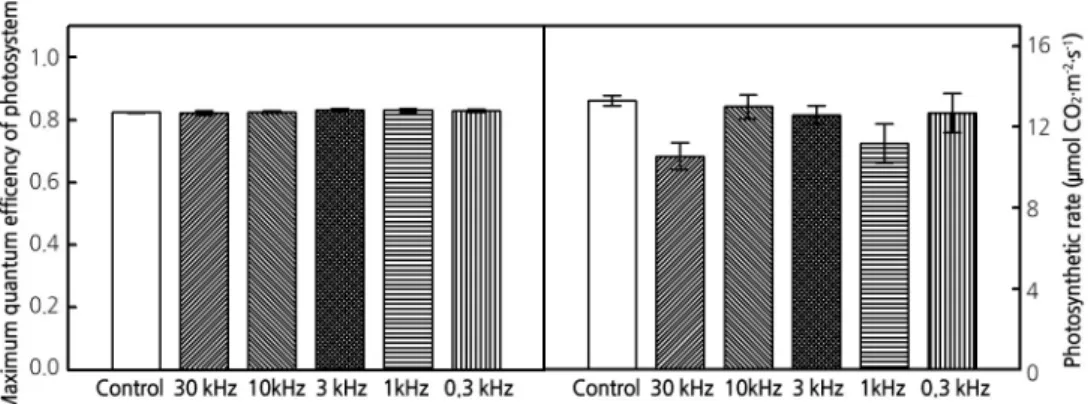
Pulsed LED treatments influenced the photosynthetic apparatus in lettuce plants (Fig. 2) . F
v/F
mratio showed no significant difference between the control and the pulsed LED treatments regardless of frequency (Fig. 2A) , as did Pn (Fig.
Table 2. Lettuce plant growth parameters under pulsed LEDs after 4 weeks of LED treatment (n = 4). The parameters: fresh weight (FW) and dry weight (DW) of shoots and roots, leaf area, specific leaf weight (SLW), and chlorophyll content (SPAD)
Frequency (kHz)
Shoot (g) Root (g) Leaf area
(cm
2)
SLW
(mg DW·cm
-2) SPAD
FW DW FW DW
30 44.27 2.19 b
z3.92 abc 0.19 bc 984.87 2.23 b 19.20
10 41.19 2.08 b 3.83 abc 0.19 bc 907.34 2.29 b 19.68
3 43.53 2.11 b 3.54 c 0.16 c 927.05 2.27 b 19.74
1 48.00 2.27 ab 4.48 ab 0.22 b 928.54 2.45 b 21.74
0.3 42.27 2.04 b 3.74 bc 0.18 bc 850.59 2.42 b 22.15
Control
y48.49 2.47 a 4.51 a 0.26 a 847.64 2.92 a 22.68
Significance
xNS * * *** NS *** NS
z
Different letters within columns indicate significant differences by Duncan’s multiple range test.
y
Continuous irradiation of combined with red (R; 655 nm), white (W; 456 nm + 558 nm), and blue (B; 456 nm) LEDs [R:W:B = 7:2:1 (based on the number of LED chip)].
x
Significance at p < 0.05 (*), p < 0.001 (***) level, or not-significant (NS).
2B) . In photosystem II, F
v/F
mreflects the potential quantum efficiency and is an indicator of plant photosynthetic performance. Normal or optimal value for F
v/F
mis typically around 0.83 (Maxwell and Johnson, 2000). The current study showed that all the pulsed LED treatments, as well as the control, had similar F
v/F
mvalues (0.822-0.831), indicating that the function of photosynthetic machinery was normal under intermittent light conditions. The positive effect was found in the results by Olvera-Gonzalez et al. (2013) where they obtained a better quantum efficiency of photosystem II ( ΦPSII) under pulsed LEDs (50% ratio with 0.1, 1, 100, or 1,000 Hz) than those under continuous light in tomato plants. In addition, Dong et al. (2015) found that the ΦPSII and photosynthetic electron transport (ETR) for wheat plants subjected to intermittent irradiation with 70% and 80% duty ratios were significantly higher than that of continuous light.
Typically, Pn is positively correlated with the PPFD (Emerson and Arnold, 1932), which was positively associated with duty ratio in this study. Hashimoto et al. (1988) observed no decrease in Pn when the pulsed irradiation PPFD was the same as continuous light. In this study, however, Pn of all the pulsed LEDs showed no significant decrease, despite the reduction of PPFD as compared to continuous light, regardless of frequency. This result is consistent with our previous study (Son et al., 2016). Jishi et al. (2011), which also observed that the pulsed LEDs (at 75% duty ratio) with 0.1, 0.2, 0.4, 0.8, 1.6, 3.2, 6.4, and 12.8 kHz frequencies did not cause a significant decrease in Pn compared to continuous light in romaine lettuce. This phenomenon may be explained by the electron transport system where there is some time gap for transporting the light energy between one and the next electron receptor. Thus, pulsed irradiation might improve the light use efficiency for photosynthesis compared to continuous irradiation (Jishi et al., 2015). These results suggest the possibility of normal photochemistry and photosynthesis in plants exposed to pulsed irradiation.
Mineral Contents
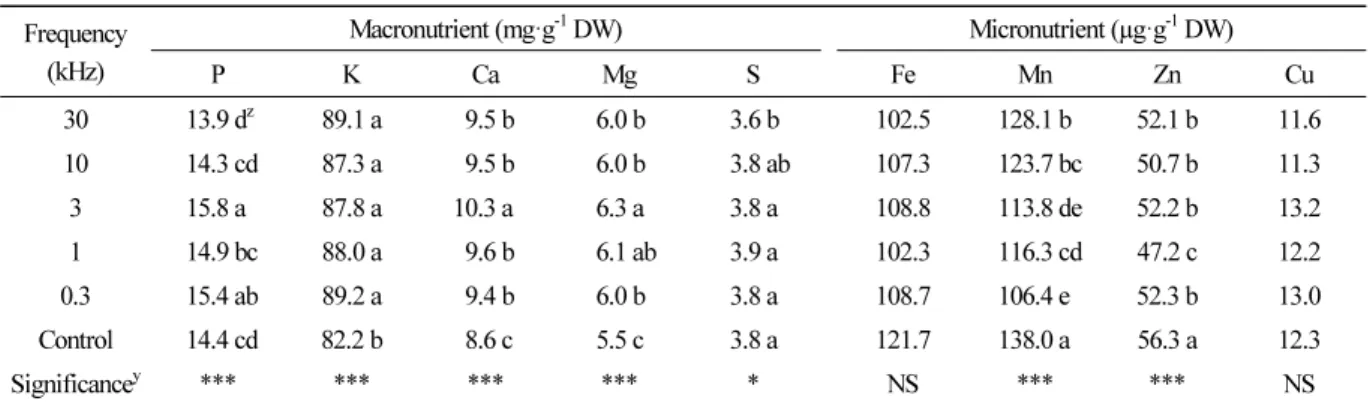
Lettuce leaf mineral contents showed significant differences from the pulsed LED treatments (Table 3) . The contents of K, Ca, and Mg macronutrients were significantly higher in all pulsed LED treatments than the control. Specifically, the 3 kHz treatment showed the highest macronutrient content. Among micronutrients, Fe and Cu were not significantly different, but Mn and Zn in the control were higher than the pulsed LED treatments.
Fig. 2. Maximum quantum efficiency of photosystem II (A) and photosynthetic rate (B) of lettuce plants grown under
various pulsed LEDs for 4 weeks.
Table 3. Mineral content of lettuce leaves grown under pulsed LEDs for 4 weeks (n = 4) Frequency
(kHz)
Macronutrient (mg·g
-1DW) Micronutrient (µg·g
-1DW)
P K Ca Mg S Fe Mn Zn Cu
30 13.9 d
z89.1 a 9.5 b 6.0 b 3.6 b 102.5 128.1 b 52.1 b 11.6
10 14.3 cd 87.3 a 9.5 b 6.0 b 3.8 ab 107.3 123.7 bc 50.7 b 11.3
3 15.8 a 87.8 a 10.3 a 6.3 a 3.8 a 108.8 113.8 de 52.2 b 13.2
1 14.9 bc 88.0 a 9.6 b 6.1 ab 3.9 a 102.3 116.3 cd 47.2 c 12.2
0.3 15.4 ab 89.2 a 9.4 b 6.0 b 3.8 a 108.7 106.4 e 52.3 b 13.0
Control 14.4 cd 82.2 b 8.6 c 5.5 c 3.8 a 121.7 138.0 a 56.3 a 12.3
Significance
y*** *** *** *** * NS *** *** NS
DW: Dry weight.
z
Different letters within columns indicate significant differences by Duncan’s multiple range test.
y