Vol. 10, No. 2, p. 123−129, June 2006
Constitutive equations for saturated hydraulic properties of deforming porous geologic media with compressible solid constituents
ABSTRACT: A series of constitutive equations is presented to evaluate the changes in the saturated hydraulic properties (i.e., porosity and saturated hydraulic conductivity) which result from the mechanical deformation of porous geologic media. The con- stitutive equation for the deformation-dependent porosity is derived from the relationship between the porosity and the volu- metric strain considering both solid skeleton and solid constituent (solid grain) to be compressible while the latter is less compress- ible. The constitutive equation for the deformation-dependent sat- urated hydraulic conductivity is then obtained by substituting the constitutive equation for the deformation-dependent porosity into the Kozeny-Carman equation assuming that the mechanical deformation of porous geologic media does not alter the shape of the pores since the individual solid grains are relatively incom- pressible compared with the solid skeleton.
Key words: porous geologic media, compressible solid skeleton, less compressible solid constituents, saturated hydraulic properties, defor- mation dependence, constitutive equations
1. INTRODUCTION
Since the pioneering work of Biot (1941), a generalized poroelasticity theory describing groundwater flow and solid skeleton deformation in a variably saturated porous geo- logic medium may be formulated by fully (i.e., explicitly and implicitly) coupling the groundwater flow field and the solid skeleton deformation field as a system. The explicit coupling between these two fields takes place by the hydro- mechanical interaction between the pore water pressure (pressure head) and the effective stress (solid displacement) making the system behave linearly. This explicit coupling can be achieved by combining and simultaneously solving the poroelastic governing equations for groundwater flow and solid skeleton (i.e., land) deformation in a variably sat- urated porous geologic medium. The poroelastic governing equations for groundwater flow and solid skeleton defor- mation in variably saturated porous geologic media have been formulated by many scientists (Verruijt, 1969; Safai and Pinder, 1979; Bear and Corapcioglu, 1981; Noorishad et al., 1982; Kim, 1996; Kim and Parizek, 1997; Kim et al., 1997; Kim and Parizek, 1999a; Kim and Parizek, 1999b;
Kim, 2000; Kim, 2004; Kim, 2005; Kim and Parizek, 2005). On the other hand, the implicit coupling between the
two fields occurs in two ways making the system behave nonlinearly. The first implicit coupling is caused by the changes in the degree of water saturation and the relative hydraulic conductivity due to unsaturated water flow (Ver- ruijt, 1969; Safai and Pinder, 1979; Bear and Corapcioglu, 1981; Noorishad et al., 1982; Kim, 1996; Kim and Parizek, 1997; Kim et al., 1997; Kim and Parizek, 1999a; Kim and Parizek, 1999b; Kim, 2000; Kim, 2004; Kim, 2005; Kim and Parizek, 2005). Such changes in the unsaturated hydraulic properties then give rise to the change in the degree of coupling between the fields and the change in the body force acting on the system. The second implicit cou- pling is caused by the changes in the porosity and the sat- urated hydraulic conductivity due to solid skeleton deformation.
Several experimental studies (Hughes and Cooke, 1953;
Knutson and Bohor, 1963; Zoback and Byerlee, 1976; Zim- merman et al., 1986) strongly suggest such deformation dependence of the saturated hydraulic properties of porous sediments and rocks. Such changes in the saturated hydrau- lic properties then produce hydraulic heterogeneity and anisotropy within the geologic medium even when it is fully saturated with water. These two implicit couplings can be accomplished by implementing appropriate constitutive mathematical equations for the changes in the unsaturated hydraulic properties (i.e., degree of water saturation and rel- ative hydraulic conductivity) by unsaturated water flow (Brooks and Corey, 1964; Van Genuchten, 1980) and the changes in the saturated hydraulic properties (i.e., porosity and saturated hydraulic conductivity tensor) by solid skel- eton deformation (Gangi, 1978; Bai and Elsworth, 1994;
Kim and Parizek, 1999b) into the poroelastic governing equations, which then become nonlinear. However, the con- stitutive equations for the deformation-dependent porosity and saturated hydraulic conductivity proposed by Kim and Parizek (1999b) assume that the solid skeleton is compress- ible, but its solid constituent is completely incompressible.
The compressibility of the solid constituent is relatively insignificant and thus can be ignored for most soils. How- ever, it is important for most rocks because it is comparable to the compressibility of the solid skeleton. Gangi (1978) and Bai and Elsworth (1994) also proposed constitutive equations to determine the change in the permeability with effective stress based on the size changes of the individual Jun-Mo Kim* School of Earth and Environmental Sciences, Seoul National University, Seoul 151-742, Republic of Korea
*Corresponding author: [email protected]
solid grains. However, they considered only less compress- ible solid grains and disregarded more compressible solid skeleton. Using their constitutive equations also requires additional parameters, which are not easy to measure.
Thus more general and simple constitutive equations, which can consider both solid skeleton and solid constit- uent to be compressible and do not require any additional parameters, for the deformation-dependent saturated hydraulic properties are highly desirable in order to more precisely and practically analyze fully coupled ground- water flow and solid skeleton deformation in actual geo- logic systems due to various causes (e.g., pumping, loading, mining, and tunneling).
The objective of this paper is to formulate a set of con- stitutive equations for the deformation-dependent porosity and saturated hydraulic conductivity of porous geologic media with compressible solid constituents. Although such constitu- tive equations are not applicable to all hydrogeological and geomechanical phenomena, they can find useful applications in many problems associated with fully coupled groundwater flow and solid skeleton deformation.
2. DEFORMATION DEPENDENCE OF SATURATED HYDRAULIC PROPERTIES
The change in the porosity n=Vp/Vt of a porous geologic medium or solid skeleton (soil or rock) due to its mechan- ical deformation can be expressed as follows:
(1)
where Vt is the volume of the solid skeleton (i.e., total vol- ume), Vp is the volume of the pores (i.e., pore volume), and
Vs is the volume of the solid constituent or solid grains (i.e., solid volume). Here dVp=dVt−dVs and Vs/Vt=(Vt−Vp)/Vt=1−n since the total volume Vt is the sum of the pore volume Vp and the solid volume Vs, i.e., Vt=Vp+Vs.
As mentioned in the introduction section, the compress- ibility of the solid constituent βs is relatively insignificant and thus can be ignored for most soils, i.e., β>>βs and
dVs 0. However, it is important for most rocks because it is comparable to the compressibility of the solid skeleton β, i.e., β≥βs and . Thus the compressibility of the solid constituents βs is included as well as the compressibility of the solid skeleton β in the following formulation of consti- tutive equations for the saturated hydraulic properties of a deforming porous geologic medium for their generalization.
The compressibility of the solid constituent βs can be defined as follows (Biot, 1941; Palciauskas and Domenico,
1989):
(2)
where Ks is the bulk modulus of the solid constituent, σ's= ( + + )/3 is the mean confining effective solid stress, = + + is the volumetric solid strain or solid volume dilation (positive for tension), λs=Esνs/[(1+νs)(1−
2νs)], Gs=µs=Es/[2(1+νs)] is the shear modulus (modulus of rigidity) of the solid constituent, Es is Young’s modulus (modulus of elasticity) of the solid constituent, νs is Pois- son’s ratio of the solid constituent, and σ'=( + + )/
3=(1−n)σ's is the mean confining effective stress. Here is the effective solid stress tensor (positive for tension), εijsis the solid strain tensor (positive for tension), and is the effective stress tensor (positive for tension) for i, j=x, y, z. In addition, the pair of λs and µs are often referred to as Lamé’s constants of the solid constituent (Love, 1944). The compressibility of the solid skeleton β can also be defined as follows (Biot, 1941; Palciauskas and Domenico, 1989):
(3) where K is the bulk modulus of the solid skeleton, εv=
εxx+εyy+εzz is the volumetric strain or volume dilation of the solid skeleton (positive for tension), λ=Eν/[(1+ν)(1−2ν)],
G=µ=E/[2(1+ν)] is the shear modulus (modulus of rigidity) of the solid skeleton, E is Young’s modulus (modulus of elasticity) of the solid skeleton, and ν is Poisson’s ratio of the solid skeleton. Here the pair of λ and µ are often referred to as Lamé’s constants of the solid skeleton (Love, 1944).
Equation (1) can then be expressed using equations (2) and (3) as follows:
(4)
where αc=1−βs/β=1−K/Ks is Biot’s hydromechanical cou- pling coefficient or the effective stress coefficient (0≤αc≤1), which determines the degree of coupling between the groundwater flow and solid skeleton deformation fields, in the effective stress concept (Biot, 1941; Nur and Byerlee, 1971; Carroll, 1979; Thompson and Willis, 1991; Cheng, 1997; Kim, 2004). As mentioned above, the compressibility of the solid skeleton β is always greater than or equal to the compressibility of the solid constituents βs (i.e., β≥βs). Thus Biot’s hydromechanical coupling coefficient αc approaches
dn d Vp Vt
---
⎝ ⎠⎛ ⎞ VtdVp–VpdVt
Vt2
--- dVVp ---t ndVt
Vt
--- –
= = =
1–n
( )dVt Vt
--- 1( –n)dVVs ---s
–
=
≈
dVs≠0
βs 1
Ks
--- σ′---εvss 3 3λs+2Gs
--- 3 1 2( – νs) Es
---
= = = =
V1s
---dVs
dσ′s
--- 1–n
Vs
---dVdσ′---s
=
=
σxx′s σyy′s σ′zzs
εvs εxxs εyys εzzs
σxx′ σyy′ σzz′ σij′s σij′
β 1
K---- σ′---εv 3 3λ+2G
--- 3 1 2( – ν) ---E =1
Vt
----dσ′---dVt
= = = =
dn = (1–n)βdσ′ β– sdσ′ = ⎝⎛1–n–β----βs⎠⎞βdσ′
αn–n ( )βdσ′
=
to its upper limit unity (i.e., αc=1) when the compressibility of the solid skeleton β is much greater than the compress- ibility of the solid constituents βs (i.e., β>>βs). On the other hand, it approaches to its lower limit zero (i.e., αc=0) when the compressibility of the solid skeleton β is equal to the compressibility of the solid constituents βs (i.e., β=βs). As a result, Biot’s hydromechanical coupling coefficient αc is almost unity for most soils, but it decreases from unity to zero for most rocks as their rigidity increases (Palciauskas and Domenico, 1989; Domenico and Schwartz, 1990).
Equation (4) is an equation for the confining effective stress- dependent porosity and can be changed into an equation for the strain (deformation)-dependent porosity using equation (3) as follows:
(5) Integrating equation (5) with the constraint n=no when
Vt=Vto yields the following equation:
(6) where no is the initial porosity, and Vto is the initial total vol- ume before the deformation takes place. Thus the deforma- tion-dependent porosity n of a porous geologic medium can be expressed using the relationship Vt=Vto+∆Vt and the empirical definition of the volumetric strain εv=∆Vt/Vto as follows:
(7) The saturated hydraulic conductivity Ksat of the porous geologic medium can then be related to the porosity n through the following equation (Kozeny, 1927; Carman, 1937; Carman, 1938; Carman, 1956; Bear, 1988):
(8) where ρw is the density of the water, g is the gravitational acceleration constant, µw is the dynamic viscosity of the water, ksat is the saturated intrinsic permeability that repre- sents the properties of the medium, fs=1/(ckMs2d2)=1/180 is the shape factor of the pores and solid grains, fn=n3/(1−n)2 is the porosity factor, and d is the mean or effective diameter of the solid grains. Here ck=5 is Kozeny’s coefficient, and
Ms=6/d is the specific surface area of the solid grains, which are assumed to be spheres in shape. Equation (8) is also known as the Kozeny-Carman equation, which is one of the most widely accepted and hydraulically based derivations of the saturated hydraulic conductivity and its relationship to the properties of the porous geologic medium.
It can be assumed that the elastic deformation of a porous geologic medium is self-similar (i.e., locally uniform) and thus does not alter the shape factor fs in equation (8) since the individual solid grains are relatively incompressible, i.e., less deformable compared with the solid skeleton. This is also supported by the micro-homogeneity and micro-isot- ropy assumptions (Nur and Byerlee, 1971; Carroll, 1979;
Thompson and Willis, 1991; Cheng, 1997). Thus substitut- ing equation (7) into equation (8) yields the deformation- dependent saturated hydraulic conductivity Ksat of the porous geologic medium as follows:
(9) where Ksato is the initial saturated hydraulic conductivity before the deformation takes place and can be obtained from equation (8) replacing the porosity n by the initial porosity
no. The deformation-dependent saturated hydraulic conduc- tivity tensor Ksat (Ksat ij=Ksat ji for i, j=x, y, z) can then be expressed using equation (9) as follows:
(10) where Ksato (Ksat ij=Ksat jio for i, j=x, y, z) is the initial satu- rated hydraulic conductivity tensor before the deformation takes place.
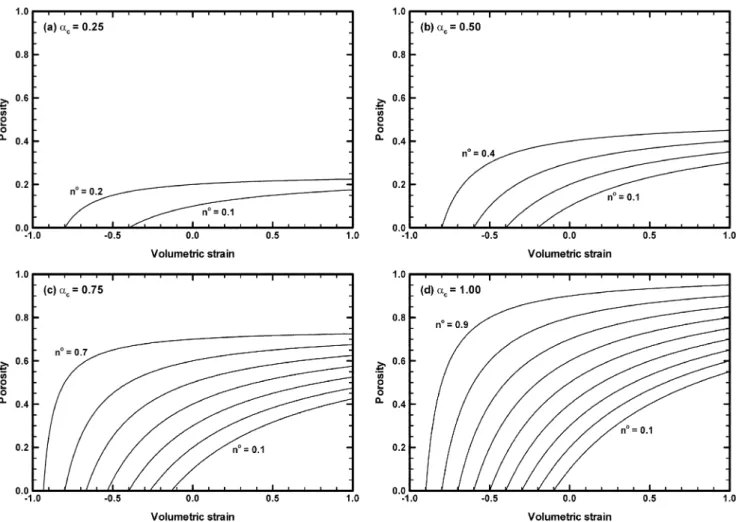
Since the deformation-dependent porosity n and saturated hydraulic conductivity Ksat in equations (7), (9), and (10) increase with the volumetric strain εv (positive for tension) from a physical perspective, the initial porosity no must be greater than or equal to zero and less than Biot’s hydrome- chanical coupling coefficient αc (i.e., 0≤no<αc). Under this condition, the deformation-dependent porosity n must also be greater than or equal to zero and less than Biot’s hydro- mechanical coupling coefficient αc (i.e., 0≤n<αc). These two conditions may give a clue for the relationship between the deformation-dependent porosity and Biot’s hydrome- chanical coupling coefficient for porous geologic media.
Thus equations (7), (9), and (10) are valid only for the fol- lowing condition:
(11) This limiting condition eliminates the possibility of over- closure of the pores. It also implies that if the magnitude of compressional deformation is out of the limiting condition (i.e., εv<−no/αc), the individual solid grains may be no longer relatively incompressible and will be further deformed and even failed (damaged) resulting in the change in the shape factor fs in equation (8). When the
dn (αc–n)dVVt
---t
=
αc–no αc–n
--- Vt
Vto
---
=
n αc αc–no
1+εv
--- –
=
Ksat ρwg µw
---ksat ρµwg
---wfs fnd2 ρµwg
--- 1w180---(---1n–3n)2d2
= = =
Ksat Ksato αc
no
--- αc–no
no
--- 11---+εv
⎝ – ⎠
⎛ ⎞ 1–αc
1–no
--- αc–no 1–no --- 11---+εv
⎝ + ⎠
⎛ ⎞–2 3⁄ 3
=
Ksat Ksato αc
no
--- αc–no
no
--- 11---+εv
⎝ – ⎠
⎛ ⎞ 1–αc
1–no
--- αc–no 1–no
--- 11---+εv
⎝ + ⎠
⎛ ⎞–2 3⁄ 3
=
1<
– αno ---c
– ≤εv
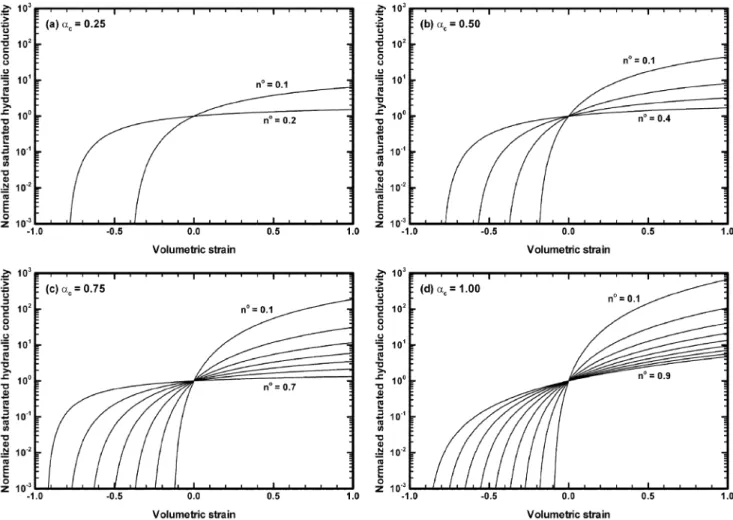
volumetric strain εv approaches to its lower limit −no/αc (i.e., εv=−no/αc), the pores may be completely closed, and both porosity n and saturated hydraulic conductivity Ksat
become zero (i.e., n=0 and Ksat=0). When the volumetric strain εv approaches to its upper limit infinity (i.e., εv=∞), the porosity n reaches Biot’s hydromechanical coupling coef- ficient αc, and the saturated hydraulic conductivity Ksat
reaches (i.e., n=αc and
Ksat= ).
Equations (7) and (9) are graphically shown in Figures 1 and 2, respectively, with the limiting condition, i.e., equation (11). As shown in Figures 1 and 2, the effect of the solid skeleton deformation on the changes in the porosity n and saturated hydraulic conductivity Ksat becomes more prom- inent as the initial porosity no is smaller (i.e., no→0), and Biot’s hydromechanical coupling coefficient αc is larger (i.e., αc→1). In addition, the saturated hydraulic conductiv- ity Ksat is more sensitive than the porosity n in response to the solid skeleton deformation.
If the solid constituent is completely incompressible (i.e.,
βs=0 or Ks=∞), Biot’s hydromechanical coupling coefficient
αc becomes equal to unity (i.e., αc=1), and then Equations (7), (9), (10), and (11) become equal to a series of consti- tutive equations (8), (10), (11), and (12), respectively, pro- posed by Kim and Parizek (1999b). In that case, when the volumetric strain εv approaches to infinity (i.e., εv =∞), the porosity n reaches unity, and the saturated hydraulic con- ductivity Ksat reaches infinity (i.e., n=1 and Ksat=∞).
The constitutive equations (7), (9), (10), and (11) derived above for the deformation-dependent saturated hydraulic properties (i.e., porosity and saturated hydraulic conductiv- ity) requires only no, Ksat, αc, and εv, which are the given (known) parameters. The volumetric strain εv can be deter- mined from displacement, total stress, or effective stress through the relevant constitutive functional relationships (Love, 1944; Nur and Byerlee, 1971; Carroll, 1979; Thompson and Willis, 1991; Cheng, 1997; Kim, 2004). In addition, the constitutive equations (7), (9), (10), and (11) are applicable to both linear and nonlinear elastic deformation. However, the constitutive equations (7), (9), (10), and (11) cannot explain the formation of hydraulic anisotropy, which may also result from the solid skeleton deformation, because
Ksato (αc⁄no)3[(1–no)⁄(1–αc)]2
Ksato (αc⁄no)3[(1–no)⁄(1–αc)]2
Fig. 1. Change in porosity n with volumetric strain εv when Biot’s hydromechanical coupling coefficient αc is equal to (a) 0.25, (b) 0.50, (c) 0.75, and (d) 1.00, respectively. The interval of the initial porosity no is 0.1.
they are based on the relationship between the porosity and the bulk volumetric strain. In addition, if the elastic defor- mation of a porous geologic medium is not self-similar, the shape factor fs in the Kozeny-Carmen equation (8) may not stay constant, and thus effects of the elastic deformation on the shape factor should be incorporated into equations (9) and (10). The Kozeny-Carman equation is also valid for unconsolidated and consolidated porous geologic media with random pore structures (e.g., granular beds) but not applicable to parallel-oriented fibers. In addition, the Kozeny-Carman equation assumes that the range of pore shapes is such that Kozeny’s coefficient ck is reasonably constant, and the tortuosity is not also susceptible to vari- ations in pore geometries. Another limitation of the Kozeny-Carman equation is that uniformity of pore size is implied. Thus if the saturated hydraulic conductivity of a deforming porous geologic medium cannot be expressed by the Kozeny-Carman equation, it should be replaced by an alter- native (Fair and Hatch, 1933; Scheidegger, 1960; Vukovic and Soro, 1992).
3. DISCUSSIONS
The premise of this study is that the deformation of a porous geologic medium can be related to its porosity change and thence to its saturated hydraulic conductivity change once one can obtain effective stress or strain using poroelasticity theory (Biot, 1941; Verruijt, 1969; Safai and Pinder, 1979; Bear and Corapcioglu, 1981; Noorishad et al., 1982; Kim, 1996; Kim and Parizek, 1997; Kim et al., 1997;
Kim and Parizek, 1999a; Kim and Parizek, 1999b; Kim, 2000; Kim, 2004; Kim, 2005; Kim and Parizek, 2005) or some other tools. It would be of great value if the consti- tutive equations proposed above can be applied to real sys- tems in order to analyze the changes in the saturated hydraulic properties (i.e., porosity and saturated hydraulic conductivity) and their effects on various hydrogeological, geomechanical, and hydrogeomechanical phenomena within the systems.
Even though the magnitude of the changes in the satu- rated hydraulic properties is not so dramatic, their effects on
Fig. 2. Change in normalized saturated hydraulic conductivity Ksat/Ksat with volumetric strain εv when Biot’s hydromechanical coupling coefficient αc is equal to (a) 0.25, (b) 0.50, (c) 0.75, and (d) 1.00, respectively. The interval of the initial porosity no is 0.1.
hydrogeomechanical behavior within porous geologic media can be quite significant as shown by Kim and Parizek (1999b) using the constitutive equations, which assume completely incompressible solid constituents (i.e., βs=0 or Ks=∞). Thus the changes in the saturated hydraulic properties due to the deformation of porous geologic media cannot always be ignored, and such changes should be properly considered especially when the long-term pore fluid pressure change and solid skeleton deformation induced by various causes (e.g., pumping, loading, mining, and tunneling) are to be predicted more reasonably and rigorously.
This study also suggests that it may be inappropriate to use conventional methods (Casagrande and Fadum, 1940;
Cooper and Jacob, 1946), which assume constant saturated hydraulic properties, in estimating the saturated hydraulic conductivity of porous geologic media from consolidation or pumping test data. By using such conventional methods, one may either overestimate the original (initial) saturated hydraulic conductivity under tensional conditions or under- estimate it under compressional conditions producing a sig- nificant error which cannot be ignored.
4. CONCLUSIONS
A series of constitutive equations was presented to ana- lyze the deformation dependence of the saturated hydraulic properties such as porosity and saturated hydraulic conduc- tivity of porous geologic media. The constitutive equation for the deformation-dependent porosity was derived from the relationship between the porosity and the volumetric strain considering both solid skeleton and solid constituent (solid grain) to be compressible while the latter is less com- pressible. The constitutive equation for the deformation- dependent saturated hydraulic conductivity was then obtained by substituting the constitutive equation for the deforma- tion-dependent porosity into the Kozeny-Carman equation assuming that the mechanical deformation of porous geo- logic media does not alter the shape of the pores since the individual solid grains are relatively incompressible com- pared with the solid skeleton. Since the porosity and satu- rated hydraulic conductivity increase with the volumetric strain from a physical perspective, the initial porosity must be greater than or equal to zero and less than Biot’s hydro- mechanical coupling coefficient. Under this condition, the porosity must also be greater than or equal to zero and less than Biot’s hydromechanical coupling coefficient. These two conditions give a clue for the relationship between the porosity and Biot’s hydromechanical coupling coefficient for porous geologic media. On the other hand, the effect of the solid skeleton deformation on the changes in the poros- ity and saturated hydraulic conductivity becomes more prominent as the initial porosity is smaller, and Biot’s hydromechanical coupling coefficient is larger. In addition, the saturated hydraulic conductivity is more sensitive than
the porosity in response to the solid skeleton deformation.
Although such constitutive equations are not applicable to all hydrogeological and geomechanical phenomena, they can find useful applications in many problems associated with fully coupled groundwater flow and solid skeleton deformation.
ACKNOWLEDGMENTS: This work was supported by the Carbon Dioxide Reduction and Sequestration Research and Development Cen- ter of the 21st Century Frontier Research and Development Program, Ministry of Science and Technology, Republic of Korea. This work was also supported in part by the Brain Korea 21 Project, Ministry of Education and Human Resources Development, Republic of Korea.
The author would also like to thank the two anonymous reviewers for their invaluable and constructive comments.
REFERENCES
Bai, M. and Elsworth, D., 1994, Modeling of subsidence and stress- dependent hydraulic conductivity for intact and fractured porous media. Rock Mechanics and Rock Engineering, 27, 209−234.
Bear, J., 1988, Dynamics of Fluids in Porous Media, republication.
Dover Publications, Mineola, New York, 764 p.
Bear, J. and Corapcioglu, M.Y., 1981, Centrifugal filtration in deform- able porous media. In: Bear, J. and Corapcioglu, M.Y. (eds.), A Series of Four Papers on Water Flow in Deformable Porous Media. Technical Report UMR-0284, Department of Civil Engi- neering, University of Michigan, Ann Arbor, Michigan, Section I, 42 p.
Biot, M.A., 1941, General theory of three-dimensional consolidation.
Journal of Applied Physics, 12, 155−164.
Brooks, R.H. and Corey, A.T., 1964, Hydraulic Properties of Porous Media. Hydrology Papers 3, Colorado State University, Fort Col- lins, Colorado, 27 p.
Carman, P.C., 1937, Fluid flow through granular beds. Transactions of the Institution of Chemical Engineers, 15, 150−166.
Carman, P.C., 1938, The determination of the specific surface of powders, I. Journal of the Society of Chemical Industry, 57, 225−
Carman, P.C., 1956, Flow of Gases through Porous Media. Butter-234.
worths Scientific Publications, London, 182 p.
Carroll, M.M., 1979, An effective stress law for anisotropic elastic deformation. Journal of Geophysical Research, 84, 7510−7512.
Casagrande, A. and Fadum, R.E., 1940, Notes on Soil Testing for Engineering Purposes. Soil Mechanics Series 8, Graduate School of Engineering, Harvard University, Cambridge, Massachusetts, 74 p.
Cheng, A.H.D., 1997, Material coefficients of anisotropic poroelas- ticity. International Journal of Rock Mechanics and Mining Sci- ences, 34, 199−205.
Cooper, Jr., H.H. and Jacob, C.E., 1946, A generalized graphical method for evaluating formation constants and summarizing well-field history. Transactions of the American Geophysical Union, 27, 526−534.
Domenico, P.A. and Schwartz, F.W., 1990, Physical and Chemical Hydrogeology. John Wiley and Sons, New York, 824 p.
Fair, G.M. and Hatch, L.P., 1933, Fundamental factors governing the stream flow of water through sand. Journal of the American Water Works Association, 25, 1551−1565.
Gangi, A.F., 1978, Variation of whole and fractured porous rock per-
meability with confining pressure. International Journal of Rock Mechanics and Mining Sciences & Geomechanics Abstracts, 15, 249−257.
Hughes, D.S. and Cooke, C.E., 1953, The effect of pressure on the reduction of pore volume of consolidated sandstones. Geophys- ics, 18, 298−309.
Kim, J.M., 1996, A Fully Coupled Model for Saturated-Unsaturated Fluid Flow in Deformable Porous and Fractured Media. Ph.D.
thesis, Pennsylvania State University, University Park, Pennsyl- vania, 201 p.
Kim, J.M., 2000, A fully coupled finite element analysis of water- table fluctuation and land deformation in partially saturated soils due to surface loading. International Journal for Numerical Meth- ods in Engineering, 49, 1101−1119.
Kim, J.M., 2004, Fully coupled poroelastic governing equations for groundwater flow and solid skeleton deformation in variably sat- urated true anisotropic porous geologic media. Geosciences Jour- nal, 8, 291−300.
Kim, J.M., 2005, Three-dimensional numerical simulation of fully coupled groundwater flow and land deformation in unsaturated true anisotropic aquifers due to groundwater pumping. Water Resources Research, 41, W01003, doi:10.1029/2003WR002941.
Kim, J.M. and Parizek, R.R., 1997, Numerical simulation of the Noordbergum effect resulting from groundwater pumping in a layered aquifer system. Journal of Hydrology, 202, 231−243.
Kim, J.M. and Parizek, R.R., 1999a, Three-dimensional finite ele- ment modelling for consolidation due to groundwater withdrawal in a desaturating anisotropic aquifer system. International Journal for Numerical and Analytical Methods in Geomechanics, 23, 549−571.
Kim, J.M. and Parizek, R.R., 1999b, A mathematical model for the hydraulic properties of deforming porous media. Ground Water, 37, 546−554.
Kim, J.M. and Parizek, R.R., 2005, Numerical simulation of the Rhade effect in layered aquifer systems due to groundwater pumping shutoff. Advances in Water Resources, 28, 627−642.
Kim, J.M., Parizek, R.R. and Elsworth, D., 1997, Evaluation of fully- coupled strata deformation and groundwater flow in response to longwall mining. International Journal of Rock Mechanics and Mining Sciences, 34, 1187−1199.
Knutson, C.F. and Bohor, B.F., 1963, Reservoir rock behavior under moderate confining pressure. In: Fairhurst, C. (ed.), Proceedings of the Fifth U. S. Symposium on Rock Mechanics, University of
Minnesota, Minneapolis, Minnesota. Pergamon Press, Oxford, p.
627−659.
Kozeny, J., 1927, Über kapillare leitung des wassers im boden. Sit- zungsberichte, Akademie der Wissenschaften, Wien, 136, 271−306.
Love, A.E.H., 1944, A Treatise on the Mathematical Theory of Elas- ticity, fourth edition, republication. Dover Publications, New York, 643 p.
Noorishad, J., Mehran, M. and Narasimhan, T.N., 1982, On the for- mulation of saturated-unsaturated fluid flow in deformable porous media. Advances in Water Resources, 5, 61−62.
Nur, A. and Byerlee, J.D., 1971, An exact effective stress law for elastic deformation of rock with fluids. Journal of Geophysical Research, 76, 6414−6419.
Palciauskas, V.V. and Domenico, P.A., 1989, Fluid pressures in deforming porous rocks. Water Resources Research, 25, 203−213.
Safai, N.M. and Pinder, G.F., 1979, Vertical and horizontal land deformation in a desaturating porous medium. Advances in Water Resources, 2, 19−25.
Scheidegger, A.E., 1960, The Physics of Flow through Porous Media, revised edition. Macmillan, New York, 313 p.
Thompson, M. and Willis, J.R., 1991, A reformulation of the equa- tions of anisotropic poroelasticity. Journal of Applied Mechanics, Transactions of the American Society Mechanical Engineers, 58, 612−616.
Van Genuchten, M.Th., 1980, A closed-form equation for predicting the hydraulic conductivity of unsaturated soils. Soil Science Society of America Journal, 44, 892−898.
Verruijt, A., 1969, Elastic storage of aquifers. In: De Wiest, R.J.M.
(ed.), Flow through Porous Media. Academic Press, New York, p. 331−376.
Vukovic, M. and Soro, A., 1992, Determination of Hydraulic Con- ductivity of Porous Media from Grain-Size Composition. Water Resources Publications, Littleton, Colorado, 83 p.
Zimmerman, R.W., Somerton, W.H. and King, M.S., 1986, Com- pressibility of porous rock. Journal of Geophysical Research, 91, 12765−12777.
Zoback, M.D. and Byerlee, J.D., 1976, Effect of high-pressure defor- mation on permeability of Ottawa sand. American Association for Petroleum Geologists Bulletin, 60, 1531−1542.
Manuscript received October 13, 2005 Manuscript accepted June 7, 2006