• 검색 결과가 없습니다.

Factors Associated with Place of Death in Korean Patients with Terminal Cancer

N/A
N/A
Protected

Academic year: 2021

Share "Factors Associated with Place of Death in Korean Patients with Terminal Cancer"

Copied!
6
0
0

로드 중.... (전체 텍스트 보기)

전체 글

(1)

Factors Influencing Place of Death of Korean Patients with Terminal Cancer

Asian Pac J Cancer Prev, 14 (12), 7309-7314

Introduction

Choice and control over where death occurs (at home or elsewhere) is one of the 12 principles of a good death (Smith, 2000). Place of death also has a significant meaning in the allocation of medical resources. In other words, hospital deaths consume and need more medical resource than home or hospice death.

In 2011, 71,579 patients died of cancer in Korea, and 87.6% died in a hospital and 9.3% died at home (StatisticsKorea, 1991-2011). In contrast, in 1991, the proportion of home deaths was 77.2% and that of hospital deaths was approximately 19.1%. Since then, hospital deaths have increased and the proportion of hospital deaths have been more than that of home death in Korea.

Analyses of results for other countries do not match. For example, in London, the proportion of hospital deaths

1
National Evidence-based Healthcare Collaborating Agency,

2

Department of Oncology, Asian Medical Center,

7

Department of Oncology, Gangneung Asian Hospital, University of Ulsan College of Medicine,

3

Seoul National University Hospital and College of Medicine,

6

Cancer Research Institute, Department of Internal Medicine, Seoul National University Hospital, Seoul,

4

Research Institute and Hospital, National Cancer Center, Goyang,

5

Division of Hematooncology, Department of Internal Medicine, Dongsan Medical Center, Keimyung University School of Medicine, Daegu,

8

Division of Hematooncology, Department of Internal Medicine, Chungnam University School of Medicine, Daejeon, Korea *For correspondence: [email protected]

Abstract

Aim: To investigate factors that affect the place of death (POD) of terminal cancer patients. Materials and Methods: We recruited 702 consecutive patients (≥18 years) from 12 centers during July 2005 to October 2006, and 481 completed the questionnaire. In April 2011, we linked the data for 96.0% (n=462) of the deceased patients to the POD using the 2005-2009 death certificate data of Korea’s National Statistical Office. The primary outcome variable was POD, and the predictive value of variables pertaining to patients and caregivers was evaluated using univariate and multivariate analyses. Results: Most patients died in a hospital (91.5%, n=441) and age, education, preference for place of terminal care, wish to use hospice/palliative care services, terminal cancer awareness, time between diagnosis and death, and global quality-of-life subscale of the EORTC QLQ-C30 of patients, and education and preference for place of terminal care of caregivers were significant predictors in univariate analyses. On multivariate analysis, patients and caregivers who preferred hospital/palliative care as the terminal care option over home care [adjusted odds ratio (aOR), 2.68; 95% confidential interval (CI), 1.18- 7.04 and aOR: 2.65; 95%CI: 1.15-6.09 for patient and caregiver preferences, respectively] and caregivers who were highly educated (aOR, 3.19; 95%CI, 1.44-7.06) were predictors of POD. Conclusions: Most of the terminal cancer patients died in a hospital. Our findings indicate that major predictors of hospital deaths are preference of both the patient and caregiver for hospital/palliative care as the terminal care option and higher education of the caregiver.

Keywords: Neoplasms - terminal care - place of death - influencing factors - Korea

RESEARCH ARTICLE

Factors Associated with Place of Death in Korean Patients with Terminal Cancer

Min Kyung Hyun 1 , Kyung Hae Jung 2 , Young Ho Yun 3 *, Young Ae Kim 4 , Woo Jin Lee 4 , Young Rok Do 5 , Keun Seok Lee 4 , Dae Seog Heo 6 , Jong Soo Choi 7 , Sam Yong Kim 8 , Heung Tae Kim 4 , Seok-Won Hong 1

was 56.1% in 2002 and 50.3% in 2007 (Madden et al., 2011). In Italy, the proportion of home deaths increased from 60% in 1987 to 80% in 2007 (Casadio et al., 2010).

However, the proportions are similar in Japan and Korea, with hospital death accounting for 85% of cancer deaths in Japan in 2008 (Ministry of Health, 2011).

There are a variety of factors affecting the place of

death. A systematic review showed that home death was

strongly associated with a patients’ low function status,

preferences of the patient, use of home care, intensity

of home care, and whether the patient was living with

relatives and had extended family support (Gomes and

Higginson, 2006). Recent studies identified that home

death was associated with specific parameters in patient

subsets, such as whether the patient was living with others,

in the case of female patients(Masucci et al., 2010); and

with higher socio-economic status, older age, and co-

(2)

habitation with others, in the case of non-cancer patients (Houttekier et al., 2009). Home death was also associated with pre-discharge health care support in hospital, post- discharge health care support after transferring to home care; preferences of the caregiver, preferences of the patient, caregiver’s perception of social support, number of hospital admission days, and number of palliative home care team visits (Alonso-Babarro et al., 2011).

Using the 10-year death certificate data from Korea Statistics, one study found that hospital deaths were associated with young age, high education, white-collar jobs, and availability of more hospital beds in the region (Yun et al., 2006). The study could not gather detailed characteristics and data pertaining to quality of life (QOL) in the decision for a place of death (POD) because it was a retrospective population-based study. Wright et al.

(Wright et al., 2010) found that worse QOL is associated with hospital or Intensive care unit (ICU) death.

However, few studies have comprehensively examined the relationship of various factors including QOL and quality of care with preferred place of care. Therefore, we investigated the relationship between the demographic characteristics, job status, burden of patient and caregiver, the preference of place for terminal care, wish to use hospice/palliative care service, terminal cancer awareness, treatment satisfaction, the time between diagnosis and death; and the European Organization for Research and Treatment of Cancer Quality of Life Questionnaire Core-30 (EORTC QLQ-C30) and the place of care. The Study to Understand Risks, Priority, and Issues at End- of-Life (SURPRISE), a multicenter study, was designed to identify important issues in the end-of-life (EOL) care from July 2005 to October 2006 (Yun et al., 2010; 2011).

In this study, we sought to identify the factor(s) that affected the POD in patients with terminal cancer the most significantly in this prospective longitudinal multicenter study. It is generally difficult to identify factors associated with hospital deaths, because hospital death may be influenced by the condition of patient and caregiver.

As a result, we performed a comprehensive analysis to determine the POD of terminal cancer patients to identify factors predictive of POD through seven patient-related parameters (the demographic characteristics, job status, burden of patient and caregiver, preference for POD, terminal cancer awareness, treatment satisfaction, the time between diagnosis and death), and the EORTC QLQ-C30 and six caregiver-related parameters (the demographic characteristics, job status, burden of patient and caregiver, preference for POD, terminal cancer awareness, and treatment satisfaction).

Materials and Methods

Patients and data collection

SURPRISE was a prospective, longitudinal, multicenter (11 university hospitals and the National Cancer Center) cohort study of terminal cancer patients and their caregivers. Details of the study design have been published elsewhere (Yun et al., 2010; 2011). The study protocol was approved by the Institutional Review Board (IRB) of the Seoul National University College of

Medicine and each institution.

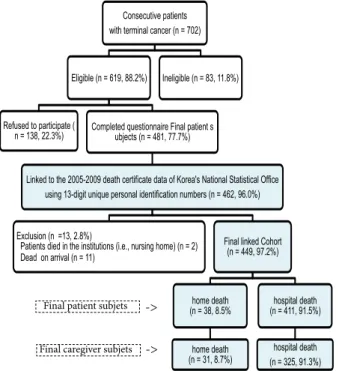
Between July 2005 to October 2006, 702 consecutive patients (≥18 years) who provided informed consent to participate in this study were recruited to the SURPRISE, and 11.8% (n=83) patients were excluded because of continuous anticancer therapy, non-evaluable disease, follow-up loss, and physical or mental incapacitation that prohibited them from completing the questionnaire. Of the remaining 619 eligible participants, 138 patients did not participate for reasons such as lack of time, illness and violation of privacy. Then, a total of 481 patients who had completed the questionnaire remained in the study (Figure 1). We conducted face-to-face interviews of patients and their caregivers at the baseline time point of the study and mailed a monthly survey within 2 months. We also conducted bereavement telephone surveys after the patient died.

We collected and recorded data pertaining to the following eight parameters: the demographic characteristics (age, sex, marital status, education, religion); job status (before cancer diagnosis, at terminal cancer diagnosis); burden of patient and caregiver (patient and caregiver burden, patient and caregiver needs of future treatment plan and financial plan etc); preference for POD (preference for place of terminal care; wish to use/

not use hospice/palliative care services); terminal cancer awareness; treatment satisfaction; time between diagnosis and death; and EORTC QLQ-C30.

In April 2011, we linked these data of the 481 patients to the 2005–2009 death certificate data from Korea’s National Statistical Office (NSO) using the 13-digit unique personal identification numbers, and were able to link the POD data for 96.0% (n=462) of the deceased patients.

In addition, we excluded patients who died in

Figure 1. Flow Chart for Patient Selection. Modified from Yun YH, et al. Impact of Awareness of Terminal Illness and Use of Palliative Care of Intensive Care unit on the Survival of Terminally Ill Patients With Cancer: Prospective Cohort Study.

J Clin Oncol published online on May 16, 2011

Final patient subjets Final caregiver subjets

->

->

->

Consecutive patients with terminal cancer (n = 702)

Eligible (n = 619, 88.2%)

Refused to participate (

n = 138, 22.3%) Completed questionnaire Final patient s ubjects (n = 481, 77.7%)

Linked to the 2005-2009 death certificate data of Korea's National Statistical Office using 13-digit unique personal identification numbers (n = 462, 96.0%)

Exclusion (n =13, 2.8%)

Patients died in the institutions (i.e., nursing home) (n = 2) Dead on arrival (n = 11)

Final linked Cohort (n = 449, 97.2%)

home death (n = 38, 8.5%

home death (n = 31, 8.7%)

hospital death (n = 411, 91.5%)

hospital death

(n = 325, 91.3%)

Ineligible (n = 83, 11.8%)

(3)

Factors Influencing Place of Death of Korean Patients with Terminal Cancer institutions (i.e, nursing homes; n=2) or were dead on

arrival at the hospital (n=11), and finally analyzed data for a cohort of 449 deceased patients. And we also obtained completed questionnaires from 356 caregivers (Figure 1).

Statistical analysis

As a primary outcome variable, we used the variable

‘POD’ from NSO, and predictor variables from the EORTC QLQ-C30, including the time between diagnosis and death, terminal care awareness, and preference for place of terminal care. We calculated the scores of EORTC QLQ-C30 according to the EORTC scoring manual (Fayers et al., 2001), and linearly transformed the EORTC QLQ-C30 data to yield scores from 0-100; a higher score represents a better global health status and a better performance on the functional scales; a lower score represents a worse performance on the symptoms scale.

We divided the patients into two groups; the problematic and non-problematic groups. The problematic group had scores <33.33 (poorer QOL and functional scales) or >66.66 (poorer performance on the symptoms scales) (Fayers, 2001a; 2001b; Ahn et al., 2007).

The Chi-square test was used to compare the differences in POD between different subsets of patients through a univariate logistic regression analysis. In addition, for factors significantly associated with POD in the univariate analysis, we performed a multivariate logistic regression analysis, with stepwise selection for

each dependent variable, to evaluate the independent variables that best predicted POD. A two-sided p value of

<0.05 was considered to indicate statistical significance in our study. Statistical analysis was performed using SAS version 9.1 (SAS Institute Inc, Cary, NC, USA).

Results

Patient characteristics and POD

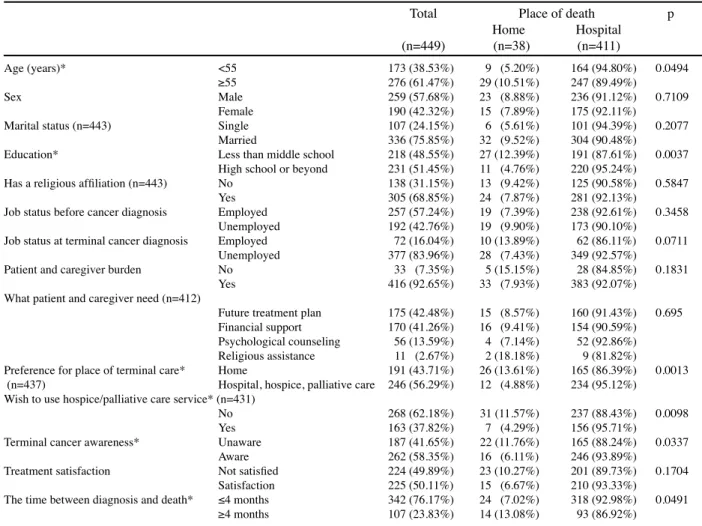
Most patients died in a hospital (91.5%, n=411) and only 8.5% (n=38) died at home. Table 1 shows the characteristics of the patients and place of death at the time of the first face-to-face survey. The survey data indicated that 43.7% (n=191) patients wanted to die at home, but only 13.6% (n=26) of these patients died at home. On the other hand, 56.3% (n=246) patients wanted to die while under hospital/hospice/palliative care, and 95.1% (n=234) of these patients died at their preferred POD.

Significant differences were found in the age, education, preference for place of terminal care, desire to use palliative care, terminal cancer awareness, and the time between diagnosis and death between the problematic and non-problematic groups of patients (Table 1).

Association between POD and EORTC QLQ-C30 Different parameters within the global QOL subscales of the EORTC QLQ-C30 showed significant differences in the POD of patients in the two groups (Table 2).

Table 1. Patient Characteristics and Place of Death (n=449)

Total Place of death p

Home Hospital (n=449) (n=38) (n=411)

Age (years)* <55 173 (38.53%) 9 (5.20%) 164 (94.80%) 0.0494

≥55 276 (61.47%) 29 (10.51%) 247 (89.49%)

Sex Male 259 (57.68%) 23 (8.88%) 236 (91.12%) 0.7109

Female 190 (42.32%) 15 (7.89%) 175 (92.11%)

Marital status (n=443) Single 107 (24.15%) 6 (5.61%) 101 (94.39%) 0.2077

Married 336 (75.85%) 32 (9.52%) 304 (90.48%)

Education* Less than middle school 218 (48.55%) 27 (12.39%) 191 (87.61%) 0.0037

High school or beyond 231 (51.45%) 11 (4.76%) 220 (95.24%) Has a religious affiliation (n=443) No 138 (31.15%) 13 (9.42%) 125 (90.58%) 0.5847

Yes 305 (68.85%) 24 (7.87%) 281 (92.13%)

Job status before cancer diagnosis Employed 257 (57.24%) 19 (7.39%) 238 (92.61%) 0.3458 Unemployed 192 (42.76%) 19 (9.90%) 173 (90.10%)

Job status at terminal cancer diagnosis Employed 72 (16.04%) 10 (13.89%) 62 (86.11%) 0.0711 Unemployed 377 (83.96%) 28 (7.43%) 349 (92.57%)

Patient and caregiver burden No 33 (7.35%) 5 (15.15%) 28 (84.85%) 0.1831

Yes 416 (92.65%) 33 (7.93%) 383 (92.07%)

What patient and caregiver need (n=412)

Future treatment plan 175 (42.48%) 15 (8.57%) 160 (91.43%) 0.695 Financial support 170 (41.26%) 16 (9.41%) 154 (90.59%) Psychological counseling 56 (13.59%) 4 (7.14%) 52 (92.86%) Religious assistance 11 (2.67%) 2 (18.18%) 9 (81.82%)

Preference for place of terminal care* Home 191 (43.71%) 26 (13.61%) 165 (86.39%) 0.0013 (n=437) Hospital, hospice, palliative care 246 (56.29%) 12 (4.88%) 234 (95.12%)

Wish to use hospice/palliative care service* (n=431)

No 268 (62.18%) 31 (11.57%) 237 (88.43%) 0.0098

Yes 163 (37.82%) 7 (4.29%) 156 (95.71%)

Terminal cancer awareness* Unaware 187 (41.65%) 22 (11.76%) 165 (88.24%) 0.0337

Aware 262 (58.35%) 16 (6.11%) 246 (93.89%)

Treatment satisfaction Not satisfied 224 (49.89%) 23 (10.27%) 201 (89.73%) 0.1704 Satisfaction 225 (50.11%) 15 (6.67%) 210 (93.33%)

The time between diagnosis and death* ≤4 months 342 (76.17%) 24 (7.02%) 318 (92.98%) 0.0491

≥4 months 107 (23.83%) 14 (13.08%) 93 (86.92%)

* p<0.05 by the Chi-square test, Abbreviations: DNR, do not resuscitate

(4)

Caregivers’ characteristics and POD

The characteristics of the caregivers in the two patient groups and their association with the POD at the time of the first face-to-face survey are shown in Table 3 Significant differences were found in the education and preference for place of terminal care between the two groups of patients (Table 3).

Factors associated with hospital death of patients in multivariate analysis

The results of the multivariate analysis of factors that were associated with POD in the univariate analysis are shown in Table 4. In multivariate analysis, patients who preferred hospital/palliative terminal care [adjusted odds ratio (aOR), 2.88; 95% confidential interval (CI), 1.18- 7.04], had caregivers who were highly educated (aOR, 3.19; 95%CI, 1.44-7.06), preferred hospital/hospice/

palliative terminal cancer care (aOR, 2.65; 95%CI, 1.15- 6.07) were more likely to have the hospital as the POD (Table 4).

Discussion

In this prospective longitudinal multicenter study, we found that 91.5% of terminal cancer patients in our cohort died in a hospital, after linkage of the cohort data with

death certificate data of Korea’s NSO. Our data indicated that 43.7% of the patients wanted to die at home, but only 13.6% of these patients died at home. On the other hand, 56.3% of the patients wanted to die in the hospital/hospice/

palliative care, and most 95.1% of these patients died at this preferred POD.

Multivariate analysis indicated that the three most powerful predictors of hospital death were a caregiver with a higher education status, and the preferences of the caregiver and the patient for hospital/palliative care of terminal cancer. The patient’s age, education, wish to use palliative care, the time between diagnosis and death, global quality-of-life subscale data of EORTC QLQ-C30 were significantly associated with POD in univariate logistic regression analysis, but were not significant in multivariable logistic regression analysis when analyzed in conjunction with caregivers’ independent predictor variables.

The proportion of cancer patients who had hospital deaths was 22.1% in United States in 2009 (Teno et al., 2013), 61.4% in Belgium in 2003 (Cohen et al., 2010), 31.0% in Netherlands in 2003 (Cohen et al., 2010), 49.9% in England in 2003 (Cohen et al., 2010), 50.3%

in London in 2007 (Madden et al., 2011), 18% in Italy in 2007 (Casadio et al., 2010), 60% and 85.2% in 2007 and 2009, respectively, in Korea (Statistics Korea, 1991-2011)

0 25.0 50.0 75.0 100.0

Newl y di agnosed wi thout tr eatment Newl y di agnosed wi th tr eatment Persi stence or recurr ence Remi ssi on None Chemother ap y Radi other ap y Concurr ent chemor adi ati on

10.3

0 12.8

30.0 25.0

10.1 20.3 6.3

51.7 51.1 75.0

31.3 30.0 54.2

56.3 46.8

25.0 27.6 30.0 33.1

23.7 31.3 31.3 38.0

0 25.0 50.0 75.0 100.0

Newl y di agnosed wi thout tr eatment Newl y di agnosed wi th tr eatment Persi stence or recurr ence Remi ssi on None Chemother ap y Radi other ap y Concurr ent chemor adi ati on

10.3

0 12.8

30.0 25.0

10.1 20.3 6.3

51.7 51.1 75.0

31.3 30.0 54.2

56.3 46.8

25.0 27.6 30.0 33.1

23.7 31.3 31.3 38.0

Total Place of death p

(n=449) Home (n=38) Hospital (n=411) Global health status/QOL

Quality of life* Non-problematic group 258 (57.46%) 28 (10.85%) 230 (89.15%) 0.0345 Problematic group 191 (42.54%) 10 (5.25%) 181 (94.76%)

Functional scales

Physical functioning Non-problematic group 0 0 0

Problematic group 449 (100%) 38 (8.46%) 411 (91.54%)

Role functioning Non-problematic group 0 0 0

Problematic group 449 (100%) 38 (8.46%) 411 (91.54%)

Emotional functioning Non-problematic group 367 (81.74%) 31 (8.45%) 336 (91.55%) 0.9789 Problematic group 82 (18.26%) 7 (8.54%) 75 (91.46%)

Cognitive functioning Non-problematic group 375 (83.52%) 32 (8.53%) 343 (91.47%) 0.9044 Problematic group 74 (16.48%) 6 (8.11%) 68 (91.89%)

Social functioning Non-problematic group 279 (62.14%) 27 (9.68%) 252 (90.32%) 0.2363 Problematic group 170 (37.86%) 11 (6.47%) 159 (93.53%)

Symptom scales/items

Fatigue Non-problematic group 174 (38.75%) 14 (8.05%) 160 (91.95%) 0.8005 Problematic group 275 (61.25%) 24 (8.73%) 251 (91.27%)

Nausea/vomiting Non-problematic group 319 (71.05%) 26 (8.15%) 293 (91.85%) 0.7091 Problematic group 130 (28.95%) 12 (9.23%) 118 (90.77%)

Pain Non-problematic group 216 (48.11%) 21 (9.72%) 195 (90.28%) 0.3561 Problematic group 233 (51.89%) 17 (7.30%) 216 (92.70%)

Dyspnea Non-problematic group 260 (57.91%) 22 (8.46%) 238 (91.54%) 0.9988 Problematic group 189 (42.09%) 16 (8.47%) 173 (91.53%)

Insomnia Non-problematic group 193 (42.98%) 18 (9.33%) 175 (90.67%) 0.5683 Problematic group 256 (57.02%) 20 (7.81%) 236 (92.19%)

Appetite loss Non-problematic group 150 (33.41%) 13 (8.67%) 137 (91.33%) 0.9127 Problematic group 299 (66.59%) 25 (8.36%) 274 (91.64%)

Constipation Non-problematic group 239 (53.23%) 21 (8.79%) 218 (91.21%) 0.7928 Problematic group 210 (46.77%) 17 (8.10%) 193 (91.90%)

Diarrhea Non-problematic group 351 (78.17%) 31 (8.83%) 320 (91.17%) 0.5953 Problematic group 98 (21.83%) 7 (7.14%) 91 (92.86%)

Financial problems Non-problematic group 191 (42.54%) 17 (8.90%) 174 (91.10%) 0.7746 Problematic group 258 (57.46%) 21 (8.14%) 237 (91.86%)

* p<0.05 by the Chi-square test, Note. The patients were sorted into two groups, the problematic and non-problematic groups. In the problematic group: the score was

≤33.33 (quality of life and functional scales), and >66.66 (symptoms scales) on a scale of 0-100

(5)

Factors Influencing Place of Death of Korean Patients with Terminal Cancer

and 85% in Japan in 2008 (Ministry of Health, 2011). The hospital deaths in this study reached 91.5% in terminal cancer patients. Korea and Japan have a greater proportion of aged members and therefore a discussion of an efficient distribution of limited health care resources is imperative in both countries, in the light of the high medical cost of the care and treatment of terminal cancer patients.

Therefore, policy makers need to know the predicting factors for hospital death of terminal cancer patients and suggest policy changes to improve the likelihood of a good death for these patients, while weighing the impact of the policies on health care costs.

In this study, we identified three patient- and caregiver- related factors associated with POD, consistent with data in some recent reports (Yun et al., 2006; Houttekier et al., 2009; Alonso-Babarro et al., 2011; Cardenas-Turanzas et al., 2011), and inconsistent with the results of some other studies (Wright et al., 2010). In particular, in our study, we investigated the effects of EORTC QLQ-C30, and found that only some items in the questionnaire were significantly associated with differences in POD.

However, the recent report from Wright et al. (2010) found that a worse QOL at the end of life was increasing the risk of hospital deaths. We propose that the reason for this discrepancy is that the scale for QOL used in that study is different from that in this study, in that they used the Likert scale (from 0-10) to evaluate the QOL at the end of life, but our study used the EORTC QLQ-C30, which is a cancer-specific instrument. Also, we surmise that there are differences in the cultural and healthcare systems relevant to the two studies. Many patients, caregivers, or medical health professionals still think that end-of-life treatments in hospital have some utility in Korea, and

Table 3. Association between Caregivers’ Characteristics and Patients’ Place of Death

Total (n=356) Place of death p Home (n=31) Hospital (n=418)

Age years (n=354) <55 245 (69.21%) 20 (8.16%) 225 (91.84%) 0.5535

≥55 109 (30.79%) 11 (10.09%) 98 (89.91%)

Sex (n=356) Male 116 (32.58%) 9 (7.76%) 107 (92.24%) 0.6588

Female 240 (67.42%) 22 (9.17%) 218 (90.83%)

Marital status (n=355) Unmarried 68 (19.15%) 6 (8.82%) 62 (91.18%) 0.9764

Married 287 (80.85%) 25 (8.71%) 262 (91.29%)

Education* (n=356) Less than middle school 89 (25.00%) 14 (15.73%) 75 (84.27%) 0.0067 High school or beyond 267 (75.00%) 17 (6.37%) 250 (93.63%)

Has a religion (n=346) No 114 (32.95%) 11 (9.65 %) 103 (90.35%) 0.6502

Yes 232 (67.05%) 19 (8.19%) 213 (91.81%)

Job status before cancer diagnosis Employed 195 (55.24%) 15 (7.69%) 180 (92.31%) 0.4217

(n=353) Unemployed 158 (44.76%) 16 (10.13%) 142 (89.87%)

Job status at terminal cancer diagnosis Employed 120 (35.19%) 8 (6.67%) 112 (93.33%) 0.306

(n=341) Unemployed 221 (64.81%) 22 (9.95%) 199 (90.05%)

Patient and caregiver burden No 8 (2.27%) 0 (0%) 8 (100.00%) 0.3747

(n=353) Yes 345 (97.73%) 31 (8.99%) 314 (91.01%)

What patient and caregiver need Future treatment plan 161 (47.63%) 13 (8.07%) 148 (91.93%) 0.9656

(n=338) Financial support 122 (36.09%) 12 (9.84%) 110 (90.16%)

Psychological counseling 44 (13.02%) 4 (9.09%) 40 (90.91%) Religious assistance 11 (3.25%) 1 (9.09%) 10 (90.91%)

Preference for place of terminal care* Home 97 (27.32%) 17 (17.53%) 80 (82.47%) 0.0003 (n=355) Hospital, hospice, palliative care 258 (72.68%) 14 (5.43%) 244 (94.57%) Wish to use hospice/palliative care service No 170 (48.85%) 19 (11.18%) 151 (88.82%) 0.1466

(n=348) Yes 178 (51.15%) 12 (6.74%) 166 (93.26%)

Terminal cancer awareness (n=355) Unaware 58 (16.34%) 7 (12.07%) 51 (87.93%) 0.3251

Aware 297 (83.66%) 24 (8.08%) 273 (91.92%)

Treatment satisfaction (n=350) Not satisfied 189 (54%) 19 (10.05%) 170 (89.95%) 0.2834 Satisfaction 161 (46%) 11 (6.83%) 150 (93.17%)

Table 4. Multivariate Logistic Regression Analysis of Hospital Deaths in Terminal Cancer Patients and Caregivers (n=356)

Patients Odds ratio 95% CI

Age (years) <55

≥55 N/S

Education Less than middle school

High school or beyond N/S Preference for place of terminal care

Home 1

Hospital, hospice, palliative care 2.88 (1.182-7.037) Wish to use hospice/palliative care service

No Yes N/S

Terminal cancer awareness Unaware

Aware N/S

The time between diagnosis and death Less than 4 months

More than 4 months N/S

Quality of life

Non-problematic group

Problematic group N/S

Education Less than middle school 1

High school or beyond 3.19 (1.443-7.064) Preference for place of terminal care

Home 1

Hospital, hospice, palliative care 2.65 (1.149-6.088)

*All binary variables significant at p<0.05 in the Chi-square test in the univariate

logistic regression analysis were included in the multivariate analysis with stepwise

selection. An odds ratio (OR) <1 indicated that the condition is less likely to occur

in the group of patients who died at a hospital, N/S, not significant; Ref, reference

(6)

they choose hospital care even at the terminal stages of cancer for cultural reasons specific to Asia, namely, the satisfaction from or the perception of having done their best for the patient till death. According to the National Evidence-based Healthcare Collaborating Agency report, the number of patients receiving futile life-sustaining treatments (within 1 month before death) in terminally ill patients was 138,181 (57.7% of the all deaths) in 2007, and cancer patients (26.6% of the total) accounted for the largest proportion of patients who were receiving medical treatment (Ryu, 2009). In the Korean healthcare system, medical treatment costs are less expensive than in other countries and the palliative/home care system for terminal cancer is not well-developed. This limitation has led to a disproportionate increase in hospital deaths in Korea, compared to the increases in other countries. In this study, the patients that preferred hospital/palliative terminal care over home care were more likely to die in a hospital.

Although 40.1% (n=165) of the patients in this study preferred home care, only 13.6% of these patients died at home, with the remaining experiencing a hospital death.

These data suggest that even when the patient preferred a home death, they could not select home as the POD at the end. This disagreement between where people want to die and where people actually die is consistent with the data described in previous studies (Cohen et al., 2006).

In this study, 43.7% (n=191) of patients and 27.3%

(n=97) of caregivers wanted home as the place of terminal care. This proportion of patient preference is different from that described in a 2005 study by Choi et al. (Choi et al., 2005), which found that 53% of the patients and 49% of family members prefer their home, and 30% of patients and 40% of family members prefer the hospital/

hospice/palliative care as the place of terminal care. In 2003, 45.1% of deaths were hospital deaths in Korea and this was the first time that the proportion of hospital deaths was higher than that of home deaths (StatisticsKorea, 1991-2011). Since 2003, the proportion of hospital deaths has continually increased, and reached 87.6%

in 2011(StatisticsKorea, 1991-2011). In this study, we found that the preference of the patients and caregivers is very important. Therefore, policy makers would need to publicize the advantage of home deaths and home death could be better option than futile life-sustaining treatments in a hospital for terminal cancer patients. The different parameters that must be taken into consideration by the patients, their caregivers, and the medical professionals responsible for the care and treatment of terminally ill cancer patients have been defined from the perspective of optimizing the likelihood of a good death for the patient.

Our study has the following limitation: it is likely that the high probability of hospital deaths in this study was due to enrollement/selection of the patients receiving hospital treatment at the time of diagnosis of terminal cancer. If we could include home care patients with terminal cancer, the results might have been different.

In conclusion, most of the terminal cancer patients died in a hospital and three factors, the availability of a highly educated caregiver and preference of both the patient and caregiver for hospital/hospice/palliative terminal care, were associated with the POD in Korea.

References

Ahn SH, Park BW, Noh DY, et al (2007). Health-related quality of life in disease-free survivors of breast cancer with the general population. Ann Oncol, 18, 173-82.

Alonso-Babarro A, Bruera E, Varela-Cerdeira M et al (2011).

Can this patient be discharged home? Factors associated with at-home death among patients with cancer. J Clin Oncol, 29, 1159-67.

Cárdenas-Turanzas M, Torres-Vigil I, Tovalín-Ahumada H, Nates JL (2011). Hospital versus home death: results from the Mexican health and aging study. J Pain Symptom Manage, 41, 880-92.

Casadio M, Biasco G, Abernethy A, et al (2010). The national tumor association foundation (ANT): a 30 year old model of home palliative care. BMC Palliat Care, 9, 12.

Choi KS, Chae YM, Lee CG, et al (2005). Factors influencing preferences for place of terminal care and of death among cancer patients and their families in Korea. Support Care Cancer, 13, 565-72.

Cohen J, Bilsen J, Hooft P, et al (2006). Dying at home or in an institution using death certificates to explore the factors associated with place of death. Health Policy, 78, 319-29.

Cohen J, Houttekier D, Onwuteaka-Philipsen B, et al (2010). Which patients with cancer die at home? A study of six European countries using death certificate data. J Clin Oncol, 28, 2267-73.

Fayers PM (2001). Interpreting quality of life data: population- based reference data for the EORTC QLQ-C30. Eur J Cancer, 37, 1331-4.

Fayers PM, Bjordal K, Groenvold M, et al (2001). The EORTC QLQ-C30 Scoring Manual (3

rd

Edition). European Organisation for Research and Treatment of Cancer, Brussels.

Gomes B, Higginson IJ (2006). Factors influencing death at home in terminally ill patients with cancer: systematic review. BMJ, 332, 515-21.

Houttekier D, Cohen J, Bilsen J, et al. (2009). Determinants of the place of death in the Brussels metropolitan region. J Pain Symptom Manage, 37, 996-1005.

Madden P, Coupland V, Moller H, Davies E (2011). Using maps and funnel plots to explore variation in place of death from cancer within London, 2002-2007. Palliat Med, 25, 323-32.

Masucci L, Guerriere DN, Cheng R, Coyte PC (2010). Determinants of place of death for recipients of home-based palliative care.

J Palliat Care, 26, 279-86.

Ministry of Health (2011). Vital Statistics 2008 (in Japanese).

Ryu HG, Jung SY, Jo JH, Lee LR (2009). Societal consensus formation regarding the withdrawal of meaningless life- sustaining treatment (NC2009-002). The National Evidence- based Healthcare Collaborating Agency (NECA).

Smith R (2000). A good death. An important aim for health services and for us all. BMJ, 320, 129-30.

Teno JM, Gozalo PL, Bynum JP, et al (2013). Change in end-of- life care for medicare beneficiaries: site of death, place of care, and health care transitions in 2000, 2005, and 2009. JAMA, 309, 470-7.

Wright AA, Keating NL, Balboni TA, et al (2010). Place of death:

correlations with quality of life of patients with cancer and predictors of bereaved caregivers’ mental health. J Clin Oncol, 28, 4457-64.

Yun YH, Kwon YC, Lee MK, et al (2010). Experiences and attitudes of patients with terminal cancer and their family caregivers toward the disclosure of terminal illness. J Clin Oncol, 28, 1950-7.

Yun YH, Lee MK, Kim SY, et al. (2011). Impact of awareness of terminal illness and use of palliative care or intensive care unit on the survival of terminally ill patients with cancer: prospective cohort study. J Clin Oncol, 29, 2474-80.

Yun YH, Lim MK, Choi KS, Rhee YS (2006). Predictors associated

with the place of death in a country with increasing hospital

deaths. Palliat Med, 20, 455-61.

수치

Figure 1. Flow Chart for Patient Selection.  Modified  from Yun YH, et al. Impact of Awareness of Terminal Illness and  Use of Palliative Care of Intensive Care unit on the Survival of  Terminally Ill Patients With Cancer: Prospective Cohort Study
Table 1. Patient Characteristics and Place of Death (n=449)
Table 3. Association between Caregivers’ Characteristics and Patients’ Place of Death

참조

관련 문서

Methods: The medical records of patients with cancer receiving palliative systemic treatment at other hospitals who were transferred to our hospital for terminal care were

Objectives: This study aimed to find out the effects of hospice care in public health centers by evaluating the quality of life of terminal cancer patients and care-giver