Design of a Hospice Referral System for
Terminally Ill Cancer Patients Using a
Standards-Based Health Information Exchange System
Kahyun Lim, MS1*, Jeong-Whun Kim, MD, PhD2*, Sooyoung Yoo, PhD1, Eunyoung Heo, MS1,
Hyerim Ji, MS1, Beodeul Kang, MD3
1Office of e-Health Research and Business, 2Department of Otorhinolaryngology, Seoul National University Bundang Hospital, Seongnam, Korea; 3Division of Medical Oncology, Department of Internal Medicine, Yonsei Cancer Center, Yonsei University College of Medicine, Seoul, Korea
Objectives: The demand for hospice has been increasing among patients with cancer. This study examined the current hospice referral scenario for terminally ill cancer patients and created a data form to collect hospice information and a modi-fied health information exchange (HIE) form for a more efficient referral system for terminally ill cancer patients. Meth-ods: Surveys were conducted asking detailed information such as medical instruments and patient admission policies of hospices, and interviews were held to examine the current referral flow and any additional requirements. A task force team was organized to analyze the results of the interviews and surveys. Results: Six hospices completed the survey, and 3 physi-cians, 2 nurses, and 2 hospital staff from a tertiary hospital were interviewed. Seven categories were defined as essential for establishing hospice data. Ten categories and 40 data items were newly suggested for the existing HIE document form. An implementation guide for the Consolidated Clinical Document Architecture developed by Health Level 7 (HL7 CCDA) was also proposed. It is an international standard for interoperability that provides a framework for the exchange, integration, sharing, and retrieval of electronic health information. Based on these changes, a hospice referral scenario for terminally ill cancer patients was designed. Conclusions: Our findings show potential improvements that can be made to the current hos-pice referral system for terminally ill cancer patients. To make the referral system useful in practice, governmental efforts and investments are needed.
Keywords: Hospices, Referral and Consultation, Health Information Exchange, Cancer Care Facilities, Methodological Study Healthc Inform Res. 2018 October;24(4):317-326.
https://doi.org/10.4258/hir.2018.24.4.317 pISSN 2093-3681 • eISSN 2093-369X
Submitted: September 3, 2018
Revised: 1st, October 15, 2018; 2nd, October 24, 2018 Accepted: October 24, 2018
Corresponding Author Beodeul Kang, MD
Division of Medical Oncology, Department of Internal Medicine, Yonsei Cancer Center, Yonsei University College of Medicine, 50-1 Yonsei-ro, Seodaemun-gu, Seoul 03722, Korea. Tel: +82-2-2228-8130, E-mail: [email protected] (https://orcid.org/0000-0001-5177-8937) *These two authors are contributed equally to this work.
This is an Open Access article distributed under the terms of the Creative Commons Attribution Non-Commercial License (http://creativecommons.org/licenses/by-nc/4.0/) which permits unrestricted non-commercial use, distribution, and reproduction in any medium, provided the original work is properly cited.
I. Introduction
Well-dying, a term referring to dying with dignity, has be-come prominent as the world is rapidly becoming an aging society [1]. In the same line, a growing number of terminally ill patients prefer hospice care to maintain their quality of life instead of going through long-suffering treatment to prolong their life by a few months or years [2]. Therefore, hospice referral for terminally ill cancer patients is becoming popular and crucial [3].
According to a World Health Organization report, in devel-oped countries, 60% of the deaths by cancer require hospice care, and 40% of the deaths are targeted for it. Among them, 34% were cancer patients [4]. In Korea, 7 out of 10 people responded they would use hospice if they were in a terminal condition, and almost 100% of doctors agreed with it. In ad-dition, according to the satisfaction survey of hospice care, 85% answered that the services were satisfactory [5]. Patients with a life expectancy of 6 months or less can request hos-pice care if they state and sign that they no longer want to continue chemotherapeutic treatments [6].
The health information exchange (HIE) system developed by the Ministry of Health and Welfare (MOHW) [7] facili-tates hospice referrals. In the case of terminally ill cancer patients, efficient and accurate data exchange is particularly important because of the consquences of wrong cancer treat-ments [8].
Our study focused on examining the current hospice refer-ral system for terminally ill cancer patients and analyzed the problems and requirements of the medical staffs so that we could suggest a more practical and efficient referral system for terminally ill cancer patients requiring hospice care. Therefore, we prepared a data form to collect information about hospices. Additional data essential for hospice referral for terminally ill cancer patients are newly defined based on the existing HIE data form. Additionally, we proposed im-plementing the Consolidated Clinical Document Architec-ture guidelines developed by Health Level 7 (HL7 CCDA). It is an international standard for interoperability that provides a framework for the exchange, integration, sharing, and retrieval of electronic health information. Based on these changes, a new hospice referral system for terminally ill can-cer patients was proposed.
II. Methods
1. Hospice Status and User Requirements
We conducted a survey to the staffs of hospices that asked
for a detailed hospice status such as the retained medical instruments and patient admission policies. So far, there has been no studies on hospice status and patient admission pol-icies although each hospice has a different patient admission policy. This often causes delays in hospice referral due to inappropriate matching between the hospice and the patient. The questionnaire consisted of 7 categories: Hospice type, Volume of wards, Hospital information system, Patient ad-mission policy, Medical service coverage, Patient adad-mission process, and Treatment information. We sent the survey through FAX and collected the responses from the respective hospices by phone, e-mail, or FAX.
Interviews were conducted of physicians, nurses, and HIE experts in tertiary hospitals to examine the current hospice referral flow for terminally ill cancer patients; the interview-ees were asked about their hospice referral experiences and the additional requirements they needed to improve the ex-isting system.
To analyze the results of the surveys and interviews, we established a task-force team (TFT) comprising 7 experts from various fields to reflect different viewpoints: 3 physi-cians, 2 hospice nurses, 2 tertiary hospital nurses, and 3 information and communications technology (ICT) experts. The TFT held regular meetings every 2 weeks for 4 months. They analyzed the survey and interview results, diagnosed the problems within the current hospice referral system for terminally ill cancer patients, and developed strategies to improve the existing process.
2. Design of the Hospice Referral System for Terminally Ill Cancer Patients
After identifying the problems and requirements, a hospice referral scenario for terminally ill cancer patients was de-signed. To reflect the needs of the users and to consider the situational context, we focused on attempting to minimize the physical and psychological burden of all participants. Through regular task force meetings, we elicited feedback from the TFT as an iterative process to drive a new scenario aligned with the needs and values of this project.
3. Data Standardization
To ensure interoperability of the newly added data set in the HIE form, we searched for an appropriate template to repre-sent each content in a standardized way. Among a variety of international standards for health records, we proposed the HL7 CCDA, a popular and flexible international standard [9], with a wide range of contents. Furthermore, the existing HIE also follows the HL7 standard [10]. Therefore, it would
maintain the integrity of the total dataset. Data contents difficult to match with the existing version of the HL7 Clini-cal Document Architecture (CDA) Release 2 standards are presented in the form of a narrative block of the CDA docu-ment. Narrative blocks allow ‘human-readability’ of a CDA document. Within a document section, the narrative block represents contents rendered for viewing [11].
III. Results
1. Hospice Referral System for Terminally Ill Cancer Pa-tients
A total of 6 hospices completed the surveys, and 3 physi-cians, 2 nurses, and 2 hospital staff from a tertiary hospital were interviewed. Seven categories were defined as essential data for establishing hospice data. Collected questionnaires and interview results were analyzed by the TFT. The results of the investigation are as follows.
1) Status of hospice referral for terminally ill cancer patients in Korea
There had been no medical reimbursement policy to cover hospice services by the National Medical Insurance until 2015 in Korea [12]. However, since July 15, 2015, the Health Insurance Review and Assessment Service (HIRA) of Korea started a new health insurance policy on hospice service for cancer patients to encourage hospice care [13]. According to the report of the Health and Social Welfare Review of Korea, the number of inpatients in hospice care facilities is gradu-ally increasing. Additiongradu-ally, the hospice utilization rates are increasing among cancer patients [14]. Based on these statis-tics, health and social welfare researchers have predicted that 27.9% of cancer patients are going to receive hospice care by 2020.
2) Current hospice referral process for terminally ill cancer patients
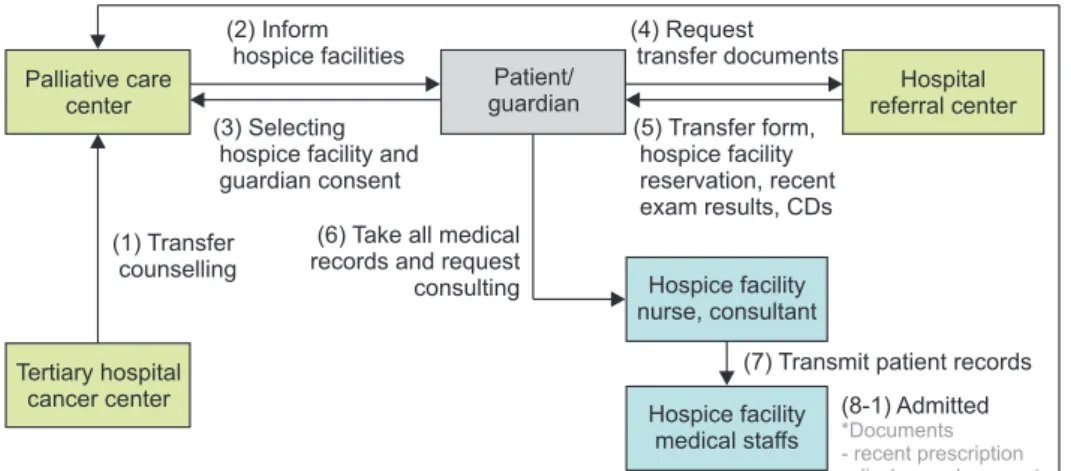
The current hospice referral process for terminally ill cancer patients through referral centers in tertiary hospitals is as follows: (1) If an inpatient with cancer and a life expectancy of 6 months or less states that he/she no longer wants to continue anti-cancer treatment, (2) the patient is guided to the hospice counseling center of the hospital to request for a referral. The counselor calls hospices to check whether they have an open-bed and informs the guardian. (3) From among the hospices that have open-beds, the guardian and patient select one and inform the counselor about their choice. The counselor then guides them to the Hospital Re-ferral Center. (4) The patient or the guardian requests for referral documents from the Hospital Referral Center. (5) The referral center arranges a reservation and provides the care record summary (CRS), recent exam results, and CDs. Additionally, the patient/guardian signs a consent form for the HIE. (6) Thereafter, the guardian takes all the medical records and visits the hospice to request admission consult-ing. (7) A nurse or consultant of the hospice transmits the patient records to the medical staff. (8-1) If the patient is admitted, the patient is discharged from the tertiary hospital and proceeds with the admission process in the hospice. (8-2) If not, the guardian returns to the tertiary hospital and re-starts the process from (2) until the patient is admitted to a suitable hospice (Figure 1).
There is a HIE system to make the patient exchange be-tween institutions easy and efficient. However, the current standard has a limitation that cannot cover important pa-tient information. Guardians have to visit various offices to get copies of all medical records because they do not know what kind of documents they need. The medical records are voluminous and may confuse the consulting manager at the
Figure 1. Current terminal cancer pa-tient transfer process.
(1) Transfer counselling
(2) Inform hospice facilities
(3) Selecting hospice facility and guardian consent
(6) Take all medical records and request consulting (4) Request transfer documents (5) Transfer form, hospice facility reservation, recent exam results, CDs
(7) Transmit patient records (8-1) Admitted *Documents - recent prescription - discharge document Palliative care center Tertiary hospital cancer center Hospital referral center Hospice facility nurse, consultant Hospice facility medical staffs Patient/ guardian
hospice, which may result in under-recognition of important information regarding the care needed for the patient. In ad-dition, lack of information about hospices makes it difficult to select a suitable hospice for each patient.
2. Process Problems and User Requirements
In all, 10 categories and 40 data items are newly suggested for addition to the existing HIE document form. Based on the current system and the results of the investigation on the process, the TFT identified the following two problems that may result in complications and delays in the referral pro-cess.
1) A narrow range of patient information in the current HIE form
The existing HIE form does not provide enough specific information to maintain the continuity of patient care for terminally ill cancer patients. To maintain the continuity of patient care, specific information about the patient’s current status and treatment is needed, such as the status of the ter-minally ill (no option for active anti-cancer treatment; con-dition of gradual deterioration) and the use of specific drugs (restricted antibiotics, inotropics, and non-reimbursement drugs). Furthermore, knowing a patient’s (1) mental status data, whether he or she is mentally alert, (2) functional status data, such as vital sign stability or ventilator usage, ascites/ pleural catheter insertion, and (3) data on whether the pa-tient has contracted any infectious disease, and so on, are all crucial in the care for cancer patients. For patient admission consulting and sustainable treatment, each facility requires various medical records. However, because the current HIE form does not cover many of these, the guardian should visit each office to get copies of all the medical records. This takes up the time and resources of the guardian both physically and psychologically.
2) Lack of information about hospices
When the counselor of a palliative care center in a tertiary hospital chooses a facility, he or she calls the hospice to check whether there is an open bed. Even if there is an open bed, there is a possibility that the patient is refused admis-sion because each facility has different patient admisadmis-sion policies and service coverages. When reserving a facility, the counselor will consider these factors to prevent a guardian from having to repeat the admission process multiple times. Based on the results of the problem analysis, the expert panel identified three outputs to strengthen the current sys-tem: they (1) re-defined the HIE form, (2) made an entity
definition to collect practical information about hospices and (3) re-designed the hospice referral scenario for termi-nally ill cancer patients.
3. Design of the Hospice Referral Scenario for Terminally Ill Cancer Patients
This scenario is designed based on the two research outputs mentioned above. The newly designed process is as follows: If an inpatient with cancer and a life expectancy of 6 months or less states that he/she no longer wants to continue anti-cancer treatment, (1) then the hospital referral center staff checks the information on the hospices taking into consid-eration the status of the patient, admission policies of each hospices, open-bed status, and treatment coverages. After selecting adequate candidates, the staff informs the patient/ guardian. The patient/guardian agrees to participate in the HIE and selects one hospice. (2) Through the HIE system, the tertiary hospital staff sends the patient information to the hospice. (3) The staff in the hospice receives and checks the information before deciding whether the patient can be admitted. After making a decision, the hospice informs the tertiary hospital staff and notifies them of the available time to visit. (4) After receiving the reply, the tertiary hospital staff informs the patient/guardian to arrange a visit. (5) After arranging an appointment, the patient/guardian visits the hospice at the appointed time, and the patient is discharged from the tertiary hospital to proceed with the admission process into the hospice (Figure 2).
In this scenario, the staff at the tertiary hospital can search for suitable hospices. The guardian does not have to go back and forth between hospices because all the patient infor-mation is delivered to the hospice institution in advance through the HIE system. Additionally, the staff at the hospice can easily access the medical records important for caring for the patient.
4. Data Standardization
We matched and suggested each content with a global stan-dard to ensure the interoperability of the newly added con-tents in the referral form.
1) HIE form for hospice referral for terminally ill cancer pa-tients
(1) Basic information
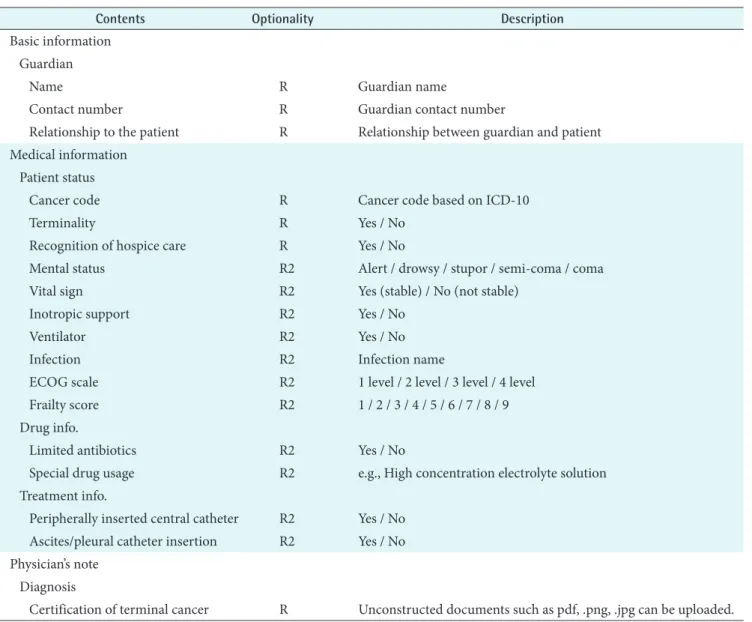
The header section of the standard HIE form describes the basic patient information [15]. However, all the interviewees responded that they would contact the guardian instead of the patient. Therefore, guardian information is proposed
to be added to the header section, and all optionality of the sub-contents are set as an essential value, which means they ‘must be filled in’. There are three options: O, R, and R2. O
refers to data that are completed on the HIE form depend-ing on the decision of the medical staff. R refers to data that are essential and required on the HIE form, and R2 refers to
(1) Check the information of hospice facilities in advance
(2) Information exchange through HIE system
- Palliative care consent - Terminal cancer certificate - Medical treatment benefit
document
- Patient medical records
(3) Availability and schedule inform (5) Visit the hospice in pre-arranged schedule
(4) Inform available hospice facility information and reserved date by phone or message Hospital referral center Tertiary hospital cancer center Hospice facility medical staffs Patient/ guardian
Figure 2. Newly designed terminal cancer patient transfer pro-cess.
Table 1. Additional data items for hospice referral for terminally ill cancer patients
Contents Optionality Description
Basic information Guardian
Name R Guardian name
Contact number R Guardian contact number
Relationship to the patient R Relationship between guardian and patient
Medical information Patient status
Cancer code R Cancer code based on ICD-10
Terminality R Yes / No
Recognition of hospice care R Yes / No
Mental status R2 Alert / drowsy / stupor / semi-coma / coma
Vital sign R2 Yes (stable) / No (not stable)
Inotropic support R2 Yes / No
Ventilator R2 Yes / No
Infection R2 Infection name
ECOG scale R2 1 level / 2 level / 3 level / 4 level
Frailty score R2 1 / 2 / 3 / 4 / 5 / 6 / 7 / 8 / 9
Drug info.
Limited antibiotics R2 Yes / No
Special drug usage R2 e.g., High concentration electrolyte solution
Treatment info.
Peripherally inserted central catheter R2 Yes / No
Ascites/pleural catheter insertion R2 Yes / No
Physician’s note Diagnosis
Certification of terminal cancer R Unconstructed documents such as pdf, .png, .jpg can be uploaded.
R: essentially required data, R2: preferably filled data, ICD-10: the 10th revision of the International Statistical Classification of Dis-eases and Related Health Problems, ECOG: Eastern Cooperative Oncology Group.
data that are optional on the HIE form. (2) Medical information
The body section of the current HIE form contains the medical information of the patient such as diagnosis, exami-nations, investigations carried out, prescription, etc. Except for these, the status of the patient, specific drug information, and the treatment information such as ascites or pleural catheter insertion are also important information to assess the admission and continuous care of a patient. Therefore, we suggest adding these datasets to the current HIE form, and the optionality of all data are set as ‘will be completed if necessary’. Some of the data are needed to make sure
wheth-er the facility has the specific treatment instruments that are vital to care for patients, such as ventilators, inotropic sup-port, etc. (Table 1).
(3) Physician’s note
Due to the MOHW’s legal amendments, a physician’s note must be submitted to certify that the patient is terminally ill with a life expectancy of 6 months or less. Therefore, the standard HIE form is supplemented with the physician’s note block. Because the physician’s note will include a brief nar-rative of the clinical findings and patient status, it is set in an unstructured form, and documents and images can be at-tached to it (Table 1).
Table 2. Consent form for health information exchange (HIE)
Contents Optionality Description
Document
Document name R HIE agreement form
Registration number R HIE registration number
Registration date, time R HIE registration date and time
Patient
Name R Patient name
ID number R Patient identification number
Address R Patient address
Contact number R Patient contact number
Guardian
Name R Guardian name
ID number R Guardian identification number
Relationship with patient R Relationship between guardian and patient
Address R Guardian address
Contact number R Guardian contact number
Receiving medical institution
Institution number R Object Identifier (OID) of medical institution
Hospice code R Hospice code issued by HIRA
Hospice name R Hospice name
Contact number R Hospice contact number
Address O Hospice address
Transferring medical institution
Institution number R Exchange object registration number
Institution code R Institution code issued by HIRA
Institution name R Institution name
Contact number R Institution contact number
Address O Institution address
R: essentially required data, O: data to be filled depending on the decision of medical staff, HIRA: Health Insurance Review & As-sessment Service.
(4) HIE agreement
When exchanging the health information of patients, the consent of a patient is essential. However, because of the
pa-tients’ poor general condition, most patients find it difficult to visit the referral center by themselves. Therefore, a guard-ian who can prove his or her relationship with the patient Table 3. Suggested HL7 CCDA documents and sections for each newly proposed data item
Contents Added contents Document Section Optionality
Guardian
Name CCDA CCDA Templates for Clinical Notes Draft
standard for Trial use Release 2.1 - US Realm Header
US Ream Header
Guardian/guardianPer-son/Name
Contact number CCDA Guardian/telecom
Relationship with patient CCDA Guardian/code
Palliative care recognition None Narrative block -
-Functional status
Vital sign stability None Narrative block -
Ventilator usage None Narrative block -
ECOG scale Oncology
CDA
Clinical Oncology Treatment Plan and Summary Release 1 - US Realm
Functional status Sec-tion CCTPS
ECOG assessment scale observation
Frailty score CCDA CDA Templates for Clinical Notes
Draft standard for Trial use Release 2.1
Functional status
Assessment scale supporting observation Mental status
Mental status CCDA CDA Templates for Clinical Notes
Draft standard for Trial use Release 2.1
Mental status Assessment scale supporting Assessment and plan
PICC CCDA CDA Templates for Clinical Notes
Draft standard for Trial use Release 2.1
Assessment and plan
Planned Act > Instruction Ascites/Pleural catheter
insertion
CCDA Assessment
and plan
Planned Act > Instruction Patient status
C-code UI Cancer patient registration code -
Infected disease name UI Checking diagnosis code is required
(MRSA:&U82.1, VRSA:&U83.0, VRE:&U83.0, CRE:&U82.80)
-
Cancer stage (terminality) Oncology CDA
Clinical Oncology Treatment Plan and Summary Release 1 - US Realm
Problem section
SCP/Cancer Concern Act/ Cancer Type
Observation/Tumor Clinical Stage Drug Info.
Limited antibiotic usage None Narrative block -
High concentration electrolyte solution
None Narrative block -
Non-paid drug usage None Narrative block -
Inotropics usage UI Check the medication (yes / no) -
-CCDA: Consolidated Clinical Document Architecture, CDA: Clinical Document Architecture, UI: user interface, CCTPS: Com-munity-based Care Transition Care Programs, ECOG: Eastern Cooperative Oncology Group, PICC: peripherally inserted central catheter.
Table 4. Example of data form to collect information on hospices
Hospice A Hospice B Hospice C Hospice D Hospice E Hospice F
Hospice type (location)
Urban Yes No Yes Yes Yes No
Independent No Yes No No Yes Yes
Nature-friendly Yes No No No Yes No
Volume of wards
Total 11 beds 60 beds 20 beds 17 beds 12 beds 17 beds
General ward 2 wards
(4 men/ room) 6 wards (3 men/room) 4 wards (4 men/room) 4 wards (4 men/room) 3 wards (12 men/ room) 4 wards (3 men/room) 1 ward (4 men/room)
Single/double room 3 single rooms 4 single rooms,
19 double rooms
4 single rooms 1 single room None 1 single room
HIS
HIS usage Yes Yes Yes No Yes No
Using commercial S/W To be changed Self-developed Yes No Yes No
Patient admission policy (patient status)
Alert patient only Yes Yes No No No No
Infected patient Yes No Yes No No No
Medical service coverage
Care guide service No Yes Yes Yes Yes Yes
Care guide pay No Yes Yes Yes Yes Yes
Hemodialysis No No Yes No No No
Transfusion Yes No Yes No Yes No
Thoracentesis/Paracentesis Yes/Yes Yes/Yes Yes/Yes Yes/Yes Yes/Yes No/Yes
Patient admission process
Face-to-face consultation Yes No Yes Yes Yes No
Waiting Yes Yes Yes None Yes Yes
Waiting time open Yes No Yes None Yes No
Treatment information
PICC Yes No Yes Yes Yes Yes
Ascites/Pleural catheter insertion
Yes No Yes Yes Yes Yes
Etc. #URE patient
isolated None #physician’s order of recent 3 days, drugs for 1 month needed #drugs for 3 days needed #referral form, medical records needed, #spiritual care provided None
can sign the consent form instead of the patient. Therefore, we suggested adding the consent section to the current stan-dard HIE form. Once the patient or the guardian agrees to share the medical records of the patient, the Master Patient Index (MPI) number to identify the patient is issued, and the private information of patient is protected (Table 2). The MPI is an index issued to each patient for maintaining con-fidentiality about each patient registered in the system. In this system, the patient document created is referred to by its MPI number.
(5) Document standard
We proposed to adopt the HL7 CCDA international stan-dard because it can cover a wide range of contents, and the existing referral form designed by the MOHW of Korean government also follows the global HL7 standard. In the case of data not defined by the HL7 CCDA, they are set as a part of the narrative block. The narrative block is the area in the CDA document that people can read (Table 3).
2) Entity definition to collect practical information about hospices
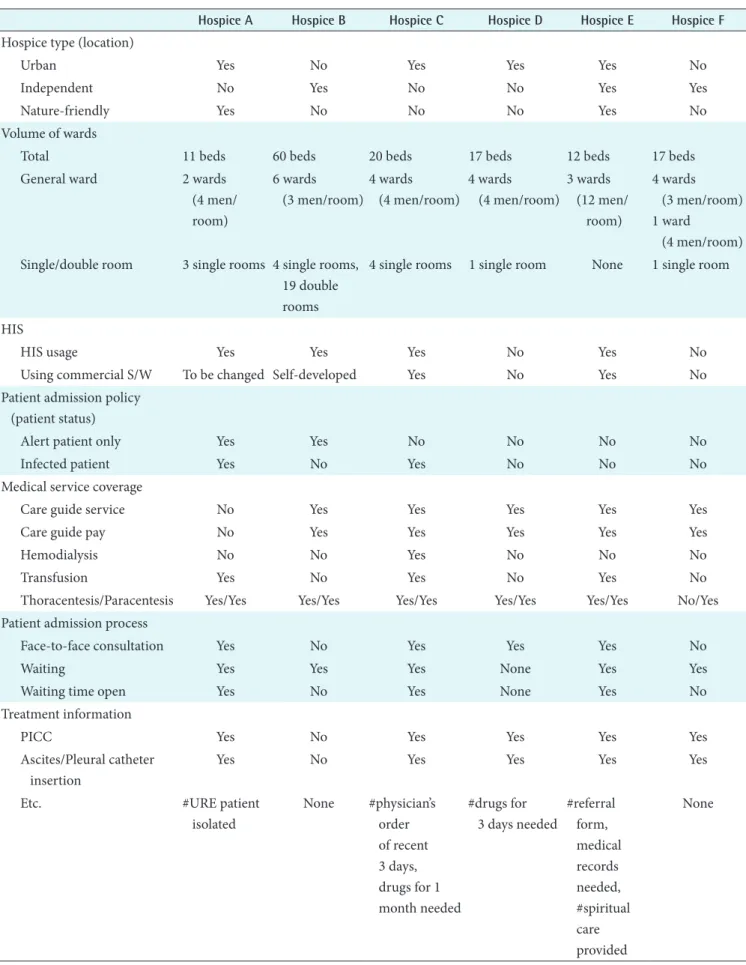
We defined datasets for collecting hospice information needed to select facilities that are suitable for the patients’ needs based on the requirements of the institutions. A total of 7 categories and 21 items were defined except for the in-formation on the interviewer and the basic inin-formation on the hospice organization.
The suggested data categories and contents are as follows: facility type, volume of wards, the kind of HIS, patient ad-mission policy, range of services provided, patient admis-sion process, and treatment information. After defining the datasets, information corresponding to the data model in 6 hospice institutions was collected (Table 4).
IV. Discussion
About 15% of cancer patients presently receive hospice care, and the rate is gradually growing. However, hospice referral for terminally ill cancer patients is not a smooth process; in-stead, there are frequent delays. There are considerable chal-lenges in exchanging patient medical records and selecting adequate hospices. The obstacles are in the existing standard of the HIE form, which does not fully cover the necessary medical records and documents and does not include de-tailed information on hospices, such as patient admission policies, service coverages, and current bed occupancies. Re-ceiving the right care in the right place at the right time is
vi-tal to patients who are living their last few weeks or months [15]. To ensure their quality of life, the existing referral sys-tem must be strengthened.
There are precedent studies that have raised issues regard-ing the current HIE system, such as its usability, elements of the HIE form, and patient or guardian consent for sharing patient medical records [7]. These issues have been raised not only in Korea but also in other countries. Kisekka and Giboney [16] found that privacy concerns reduce the fre-quency of patient access to health records use and positive attitudes towards the HIE. However, belief in the effective-ness of information security increases the frequency of pa-tient access to health records and helps to develop a positive attitude towards the HIE. Parker et al. [17] argued about the limited extent of data and lack of participation, which pre-vent further development of HIEs. Based on these studies, our study tried to provide insights into encouraging referrals of cancer patients to hospice facilities by suggesting a data model for collecting hospice facility information, a more ad-equate HIE form, and a re-design of the hospice referral for terminally ill cancer patients. However, there are many chal-lenges to improving the existing referral system for cancer patients. Most of the hospice facilities have different patient admission policies and tend to deny admission to patients who need intensive care. Therefore, government-centered detailed guidelines and instrumentation requirements to admit patients to hospice care facilities are needed in the future. We expect our study to contribute by improving the quality of life of cancer patients, not only for the 10% of pa-tients with cancer who are receiving hospice care presently but also for potential users in the future, by making the hos-pice referral system more efficient.
Conflict of Interest
No potential conflict of interest relevant to this article was reported.
Acknowledgments
This work was supported by the Creative Industrial Technol-ogy Development Program (No. 10053249, Development of personalized healthcare system exploiting user life-log and open government data for business service model proof on whole life cycle care) funded by the Ministry of Trade, In-dustry & Energy, Korea.
References
1. Hemati Z, Ashouri E, AllahBakhshian M, Pourfarzad Z, Shirani F, Safazadeh S, et al. Dying with dignity: a con-cept analysis. J Clin Nurs 2016;25(9-10):1218-28. 2. Jordhoy MS, Fayers P, Loge JH, Ahlner-Elmqvist M,
Kaasa S. Quality of life in palliative cancer care: re-sults from a cluster randomized trial. J Clin Oncol 2001;19(18):3884-94.
3. De Palma R, Fortuna D, Hegarty SE, Louis DZ, Melotti RM, Moro ML. Effectiveness of palliative care services: a population-based study of end-of-life care for cancer patients. Palliat Med 2018;32(8):1344-52.
4. Worldwide Palliative Care Alliance. Global atlas of pal-liative care at the end of life. London, UK: Worldwide Palliative Care Alliance; 2014.
5. Treating patients with cancer: reason for being popular, hospice care [Internet]. Seoul, Korea: Hankyung.com; 2017 [cited at 2018 Oct 1]. Available from: http://news. hankyung.com/health/article?aid=201701020995a. 6. Health Insurance Review & Assessment Service. Effect
analysis of hospice care. Wonju, Korea: Health Insur-ance Review & Assessment Service; 2018.
7. Ji H, Yoo S, Heo EY, Hwang H, Kim JW. Technology and policy challenges in the adoption and operation of health information exchange systems. Healthc Inform Res 2017;23(4):314-21.
8. Wright AA, Zhang B, Keating NL, Weeks JC, Prigerson HG. Associations between palliative chemotherapy and adult cancer patients' end of life care and place of death: prospective cohort study. BMJ 2014;348:g1219.
9. HL7/ASTM Implementation Guide for CDA R2 - Con-tinuity of Care Document (CCD) Release 1 [Internet]. Ann Arbor (MI): Health Level Seven International;
c2018 [cited at 2018 Oct 1]. Available from: http:// www.hl7.org/implement/standards/product_brief. cfm?product_id=6
10. Ministry of Health and Welfare. Guideline for adopting standard health information exchange. Seoul, Korea: Ministry of Health and Welfare; 2017.
11. Kernan R. Clinical Document Architecture (CDA), Consolidated-CDA (C-CDA) and their role in meaning-ful use (MU) [Internet]. Washington (DC): Office of the National Coordinator for Health Information Technol-ogy; 2012 [cited at 2018 Oct 1]. Available from: https:// www.healthit.gov/sites/default/files/resources/cda_c-cda_theirrole_in_mu.pdf.
12. Rhee YJ. Hospice and palliative care services in South Korea supported by the National Health Insurance (NHI) program. Health 2015;7:689-95.
13. Kim CG. Hospice & palliative care policy in Korea. Ko-rean J Hosp Palliat Care 2017;20(1):8-17.
14. Park SK, Chwa YK, Kim M, Cho K, Kang D, Kim J, et al. Health information exchange standard adopting guide-line. Cheongju, Korea: Korea Health Industry Develop-ment Institute; 2017.
15. van Oorschot B. Early integrated palliative care in can-cer patients improves quality of life and encourages discussions about preferences for care at the end of life. Strahlenther Onkol 2018;194(2):178-80.
16. Kisekka V, Giboney JS. The effectiveness of health care information technologies: evaluation of trust, security beliefs, and privacy as determinants of health care out-comes. J Med Internet Res 2018;20(4):e107.
17. Parker C, Weiner M, Reeves M. Health information ex-changes: unfulfilled promise as a data source for clinical research. Int J Med Inform 2016;87:1-9.