© Copyright
Keimyung University School of Medicine 2015
A 50-year-old man visited our pain clinic due to acute herpes zoster with rash occurred 10 days ago. The crusts formed and covered left C3-4 dermatome.
Neuroaxial block was worried about infection. Superficial cervical plexus block (SCPB) was performed at left C4 level twice for a month with 1% lidocaine 20 mL and triamcinolone 20 mg. After SCPB, pain and itching were reduced and the patient could sleep at night without awakening. But pregabaline 150 ㎎/day was kept due to mild to moderate pain and itching 7 months later from rash. In this case, SCPB was effective method to reduce acute pain and itching but it could not prevent postherpetic neuralgia.
Key Words: Cervical plexus, Herpes zoster, Nerve block, Postherpetic neuralgia
Introduction
Acute herpes zoster results from reactivation of endogenous varicella zoster virus which cause chickenpox in childhood and become latent in dorsal root ganglia of spinal nerve or trigeminal ganglia. Pain caused by acute herpes zoster is characterized as shooting, burning, throbbing, and itching with or without allodynia [1].
Sympathetic block, epidural block or paravertebral block were performed as interventions to prevent postherpetic neuralgia (PHN) [2-4]. Deep cervical plexus block combined with stellate ganglion block or occipital nerve block in 2 cases might reduce acute pain and prevent PHN [5].
The superficial cervical plexus composed with ventral rami of C1-4 spinal nerve. The dye spread of superficial cervical plexus block (SCPB) was found at deep cervical space [6]. Therefore, SCPB may be
Received: August 25, 2015 Revised: October 6, 2015 Accepted: October 13, 2015
Corresponding Author: Park Ki-Bum, M.D., Department of Anesthesiology and Pain Medicine, Keimyung University School of Medicine, 56 Dalseong-ro, Jung-gu, Daegu 41931, Korea Tel: +82-53-250-7249
E-mail: [email protected]
• The authors report no conflict of interest in this work.
Department of Anesthesiology and Pain Medicine, Keimyung University School of Medicine, Daegu, Korea
Ki-Bum Park, M.D.
Superficial Cervical Plexus Block for Acute Herpes
Zoster at C3-4 Dermatome
helpful for reduction of pain in acute herpes zoster around neck and prevent PHN in cases which epidural block is relatively contraindicated.
In this article, we reported 50-year-old man who had acute herpes zoster in the left C3-4 area suffering with severe itching and shooting pain, was treated effectively with SCPB.
Case Report
A 50-year-old man, who had crust formation without pustule in the left neck, visited our pain clinic due to pain. The rash was formed 10 days ago and throbbing pain preceded 3 days before rash eruption. He complained pain which characterized with pricking, shooting and itching.
The Visual analogue scale (0 = no pain, 10 = worst pain imaginable) was 7-8 and severe itching occurred abruptly. The symptoms disturbed sleep frequently. Pregabalin 300 ㎎/day, celecoxib 200
㎎/day, nortriptyline 10 ㎎/day and famciclovir 250
㎎/day was prescribed for pain control. In the past medical history, he had hypertension only.
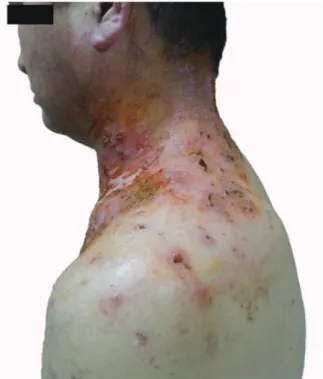
In inspection, the dermatome C3-4 covered with a lot of crusts spreading broadly left anterior to posterior neck (Fig. 1). Although, laboratory findings such as white blood cell count, erythrocyte sedimentation rate, and C-reactive protein were normal, epidural block for left unilateral injection worried about infection in neural axis. Instead of epidural block, we considered that SCPB might be adequate block to reduce pain and escape infection risk of neural axial injection although increasing infection risk of injection site.
The ultrasound (10-15 Hz, linear probe, SSD 4000, Aloka) guided SCPB block was done at the C4 level. The skin was prepared with 10%
povidone iodied. The needle was positioned to behind sternocleidomastoid (SCM) muscle but
superficial to the deep fascia (Fig. 2). The 0.5%
lidocaine 20 mL mixed with triamcinolon 20 mg Fig. 1. Crusts formation was observed in left C3-4 dermatome from anterior to posterior neck. The skin was cured without infection.
Fig. 2. Superfical cervical plexus block was done at left C4 level. The arrowheads points needles which located behind sternocleidomastoid (SCM) muscle and did not penetrate deep fascia. CA: carotid artery, SM: scalenus medius.
was injected and it spread toward to carotid sheath.
The procedure was done twice for a month with two weeks intervals. One month after first SCPB, pregabaline 300 mg/day was maintained and the pain was reduced (VAS 3-4). The frequency and intensity of itching were reduced but sporadic itching sensation with few seconds bothered the patient 6-7 times during daytime. The patient could sleep at night without awakening so he did not want additional neuroaxial block for work even though wound of skin had been clear. After pregabaline 300 mg/day was kept for two months, the dose of pregabalin could be reduced to 150 mg/day. The pain (VAS 3-4) and mild to moderate itching for a few times were continued to 7 months later from rash. The SCPB was effective to reduce symptom of acute herpes zoster without infection but it could not prevent PHN.
Discussion
The patient was diagnosed with acute herpes zoster at left C3-4 dermatome with prodromal symptom 3 days before rash. He complained severe pain (VAS 7-8) and itching which occurred abruptly and disturbed sleep. The SCPB was performed twice for a month and it reduced the pain and itching of acute herpes zoster. It could reduce the dose of medication also, but could not prevent PHN.
The definition for PHN is different among the researchers. PHN defines continuation of pain over 90 days after acute herpes zoster rash. The severity of pain is ≥ 3 (0 = no pain, 10 = as imagine as) [7].
The prevalence of PHN increases with age more than 50 years [8]. Old age, acute pain intensity and deep pain are important factors as the predictor of PHN [9,10]. The mean of deep pain is deeper pain compared with superficial pain which was from
cutaneous surface or evoked by finger pinch of skin [10]. Other factors increased incidence of PHN were walking problem at enrollment and pain which influence relationship with other people at enrollment [11]. In this case, the patient was 50-year-old with hypertension. Therefore, the risk factors in this case were old age, and severity of pain.
To treatment of herpes zoster, early antiviral drugs administration reduces acute pain [12].
Another important method for prevention of PHN is neuroaxial block. Continuous epidural block revealed more effective to reduce intensity of pain and incidence of sustenance for pain than intermittent epidural block [13]. Peripheral nerve block was used sometimes in cases which neuroaxial block accompany with some risks such as infection and hematoma. Peripheral nerve block with steroid reduced pain in nerve injury model.
The mechanism suggested that steroid reduce ectopic discharge from damaged neuron [14] and reduce perineural inflammation which results to stabilize membrane [15]. Three-in-one-block or deep cervical plexus block were used and had effective reduction of pain in acute herpes zoster [5,16]. Superficial cervical plexus gives four branches which are lesser occipital nerve (C2), greater auricular nerve (C2,3), transverse cutaneous nerve of neck (C2,3) and supraclavicular nerve (C3,4). Those branches emerge from posterior border of SCM muscle. SCPB easily performed by ultrasound guided block. Especially in SCPB, local analgesics spread to cervical root in cadaveric study [6]. In our case, SCPB was done with 0.5%
lidocaine 20 mL plus triamcinolone 20 mg twice using ultrasound and we observed local anesthetic spread from behind SCM muscle to carotid sheath.
The sympathetic block was traditionally used for treatment of herpes zoster to relieve acute pain and prevent PHN. Sympathetic action after nerve
injury was observed through α-adrenergic antagonist relieved pain [17] or sympathetic axons sprout onto dorsal root ganglion after peripheral nerve injury [18]. Shin et al. [19] reported that symptoms of acute herpes zoster at C3 dermatome in 65-year-old man were reduced effectively by stellate ganglion block and SCPB, but did not described long-term follow up in that case. In our case, only SCPB was performed twice for a month and contributed effectively to reduce acute herpes zoster pain and minimized chronic pain, but unfortunately, might be insufficient to prevent PHN.
In conclusion, SCPB reduced acute pain effectively induced by herpes zoster in C3-4 dermatome level but it did not prevent postherpetic neuralgia. More study should be needed for whether SCPB prevent PHN.
References
1. Johnson RW, Wasner G, Saddier P, Baron R. Herpes zoster and postherpetic neuralgia: optimizing management in the elderly patient. Drugs Aging 2008;25:991-1006.
2. Pasqualucci A, Pasqualucci V, Galla F, De Angelis V, Marzocchi V, Colussi R, et al. Prevention of post- herpetic neuralgia: acyclovir and prednisolone versus epidural local anesthetic and methylprednisolone. Acta Anaesthesiol Scand 2000;44:910-8.
3. Ji G, Niu J, Shi Y, Hou L, Lu Y, Xiong L. The effectiveness of repetitive paravertebral injections with local anesthetics and steroids for the prevention of postherpetic neuralgia in patients with acute herpes zoster. Anesth Analg 2009;109:1651-5.
4. Makharita MY, Amr YM, El-Bayoumy Y. Effect of early stellate ganglion blockade for facial pain from acute herpes zoster and incidence of postherpetic neuralgia. Pain Physician 2012;15:467-74.
5. Hardy D. Relief of pain in acute herpes zoster by nerve blocks and possible prevention of post-herpetic neuralgia. Can J Anaesth 2005;52:186-90.
6. Pandit JJ, Dutta D, Morris JF. Spread of injectate with superficial cervical plexus block in humans: an anatomical study. Br J Anaesth 2003;91:733-5.
7. Oxman MN, Levin MJ, Johnson GR, Schmader KE, Straus SE, Gelb LD, et al. A vaccine to prevent herpes zoster and postherpetic neuralgia in older adults. N Engl J Med 2005;352:2271-84.
8. Yawn BP, Gilden D. The global epidemiology of herpes zoster. Neurology 2013;81:928-30.
9. Drolet M, Brisson M, Schmader K, Levin M, Johnson R, Oxman M, et al. Predictors of postherpetic neuralgia among patients with herpes zoster: a prospective study.
J Pain 2010;11:1211-21.
10. Kanbayashi Y, Onishi K, Fukazawa K, Okamoto K, Ueno H, Takagi T, et al. Predictive factors for postherpetic neuralgia using ordered logistic regression analysis. Clin J Pain 2012;28:712-4.
11. Kawai K, Rampakakis E, Tsai TF, Cheong HJ, Dhitavat J, Covarrubias AO, et al. Predictors of postherpetic neuralgia in patients with herpes zoster: a pooled analysis of prospective cohort studies from North and Latin America and Asia. Int J Infect Dis 2015;34:126-31.
12. Wassilew S. Brivudin compared with famciclovir in the treatment of herpes zoster: effects in acute disease and chronic pain in immunocompetent patients. A randomized, double-blind, multinational study. J Eur Acad Dermatol Venereol 2005;19:47-55.
13. Manabe H, Dan K, Higa K. Continuous epidural infusion of local anesthetics and shorter duration of acute zoster-associated pain. Clin J Pain 1995;11:220- 8.
14. Johansson A, Bennett GJ. Effect of local methylpredni-solone on pain in a nerve injury model.
A pilot study. Reg Anesth 1997;22:59-65.
15. O'Gradaigh D, Merry P. Corticosteroid injection for the treatment of carpal tunnel syndrome. Ann Rheum
Dis 2000;59:918-9.
16. Hadzic A, Vloka JD, Saff GN, Hertz R, Thys DM. The
"three-in-one block" for treatment of pain in a patient with acute herpes zoster infection. Reg Anesth 1997;22:575-8.
17. Raja SN, Treede RD, Davis KD, Campbell JN.
Systemic alpha-adrenergic blockade with phentolamine: a diagnostic test for sympathetically maintained pain. Anesthesiology 1991;74:691-8.
18. McLachlan EM, Janig W, Devor M, Michaelis M.
Peripheral nerve injury triggers noradrenergic sprouting within dorsal root ganglia. Nature 1993;363:543-6.
19. Shin HY, Kim DS, Kim SS. Superficial cervical plexus block for management of herpes zoster neuralgia in the C3 dermatome: a case report. J Med Case Rep 2014;8:59.