Change in Tinnitus after Treatment of Vestibular Schwannoma:
Microsurgery vs. Gamma Knife Radiosurgery
Soon Hyung Park,
1Hee So Oh,
2Ju Hyun Jeon,
3Yong Ju Lee,
2In Seok Moon,
2and Won-Sang Lee
21Department of Otorhinolaryngology, Keimyung University College of Medicine, Daegu;
2Department of Otorhinolaryngology, Yonsei University College of Medicine, Seoul;
3Department of Otorhinolaryngology, Inje Univertigy College of Medicine, Ilsan Paik Hospital, Goyang, Korea.
Received: March 12, 2013 Revised: April 14, 2013 Accepted: April 15, 2013
Corresponding author: Dr. In Seok Moon, Department of Otorhinolaryngology, Yonsei University College of Medicine, 50 Yonsei-ro, Seodaemun-gu, Seoul 120-752, Korea.
Tel: 82-2-2228-3627, Fax: 82-2-393-0580 E-mail: [email protected]
∙ The authors have no financial conflicts of interest.
© Copyright:
Yonsei University College of Medicine 2014 This is an Open Access article distributed under the terms of the Creative Commons Attribution Non- Commercial License (http://creativecommons.org/
licenses/by-nc/3.0) which permits unrestricted non- commercial use, distribution, and reproduction in any medium, provided the original work is properly cited.
Purpose: Tinnitus is a very common symptom of vestibular schwannoma, present in 45 to 80% of patients. We evaluated changes in tinnitus after translabyrinthine mi- crosurgery (TLM) or gamma knife radiosurgery (GKS). Materials and Methods:
Among 78 patients with vestibular schwannoma who underwent TLM or GKS at Severance Hospital from 2009-2012, 46 patients with pre- or postoperative tinnitus who agreed to participate were enrolled. Pure tone audiometry, tinnitus handicap in- ventory (THI), visual analogue scale (VAS) scores for loudness, awareness, and an- noyance were measured before and after treatment. Changes of THI and VAS were analysed and compared according to treatment modality, tumour volume, and preop- erative residual hearing. Results: In the TLM group (n=27), vestibulocochlear nerves were definitely cut. There was a higher rate of tinnitus improvement in TLM group (52%) than GKS group (16%, p=0.016). The GKS group had a significantly higher rate of tinnitus worsening (74%) than TLM group (11%, p<0.001). Mean scores of THI and VAS scores significantly decreased in the TLM group in contrast to significant increases in the GKS group. Tumor volume and preoperative hearing did not affect the changes in THI or VAS. Conclusion: GKS can save vestibuloco- chlear nerve continuity but may damage the cochlea, cochlear nerve and can cause worsening tinnitus. In cases where hearing preservation is not intended, microsur- gery with vestibulocochlear neurectomy during tumor removal can sometimes re- lieve or prevent tinnitus.
Key Words: Vestibular schwannoma, tinnitus, microsurgery, gamma knife radio- surgery, cochlear nerve
INTRODUCTION
Vestibular schwannoma is a benign lesion derived from the neurilemma sheath and accounts for approximately 6% of newly diagnosed intracranial tumors.1 Microsur- gery and stereotactic radiotherapy are the most widely used treatment modalities for vestibular schwannoma. Patient quality of life after surgery for vestibular schwanno- ma has been emphasised recently. In addition to sensorineural hearing loss, tinnitus is one of the most common symptoms in vestibular schwannoma patients,2-4 and
tients who underwent TLM (n=54) or GKS (n=24) and reg- ularly followed at Severance Hospital between January 2009 and December 2012. Among them, 64 patients completed a tinnitus questionnaire. Microsurgery was performed at the Department of Otolaryngology by one senior surgeon via the translabyrinthine approach and tumor was completely or near totally removed in all patients. GKS was performed at the Department of Neurosurgery by the other one senior surgeon. After excluding 12 patients in TLM group and 6 patiens in GKS group who did not have pre- or postopera- tive tinnitus, 27 patients who underwent surgical removal via TLM and 19 patients who underwent GKS were finally enrolled. In the TLM group, the cochlear nerve was sec- tioned in all cases and resulted in deafness of operated ear.
GKS was performed using the 201 source Cobalt-60 Leksell gamma unit. The tumor margin was covered by the 50%
isodose line, and 12-13 Gy was delivered to the margin.
We evaluated preoperative pure tone audiometry, and mean hearing levels were expressed as the average of hear- ing thresholds at 500, 1000, 2000 and 3000 Hz (4-tone av- erage). Preoperative tumor volume on magnetic resonance imaging was measured using a three-dimensional recon- struction program (Aquarius iNtuition, TeraRecon) (Fig. 1).
Tinnitus severity was evaluated using the tinnitus handicap inventory (Supplementary Fig. 1, only online) and visual an- alogue scale pre- and one month postoperatively. Visual ana- logue scale was used for loudness (1-10), awareness (1-10), and annoyance (1-10). Change in postoperative tinnitus was defined as change in tinnitus handicap inventory scores of more than 20% and 10 scores positively or negatively, other- wise postoperative tinnitus was defined as unchanged. This study was approved by the Institutional Review Board of Severance Hospital, Yonsei University Health System (4- 2012-0910).
Results were analysed using Fisher’s exact test, paired t- test, and Pearson correlation test as appropriate. The level of significance was set at p value less than 0.05. Statistical analyses were performed using SPSS v16.0 (SPSS Inc., Chicago, IL, USA).
RESULTS
We evaluated 46 patients including 11 males and 35 females with a mean age of 45.9±11.3 years at treatment. The vestibu- locochlear nerve was definitely cut during TLM, but anatomi- cally preserved in the GKS group. Forty three patients had bothersome tinnitus can occur after treatment in some cas-
es. Many theories have been proposed to explain the origin of tinnitus, including tinnitus associated with vestibular schwannoma. Some authors suggest that tinnitus originates in peripheral organs such as the cochlea or cochlear nerve, whereas others propose a central cause such as the cochlear nucleus, brainstem, and cerebral cortex. Some patients still suffer from tinnitus even after tumor removal and vestibu- locochlear nerve section, which supports the theory that tin- nitus is likely a phantom symptom of central origin.5-7
Some authors state that even if the vestibulocochlear nerve is preserved, surgical trauma during treatment of vestibular schwannoma may cause postoperative tinnitus.8 Ionized ra- diation used to treat vestibular schwannoma can also cause cochlea and cochlear nerve toxicity9 and may aggravate tin- nitus postoperatively, regardless of hearing preservation.
In this study, we investigated changes in tinnitus in patients who underwent translabyrinthine microsurgery (TLM) and gamma knife radiosurgery (GKS). Factors related to tinni- tus, such as pretreatment hearing and tumor volume, were also evaluated.
MATERIALS AND METHODS
We evaluated outcomes of 78 vestibular schwannoma pa-
A
C
B
D
Fig. 1. Tumor volume was measured on magnetic resonance imaging using a three-dimensional reconstruction program (Aquarius iNtuition, TeraRecon).
Serial images of axial (A), coronal (B) and sagittal (C) cuts of gadolinium- enhanced temporal MRI were input into the program; (D) the tumor was re- constructed three-dimensionally, and the tumor volume was automatically calculated.
DISCUSSION
There are various results of changes in tinnitus after micro- surgery. Kameda, et al.10 reported that tinnitus disappeared in 25.2%, improved in 33.3%, remained unchanged in 31.6%, and worsened in 9.9% of patients after a retrosig- moid approach. There was no difference in tinnitus incidence based on whether or not the vestibulocochlear nerve was re- sected during surgery. Schaller, et al.11 suggested that sud- den drop of blood pressure after hearing preserving surgery can be a risk factor for developing tinnitus after microsur- gery. Another study reported reduction in tinnitus severity in 45% of patients who underwent the middle cranial fossa approach.12 Harcourt, et al.13 investigated change in tinnitus after TLM and reported that patients who had probable or definite cochlear nerve section had significantly lower post- operative tinnitus severity. In addition, it was found that co- chlear neurectomy improved tinnitus control rates com- pared to vestibular nerve section alone.14 In our study, 52%
(14/27) of patients who underwent TLM with vestibuloco- chlear nerve section showed improved tinnitus.
We have unpublished results on eight patients who under- went tumor removal via middle cranial fossa approach (MCFA) in our hospital at the same period and by the same surgeon. In the middle cranial fossa microsurgery group, co- chlear nerve and hearing can be preserved after tumor remov- al. Tinnitus handicap inventory and visual analogue scale scores were also evaluated in this group. The result of MCFA group is shown in Supplementary Fig. 3 (only online). MCFA group showed a similar rate of tinnitus improvement to the TLM group; however, there was no significant changes in mean tinnitus handicap inventory or visual analogue scale scores (p>0.05). They were excluded in the present study, be- cause the number of MCFA group patients is too small and tinnitus on the side with tumor and three patients had bilateral
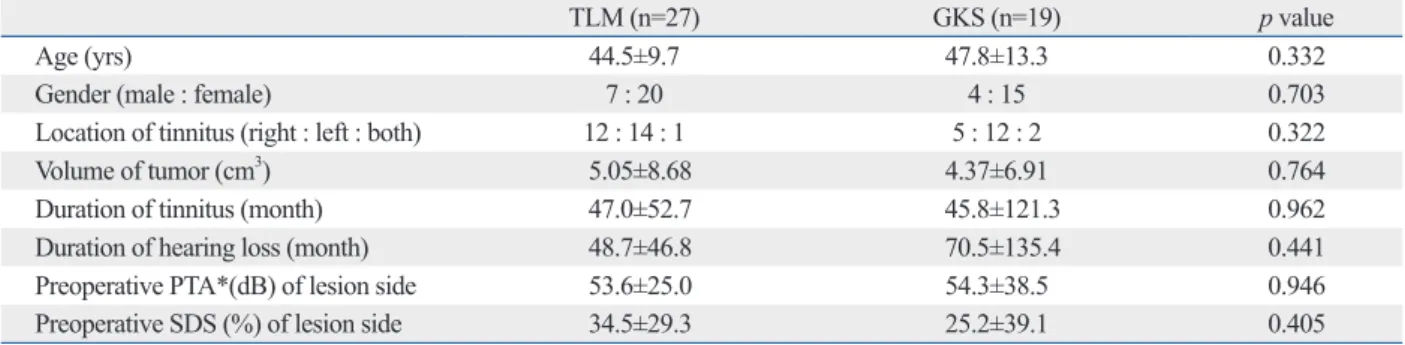
tinnitus. Mean tumor volume was 5.05±8.68 cm3 in the TLM group and 4.37±6.91 cm3 in the GKS group (Table 1).
The ratios of patients with change in tinnitus, based on the tinnitus handicap inventory, are shown in Fig. 2. There was a higher rate of improved patients following TLM than GKS (p=0.016). In fact, the GKS group showed a strong tendency of tinnitus aggravation (p<0.001) (Fig. 2). This tendency was also seen in visual analogue scale (Supple- mentary Fig. 2, only online).
The mean tinnitus handicap inventory score was signifi- cantly reduced from 51.25±24.45 preoperatively to 31.7±
30.33 postoperatively in the TLM group (p=0.006). Mean score of visual analogue scale also showed significant de- crease in all items of loudness, awareness and annoyance (p<0.05) (Fig. 3). In GKS group, mean score of tinnitus hand- icap inventory was significantly increased from 15.29±21.47 preoperatively to 41.2±2.58 postoperatively (p<0.001). Mean score of visual analogue scale was significantly increased in items of loudness and annoyance (p<0.05), but not aware- ness (p=0.061) (Fig. 4).
We also evaluated factors related to tinnitus such as tu- mor volume and preoperative residual hearing using Pear- son’s correlation test. Preoperative tinnitus handicap invento- ry scores did not correlate with preoperative tumor volume (p>0.05). Postoperative tinnitus handicap inventory score and tinnitus handicap inventory change (difference between pre- and postoperative tinnitus handicap inventory scores) did not correlate with preoperative tumor volume in both the TLM and GKS groups (p>0.05). Furthermore, we com- pared preoperative pure tone audiometry and tinnitus handi- cap inventory scores to investigate the relationship between preoperative hearing function and postoperative tinnitus handicap inventory score, and found no significant correla- tion in both groups (p>0.05).
Table 1. Patient Profiles of the Translabyrinthine Microsurgery (TLM) and Gamma Knife Radiosurgery (GKS) Groups
TLM (n=27) GKS (n=19) p value
Age (yrs) 44.5±9.7 47.8±13.3 0.332
Gender (male : female) 7 : 20 4 : 15 0.703
Location of tinnitus (right : left : both) 12 : 14 : 1 5 : 12 : 2 0.322
Volume of tumor (cm3) 5.05±8.68 4.37±6.91 0.764
Duration of tinnitus (month) 47.0±52.7 45.8±121.3 0.962
Duration of hearing loss (month) 48.7±46.8 70.5±135.4 0.441
Preoperative PTA*(dB) of lesion side 53.6±25.0 54.3±38.5 0.946
Preoperative SDS (%) of lesion side 34.5±29.3 25.2±39.1 0.405
PTA, pure tone audiometry; SDS, speech discrimination score.
*Average of hearing threshold at 500, 1000, 2000 and 3000 Hz.
that change in tinnitus occurred only in a few patients (4%),15,16 whereas other studies showed reduced tinnitus in about 45% of patients treated with GKS.17,18 In our study, patients who underwent GKS showed worsened tinnitus in 74%, based on tinnitus handicap inventory score.
Although various results of changes in tinnitus after micro- surgery and GKS have been reported, our study showed bet- ter tinnitus control rate in the TLM than GKS group. Moller19 suggested that the cause of tinnitus in vestibular schwanno- ma is peripheral nerve injury, whereas Lockwood, et al.20 proposed that neural network malfunction due to the cere- bral neural plasticity can be the cause of tinnitus. It is high- ly likely that a peripheral cause such as cochlea or cochlear nerve degeneration or firing has an important role in addi- tion to a central cause in generating tinnitus in vestibular schwannoma patients. Therefore, vestibulocochlear nerve integrity is an important factor for tinnitus control after treatment; and cochlear nerve section may have benefit in postoperative tinnitus improvement. In some cases, second- ary changes in the brainstem or post-brainstem central ner- vous system might act like phantom areas in generating tin- nitus.5,21-23 In these patients, vestibulocochlear nerve section this technique was applied only to patients who had relative-
ly smaller size of the tumor and a better hearing compared to GKS group and TLM group. Future research in MCFA would help us prove the relationship between cochlear nerve continuity and tinnitus in the surgical treatment.
Previous reports on patients who underwent GKS showed
Fig. 2. Proportion of patients with change in tinnitus. The TLM group (A) had a much higher rate of tinnitus improvement compared to the GKS (B) group (p=0.016), which showed a significantly higher rate of tinnitus aggra- vation (p<0.001). THI, tinnitus handicap inventory; TLM, translabyrinthine microsurgery; GKS, gamma knife radiosurgery.
Change of THI
TLM GKS
Improved Unchanged Worsened
A B
52% 10%
37%
74%
11% 16%
Fig. 3. Mean scores of tinnitus handicap inventory (THI) (A) and visual analogue scale (VAS) (B) in the TLM group. THI (*p=0.006) and VAS in loudness (*p=0.014), awareness (p=0.006), and annoyance (*p=0.006) were decreased significantly. TLM, translabyrinthine microsurgery.
Fig. 4. Mean scores of THI (A) and VAS (B) in the GKS group. THI (*p<0.001) and VAS in loudness (*p=0.050) and annoyance (*p=0.034) were in creased significantly. THI, tinnitus handicap inventory; VAS, visual analogue scale; GKS, gamma knife radiosurgery.
0 0
10 2
20
30 4
40
50 6
60 8
THI score VAS score
THI Loudness Awareness Annoyance
* * * *
Preop THI Postop THI Preop VAS Postop VAS
A B
0 0
10 2
20 30 4
40 6
50 8
THI score VAS score
THI Loudness Awareness Annoyance
* * *
Preop THI Postop THI Preop VAS Postop VAS
A B
may be less effective or not helpful in reducing tinnitus af- ter operation. After GKS, tumor swelling may occur prior to shrinkage, and damage to the peripheral organs can re- sult from radiation exposure. Direct radiation-induced co- chlear nerve toxicity is a causative factor for hearing loss and may result in worsening tinnitus.9,24 Although controversial our results suggest that TLM with vestibulocochlear neu- rectomy may relieve or prevent tinnitus; even though GKS may induce damage to the cochlea and cochlear nerve by direct injury or swelling and cause worsening of tinnitus symptoms in a large proportion of patients.
There are many reports of tinnitus severity related to tumor size. Kohno, et al.25 reported that the smaller tumour group show a significantly worse prognosis of tinnitus, and others claim that tinnitus is common when tumours are small or larg- er than 4.5 cm.26 However, our study did not find any rela- tionship between tumor volume and tinnitus handicap in- ventory scores or differences in pre- and postoperative tinnitus handicap inventory scores in both groups.
In studying hearing function, Kanzaki, et al.27 found that tinnitus present in 78.6% of patients preoperatively increased to 89.3% postoperatively when hearing preservation was attempted. Kohno, et al.25 found that the group with better preoperative hearing showed higher rate of worsening tinni- tus. In our study, all patients in the TLM group sacrificed hearing, and there was no relationship between preoperative pure tone audiometry and pre- or postoperative tinnitus handicap inventory scores or change in tinnitus handicap in- ventory scores. In the GKS group, we also did not find any relationship between preoperative pure tone audiometry and pre- or postoperative tinnitus handicap inventory scores or change of tinnitus handicap inventory scores.
In cases where hearing preservation is not intended, cut- ting the vestibulocochlear nerve may help reduce the devel- opment of tinnitus in vestibular schwannoma treatment.
ACKNOWLEDGEMENTS
This study was supported by a grant from the National Re- search Foundation of Korea (Project number 2012R1A1A 2004323).
REFERENCES
1. Propp JM, McCarthy BJ, Davis FG, Preston-Martin S. Descriptive
epidemiology of vestibular schwannomas. Neuro Oncol 2006;8:1-11.
2. Moffat DA, Baguley DM, Beynon GJ, Da Cruz M. Clinical acu- men and vestibular schwannoma. Am J Otol 1998;19:82-7.
3. Kentala E, Pyykkö I. Clinical picture of vestibular schwannoma.
Auris Nasus Larynx 2001;28:15-22.
4. Haapaniemi J, Laurikainen E, Johansson R, Miettinen S, Varpula M. Cochleovestibular symptoms related to the site of vestibular schwannoma. Acta Otolaryngol Suppl 2000;543:14-6.
5. Møller AR. Pathophysiology of tinnitus. Ann Otol Rhinol Laryn- gol 1984;93(1 Pt 1):39-44.
6. Pulec JL, Hodell SF, Anthony PF. Tinnitus: diagnosis and treat- ment. Ann Otol Rhinol Laryngol 1978;87(6 Pt 1):821-33.
7. Shea JJ, Emmett JR, Orchik DJ, Mays K, Webb W. Medical treat- ment of tinnitus. Ann Otol Rhinol Laryngol 1981;90(6 Pt 1):601-9.
8. Hazell JW, Jastreboff PJ. Tinnitus. I: Auditory mechanisms: a mod- el for tinnitus and hearing impairment. J Otolaryngol 1990;19:1-5.
9. Pollack AG, Marymont MH, Kalapurakal JA, Kepka A, Sathias- eelan V, Chandler JP. Acute neurological complications following gamma knife surgery for vestibular schwannoma. Case report. J Neurosurg 2005;103:546-51.
10. Kameda K, Shono T, Hashiguchi K, Yoshida F, Sasaki T. Effect of tumor removal on tinnitus in patients with vestibular schwanno- ma. J Neurosurg 2010;112:152-7.
11. Schaller BJ, Rasper J, Filis A, Buchfelder M. Difference in func- tional outcome of ipsilateral tinnitus after intraoperative occur- rence of the trigemino-cardiac reflex in surgery for vestibular schwannomas. Acta Neurochir (Wien) 2008;150:157-60.
12. Haid C. Acoustic Tumor Surgery and Tinnitus. Int Tinnitus J 1998;4:155-8.
13. Harcourt J, Thomsen J, Tos M. Translabyrinthine vestibular schwannoma surgery: postoperative tinnitus and cochlear nerve integrity. Auris Nasus Larynx 1997;24:21-6.
14. Silverstein H, Haberkamp T, Smouha E. The state of tinnitus after inner ear surgery. Otolaryngol Head Neck Surg 1986;95:438-41.
15. Myrseth E, Møller P, Pedersen PH, Lund-Johansen M. Vestibular schwannoma: surgery or gamma knife radiosurgery? A prospec- tive, nonrandomized study. Neurosurgery 2009;64:654-61.
16. Hempel JM, Hempel E, Wowra B, Schichor Ch, Muacevic A, Rie- derer A. Functional outcome after gamma knife treatment in ves- tibular schwannoma. Eur Arch Otorhinolaryngol 2006;263:714-8.
17. Bertalanffy A, Dietrich W, Aichholzer M, Brix R, Ertl A, Heim- berger K, et al. Gamma knife radiosurgery of acoustic neurino- mas. Acta Neurochir (Wien) 2001;143:689-95.
18. Niranjan A, Lunsford LD, Flickinger JC, Maitz A, Kondziolka D.
Dose reduction improves hearing preservation rates after intracana- licular acoustic tumor radiosurgery. Neurosurgery 1999;45:753-62.
19. Moller AR. Similarities between severe tinnitus and chronic pain.
J Am Acad Audiol 2000;11:115-24.
20. Lockwood AH, Salvi RJ, Coad ML, Towsley ML, Wack DS, Murphy BW. The functional neuroanatomy of tinnitus: evidence for limbic system links and neural plasticity. Neurology 1998;
50:114-20.
21. Berliner KI, Shelton C, Hitselberger WE, Luxford WM. Acoustic tumors: effect of surgical removal on tinnitus. Am J Otol 1992;13:
13-7.
22. House JW, Brackmann DE. Tinnitus: surgical treatment. Ciba Found Symp 1981;85:204-16.
23. Jastreboff PJ, Hazell JW. A neurophysiological approach to tinni- tus: clinical implications. Br J Audiol 1993;27:7-17.
24. Linskey ME, Johnstone PA, O’Leary M, Goetsch S. Radiation ex-
26. Baguley DM, Humphriss RL, Axon PR, Moffat DA. The clinical characteristics of tinnitus in patients with vestibular schwannoma.
Skull Base 2006;16:49-58.
27. Kanzaki J, Satoh A, Kunihiro T. Does hearing preservation sur- gery for acoustic neuromas affect tinnitus? Skull Base Surg 1999;
9:169-76.
posure of normal temporal bone structures during stereotactically guided gamma knife surgery for vestibular schwannomas. J Neu- rosurg 2003;98:800-6.
25. Kohno M, Shinogami M, Yoneyama H, Nagata O, Sora S, Sato H.
Prognosis of Tinnitus After Acoustic Neuroma Surgery-Surgical Management of Postoperative Tinnitus. World Neurosurg 2012.
1. Because of your tinnitus, is it difficult for you to concentrate? Yes Sometimes No 2. Does the loudness of your tinnitus make it difficult for you to hear people? Yes Sometimes No
3. Does your tinnitus make you angry? Yes Sometimes No
4. Does your tinnitus make you fell confused? Yes Sometimes No
5. Beacuse of your tinnitus, do you feel desperate? Yes Sometimes No
6. Do you complain a great deal about your tinnitus? Yes Sometimes No
7. Because of your tinnitus, do you have trouble falling to sleep at night? Yes Sometimes No 8. Do you feel as tyough you cannot escape your tinnitus? Yes Sometimes No 9. Does your tinnitus interfere with your ability to enjoy your social activities
(such as going out to dinner, to the movies)? Yes Sometimes No
10. Because of your tinnitus, do you feel frustrated? Yes Sometimes No
11. Because of your tinnitus, do you feel that you have a terrible disease? Yes Sometimes No 12. Does your tinnitus make it difficult for you enjoy life? Yes Sometimes No 13. Does your tinnitus interfere with your job or household responsibilities? Yes Sometimes No 14. Because of your tinnitus do you find that you are often irritable? Yes Sometimes No 15. Because of your tinnitus, is it difficult for you to read? Yes Sometimes No
16. Does your tinnitus make you upset? Yes Sometimes No
17. Do you feel that your tinnitus problem has placed stress on your relationships with members
of your family and friends? Yes Sometimes No
18. Do you find it difficult to focus your attention away from your tinnitus and on other things? Yes Sometimes No 19. Do you feel that you have no control over your tinnitus? Yes Sometimes No
20. Because of your tinnitus, do you often fell tired? Yes Sometimes No
21. Because of your tinnitus, do you feel depressed? Yes Sometimes No
22. Does your tinnitus make you feel anxious? Yes Sometimes No
23. Do you feel that you can no longer cope with your tinnitus? Yes Sometimes No 24. Does your tinnitus get worse when you are under stress? Yes Sometimes No
25. Does your tinnitus make you feel insecure? Yes Sometimes No
Supplementary Fig. 1. Neumann’s Tinnitus Handicap Inventory.
Supplementary Fig. 2. Proportion of patients with change in tinnitus according to visual analogue scale (VAS). The translabyrinthine mi- crosurgery (TLM) (A) showed lower rate of tinnitus aggravation comto group. The gamma knife radiosurgery (GKS) group (p=0.022) (B).
Improved Unchanged Worsened
A B
48%
26%
37%
48%
15%
26%
Preop THI Postop THI Preop VAS Postop VAS Supplementary Fig. 3. Change of tinnitus in middle cranial fossa microsurgery group. Tinnitus handicap inventory (THI) and visual analogue scale (VAS) showed similar rate of tinnitus improvement to the translabyrinthine microsurgery group (A and B). But, mean THI and VAS showed no significant changes (C and D).
0 0
10 5
2 15
20
4 25
30 35
THI score VAS score
THI Loudness Awareness Annoyance
Improved Unchanged Worsened
43% 57%
43% 29%
14% 14%
A B C D