ORIGINAL ARTICLE
혼합 생균제 급여가 거세한우의 성장, 혈액성상 및 육질에 미치는 영향
Paradhipta H. V. Dimas․전충환1)․최인학2)․이혁준․주영호․이성신․김동현․김삼철*
경상대학교 응용생명과학부(BK21Plus, 농업생명과학연구원), 1)합천축협, 2)중부대학교 애완동물자원학과
Effects of Probiotic Supplementation on Growth Performance, Blood Metabolites, and Meat Quality of Hanwoo Steer
Dimas H. V. Paradhipta, Chung-Hwan Jeon1), In-Hag Choi2), Hyuk-Jun Lee, Young-Ho Joo, Sung-Shin Lee, Dong-Hyeon Kim, Sam-Churl Kim*
Division of Applied Life Science (BK21Plus, Insti. of Agric. & Life Sci.), Gyeongsang National University, Jinju 52828, Korea
1)Hapcheon Livestock Cooperatives, Hapcheon 50233, Korea
2)Department of Companion Animal & Animal Resources Science, Joongbu University, Geumsan 32713, Korea
Abstract
In this study, the effect of probiotic supplementation on growth performance, blood metabolites, and meat quality of Hanwoo steer was investigated. A total of 32 Hanwoo steers (15-17 months, average body weight 462±37.9 kg) were randomly allotted to 4 dietary treatments (0, 0.5, 1.0, and 1.5% mixed probiotics), with four Hanwoo steers per pen (two replicates per treatments), and reared for 12 months. There were no differences among treatments in growth performance of Hanwoo steer (P>0.05); however, feed intake decreased linearly with increasing levels of mixed probiotics. Growth hormone and Blood Urea Nitrogen (BUN) levels responded linearly with increasing levels of dietary mixed probiotics (P<0.05), but not insulin and blood glucose did not. In particular, total cholesterol was significantly lower for the 1% mixed probiotic treatment in comparison with that of the other treatments (P<0.05). The pH, Thiobarbituric Acid Reactive Substances (TBARS), cooking loss, and meat color were influenced by increasing levels of mixed probiotics (P<0.05), but the carcass characteristics and shear force were not. Regarding sensory evaluation, the addition of mixed probiotics resulted in significant difference in meat color, tenderness, aroma, off-flavor, juiciness, and marbling score, but not in overall acceptability. In addition, fatty acid profiles indicated no differences between control and mixed probiotic treatments. In conclusion, mixed probiotic treatment at 1% levels can enhance consumer preferences possibly by reducing cholesterol and TBARS.
Key words : Blood metabolites, Growth performance, Hanwoo steer, Meat quality, Probiotic 1)
Received 13 June, 2017; Revised 18 July, 2017;
Accepted 18 July, 2017
*Corresponding author: Sam Churl Kim, Division of Applied Life Science (BK21Plus, Insti. of Agri. & Life Sci.), Gyeongsang National University, Jinju 52828, Korea
Phone : +82-55-772-1947 E-mail : [email protected]
ⓒ The Korean Environmental Sciences Society. All rights reserved.
This is an Open-Access article distributed under the terms of the Creative Commons Attribution Non-Commercial License (http://
creativecommons.org/licenses/by-nc/3.0) which permits unrestricted non-commercial use, distribution, and reproduction in any medium, provided the original work is properly cited.
1. 서 론
항생제 사용의 주 목적은 가축 생산성 향상, 질병예 방 및 농가 소득 증가를 위해서이다(Barton, 2000;
McGuffey et al., 2001). 그러나, 항생제의 과다사용은 축산물 내 잔류, 잔류된 축산물 섭취 시 항생제 내성 및 병원성 유해균의 증식 등의 문제로 인하여 가축과 국민의 건강에 큰 영향을 주게 되었다. 이러한 이유로 국내에서 항생제 사용은 2006년부터 감소하여 2011 년 7월에 금지되었다(Shin et al., 2013; Lee et al., 2015). 동시에 항생제의 사용이 금지되면서 항생제 대 체제인 생균제에 대한 연구가 많이 진행되어, 살아있 는 미생물을 이용한 사료첨가제로서 생균제는 가축에 급여 시 장내 유익균 우점으로 가축의 성장촉진, 건강 개선 등의 효과가 있는 것으로 보고되었다(Fuller, 1989). 또한 오래 전부터 장내 미생물 균형을 이루어 가축의 질병으로부터 보호하는 역할 뿐만 아니라, 숙 주 건강 개선과 위장 기능 장애 예방 등의 목적으로 사 용되기도 하였다(Gibson and Roberfroid, 1995;
Salminen et al., 1999). 현재 가축에 사용되는 생균제 는 미생물의 종류에 따라 효과가 다양하며, 주로 Lactobacillus, Enterococcus, Bacillus, Saccharomyces, Biffidobacterium 등이 많이 이용된다(Falcāo-e-Cunha et al., 2007; Gaggia et al., 2010; Seo, 2010). 특히 반 추가축의 경우, 생균제는 성장능력 개선, 유 생산성 개 선 및 어린 가축의 성장 능력을 개선시키는데 있으며 (Krehbiel et al., 2003; LeJeune and Wetzel, 2007), 그 중 반추위 내 lactic acid 대사에 관여하는 유산균이 생 균제 제조 시 가장 많이 쓰이는 미생물로 알려져 있다 (McAllister et al., 2011). Bayatkouhsar et al.(2013)은 어린 송아지에 유산균이 포함된 생균제를 급여 시 성 장 능력의 개선, 분 중 유산균 수가 증가 및 병원균 수 가 감소하여 장내 건강 개선의 효과가 있다고 보고하 였다.
생균제에 대한 새로운 접근법으로 유산균, 효모균 및 고초균 등이 혼합된 생균제를 많이 사용하면 가축 에게 급여시 사료섭취량, 일당 증체량 및 사료효율 개 선의 효과가 있다고 하였다(Chiofalo et al., 2004;
Adams et al., 2008; Elam et al., 2013). 예를 들면, Hossaini et al.(2010)은 새로 태어난 송아지에 혼합 생
균제를 2 g/d 수준으로 급여했을 때 증체량 및 일당 증 체량이 항생제와 동등한 결과를 나타내어 항생제 대 체제로서 이용이 가능할 것으로 보고하였다.
따라서 본 연구에서는 항생제 대체용 사료첨가제 로서 Pediococcus acidilactic BBG-L1, Lactobacillus plantarum BBG-L30 및 Saccharomyces cerevisiase BBG-Y6이 혼합되어 있는 혼합 생균제를 한우사료에 첨가 급여하여 한우생산성, 혈액성상 및 육질 특성을 조사하였고, 이에 대한 결과를 한우경영주에게 자료 와 정보를 제공하여 경영개선에 도움을 주고자 하는 데 있다.
2. 연구 방법
2.1. 공시동물, 시험사료 및 사양관리
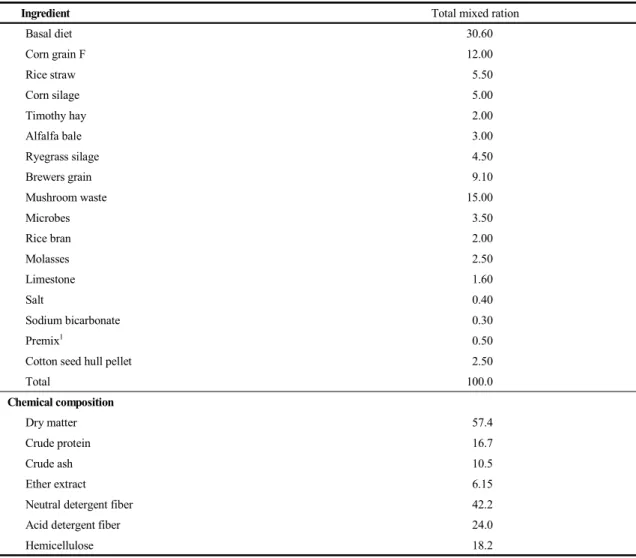
본 시험은 경남 합천군 적중면 소재 한우시험장의 동물생명윤리 지침과 사양프로그램에 준하여 육성·비 육우 32두(15~17개월령, 462±37.9 kg)를 공시하여 12 개월간 사양시험을 실시하였다. 사양시험은 개발된 생균제 첨가수준을 0, 0.5, 1.0 및 1.5%로 4개의 시험 구로 하여, 각 시험구 당 8두씩 배치하여 우방 당 4마 리, 2반복으로 실시하였다. 시험에 이용된 Total Mixed Ratio (TMR) 사료의 배합비와 영양소 함량은 Table 1에 제시하였다. 사료는 합천축협 TMR배합사 료공장에서 제조된 것을 본 시험에 이용하였다. 혼합 생균제는 ㈜빅바이오젠(Anseong, South Korea)으로 부터 공급받았으며, 유산균(Pediococcus acidilactic BBG-L1, 9.30 log CFU/g; Lactobacillus plantarum BBG-L30, 10.12 log CUF/g)과 효모균(Saccharomyces cerevisiase BBG-Y6, 8.21 log CFU/g)이 포함되었다.
사료 급여는 오전 (9:00)과 오후 (16:00)로 나누어 두 번 급여하였고, 오전 사료 급여 전 잔량을 수거하여 사 료 섭취량을 계산하였다. 시험 개시 전과 종료 후 개체 별로 체중을 측정하여 일당 증체량과 사료효율을 계 산하였다. 또한, 음수는 자유로이 먹을 수 있도록 하였 다.
2.2. 시료 채취와 혈액분석
공시동물의 급여 사료가 바뀌는 시점에 시료 약 1 kg를 채취하여 영양소 함량 분석에 이용하였다. 채취한
Ingredient Total mixed ration
Basal diet 30.60
Corn grain F 12.00
Rice straw 5.50
Corn silage 5.00
Timothy hay 2.00
Alfalfa bale 3.00
Ryegrass silage 4.50
Brewers grain 9.10
Mushroom waste 15.00
Microbes 3.50
Rice bran 2.00
Molasses 2.50
Limestone 1.60
Salt 0.40
Sodium bicarbonate 0.30
Premix1 0.50
Cotton seed hull pellet 2.50
Total 100.0
Chemical composition
Dry matter 57.4
Crude protein 16.7
Crude ash 10.5
Ether extract 6.15
Neutral detergent fiber 42.2
Acid detergent fiber 24.0
Hemicellulose 18.2
1Fe 18,041 ppm; Mn 99.3 ppm; Pb 3.35 ppm; Hg 0.08 ppm; F 18.4 ppm; Vitamin A 5,640,000 IU/kg; Vitamin D3 1,300,000 IU/kg; Vitamin E 30,000 IU/kg
Table 1. Ingredients and chemical compositions of total mixed ration (%, DM basis)
시료는 잘 혼합하여 60℃에서 48시간 동안 건조 후 1 mm screen을 가진 Willey mill (Shinmyung Electronic Co., Ltd, South Korea)로 분쇄하여 분석에 이용하였 다. 수분, 조단백질, 조지방 및 조회분 함량은 AOAC (1995) 방법에 준하여 분석하였다. ADF와 NDF 함량 은 Van Soest et al.(1991)법에 따라 분석되었다. 혈액 채취는 시험 종료 후 비육우 개체 별로 경정맥을 통해 혈액을 happarin tube (BD vacutainer, Frankin Lakes, NJ, USA)에 넣어 즉시 혈청을 분리하여 -20℃에서 냉
동보관 하였다. Insulin, growth hormone, total cholesterol, blood urea nitrogen 및 blood glucose의 함량 혈액자동분석기(Hitachi 7020, Japan)를 이용하 여 분석하였다.
2.3. 도체 및 육질 분석
시험 종료 후 모든 공시축을 김해 및 고령 도축장에 이송하여 24시간 계류 후 도축하고, 24시간 예냉 후 등급판정기준에 준하여 등급 판정(배최장근 단면적 (Longissimus muscle area)과 등지방 두께(back fat
thickness)를 측정하였다. 도체 등급 판정을 받은 후 제 13번째와 제 12번째 늑골의 등심부위 사이에서 일 정량(1 kg)을 시료로 채취하고 개체 별로 냉장상태 (0-5℃)를 유지시켜 육질분석에 이용하였다. pH 함량 은 시료 3 g과 증류수 27 mL을 함께 넣어 polytron homogenizer (IKA T25basic, Malaysia)로 13,500 rpm에서 10초간 균질하여 pH meter (Orion 520A, USA)로 측정하였다. 지방산패도(Thiobabituric Acid Reactive Substances, TBARS)는 Buege and Aust (1978)의 방법으로 측정하였다. 먼저 시료를 칼로 작 게 세분하여, 시료 5 g을 Butylated Hydroxytoluence (BHT) 50 uL 증류수 15 mL을 혼합하였다. 균질기 (IKA model T-25 Basic, Malaysia)를 이용하여 13,500 rpm에서 10초간 균질하였다. 균질액 2 mL에 TBA/TCA 혼합용액 4 mL를 넣고 교반기에서 10초간 혼합 후 90℃ 항온조에서 15분간 가열 반응시켰다. 냉 각수로 식힌 시료는 3,000 rpm에서 15분간 원심분리 (Hanil model Union 5kr, Korea)하여, 상층액을 회수 하여 분광광도계(Spectronic model Genesys 5, USA) 로 531 nm에서 측정하였다. 가열감량(cooking loss) 은 각 시료의 가열 전과 가열 후의 무게를 측정하여 계 산하였다(Boles and Swan, 1996). 전단가(shear force) 는 V-shaped shear blade가 설치된 instron universal testing machine (Model 4443, Instron, USA)를 이용 하여 분석하였다. 육색은 minolta chromameter (CR-300, Minolta Co., LTD. Japan)를 사용하여 동일 한 시료의 근육 표면 육색을 각각 5회 반복 측정하였 으며, 표준색판(L*=93.5, a*=0.3132, b*=0.3198)을 이용하여 표준화하였다. 지방산(fatty acid) 분석은 Jenkins et al.(2001)의 방법에 준하여 분석을 위한 전 처리를 실시하였다. 동결 건조된 시료 1 g를 지방산 전용 tube에 넣고, 내부지표물질(internal standard, C19:0) 1 mL과 0.5 M sodium methoxide 2 mL를 넣 은 후 50℃에서 7분 간 배양하 후 5% methanolic HCl 3 mL을 넣고 80℃에서 10분 간 배양하였다. 배양된 시료에 hexane 1 mL과 6% K2CO3 7.5 mL을 넣고 3,000 rpm에서 15분간 원심 분리하여 상ㆍ하층을 분 리하였다. 분리된 상층은 수거하여 gas chromatograph (450-GC, Bruker)를 이용하여 분석하였다.
관능검사는 Meilgaard et al.(1999)의 방법에 준하
여 훈련된 관능검사요원 7명을 선발하여 각 시험구별 로 9점 척도법으로 관능검사를 실시하였다. 검사 항목 으로는 육색(1-3 : 창백함, 4-6 : 보통, 7-9 : 어두움), 연도(1-3 : 질김, 4-6 : 보통, 7-9 : 연함), 향(1-3 : 약함, 4-6 : 보통, 7-9 : 강함), 불쾌취(1-3 : 약함, 4-6 : 보통, 7-9 : 강함), 다즙성(1-3 : 적음, 4-6 : 보통, 7-9 : 많음), 근내지방도(1-3 : 적음, 4-6 : 보통, 7-9 : 많음)및 전체 기호성(1-3 : 좋지않음, 4-6 : 보통, 7-9 : 좋음)으로 나 타내었다.
2.4. 통계처리
본 시험에서 얻어진 모든 결과는 GLM SAS program (SAS, 2002)을 이용하여 분산분석(ANOVA) 을 실시하였으며, polynomial contrasts를 이용하여 혼 합 생균제 첨가 수준에 따른 효과(linear, quadratic 및 cubic)를 분석하였다. 한편 처리구 간 유의성 검증은 Tukey test(P<0.05)를 이용하여 분석하였다.
3. 결과 및 고찰
3.1. 거세한우의 성장 특성
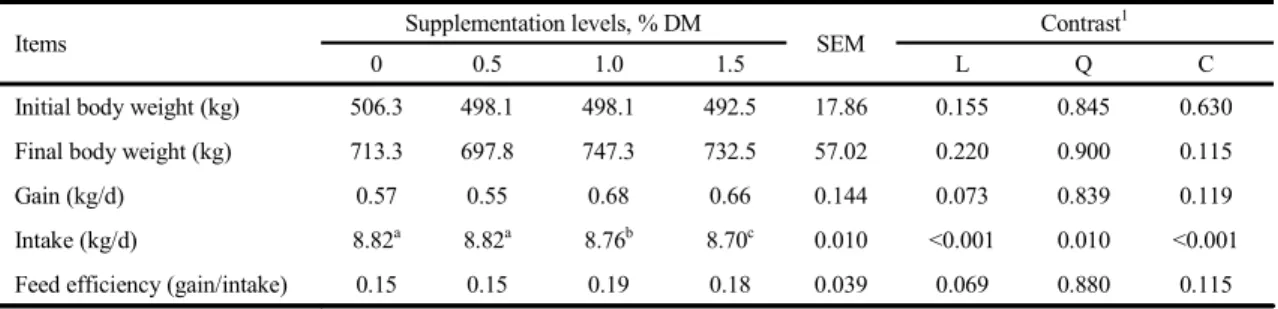
혼합 생균제 첨가가 거세한우의 성장 특성에 미치 는 영향을 조사한 결과는 Table 2에 제시하였다. 혼합 생균제 첨가 수준이 증가할수록 사료섭취량은 점차 감소하는 반면(P<0.05), 일당 증체량과 사료효율은 모 든 처리구에서 유의적인 차이가 없었다(P>0.05).
Raeth-Knight et al.(2007)의 연구에 따르면, 젖소에 혼합 생균제 급여시 성장능력에 영향을 미치지 않는 다고 보고하였다. 또한, Keyser et al.(2007)은 어린 송 아지에 생균제를 첨가했을 때 일당증체량과 사료효율 에 영향을 미치지 않는다고 하여 본 연구와 일치한다.
통계적 유의성을 제외하더라도, 이 연구에서 주목할 점은 일당 증체량이 1% 혼합 생균제 처리구에서 가장 높았다는 점이다. 다시 말하면, 일당 증체량과 사료섭 취량에 영향을 줄 수 있는 거세한우의 사료 급여시 혼 합 생균제의 최적 비율은 1%로 결정할 수 있다는 것 을 의미한다.
3.2. 혈액 성상
혼합 생균제 첨가가 거세한우의 혈액성상에 미치 는 영향을 조사한 결과는 Table 3에 요약하였다. 혈액
Items Supplementation levels, % DM
SEM Contrast1
0 0.5 1.0 1.5 L Q C
Initial body weight (kg) 506.3 498.1 498.1 492.5 17.86 0.155 0.845 0.630
Final body weight (kg) 713.3 697.8 747.3 732.5 57.02 0.220 0.900 0.115
Gain (kg/d) 0.57 0.55 0.68 0.66 0.144 0.073 0.839 0.119
Intake (kg/d) 8.82a 8.82a 8.76b 8.70c 0.010 <0.001 0.010 <0.001
Feed efficiency (gain/intake) 0.15 0.15 0.19 0.18 0.039 0.069 0.880 0.115
a,bMeans in the same row with different superscripts differ significantly (P<0.05)
1L, linear effect; Q, quadratic effect; C, cubic effect
Table 2. Effects of probiotic supplementation levels on growth performance and carcass characteristics of Hanwoo steers
Item Supplementation levels, % DM
SEM Contrast1
0 0.5 1.0 1.5 L Q C
Insulin (μg/L) 2.59 2.56 3.00 2.86 0.617 0.271 0.845 0.402
Growth hormone (ng/mL) 0.23b 0.19b 0.33ab 0.60a 0.230 0.005 0.120 0.878
Total cholesterol (mg/dL) 196.2ab 226.0a 171.6b 225.8a 26.14 0.542 0.318 0.002 Blood urea nitrogen (mg/dL) 14.0b 15.0ab 13.9b 16.4a 0.948 0.003 0.096 0.005
Blood glucose (mg/dL) 91.8 90.3 90.0 70.8 14.83 0.041 0.195 0.516
a,bMeans in the same row with different superscripts differ significantly (P<0.05)
1L, linear effect; Q, quadratic effect; C, cubic effect
Table 3. Effects of probiotic supplementation levels on blood metabolites of Hanwoo steers 성상 가운데, 성장호르몬(growth hormone), 총 콜레
스테롤(total cholesterol) 및 혈중 요소태 질소(Blood Urea Nitrogen, BUN)가 혼합 생균제 첨가 수준에 따 라 영향(linear effect와 cubic effect)을 주는 것으로 나 타났다(P<0.05). Stein et al.(2006)과 Ghoneim and Moselhy(2016)에 의하면 생균제를 급여 시 단백질 합 성과 근육 증진에 영향을 미치는 anabolic steroid를 분비하여 성장 호르몬이 증가한다고 보고하여 본 연 구와 유사한 결과를 나타내었다. 한편, 총 콜레스테롤 수치는 0.5%와 1.5% 처리구에서 가장 높게 나타났지 만, 1.0% 처리구에서 가장 낮게 나타났다(P<0.05). 이 것은 혈중 콜레스테롤 수치를 감소시키는데 가장 큰 영향을 주는 사료첨가제로서 최적 비율은 1% 라는 점 을 인지할 수 있다. 이와는 반대로 Chiofalo et al.
(2004)에 의하면 Lactobaciili 계통의 생균제는 어린 염소에서 장내 영양소 흡수율 개선으로 콜레스테롤 수치가 증가한다고 하였다. 혈중 요소태 질소는 반추
동물의 경우 10~20 mg/dL로 분포하고 있으며(Kwon et al., 2005), 우리의 결과를 보면 이 범위 내에 있었 다. 일반적으로 혈중 요소태 질소는 단백질 합성 조직 에 질소가 축적이 되는 과정(Enright et al., 1990)이며, 사료 중 단백질 함량이 높은 공급원을 급여하면 반추 위 내 암모니아 발생량 및 흡수량이 증가하여 간 대사 과정을 통해 요소 합성이 증가되어 신장장애가 나타 나는 것으로 보고되고 있다(Ahn, 2007). 현재의 결과 를 보면(Table 3), 혼합 생균제 급여 수준이 증가할수 록 BUN 농도가 가장 낮은 처리구는 1% 처리구로 거 세한우에서 체내 대사 활동이 가장 효율적으로 작용 할 수 있다는 직접적인 증거가 될 수 있다. 그러나 혈 액성상에서 통계적 차이가 인정되지 않은 항목은 insulin과 혈당(blood glucose)이었다. 혈당은 insulin, glucagon 및 glucorticoid의 상호 대사과정에서 이루 어지며, 체내에서 남은 당은 지방의 형태로 축적되어 마블링 생성에 중요한 역할을 하게 되는 것으로 비육
Item Supplementation levels, % DM
SEM Contrast1
0 0.5 1.0 1.5 L Q C
Carcass characteristics
Longissimus muscle area (cm2) 89.2 93.8 91.5 97.6 9.921 0.614 0.278 0.224
Back fat thickness (mm) 18.3 14.5 15.5 17.3 2.301 0.671 0.027 0.546
Physicochemical characteristics
pH 5.66ab 5.73a 5.52b 5.54b 0.076 0.006 0.530 0.017
TBARS 0.32ab 0.34a 0.30b 0.32ab 0.014 0.526 0.012 <0.001
Cooking loss (%) 34.5a 32.8ab 30.0bc 28.7c 1.602 0.001 0.843 0.541
Shear force (kg/cm2) 3.08 3.01 3.02 3.04 0.241 0.893 0.689 0.314
L* (Lightness) 36.2b 39.1ab 39.3ab 39.9a 1.536 0.012 0.166 0.325
a* (Redness) 22.9ab 24.6a 20.0b 20.3b 1.951 0.004 0.444 0.010
b* (Yellowness) 11.3ab 11.7a 9.27bc 7.80c 0.812 <0.001 0.072 0.116
a~cMeans in the same row with different superscripts differ significantly (P<0.05)
1L, linear effect; Q, quadratic effect; C, cubic effect
Table 4. Effects of probiotic supplementation levels on carcass and physicochemical characteristics of longissimus muscle in Hanwoo steers
Item Supplementation levels, % DM
SEM Contrast2
0 0.5 1.0 1.5 L Q C
Meat color 6.92a 6.80ab 6.89a 6.09b 0.181 <0.001 0.647 0.965
Tenderness 3.08b 3.13ab 3.22ab 3.34a 0.135 0.052 0.647 0.965
Aroma 4.04b 4.54ab 5.00a 4.20b 0.285 0.174 0.001 0.103
Off-flavor 4.33a 4.44a 3.38b 2.60c 0.309 <0.001 0.024 0.076
Juiciness 5.00a 4.17ab 4.04ab 3.48b 0.528 0.007 0.655 0.400
Marbling score 5.20c 6.14ab 6.52a 6.10b 0.745 0.050 0.068 0.889
Overall acceptability 6.08 5.72 5.89 5.77 0.668 0.656 0.754 0.627
a~cMeans in the same row with different superscripts differ significantly (P<0.05)
1Sensory scores were assessed on 9-point scale from 1 (extremely bad or slight) to 9 (extremely good or much)
2L, linear effect; Q, quadratic effect; C, cubic effect
Table 5. Effects of probiotic supplementation levels on sensory evaluations1 of raw longissimus muscle in Hanwoo steers
중기 단계에 해당된다(Smith, 1989; Kim et al., 2016).
따라서 우리의 결과는 비육후기에 해당되므로 insuline과 혈당에 크게 영향을 주지 않은 것으로 판단 된다.
3.3. 도체 및 육질 특성
Table 4는 혼합 생균제 첨가가 거세한우 도체와 육 질 특성에 미치는 영향을 조사한 결과이다. 시험 종료
후 도축하여 분석한 등심육의 배최장근 단면적과 등 지방두께는 혼합 생균제 첨가에 의해 큰 영향을 주지 는 않는 것으로 나타났다(P>0.05). 또한, 등지방두께 는 혼합 생균제 0.5와 1.0% 처리구가 다른 처리구에 비해 낮게(Q=0.027) 나타났다. 그러나 본 연구에서 얻 어진 도체 특성의 전체적인 경향은 Lee et al.(2015)과 Muhlisin et al.(2016)이 보고한 결과에 비해 다소 높게
Item Supplementation levels, % DM
SEM Contrast1
0 0.5 1.0 1.5 L Q C
C14:0 0.56 0.57 0.83 0.71 0.309 0.269 0.662 0.377
C16:0 23.10 26.10 23.10 27.80 4.496 0.251 0.690 0.185
C16:1 4.25 3.72 4.13 3.98 0.958 0.843 0.686 0.484
C18:0 12.10 12.90 15.21 13.20 3.125 0.402 0.344 0.407
C18:1n-9 54.70 51.10 52.00 48.80 5.925 0.188 0.947 0.526
C18:2n-6 3.41 3.78 3.05 3.62 0.926 0.988 0.781 0.270
C18:3n-3 0.65 0.36 0.70 0.57 0.307 0.849 0.593 0.128
C20:0 0.09 0.08 0.10 0.07 0.018 0.413 0.261 0.055
C20:4n-6 0.31 0.36 0.25 0.32 0.135 0.820 0.734 0.382
C20:5n-3 0.60 0.73 0.44 0.72 0.310 0.931 0.610 0.170
C22:5n-3 0.16 0.20 0.13 0.14 0.082 0.411 0.662 0.327
C22:6n-3 0.07 0.10 0.06 0.07 0.036 0.402 0.607 0.128
SFA 35.85 39.65 39.24 41.78 6.989 0.248 0.846 0.646
UFA 64.15 60.35 60.76 58.22 6.989 0.248 0.846 0.646
UFA/SFA 1.79 1.52 1.55 1.39 0.531 0.210 0.927 0.483
a,bMeans in the same row with different superscripts differ significantly (P<0.05)
1L, linear effect; Q, quadratic effect; C, cubic effect
Table 6. Effects of probiotic supplementation levels on fatty acid profiles of longissimus muscle in Hanwoo steers
나타났다. 육질 특성 중, 전단가를 제외하고, pH, TBARS, 가열감량 및 육색도는 혼합 생균제 첨가에 따라 그 영향(linear effect, quadratic effect 및 cubic effect)이 다양하게 분포하는 것으로 나타났다 (P<0.05). 특히 고기의 pH는 육색, 신선도, 보수력, 조 직감 및 지방산패도에 영향을 미치는데, pH가 감소하 면 TBARS 감소한다고 알려져 있다. 본 연구에서는 혼합 생균제 1.0% 처리구에서 pH와 지방산패도가 가 장 낮게 나타나 이전의 연구결과를 뒷받침한다 (Honikel et al., 1986; Ha et al., 2006; Choi et al., 2010). 가열감량의 경우, 고기를 가열하였을 때 육즙 이 빠져 나오는 양을 나타내는 것으로 가열감량이 낮 을수록 수분을 보유하는 능력이 좋다는 것을 의미한 다. 또한 대조구와 비교할 때 혼합 생균제 첨가 수준이 증가할수록 가열감량은 감소하는 것으로 나타나 육질 에 영향을 줄 수 있다는 것을 알 수 있다. Ceslovas et al.(2005)은 생균제 이용 시 가열감량과 전단가가 감 소된다고 하였고 이점은 우리의 연구와는 정반대의 결과를 보여주었다. 본 시험에서 고기의 명도를 나타
내는 L*값은 혼합 생균제 첨가 수준이 증가할수록 증 가하고, 적색도와 황색도를 나타내는 a*와 b*값은 혼 합 생균제 첨가에 따라 감소하였다. 신선육의 육색도 는 소비자의 기호도를 결정하는 중요한 요인으로 도 체 등급 기준에도 명도와 적색도가 높은 고기일수록 품질이 좋다고 하였다(Zhu and Brewer, 1998; Lee et al., 2001). 결국 소비자들은 붉은 육색을 띄는 고기를 선택하는 것으로 미루어 볼 때, 혼합 생균제를 첨가하 여 얻어진 등심육을 선호할 것으로 판단된다.
3.4. 신선육의 관능평가
혼합 생균제를 첨가한 거세한우 신선육의 관능평 가에 미치는 영향을 조사한 결과는 Table 5와 같다. 고 기의 부드러움 정도를 나타내는 연도(tenderness)와 불쾌치(Off-flavor)는 관능평가 항목 중 가장 낮게 나 타났으며(P<0.05), 연도는 혼합 생균제 처리구가 대조 구에 비해 높았지만, 불쾌치는 낮게 나타났다. Lee et al.(2015)은 생균제를 첨가시 산국의 영향에 의해 불 쾌치가 감소한다고 보고하였고 위의 결과와 유사하게
나타나 소비자들의 선호도 개선에 도움을 줄 것으로 사료된다. 근내지방도(marbling score)는 대조구보다 혼합 생균제 처리구가 높았다. Taturn et al.(1980)에 의하면 근내지방도는 고기의 연도에 영향을 미치고, 근내지방도가 높을수록 연도가 좋아진다고 보고하였 는데, 우리의 결과 역시 근내지방도가 높아진 이유는 연도의 증가와 연관성이 있음을 알 수 있다. 육색 (meat color), 향(aroma) 및 다즙성(juiceness)은 전체 적으로 혼합 생균제 첨가에 따라 통계적 유의성 면에 서 영향을 주었지만, 처리구간에 비교 시에는 두드러 진 차이는 없었다. 전체 기호성(overall acceptability) 은 모든 처리구에서 보통의 결과로 나타나 크게 영향 을 주지 않았다.
3.5. 등심육의 지방산 조성
혼합 생균제를 첨가한 거세한우 등심육의 지방산 조성에 미치는 영향은 Table 6에 나타내었으며, 모든 처리구에서 지방산 조성은 유의적인 차이가 없었다 (P>0.05). 일반적으로, 지방산 조성은 도체의 품종, 성 별, 계절별 및 사료와 비육기간에 따라 다르고, 지방산 조성에 따라 고기의 맛과 풍미 등 기호성에 영향을 미 치는 것으로 알려져 있다(Jin et al., 2006; Kim, 2006).
그러나, 본 연구결과는 혼합 생균제를 첨가하면 거세 한우의 지방산 조성에 아무런 영향을 주지 않는다는 것을 보여주었다.
4. 결 론
거세한우사료에 혼합 생균제 1% 첨가는 콜레스테 롤 함량을 낮추고 육질 특성 중지방산패도를 감소시 키는 데 효과적이었다. 더 나아가, 연도와 근내지방도 증가 또는 불쾌치 감소는 혼합 생균제 1% 수준에서 소고기를 선택할 때 소비자들의 선호도 개선에 도움 을 줄 것으로 사료된다. 그러나, 거세한우의 성장, 도 체 특성, 지방산 조성 및 전체 기호성 면에서 혼합 생 균제의 첨가는 크게 영향을 주지 않았다. 또한 축산 경 영주 입장에서 혼합 생균제에 대한 인식과 정보는 소 비자들에게 접근할 때 이 자료가 크게 영향을 미칠 것 으로 판단된다.
감사의 글
본 연구는 농림수산식품기술기획평가원 공동연구 사업(No.315017-05-2-SB030)의 지원에 의해 이루어 졌습니다.
REFERENCES
Adams, M. C., Luo, J., Rayward, D., King, S., Gbison, R., Moghaddam, G. H., 2008, Selection of a novel direct-fed microbial to enhance weight gain in intensively reared calves, Anim. Feed Sci. Technol., 145, 41-52.
Ahn, G. C., 2007, Studies on rumen fermentation nutrient metabolism and digestibility by dietary supplementation of nonionic surfactant in Hanwoo steer, MS Thesis, Konkuk University, Korea.
AOAC, 1995, Association of official analytical chemist, Official Method of Analysis, 17th edn. AOAC, Washington, DC.
Barton, M. D., 2000, Antibiotic use in animal feed and its impact on human health, Nutr. Res. Rev., 13, 279-299.
Bayatkouhsar, J., Tahmasebi, A. M., Naserian, A. A., Mokarram, R. R., Valizadeh, R., 2013, Effects of supplementation of lactic acid bacteria on growth performance, blood metabolites and fecal coliform and lactobacilli of young dairy calves, Anim. Feed Sci.
Technol., 186, 1-11.
Boles, J. A., Swan, J. E., 1996, Effect of post-slaughter processing and freezing on the functionality of hot-boned meat from young bull, Meat Sci., 44, 11-18.
Buege, J. A., Aust, S. D., 1978, Microsomal lipid peroxidation, Method in Enzymology, 52, 302-310.
Ceslovas, J., Vigilijus, J., Almantas, S., 2005, The effect of probiotic and phytobiotics on meat properities and quality in pigs, Vet. Zootech., 29, 80-84.
Chiofalo, V., Liotta, L., Chiofalo, B., 2004, Effects of the administration of Lactobacilli on body growth and on the metabolic profile in growing Maltese goat kids, Reprod. Nutr. Dev., 44, 449-457.
Choi, I. H., Park, W. Y., Kim, Y. J., 2010, Effects of dietary garlic powder and α-tocopherol supplementation on performance, serum cholesterol levels, and meat quality of chicken, Poult. Sci., 89, 1724-1731.
Elam, N. A., Gleghorn, J. F., Rivera, J. D., Galyean, M. L., Defoor, P. J., Barshears, M. M., Younts-Dahl, S. M., 2013, Effects of live cultures of Lactobacillus acidophilus (strains NP45 and NP51) Propionibacterium freudenreichii on performance, carcass, and intestinal characteristics, and Escherichia coli strain O157 shedding of finishing beef steers, J. Anim. Sci., 81, 2686-2698.
Enright, W. J., Quirke, J. F., Gluckman, P. D., Breier, B.
H., Kenndy, L. G., Hart, I. C., Rochecoert, J. F., Allen, P., 1990, Effects of long time administration of pituitary derrived bovine growth hormone and estradiol on growth in steers, J. Anim. Sci., 68, 2345-2356.
Falcāo-e-Cunha, L., Castro-Solla, L., Maertens, L., Marounek, M., Pinheiro, V., Freire, J., Mourāo, J. L., 2007, Alternatives to antibiotic growth promoters in rabbit feeding: A Review, World Rabbit Sci., 15, 127-140.
Fuller, R., 1989, Probiotics in man and animals, J. Appl.
Bacteriol., 66, 365-378.
Gaggìa, F., Mattarelli, P., Biavati, B., 2010, Probiotics and prebiotics in animal feeding for safe food production, Int. J. Food. Microbiol., 141, 15-28.
Ghoneim, M. A., Moselhy, S. S., 2016, Antioxidant status and hormonal profile reflected by experimental feeding of probiotics, Toxicol. Ind. Health., 32, 741-750.
Gibson, G. R., Roberfroid, M. B., 1995, Dietary modulation of the human colonic microbiota:
Introducing the concept of prebiotics, J. Nutrition., 125, 1401-1412.
Ha, K. H., Lee, C. W., Jin, S. K., Kim, I. S., Song, Y. M., Hur, S. J., Kim, H. Y., Lyou, H. J., Ha, J. H., 2006, Effect of feeding probiotics on phsico-chemical properties and sensory evaluation of pork, Korean J.
Food Ani. Resour., 25, 295-303.
Honikel, K. O., Kim, C. J., Hamm, R., 1986, Sarcommere shortening of prerigor muscles and its influence on drip loss, Meat Sci., 16, 267-275.
Hossaini, S. M. R., Bojarpour, M., Manouei, M., Asadian, A., Fayazi, J., 2010, Effects of probiotics and antibiotic supplementation in daily milk intake of newborn calves on feed intake, body weight gain, fecal scores and health condition, J. Anim. Vet. Adv., 9,
872-875.
Jenkins, T. C., Thies, E. J., Mosley, E. E., 2001, Direct methylation procedure for converting fatty amides to fatty acid methyl ester in feed and digesta samples, J.
Agric. Food Chem., 49, 2142-2145.
Jin, S. K., Kim, I. S., Song, Y. M., Ha, J. H., Park, K. H., Lee, J. I., Lee, J. R., Lee, C. W., 2006, Effects of feeding probiotics on quality properties of pork, Korean. J. Food. Sci. Anim. Res., 26, 49-57.
Keyser, S. A., McMeniman, J. P., Smith, D. R., MacDonald, J. C., Galyean, M. L., 2007, Effects of saccharomyces cerevisiae subspecies boulardii cncm i-1079 on feed intake by healthy beef cattle treated with florfenicol and on health and performance of newly received beef heifers, J. Anim. Sci., 85, 1264-1273.
Kim, B. K., 2006, Effects of feeding timothy hay roughage in the beef quality of growing period fattening Hanwoo steers, Kor. J. Food. Sci. Anim. Res., 26, 284-289.
Kim, B. K., Ha, J. J., Yi, J. K., Oh, D. Y., Jung, D. J., Hwang, E. G., Kim, S. J., Ann, Y. G., 2016, Effect of herbal probiotic supplementation on weight, blood composition, meat quality and immunity in beef, Korean J. Food Nutr., 29, 860-869.
Krehbiel, C. R., Rust, S. R., Zhang, G., Gilliland, S. E., 2003, Bacterial direct-fed microbials in ruminant diets: Performance response and mode of action, J.
Anim. Sci., 81, 120-132.
Kwon, E. G., Hong, S. K., Seong, H. H., Yun, S. G., Park, B. K., Cho, Y. M., Chang, W. M., Shin, S. S., Park, B.
H., 2005, Effects of ad libitum and restricted feeding of concentrates on body weight gain, feed intake and blood metabolites of Hanwoo steers at various growth stages, J. Anim. Sci. Technol. (Kor.), 47, 745-758.
Lee, H. J., Cho, S. L., Kim, D. H., Amanullah, S. M., Joo, Y. H., Yang, H. S., Choi, I. H., Moon, S. S., Kim, S. C., 2015, Effects of Chrysanthemum boreale probiotic on growth performance and meat quality of Hanwoo Steer, J. Agric. Life. Sci., 48, 85-94.
Lee, S. K., Kim, Y. S., Kim, J. Y., Liang, C. Y., Yang, B.
K., 2001, Effects of reducing ability on meat color stability and lipid oxidation of Hanwoo (Korean native cattle) beef, Kor. J. Anim. Sci. Technol., 43, 401-408.
LeJeune, J. T., Wetzel, A. N., 2007, Preharvest control of
Escherichia coli O157 in cattle, J. Anim. Sci., 85, 73-80.
McAllister, T. A., Beauchemin, K. A., Alazzeh, A. Y., Baah, J., Teather, R. M., Stanford, K., 2011, Review:
The use of direct fed microbials to mitigate pathogens and enhance production in cattle, Can. J. Anim. Sci., 91, 193-211.
McGuffey, R. K., Richardson, L. F., Wilkinson, J. I. D., 2001, Ionophores for dairy cattle: Current status and future outlook, J. Dairy. Sci., 84, 194-203.
Meilgaard, M., Civille, G. V., Carr, B. T., 1999, Sensory evaluation techniques (3rd ed.), CRC Press 387, Boca Ration, Florida.
Muhlisin, C. S. S., Song, C. S., Rhee, Y. H., Song, Y. H., Lee, S. K., 2016, Effects of direct-fed microbial and pine cone extract on carcass traits and meat quality of Hanwoo (Korean native cattle), Asian-Aust. J. Anim.
Sci., 29, 722-730.
Raeth-Knight, M. L., Linn, J. G., Jung, H. G., 2007, Effect of direct-fed microbials on performance, diet digestibility, and rumen characteristics of holstein dairy cows, J. Dairy Sci., 90, 1802-1809.
Salminen, S., Ouwehand, A., Benno, Y., Lee, Y. K., 1999, Probiotics: How should they be defined?, Trends Food. Sci. Technol., 10, 107-110.
SAS Institute, 2002, SAS/STAT user’s guide: Version 8.2, SAS Institute Inc., Cary, NC.
Seo, J. K., Kim, S. W., Kim, M. H., Upadhaya, S. D., Kam,
D. K., Ha, J. K., 2010, Direct-fed microbials for ruminant animals, Asian-Aust. J. Anim. Sci., 23, 1657-1667.
Shin, D. K., Kim, K. W., Jin, M. J., Ryu, K. S., 2013, Assessment of antimicrobial and antioxidant effects of ripened medicinal herb extracts to select an optimum dietary natural antibiotic for chickens, Korean J. Poult.
Sci., 40, 25-29.
Smith, J., 1989, Biological action and interactions of insulin and glucagon, 358, Wisconsin University, USA.
Stein, D. R., Allen, D. T., Perry, E. B., Bruner, J. C., Gates, K. W., Rehberger, T. G., 2006, Effects of feeding propionibacteria to dairy cows on milk yield, milk components, and reproduction, J. Dairy. Sci., 89, 111-125.
Taturn, J. D., Smith, G. C., Berry, B. W., Murphey, C. E., Wiliams, F. L., Carpenter, Z. L., 1980, Carcass characteristics, time on feed and cooked beef palatability attributes, J. Anim. Sci., 50, 833.
Van Soest, P. J., Robertson, J. B., Lewis, B. A., 1991, Methods for dietary fiber, neutral detergent fiber and non-starch polysaccharides in relation to animal nutrition, J. Dairy. Sci., 74, 3568-3597.
Zhu, L. G., Brewer, M. S., 1998, Discoloration of fresh pork as related to muscle and display conditions, J.
Food. Sci., 63, 763-767.