Print ISSN: 2288-4637 / Online ISSN 2288-4645 doi:10.13106/jafeb.2021.vol8.no4.0763
The Effects of Corporate Governance on Segment Reporting Disclosure: A Case Study in Vietnam
Quoc Thinh TRAN 1 , Ngoc Khanh Dung NGUYEN 2 , Xuan Thuy LE 3
Received: December 15, 2020 Revised: March 06, 2021 Accepted: March 15, 2021
Abstract
Accounting information is essential for users. Useful information helps users to make appropriate investment-related decisions. Segment reporting disclosure plays a practical role for an investor in a business. The article data was surveyed by ordinary least squares to test the effects of corporate governance on the segment reporting disclosure. The article employed time-series data with 136 observations of the top 100 non-financial Vietnamese enterprises listed on the stock exchange in the period of 2018–2019. The research used two popular theories related to stakeholder and agency to explain the effects of factors on segment reporting disclosure. The results have identified two factors that have a positive impact on segment reporting disclosure, namely, the size of the board and the ratio of foreign members to the total number of the board. Accordingly, the managers of the top 100 Vietnamese listed enterprises should increase the number of board members as well as pay attention to the number of foreign members to contribute to improving the information disclosure on the segment reporting.
It is the basis to improve the quality of information to ensure completeness and transparency. It contributes to attracting foreign investment to meet the trend of international economic integration.
Keywords: Accounting Information, Corporate Governance, Information Disclosure, Segment Reporting, VN100 Index JEL Classification Code: M41, M42, O16
CG has helped in the provision of information to improve completeness, reliability, and transparency (Eliada et al., 2015). However, the current information status of Vietnamese listed enterprises, in particular, SR has some shortcomings. The status of information on SR of Vietnamese listed enterprises is still not really transparent and ensures the completeness of the information (Tran & Nguyen, 2016; Tran, 2019). This is an obstacle for Vietnamese listed enterprises in the process of seeking and attracting capital for investment and development.
2. Literature Review
The Organization for Economic Co-operation and Development (OECD) considered CG as internal measures to run an enterprise, related to the relationships between the board of directors, the board and the shareholders of an enterprise (OECD, 2019). CG is a monitoring and control process carried out to ensure that CG activities are performed for the interests of shareholders to influence the behavior of managers and determine the necessary authority (Ibrahim & Hartini, 2015).
According to the International Financial Reporting Standards for segment reporting (IFRS 8), SR aims to provide
1
First Author and Corresponding Author. Associate Professor, Faculty of Accounting and Auditing, Industrial University of Ho Chi Minh City, Ho Chi Minh City, Vietnam [Postal address: 86 Nguyen Hong Street, Ward 1, Go Vap District, Ho Chi Minh City, 70000, Vietnam] Email: [email protected]
2
Faculty of Accounting and Auditing, Industrial University of Ho Chi Minh City, Ho Chi Minh City, Vietnam.
Email: [email protected]
3
Deputy Director, HDBank, Vietnam.
Email: [email protected]
© Copyright: The Author(s)
This is an Open Access article distributed under the terms of the Creative Commons Attribution Non-Commercial License (https://creativecommons.org/licenses/by-nc/4.0/) which permits unrestricted non-commercial use, distribution, and reproduction in any medium, provided the original work is properly cited.
1. Introduction
Information from financial statements is important to
users. Segment reporting disclosure (SR) makes more sense
for investors to concretely recognize material information
of each part of the enterprise (Geltmeyer, 2010). According
to the study, the degree of disclosure is impacted by some
factors, of which corporate governance (CG) has received
more attention in recent years (Agyei-Mensah, 2012).
information to investors and creditors regarding financial results and key activities of each entity in the enterprise as a basis for corporate decisions (IFRS Foundation, 2021).
The Vietnamese accounting standards for segment reporting (VAS 28) instructed SR to include two aspects – the business sector and the geographic area. The business sector of SR is an identifiable part of an enterprise engaged in the production or supply of products or services that has risks and economic benefits different from those of other departments. The geography of SR is a distinguishable part of an enterprise engaged in the production or supply of products or services that has risks and economic benefits in other economic environments (Vietnamese Ministry of Finance, 2005).
Stakeholder theory shows that key stakeholders include customers, shareholders, suppliers, employees, and the community. They are people who can have a significant impact or have a key role in the success of the business. According to the theory, governance decisions should be designed to please stakeholders. Consequently, stakeholders have a significant influence on governance decisions, which in turn affects the level of information in entities (Freeman, 1984). Meanwhile, the agency theory states that, when there is a separation between ownership and operator rights, a conflict between owner and operator arises. Both sides want to maximize their benefits. The theory holds that these managers are always more inclined to make decisions that benefit themselves rather than the interests of the company. On the other hand, the manager is also the informant of the business; for its own sake, the manager tends to provide little information or hide it to the owner. The theory will also explain more clearly the corporate governance to the information disclosure of the enterprise (Jensen & Meckling, 1976).
Currently, there are a number of studies interested in examining the factors influencing disclosure on SR. Factors are viewed on a number of aspects such as CG, financial indicators or a combination of many factors. Geltmeyer (2010) studied 119 companies in Belgium from 2006 to 2007 to examine the factors that influence the information on SR. The study used quantitative methods for testing.
The research results showed that factors of firm size, industry, audit firm, and degree of ownership dispersion have a positive impact on SR. Ahfaraih and Alanezi (2011) evaluated the factors influencing SR of companies listed on the Kuwaiti stock exchange. The article used ordinary least squares (OLS) to examine the influence of these factors.
Analysis results pointed out that the firm size, and type of audit positively impact SR. In contrast, the degree of dispersion of ownership and firm growth have negligible effects on SR. Ibrahim and Hartini (2015) studied the factors affecting the level of SR information according to IRFS 8 during the transition period of 97 listed companies in Nigeria in 2012. The analysis was verified by the OLS method. The results of the regression analysis showed that the factors
that positively affect SR are the duality of the chairperson and the board of directors, the size of the board the industry having the same effect SR while meeting frequency has the opposite effect SR. Lucchese and Carlo (2016) studied the effects of IFRS 8 on the SR of 195 non-financial companies in Italy from 2008 to 2012. OLS method is used to test the model. The results of regression analysis demonstrated that the factors of growth rate, industrial competitiveness, scale and dispersion of ownership all have opposite effects on SR.
André et al (2016) examined the factors influencing SR. The article used 270 companies from 17 European countries in 2009. The article used OLS for testing. The results showed that ROA, mergers or acquisitions, and Big 4 auditing have a positive effect on SR. Aboud and Roberts (2018) studied 208 non-financial firms in 17 European countries in 2011.
The article used OLS for assessment. The results revealed that free cash flow per share, company size, and profit have a positive influence on SR.
For Vietnam, issues related to information disclosure of enterprises have been the focus of many studies (Tran et al., 2020; Nguyen et al., 2020; Tran et al., 2021). However, research focusing on SR is quite modest. Tran and Nguyen (2016) studied the factors affecting the information disclosure on SR of 139 Vietnamese listed enterprises in 2014. The article used OLS to test the model. The study results showed that firm size (ROE) and financial leverage have a positive impact on SR, but dispersion complexity of ownership has an opposite effect with SR. Tran (2019) studied 278 listed companies of the Ho Chi Minh stock exchange (HOSE) in 2016–2017 to check factors of corporate governance impact on the level of accounting disclosure for segment reporting.
The article used OLS to examine the model. The result showed that the board size and the frequency of the meeting impact on SR.
Both domestic and foreign studies shows that the assessment of factors affecting information on SR is of interest, but research on corporate governance factors on SR is very few, except for research by Ibrahim and Hartini (2015). For studies in Vietnam, no separate studies and considerations of corporate governance factors affecting the information disclosure on the SR of the top 100 Vietnamese listed enterprises (VN100) have been found in recent times.
3. Methodology
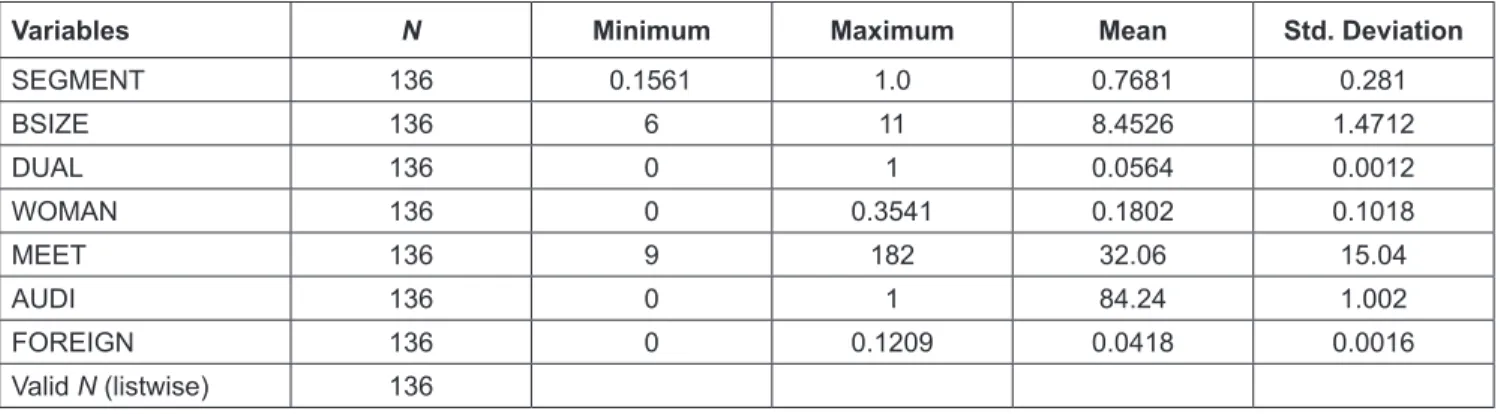
The article used time-series data of 136 non-financial listed enterprises of VN100 in 2018–2019.
The dependent variable is measuring the disclosure of SR in VN100 and the disclosure will be calculated by the following formula:
T
j= d n
i ijn j j