• 검색 결과가 없습니다.

Investigation of Aerosol Number Concentration at Gosan Site in Jeju, Korea

N/A
N/A
Protected

Academic year: 2021

Share "Investigation of Aerosol Number Concentration at Gosan Site in Jeju, Korea"

Copied!
8
0
0

로드 중.... (전체 텍스트 보기)

전체 글

(1)

Investigation of Aerosol Number Concentration at Gosan Site in Jeju, Korea

Chang-Hee Kang, Chul-Goo Hu

1)*

Department of Chemistry, Jeju National University, Jeju 690-756, Korea

1)

Department of Environmental Engineering, Jeju National University, Jeju 690-756, Korea (Manuscript received 12 December, 2011; revised 20 December, 2011; accepted 25 January, 2012)

Abstract

The aerosol number concentration have measured with an aerodynamic particle sizer spectrometer(APS) at Gosan site in Jeju, Korea, from March 2010 to March 2011. And then the atmospheric aerosol number concentration, the temporal variation and the size distribution of aerosol number concentration have been investigated.

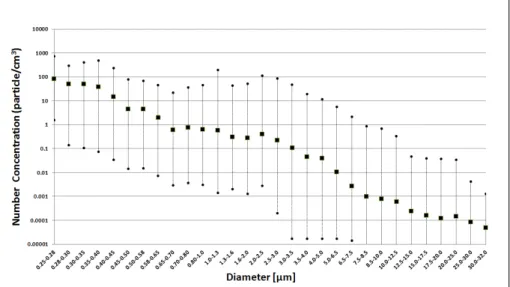
The aerosol number concentration varies significantly from 748 particles/㎝3 to zero particles/㎝3. The average number concentration in small size ranges are very higher than those in large size ranges. The number concentrations in the size range 0.25∼0.28 ㎛, 0.40∼0.45 ㎛ and 2.0∼2.5 ㎛ are about 84 particles/㎝3, 2 particles/㎝3 and 0.4 particles/㎝3, respectively. The number concentrations inrange of larger than 7.5 ㎛ are below 0.001 particles/㎝3.

The seasonal variations in the number concentration for smaller particle(<1.0 ㎛) are not much, but the variations for larger particle are very evident. And strong amplitudes of diurnal variations of entire averaged aerosol number concentration are not observed.

Size-fractioned aerosol number concentrations are dramatically decreased with increased particle size. The size-fractioned aerosol number concentrations in size range 0.8∼4.0 ㎛ during nighttime are evidently higher than during daytime, but similar levels are appeared in other size range. The seasonal differences in the size-fractioned number concentrations for smaller size range(<0.7 ㎛) are not observed, however, the remarkable seasonal differences are observed for larger size than 0.7 ㎛.

Key Words : Aerosol, Number concentration, Seasonal variation, Diurnal variation Size-fractioned concentration, Gosan site

1)

1. Introduction

Atmospheric aerosols are emitted from a large variety of sources, thus they have various sizes, shapes and made up of hundreds of different chemicals. Aerosols have an important influence on the atmospheric visibility, irradiation balance and they also act as cloud condensation nuclei and affect precipitation patterns. Therefore atmospheric aerosols

*Corresponding author : Chul-Goo Hu, Department of Environ- mental Engineering, Jeju National University, Jeju 690-756, Korea

Phone: +82-64-754-3443 E-mail: [email protected]

play an important role in the variation of weather and climate. There is growing concern related to the human health effects of atmospheric aerosols, because of the epidemiological studies that the adverse health effects of atmospheric aerosols include respiratory irritation and changes in pulmonary function. (Vyziene and Girgzdys, 2009; Sharma et al., 2003)

The size distribution, composition, sources and

sinks of atmospheric aerosols are important parameters

in understanding and managing aerosol effects on

health, visibility and climate. The size distribution

and composition of atmospheric aerosols , especially,

(2)

are key factors in assessing these effects. Recently, there has been an increased interest in the relative health effects of particles of smaller sizes. Several researchers have also reported that the health effects of aerosols, for a given mass concentration, are larger for smaller particles.(Buzorius et al., 1999:

Stanier et al., 2004; Bigi and Ghermandi, 2011) The number concentration of small size aerosol is usually very high, but its mass concentration is relatively low. Several researches have also shown that the health effects of aerosols may be more sensitive to the number than mass concentration. (Yan et al., 2004) In spite of these facts, most of the air quality managements so far have been based on aerosol mass concentration.

Recently, a large number of observational studies on aerosol number concentrations have been performed.

The features and temporal and/or spatial variations of atmospheric aerosol number concentrations have been investigated.(Vyziene and Girgzdys, 2009;

Sharma et al., 2003; Stanier et al., 2004; Buzorius et al., 1999; Choi et al., 2005) Many studies on the relationship of aerosol number concentration and mass concentration have been performed.(Yan et al., 2004; Bigi and Ghermandi, 2011) A lot of studies on the aerosol number concentrations during Asian dust storm have been done.(Watanabe et al., 2005; Zhang et al., 2008; Chun et al., 1999) And the meteorological dependences of aerosol number concentration have been analyzed.(Paatero et al., 2005; Hussein et al., 2006) Also the number concentrations of atmospheric ultrafine aerosol have been studied.(Sharma et al., 2011; Longly et al., 2005; Minoura and Takekawa, 2005) However, few continuous measurements have been made of size-separated number concentration of atmospheric aerosol in Jeju, Korea.

In this study, we have continuously measured the aerosol number concentration with an aerodynamic particle sizer spectrometer(APS) measuring from

0.25 to 32.0㎛ from March 2010 to March 2011 at Gosan in Jeju. The temporal variation of size-separated number concentration of atmospheric aerosol and the size distribution of aerosol number concentration have been studied.

2. Materials and Methods

2.1. Monitoring site

The monitoring site, Gosan(33˚17'N, 126˚10'E), is located at the western tip of Jeju Island. The site, shown in Fig. 1, is one of the background sites in Korean Peninsula. Jeju Island is a volcanic island with peak elevation of ∼2000 m and is a major resort area with no large industrial sources. The island is located in the East China Sea, ∼100 km south of the Korea mainland, ∼250 km west of Kyshu, Japan, ∼ 500 km east-northeast of Shanghai, China. The site is about 70 m above sea and adjacent to the seashore.

Fig. 1. Location of the monitoring site and surrounding

region.

2.2. Instruments and measurements

In the present research, an aerodynamic particle

sizer spectrometer(APS, GRIMM Aerosol Technik

(3)

Fig. 2. The grand average aerosol number concentration measured separately in the 30 size ranges.

GmbH & Co., Model #179), which uses light scattering method, has been installed at Gosan site.

This instrument measures atmospheric aerosol number concentration in 30-channel of different size range from 0.25∼0.28 ㎛ to 30.0∼32.0 ㎛.

Atmospheric aerosols have been sampled at 3 m from the ground level and the number concentration have been measured after having removed moisture.

The measurement of the aerosol number concentration has been performed every 5 minute, from March 2010 to March 2011. The number concentration of aerosol particles have been measured separately in the 30 size ranges, such as 11-channel in range of 0.25∼1.0 ㎛, 4-channel in range of 1.0∼2.5 ㎛, 8-channel in range of 2.5∼10.0 ㎛, 7-channel in range of 10.0∼32.0 ㎛. The 1-hour averaged data of the number concentration of aerosol obtained every 5-minute from APS have been used in this study.

3. Results and Discussions

3.1. Overview of aerosol number concentration The grand average aerosol number concentrations measured separately in the 30 size ranges during the experimental period are shown in Fig. 2. From these

results, it is found that the aerosol number concentration varies significantly with particle size from 748 particles/㎝

3

to zero particles/㎝

3

. The average number concentrations in small size ranges are higher greatly than those in large size ranges. The average concentration is about 84 particles/㎝

3

in the smallest size range (0.25∼0.28 ㎛), 15 particles/㎝

3

in the size range 0.40∼0.45 ㎛, 2 particles/㎝

3

in the size range 0.58∼0.65 ㎛, 0.4 particles/㎝

3

in the size range 2.0∼2.5 ㎛. On the other hand, the average number concentrations of larger particles(≥7.5 ㎛) are lower than 0.001 particles/㎝

3

.

The values of overall aerosol number concentrations have large differences according to measurement methods, in particular, lower limit measuring size range. In general, the values of overall aerosol number concentrations are greatly more than 10,000particles/

3

in case of using the method which can measure ultrafine particles(≤100 ㎚).(Sharma et al., 2011;

Longly et al., 2005; Minoura and Takekawa, 2005)

However, in this study, the overall aerosol number

concentration in excess of 1000 particles/㎝

3

has

never observed because the lower limit measuring

size range(0.25∼0.28 ㎛) is large, relatively.

(4)

The aerosol number concentrations measured in this study are low in comparison with other previous researches performed in urban area. For example, Sharma et al. has reported that the aerosol number concentrations measured in Roorkee, India, in the size range 0.3-0.5 ㎛, 1.0-2.0 ㎛ and 2.0-5.0 ㎛ are 1.5×10

4

-2×10

5

particles/ℓ, 1×10

3

-5.6×10

3

particles/

ℓ and 50-300 particles/ℓ, respectively.(Sharma et al., 2003) Also, Park et al. has reported that the aerosol number concentrations measured in Seoul, in the size range 0.3-0.5 ㎛, 0.82-2.23 ㎛, 2.23-6.06 ㎛ and 6.06-10.0 ㎛ are 32.3 particles/㎝

3

, 8.5 particles/

3

, 1.6 particles/㎝

3

and 0.008 particles/㎝

3

, respectively.(Park et al., 2001)

Table 1. shows the basic statistics of the number concentration in the five wide size ranges without larger range(>10 ㎛) having very low concentration.

The average concentration is about 241 particles/㎝

3

in the size range 0.25∼0.5 ㎛, but the average concentration for larger particles(>0.5 ㎛) are decreased severely to lower than 10 particles/㎝

3

. We can see, from these results, that the number concentration in the size range 0.25∼0.5 ㎛ has more than 96% of the number concentration of PM2.5 and/or PM10. It is well known that number concentration of particles larger than 0.5 ㎛ is very low compared to particles smaller than 0.5

㎛.(Buzorius et al., 1999) The standard deviation of the number concentration data for small particles (<0.5 ㎛) is less than the mean value of the data, on the other hand, the standard deviation for large particles(>2.5 ㎛) is greater than ten times the mean value. These results show that the number concentration for smaller particles have higher values and less variation amplitude than larger particles, relatively.

Atmospheric aerosols have size distribution from few nanometers to 100 ㎛. The aerosols of various sizes are generated by different sources, such as, coarse particles(〉2.5 ㎛) are generated from blowing

and excavation etc., but fine particles(〈2.5 ㎛) are mainly generated from traffic, combustion and secondary formation in atmosphere.(Buzorius et al., 1999; Sharma et al., 2011) In addition, aerosol number concentrations are influenced by regional and local sources and meteorological conditions. It has been assumed that the number concentration for fine mode particles have less variation than coarse particles due to the feature of measurement site with no large anthropogenic sources.

Table 1. The basic statistics of the aerosol number

concentration data in the five wide size ranges

(particle/cm3)

Size

Range(

) Mean Min Max S.D

0.25~0.5 241.488 3.149 1703.365 234.085 0.5~1.0 8.413 0.033 189.152 11.867 1.0~2.5 1.543 0.008 260.466 9.484 2.5~5.0 0.810 0.003 249.195 8.514 5.0~10.0 0.014 0.000 9.325 0.148

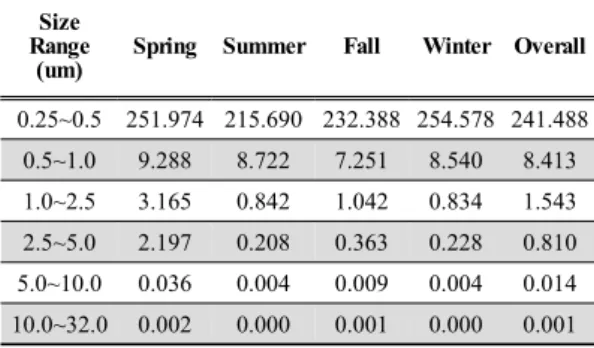
3.2. Temporal variation of aerosol number concentration The number concentration of ambient particles changes not only with the season but also within minutes. In this study, the seasonal averages of the aerosol number concentration for six size ranges are shown in table 2 to find the seasonal variation of those.

Table 2. The seasonal averages of the aerosol number

concentration for six size ranges

(particle/cm

3

) Size

Range

(um) Spring Summer Fall Winter Overall

0.25~0.5 251.974 215.690 232.388 254.578 241.488

0.5~1.0 9.288 8.722 7.251 8.540 8.413

1.0~2.5 3.165 0.842 1.042 0.834 1.543

2.5~5.0 2.197 0.208 0.363 0.228 0.810

5.0~10.0 0.036 0.004 0.009 0.004 0.014

10.0~32.0 0.002 0.000 0.001 0.000 0.001

(5)

Fig. 3. Diurnal variations of the aerosol number concentration during experimental period.

The seasonal averages of the aerosol number concentration in size range of 0.25∼0.5 ㎛ are from 215.7 to 254.6 particles/㎝

3

, those in size range of 0.5

∼1.0 ㎛ are from 7.3 to 9.3 particles/㎝

3

approximately, hence the seasonal differences are less than 24% of overall averages. However, the average number concentrations in size ranges of larger than 1.0 ㎛ during the spring time are much more than other season. For example, the spring time average in size range of 2.5∼5.0 ㎛ is more than ten times the summer time average. It can be seen from table 2 that the seasonal differences in the number concentration for smaller particle ranges(0.25∼0.5 ㎛, 0.5∼1.0 ㎛) are not much, but the differences for larger particle ranges are very evident. It is well established that airborne particles over size 1 ㎛ are dominated by mineral particles with quite different sources and

transport properties than finer particles(〈1

㎛).(Longly et al., 2005) It seems that the seasonal average number concentrations for larger particles in spring are significantly high due to Asian dust storm, pollen etc., on the other hand those in summer are low due to scavenging by precipitation. Stanier et al.

have reported that there is the absence of a clear seasonal trend in average aerosol number concentration in small size range(〈0.56 ㎛).(Stanier et al., 2004)

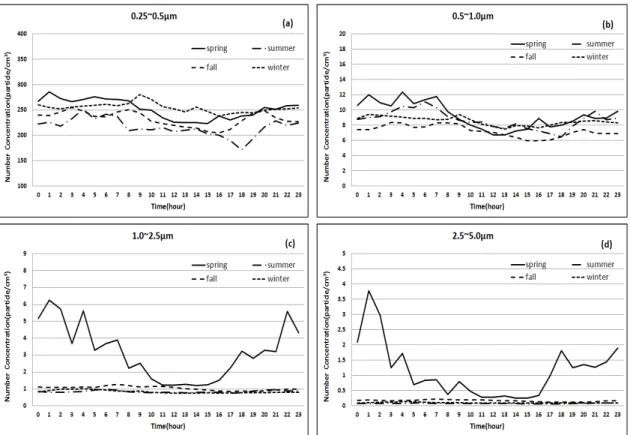
To find diurnal variation of the aerosol number concentration, the hourly averages of the concentration during experimental period are presented in Fig. 3.

The diurnal aerosol number concentration pattern is

driven by emission characteristics of dominant sources

and meteorological conditions. The aerosol number

concentration has a evident diurnal variation in urban

(6)

area due to the local sources of finer aerosol. In general, the aerosol number concentration is high during rush hour and nighttime.(Yan et al., 2004;

Vyziene and Girgzdys, 2009; Sharma et al., 2003;

Bigi and Ghermandi, 2011) However, it is can be seen from Fig.3 that strong amplitudes of diurnal variations of entire averaged aerosol number concentration are not observed because of the location of measurement site with no large anthropogenic sources.

As shown in Fig. 3, in the size ranges 0.25∼0.5 ㎛ and 0.5∼1.0 ㎛, the aerosol number concentration during daytime is slightly lower than nighttime. This trend in spring season is appeared remarkably compared to other season. It is suggested that the fine aerosol is generated by condensation because of high humidity and low temperature at that time.(Sharma et al., 2003) The similar diurnal variation patterns to these results are reported previously by many other researchers.(Yan et al., 2004; Vyziene and Girgzdys, 2009; Bigi and Ghermandi, 2011) On the other hand, interesting diurnal variations of the aerosol number concentration are found in the size ranges 1.0∼2.5 ㎛ and 2.5∼5.0 ㎛. The aerosol number concentrations during daytime(especially, 10:00∼16:00) in the spring season are drastically lower than nighttime, though there are no evident diurnal variations of the concentrations in the summer, fall and winter. The reason of this phenomenon is not clearly realized in this study, thus the intensive studies are required to explain this tendency in future.

3.3. Size distribution of aerosol number concentration It is known that the aerosol composition and size distribution are key factors in assessing the effects on human health, global heat balance and weather.(Bigi and Ghermandi, 2011)

Size-fractioned aerosol number concentration, [N(D)=dN/dlog(D)], for the entire averages, for the daytime averages and the nighttime averages and for the seasonal averages are presented in Fig. 4., Fig. 5.

and Fig. 6., respectively. As shown in Fig. 4., it is found that the N(D) values for the entire averages are dramatically decreased with increased particle size, although three different patterns are observed with the size range. For example, the N(D) curve for smaller size range(<0.8 ㎛) has a steep slope but the N(D) curve for size range 0.8∼3.0 ㎛ has a more gentle slope, and then the N(D) curve is changed steeply for larger size range(>3.0 ㎛).

Fig. 5. shows that the differences in size distributions for smaller size range(<0.8 ㎛) and for larger size range(>4.0 ㎛) between the daytime averages and the nighttime averages are not much. However, in size range 0.8∼4.0 ㎛, the N(D) values during daytime are evidently higher than during nighttime. It is assumed that the aerosol group in size range 0.8∼4.0

㎛ has a slight number variation but has an evident temporal variation with size range.

Fig. 4. Size distribution of the entire averaged aerosol

number concentration during experimental period.

Fig. 5. Size distribution of the daytime and nighttime

averaged aerosol number concentration during experimental period.

(7)

Fig. 6. Size distribution of the seasonal averaged aerosol

number concentration during experimental period.

The seasonal differences in the size-fractioned number concentrations for smaller size range(<0.7

㎛) are not observed, however, the seasonal averages of the N(D) values for larger size than 0.7 ㎛ are remarkably different.(Fig. 6.) For example, the size- fractioned number concentrations during the spring are significantly higher than other season, and the N(D) values in coarse particle ranges(>10 ㎛) during the summer are greatly low compared to other season.

It is seemed that these tendencies caused by the sources and sinks of larger particles, such as, Asian dust storm and pollen in spring and scavenging by precipitation in summer.

4. Conclusions

The aerosol number concentration have measured with an aerodynamic particle sizer spectrometer (APS) at Gosan site in Jeju, Korea, from March 2010 to March 2011. And then the atmospheric aerosol number concentration, the temporal variation and the size distribution of aerosol number concentration have been studied. Results derived from this study are summarized as follows.

The aerosol number concentration varies significantly from 748 particles/㎝

3

to zero particles/㎝

3

. The average number concentration in small size ranges are very higher than those in large size ranges, such as, about

84 particles/㎝

3

in the smallest size range (0.25∼0.28

㎛), 0.4 particles/㎝

3

in the size range 2.0∼2.5 ㎛ and below 0.001 particles/㎝

3

in range of larger than 7.5 ㎛.

The seasonal variations in the number concentration for smaller particle(<1.0 ㎛) are not much, but the variations for larger particle are very evident. And strong amplitudes of diurnal variations of entire averaged aerosol number concentration are not observed, but interesting diurnal variations are observed in the size ranges 1.0∼2.5 ㎛ and 2.5∼5.0

㎛. The concentrations during daytime are drastically lower than nighttime in the spring, but there are no evident diurnal variations in other season.

Size-fractioned aerosol number concentrations are dramatically decreased with increased particle size, although the curve slope varies with the size range. In size range 0.8∼4.0 ㎛, the size-fractioned aerosol number concentrations during nighttime are evidently higher than during daytime, but similar levels are appeared in other size range. The seasonal differences in the size-fractioned number concentrations for smaller size range(<0.7 ㎛) are not observed, however, the remarkable seasonal differences are observed for larger size than 0.7 ㎛.

Acknowledgements

This work was funded by the Korea Meteorological Administration Research and Development Program under Grant RACS 2011-1015.

References

Alessandro, B., Grazia, G., 2011, Particle Number Size Distribution and Weight Concentration of Background Urban Aerosol in a Po Valley Site, Water Air Soil Pollut, 220, 265-278.

Buzorius, G., Hämeri, K., Pekkanen, J., Kulmala, M.,

(8)

1999, Spatial variation of aerosol number concentration in helsinki city, Atmospheric Environment, 33, 553-565.

Choi, B. C., Iwasaka, Y., Lim, J. C., Jeong, S. B., Kim, Y. S., Dmitri, T., Nagatani, T., Yamada, M., Kim, S. B., Hong, G. M., Lee, Y. G., Yoo, H. J., 2005, Features on the vertical size distribution of aerosols using ballan-borne optical particle counter at anmyeon, Journal of Atmosphere, 15(3), 149-153.

Chun, Y. S., Kim, J. y., Choi, J. C., Shin, D. S., 1999, The characteristics of the aerosol number concentration observed in seoul and anmyondo during an yellow sand phenomenon, Journal of Korean Society for Atmospheric Environment, 15(5), 575-586.

Hussein, T., Karppinen, A., Kukkonen, J., Härkönen, J., Aalto, P. P., Hämeri, K., Kerminen, V. M., Kulmala, M., 2006, Meteorological dependence of size- fractionated number concentrations of urban aerosol particles, Atmospheric Environment, 40, 1427-1440.

Longley, I. D., Inglis, D. W. F., Gallagher, M. W., Williams, P. I., Allan, J. D., Coe, H., 2005, Using NO

x

and CO monitoring data to indicate fine aerosol number concentrations and emission factors in three UK conurbations, Atmospheric Environment, 39, 5157-5169.

Minoura, H., Takekawa, H., 2005, Observation of number concentrations of atmospheric aerosols and analysis of nanoparticle behavior at an urban background area in japan, Atmospheric Environment, 39, 5806-5816.

Paatero, P., Aalto, P., Picciotto, S., Bellander, T., Castano, G., Cattani, G., Cyrys, J., Kulmala, M., Lanki, T., Nyberg, F., Pekkanen, J., Peters, A., Sunyer, J., Forastiere, F., The HEAPSS study group, 2005, Estimating time series of aerosol particle number concentrations in the five HEAPSS cities on the basis of measured air pollution and meteorological variables, Atmospheric Environment,

39, 2261-2273.

Park, K. J., Cho, K. S., Choi, B. C., Kim, J. Y., Choi, J.

C., 2001, Characteristics of aerosol number concentration with meteorological factors in Seoul, Atmosphere, 11(1), 399-401.

Renjian, Z., Zhiwei, H., Zhenxing, S., Junji, C., 2008, Continuous Measurement of Number Concentrations and Elemental composition of aerosol Particles for a Dust Storm Event in Beijing, Advances in Atmospheric Siciences, 25(1), 89-95.

Sharma, D. K., Rai, J., Israil, M., Singh, P., 2003, Summer variations of the atmospheric aerosol number concentration over roorkee, india, Journal of Atmospheric and Solar-Terrestrial Physics, 65, 1007-1019.

Sharma, N. L., Sharma, J. C., Singh, M., Sharma, P., Chand, K., Negi, A. K., Sharma, M., Thakur, H.

K., 2011, Atmospheric ultrafine aerosol number concentration and its correlation with vehicular flow at two sites in the western Himalayan region: Kullu-Manali, India, J. Earth Syst. Sci., 130(2), 281-290.

Stanier, C. O., Khlystov, A. Y., Pandis, S. N., 2004, Ambient aerosol size distributions and number concentrations measured during the pittsburgh air quality study (PAQS), Atmospheric Environment, 38, 3275-3284.

Vyziene, R., Girgždys, A., 2009, Investigation of aerosol number concentration in jonava town, Journal of Environmental Engineering and Landscape Management, 17(1), 51-59.

Watanabe, K., Suzuki, I., Dokiya, Y., 2005, Aerosol number concentrations during kosa events on suburban hills in Japan, Water, Air, and Soil Pollution, 5, 195-206.

Yan, F., Hu, H., Yu, T., 2004, Analysis of particulate

mass concentration, aerosol number concentration

and visibility in beijing, China Particuology, 2(1),

25-30.

수치

Fig. 1. Location of the monitoring site and surrounding  region.
Fig. 2. The grand average aerosol number concentration measured separately in the 30 size ranges.
Table 1. The basic statistics of the aerosol number  concentration data in the five wide size ranges
Fig. 3. Diurnal variations of the aerosol number concentration during experimental period
+3

참조

관련 문서

당뇨의 적정관리 평가지표로는 당화혈색소 검사, 미세단백뇨 검사, 안저 검사 등이 있으며(Armesto et al., 2007; Nicolucci et al., 2006), 이에 따른 기준으로

화학시냅스에서 시냅스전뉴런의 활동전압이 시냅스후 뉴런으로 전도되는 과정. Principles of Neuroscience, Kandel

(1) Differences: Ground/ Height/ Elevation/ Terrain (p.7, Li et al, 2005) - Ground: the solid surface of the earth, a solid base or foundation, a.. surface of the earth, bottom

Marfaing Marfaing Marfaing Marfaing- -- -Koka A, Devergne O, Gorgone G, et al: Koka A, Devergne O, Gorgone G, et al: Koka A, Devergne O, Gorgone G, et al: Koka A, Devergne O,

Following the spirit of Mehlum et al.(2006), we hypothesize that the effect of an abundance of natural resources on a country’s level of corruption depends on the quality of

Lappas, “Design and Structural Analysis of a Control Moment Gyroscope (CMG) Actuator for CubeSats”, Aerospace, Vol. Cheng et al., “Numerical Simulation of Separation

Peano-HASEL actuators: Muscle-mimetic, electrohydraulic transducers that linearly contract on activation, Nicholas Kellaris, et al...

Near-infrared fluorescent type II quantum dots for sentinel lymph node mapping,.. Sungjee Kim, Yong Taik