• 검색 결과가 없습니다.

Development and Distribution of Risk Governance Framework in Terms of Socially Viable Solutions

N/A
N/A
Protected

Academic year: 2021

Share "Development and Distribution of Risk Governance Framework in Terms of Socially Viable Solutions"

Copied!
9
0
0

로드 중.... (전체 텍스트 보기)

전체 글

(1)

Print ISSN: 2288-4637 / Online ISSN 2288-4645 doi:10.13106/jafeb.2018.vol5.no3.185

Development and Distribution of Risk Governance Framework in Terms of Socially Viable Solutions

Choongik Choi 1 , Junho Choi 2

Received: May 3, 2018 Revised: May 8, 2018 Accepted: July 30, 2018

Abstract

This paper aims to explore the risk governance framework and socially viable solutions, attempting to provide guidance for the decision making process. The key idea of this study start with overcoming the limitations of IRGC risk governance framework, which mainly focuses on a comprehensive framework for risk governance. This article has employed SWOT analysis as a methodology, which is a strategic planning technique used to help identifying the strengths, weaknesses, opportunities, and threats related to business competition or risk management. In this paper, socially viable solutions as an alternative plan place emphasis on the adoption of concern assessment through a concerns table. It is also proposed that scoping has to get introduced, with SWOT analysis in the process. The results of this paper support that multiple stakeholders have to participate in the process of identifying and framing risk and communicating with each other, considering the context. It should be noted that communities can become involved and take important parts in decision making process in various ways.

It is recommended that engaging stakeholders to both risk assessment and risk management is material to dealing with risk in a socially viable way. It also implies that the community-based disaster management should be better prepared for the decision making process in socially viable solutions.

Keywords: Risk Governance Framework, Concern Assessment, Scoping, Decision Making, International Risk Governance Council (IRGC).

JEL Classification Code: D70, D74, D83, H75, O21.

1

1. Introduction: Socially Viable Solutions Development

There has been a growing consensus among planners and researchers about the need to promote and invigorate socially viable solutions by incorporating citizen concerns into disaster risk management. Advocating socially viable solutions for disaster risk management is crucial for many reasons.

This study attempts to develop a risk governance framework based on a review of the literature on disaster risk management. The first section identifies the gaps in

* This paper was based on the first and second chapter of Ph. D.

dissertation of Junho Choi and also was supported by the National Research Foundation of Korea Grant funded by the Korean Government (NRF-2017S1A3A2066149)

1 First Author, Professor, Department of Public Administration, Kangwon National University, Korea.

2 Corresponding Author, Postdoctoral Fellow, Department of Public Administration, Kangwon National University, South Korea.

Tel: +82-33-250-6810, E-mail: [email protected]

disaster risk management studies and the need for a socially viable solution. The second section provides a comprehensive understanding of existing participatory approaches (Cronin et al., 2004; Chen et al., 2006; Bajek et al., 2007; Pelling, 2007; Yamori, 2009; Miles, 2011). After these two sections have presented their scientific argument for the need for risk governance, the following section examines the exiting risk governance structure and identifies its gaps. Finally, this study proposes a risk governance framework and identifies potential methods of executing it to improve disaster management.

Finding socially viable solutions through collaborative

knowledge development has become more important in

recent decades because researchers and planners now

advocate community and household disaster preparedness,

as engineering-based solutions alone are considered

inadequate for disaster resiliency (Paton, 2003). As a result,

governments are enhancing their coping capacities and

disaster preparedness in local communities instead of trying

to guarantee their own disaster management. When the

governments act as the responsible administrative bodies,

they inevitably tend to emphasize the need for top-down

command control. Thus, the local residents of disaster-

(2)

186 Choongik Choi, Junho Choi / Journal of Asian Finance, Economics and Business Vol 5 No 3 (2018) 201-209

prone areas are being encouraged to develop disaster- resilient communities (Samaddar et al., 2014).

Social learning and social involvement would allow stakeholders to enhance management capacities (Pahl- Wostl, 2006) through an awareness of each other’s goals and perspectives, shared problem identification, understanding of stakeholders’ interdependency, conflict resolution, learning to work together, building trust, and building formal and informal relationships. Thus, the collaborative generation of knowledge and technology through social learning is essential for disaster prevention (Ikeda et al., 2008).

2. Development and Distribution of Socially Viable Solutions through Public Involvement in Disaster Risk Management

Collaborative knowledge development is important also because researchers and planners have advocated community and household disaster preparedness in recent decades since a single focus on engineering-based solutions is considered inadequate for disaster resiliency (Paton, 2003). Public participation in disaster risk management operates on several levels (Arnstein, 1969;

Pearce, 2003). At the lowest level, the community may be targeted with relevant information. However, studies show that providing information, while essential, is not enough.

Therefore, members of the community may be selected to take part in exercises meant to provide them with a certain degree of decision making authority. Moreover, the community, as a stakeholder, may actually implement countermeasures such as location choices, house mitigation, and evacuation decisions.

Implementing disaster risk management often requires wide-ranging stakeholder involvement. Various stakeholders with differing sets of alternatives will be asked to help find an implementable community solution, known as a ‘socially viable solution’ (Yamori, 2011; Okada et al., 2013).

The “risk governance” idea and planning framework have begun to gain popularity among researchers, planners, and practitioners as a way of developing socially viable solutions.

However, few risk governance studies have comprehensively tackled risk issues in the context of active community participation (Choi, 2015). Relevant studies have also been limited to the developed and developing regions of Asia (Rahman & Khatun, 2018). Therefore, developing and empirically examining a comprehensive risk governance framework are urgent tasks.

Responding to the urgent need to develop socially viable solutions for integrated risk management, this study proposes a comprehensive risk governance framework that systematically promotes the involvement of important stakeholders, particularly local communities, in the management decision making process, and examines the significance of this framework by analyzing the empirical evidence concerning public participation in risk management.

To achieve the above mentioned main issues, this study proposes two-stage implementation policy. In the first stage, the systematic inclusion of the appropriate stakeholders in decision making need to be well set up for a comprehensive risk governance framework. The second stage includes the development and application of specific measures in order to implementing the proposed risk governance framework consisting of concern assessment, scoping, planning, and implementation.

The measures have also been developed to obtain public input about the more value laden and policy oriented aspects of disaster management (Chess & Purcell, 1999;

Rowe & Frewer, 2000) such as environmental planning and risk management, including public opinion surveys, in-depth interviews, focus group interviews, consensus conferences, and citizen juries(Kim, 2016; Mehadi et al., 2018)

3. IRGC Risk Governance Framework

In response to the complexities of risk management and of finding a socially viable solution, a new proposal in professional risk assessment and management communities suggests combining the terms “governance”

and “risk” into the compound “risk governance.” The “risk governance” notion has been coined only recently. Its origins and its introduction into the scholarly literature can be traced back to various sources. The term is a translation of the substance and core principles of governance within the context of risk and risk-related decision making (IRGC, 2005; Renn, 2006; Renn, 2008; Renn & Walker, 2008).

The risk governance framework of the International Risk Governance Council (IRGC, 2005) is a comprehensive approach to an understanding, analysis, and management of the important risk issues for which there are deficits in current risk governance structures and processes. The framework is comprised of five linked phases: 1) pre- assessment, 2) appraisal, 3) characterization and evaluation 4), management, and 5)communication <see Figure 1>.

<Table 1> summarizes the broad scope of the IRGC

framework’s stages. <Figure 1> details the framework’s

sequential tasks and programs for improving risk

governance.

(3)

Source: IRGC ( Fig

Table 1. A d components, fu

Stages an Component Risk Governanc

Pre-assessm

Risk Apprais

Characteriza and Evaluati

Management

(2005); IRGC (2 gure 1. IRGC ris

escriptive note unctions, and sc nd

s of

ce

ment

The ob investiga viewpoin pertainin Pre-asse and limit the tools and ana

sal

The obj develop understa to be tr taken in concern appraisa probabili of risk a conventi is design Concern such as stakehol and bene

ation on

The ob evaluatio classifyin three t intolerab risk, its option involving

t

The ob impleme former p transferr establish options a

2008).

sk governance f

on IRGC risk cope

Scope and F

bjective of pre ate and eluc nts on estimatin ng to diverse sta essment deals tations of risk;

s and methods t lytically.

jectives of ris and arrange in anding and awa

reated, reduced nto account. Ri

assessment ar al. Risk ass ity, deals with t as factual, phy ional tool, while ned to supplem n assessment d

opinions and th lders on the soc efits of risk.

bjectives of c on are based o ng and assess types: accepta ble. This phase impact on life, a values for g risk.

bjective of m ent actions acco

phases such as ring, and retainin hed to reduce and strategies fo

framework

k governance s

Functions

e-assessment cidate the v g and managin akeholders.

with the dimen this phase asse to do so scienti

sk appraisal a nformation such areness of how r d, or continued isk assessment re constitutive o essment, incl the scientific so ysical factors. It concern assess ent risk assess deals with con e thoughts of va cio-economic im

characterization n risk appraisa sing risk as on able, tolerable

deals with pot and the possibi handling situa

management i rding to the resu s avoiding, redu ng risk. This pha risk by devel or implementatio

stages,

is to varied

g risk

nsions esses fically

re to h that risk is d are t and of risk luding ources t is a sment sment.

ncerns arious mpacts

and l, and ne of e, or

tential ility of ations

s to ults of ucing, ase is loping on.

Co

Sou

4.

T stru gov and exp pro its r few whe idea nee

“cha it a iden and and task pha of p inte iden is esta of s

T con ass part ass to e

Sou

ommunication

urce: IRGC (200

Risk Gov of Socially

The IRGC fram ucture that has vernance pers d evaluation p ploring the eme

posed by stak risk categoriza w categories ereas a wider as, values, an eded. Therefo aracterization as “scoping” <

ntify and priori d potential role d explore the ks. The follow ase are neede priority of risks ernal and exte ntification of a connected w ablishing clear stakeholders.

The scoping p ncern asses sessment ma ticularly by ide sessment prov execute the sc

urce: Tatano & Y Figure 2. A

Communicat carrying out Communicat and should decisions ab 5); IRGC (2008

vernance y Viable S

mework is a co s limitations fro spective, partic phase. First, i

erging risk pre keholders in th ation is predet such as “t r platform tha d perceptions ore, instead o

and evaluatio

<see Figure 2 itize risks, exp es and respon emerging op wing four imp ed. The first ta s. The second ernal capacitie actions and pri with the sta r-cut lines of a

process is stro ssment. A ay help wid

entifying risks vides a system coping exercise

Yoshida (2014).

A proposed fram

tion is an ess every other pha tion is involved allow people t out risk and its m ).

Framewor Solutions

omprehensive om the local le

cularly in its it fails to cate eparedness op heir initial discu termined and tolerable” an at accommoda s from multiple

of describing on”, this study 2>, during wh plore the capac nsibilities of th

tions for impl portant tasks ask is related task includes s, while the th iority of action akeholder ide authorities and

ongly intercon comprehen den the sco

and capacitie matic understa

e.

mework of risk go

ential factor fo ase successfully in every phas to make rationa

management.

rk in term

risk governanc evel disaster ri

characterizatio egorize risks ptions and ide ussions; secon

limited to just d “intolerable ates the divers e stakeholders this phase would describ hich participan cities, resourc he stakeholder

ementing tho of the scopin to the selectio s identification

hird task cove ns. The last ta entification w d responsibiliti

nected with th nsive conce

oping proces es. The conce anding by whi

overnance or y.

se al

ms

ce sk on by as nd, t a e,”

se is as be nts es, rs, se ng on of ers sk ith es

he

ern

ss,

ern

ch

(4)

188 Choongik Choi, Junho Choi / Journal of Asian Finance, Economics and Business Vol 5 No 3 (2018) 201-209

5. Development and Distribution for Risk Governance Frameworks

This paper has introduced two such techniques and tools for systematically describing and analyzing risk governance frameworks: the concerns table and the SWOT analysis.

IRGC(2005) launched systematic ‘risk governance framework’ but they did not develop the methodology on each phase of risk governance. IRGC(2008) emphasized that the concern assessment at risk appraisal should be special innovation of risk governance framework.

Unfortunately, IRGC did not proposed a specific methodology about concern assessment. In this context, this study attempted to suggest a methodology about concern assessment and introduce scoping that could utilize concerns to implementation risk management. The concerns table is generally used to analyze and evaluate concern assessments, while SWOT analysis is used in scoping. The two main methods of this qualitative analysis will be discussed in terms of socially viable solutions in the section below. There have been various risk management related studies by using SWOT analysis. However, it is different from the other ones in that this study did not only focused risk management aspect, but also concern assessment with a specific SWOT analysis as scoping the concerns within risk governance.

5.1. Concerns Table: A Proposed Tool of Concern Assessment

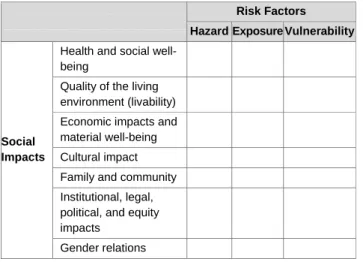
The purpose of the concerns table is to visualize and map the social consequences likely to follow from the risk. The table is divided into two parts. The vertical line represents the social and cultural impacts of the risk, derived from the

“social impact assessment” approach (Vanclay, 2002). The vertical line is defined by “Risk” and consists of “Hazard,”

“Exposure,” “Vulnerability,” and “Capacity.” The “social impact” and “risk components” items are incorporated to provide a broad perspective on concern assessment as a systemic process of gathering knowledge not only about the concerns, expectations, and perceptions that individuals, groups, or cultures may link to a certain risk but also to identify the wider concerns and implications not directly related to a given risk <See Table 2>.

The concerns table includes all the social and cultural consequences to residents of any disaster risk that could alter the way people live, work, play, relate to one another, organize to meet their needs, and generally cope as members of a society. The table provides guidance for systematically conceptualizing and framing the

consequences of the disaster risk as it impinges upon the local community. Its ultimate purpose is to not only identify the community’s concerns about the consequences of the risks but also to explore the social and cultural reasons for those concerns. Hence, it provides direction for the understanding, managing, and controlling of change, and helps in identifying, developing, and implementing mitigation strategies to minimize the potential social impacts. The “risk”

and “social impact” components of the concerns table are discussed in detail below.

5.1.1. Risk

Risk is defined in terms of hazard, vulnerability, and exposure. Hazard refers to the frequency and severity of an event that may cause loss of life or injury, property damage, social and economic disruptions, or environmental degradation (UNISDR, 2004). Exposure refers to the presence of people, livelihood, environmental services and resources, infrastructure, or economic, social, or cultural assets that may be adversely affected by physical events (Lavell & Maskrey, 2014). Vulnerability refers to the characteristics of a person or group and their situation that influence their capacity to anticipate, cope with, resist, and recover from the impact of a natural hazard; this involves a combination of factors that determine the degree to which someone’s life, livelihood, property, and other assets are put at risk by a discreet and identifiable natural or social event (Wisner et al., 2004).

Table 2. Concerns table: An operational format

5.1.2. Social Impact

Notions of social impact in this study are derived from the

“social impact assessment” idea developed by Vanclay (2002) to assess the potential social and cultural consequences of any exogenous social development

Risk Factors Hazard Exposure Vulnerability

Social Impacts

Health and social well- being

Quality of the living environment (livability) Economic impacts and material well-being Cultural impact Family and community Institutional, legal, political, and equity impacts

Gender relations

(5)

(Vanclay, 2002; Burdge & Vanclay, 1995). A social impact is the social, economic, and cultural impact of an adverse event, as determined not only by the direct physical consequences of the event but also by the interaction of the psychological, cultural, social, and institutional processes that amplify or attenuate the public experience of risk and produce secondary impacts (Dreyer et al., 2006; Choi, 2016;

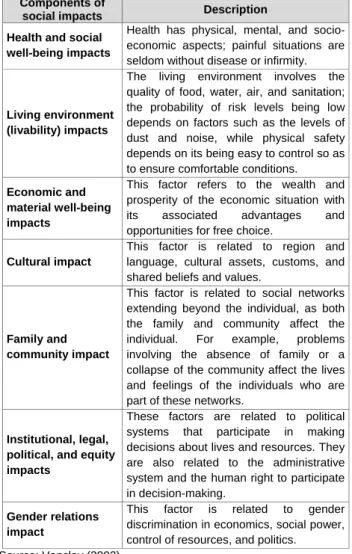
Phuoc et al., 2018). In this study, social impact refers to interested and affected parties’ concerns about the social consequences or changes produced by risks. Many social scientists have tried to develop a classification of social impact types, but few have developed lists of specific social impacts, and fewer still have provided operational definitions of their variables (Cho et al., 2016; Seong, et al., 2016; Choi et al., 2018). In this study, operational variables of social impacts proposed in Vanclay (2002) were used, as depicted in <See Table 3>.

Table 3. Descriptions of social impact components Components of

social impacts Description Health and social

well-being impacts

Health has physical, mental, and socio- economic aspects; painful situations are seldom without disease or infirmity.

Living environment (livability) impacts

The living environment involves the quality of food, water, air, and sanitation;

the probability of risk levels being low depends on factors such as the levels of dust and noise, while physical safety depends on its being easy to control so as to ensure comfortable conditions.

Economic and material well-being impacts

This factor refers to the wealth and prosperity of the economic situation with its associated advantages and opportunities for free choice.

Cultural impact

This factor is related to region and language, cultural assets, customs, and shared beliefs and values.

Family and community impact

This factor is related to social networks extending beyond the individual, as both the family and community affect the individual. For example, problems involving the absence of family or a collapse of the community affect the lives and feelings of the individuals who are part of these networks.

Institutional, legal, political, and equity impacts

These factors are related to political systems that participate in making decisions about lives and resources. They are also related to the administrative system and the human right to participate in decision-making.

Gender relations impact

This factor is related to gender discrimination in economics, social power, control of resources, and politics.

Source: Vanclay (2002).

5.2. SWOT Analysis: Scoping Tool

Scoping sets up goals and identifies stakeholders’

principal obstacles. This study uses SWOT analysis (Hill &

Westbrook, 1997) for its scoping. The concerns table provides one a broad picture of residents’ concerns about the social and cultural impacts of the risk. The SWOT analytical perspective has been introduced in this study to integrate those concerns into the risk management and planning processes through an improved scoping process.

Two types of SWOT analysis have been carried out: the SWOT issue analysis and the SWOT strategy analysis. The first helps us identify the relevant stakeholders, as well as the community’s internal and external capacities and weaknesses; the SWOT strategy analysis explores how these capacities can be used or transformed into options for reducing the identified vulnerabilities and weaknesses, and thus enhances risk preparedness. The SWOT strategy analysis reveals what a community can do by using its own resources and identifies where it needs to collaborate with external agencies to develop and implement an action plan.

This study also introduces the YSM as a potential scoping tool. Detailed descriptions of all the tools are given below.

5.2.1. SWOT Issue Analysis

This study carried out a SWOT issue analysis <see Table 4> to identify the strengths (S), weaknesses (W), opportunities (O), and threats (T) apparent in residents’

concerns. This study considers (S) and (W) as internal factors or aspects inside, or controlled by, the community;

(O) and (T) are considered external factors, happening outside the community and handled by the local government.

Therefore, SW provides a scenario for reviewing the community’s strengths and weaknesses concerning risks, while OT describes the current and potential opportunities and threats that the local government must consider in order to improve risk management.

5.2.2. SWOT Strategy Analysis

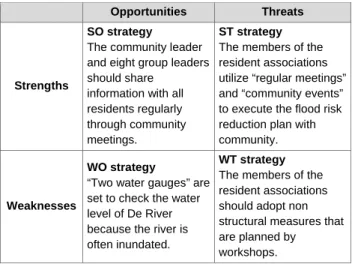
This study used the SWOT strategy analysis (Weihrich, 1982) to strengthen the scoping process by converting the emerging strengths, weaknesses, opportunities, and threats into potential strategy items through internal and external organizational collaboration between the community and external agencies such as the local government. SWOT strategy analysis generally consists of four components

<see Table 5>. SO strategies are related to using strengths

to take advantage of opportunities. ST strategies are used

to utilize strengths to minimize threats. WO strategies

attempts to overcome weaknesses by taking advantage of

(6)

190 Choongik Choi, Junho Choi / Journal of Asian Finance, Economics and Business Vol 5 No 3 (2018) 201-209

opportunities, while WT strategies seek to minimize weaknesses and avoid threats.

Table 4. SWOT Issue Analysis: The Community’s Internal and External Capacities and Susceptibilities

Internal Factors (community level)

External Factors (outside the community;

controlled by external agencies, like local

government Helpful

for achieving the objective

Strengths (S) Opportunities (O)

Harmful to achieving the objective

Weaknesses (W) Threats (T)

Source: Hill &Westbrook (1997).

Table 5. SWOT Strategy Analysis: Collaborative Strategy Creation by Internal and External Agencies

Internal Factors (community level) Strengths (S) Weaknesses

(W)

External Factors (administrative or local government

level)

Opportunities (O)

(SO) Maxi–Maxi strategies:

strategies that use strengths to

maximize opportunities

(WO) Mini–Maxi strategies:

strategies that minimize weaknesses by

taking advantage of opportunities

Threats (T)

(ST) Maxi–Mini strategies:

strategies that use strengths to

minimize threats

(WT) Mini–Mini strategies:

strategies that minimize weaknesses

and avoid threats

Source: Weihrich (1982).

5.3. A Case study : A Series of Workshops on the Muraida Community in Shiga Prefecture, Japan

Muraida community in Maibara City, Shiga Prefecture, Japan that has flood risk because it located near large River held workshops to develop flood risk reduction action plans by cooperation of community residents and local

government. Many important crucial concerns in order to make the plan were expressed by community residents through workshops.

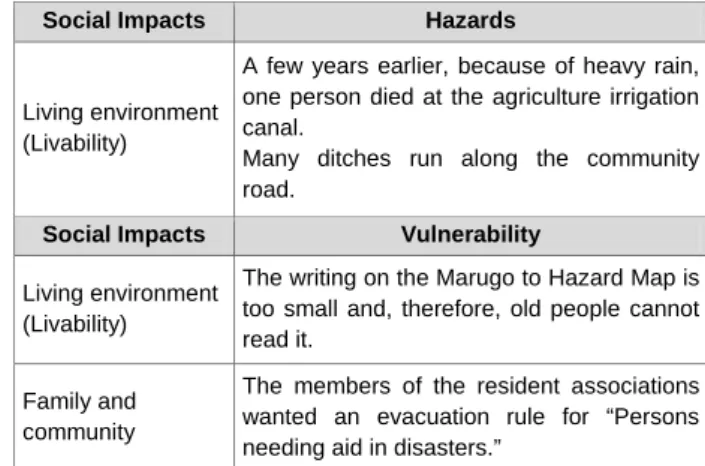
By using concern table, we could map to change the community residents’ concerns dynamically and arrange visually <See Table 6>. In addition, we have carried out two types of SWOT analyses: SWOT issue analysis and SWOT strategy analysis. The SWOT issue analysis revealed various risk-related factors of Muraida community such as cultural and environment factors <See Table 7>. The SWOT strategy analysis proposed how community strengths can be utilized in planning through close cooperation between the community and local government <See Table 8>. The methodology of this study eventually focuses on not only collecting the community’s concern, but can also proposing the direction to develop socially viable solutions by sharing their concern effectively.

Table 6. A sample of concern table at Muraida workshop (Oct. 7, 2011)

Social Impacts Hazards

Living environment (Livability)

A few years earlier, because of heavy rain, one person died at the agriculture irrigation canal.

Many ditches run along the community road.

Social Impacts Vulnerability

Living environment (Livability)

The writing on the Marugo to Hazard Map is too small and, therefore, old people cannot read it.

Family and community

The members of the resident associations wanted an evacuation rule for “Persons needing aid in disasters.”

Table 7. A sample of SWOT issue analysis of Muraida community

Strength Weakness

The community started initiatives on flood risk management.

Residents’ risk awareness is growing because of the workshops

De River is often inundated.

Ane River is seldom flooded, but once flooded, it becomes swollen.

The Kami area is the most potentially hazardous zone but the community believes it is a safe place.

Opportunity Threat

The local government is willing to reduce flood problems in the area as promptly as possible

The “river improvement” of Ane

River has not been completed

yet.

(7)

Table 8. A sample of SWOT strategy analysis of Muraida community

Opportunities Threats

Strengths

SO strategy The community leader and eight group leaders should share

information with all residents regularly through community meetings.

ST strategy The members of the resident associations utilize “regular meetings”

and “community events”

to execute the flood risk reduction plan with community.

Weaknesses

WO strategy

“Two water gauges” are set to check the water level of De River because the river is often inundated.

WT strategy The members of the resident associations should adopt non structural measures that are planned by workshops.

6. Conclusion

6.1. Summary

This study makes some suggestions on the conceptual frameworks for developing socially viable solutions to improve public participation in risk governance. A special focus is placed on the risk governance framework developed by the International Risk Governance Council (IRGC), which reaches the limitations on scope of the framework and possibilities for improvements.

This study employs the tools and techniques, which can be useful for analyzing and evaluating the frameworks such as concern table and SWOT analysis. The article also proposed a specific methodology, so that it could make socially viable solutions in disaster management aspect.

Moreover, this study focused on not only disaster management, but also socially viable solutions from the perspective of risk governance. Based on these purposes, this study looked into so-called ideal risk governance framework by IRGC and identified some limitations about the framework. To overcome these limitations, this study devised the concern table as a concern assessment tool and proposed to utilize SWOT analysis as a scoping tool. In conclusion, although IRGC mentioned that concern assessment is particular innovation, there are some limits in that they did not develop the methodology. In this context, this study not only introduced concern assessment tool but also developed system implementation by organizing the scoping phase, next step of concern assessment.

6.2. Limitation and Implication

This study shows that the need for socially viable solutions in disaster management is absolute for two critical reasons. First, disaster risk issues are so uncertain and complex that stakeholders hold diverse views regarding disaster management plan. Second, encouraging communities to adopt non-structural preventive measures to improve preparedness is critical, and it is important to invite major stakeholders to participate in the process of decision making in local governments. The collaborative generation between knowledge and technology is so essential. The results of this study also support that it is not always feasible to integrate stakeholder participation and disaster management. In these contexts, community-based disaster management and participatory disaster risk management are greatly significant. The participatory styles of community disaster management reveal the weaknesses and limitations of conventional disaster management based on a research- centered, non-reciprocal risk communication mode that represents top-down processing from disaster experts down to the community.

In spite of their contributions to sustainable disaster management, they have several limitations. The interactive learning system and knowledge development process retain the idea that authorities and experts, who are in charge of disaster prevention and reduction, should mainly generate knowledge and plan. All such participatory methods assume that the community passively absorbs the knowledge and technology that the specialists have prepared in advance.

The major impediments of such community-based disaster management programs are their over-dependency on donors and governments and their failure to give the community ownership of the problem and planning authority.

Therefore, the key goal is putting the community in the driver’s seat instead of only inviting them to consult on an existing plan on a predetermined issue identified by outsiders or governments. To facilitate a socially viable solution to risk management, this study would describe this phase of risk governance as “scoping,” during which participants identify and prioritize risks, explore the capacities, resources, and potential roles and responsibilities of the stakeholders, and explore the emerging options for implementing those tasks. To this end, communities can become involved in decision making in a number of ways.

References

Arnstein, S. R. (1969). A ladder of citizen participation.

Journal of the American Institute of Planners, 35(4),

216-224.

(8)

192 Choongik Choi, Junho Choi / Journal of Asian Finance, Economics and Business Vol 5 No 3 (2018) 201-209

Bajek, R., Matsuda, Y., & Okada, N. (2007). Japan's jishu bosai soshiki community activities: Analysis of its role in participatory community disaster management.

Natural Hazards, 44(2), 281-292.

Burdge, R., & Vanclay, F. (1995). Social impact assessment.

In: Vanclay, F., & Bronstein, D. (Eds.). Environmental and Social Impact Assessment(pp.31-65). Sussex, UK: Wiley & Sons.

Chen, L. C., Liu, Y. C., & Chan, K. C. (2006). Integrated community based disaster management program in Taiwan: A case study of Shang-an Village. Natural Hazards, 37, 209-223.

Chess, C., & Purcell, K. (1999). Public participation and the environment: Do we know what works.

Environmental Science & Technology, 33(16), 2685- 2692.

Cho, M. R., & Mukoyama, M. (2016). Conceptual framework of reverse retail internationalization: From the perspective of retail Innovation and retail. Journal of Distribution Science, 14(11), 5-17.

Choi, C. I. (2015). A discourse on the paradigm shift of national risk management in risk society. Journal of the Korean Cadastre Information Association, 17(2), 37-45.

Choi, C. I. (2016). Does economic growth really reduce disaster damages? Index decomposition analysis for the relationship between disaster damages, urbanization and economic growth. International Journal of Urban Sciences, 20(2), 188-205.

Choi, N. H., Park, S. M., & Lim, A. Y. (2018). Roles of consumer’s social relationship and perceived justice type on service recovery satisfaction. The International Journal of Industrial Distribution &

Business, 9(1), 77-88.

Cronin, S. J., Petterson, M. G., Taylor, P., & Biliki, R. (2004).

Maximizing multi stakeholder participation in government and community volcanic hazard management programs: A case study from Savo, Solomon Islands. Natural Hazards, 33(1), 105-136.

Dreyer L. C., Hauschild M. Z., & Schierbeck, J. (2006). A framework for social life cycle impact assessment.

The International Journal of Life Cycle Assessment, 11(2), 88-97.

Hill, T., & Westbrook, R. (1997). SWOT analysis: It’s time for a product recall. Long Range Planning, 30(1), 46-52.

Ikeda, S., Sato, T., & Fukuzono, T. (2008). Towards an integrated management framework for emerging disaster risks in Japan. Natural Hazards, 44(2), 267- 280.

IRGC (2005). White paper on risk governance: Toward an Integrative Approach. Geneva, Switzerland: The International Risk Governance Council.

IRGC (2008). An Introduction to the IRGC Risk Governance Framework. Geneva, Switzerland: The International Risk Governance Council.

Kim, E. J. (2016). A study on public ethics of care: Care, justice and economics of social service. Journal of Distribution Science, 14(10), 39-45.

Lavell, A., & Maskrey, A. (2014). The future of disaster risk management. Environmental Hazards, 13(4), 267- 280.

Mehadi, M., Mazumder, M., & Hossain, D. M. (2018).

Research on corporate risk reporting: Current trends and future avenues. The Journal of Asian Finance, Economics and Business, 5(1), 29-41.

Miles, S. B. (2011). Participatory model assessment of earthquake-induced landslide hazard models.

Natural Hazards, 56(3), 749–766.

Okada, N., Na, J. I., Fang, L., & Teratani, A. (2013). The yonmenkaigi System Method: An implementation oriented group decision support approach. Group Decision and Negotiation, 22(1), 53-67.

Pahl-Wostl, C. (2006). The importance of social learning in restoring the multi-functionality of rivers and flood plains. Ecology and Society, 11(1), 10.

doi:org/10.5751/ES-01542-110110.

Paton, D. (2003). Disaster preparedness: A social cognitive perspective. Disaster Prevention and Management, 12(3), 210–216.

Pearce, L. (2003). Disaster management and community planning, and public participation: How to achieve sustainable hazard mitigation. Natural Hazards, 28(2-3), 211-228.

Pelling, M. (2007). Learning from others: The scope and challenges for participatory disaster risk assessment.

Disasters, 31(4), 373-385.

Phuoc, L. T., Kim, K. S., & Su, Y. (2018). Reexamination of estimating beta coefficient as a risk measure in CAPM. The Journal of Asian Finance, Economics and Business, 5(1), 11-16.

Rahman, M., & Khatun, N. (2018). A comparative analysis of corporate governance guidelines: Bangladesh perspective. The East Asian Journal of Business Management, 7(2), 5-16.

Renn, O. (2006). Risk communication - consumers between information and irritation. Journal of Risk Research, 9(8), 833-850.

Renn, O. (2008). Risk governance.: Coping with Uncertainty in a Complex World. London, UK: Earthscan.

Renn, O., & Walker, K. D. (2008). Global Risk Governance, Concept and Practice Using the IRGC Framework.

Amsterdam, Netherlands: Springer.

Rowe, G., & Frewer, L. J. (2000). Public participation

methods: A framework for evaluation. Science,

(9)

Technology & Human Values, 25(1), 3-29.

Samaddar, S., Choi, J. H., Misra, B. A., & Tatano. H. (2014).

Insights on social learning and collaborative action plan development for flood risks mitigation:

Practicing yonmenkaigi system method (YSM) in hotspot Mumbai. Natural Hazards, 75(2), 1531-1554.

Seong, N. C., Moon, J. S., & Park, K. H. (2016). The effect of distribution enterprise leader's coaching behavior on organizational citizenship behavior and turnover Intention: Mediating role of authentic leadership and moderating role of emotional intelligence. Journal of Distribution Science, 14(1), 75-84.

Tatano, H., & Yoshida, M. (2014). Integrated Disaster Risk Management from the Perspective of Human Security Engineering. Challenges for Human Security Engineering: Environmental Science and Engineering: Springer, pp 111-142.

UNISDR (2004). Living with risk: a global review of disaster reduction initiatives. Geneva, Switzerland: United

Nations Office for Disaster Risk Reduction (UNISDR).

Vanclay, F. (2002). Conceptualizing social impact.

Environmental Impact Assessment Review, 22(3), 183-211.

Weihrich, H. (1982). The TOWS matrix - A tool for situational analysis. Long Range Planning, 15(2), 54- 66.

Wisner, B., Blaikie, P. M., Cannon, T., & Davis, I. (2004). At Risk: Natural Hazards, People’s Vulnerability and Disasters. London, UK: Routledge.

Yamori, K. (2009). Action research on disaster reduction education: Building a “community of practice”

through a gaming approach. Journal of Natural Disaster Science, 30(2), 83-96.

Yamori, K. (2011). The roles and tasks of implementation

science on disaster prevention and reduction

knowledge and technology: From efficient application

to collaborative generation. Journal of Integrated

Disaster Risks Management, 1(1), 48-58.

수치

Table 2. Concerns table: An operational format
Table 3. Descriptions of social impact components    Components of
Table 5. SWOT Strategy Analysis: Collaborative Strategy Creation  by Internal and External Agencies
Table 8. A sample of SWOT strategy analysis of Muraida community

참조

관련 문서

* 원천기술혁신은 새로운 문제, 이를 해결하기 위한 과학, 기술과 잠재적 시장에 대한 정보, 그리고 이를 수행하는 데 필요한 역량과 활동을 matching 시키는 매우

Risk Management and Decision

KEY WORDS Public Pension․Fund, Socially Responsible Investment(SRI), Corporate Social Responsibility(CSR), Institutional Investors, Corporate Governance,

This study was conducted to analyze the effects of obesity on the core stability and metabolic syndrome risk factors of middle - aged women.. The effect

Finally, this study has an implication that the comprehensive analysis framework, rather than a single model, was more useful in analyzing a dynamic policy formation

In this way, it need to investigate and research the risk element for the safety of marine traffic to prevent marine pollution, life and property resulted from marine

For improvement measures, this study proposes the enactment of the provisional Framework Act on Crisis Management and exemplary provi- sions thereof. This study concentrates

OECD’s Principles of Corporate Governance applied to private enterprises plays a great role in Guidelines on Corporate Governance of State-Owned Enterprises enacted and