韓 國 水 資 源 學 會 論 文 集 第40卷 第12號․2007年 12月
pp. 921~930
A2 시나리오에 따른 국내 수자원의 변동성 전망
Outlook on Variation of Water Resources in Korea under SRES A2 Scenario
배 덕 효 * / 정 일 원 ** / 이 병 주 ***
Bae, Deg Hyo / Jung, Il Won / Lee, Byong Ju
...
Abstract
The objective of this study is to present temporal-spatial variation of water resources on climate change impacts using the IPCC SRES A2 scenario and dynamical downscaling of the results (using the MM5 model with a resolution of 27km by 27km) at 139 sub-basins in Korea. The variation of runoff shows differences in the change of rate according to the each sub-basins and analysis durations. It has increased in the sub-basins located in Han river basin and east part of it, the other basins have decreased. In seasonal analysis, runoff in autumn and winter have increased, while in spring and summer have decreased. The results of frequency analyzing classified runoff(Low flow(Q≤
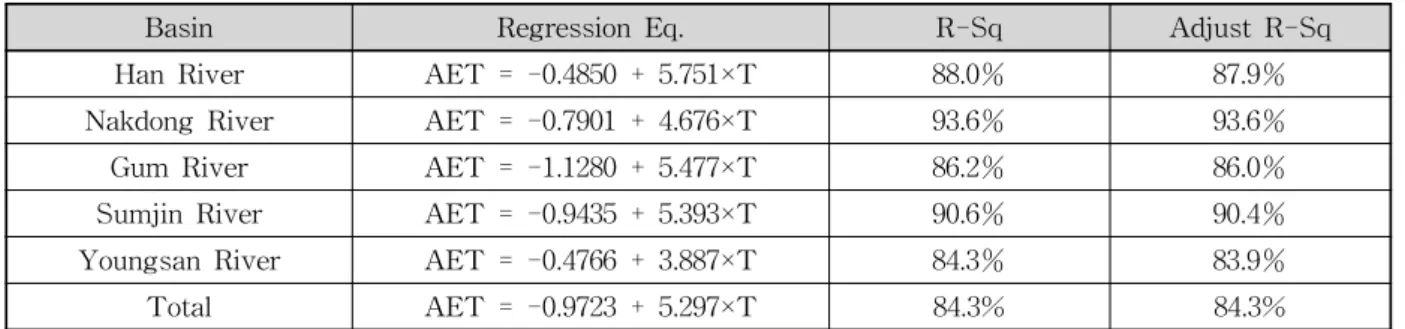
5mm), Normal flow(5<Q<100mm), High flow(Q≥100mm)) show that low flow increase in most of the sub-basins for 2031-2060 and 2061-2090. In the case of high flow, it have higher frequency ranging from -100% to 500% than low flow. Regardless of the variation of mean runoff, maximum discharge appeared to be increase in process of time. The regression method is used to figure out the relationship between the rate of runoff change and mean temperature, mean precipitation under A2 scenario. The mean actual evapotranspirations from the regression equations increased by 3.4~5.3%
for the change of 1°C. Also, for the precipitation change of ±10%, runoff variety range is -18.2~
+12.4% in Han River, -21.6~+14.6% in Nakdong River, -17.5~+11.5% in Gum River, -18.4~+10.6% in Sumjin River, -19.9~+12.7% Youngsan River basin.
keywords : Climate change impact assessment, Water resources, A2 scenario, PRMS
...
요 지
본 연구에서는 SRES A2 시나리오의 GCM 결과를 역학적으로 다운스케일한 해상도 27km×27km 자료를 이용하 여 국내 139개 유역에 대해 기후변화에 따른 수자원의 시공간 변화를 평가하고 결과를 제시하였다. 유출량의 변화는 유역에 따라 그리고 분석기간에 따라 변화율에서 차이가 나타났다. 기간별로 차이는 있으나 한강과 한강동해안에 위 치한 유역에서는 연평균유출량이 증가하고 나머지 유역에서는 감소할 것으로 분석되었다. 계절별 분석에서는 가을과 겨울철 유출량의 증가와 봄과 여름철의 유출량이 감소하는 것으로 나타났다. 유역별 유출고를 저수(Q≤5mm), 평수 (5mm<Q<100mm), 고수량(Q≥100mm)으로 구분하여 변화를 분석한 결과, 대부분의 유역에서 2031-2060년과
* 세종대학교 물자원연구소․토목환경공학과 부교수Associate Prof., Dept. of Civil and Environmental Engrg., Sejong Univ, Seoul 143-747, Korea (e-mail: [email protected])
** 세종대학교 토목환경공학과 박사과정
Ph.D. Candidate, Dept. of Civil and Environmental Engrg., Sejong Univ, Seoul 143-747, Korea (e-mail: [email protected])
*** 세종대학교 토목환경공학과 박사과정
Ph.D. Candidate, Dept. of Civil and Environmental Engrg., Sejong Univ, Seoul 143-747, Korea (e-mail: [email protected])