1. INTRODUCTION
Over the past decade, the incidence of urban traffic accidents still has increased, while the in- cidence of an overall traffic accident has slowly decreased. According to “European accident re- search and safety report 2013” [1], more than 90 percent of those driving accidents originated from the mistakes of drivers. In order to decrease the accidents occurred by the mistakes, there is a ten- dency to obligatory installation of intelligent ve- hicle system using various sensors such as Lidar, Laser, Radar, and camera.
Those sensor-based ADASs have achieved great developments, which provide better under- standing of the environment in order to improve traffic safety and efficiency. ADAS mainly assists human drivers by alerting them in the situation such as lane and road departure, obstacle collision, pedestrian and vehicle detection, and parking assistance. Among the various sensing modalities, imaging technology has extremely been developed in recent years. Vision-based sensors are cheaper, smaller, and of higher quality than ever before.
Simultaneously, computing power has dramatically increased. Vision-based sensors especially give
Superpixel-based Vehicle Detection using Plane Normal Vector in Disparity Space
Jeonghyun Seo
†, Kwanghoon Sohn
††ABSTRACT
This paper proposes a framework of superpixel-based vehicle detection method using plane normal vector in disparity space. We utilize two common factors for detecting vehicles: Hypothesis Generation (HG) and Hypothesis Verification (HV). At the stage of HG, we set the regions of interest (ROI) by estimating the lane, and track them to reduce computational cost of the overall processes. The image is then divided into compact superpixels, each of which is viewed as a plane composed of the normal vector in disparity space. After that, the representative normal vector is computed at a superpixel-level, which alleviates the well-known problems of conventional color-based and depth-based approaches.
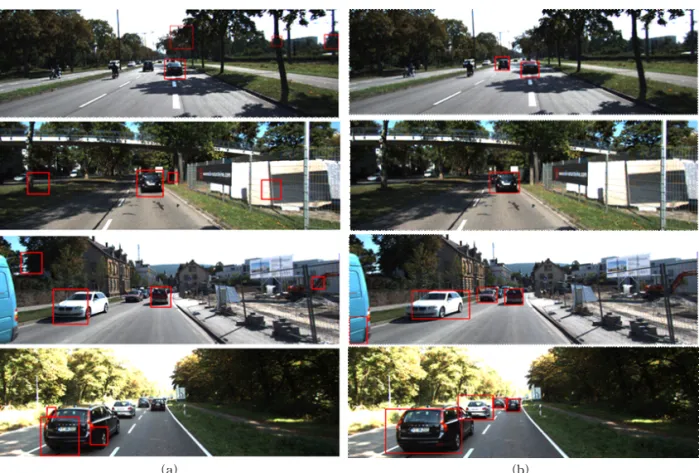
Based on the assumption that the central-bottom of the input image is always on the navigable region, the road and obstacle candidates are simultaneously extracted by the plane normal vectors obtained from K-means algorithm. At the stage of HV, the separated obstacle candidates are verified by employing HOG and SVM as for a feature and classifying function, respectively. To achieve this, we trained SVM classifier by HOG features of KITTI training dataset. The experimental results demonstrate that the proposed vehicle detection system outperforms the conventional HOG-based methods qualitatively and quantitatively.
Key words: Normal Vector Computation, Stereo Matching, Superpixel Segmentation, Free Space Estimation, Vehicle Detection
※ Corresponding Author : Kwanghoon Sohn, Address:
C129, The 3rd Engineering Building, Yonsei University, 50 Yonsei-ro, Seodaemun-Gu, Seoul 120-749, Korea, TEL : +82-2-2123-2879, FAX : +82-2-2123-7712, E-mail : [email protected]
Receipt date : Dec . 25, 2015 Revision date : Apr . 10, 2016 Approval date : May . 18, 2016
††
Dept. of Electrical and Electronic Engineering, Yonsei University (E-mail : [email protected])
††
Dept. of Electrical and Electronic Engineering, Yonsei University
※ This work was supported by the National Research
Foundation of Korea(NRF) grant funded by the Korea
government(MSIP) (NRF-2013R1A2A2A01068338)
lots of information such as colors, shapes, depth and have advantages that driver can effectively understand surrounding environment by seeing image.
With advances in camera sensing and computa- tional technologies, advances in vehicle detection using monocular / stereo vision, and sensor fusion has been an extremely active research area in the intelligent vehicles community. Basically, resear- chers use the monocular vision-based system for vehicle detection. Most monocular vision-based systems utilize the low-level information such as color, texture, edges, and motion information ob- tained from difference images between temporal neighborhoods. The low-level information is pow- erful to understand environment around vehicles and to detect obstacles. However, there are some limitations which cause the loss of the depth and structure information in monocular vision- based ones. To overcome these limitations, the stereo vi- sion-based system is introduced and researched in recent years. Not just supplement the depth and structure information, stereo vision-based systems can also provide the real distance to obstacles and inform the accurate location of the obstacles to drivers. However, the quality of these information is extremely dependent on depth information. The depth is measured by calculating the difference be- tween the position of a feature in a reference image and the one of the target image. In this paper, ve- hicle detection method is proposed to alleviate the problems of conventional color-based and depth- based approaches. It is based on a superpixel- based plane normal vector in disparity space, where Histogram of Gradient (HOG) and Support Vector Machine (SVM) are used as a feature and classi- fier, respectively.
The rest of this paper is organized as follows.
Chapter 2 provides a brief review of vision-based vehicle detection. We then describe the proposed vehicle detection methods in Chapter 3. Chapter 4 shows the experimental results and their evalua-
tions on the KITTI dataset. Finally, we conclude the paper with discussion for further works in Chapter 5.
2. RELATED WORKS
Vehicle detection methods can be categorized into two groups: 1) correlation based approaches using template matching and 2) learning based ap- proaches using an object classifier.
1) Template Matching: The correlation based method uses a predefined template and determines a similarity measure by calculating correlation be- tween the ROI and the template. Since there are various models of vehicles with different appear- ances, a general template with common features of a vehicle is used. These features include the rear window and number plate, a rectangular box with specific aspect ratio and a “U” shaped pattern with one horizontal and two vertical edges [2], [3]. A vehicle could appear in different sizes depending on its distance from the camera; therefore, the cor- relation test is usually performed at several scales of ROI. Intensity of the image is also normalized before the correlation test to get a consistent result.
2) Classifier-Based Vehicle Verification: This
approach uses two-class image classifiers to dif-
ferentiate vehicle from non-vehicle candidates. A
classifier learns the characteristics of a vehicle’s
appearance from training images. Training is
based on a supervised learning approach where a
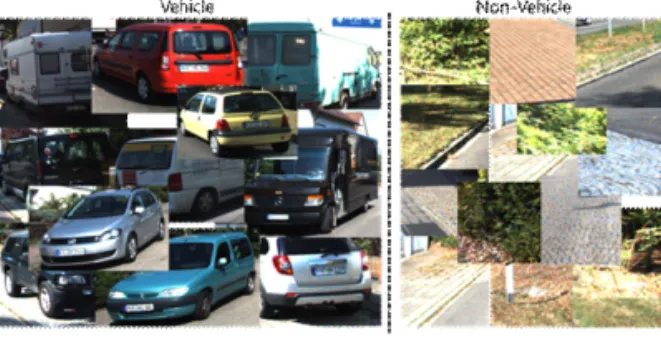
large set of labeled positive (vehicle) and negative
(non-vehicle) images are used. The most common
classification schemes for vehicle verification in-
clude SVM [4,20], AdaBoost [5]. To facilitate the
classification, training images are first prepro-
cessed to extract descriptive features. Selection of
features is important for achieving good classi-
fication results. A fine set of features should cap-
ture most of the variability in the appearance of
a vehicle. Numerous features for vehicle classi-
fication have been proposed such as HOG [6],
Gabor [7], Principal Component Analysis (PCA) [8].
HOG feature captures local histogram of an im- age’s gradient orientations in a dense grid and it was first proposed by Dalal [6] for human classi- fication. System developed using a linear SVM classifier trained on HOG features was able to spot vehicles in different traffic scenarios [9].
Gabor features had been known for texture analysis of images [10] as they capture local lines and edges information at different orientations and scales. SVM classifier trained on Gabor features were tested for vehicle detection and achieved 94.5% detection rate at 1.5% false detection [7]. It was shown that the classifier outperformed a PCA feature based ANN classifier. A systematic and general evolutionary Gabor filter optimization (EGFO) approach to select optimal Gabor parame- ters (orientation and scale) was investigated to im- prove the performance of vehicle detection [11].
SVM classifier trained on Boosted Gabor features with parameters (orientation and scale) selected from learning had reported 96% detection rate [12].
3. PROPOSED METHOD
3.1 Algorithm overview
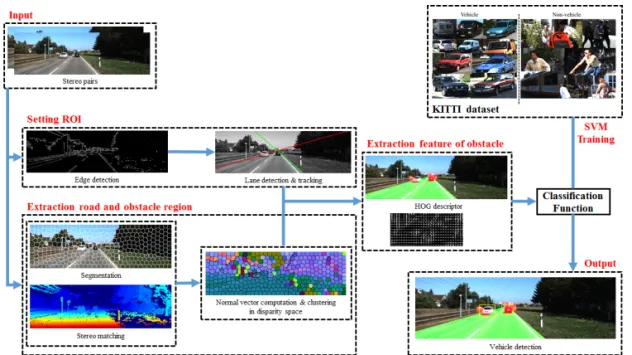
The proposed vehicle detection method aims at effective collision avoidance by identifying not only the vehicle but also the road. The overview of the proposed framework is illustrated in Fig. 1. We uti- lize the two factors common to vision-based ve- hicle detection methods: Hypothesis Generation (HG) and Hypothesis Verification (HV).
At the stage of HG, the lane estimation is per- formed for an adaptive ROI selection. We employ Canny edge detection and Hough transform, where the lane is tracked every frame. Simultaneously, the disparity estimation is performed using a Semi Global Matching (SGM) [14], and Simple Linear Iterative Clustering (SLIC) superpixels [13] are then extracted based on the color information, which divides the estimated depth map to compute the plane normal vectors in disparity space. A clustering is employed to the normal vector of each plane at a superpixel level. With the assumption that the central-bottom of the input image is al- ways on the road region, the K-means clustering algorithm is utilized to decide whether each plane
Fig. 1. Overview of the proposed framework.
belongs to the road or obstacle. In this process, we extract the obstacle candidates in the selected ROI.
Next, at the stage of HV, the obstacle candidate regions are verified by employing HOG and SVM as a feature and classifying function, respectively.
To achieve this, we trained SVM classifier with HOG features of KITTI training dataset. We then extract HOG features of the obtained obstacle can- didates and classify the vehicles by the trained SVM classifier. Each step of the proposed frame- work is described in the following subsections.
3.2 Selection of a region of interest (ROI) using lane detection and tracking
The definition of vanishing point is the image point at which the projection of parallel line intersect. It is invariant feature of the image and has been used for both qualitative and quantitative image analysis. The methods using local oriented textures are able to detect more reliable vanishing points for unstructured road, but edge-based van- ishing point detection method is suitable for re- al-time implementation. In this paper, since we mainly deal with vehicle detection for structured environments such as highway and urban scene in KITTI dataset, we employ an edge-based vanish- ing point detection. First, the edges are detected by Canny edge detection method. Lines are esti- mated by Hough transform. The detection of the straight line is a necessary prerequisite process for all the methods of vanishing point detection. Lines are comprised of the basis of grouping connected regions of pixels which have similar gradient orientations. In many lines, we extract two domi- nant lines by angle of lines. We assume that the two dominant lines is lane, and designate un- der-region as a region of interest (ROI). These ROIs are essential to reduce the computational cost of the following process. Vehicle detection in ROI has advantages that are robust to damaged roads, various traffic environment. Thus, the ROI using vanishing point detection is able to provide a
strong constraint in challenging traffic environ- ment.
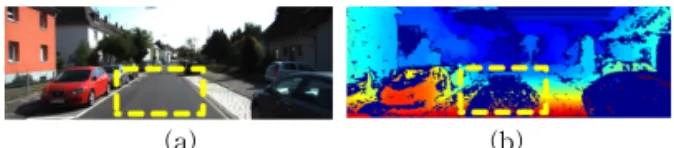
3.3 Road and obstacle region extraction using plane normal vector in disparity space Disparity is the measure of difference between the position of a feature in a reference image and the target image. Since it provides depth in- formation robust to illumination variation, we esti- mate disparity to distinguish the road from the obstacles. In this paper, dense disparity maps are computed using a semi-global matching (SGM) [14]. Although the SGM is one of the most reliable stereo matching algorithms, the estimated dis- parity map is still sparse in challenging traffic scene including low-textured road surfaces or shady regions. As shown in Fig. 2(a), it can be seen that the disparity values in low-textured region are presented sparse due to the failure of estimation.
In order to handle this problem, the image is seg- mented by superpixels and the representative dis- parity value is allocated to each superpixel. Notic- ing that the disparity estimation technique relies on the smoothness assumption, i.e., nearby pixels with similar appearance have similar disparities.
The low-texture and shadow problem thus can be handled effectively by the manner of the over-seg- mentation since superpixels are likely to be uni- form in color and texture. We perform the over- segmentation of the input image into superpixels using SLIC [13]. As shown in Fig. 2(b), superpixels produce spatially appealing segments of road and tend to preserve boundaries effectively.
In order to estimate geometric information of the input stereo pair, we find the best-fit plane for each
(a) (b)
Fig. 2. Scene including low textured road surface. (a)
Original image, (b) its corresponding disparity
map.
superpixel. The best-fit plane is obtained from a set of points which consists of image coordinates and disparity. Let us denote given stereo pairs
I →R
and
I →R
, and their corresponding disparity map I →L that assigns each pixel index p to a disparity
∈L , where I ⊂ N
is a dense dis- crete image domain and L is a discrete candidate.
Our goal is to estimate plane normal vectors N
I →R
and N
I →R
. Without loss of general- ity, we concentrate on deriving N
in the following.
Let S
denote the -th index set of pixels in
. The plane is defined as follows;
A
B
C
(1)
where the A
, B
, and C
represent the constants of the plane equation in the -th superpixel, and u, v, and d are the variables of X, Y, and Z coor- dinates, respectively. We then yield the error func- tion
to fit the best-fit plane in S
as follows;
∈ S
A
B
C
(2) where S
denotes the -th index set of non-error disparity pixels in S
. Since equation (2) shows the quadratic form, the optimal values for A
B
C
can be computed by its derivative as follows;
∇
∈ S
A
B
C
(3)
Then, the representative normal vector
of the plane in S
is estimated as follows;
C
A
C
B
C
(4)
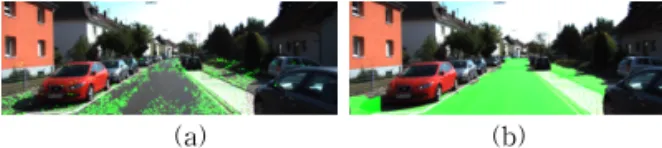
As a result, the representative normal vector in equation (4) is assigned to each superpixel. Noting that the normal vector is estimated by non-error disparity values in each superpixel, the proposed framework shows robustness to the error of stereo matching as shown in Fig. 3.
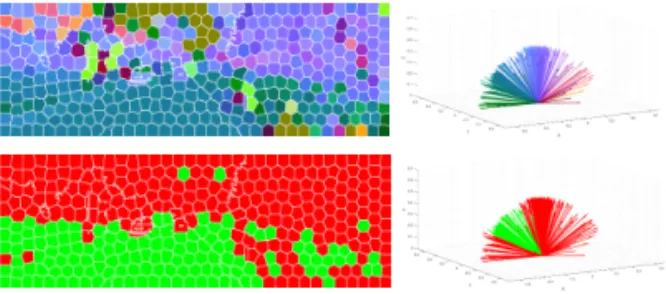
Here we are targeting to determine the region of road for each superpixel by considering the sim- ilarity of
. Based on the assumption that the
central-bottom of input image is included in the road region, we apply the K-means clustering al- gorithm for
to decide whether each superpixel belongs to the road or not [15]. Let us denote
is clustered into a set of K clusters, where
is an index set of the -th cluster. K-means algorithm finds a partition which minimizes the squared error between the mean of a cluster and the normal vec- tors in the cluster. Let
be the mean of normal vectors in the -th cluster. The sum of squared er- ror between
and the normal vectors in the -th cluster is defined as
∈
∥
∥
(5)
The goal of K-means clustering is to minimize the sum of squared error over all the K clusters as follows: