Effect of separate and mixed refining of hardwood and softwood pulps on paper properties
Vipul S. Chauhan
†, Nitin Kumar, Manoj Kumar
1, Swapan K. Chakrabarti, S. K. Thapar
2(Received October 10, 2011: Accepted December 21, 2011)
• Thapar Centre for Industrial Research and Development, Yamuna Nagar – 135 001, Haryana, INDIA 1 Present address: Star Paper Mills Ltd., Saharanpur – 247 001, U.P., INDIA
2 Present address: Anmol Polymers Pvt. Ltd., New Delhi – 110 034, INDIA
†Corresponding author: [email protected]
ABSTRACT
Beating or refining is an energy intensive process in paper industry. In India, most of the paper industries blend long fibered softwood pulps with short fibered hardwood or agro based pulps to get the paper prop- erties of competitive level. Refining characteristics of the blend of pulps is very crucial with respect to freeness and strength properties. This study has been carried out to understand the refining behavior of three hardwood pulps and a softwood pulp. The hardwood and softwood pulps are blended in different proportions in two different ways; a) blending after their separate refining, and b) blending before refin- ing followed by mixed refining of the blended pulps. Freeness of pulp, strength, optical and surface prop- erties of paper along with formation have been determined and compared for both the refining methods.
The fiber classification of refined pulps was also carried out to analyze the effect of refining method on fiber morphology. The mixed refining of hardwood and softwood pulps marginally affects the fiber mor- phology in comparison to separate refining of pulps. The strength and other properties of paper prepared from mixed refining of pulps are either better or comparable than those of separately refined pulps.
Keywords: Fiber, Freeness, Hardwood, Mixed refining, Separate refining, Softwood, Strength
1. Introduction
The demand of quality paper is increasing day-by- day. At the same time, the entire manufacturing process needs to be as cost-effective as possible. Process development plays a key role to get an efficient process for paper manufacturing.
Refining is a mechanical treatment of a pulp suspension, with the aim to achieve pulp properties
suitable for papermaking. The properties of fiber surfaces change naturally as refining progresses1). The primary effect of refining on fiber is considered to be (a) external fibrillation, (b) internal fibrillation, (c) the production of fines, and (d) fiber shortening. Through the use of microscopic techniques, both optical and electron, many researchers have provided evidence of fibrillation caused by refining2).
Refining requires a considerable amount of energy
but attributes flexibility to the fibers and increases surface area for interfiber bonding3). It increases the drainage resistance of the refined pulp and decreases the bulk of paper. Refining enhances the tensile strength, or in some cases tensile energy absorption. In fact refining influences all paper properties to some extent.
Fine papers are typically produced from various softwood and hardwood mixtures. Long and coarse softwood fibers act as a reinforcement material, whereas short and fine hardwood fibers form a good printing base. Before entering the paper machine, fibers must be so refined that the desired paper properties are achieved. The different refining characteristics are linked with refiner designs due to the geometric differences.
Bleached softwood pulps contain hemicelluloses which are critically low for developing a high tensile strength by the refining process. At low hemicelluloses content the fibers loose elasticity, a development which is strengthened by an increased degradation of cellulose. Hardwood pulps are quite easy to refine but sensitive to a high intensity in the refining process 4).
Fibers have different physical dimensions and refining behavior; long and thick softwood fibers require coarser fillings and higher refining intensity than those required for short and thin hardwood fibers.
The typical refining system comprises separate refining lines for different fibers and each line has two or three refiners in series. Sometimes the fibers are mixed together and refined through a combination of refiners put in series. Studies indicated that some fibers are better refined separately, while mixed refining is preferable for other fiber mixtures5).
Recently, Koivuniemi6) carried out separate and mixed refining experiments using eucalyptus and pine pulps and showed that mixed refining gave similar quality in refined pulp. Mixed refining seems to be beneficial for tensile and bond development with less energy requirement. With higher softwood content mixed refining gives higher air resistance.
In India, most of the paper industries blend softwood pulp with hardwood or agro residue pulp to get the paper properties of desired level. The refining of hardwood and softwood pulps is generally performed separately prior to their blending. As refining is an energy intensive process, it is always desired by papermakers to refine both the pulps together from the economic point of view. In this study, separate and mixed refining of hardwood and softwood pulps have been carried out in lab scale PFI mill to analyze their effect on refining energy, fiber morphology and paper properties.
2. Materials & Methods
2.1 Materials
Three hardwood pulps were used in this study;
bleached hardwood pulp of subabul furnish (HW1) collected from Bilt Graphic Pulp and Paper Limited, Unit – APR; bleached hardwood pulp having mixed hardwood furnish (50% eucalyptus, 32% poplar and 18% bamboo) (HW2) collected from Ballarpur Industries Limited, Unit – Shree Gopal; bleached hardwood pulp of acacia furnish (HW3) collected from April Asia, Indonesia. The softwood (SW) pulp was collected from Georgia Pacific, USA.
The freeness of unrefined hardwood and softwood pulps was different; the pulp oSR of HW1, HW2, HW3 and SW pulps was 17, 20, 15 and 12 respectively. The fiber length of unrefined hardwood pulp was in the range of 775 to 953 µm; it was highest in case of SW pulp (2530 µm) followed by HW3 (953 µm), HW1 (792 µm) and HW2 (775 µm) pulp. The fiber width of HW1 and HW3 was comparable (20.1-20.2 µm) and slightly higher than that of HW2 pulp (18.7 µm).
Similar to fiber length, the width of the softwood fibers was also widest (35.5 µm). The fiber coarseness was at par with the fiber length; it was highest in SW pulp followed by HW3, HW1 and HW2 pulp. The contents of fines were highest in HW2 pulp followed by HW3
Particular HW1 HW2 HW3 SW
Average fiber length (Length weighted), µm 792 775 953 2530
Fiber width, µm 20.1 18.7 20.2 35.5
Coarseness, µg/m 87.4 66.0 104.5 230.3
Fines content, % 7.9 9.4 8.3 1.6
Viscosity, cP 10.2 14.2 8.2 15.9
Table 1. Fiber properties of unrefined hardwood and softwood pulps
Blending proportion Blended pulps Revolution, no.
80 : 20
HW1 : SW 2000 * 0.8 + 6200 * 0.2 = 2840 HW2 : SW 1500 * 0.8 + 6200 * 0.2 = 2440 HW3 : SW 3700 * 0.8 + 6200 * 0.2 = 4200
70 : 30
HW1 : SW 2000 * 0.7 + 6200 * 0.3 = 3260 HW2 : SW 1500 * 0.7 + 6200 * 0.3 = 2910 HW3 : SW 3700 * 0.7 + 6200 * 0.3 = 4450
60 : 40
HW1 : SW 2000 * 0.6 + 6200 * 0.4 = 3680 HW2 : SW 1500 * 0.6 + 6200 * 0.4 = 3380 HW3 : SW 3700 * 0.6 + 6200 * 0.4 = 4700
Table 2. Calculated PFI mill revolutions required for refining of hardwood pulps blended with softwood pulp
and HW2 pulp. In case of SW pulp, it was only 2.6%.
The CED viscosity of SW pulp was highest followed by HW2, HW1 and HW3 pulp (Table 1).
2.2 Blending and refining of pulps
Hardwood pulps were blended with softwood pulp in three proportions viz., 80:20, 70:30 and 60:40. In separate refining experiments, hardwood pulps; HW1, HW2 and HW3 were refined in PFI mill with 2000, 1500 and 3700 PFI mill revolutions, respectively to get freeness of around 24 oSR, whereas SW pulp was refined at 6200 revolutions to get 30 oSR. The pulps were then blended as per the above proportions and handsheets were made. A portion of the blended pulp was classified in Bauer McNett fiber classifier.
In mixed refining experiments, the virgin hardwood and softwood pulps were blended prior to refining in the similar proportions as in case of separate refining experiments. The refining of blended pulps was carried out in PFI mill with the calculated revolutions. The
example for the calculation of revolutions required for HW-1 and SW pulp blended in 80:20 proportions is given below:
PFI mill revolutions required for HW1 pulp refining to 24 oSR : 2000
PFI mill revolutions required for SW pulp refining to 30 oSR : 6200
PFI mill revolutions required for mixed HW1: SW (80:20) pulp = 2000 * 0.8 + 6200 * 0.2 = 2840
PFI mill revolutions required for other proportions were calculated (Table 2).
2.3 Methods
The pulp freeness was measured with Schopper- Riegler (oSR) tester as per ISO 5267-1:1999 method.
The viscosity of pulp was determined as per TAPPI T230 om-99. The Bauer McNett classification of all refined pulps was carried out as per TAPPI T233 cm-95. The micrographs of individual as well as blended pulp fibers refined to different levels were
Particular HW1 HW2 HW3 SW
Bulk, cm3/g 1.42 1.36 1.60 1.32
Stretch. % 3.34 3.08 2.81 3.43
Breaking length, km 4.99 4.96 4.25 7.03
TEA, J/m2 59.4 56.5 42.7 87.3
Burst index, kN/g 3.16 3.51 2.36 6.56
Tear index, mNm2/g 8.06 8.07 9.84 9.71
Taber stiffness 1.17 1.20 1.30 1.22
Scott bond, J/m2 311 337 272 550
Air permeance, s/100ml 5 11 4 36
PFI revolutions required for HW1, HW2, HW3 and SW pulp : 2000, 1500, 3700 and 6200 respectively
oSR of HW1, HW2, HW3 and SW pulp : 24, 24.5, 24.5 and 30 respectively Table 3. Paper properties of hardwood and softwood refined pulps
Fig. 1. Effect of PFI mill revolutions on freeness of different pulps
taken with Image Analyzer using 40X magnification and light reflection optical geometry technique. The fiber morphology of unrefined and refined pulps was carried out on L&W Fiber Tester with 200 ml of pulp slurry of 0.05% consistency (w/v). Paper handsheets having a basis weight of 70 g/m2 were prepared on Lab Handsheet Former for all the experiments. The physical properties of the handsheets were determined according to TAPPI methods.
3. Results & Discussion
3.1 Properties of individual pulps
The requirement of PFI mill revolutions to refine the pulp to same level was quite different. To achieve 24
oSR, the PFI mill revolutions required for HW1, HW2 and HW3 pulps were 2000, 1500 and 3700 respectively.
The revolutions required for SW pulp were quite high;
it was around 5000 and 6200 revolutions to achieve 24 and 30 oSR, respectively (Fig. 1). The requirement of PFI mill revolutions were in accordance with the length and coarseness of the fiber. Results show that the higher the length and coarseness of the fiber higher was the requirement of refining energy.
The properties of paper produced from refined hardwood and softwood pulps are shown in Table 3.
The properties of paper were different due to the
variation in fiber properties, viz., length, diameter, nature of fiber, cell wall thickness, cell wall constituents and interfiber bonding. The bulk of paper was highest for HW3 (1.60 cm3/g) followed by HW1 (1.42 cm3/g) and HW2 (1.36 cm3/g). The stiffness was also highest for HW3. Other strength properties of HW1 and HW2 were very similar except burst index and Scott bond which were slightly lower in case of HW1. Stretch, breaking length, tensile energy absorption (TEA), burst index and Scott bond of HW3 pulp were lowest among all hardwood pulps. Tear index of HW3 pulp (9.84 mNm2/g) was highest among all hardwood pulps. All strength properties were highest in case of SW pulp except tear index which was comparable to that of HW3 pulp, though oSR of SW
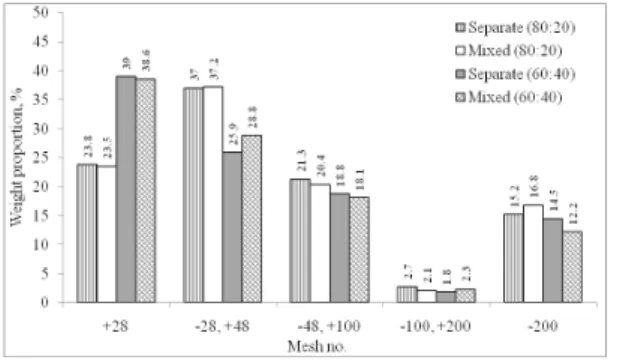
Fig. 2. Bauer McNett classification of separate and mixed refining of HW1 and SW pulp
Fig. 4. Bauer McNett classification of separate and mixed refining of HW3 and SW pulp Fig. 3. Bauer McNett classification of separate and
mixed refining of HW2 and SW pulp pulp was higher than hardwood pulp.
3.2 Properties of blended pulps 3.2.1 Fiber classification
The Bauer McNett fiber classification of separately refined hardwood and softwood pulps followed by blending in the proportion of 80:20 and 60:40 was compared with the blended pulp followed by refining.
The weight proportions of fibers collected on different screens were comparable for both the cases and all pulps (Figs. 2-4), which show that there was no difference in length of refined fibers mixed prior to refining or mixed after separate refining. The weight proportions of HW1 and SW, and HW2 and SW blended fibers (80:20 ratio) collected on mesh no. 28 were 26.6 and 28.1, and 23.8 and 23.5% for separately refined and mixed refined pulps respectively. As expected, increase in SW proportion from 20 to 40%
increased the long fiber fraction in both the cases. In case of 60:40 ratio of HW1 and SW, and HW2 and SW the retained fibers on mesh no. 28 were 41.9 and 42.4, and 39.0 and 38.6% for separately refined and mixed refined pulps respectively. The proportion of fibers collected on mesh no. 28 and 48 were 71.5 and 66.9 against 68.5 and 62.4% for the 60:40 and 80:20 for HW1 and SW blended pulp after mixed refining and separately refined respectively. Corresponding value for HW2 and SW blended pulp were slightly higher;
the proportion of fibers of mixed refined pulps was
67.4 and 60.7 against 64.9 and 60.8% of separately refined pulps blended in 60:40 and 80:20 ratio respectively (Fig. 3). The fibers passed through mesh no. 200 was slightly lower in case of mixed refining of HW1 and SW pulps (Fig. 2) though in case of other blended pulps i.e. HW2 (Fig. 3) and HW3 (Fig. 4) pulps, the fines were comparable in both separately refined and mixed refined pulps.
Fiber weight proportion of mixed refined pulps of HW3 and SW for both the ratio i.e. 80:20 and 60:40 collected on mesh no. 28 was higher than that of separately refined pulps but this trend was narrowed down in case of fibers collected on mesh no. 48. The total fibers collected on mesh no. 28 and 48 were slightly higher in case of mixed refined pulps for both the blending ratios. The proportion of fibers of mixed refined pulps was 74.4 and 70.3 against 73.1 and 68.3%
of separately refined pulps blended in 60:40 and 80:20
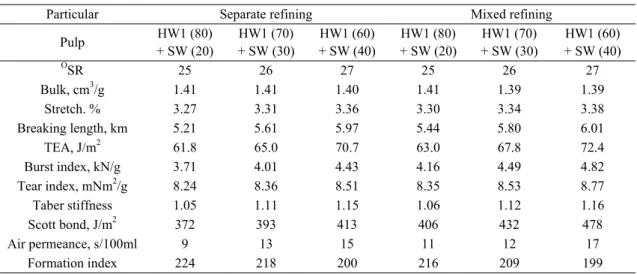
Particular Separate refining Mixed refining
Pulp HW1 (80)
+ SW (20)
HW1 (70) + SW (30)
HW1 (60) + SW (40)
HW1 (80) + SW (20)
HW1 (70) + SW (30)
HW1 (60) + SW (40)
OSR 25 26 27 25 26 27
Bulk, cm3/g 1.41 1.41 1.40 1.41 1.39 1.39
Stretch. % 3.27 3.31 3.36 3.30 3.34 3.38
Breaking length, km 5.21 5.61 5.97 5.44 5.80 6.01
TEA, J/m2 61.8 65.0 70.7 63.0 67.8 72.4
Burst index, kN/g 3.71 4.01 4.43 4.16 4.49 4.82
Tear index, mNm2/g 8.24 8.36 8.51 8.35 8.53 8.77
Taber stiffness 1.05 1.11 1.15 1.06 1.12 1.16
Scott bond, J/m2 372 393 413 406 432 478
Air permeance, s/100ml 9 13 15 11 12 17
Formation index 224 218 200 216 209 199
Table 4. Paper properties of HW-1 and SW pulps refined separately and in combination ratios respectively (Fig. 4).
3.2.2 Pulp freeness
The freeness of all hardwood and softwood blended pulps either refined separately or refined after mixing were almost comparable at same blending level. The unrefined HW1 and SW pulps blended in similar proportions also showed comparable freeness level when they were refined after blending by applying calculated PFI mill revolutions, which showed that the energy requirement to achieve the desired freeness level was similar in case of separate and mixed refined pulps. The oSR of blended hardwood and softwood pulps in both refining techniques was around 25, 26 and 27 oSR when 80:20, 70:30 and 60:40 ratio of hardwood and softwood pulps were used respectively.
This was true for all three hardwood pulps (Table 4-6).
3.2.3 Paper properties
The bulk of paper was also comparable for different proportions of hardwood and softwood pulps in both the cases. Almost all paper properties were better in case of mixed refining of HW1 and SW pulps than those of separately refined pulps. The stretch, breaking length, TEA, burst index, tear index, Scott bond and air permeance were slightly higher in case of mixed
refined pulps as compared with separately refined pulps. The same was true for all mixing proportions of HW1 and SW pulps. The stiffness and formation index were almost comparable for both the refining techniques. With a proportion ratio of 80:20, the mixed refined pulp showed around 4.6% higher breaking length, 1.9% higher TEA, 9.2% higher burst index, 1.3% higher tear index and 9.1% higher Scott bond as compared with separately refined pulps. With a proportion of 70:30, the increase in breaking length, TEA, burst index, tear index and Scott bond of mixed refined pulp was around 3.4, 4.3, 12.0, 2.0 and 9.9%
respectively as compared with separately refined pulps. Almost similar trend was seen for 60:40 blending proportion also (Table 4).
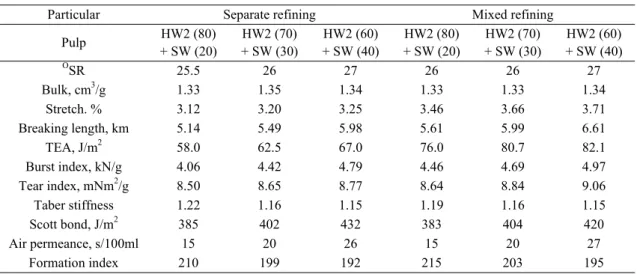
In case of mixed HW2 and SW pulps, the stretch, breaking length, TEA, burst index and tear index were slightly higher in case of mixed refining as compared with separate refining. The same was true for all mixing proportions. The bulk, stiffness, Scott bond, air permeance and formation index were almost comparable for both the refining techniques. With a proportion ratio of 80:20, the increase in stretch, breaking length, TEA, burst index and tear index of mixed refined pulp was around 10.9, 9.1, 31.0, 9.8 and 1.6% respectively as compared with separately refined pulps. Like the
Particular Separate refining Mixed refining
Pulp HW2 (80)
+ SW (20)
HW2 (70) + SW (30)
HW2 (60) + SW (40)
HW2 (80) + SW (20)
HW2 (70) + SW (30)
HW2 (60) + SW (40)
OSR 25.5 26 27 26 26 27
Bulk, cm3/g 1.33 1.35 1.34 1.33 1.33 1.34
Stretch. % 3.12 3.20 3.25 3.46 3.66 3.71
Breaking length, km 5.14 5.49 5.98 5.61 5.99 6.61
TEA, J/m2 58.0 62.5 67.0 76.0 80.7 82.1
Burst index, kN/g 4.06 4.42 4.79 4.46 4.69 4.97
Tear index, mNm2/g 8.50 8.65 8.77 8.64 8.84 9.06
Taber stiffness 1.22 1.16 1.15 1.19 1.16 1.15
Scott bond, J/m2 385 402 432 383 404 420
Air permeance, s/100ml 15 20 26 15 20 27
Formation index 210 199 192 215 203 195
Table 5. Paper properties of HW-2 and SW pulps refined separately and in combination
Particular Separate refining Mixed refining
Pulp HW3 (80)
+ SW (20)
HW3 (70) + SW (30)
HW3 (60) + SW (40)
HW3 (80) + SW (20)
HW3 (70) + SW (30)
HW3 (60) + SW (40)
OSR 25.5 26 27 26 26 27
Bulk, cm3/g 1.52 1.51 1.47 1.56 1.54 1.51
Stretch. % 2.97 3.08 3.20 2.98 3.13 3.29
Breaking length, km 4.74 5.19 5.57 4.98 5.37 5.86
TEA, J/m2 48.7 55.3 61.1 49.3 60.4 67.7
Burst index, kN/g 3.17 3.69 4.13 3.34 3.78 4.29
Tear index, mNm2/g 9.80 9.76 9.74 9.82 9.79 9.73
Taber stiffness 1.18 1.16 1.15 1.20 1.20 1.19
Scott bond, J/m2 340 364 391 373 394 411
Air permeance, s/100ml 7 12 17 5 11 15
Formation index 225 213 203 224 215 207
Table 6. Paper properties of HW-3 and SW pulps refined separately and in combination HW1 and SW blended pulps, mixed refining of HW2
and SW showed increased paper properties at all blending levels (Table 5).
Similar to HW1 and HW2, in case of HW3 pulp too some of the paper properties were better with mixed refined pulps as compared with separately refined pulp, and other properties were comparable. With a proportion of 80:20, the increase in breaking length, TEA, burst index and Scott bond of mixed refined pulp was around 5.0, 1.2, 8.5 and 9.7% respectively. The trend was similar at other blending levels. The stretch,
tear index, stiffness, air permeance and formation index were comparable for both separately and mixed refined pulps at all blending proportions (Table 6).
The results of all these blended pulps have shown that the mixed refining of pulps was at least at par to the separately refined pulps. In order to have a more precise explanation, few more experiments were conducted using HW1 and SW pulp. In earlier experiments, the HW1 and SW pulp were separately refined to get 24 and 30 oSR respectively which upon blending in the ratio of 80:20 gives around 25 oSR. For mixed refining experiments
(a) (b)
(c) (d)
(e) (f)
(g)
Fig. 5. Micrographs showing external fibrillation in fibre (a) HW1 refined at 2000 revolutions, (b) HW1 refined at 2840 revolutions, (c) SW refined at 2840 revolutions, (d) SW refined at 6200 revolutions, (e) Mixed refining of HW1 and SW (80:20) at 2840 revolutions, (f) HW1 and SW (80:20) pulps mixed after separate refining (HW1 at 2000 and SW at 6200 revolutions), (g) HW1 and SW (80:20) pulps mixed after separate refining (both at 2840 revolutions)
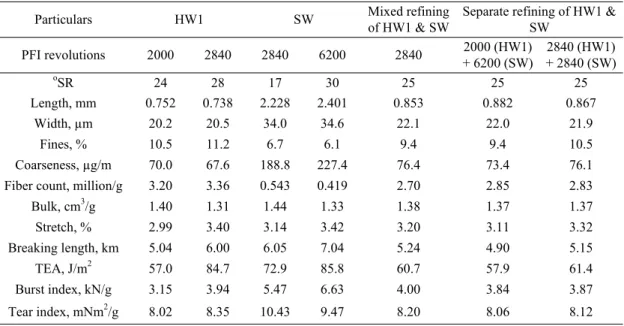
Particulars HW1 SW Mixed refining of HW1 & SW
Separate refining of HW1 &
SW
PFI revolutions 2000 2840 2840 6200 2840 2000 (HW1)
+ 6200 (SW)
2840 (HW1) + 2840 (SW)
oSR 24 28 17 30 25 25 25
Length, mm 0.752 0.738 2.228 2.401 0.853 0.882 0.867
Width, µm 20.2 20.5 34.0 34.6 22.1 22.0 21.9
Fines, % 10.5 11.2 6.7 6.1 9.4 9.4 10.5
Coarseness, µg/m 70.0 67.6 188.8 227.4 76.4 73.4 76.1
Fiber count, million/g 3.20 3.36 0.543 0.419 2.70 2.85 2.83
Bulk, cm3/g 1.40 1.31 1.44 1.33 1.38 1.37 1.37
Stretch, % 2.99 3.40 3.14 3.42 3.20 3.11 3.32
Breaking length, km 5.04 6.00 6.05 7.04 5.24 4.90 5.15
TEA, J/m2 57.0 84.7 72.9 85.8 60.7 57.9 61.4
Burst index, kN/g 3.15 3.94 5.47 6.63 4.00 3.84 3.87
Tear index, mNm2/g 8.02 8.35 10.43 9.47 8.20 8.06 8.12
Table 7. Comparison of paper properties of separate and mixed refined pulp with different revolutions to get the similar oSR value, the blended pulps were
refined to 2840 revolutions. In new experiment, both HW1 and SW pulp were refined at same revolutions separately i.e. 2840 and mixed in the same ratio of 80:20 to get the similar oSR (25). Three different pulp combinations of varying refining techniques are now available at 25 oSR level:
Pulps refined at different revolutions (HW1 at 2000 and SW at 6200) and then blended in a ratio of 80:20
Pulps mixed prior to refining and then refined at 2840 revolutions (calculated for 80:20 ratio)
Both HW1 and SW pulps refined at 2840 revolutions and then blended in a ratio of 80:20
The micrographs of fibers taken on Image analyzer showed that HW1 pulp refined at 2840 revolutions impart more external fibrillation than that at 2000 revolutions (Fig. 5a&b). In case of SW, the fiber fibrillation was quite high at 6200 revolutions which decreased on decreasing revolutions to 2840 (Fig.
5c&d). The HW1 and SW pulps refined individually at same revolutions i.e. 2840 show different fibrillation behavior of fibers probably due to difference in their
oSR (Fig. 5b&c). The mixed refining of HW1 and SW
pulp at 2840 revolution showed higher fibrillation in HW and lower in SW (Fig. 5e). Almost similar trend was observed when both pulps were refined at same revolutions (2840) separately and then mixed. This indicated that the SW fibers were not properly developed at the used revolutions (Fig. 5g). Furthermore, the mixed refining of pulps gave slightly better paper properties as compared those of other two separately refined conditions (Table 7).
These finding were not in accordance with the results presented by Baker7), who have shown that in mixed refining, the softwood fibers protect the hardwood fibers and the latter were found to be untreated up to 30
oSR. In the current experiments, the fiber length of HW1 and SW mixed refined pulp was slightly lower than that of separately refined pulp. Further, the fiber fibrillation in both refining methods was different but the paper properties were more or less same. These finding indicate that the softwood fibers were not protecting the hardwood fibers in case of mixed refining of pulp. Gao et al.8) has also demonstrated almost similar results. They have shown that co-refined eucalyptus and BCTMP provide improved physical
strength than the separately refined pulps.
Degree of freeness and fibrillation depends upon the number of revolutions in the PFI mill attributed for both the hardwood and softwood pulps. Fibrillation of softwood pulp develops slowly with the refining;
development of oSR takes more energy in case of softwood. Amongst the three hardwood pulps HW3 was more energy intensive and oSR of the HW1 and HW2 developed faster as compared to HW3.
In case of the refining of the mixed pulps, PFI revolutions which were helpful to develop more oSR in the hardwood pulp which was much larger in amount than the softwood pulp. During refining of the mixed pulp both the softwood and hardwood were equally subjected to shear and compression which in turn developed fibrillation and oSR of the pulps.
The PFI mill is high energy, low intensity refining device which is useful for laboratory comparisons. The PFI mill imposes a greater proportion of compressive to shear forces than does an industrial refiner, and this action is responsible for the higher internal fibrillation and lower external fibrillation and fiber shortening9).
The present study forms a base for the comparison of separate and mixed refining of pulp with PFI mill.
4. Conclusions
The fiber length is not affected in the blended hardwood and softwood pulp either refined together or separately in PFI mill. Also, the similar freeness level can be achieved in mixed refined pulps by applying the refining energy equivalent to the energy required to refine the pulps separately. The strength properties of paper including bulk, stiffness, air permeance and formation of mixed refined pulps were either better or comparable to those of separately refined pulps. As the mixed refining of pulps has shown positive response in terms of fiber and paper properties, it may be adopted in mills in place of separate refining. Caution should be taken when attempting to correlate the pulp properties
of PFI mill refining with those after commercial refining.
Acknowledgement
The authors are thankful to Director, Thapar Centre for Industrial Research & Development for permitting the publication of paper. The supply of pulp from corresponding mills is also gratefully acknowledged.
Literature Cited
1. Kangas, H., Pöhler, T., Heikkurinen, A. and Kleen, M.
Development of the mechanical pulp fibre surface as a function of refining energy. J. Pulp Pap. Sci. 30(11):
298-306 (2004).
2. Ghatak, H.R. Analysis of laboratory beating by fiber settling time frequency distributions. TAPPI J. 2(11):
3-6 (2003).
3. Ramezani, O. and Nazhad, M.M. The effect of refining on paper formation. APPW (2004).
4. Annergren, G. and Hagen, N. Industrial beating/refining.
In: Pulp and Paper Chemistry and Technology, Volume 3, Paper Chemistry and Technology, Monica Ek, Göran Gellerstedt, Gunnar Henriksson (Ed.) pp.121 (2009).
5. Lumiainen, J. Refining of fine paper fibers – separate or mixed refining? Proc. of TAPPI Papermakers Conf. 1996, pp. 175-186.
6. Koivuniemi, T.P. Online report of Metso paper avail- able at http://www.greenbusinesscentre.org:9080/
site/mmbase/attachments/186847/Mr_Timo__
Metso.pdf;jsessionid=419B2908BD9633A1C CC79DBB65E9EEA9(2009).
7. Baker, C. Refining technologies: a literature review.
Pira International, pp. 33 (1991).
8. Gao, Y., Huang, F., Rajbhandari, V., Li, K. and Zhou, Y. Effect of separate refining and co-refining of BCTMP/KP on paper properties. Pulp Pap. Can.
110(6): T99-104 (2009).
9. Kerekes, R.J. Characterizing refining action in PFI mills. TAPPI J. 4(3): 9-14 (2005).