1. INTRODUCTION
Human action recognition is a hot research topic in both academic and industry research [1-4]. The technique is widely used in human-computer in- teraction (HCI)[5-7], human motion analysis[8,9], video surveillance[10,11], and content-based image storage and retrieval. Human action recognition aims to recognize and understand human motion from video stream and image sequences. Since the diversity of real motion scenarios, such as lumi- nance, angles of cameras, and complex environ- ment, human action recognition is still a challeng- ing task. In different motion scenarios, the same action might exhibit different appearance. Even in a fixed motion scene, because of the large degree of freedom in the expression of human motion, the
same movement has great visual differences in di- rection and angle. In addition, some external fac- tors, such as occlusion, will also affect the per- formance of human motion recognition.
General human action recognition algorithms al- ways extract feature descriptors, which are trained to learn a classifier (such as SVM) to achieve hu- man action classification and recognition. In order to achieve high recognition accuracy, the extracted feature descriptors should be robust. However, feature descriptors of conventional algorithms were designed manually, which required high prior knowledge about trained and tested data sets.
These algorithms were generally complicated for generalization. In addition, since feature descrip- tors designed manually are always task-driven, which are dependent on specific tasks. Thus, man-
Human Motion Recognition Based on Spatio-temporal Convolutional Neural Network
Zeyuan Hu†, Sange-yun Park††, Eung-Joo Lee†††
ABSTRACT
Aiming at the problem of complex feature extraction and low accuracy in human action recognition, this paper proposed a network structure combining batch normalization algorithm with GoogLeNet network model. Applying Batch Normalization idea in the field of image classification to action recognition field, it improved the algorithm by normalizing the network input training sample by mini-batch. For convolutional network, RGB image was the spatial input, and stacked optical flows was the temporal input. Then, it fused the spatio-temporal networks to get the final action recognition result. It trained and evaluated the architecture on the standard video actions benchmarks of UCF101 and HMDB51, which achieved the accuracy of 93.42% and 67.82%. The results show that the improved convolutional neural network has a significant improvement in improving the recognition rate and has obvious advantages in action recognition.
Key words: Convolutional Neural Network; Deep Learning; Human Activity Recognition; Spatio- temporal Convolutional Neural Network.
※ Corresponding Author : Eung-Joo Lee, Address: 428, Sinseon-ro, Nam-gu, Busan, Korea, TEL : +82-51-629- 1143, E-mail : [email protected]
Receipt date : Jun. 23, 2020, Approval date : Jul. 2, 2020
†††Dept. of Information Communication Engineering, Tongmyong University E-mail : [email protected]
†††Academic Affairs and Register Team, Silla University E-mail:[email protected]
†††Dept. of Information Communication Engineering, Tongmyong University
made feature descriptors cannot guarantee that es- sential features can be obtained from human mo- tion sequences. Thus, designing robust feature de- scriptors of human motion is significant for action recognition. In recent years, deep learning-based algorithms have shown impressive performance in image processing, such as image classification[12, 13], image recognition, and image retrieval. These algorithms mimic human neural network, which consists of multiple layers to combine low-level features to form abstract high-level features. As a well-known representation of neural network, convolution neural network-based algorithms have demonstrated the impressive performance com- pared with traditional approaches. Through su- pervised and semi-supervised learning schemes, CNN based methods can learn the essential fea- tures of data, which outperform traditional meth- ods by a large margin. Convolutional neural net- work has certain scale invariance and translation invariance. Local weight sharing network struc- tures can reduce training parameters in image processing and has better performance. CNN- based algorithms also play an important role in hu- man action recognition. The general pipeline of CNN-based human action recognition can be sum- marized as follows: Human action video stream or image sequences are fed into convolution neural network as training data. Multiple network layers will extract multi-scale features and fully-con- nected layers will integrate these features. After- ward, Softmax function will be used for human ac- tion classification and recognition.
2. RELATED WORK
Human action recognition is a hot research topic in both academic and industry domains [14-18].
Traditional algorithms mainly aimed to analyze the RGB image sequences. Shotton et al.[21] utilized Harris detector and Gabor detector to detect spatial interest points, which will be constructed for 3D
gradient histogram (HOG3D) to represent features.
The authors proposed a human motion recognition method based on color spatiotemporal interest points. Kovashka et al.[19] proposed a human ac- tion recognition based on learning discriminative space-time neighborhood features. Instead of learning the predefined local descriptors, the pro- posed method aimed to learn the shape information of space-time neighborhoods to discover the most discriminative cues for human action recognition.
A class-specific distance function was introduced to recognize the most informative features to clas- sify different human actions. Hussein et al.[20]
proposed a temporal hierarchy of covariance de- scriptors to describe human action. The proposed method leverage 3D skeletion sequences extracted by depth camera, such as Kinect. In order to lever- age the information between joint movement and time, the authors leverage covariance matrices of some sequences from a designed hierarchical scheme. Skeleton joint point recognition is also an effective algorithm for action recognition. Compre- hensive experiments demonstrate that most action can be recognized by skeleton joint point recog- nition. Ellis et al. proposed to train a classifier based on logistic regression by using the delayed perception learning algorithm. The classifier can automatically determine the key posture from the 3D joint position sequence, which reduces the time of action recognition.
Deep learning-based algorithms aimed to con- struct an effect network recognition framework.
Simonyan et al.[22] proposed a two-stream net- work structure, which proved that the convolu- tional neural network trained by inter-frame opti- cal flow characteristics can still achieve good per- formance under the condition of limited data sets.
He et al.[23] leverage spatial pyramid pooling to extract features from the last convolution layer.
Wang et al.[24] constructed a maximum pooling network of three-dimensional convolution kernel to automatically recognize RGB-D video stream.
In[25], Wang et al. presented very deep two- stream convolution neural network based on the several classical neural networks. In order to solve the problem that 2D convolutional neural network cannot handle video sequences, Ji et al.[26] pro- posed 3D convolutional neural network based on 2D network. Tang et al.[27] proposed C3D network based on VGG. The experimental results shown that the network can achieve the best performance when setting the convolution kernel as × ×.
This paper proposes a network architecture that combines batch zeroing transformation and Goog LeNet network model and applies it to the field of video human action recognition. Compared with the traditional deep convolutional neural network, the training algorithm and network structure are improved in two aspects.
3. PROPOSED METHOD
In this section, we propose a novel spatio-tem- poral network for human action recognition, where batch normalization and GoogLeNet are combined to achieve this task.
3.1 Optical flow feature
Optical flow aims to recognize motion based on the spatial-temporal transformation and correla- tion of gray levels in image sequences. In general, let denotes video sequence, where ,
denotes the pixel of the time. Based on the conservation of brightness, we can obtain the fol- lowing formula.
(1)
For the trajectory points of each pixel on a se- quence image, the instantaneous velocity vector field denotes the optical flow. Then, the vector field satisfies the optical flow constraint equation:
(2)
According to the gray level conservation and global smoothing constraints, the calculation of op- tical flow field is transformed into the minimization of capacity function.
∇ ·
∇∇ (3)where ∇∇ denotes the smooth con- straint function. is a weight factor that affects gray level conservation and global smoothing. The energy function is expressed by the data term of
norm and the regular term of the total variation of optical flow, and taking into account the convex relaxation minimization function, can be reor- ganized as:
∇∇
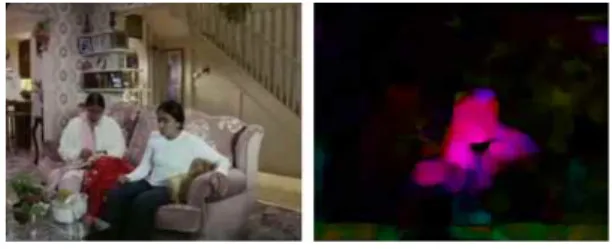
(4) When is a small constants with smaller value, the minimization formula (4) is equivalent to the minimization formula (3), which minimizes the en- ergy function by fixing U or V at one time and optimizing another variable. Optical flow estima- tion can be obtained by repeating the process. The example samples from HMDB51 data set is shown in Fig. 1.
3.2 Batch normalization
Assuming that denotes the input of network and
denotes the bias. The input set of the training images is denoted as ⋯, then the mean value of the training set is
Since the updating of offset will be cancelled in
Fig. 1. The optical flow of the movement“sit”from HMDB51 data set.
normalization, that is, the updating of and the combined effect of normalization operation do not change the input of the network layer, and then the loss function of the network layer will not be changed. As the whole network training iteration proceeds, will increase continuously, but the loss function will remain unchanged. By normalizing the input of the network layer, we hope to weaken the problem of internal covariate migration, which may bring new problems. Therefore, when calcu- lating the gradient of loss function to model pa- rameters, it is necessary to consider the depend- ence of normalization operation on network param- eters.
Let denotes the input vector of network, de- notes the training set. We perform independent batch normalization instead of joint normalization for each dimension of input.
(5)
Where denotes the k-th dimension of the in- put sample dataset. , represents the expectation and variance of the input, respectively.
In random gradient training, micro-batch samples are used to train, and each layer is calculated on each micro-batch sample to estimate the mean and variance of the layer. Therefore, the neural net- work statistics calculated in batch normalization processing can be used in gradient back propaga- tion.
3.3 Spatio-temporal convolutional neural network The video stream consists of two components:
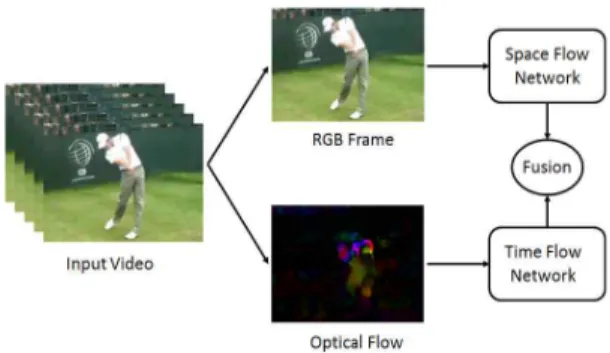
time and space. Each individual frame contains the appearance information of the scene and object. In the time part, the motion information of the camera and the object is included. The model of spa- tio-temporal dual-flow network is shown in the Fig. 2. RGB image is input to the spatio-temporal network, and time flow field is input to the spatio- temporal dual-flow network.
We leverage GoogLeNet as our basic network architecture. In this paper, we leverage the in- ception model structure with convolution sliding window filter sizes of × and × . In the in- ception model structure, the output of convolution filters with different branches is fed into a filter cascade layer, and then all the outputs are ex- panded into a column vector as the input of the next layer. Compared with the original model, the dimension-reducing Inception model structure adds a convolution filter operation with sliding window size of ×. By setting the total number of con- volution output feature maps of these × con- volution filters to a smaller number, the dimen- sion-reducing effect is achieved, and then the computational complexity is reduced in the ×
convolution filter with larger access overhead.
Fig. 2. The architecture of deep spatio-temporal net- work.
Fig. 3. The Inception model with batch normalization processing.
After the pooling filter layer, a × convolution fil- ter is added to reduce the total number of the branch filters, thus reducing the dimension of the output feature graph. The basic architecture of Inception model with batch normalization process- ing is shown in Fig. 3. The whole architecture con- sists of 3 convolution blocks, 3 maximum pooling blocks and 10 Inception blocks. Finally, human ac- tion classification and recognition can be achieved by Softmax function.
4. EXPERIMENT AND ANALYSIS
4.1 Model Training
Available data sets for human action recog- nition, such as HMDB51, UCF101, are limited by their scale compared with other well-known data- set such as ImageNet. In order to alleviate over fitting, we first conduct data enhancement. Since the random clipping technology tends to select the central block of the image, it is easy to cause over-fitting. Therefore, we cut the edge and center blocks of the image frame to enhance the scale diversity. Specifically, we fix the input data to
×, then randomly select a candidate cutting size from the setfor clipping, and fi- nally adjust the clipped blocks to ×.
In pretraining, the deep convolution neural net- work is pre-trained on the ImageNet data set.
Since the input of space network is RGB image, the network can be initialized directly by using the ImageNet pre-training model, and the optical flow field of 10 frames stacked at the input of time net- work, so some network adjustments are needed. In our implementation, we first use OpenCV to ex- tract the optical flow field of action video, and then use linear transformation to discretize the optical
flow to interval. Finally, the filter of the first layer of the spatial network model trained by ImageNet is averaged in the channel, and the aver- age structure is duplicated 10 times as the initiali- zation of the time network.
Our experiment is conducted on Caffe frame- work. In our implement, for space network, the ini- tial learning rate is 0.001, and the learning rate will be 0.0001 after 1800 iterations. For time network, the initial learning rate is 0.003, and the learning rate will be 0.0003 after 15000 iterations. We set the weight decay and momentum to 0.0002 and 0.9, respectively.
4.2 Comparative Study
We leverage UCF101 data set in our work.
Dropout layer is added in our neural network ar- chitecture to avoid overfitting. We explore the in- fluence of dropout_ratio of Dropout layer on the recognition accuracy in the constructed spatio- temporal motion recognition network. The result is shown in Table 1. As we can see from Table 1, when the dropout rate of time network is 0.7, the recognition rate is 0.17% and 0.35% higher than that of 0.4 and 0.6. When the dropout rate of space network is 0.8, the recognition rate is 1.03% and 0.45% higher than that of 0.4 and 0.6, respectively.
Fig. 4(a) and Fig. 4(b) show the training con- vergence of spatiotemporal networks. We can see form Fig. 4(a), on the spatial network, when the number of training iterations reaches 1000, the ac- curacy is close to 86%, and the loss value of train- ing decreases rapidly. When the number of training times reaches 2000, the accuracy remains above 90% and the loss value is below 0.1. With the iter- ation, the convergence tends to be stable. Similarly, on the time network, when the number of training
Table 1. The effect of different parameters on recognition accuracy
Network (dropout ratio) accuracy (dropout ratio) accuracy (dropout ratio) accuracy
Time Network (0.4) 86.52% (0.6) 86.34% (0.7) 86.69%
Space Network (0.4) 82.54% (0.6) 83.12% (0.8) 83.57%
iterations reaches 7500, the accuracy is close to 85%, and the loss value of training decreases rapidly. When the number of training times reaches 12500, the accuracy remains above 90% and the loss value is below 0.08.
we use the standard training splits and protocols provided as the original evaluation scheme. For UCF101, we found that,In the UCF-101 motion database, the recognition rate of improved three- dimensional convolutional neural network was 89.4%,And by shifting the structural framework of learning, it’s found that it saves a lot of time compared to traditional methods. The experiment result showed in table I, and we do some compar- ison with some other method, the result shows that The 3D Hubrid Model algorithm, as the best be- havior recognition algorithm before the depth of learning, has excellent results and good robustness.
It can be seen from the experimental results that the improved three-dimensional convolutional neu- ral network deep learning method has higher rec-
ognition efficiency than the k-proximity and sup- port vector machine methods in databases, and has better learning ability under the same training samples.
In our implement, we leverage linear weighting method to fuse the classification results of spatio- temporal networks, and the recognition structure is shown in the Table 2. Each experiment is con- ducted for 10 times and we calculate the average value as the final recognition accuracy. We use lin- ear weighted fusion to get the final recognition rate. When the weight of recognition confidence of spatial network and temporal network classi- fication is set to 1:1, the performance of the fusion space-time convolution neural network is better than other cases. In human motion recognition tasks, the fusion of spatiotemporal two-stream convolutional neural networks can effectively im- prove the accuracy of individual networks in rec- ognition.
Further, we conduct comparative experiments (a) Space network training iteration (b)Time network training iteration
Fig. 4. The training convergence of spatio-temporal networks.
Table 2. The recognition accuracy of the spatio-temporal network
Database UCF101 HMDB51
Space,Time 1:1 1:1.2 1:1.5 1:1 1:1.2 1:.5
Accuracy 0.9342 0.9316 0.9276 0.6853 0.6798 0.6715
with several well-known human action recognition algorithms, as shown in Table 3. Improved dense method uses a dense trajectory algorithm. IDT with higher-dimensional method is an enhanced version of traditional BOVW visual-word-bag model, which achieves higher dimensional feature coding. Two-stream achieves human action rec- ognition based on constructing a two-stream spa- tio-temporal network model. However, the net- work is shallow. Further, very deep two-stream method is proposed to solve the shortcoming of original two-stream method. KVMF method uses video segments to intercept multiple 3D volumes as the input of the network, and uses the predictive vectors from each volume to represent the action categories it belongs to.
5. CONCLUSION
In this paper, we construct a network archi- tecture combining batch normalization transfor- mation with GoogLeNet model and apply it to hu- man motion recognition from video stream. The improved network architecture is utilized to con- struct a spatio-temporal convolution neural net- work model to realize motion recognition. Spatial flow network obtains the appearance information of motion through RGB images of video stream, while temporal flow captures the motion in- formation through optical flow fields between con- secutive frames. Finally, the spatio-temporal net- work fuse both the appearance and motion infor-
mation.
REFERENCE
[ 1 ] L. Xia, C.C. Chen, and J.K. Aggarwal, “View Invariant Human Action Recognition Using Histograms of 3D Joints,” Proceeding of Computer Society Conference on Computer Vision and Pattern Recognition Workshops, pp. 20-27, 2012.
[ 2 ] A. Kovashka and K. Grauman, “Learning a Hierarchy of Discriminative Space-time N- eighborhood Features for Human Action R- ecognition,”Proceeding of Computer Society Conference on Computer Vision and Pattern Recognition, pp. 2046-2053, 2010.
[ 3 ] M.E. Hussein, M. Torki, M.A. Gowayyed, and M.E. Saban, “Human Action Recognition Using a Temporal Hierarchy of Covariance Descriptors on 3D Joint Locations,” Proceed- ing of International Joint Conference on Arti- ficial Intelligence, pp. 2466-2472, 2013.
[ 4 ] M.Y. Liu, H. Liu, and C. Chen, “Enhanced Skeleton Visualization for View Invariant Human Action Recognition,”Journal of Pattern Recognition, Vol. 68, No. 1, pp. 346-362, 2017.
[ 5 ] Y.L. Song, D. Demirdjian, and R. Davis, “Con- tinuous Body and Hand Gesture Recognition for Natural Human-computer Interaction,”Journal of ACM Transactions on Interactive Intelligent Systems, Vol. 2, No. 1, pp. 4212- 4216, 2012.
[ 6 ] T. Santini, W. Fuhl, and E. Kasneci, “CalibMe:
Fast and Unsupervised Eye Tracker Calibra- tion for Gaze-based Pervasive Human-com- puter Interaction,” P roceeding of the 2017 CHI Conference on Human Factors in Com- puting Systems, pp. 2594-2605, 2017.
[ 7 ] Y.K. Meena, H. Cecotti, K.W. Lin, A. Dutta, and G. Prasad, “Toward Optimization of Gaze-con- trolled Human-computer Interaction: Applica- tion to Hindi Virtual Keyboard for Stroke Patients,” Journal of IEEE Transactions on Neural Systems and Rehabilitation Engineer- Table 3. The recognition accuracy of the spatio-tempo-
ral network
Methods UCF101 HMDB51
Improved dense 0.8587 0.5721
IDT with higher-dimensional 0.8793 0.6116
Two-stream [25] 0.8846 0.5932
Very deep two-stream [28] 0.9133 0.6044
KVMF [29] 0.9310 0.6329
Proposed Method 0.9342 0.6783
ing, Vol. 26, No. 4, pp. 911-922, 2018.
[ 8 ] L.L. Chen, H. Wei, and J. Ferryman, “A Survey of Human Motion Analysis Using Depth Imagery,”Journal of Pattern Recogni- tion Letters, Vol. 34, No. 15, pp. 1995-2006, 2013.
[ 9 ] G.P. Dominguez, B. Taati, and A. Mihailidis,
“3D Human Motion Analysis to Detect Abnormal Events on Stairs,” Proceeding of 2012 Second International Conference on 3D Imaging, Modeling, Processing, Visualiza- tion, and Transmission, pp. 97-103, 2012.
[10] C.B. Jin, S.Z. Li, T.D. Do, and H. Kim, “Real- Time Human Action Recognition Using CNN over Temporal Images for Static Video Surveillance Cameras,”Proceeding of Pacific Rim Conference on Multimedia of Advances in Multimedia Information Precess, pp. 330-339, 2015.
[11] B.Y. Wang, Y.L. Hu, J.B. Gao, Y.F. Sun, and B.C. Yin, “Laplacian LRR on Product Grass- mann Manifolds for Human Activity Cluster- ing in Multicamera Video Surveillance,”
Journal of IEEE Transactions on Circuits and Systems for Video Technology, Vol. 27, No.
3, pp. 554-566, 2017.
[12] L. Hou, D. Samaras, T.M. Kurc, Y. Gao, J.E.
Davis, and J.H. Saltz, “Patch-based Convolu- tional Neural Network for Whole Slide Tissue Image Classification,”Proceeding of the IEEE Conference on Computer Vision and Pattern Recognition, pp. 2424-2433, 2016.
[13] S. Sladojevic, M. Arsenovic, A. Anderla, D.
Culibrk, and D. Stefanovic, “Deep Neural Net- works Based Recognition of Plant Diseases by Leaf Image Classification,” J ournal of Com- putational Intelligence and Neuroscience, Vol.
2016, No. 6, pp. 1-11, 2016.
[14] S.J. Song, C.L. Lan, J.L. Xing, W.J. Zeng, and J.Y. Liu, “An End-to-end Spatio-temporal Attention Model for Human Action Recogni- tion from Skeleton Data,” Proceeding of American Association for Artificial Intelli-
gence Conference on Artificial Intelligence, pp. 4263-4270, 2017.
[15] A. Iosifidis, A. Tefas, and I. Pitas, “Human Action Recognition Based on Multi-view Re- gularized Extreme Learning Machine,”J our- nal of Artificial Intelligence Tools, Vol. 24, No. 5, pp. 1-11, 2015.
[16] J. Wang, Z.C. Liu, Y. Wu, and J.S. Yuan, “M- ining Actionlet Ensemble for Action Recogni- tion with Depth Cameras,”Proceeding of 2012 IEEE Conference on Computer Vision and P attern Recognition, pp. 1290-1297, 2012.
[17] N. Zhang and E.J. Lee, “Human Action Recog- nition Based on an Improved Combined Fea- ture Representation,”Journal of Korea Multi- media Society, Vol. 21, No. 12, pp. 1473-1480, 2018.
[18] Z.Y. Hu, S.Y. Park and E.J Lee, “Human Action Recognition Based on Convolutional Neural Network,”Proceeding of 2018 Confer- ence on Korea Multimedia Society, pp. 233- 235, 2018.
[19] A. Kovashka and K. Grauman, “Learning a Hierarchy of Discriminative Space-time N- eighborhood Features for Human Action R- ecognition,”P roceeding of 2010 IEEE Com- puter Society Conference on Computer Vision and Pattern Recognition, pp. 2046-2053, 2010.
[20] M.E. Hussein, M. Torki, M.A. Gowayyed, and M.E. Saban, “Human Action Recognition Using a Temporal Hierarchy of Covariance Descrip- tors on 3D Joint Locations,”Proceeding of the Twenty-third International J oint Conference on Artificial Intelligence, pp. 2466-2472, 2013.
[21] J. Shotton, T. Sharp, A. Kipman, A. Fitzgibbon, M. Finocchio, and A. Blake, “Real-time Human Pose Recognition in Parts from Single Depth Images,” J ournal of Communications of the ACM, Vol. 56, No. 1, pp. 116-124, 2013.
[22] K. Simonyan and A. Zisserman, “Two-stream Convolutional Networks for Action Recogni- tion in Videos,”Proceeding of the 27th Inter-
national Conference on Neural Information P rocessing Systems, pp. 568-576, 2014.
[23] K. He, X.Y. Zhang, S.Q. Ren, and J. Sun,
“Spatial Pyramid Pooling in Deep Convolu- tional Networks for Visual Recognition,”
J ournal of IEEE Transactions on Pattern Analysis and Machine Intelligence, Vol. 37, No. 9, pp. 1904-1916, 2015.
[24] K. Wang, X.L. Wang, L. Lin, M. Wang, and W. Zuo, “3D Human Activity Recognition with Reconfigurable Convolutional Neural Net- works,”Proceeding of the 22nd ACM Inter- national Conference on Multimedia, pp. 97- 106, 2014.
[25] L.M. Wang, Y.J. Xiong, Z. Wang, and Y. Qiao,
“Towards Good Practices for Very Deep Two-stream ConvNets,” J ournal of Compu- ter Science-Computer Vision and Pattern Recognition, Vol. abs/1507.02159, pp. 1-5, 2015.
[26] S.W. Ji, W. Xu, M. Yang, and K. Yu, “3D Convolutional Neural Networks for Human Action Recognition,”Journal of IEEE Tran- sactions on P attern Analysis and Machine Intelligence, Vol. 35, No. 1, pp. 221-231, 2013.
[27] T. Du, L. Bourdev, R. Fergus, L. Torresani, and M. Paluri, “Learning Spatiotemporal Features with 3D Convolutional Networks,”
P roceeding of the IEEE International Con- ference on Computer Vision, pp. 4489-4497, 2015.
[28] K. Simonyan and A. Zisserman, “Very Deep Convolutional Networks for Large-scale Image Recognition,” J ournal of Computer Science, Vol. abs/1409.1556, pp. 1-14, 2015.
[29] W. Zhu, J. Hu, G. Sun, X. Cao, and Y. Qiao,
“A Key Volume Mining Deep Framework for Action Recognition,”Proceeding of the IEEE Conference on Computer Vision and Pattern Recognition, pp. 1991-1999, 2016.
Zeyuan Hu
was born in Dalian, Liaoning.
P.R. China, in 1992. He received the bachelor‘s degree in Auto- mation from Qingdao Institute of Technology, P.R. China(2011- 2015). He received the master's degree in Information Commu- nication Engineering from Tongmyong University, Busan, Korea(2016-2018). Currently, he has been studying for his doctoral degree in the Department of Information and Communications Engineering in Tongmyong University, Korea. And he is majoring in image processing and pattern recognition.
Sang-yun Park
received his B.S(1992-1995), in Physics, M,S(1996-1998), in mul- timedia Application from Kyung- sung University, Korea, in 1996, Aug. 1998, respectively, and Ph.
D.(2006-2011) in Information &
Communication Engineering from Tongmyong University, Korea. in Aug. 2011. His main research interests include computer vision, neural net- work, pattern recognition. image processing, HCI(hu- man computer interaction) and biometrics.
Eung-Joo Lee
received his B. S., M. S. and Ph.
D. in Electronic Engineering from Kyungpook National Uni- versity, Korea, in 1990, 1992, and Aug. 1996, respectively. Since 1997 he has worked with the Department of Information &
Communications Engineering, Tongmyong University, Korea, where he is currently a professor. From 2000 to July 2002, he was a president of Digital Net Bank Inc. From 2005 to July 2006, he was a visiting professor in the Department of Computer and Information Engineering, Dalian Polytechnic University, China. His main research interests include biometrics, image processing, and computer vision.