Face Recognition Based on Improved Fuzzy RBF Neural Network for Smart Device
Eung-Joo Lee†
ABSTRACT
Face recognition is a science of automatically identifying individuals based their unique facial features.
In order to avoid overfitting and reduce the computational reduce the computational burden, a new face recognition algorithm using PCA-fisher linear discriminant (PCA-FLD) and fuzzy radial basis function neural network (RBFNN) is proposed in this paper. First, face features are extracted by the principal component analysis (PCA) method. Then, the extracted features are further processed by the Fisher's linear discriminant technique to acquire lower-dimensional discriminant patterns, the processed features will be considered as the input of the fuzzy RBFNN. As a widely applied algorithm in fuzzy RBF neural network, BP learning algorithm has the low rate of convergence, therefore, an improved learning algorithm based on Levenberg-Marquart (L-M) for fuzzy RBF neural network is introduced in this paper, which combined the Gradient Descent algorithm with the Gauss-Newton algorithm. Experimental results on the ORL face database demonstrate that the proposed algorithm has satisfactory performance and high recognition rate.
Key words: face recognition, PCA-FLD, fuzzy RBFNN, L-M learning algorithm
※ Corresponding Author : Eung-Joo Lee, Address : Dept.
of Information and Communications Engineerings, 535 Yongdang-Dong, Nam-Gu, Busan 608-711, Korea, TEL : +82-51-629-1143, FAX : +82-51-629-1129, E-mail :ejlee
@tu.ac.kr
Receipt date : Sep. 12, 2013, Revision date : Oct. 15, 2013 Approval date : Oct. 17, 2013
†Department of Information & Communications Engin- eering, Tongmyong University, Busan, Korean
※ This research was supported by the Tongmyong University Research Grants 2012 (2012-A001).
1. INTRODUCTION
Human face recognition from still and video im- ages has become an active research area in the communities of image processing, pattern recog- nition, neural networks and computer vision. This interest is motivated by wide applications ranging from static matching of controlled format photo- graphs such as passports, credit cards, driving li- censes, and mug shots to real-time matching of surveillance video images presenting different constraints in terms of processing requirements [1].
Face recognition involves the extraction of dif- ferent features of the human face from the face im- age for discrimination it from other persons, it has evolved as a popular identification technique to perform verification of human identity.
During the past 30 years, many different face-recognition techniques have been proposed, motivated by the increased number of real-world applications requiring the recognition of human faces. PCA algorithm is known as Eigen face method; In PCA method, the images are projected onto the facial value and called "eigenspace" [2, 3]. PCA approach reduces the dimension of the data by means of basic data compression method [4] and reveals the most effective low dimensional structure of facial patterns [5]. LFA method of rec- ognition is based on the analysis the face in terms of local features e.g. eye, nose etc. by what is re- ferred LFA kernels. Recognition by Neural Network [6] and [7] are based on learning of the faces in an "Example Set" by the machine in the
“Training Phase” and carrying out recognition in
the "Generalization Phase". Support Vector Machines (SVM) technique is in fact one of the binary classification methods. The support vectors consist of a small subset of training data extracted by the algorithm given in [8]. Face recognition based on template matching represents a face in terms of a template consisting of several enclosing masks the projecting features e.g. the mouth, the eyes and the nose [9]. In [10], a face detection method based on half face-template is discussed.
Although researchers in psychology, neural sci- ences and engineering, image processing and com- puter vision have investigated a number of issues related to face recognition by human beings and machines, it is still difficult to design an automatic system for this task, especially when real-time identification is required. The reasons for this diffi- culty are two-fold: 1) Face images are highly vari- able and 2) Sources of variability include individual appearance, three dimensional (3-D) pose, facial expression, facial hair, makeup, and so on and these factors change from time to time. Furthermore, the lighting, back-ground, scale, and parameters of the acquisition are all variables in facial images ac- quired under real-world scenarios [1]. This makes face recognition a great challenging problem.
In recent work, researchers always use a hybrid method, which combines some linear and nonlinear projection methods for obtaining better recognition results. In many of the hybrid methods, the combi- nation of Neural Network and Fuzzy System has become a hot research area in recent years.
Reference [11] applied the theory of fuzzy to de- signing of RBF Neural Network, combined the re- spective advantage of Neural Network and fuzzy function and derived satisfactory results. But since the problem of learning speed with Fuzzy Neural Network, the optimal procedure is easily stacked into the local minimal value and it causes slow convergence. Generally speaking, multi-layer net- works usually coupled with the backpropagation (BP) algorithm, are most widely used in face rec-
ognition [12]. Yet, two major criticisms are com- monly raised against the BP algorithm: 1) It is computationally intensive because of its slow con- vergence speed and 2) there is no guarantee at all that the absolute minima can be achieved. On the other hand, RBF neural networks have recently at- tracted extensive interests in the community of neural networks for a wide range of applications [13,14,22].
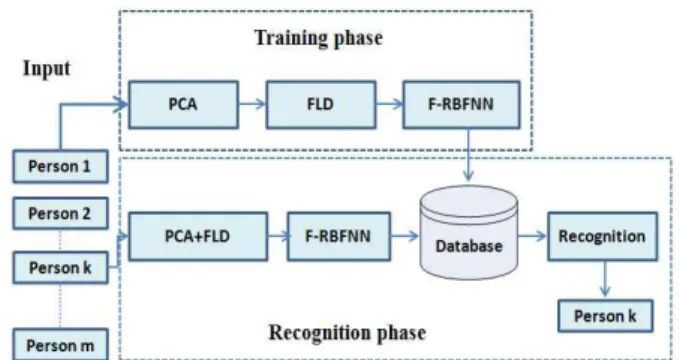
In order to avoid these cases, we propose an im- proved RBF neural network for face recognition in this paper. The whole recognition procedure in- cludes three stages, feature extraction and classification. Firstly, dimension reduction and face feature extraction using PCA-FLD algorithm is presented; and then the structure and L-M learning algorithm of the fuzzy RBF neural network (RBFNN) are introduced for face classifier. Fig. 1 shows the flow chart of proposed algorithm in this paper.
Fig. 1. Flowchart of proposed recognition algorithm.
2. Dimension Reduction and Feature Extraction
As the problem of face recognition, face image data are usually high-dimensional and large-scale, recognition has to be performed in a high-dimen- sional space. So it is necessary to find a dimen- sional reduction technique to cope the problem in a lower-dimension space. Researchers have pre- sented many linear and nonlinear projection algo- rithms such as the eigenfaces [15], Principal
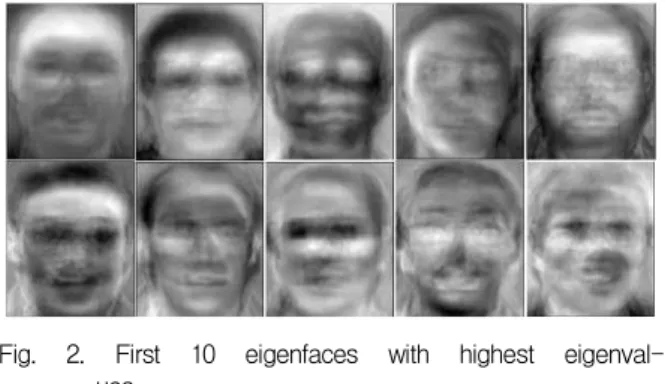
Fig. 2. First 10 eigenfaces with highest eigenval- ues.
Component Analysis (PCA) [15], Linear Discri- minant Analysis (LDA) [16,17], Fisher faces [6], Direct LDA (DLDA) [16,18], Discriminant Com- mon Vector (DCV) [19] and Independent Compo- nent Analysis (ICA) [20], etc.
In this paper, we use a hybrid algorithm, which combine PCA algorithm with FLD algorithm, for feature extraction. The number of input variables is reduced through feature selection, i.e., a set of the most expressive features is first generated by the PCA and FLD is then implemented to generate a set of the most discriminant features so that dif- ferent classes of training data can be separated as far as possible and the same classes of patterns are compacted as close as possible. The procedures are as follows:
(1) Obtaining face images , each image can be expressed as . Let the training set of face images be .
(2) Calculating the average face :
(1)
where presents the number of training face im- ages and denotes face image vector. (3) Calculating the mean subtracted face by
(2) The objective of this formula is to project to a lower dimension space.
(4) Calculating the covariance matrix
(3)
where .
(5) Calculating the and , which indicate ei- genvectors and eigenvalues of matrix. Where
determines linear combinations of the training set of face images from the eigenface [15]:
(4)
Here, we obtain a set of eigenface vectors
. Fig. 2 shows the first 10 ei-
genfaces on ORL face database.
(6) In order to find a best subspace for classi- fication, and maximize the ratio of between-class scatter and within-class scatter, so computing be- tween-class scatter matrix and within-class scatter matrix [16]:
(5)
(6)
where
is the mean of ei- genface images and
is the mean of
set of eigenface. is the number of the classes and
represents the number of class.
(7) The optimal subspace, by the FLD is determined as
arg
(7)
Where is the set of generalized ei- genvectors of and corresponding to the largest generalized eigenvalues . Thus, the feature vectors for any query face im- ages in the most discriminant sense can be calcu- lated as follows:
·· (8)
The best subspace is calculated by Lagrange multiplier. Meanwhile, the is consid- ered as the input unit of the fuzzy RBF neural network.
3. The Structure of Fuzzy RBF Neural Network
3.1 Instruction of RBF Neural Network
An RBF neural network can be considered as a mapping [21]: →.
Let ∈ be the input vector and
∈ ≤ ≤ be the prototype of the input vectors. The output of each RBF unit is as follows:
∥∥ (9) where ∥·∥ indicates the Euclidean norm on the input space. Usually, the Gaussian function is pre- ferred among all possible radial basis functions due to the fact that it is factorizable. Hence
exp
∥∥
(10)
where is the width of the RBF unit. The
output of an RBF neural network is
× (11)
where , is the weight or strength of the receptive field to the output and
is the bias of the output.
We can see from (10) and (11) that the outputs of an RBF neural classifier are characterized by a linear discriminant function. They generate linear decision boundaries (hyperplanes) in the output space. Consequently, the performance of an RBF neural classifier strongly depends on the separa- bility of classes in the u-dimensional space gen- erated by the nonlinear transformation carried out by the u RBF units.
Geometrically, the key idea of an RBF neural network is to partition the input space into a num- ber of subspaces which are in the form of hyperspheres.
3.2 Fuzzy RBF Neural Network
Based on the RBF neural network above, we
construct the environment parameters of network to give the fuzzy inference ability to it, fuzzy char- acteristics improved the learning generalization ability of neural networks and made a better ap- proximation to the actual models.
We assume that there are fuzzy rules as:
: If , then
.
Where is input vector, is output vector;
is the membership function (Gaussian function) of for , ;
corresponds to output of rule, there are rules totally and output vectors.
The output of fuzzy system can be expressed as
(12)
Where indicates the incentive intensity of
rule, namely
≤ ≤ (13) Due to the function equivalence between RBF neural networks and fuzzy inference system, and these two systems can be unified by functions. We correspond the number of pattern clustering in RBF neural network to the number of fuzzy rules.
Thus, the parameters are with fuzzy inference ability, which structure the fuzzy RBF neural network.
3.3 The Structure of Fuzzy RBF Neural Network
The structure of fuzzy RBF neural network we proposed in this paper consists of four layers: input layer, fuzzification layer, fuzzy inference layer and output layer. The topology of the fuzzy RBF neural network is shown as Fig. 3.
Suppose there are a dimensional characteristic
Fig. 3. The topology of fuzzy RBFNN.
space and classes of patterns
, which follow normal distribution. samples are selected as training set from total samples, we write them as training samples space:
. If the number of samples be- long to pattern is , then
. Through statistical calculation to these training samples, the mean vector and the variance vector of each pattern can be obtained, where and denote the mean value and variance value of feature in pattern, respectively.
Based on the analysis above, all of the samples can be processed by fuzzification when they are inputted RBF neural network, multiple input-one output system will be transformed to a multiple in- put-multiple outputs fuzzy neural classifier.
The structure of fuzzy RBF neural network con- sists of four layers as follows:
The first layer (Input layer): each node denotes an input linguistic variable and they are transferred to the next layer directly.
The second layer (Fuzzification layer): in this layer, the Gaussian radial basis function is adopted as a fuzzy membership function of neuron. This layer compose by neurons, which is divided into
groups, each group contains neurons, then
× . Thus, the input-output relationship of
neuron in group is
(14)
where denotes the probability density of fea- ture belong to the membership of pattern , the output of group of input neuron:
constitutes the membership vector of pattern for input samples. Thek-dimensional eigenvector from the input layer was translated in- to the membership of each feature to reach pattern by processing of fuzzification.
The third layer (Fuzzy inference layer): each node corresponds to a fuzzy rule and this layer im- plements the mapping from fuzzy rules to output space. In this paper, we defined the product of all input signals as the output of each node as follow.
′ (15)
where is the weight function of fuzzy rule,
is the output in last layer.
The fourth layer (Output layer): this layer is a linear combination of outputs in last layer for de- fuzzification computation.
′
(16)
where
≤ ≤ .
4. Learning Algorithm of Fuzzy RBF Neural Network
The learning process of fuzzy RBF neural net- work mainly based on updating the central value
and the radius of basis function. Usually, the adjustment algorithm of and takes K-NN clustering algorithm under unsupervised learning.
The weight mostly used BP algorithm for ad-
justing, which is a supervised learning algorithm.
Though we can apply the gradient paradigm to find the entire set of optimal parameters, the paradigm is generally slow and likely to become trapped in local minima. For solving this problem, Leven- berg-Marquart (L-M) training algorithm was used to adjust in this paper. L-M algorithm is an im- proved training algorithm of BP, which combined the advantages of gradient paradigm and newton method, it has both local performance and entire performance. The L-M training process can be il- lustrated as follow.
Assume that there are samples , the expected output of network are and the actual output are . When input the
sample, the output can be re- ceived, the error is the sum of each output error, that can be expressed by
(17)
where is error, its gradient ∇ and Hessian matrix ∇ are
∇ (18)
∇ (19) where
∇ (20)
is Jacobian Matrix, as
⋮ ⋮ ⋯ ⋯ ⋮
⋯
(21)
Assume that denote the vector con- sists of weight and threshold by and
iteration. Thus
∆ (22)
For L-M training algorithm,
∆ (23) where proportion coefficient is constant , denotes unit matrix. When , L-M algo- rithm equals to Gaussian-Newton method; when
is very large, it is approximate to gradient paradigm. In practical application, is a tentative parameter, it should be adjusted based on ∆.
The process of using L-M algorithm for training fuzzy RBF neural network can be described as below.
(1) Normalizing the training samples;
(2) Setting up predetermined training error , ,
and initialize weight and threshold vector, let
;
(3) Calculating the output of network and error function ;
(4) Calculating Jacobian matrix using E.
q. (21);
(5) Calculating ∆ using E. q. (23);
(6) If , jump to step (8);
(7) Calculating based on weight and threshold , if , then weight and threshold will be updated, namely, let
and
, return to step (3); other- wise, keep the weight and threshold, let × and return to step (5);
(8) Stop.
The error function was defined as
(24) where also be called as learning objective func- tion, in another words, the objective of training is to minimize by adjusting the parameters; means the actual output of unit in output layer;
denotes the expected output of unit in out- put layer.
5. Experimental Results
The proposed face recognition system is running
Fig. 4. Samples of ORL face database.
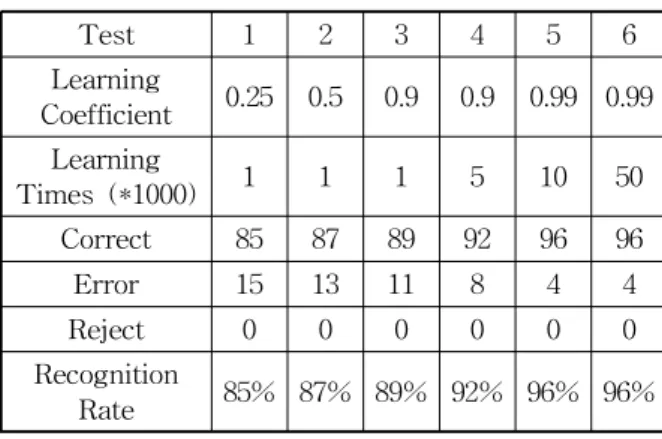
Table 1. Experimental results of fuzzy RBF neural network using BP learning algorithm
Test 1 2 3 4 5 6
Learning
Coefficient 0.25 0.5 0.9 0.9 0.99 0.99 Learning
Times (*1000) 1 1 1 5 10 50
Correct 85 87 89 92 96 96
Error 15 13 11 8 4 4
Reject 0 0 0 0 0 0
Recognition
Rate 85% 87% 89% 92% 96% 96%
on the hardware environment of Intel(R) Core(TM) 2 (2.93GHz) and the software environment of Windows 7 and Matlab R2009a.
The experiment uses the ORL Database of faces.
Their Database of Faces, formerly “The ORL Database of Faces”, contains a set of face images taken between April 1992 and April 1994 at the lab.
There are ten different images of each of 40 dis- tinct subjects. For some subjects, the images were taken at different times, varying the lighting, facial expressions (open/closed eyes, smiling/not smil- ing) and facial details (glasses/no glasses). All the images were taken against a dark homogeneous background with the subjects in an upright, frontal position, with tilting and rotation tolerance up to 20 degree, and tolerance of up to about 10% scaly.
The files are in BMP format. The size of each im- age is 92*112 pixels, with 256 grey levels per pixel.
Fig. 4 shows part samples in ORL face database.
In our experiments, we select 20 persons and 5 images each person in random. The selected 100 images are implemented as the set of training.
Meanwhile, we select the other 100 images form 20 persons for testing. The original image with size of 92*112 can be translated into a 10304*1 matrix by PCA algorithm, and we select fisrt 60 ei- genfaces for experiments. Then, the resulting fea- tures are further projected into the Fisher's optimal subspace in which the ratio of the between-class scatter and the within-class scatter is maximized.
So, the number of input units to fuzzy RBF neu- ral network is 60, namely ; the number of classes is 20, ; thus, the number of nodes in fuzzification layer is × , which in- cludes 20 groups and each group contains 60 neurons. The number of fuzzy inference layer is
× (select 20 persons and 5 images each person).
The expected output output-node's value is 1, the others are 0, but the actual outputs are around the expected value range. Based on com- petitive choice rule, the category of the input sam- ples is determined by the maximum value of actual output in fuzzy RBF neural network's output layer.
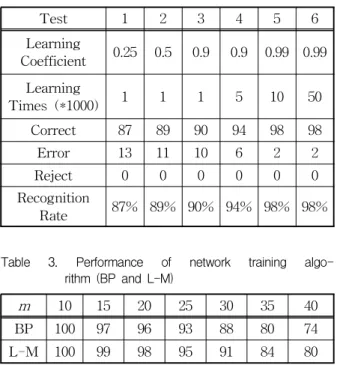
If there are not only one maximum value, the net- work will refuse to make a judgment. The ex- perimental results are shown as Table 1, Table 2 and Table 3.
From Table 1 and Table 2 we can find that:
There is no "Reject" and with low recognition error rate, the learning ability of proposed method is strong; When the number of learning times is small, the recognition rate could be improved by increasing learning coefficient; When the number of learning times is beyond a certain range (very large), the recognition rate will not be enhanced, but tends to stabilize.
Table 3. indicates that when the number of classes is low, fuzzy RBF neural network classifier has good performance. the recognition rate will re-
Table 2. Experimental results of fuzzy RBF neural network using L-M learning algorithm
Test 1 2 3 4 5 6
Learning
Coefficient 0.25 0.5 0.9 0.9 0.99 0.99 Learning
Times (*1000) 1 1 1 5 10 50
Correct 87 89 90 94 98 98
Error 13 11 10 6 2 2
Reject 0 0 0 0 0 0
Recognition
Rate 87% 89% 90% 94% 98% 98%
Table 3. Performance of network training algo- rithm (BP and L-M)
m 10 15 20 25 30 35 40
BP 100 97 96 93 88 80 74
L-M 100 99 98 95 91 84 80
duce as the number increase. From Table 1 to Table 3, result data indicate that L-M training al- gorithm is better than BP algorithm, the perform- ance of fuzzy RBF neural network trained by L-M is more stable and with faster convergence ability than the one trained by BP algorithm.
6. CONCLUSION
In this paper, a general design approach using an fuzzy RBF neural network classifier for face recognition to cope with small training sets of high-dimensional problem is presented. Firstly, face features are first extracted by PCA algorithm.
Then, the resulting features are further projected into the Fisher's optimal subspace in which the ra- tio of the between-class scatter and the with- in-class scatter is maximized. As a widely applied algorithm in fuzzy RBF neural network, BP learn- ing algorithm has the low rate of convergence, therefore, an improved learning algorithm based on L-M for fuzzy RBF neural network is introduced in this paper, which combined the Gradient Descent algorithm with the Gauss-Newton algorithm, it
has both local performance and entire performance.
The experimental results shown that the pro- posed algorithm works well on ORL face database with different expressions, poses and illumination conditions. So, this algorithm has good capability of generation, and it can effectively reduce the di- mensional of classification. Meanwhile, this algo- rithm can also reduce the computational complexity. The feature vectors are only extracted from gray-scale images, more features extracted from both gray-scale and spatial texture in- formation and a real-time face recognition system will be studied in the future work.
REFERENCE
[ 1 ] R. Chellappa, C.L. Wilson, and S. Sirohey,
"Human and Machine Recognition of Faces:
A Survey," Proc. the IEEE, Vol. 83, No. 5, pp. 705-740, 1995.
[ 2 ] M. Turk and A. Pentland, "Eigenfaces for Recognition," Journal of Cognitive Neurosci- ence, Vol. 3, No. 1, pp. 71-86, 1991.
[ 3 ] Tat-Jun Chin and D. Suter, A Study of the Eigenface Approach for Face Recognition, Technical Report of Monash University, Dept.
of Elect & Computer Systems Engineering, pp. 1-18, 2004.
[ 4 ] D. Blackburn, M. Bone, and P. Phillips, Face Recognition Vendor Test 2000: Evaluation Report, National Institute of Science and Technology, 2000.
[ 5 ] P.J. Phillips, H. Moon, S.Rizvi, and P. Rauss,
"FERET Evaluation Methodology for Face Recognition Algorithms," IEEE Transaction on Pattern Analysis and Machine Intelli- gence, Vol. 22, Issue 10, pp. 1090-1103, 2000.
[ 6 ] D. Bryliuk and V. Starovoitov, "Access Con- trol by Face Recognition using Neural Net- works and Negative Examples," Proc. 2nd International Conference on Artificial Intelli- gence, pp. 428-436, 2002.
[ 7 ] S.A. Nazeer, N. Omar, and M. Khalid, "Face Recognition System using Artificial Neural Networks Approach," Proc. IEEE Internatio- nal Conference on Signal Processing, Com- munications and Networking, pp. 420-425, 2007.
[ 8 ] Huang, X. Shao, and H. Wechsler, Face Pose Discrimination Using Support Vector Ma- chines, Technical report of George Mason University and University of Minnesota, Minneapolis Minnesota, Vol. 1, pp. 154-156.
1998.
[ 9 ] R. Brunelli and T. Poggio, "Face Recognition:
Features versus Templates,"IEEE Transac- tions on Pattern Analysis and Machine Intelligence, Vol. 15, No.10, pp. 1042-1052, 1993.
[10] W. Chen, T. Sun, X. Yang, and L. Wang,
"Face Detection based on Half Face Tem- plate," Proc. the IEEE Conference on Elec- tronic Measurement and Instrumentation, pp.
54-58, 2009.
[11] Dai Yang-chun and Xie Fang, "Face Recogni- tion Based on the Fuzzy RBF Neural Net- work," Techniques of Automation and Appli- cations, Vol. 25, No. 6, pp. 112-119, 2006.
[12] Wenkai Xu and Eung-Joo Lee, "A Combina- tional Algorithm for Multi Face Recognition,"
International Journal of Advancements in Computing Technology, Vol. 4, No. 13, pp.
146-154, 2012.
[13] A. Esposito, M. Marinaro, D. Oricchio, and S.
Scarpetta, "Approximation of Continuous and Discontinuous Mappings by a Growing Neural RBF-based Algorithm," Neural Networks, Vol. 12, No. 1, pp. 651–665, 2000.
[14] E.D. Virginia, "Biometric Identification Sys- tem using a Radial Basis Network," Proc.
IEEE International Conference of Security Technology, pp. 47–51, 2000.
[15] M. Kirby and L. Sirovich, "Application of the Karhunen-Loeve Procedure for The Charac- terization of Human Faces," IEEE Transac- tions on Pattern Analysis and Machine Intelligence, Vol. 12, No. l, pp.103-108, 1990.
[16] J. Lu, N. Plataniotis Kostantinos, and N.
Venetsanopoulos Anastasios, "Face Recogni- tion using LDA-based Algorithm," IEEE Transactions on Neural Networks, Vol. 14, No. 1, pp. 195-200, 2003.
[17] A.M. Martinez and A.C. Kak., "PCA versus LDA," IEEE Transactions on Pattern Anal- ysis and Machine Intelligence, Vol. 23, No. 2, pp. 228- 233, 2001.
[18] Z. Liang and P.F. Shi, "Uncorrelated Discri- minant Vectors using a Kernel Method,"
Pattern Recognition, Vol. 38, No. 2, pp. 307- 310, 2005.
[19] N. Peter Belhumeur, P. Joao Hespanha, and David J. Kriegman, "Eigenfaces vs. Fisherfa- ces: Using Class Specific Linear Projection,"
IEEE Transactions on Pattern Analysis and Machine Intelligence, Vol. 14, No. 2, pp. 239- 256, 1997.
[20] B. Marian, Stewart, R. Movellan Javier, and J. Sejnowski Terrence, "Face Recognition by Independent Component Analysis," IEEE Transactions on Neural Networks, Vol. 13, No. 6, pp.1450-1464, 2002.
[21] Meng Joo Er, Shiqian Wu, Juwei Lu, and Hock Lye Toh, "Face Recognition with Radial Basis Function Neural Networks", IEEE Transac- tions on Neural Networks, Vol. 13, No. 3, pp.
697-710, 2002.
[22] Wenkai Xu and Eung-Joo Lee, "Dynamic Human Activity Recognition Based on Improved FNN Model," Journal of Korea Multimedia Society, Vol. 15, No. 4, pp. 417- 424, 2012.
Eung-Joo Lee
received his B. S. , M. S. and Ph.
D. in Electronic Engineering from Kyungpook National Uni- versity, Korea, in 1990, 1992, and Aug. 1996, respectively. Since 1997 he has been with the Department of Information &
Communications Engineering, Tongmyong University, Korea, where he is currently a professor. From 2000 to July 2002, he was a president of Digital Net Bank Inc.. From 2005 to July 2006, he was a visiting pro- fessor in the Department of Computer and Information Engineering, Dalian Polytechnic University, China. His main research interests includes biometrics, image processing, and computer vision.