2
School of Dentistry, Seoul National University1
Center for Innovative in Dental Education, Seoul National University2, Young-A Ji1,2, Ho-Beom Kwon1, Ryan JinYoung Kim1, Seungho Baek1,2
Education satisfaction and self-assessment of competency among new general dentists
in Korea
Education satisfaction and self-assessment of competency among new general dentists in Korea
School of Dentistry, Seoul National University1
Center for Innovative in Dental Education, Seoul National University2, Young-A Ji1,2, Ho-Beom Kwon1, Ryan JinYoung Kim1, Seungho Baek1,2
Dental education is gradually transitioning to competency-based education system, which aims to help dentists achieve certain core competencies by means of various systems, such as curriculum accreditation. This study examined satisfaction with dental school educa- tion and the differences in the perceived importance and self-assessment of competencies among general dentists, in an attempt to propose a desirable direction for dental education.
A questionnaire was administered to new general dentists who graduated from a dental school within the past 10 years. The results of the survey were analyzed using the Importance-Performance Analysis to understand differences in dentists’ perceptions.
Overall satisfaction with education was low in terms of the curriculum’s relevance to actual practice and its capacity for cultivating required competencies. Furthermore, many of the respondents strongly perceived the need to improve dental education. Additional inves- tigations into the satisfaction with education showed no difference. Among the seven key competency domains, dentists perceived Health Promotion to be important and also assessed themselves as having high competence. However, regarding the perceived importance of the remaining domains, self-assessment of competence was low for Professionalism, Communication & Interpersonal Skills, Knowledge Base, Information Handling & Critical Thinking, Clinical Information Gathering, Diagnosis & Treatment Planning, and Establishment &
Maintenance of Oral Health.
The results of this study suggest that a competency-based education model should be developed and incorporated into dental educa- tion to set performance standards and to promote systematic self-assessment in order to foster the development of competence in dental students.
Keywords: Competency-based education, Dental education, Dentists, Self-assessment, Clinical competence Corresponding Author: Seungho Baek
Address: 413, Educational Building, School of Dentistry, Seoul National University, 101, Daehak-ro, JongnoGu Tel: +82-2-740-8722
E-mail: [email protected]
ABSTRACT
This research was supported by the Research Affairs of Seoul National University School of Dentisty Fund (No. 860-20140058)
sessment of competency among new general dentists in Korea
Ⅰ. INTRODUCTION
Competence has been defined as a concept that ex- presses an individual’s capacity to adapt to the trans- forming demands of modern society, and it is currently used as a standard for the assessment of educational outcomes. Competency-based education (CBE) has become a clear international standard for dental edu- cation and training institutions from, corroborating the fact that these institutions are increasingly incorporating outcome assessments in dental education curricula.1,2 Such transition in the dental education paradigm call for attention to and measures for enriching school curri- cula to meet accreditation standards and for advancing schools’ educational capacities to match international standards: The American Dental Education Association (ADEA), Association for Dental Education in Europe (ADEE), South East Asia Association for Dental Edu- cation (SEAADE) and so on. Each of these institutions has introduced measures to develop dentists’ compe- tence, based on which they have proposed a CBE mod- el. They are endeavoring to introduce outcome stan- dards for assessing the level of dental school graduates’
knowledge, skills, and attitudes achieved through school education. Furthermore, agencies that assess the quality of dental education such as the International Federation of Dental Educators and Association (IFDEA),3 Com- mission on Dental Accreditation (CODA) in the US,4 General Dental Council (GDC) in the UK,5 Association for Dental Education in Europe (ADEE),6,7 Australian Dental Council (ADC),8 Japanese University Accredita- tion Association (JUAA),9 and Korean Institute of Den- tal Education & Evaluation (KIDEE),10 have stepped
up their assessment of dental education quality, with an emphasis on outcome-based and CBE, or student- oriented and consumer-oriented education. They have also reflected these emphases in their assessment stan- dards for a more stringent accreditation of educational curricula.
CBE refers to an education model through which various competencies are demanded of students after the completion of a course or school; these competen- cies are defined multi-dimensionally, and curricular goals, content, methods, and assessments are planned accordingly.2 In a sense, CBE refers to outcome-based education in that competence-based curriculum de- sign focuses on the outcomes of education.11 To meet the various social demands for CBE, it is important to recognize the problems of current dental education and develop self-sustainable solutions. In most cases, the success of problem-solving is dependent on the accu- racy of identifying the problem.12 Medical schools had begun to establish medical education departments and recruit professional educators for medical education only since 1991, when a problem-based curriculum was first introduced at McMaster University.13 Unlike medical schools, dental schools in Korea had begun to implement outcome-based education since the turn of the 2010s, when integrated education emerged as a ma- jor theme across schools, and education systems in pro- fessional graduate schools underwent changes. Further- more, endeavors to adopt outcome-based education have been initiated with the KIDEE’s announcement of accreditation standards and national competency re- quirements for dentists.
As mentioned above, accurate identification of the
problems and recognition of the status quo is key to de- veloping self-sustainable solutions. Although students’
satisfaction with medical education in Korea14 and sat- isfaction with the national medical board examination15 have been surveyed,16 there has not been a recent in- vestigation of dental students’ satisfaction with dental education. Satisfaction is a useful indicator for assessing the outcomes and process of education and is acknowl- edged as an important tool for assessing medical educa- tion.16,17 However, it has never been investigated to what extent the graduates of 11 dental schools in Korea are satisfied with their school education and whether school education had adequately helped them to achieve the competencies required for dentists. Additionally, no previous study had examined whether the overall school curricula require improvements.
Hence, this study examined the graduates of 11 den- tal schools in Korea (within 10 years of graduation) to investigate their satisfaction with their alma mater, their perception of their own competence, and their percep- tion about the need to amend their school’s curriculum.
The reason we decided this period was followed. KIDEE was established about 10 years ago and dental schools have changed their educational environment focused on the competence-based learning. In addition, these re- sults were compared among different schools to discuss the future directions for dental education in the years to come.
Ⅱ. MATERIALS AND METHODS
IRB approval and informed consent have been ob-
tained: IRB No. S-D20170014.
Satisfaction with Education Questionnaire and Method of Administration
New general dentists who graduated from Korean dental schools (graduate schools) within the past 10 years were included. Questionnaires were distributed to new general dentists who work in private prac- tice via mail and e-mail from April 2015 to October 2017. The questionnaire was re-sent to those who had not responded to the first. During this process, dentists’
perception about and satisfaction with the traditional educational curriculum as well as their perception about the core competencies of a dentist were surveyed. A questionnaire was developed to examine dentists’ sat- isfaction with the current educational curriculum and their perception about the problems of and improve- ments required in the current educational curriculum.
To this end, we first investigated the core competencies described by multiple dental education institutions in Korea and abroad (e.g., ADEE, ADEA, Canada, KDA).
Then, three dental education experts reviewed the re- sults to choose the most important competencies, based on which the questionnaire was designed. The finalized questionnaire comprised self-assessment items pertain- ing to the respondents’ satisfaction with the educational curriculum, self-assessment of their own competence, perceived importance of competencies in practice, and their own achievement of the required competencies.
Questionnaire Items
The questionnaire items consisted of 3 major sec- tions: Important Perception of the general dentist’
sessment of competency among new general dentists in Korea competencies, Educational Satisfaction, Self-Perception
of the general dentist’s competencies. Important Per- ception had 7 domains (27 items): Professionalism (5 items), Communication & Interpersonal Skills (1 item), Knowledge Base, Information Handling and Critical Thinking (2 items), Clinical Information Gathering (2 items), Dignosis and Treatment Planning (4 items), Es- tablishment & Maintenance of Oral Health (12 items), Health Promotion (1 item). Self-Perception of the gen- eral dentist’s competencies had 4 items: Overall satis- faction of Dental Education, Degree of getting com- petencies, Connectivity between education and clinical practice, Necessary of the improving curriculum. Self- Perception of the general dentist’s competencies were same in the items of Important Perception.
Statistical Analysis
Frequency analysis, descriptive statistics, and paired- sample t-tests were performed to analyze the partici- pants’ perceived importance and satisfaction. Particu- larly, an importance-performance analysis (IPA) was used as the overarching framework for analyzing and interpreting the meanings of any differences between the perceived importance and practice, or between per- ceived importance and satisfaction with each item.18,19,20 One of its merits is that it provides a practical standard for determining the priorities of problems and policies, but requires limited personnel and financial resources. In an IPA matrix, quadrant 1 (high importance/high per- formance) describes a state that should be “maintained,”
while quadrant 2 (low importance/high performance) describes a state of “excess” in which too much effort is being expended in a less-important task. Quadrant
3 (low importance/low performance) describes a state of “low priority” that does not require much attention, and quadrant 4 (high importance/low performance) describes a state requiring “focus”, where urgent im- provement is needed.
Ⅲ. RESULTS
Satisfaction of New General Dentist
Dentists were asked whether they had acquired the overall competence (knowledge, skills, and attitudes) required as dentists by means of their dental school education. About 60.2% of the respondents respond- ed with “true,” while 25% responded with “neutral.”
About 7% responded with “very true,” 5% with “not true,” and 1% with “not at all true.” These results show that a considerable number of respondents are satisfied with their dental school education in terms of acquiring competence. In response to a question asking whether they believed they had been given education related to actual practice, 43.2% of the respondents answered
“true,” and 42% answered “neutral.” However, 10.2%
of the respondents answered “not true,” indicating a lower satisfaction with education in terms of its link to actual practice. When asked about the overall satisfac- tion, 55.2% were “satisfied,” and 32.2% were “neutral.”
Of note, 53.4% of the respondents agreed that their dental school education required improvement (19.3%
strongly agreed and 20.5% were neutral), showing that the predominant opinion was that current education curricula need improvements.
Level of Satisfaction with Dental Education by the Educational System
There are 11 dental schools in South Korea, and the education system for schools of dentistry is divided into two educational systems. One is a 2+4 system the other is 4+4 system. Starting in the early 2000s, the Korean Ministry of Education initiated the reformation of the education system in medical schools and dental schools.
Among the 11 dental schools, three universities have maintained their previous college education systems, while eight universities have switched to the professional graduate school education system. Therefore the level of satisfaction by sorting the satisfaction survey results from practicing dentists based on the education systems.
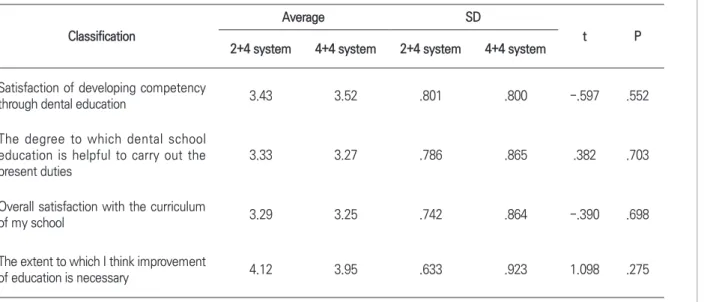
These results are shown in Table 1.
The graduates from a college of dentistry generally showed a high score of satisfaction with overall dental education except for the level of competency achieve-
ment. But, the satisfaction levels based on the education system of graduates were not statistically significant.
Difference in Perceived Competency of Dental School Graduates as Dentists
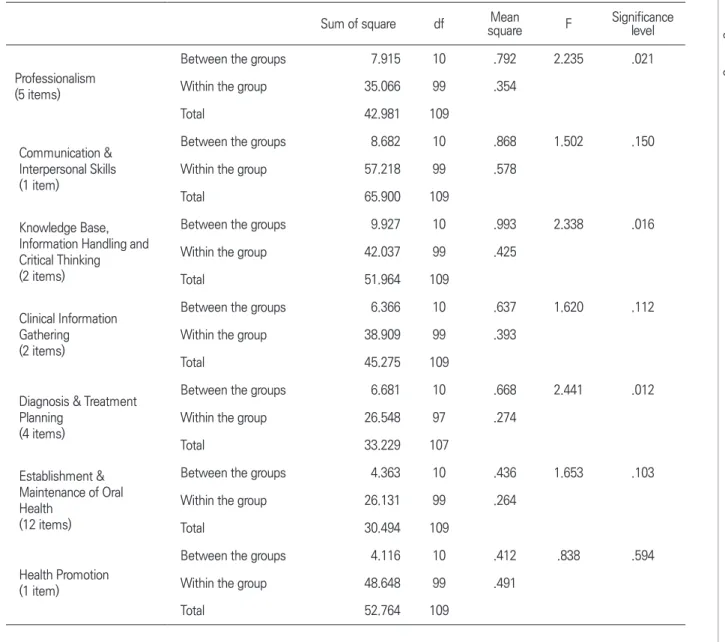
The dental school graduates from 11 universities were then divided into their respective groups, and the sur- vey results on their perceived competency in the seven dentists’ competency domains were compared using one-way analysis of variance. The results are shown in Table 2.
The result of analyzing responses by dental schools showed a distinctive difference in perceived competency in the domains of Professionalism, Knowledge Base, In- formation Handling and Critical Thinking, Diagnosis and Treatment Planning. In the remaining key compe- tency domains such as Communication & Interpersonal Skills, Clinical Information Gathering, and Establish-
Table 1. The level satisfaction with education by the educational system of dental schools
Classification Average SD
t P
2+4 system 4+4 system 2+4 system 4+4 system Satisfaction of developing competency
through dental education 3.43 3.52 .801 .800 -.597 .552
The degree to which dental school education is helpful to carry out the present duties
3.33 3.27 .786 .865 .382 .703
Overall satisfaction with the curriculum
of my school 3.29 3.25 .742 .864 -.390 .698
The extent to which I think improvement
of education is necessary 4.12 3.95 .633 .923 1.098 .275
sessment of competency among new general dentists in Korea ment & Maintenance of Oral Health, however, there
was no significant difference in the perceived compe- tency by university.
Perceived Importance of Competency and Self-
assessment of One's Own Competencies
The present study investigated the perceived impor- tance of competency by item and compared the levels of self-achievement in each competency domain. This can show whether the participant has achieved the compe-
Table 2. Difference in perceived competency of dental school graduates as dentists
Sum of square df Mean
square F Significance
level
Professionalism (5 items)
Between the groups 7.915 10 .792 2.235 .021
Within the group 35.066 99 .354
Total 42.981 109
Communication &
Interpersonal Skills (1 item)
Between the groups 8.682 10 .868 1.502 .150
Within the group 57.218 99 .578
Total 65.900 109
Knowledge Base, Information Handling and Critical Thinking
(2 items)
Between the groups 9.927 10 .993 2.338 .016
Within the group 42.037 99 .425
Total 51.964 109
Clinical Information Gathering
(2 items)
Between the groups 6.366 10 .637 1.620 .112
Within the group 38.909 99 .393
Total 45.275 109
Diagnosis & Treatment Planning
(4 items)
Between the groups 6.681 10 .668 2.441 .012
Within the group 26.548 97 .274
Total 33.229 107
Establishment &
Maintenance of Oral Health
(12 items)
Between the groups 4.363 10 .436 1.653 .103
Within the group 26.131 99 .264
Total 30.494 109
Health Promotion (1 item)
Between the groups 4.116 10 .412 .838 .594
Within the group 48.648 99 .491
Total 52.764 109
tency that he or she considers important. It also helps identify what areas of competency are lacking unlike the level of perceived importance in current education.
The survey results on the differences in dentists’ per- ceived importance of competence and self-assessment were analyzed using IPA, and the conclusion was made as shown in Figure 1.
The competencies were classified into seven domains.
The average scores for each item were analyzed to ex- amine the respondents’ perceived importance of and their perceived self-competence in each domain. Among the seven domains, perceived self-competence was higher than perceived importance in the domain of Health Promotion, while the opposite was true in the remain- ing seven domains. More specifically, the respondents perceived Diagnosis & Treatment Planning, Establish-
ment & Maintenance of Oral Health, and Professional- ism to be important, but assessed themselves to be less competent in these domains. On the other hand, the re- spondents perceived Clinical Information Gathering and Communication & Interpersonal Skills to be important and also assessed themselves to be highly competent in these domains. Both the perceived importance and per- ceived self-competence were low in Knowledge Base, Information Handling & Critical Thinking.
Ⅳ. DISCUSSION
This study reviewed the current educational curricula in Korea dental schools nationwide and sought to de- velop potential measures of improvement by investigat-
Figure 1. IPA between perception of the importance and self-assessment
sessment of competency among new general dentists in Korea ing education satisfaction as well as perceived impor-
tance of and self-assessment of competencies in relevant competency domains among dental school graduates.
New general dentists who had graduated from a dental school in Korea were surveyed to investigate their satisfaction with their alma mater, their curriculum’s adequacy in developing competence, their curriculum’s relevance to actual practice, and the need for improve- ment of these curricula. The results varied across schools, but in general, dental school graduates’ perception of developing competence through school education, sat- isfaction with education, and perceived relevance of the curriculum to actual practice were low as compared to the degree to which they perceived the need for improv- ing their school education. A strong program evaluation process supports accountability while allowing educa- tors to gain useful knowledge about their program and sustain ongoing program development.21 The percep- tion of graduates may be attributed to several internal and external factors. The traditional programs were designed to address contents that the faculty had de- fined as important, while neglecting other outcomes.22 Similarly, in the past, when the respondents were in school, the direction of education was determined solely based on the national certification system. From today’s perspective-where curricula are being changed as de- manded by the accreditation system and professional skills tests are scheduled to be implemented in the near future-students may seem to have had little opportuni- ties to receive a clinical education in the past. As today’s medical education is undergoing wide-ranging changes in its environment and system toward CBE and out- comes-based education, dental education should renew
the existing educational objectives and promote CBME.
Furthermore, practical standards for outcome should be established, and curricula should be shaped to suggest clear directions to achieve such standards. Evaluation systems for promoting such curricula should also be developed and instituted, all of which would facilitate a complete transition to CBE. Considering the varying de- grees of satisfaction with education and thoughts on the need to improve curricula across schools, there is a need for developing a common dental education curriculum to nurture the standard clinical competencies required of dental clinicians and to ensure students’ professional competence, in order to address the problems that vary across schools.23, 24
Kruger and Dunning asserted that those with limited knowledge also have little ability to realize it.25 As ex- perts are responsible for their own lifelong education, they are also obliged to cultivate the capacity to iden- tify their shortcomings and to determine ways of ad- dressing them. New general dentists in Korea perceive themselves as falling short of the level of competence in domains they believe to be important. The gap between perceived importance and self-assessment of compe- tence was particularly high in the domains of Diagnosis
& Treatment Planning, Establishment & Maintenance of Oral Health, and Professionalism. One reason for the lack of competence in these domains is that, un- like basic knowledge in dentistry, professional skills, management, ethics, and dental humanities are rarely included in the regular curriculum, and are not heav- ily weighted in student assessments. In fact, the Korean Ministry of Health and Welfare conducted a survey in 2013 on the general population to examine their ex-
pectations for and satisfaction with the social compe- tence among healthcare professionals, and found that the general public perceived physicians to exhibit subpar communicational skills, leadership, and professional re- sponsibility.26 In addition, many of the faculty members who must implement these new initiatives are unable to articulate the attributes and behaviors characteristic of the doctor as a professional.22,27 Such demands by the society, education suppliers, and education consumers should be translated into actual changes in the dental curriculum, and educational goals should be formulated around strengthening the link between school education and real-life practice.
Ⅴ. CONCLUSION
The results of this study highlight that the most im- portant feature of dental education is to clarify to stu- dents what is expected of them and to promote con- tinuous self-assessment, such that the students are able to develop and mature the required competencies and
meet the expected outcome standards. Furthermore, curricula should be designed to cultivate holistic dentists capable of comprehensive and critical thinking, who are equipped with clinical skills, including administration of patient tests, treatment planning, and treatment delivery.
A quantitative evaluation system is incapable of assess- ing the quality of performance, hindering an accurate understanding of graduates’ competency and quality of dental treatment. As demanded in accreditation stan- dards in Korea and abroad, dental education should focus more on delivering an integrated education that stresses both basic science and clinical practice. More- over, a competency-based dental education model should be developed and implemented to enhance the quality of students’ outcome.
Declaration of interests: The authors declare that they have no competing interests
Acknowledgments: This research was supported by the Research Affairs of School of Dentistry, Seoul Na- tional University Fund Fund (No. 860-20140058).
sessment of competency among new general dentists in Korea 1. McClelland DC. Introduction. In: Spencer LM, Spencer SM, editors.
Competence at work. New York, NJ: John Wiley & Sons, Inc. 1993.
2. Frank JR, Mungroo R, Ahmad Y, Wang M, De Rossi S, Horsley T.
Toward a definition of competency-based education in medi- cine: a systematic review of published definitions. Med Teacher 2010;32(8):631-37.
3. International Federation of Dental Educators and Associations; 2017 [updated 131 2017 Feb 6]. At: http://www.ifdea.org/about/Pages/
default.aspx. Accessed: October 6, 2017.
4. Commission on Dental Accreditation. Accreditation Standards for Dental Education Program. Commission on Dental Accreditation 2015.
5. General Dental Council. Preparing for practice: dental team learning outcomes for registration. London: The General Dental Council, 2012. At: http://www.gdcuk.org/newsandpublications/publica- tions/publications/gdc%20learning%20outcomes.pdf. Accessed:
September 22, 2017.
6. Nine years of Dend Ed - a global perspective on dental education.
7. Cowpe J, Plasschaert A, Harzer W, Vinkka-puhakka H, Walmsley AD. Profile and competences for the graduating European dentist- update 2009. Eur J Dent Educ 2010;14(4):193-202.
8. Australian Dental Council (ADC). Accreditation Standards for Dental Practitioner Programs. ADC Consultation Paper 2014.
9. Japan University Accreditation Association. University Standards and Explanation. Japan: Japan University Accreditation Association 2011. AT: http://juaa.or.jp/en/accreditation/university.html. Ac- cessed: November 6, 2017.
10. KIDEE. Korean Institute of Dental Education & Evaluation At:
http://www.kidee.org/Evaluation/Standard.asp Accessed: June 13, 2017.
11. Yoon BY, Choi IS, Kim SJ, Park HJ, Joo HJ, Lee BD, Lee JT.
Suggestions for a successful application of competence-based medical education in Korea. KMER 2015;
12. Chi MT, Glaser R, Farr MJ, editors. The nature of expertise. Hills- dale, NJ: Lawrence Erlbaum Associates, 1988.
13. Choi I, Yoon BY. New challenges for Korean medical education:
Enhancing students’ abilities to deal with uncertain ill-defined problems. Korean Med Educ Rev 2014;16(3):111-8.
14. Kim CY, Kim SM, Suh CD, Um YE, Ahn YO, Kim SK, Chae JI, Lee SH. A survey of students’ satisfaction with medical education.
Korean J Med Educ 1996;8(2):169-188.
15. Park JH, Kim WM, Lee WC, Lee YS. A study on the satisfaction of medical licensing examination and the present condition of skill test in medical schools. J Educ Eval Health Prof 2004;1(1):77-86.
16. Foldevi M. Undergraduate medical students’ rating of clerkship in general practice. Fam Pract 1995;12(2):207-13.
17. Irby DM. Teaching and learning in ambulatory care settings: a thematic review of the literature. Acad Med 1995;70(10):898-931.
18. Martilla J, James J. Importance-performance analysis. J Market- ing 1977;41(1):77-9.
19. Matzler K, Sauerwein E, Heischmidt K. Importance-performance analysis revisited: The role of the factor structure of customer satisfaction. Serv Indus J 2003;23(2):112-9.
20. Bacon D. A comparison of approaches to importance-perfor- mance analysis. Int J Market Res 2003;45(1):55-71.
21. Goldie J. AMEE education guide no. 29: Evaluating educational programmers. Med Teach 2006;28(3):210-24.
22. Gruppen LD, Burkhardt JC, Fitzgerald JT, Funnell M, Haftel HM, Lypson ML, Mullan PB, Santen SA, Sheets KJ, Stalburg CM, Vasquez JA. Competency-based education: Programme design and challenges to implementation. J Med Educ 2016;50(5):532-9.
23. Peter Mccrorie & Katharine A. M. Boursicot. Variations in medical school graduating., 2009.
24. McCrorie P, Boursicot KA. Variations in medical school graduat- ing examinations in the United Kingdom: are clinical competence standards comparable? Med Teach 2009;31(3):223-9.
25. McManus I, Elder AT, De Champlain A, Dacre JE, Mollon J, Chis L.
Graduates of different UK medical schools show substantial dif- ferences in performance on MRCP (UK) Part 1, Part 2 and PACES examinations. BMC Med 2008;6:5.
26. Kruger J, Dunning D. Unskilled and unaware of it: How difficulties in recognizing one's own incompetence lead to inflated self- assessments. J Pers Soc Psychol 1999;77:1121-34.
27. Steinert Y, Cruess S, Cruess R, Snell L. Faculty development for teaching and evaluating professionalism: from programme design to curriculum change. Med Educ 2005;39(2):127-36.