• 검색 결과가 없습니다.

Understanding Abusive Supervision: The Impacts of Abusive Supervision on Employees' Engagement and Organizational Commitment in the Deluxe Hotel

N/A
N/A
Protected

Academic year: 2021

Share "Understanding Abusive Supervision: The Impacts of Abusive Supervision on Employees' Engagement and Organizational Commitment in the Deluxe Hotel"

Copied!
8
0
0

로드 중.... (전체 텍스트 보기)

전체 글

(1)

1. INTRODUCTION

Supervisor’s behavior is one of the most influential factors on the attitude and behavior of members of an organization that directly determines the performance and survival of the organization. As abusive supervision is being regarded as the most destructive form of leadership that hinders success in hospitality industry (Jian, Kwan, Qiu, Liu, & Yim, 2012), re- search on abusive behavior of supervisors is receiving more and more attention (Lyu, Zhu, Zhong, & Hu, 2016). In parti- cular, a recent study reported that as much as 62% of em- ployees responded that they experienced rude treatment from their boss in the organization for more than once a month (Porath, 2016). Rude words and behavior from cowor-

kers or bosses can be frequently linked to displeasure in life at work (Sguera, Bagozzi, Huy, Boss, & Boss, 2016).

Employees in hospitality industry receive excessive stress as they are exposed to rudeness from coworkers or supervisors inside the organization (Rowley & Purcell, 2001). In case of deluxe hotel, employees are particularly more vulnerable to stressful situation due to the characteristics of work that takes place in restricted space and the top-to-bottom culture (Kim, Im, & Heang, 2015). The interesting thing is that rudeness from abusive supervisor can be learnt and copied as proven in Anderson and Thompson (2004). Their study showed that even good-natured subordinates can become similar to their supervisor when they work with aggressive and ill-natured supervisor for long time. Among the studies related to abusive Information available at the Culinary Society of Korea (http://www.culinary.re.kr/)

Culinary Science & Hospitality Research

Journal & Article Management System: https://cshr.jams.or.kr/

21-28

http://dx.doi.org/10.20878/cshr.2018.24.2.002

Understanding Abusive Supervision: The Impacts of Abusive Supervision on Employees’ Engagement and Organizational Commitment in the Deluxe Hotel

Hyo Sun Jung

1

, Ki-bbeum Kim

2

& Hye Hyun Yoon

1

1

Dept. of Culinary Science Arts and Service Management, Kyung Hee University

2
Dept. of Culinary Arts and Hotel Service, Far East University

KEYWORDS ABSTRACT

Abusive supervision, Engagement, Organizational

commitment, Deluxe hotel.

This study examines the effect of abusive supervision on employees’ engagement and commitment in the deluxe hotel. Based on total 272 hotel employees obtained from the empirical research, this study verified total 3 hypotheses. The hypothesized relationships in the model were tested simul- taneously by using structural equation modelling. Abusive supervision perceived by employees had negative effect on engagement and employees’ engagement had positive effect on organizational commitment. Also, abusive supervision perceived by employees did not have a significant effect on organizational commitment, full mediation effect through engagement existed. The study results are expected to be used as data for searching for effective responding ways at an organizational level and find practical ways to further increase employees’ positive organizational behavior.

Corresponding author: Hye Hyun Yoon, Dept. of Culinary Science Arts and Service Management, Kyung Hee University, 26, Kyungheedae-ro,

Dongdaemun-gu, Seoul 02447, Tel. +82-2-961-9403, Fax. +82-2-965-2537, E-mail: [email protected]

(2)

supervision in hospitality industry, Leung, Wu, Chen, and Young (2011) reported that exclusivism and exclusionism from bosses in working environment of deluxe hotel has negative impact on the employees’ work participation and service performance. Jian et al. (2012) argued that supervisor’s violent behavior decreased employees’ self-respect and service per- formance in case of hotels. Holm, Torkelson, and Backstrom (2015) found that supervisor’s rudeness perceived by the em- ployees in hospitality industry has a significant negative im- pact on performance through a medium of low social support and controllability. Chiu, Cheng, and Ko (2016) observed that supervisor’s abusive supervision has a significant impact on work involvement and deviating behavior of employees. Lyu et al. (2016) noted that abusive supervision has a negative im- pact on work engagement of hotel employees in China, con- sequently diminishing customer-oriented organizational citizen- ship behavior. Their study also suggested that hostile attri- bution bias reinforces the negative relationship between abu- sive supervision and work engagement. Lee and Lee (2016) asserted that abusive supervision from supervisors, which is one of the abusive behavior of supervisors, increases burnout of employees in working environment in hotel and decreases the level of service provision. Most of the existing studies on abusive supervision in hospitality industry are focused on its relevance to negative performance. There is scarce study that is related to employees’ positive behavior and performance.

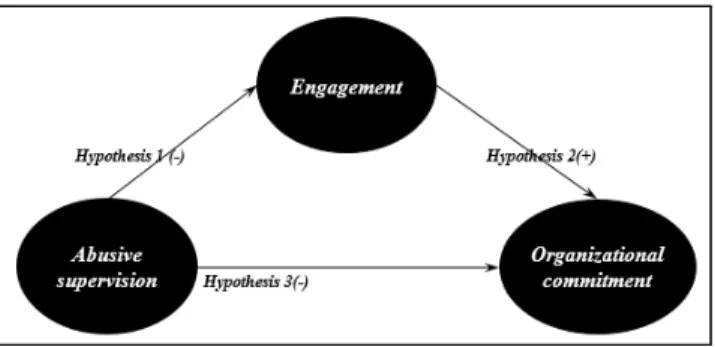
This study examines the effect of abusive supervision, which means inhumane treatment that employees experience from their supervisor on employees’ engagement and commitment using employees in food and beverage (F & B) section in deluxe hotels as a subject (See Fig. 1). The study results are expected to be used as data for searching for effective res- ponding ways at an organizational level and find practical ways to further increase employees’ positive organizational behavior.

Fig. 1. Research model.

2. LITERATURE REVIEW

2.1. Abusive Supervision and Engagement

Sakurai and Jex (2012) reported that rudeness in workplace decreases employees’ efforts and engagement for work. Gri- ffin, Bell, and Marusarz (2007) showed that engagement ex- ponentially decreased according to the level of abusiveness in interpersonal relationship with supervisor at work. Marty- nowicz (2016) argued that supervisor’s rudeness that employees experience in an organization is closely related to the em- ployees’ work engagement. Park and Ono (2016) found that rudeness from supervisor increases anxiety over work to consequently decrease the employees’ engagement. Scheuer, Burton, Barber, Finkelstein, and Parker (2016) noted that employees’ engagement decreases when they perceive and experience supervisor’s violent behavior or language. Based on the above previous studies, this study established the following study hypotheses.

Hypothesis 1: Abusive supervision negatively influences the employees’ engagement.

2.2. Engagement and Organizational Commitment Bakker, Hakanen, Demerouti, and Xanthopoulu (2007) argued that employees who are engaged in their work and devote themselves also have excellent commitment to the organi- zation. Schaufeli, Taris, and Rhenen (2008) reported that em- ployees who are immersed and devoted to their work and have enthusiasm also have significantly higher work satisfac- tion and organizational commitment. Kim and Yoo (2009) asserted that employees’ engagement and commitment are closely related to each other. Albdour and Altarawneh (2014) demonstrated that work engagement of employees at service contact point has a significant relationship with emotional organizational commitment. Kim (2015) noted that commit- ment to organization increased when work engagement among cabin attendants in airline was higher. Chae (2016), which interpreted the concept of engagement among employees in deluxe hotel as a motivation that makes the employees actively use their personal capacity that is relevant to the role and responsibility, argued that devotion and commitment to organization increases with stronger engagement.

Hypothesis 2: Employees’ engagement positively influences

the employees’ organizational commitment.

(3)

2.3. Abusive Supervision and Organizational Commitment Ogunfowora (2013) argued that abusive supervision has negative impact on employees’ commitment. Kim and Lee (2015) conducted an experiment using employees in travel agency as a sample and reported that abusive supervision decreases employees’ commitment. Kernan, Racicot, and Fisher (2016) suggested that abusive supervision experienced in organization has a very strong negative correlation with organizational commitment and that employees’ commitment to organization decreases as a result of abusive supervision.

There are several studies related to abusive supervision and employees’ behavior, although these studies did not investi- gate organizational commitment. Ahmed and Muchiri (2014) noted that organization citizenship behavior decreased due to impersonal supervisor. Penny and Spector (2005) argued that trouble with supervisor in workplace or rudeness from su- pervisor is in positive relationship with deviating behavior, such as reducing efforts for work. Berthelsen, Skogstad, Lau, and Einarsen (2011) found that employees who experienced rudeness from supervisor, such as being excluded from work, are more likely to commit deviating behavior like leaving the workplace than those who did not. Berry, Gillespie, Gates, and Schafer (2012) observed that harassment that employees experience from supervisor in working environment decreases their ability to manage workload and consequently increases deviating behavior. Sims and Sun (2012) suggested that situa- tions in workplace such as bullying increases possibility of taking action against the organization by increasing employees’

stress level.

Hypothesis 3: Abusive supervision negatively influences the employees’ organizational commitment.

3. METHODS

3.1. Sample and Data Collection

For this study, 11 deluxe hotels located in Seoul, South Korea were selected. We conducted survey on employees in food and beverage section in the chosen hotels. Prior to the main survey, 50 copies of preliminary questionnaire were first distributed for preliminary survey, whose purpose was to test the validity and reliability of the survey questions. The main survey was implemented for one month of July 2017. A total of 330 copies of questionnaire were distributed, 30 copies per hotel. Among them, 272 copies that can be statistically ana-

lyzed were used for the final analysis. Data were coded and then analyzed by using SPSS and AMOS program. To check the validity and reliability of the measured items, we con- ducted confirmatory factor analysis and reliability analysis. A correlation analysis was implemented to measure the cor- relation among the extracted factors. For research hypothesis test, we analyzed structural equation model.

3.2. Measurement Development

Next summarizes the operational definition of the variables used in this study and questionnaire composition. Abusive su- pervision can be defined as perception of subordinate on the extent to which his supervisor continues hostile verbal or non- verbal behavior, except for physical contact (Tepper, 2000).

Behaviors from abusive supervisor include use of dismissive language to subordinates, getting angry to, embarrassing, disgracing, and ignoring subordinates in workplace, ridiculing subordinates in public occasion, or stealing away subordi- nate’s deserved success (Tepper, 2007). We measured abusive supervision using a total of 15 questions in Likert 7-point scale by referring to Tepper (2000) and Lyu et al. (2016) (Likert 7-point scale was used to measure the other variables too).

The concept of engagement was first introduced by Kahn (1990) and it refers to a state of being related to positive and progressive work (Schaufeli and Bakker, 2004). In our study, engagement was measured in four questions based on Schau- feil, Martinez, Marques-Pinto, Salanova, and Bakker (2002).

Organizational commitment refers to one’s desire to remain as a member of an organization through efforts such as iden- tifying him with the organization that he belongs to, being committed to the organization, and accepting the goal and value of the organization (Meyer & Allen, 1991). In this study, we measured organizational commitment in five questions developed by Allen and Meyer (1990).

4. RESULTS

4.1. Descriptive Statistics of Samples

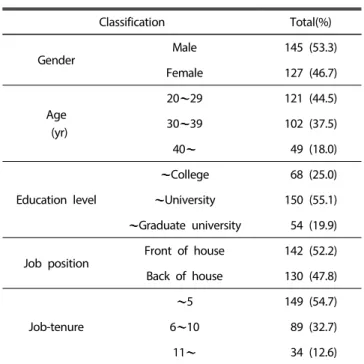
A total of 272 questionnaires (82.4%) except for ones with incomplete responses were used for analysis. Of those, 53.3%

were male and 46.7% were female. The percentages of the

respondents who were in their 20s (44.5%) and who had

been working in the deluxe hotel less than 5 years were

54.7%.

(4)

Table 1. General characteristics of samples (N=272)

Classification Total(%)

Gender

Male 145 (53.3)

Female 127 (46.7)

Age (yr)

20 29 121 (44.5)

30 39 102 (37.5)

40 49 (18.0)

Education level

College 68 (25.0)

University 150 (55.1) Graduate university 54 (19.9)

Job position

Front of house 142 (52.2) Back of house 130 (47.8)

Job-tenure

5 149 (54.7)

6 10 89 (32.7)

11 34 (12.6)

4.2. Measurement Model

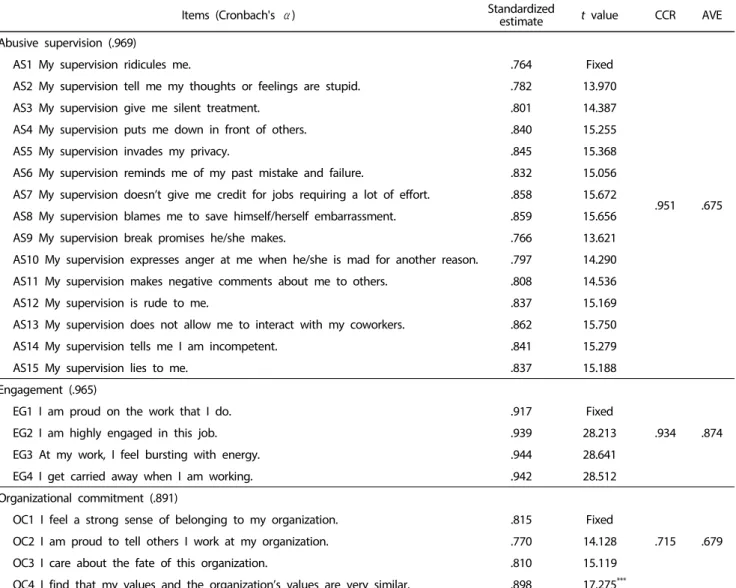
We conducted confirmatory factor analysis and reliability analysis to test the validity and reliability of the measurement items in this study (Table 2). In the analysis result, stan- dardized factor loading of all of the 23 items was over .0.7 and t-value was also significant (p<0.001). Composite construct reliability (CCR) of the three factors extracted from the confirmatory factor analysis was over 0.7 and average variance extracted (AVE) value was also over 0.6. Cronbach’s alpha was higher than 0.8 in case of all items. All of these results satisfy the validity criterion (Anderson & Gerbin, 1988). Goodness of fit of the model was satisfactory with χ

2

=675.032, χ

2

/df= 2.974, GFI=.805, NFI=.900, IFI=.931, CFI=.931, RMR=.064. We com- pared the square of the correlation coefficients and AVE value to examine the discriminant validity (Table 3). Range of the square of the correlation coefficients was .306~509, which is relatively smaller than that of AVE value. Hence, discriminant validity of the extracted factors was also confirmed (Fornell

& Larcker, 1981).

4.3. Structural Equation Model

Before hypothesis test, we first check whether the correla- tion among the factors coincides with the hypothesis through correlation analysis (Table 3). Abusive supervision showed negative correlation with engagement, organizational commit-

ment, which is consistent with the hypothesis in this study.

In the hypothesis test based on the structural equation model (Table 4), goodness of fit of the research model was χ

2

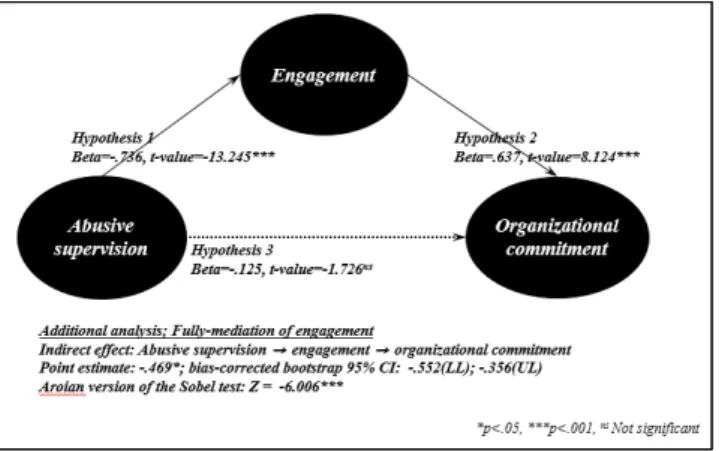
= 675.032 (df=227), GFI=.805, IFI=.931, and CFI=.931, which is an acceptable level considering that no modification index was used. The hypothesis test result can be summarized as follows. Hypothesis 1,which assumes that abusive supervision perceived by the employees in deluxe hotel will have a significant negative impact on engagement, was accepted (β=

-.736, t=-13.245, p<.001). This implies that employees’ ex- perience of impersonal supervisor decreases their engagement in work situation, which is consistent with Griffin et al. (2007), Martynowicz (2016), and Park and Ono (2016). Hypothesis 2, which assumes that employees’ engagement will have a sig- nificant positive impact on organizational commitment (β=

.637, t=8.124, p<.001), was also accepted. This is consistent with a number of existing studies that reported that employees’

commitment can been hanced through engagement (Bakker et al, 2007; Kim & Yoo, 2009; Kim, 2015). Meanwhile, hypo- thesis 3 was rejected as abusive supervision did not have a significant impact on organizational commitment (β=-.125, t=-1.726, p>.05). This contrasts with the previous literature including Ogunfowora (2013), Kim and Lee (2015), and Kernan et al. (2016) which argued that abusive supervision has nega- tive impact on organizational commitment. We believed that even if no direct impact from abusive supervision on organiza- tional commitment was observed in this study, there can be an indirect effect through a medium of engagement. We conducted additional analysis whose result is described in Fig.

2. Bootstrapping test was implemented to check the indirect effect of abusive supervision on organizational commitment through the mediating role of engagement. In the test result, power of indirect effect was β=-.469, indicating a significance (p<0.05). Sobel test also confirmed the existence of full mediation effect with Z-score=-6.006.

5. DISCUSSION AND CONCLUSIONS

This study examined the effect of abusive supervision per-

ceived by employees on the employees’ engagement and com-

mitment in case of in deluxe hotels in South Korea. The study

result can be summarized as follows. First, three factors in-

cluding abusive supervision, engagement, and organizational

commitment showed excellent reliability and validity. Correla-

tion among the three factors was also proven to be consistent

(5)

Table 2. Confirmatory factor analysis and reliability analysis results

Items (Cronbach's α) Standardized

estimate t value CCR AVE

Abusive supervision (.969)

.951 .675

AS1 My supervision ridicules me. .764 Fixed

AS2 My supervision tell me my thoughts or feelings are stupid. .782 13.970

AS3 My supervision give me silent treatment. .801 14.387

AS4 My supervision puts me down in front of others. .840 15.255

AS5 My supervision invades my privacy. .845 15.368

AS6 My supervision reminds me of my past mistake and failure. .832 15.056 AS7 My supervision doesn’t give me credit for jobs requiring a lot of effort. .858 15.672 AS8 My supervision blames me to save himself/herself embarrassment. .859 15.656

AS9 My supervision break promises he/she makes. .766 13.621

AS10 My supervision expresses anger at me when he/she is mad for another reason. .797 14.290 AS11 My supervision makes negative comments about me to others. .808 14.536

AS12 My supervision is rude to me. .837 15.169

AS13 My supervision does not allow me to interact with my coworkers. .862 15.750

AS14 My supervision tells me I am incompetent. .841 15.279

AS15 My supervision lies to me. .837 15.188

Engagement (.965)

.934 .874

EG1 I am proud on the work that I do. .917 Fixed

EG2 I am highly engaged in this job. .939 28.213

EG3 At my work, I feel bursting with energy. .944 28.641

EG4 I get carried away when I am working. .942 28.512

Organizational commitment (.891)

.715 .679

OC1 I feel a strong sense of belonging to my organization. .815 Fixed

OC2 I am proud to tell others I work at my organization. .770 14.128

OC3 I care about the fate of this organization. .810 15.119

OC4 I find that my values and the organization’s values are very similar. .898 17.275

***

Note: CCR=composite construct reliability; AVE=average variance extracted; χ

2

=675.032 (df=227); χ

2

/df=2.974; GFI=.805; NFI=.900; IFI=.931;

CFI=.931; RMR=.064.

Table 3. Correlation analysis

Items M±SD 1 2 3

1. Abusive supervision 3.44±1.05 1 .509

1)

.306

2. Engagement 4.67±1.34 -.714

**

1 .456

6. Organizational commitment 4.54±1.48 -.554

**

.676

**

1 Note:

**

p<.01 (2-tailed),

1)

R

2

.

Table 4. Structural equation model

Hypothesis Standardized estimate t value p value

H1 Abusive supervision Engagement -.736 -13.245 .000

H2 Engagement Organizational commitment .637 8.124 .000

H3 Abusive supervision Organizational commitment -.125 -1.726 .084

Note: χ

2

=675.032 (df=227); p<0.001; GFI=.805; IFI=.931; CFI=.931; RMR=.064.

with the hypothesis. Second, abusive supervision perceived by

employees had negative impact on engagement and em-

ployees’ engagement had positive impact on organizational

commitment. Third, although abusive supervision perceived

by employees did not have a significant impact on organi-

zational commitment, full mediation effect through engage-

ment existed.

(6)

Fig. 2. Structural equation model with estimate.

This study provides several academic implications. This study is meaningful as the subject of this study, which is employees in F & B section in deluxe hotels, has received no profound debate on so far. Considering that works in deluxe hotels particularly involve continuous interaction with super- visor within a restricted working space, this study has more significance as it focuses on the case of deluxe hotels. This study result can ignite discussion on the organization culture, which comes from abusive supervision that is prevalent in deluxe hotels, at an organizational level. Previous studies mainly put stress on negative work performance induced by abusive harassment from supervisor focusing on the role and responsibility. This study investigated transfer effect from reaction to behavior by examining employees’ engagement and commitment that originates from abusive supervision.

The study result can provide basic data that is necessary to stimulate and expand future studies. This study provides several practical implications that can be used to find political response to the timely issue at present. Summarizing the previous studies, assault rate by upper level (supervisor) inside an organization is very high in Korea, which implies that wrongdoing of power group is often acknowledged and con- nived in organizational culture in Korea. Harassment behavior that occurs in workplace is an organizational problem, rather than a personal problem. In particular, subjective damage probability that is lower than operational damage probability is a peculiar phenomenon observed only in Korea. This implies that large proportion of members inside an organization does not recognize the fact that they are being harassed even when they experience it. Restaurant and accommodation in- dustry (27.5%) and health and social service industry (26.0%), which cover hospitality industry, showed highest operational

damage probability. It is difficult to distinguish criminal be- havior of harassment and rudeness in workplace from the conflicts and stress experienced by the workers in the frontier of service in deluxe hotels. Moreover, organizational culture that connives at abusive behavior is prevalent in deluxe hotel, which caused the current problematic situation. At this point, this study proved that abusive supervision perceived by employees in deluxe hotel decreases the employees’ engage- ment, which further decreases their commitment to the orga- nization. Based on this study result, realistic response to abusive supervision will have to be prepared at company level. Spe- cifically, systematic guideline should be prepared such that victims of low-level employees can report and testify super- visor’s rude treatment or behavior without being concerned over the supervisor’s retaliation or unreasonable measure.

Supervisor’s inhumane behavior that cannot be described as a normally executed management behavior should be con- trolled by a clear regulation through an establishment of guideline at an acceptable level (existence of repressive labor management, authoritative and violent leadership, and inva- sion of privacy). Systematization is also required so that pro- blems can be solved through a separately prepared grievance settlement committee. Harassment in every aspect that can occur in hospitality industry should be prevented and discussed company wide so that employees will not commit harmful behavior to the organization.

One of the limitations in this study is the potential error of generalization of sample as the survey was conducted on employees in deluxe hotels located in Seoul, South Korea. In this study, only engagement and commitment was used as positive outcome variable from abusive supervision. Future studies will have to provide implications by incorporating di- verse performance variables at organizational level using more specific performance variable. Despite a few limitations from an aspect of research design, this study is expected to provide several implications for future studies as a pioneering research on employees in deluxe hotels that used abusive supervision and positive performance.

REFERENCES

Ahmed, E., & Muchiri, M. (2014). Linking abusive supervision

to employees’ OCBs and turnover intentions: the role of

a psychological contract breach and perceived organi-

sational support. Comtemporary Management Research,

(7)

10(2), 147-164.

Albdour, A. A., & Altarawneh, I. I. (2014). Employee engagement and organizational commitment: Evidence from Jordan.

International Journal of Business, 19(2), 193-212.

Allen, N. J., & Meyer, J. (1990). Organizational socialization tactics: a longitudinal analysis of links to newcomers' com- mitment and role orientation. Academy of Management Journal, 33(4), 847-858.

Anderson, J. C., & Gerbing, D. W. (1988). Structural equation modeling in practice: A review and recommended two- step approach. Psychological Bulletin, 103(3), 411-423.

Anderson, M. J., & Thompson, A. A. (2004). Multivariate control charts for ecological and environmental monitoring. Ecolo- gical Applications, 14, 1921-1935.

Bakker, A. B., Hakanen, J. J., Demerouti, E., & Xanthopoulu, D.

(2007). Job resources boost work engagement, particularly when job demands are high. Journal of Educational Psy- chology, 99(2), 274-284.

Berry, P. A., Gillespie, G. L., Gates, D., & Schafer, J. (2012). No- vice nurse productivity following workplace bullying. Jour- nal of Nursing Scholarship, 44, 80-87.

Berthelsen, M., Skogstad, A., Lau, B., & Einarsen, S. (2011). Do they stay or do they go? a longitudinal study of intentions to leave and exclusion from working life among targets of workplace bullying. International Journal of Manpower, 32(2), 178-193.

Chae, S. S. (2017). The effect of work-life quality on job en- gagement, organizational commitment and turnover intention: research based on deluxe hotel food and be- verage employees in Seoul. Korea Journal of Tourism Re- search, 14(1), 165-183.

Chiu, J. Z., Cheng, C. H., & Ko, C. L. (2016). The effect of abusive supervision on hospitality employees’ job involvement and voice behavior. International Journal of Management and Applied Science, 2(7), 134-138.

Fornell, C., & Larcker, D. F. (1981). Evaluating structural equa- tion models with unobservable variables and measure- ment error. Journal of Marketing Research, 18(1), 39-50.

Griffin, B., Bell, A., & Marusarz, T. (2007). Incivility at work : Impact on employee engagement. Better Work, Better Organisations, Better World : Conference Proceedings of the 7th Industrial and Organisational Psychology Confe- rence/1st Asia Pacific Congress on Workplace and Or- ganisational Psychology.

Jian, Z., Kwan, H. K., Qiu, Q., Liu, Z. Q., & Yim, F. H. K. (2012).

Abusive supervision and frontline employees’ service per- formance. Service Industrial Journal, 32(5), 683-698.

Kahn, S. (2015). Abusive supervision and negative employee outcomes: The moderating effects of intimidation and recognition. Journal of General Management, 41(1), 61-82.

Kernan, M. C., Racicot, B. M., & Fisher, A. M. (2016). Effects of abusive supervision, psychological climate, and felt viola- tion on work outcomes: A moderated mediated model.

Journal of Leaderships and Organizational Studies, 23(3), 309-321.

Kim, H. W., & Yoo, T. Y. (2009). The effects of job-related va- riables on work-family conflict and the influences of work- family conflict on organizational commitment and job engagement. Korean Journal of Industrial and Organiza- tional Psychology, 22(2), 155-182.

Kim, P. Y., & Lee, Y. L. (2015). Effects of abusive supervision on organizational silence and organizational commitment in travel agency. The Journal of the Korea Contents Asso- ciation, 15(5), 507-514.

Kim, Y. K. (2015). The relationship between job engagement, job burnout, and affective commitment: The moderating effect of emotion regulation. Journal of Foodservice Ma- nagement Society of Korea, 18(6), 277-300.

Kim, S. S., Im, J., & Heang, J. (2015). The effects of mentoring on role stress, job attitude, and turnover intention in the hotel industry. International Journal of Hospitality Manage- ment, 48, 68-82.

Lee B. H., & Lee T. H. (2016). Effect of abusive supervision and operation in departmental silos in hotels on emotional burn-out and level of service delivery. Korea Tourism Research, 30, 153-166.

Leung, A. S. M., Wu, L. Z., Chen, Y. Y., & Young, M. N. (2011).

The impact of workplace ostracism in service organiza- tions. International Journal of Hospitality Management, 30, 836-844.

Lyu, Y., Zhu, H., Zhong, H .J., & Hu, L. (2016). Abusive super- vision and customer-oriented organizational citizenship behavior: the roles of hostile attribution bias and work engagement. International Journal of Hospitality Manage- ment, 53, 69-80.

Martynowicz, J. (2016). The role of workplace incivility on em- ployee engagement in the pharmaceutical industry. Doc- toral Theory, University of Phoenix.

Meyer, J. P., & Allen, N. J. (1991). A three component con-

ceptualization of organizational commitment. Human Re-

(8)

source Management Review, 1(1), 61-89.

Ogunfowoa, B. (2013). When the abuse is unevenly distri- buted: the effects of abusive supervision variability on work attitudes and behavior. Journal of Organizational Behavior, 34(8), 1105-1123.

Park, J. H., & Ono, M. (2015). Effects of workplace bullying on work engagement and health: the mediating role of job insecurity. The International Journal of Human Resource Management, Online Publish.

Penny, L. M., & Spector, P. E. (2005). Job stress, incivility, and counterproductive work behavior(CWB): The moderating role of negative affectivity. Journal of Organizational Be- havior, 26(7), 777-796.

Porath, C. L. (2016). An antidote to incivility. Harvard Business Review, April.

Rowley, G., & Purcell, K. (2001), As cooks go, she went: is labour churn inevitable? Hospitality Management, 20(2), 163-185.

Sakurai, K., & Jex, S. M. (2012). Coworker incivility and incivility targets’ work effort and counterproductive work beha- viors: The moderating role of supervisor social support.

Journal of Occupational Health Psychology, 17(2), 150-161.

Schaufeli, W. B., & Bakker, A. B. (2004). Job demands, job resources, and their relationship with burnout and engage- ment. Journal of Organizational Behavior, 25, 293-315.

Schaufeli, W. B., Martinez, I., Marques-Pinto, A., Salanova, M.,

& Bakker, A. B. (2002). Burnout and engagement in uni-

versity students: A cross national study. Journal of Cross- Cultural Psychology, 33, 464-481.

Schaufeli, W. B., Taris, T. W., & Rhenen, W. V. (2008). Work- aholism, burnout, and work engagement: Three of kind three different kinds of employee well-being? Applied Psychology: An International Review, 57(2), 173-203.

Scheuer, M. L., Burton, J. P., Barber, L. K., Finkelstein, L. M.,

& Parker, C. P. (2016). Linking abusive supervision to em- ployee engagement and exhaustion. Organizational Ma- nagement Journal, 13(3), 138-147.

Sguera, F., Bagozzi, R. P., Huy, Q. N., Boss, R. W., & Boss, D.

S. (2016). Curtailing the harmful effects of workplace inci- vility: The role of structural demands and organization- provided resources. Journal of Vocational Behavior, 95/96, 115-127.

Sims, R. L., & Sun, P. (2012). Witnessing workplace bullying and the Chinese manufacturing employee. Journal of Ma- nagerial Psychology, 27, 9-26.

Tepper, B. J. (2000). Consequences of abusive supervision.

Academy of Management Journal, 43(2), 178-190.

Tepper, B. J. (2007). Abusive supervision in work organizations:

review, synthesis, and research agenda. Journal of Mana- gement, 33(3), 261-289.

Received:

Revised:

Accepted:

28 November, 2017

17 February, 2018

22 February, 2018

수치

Fig. 1. Research model.
Table 1. General characteristics of samples  (N=272) Classification Total(%) Gender Male 145 (53.3) Female 127 (46.7) Age  (yr) 20 29 121 (44.5)30 39102 (37.5) 40  49 (18.0) Education level College  68 (25.0)University150 (55.1) Graduate university  54 (19
Table 2. Confirmatory factor analysis and reliability analysis results
Fig. 2. Structural equation model with estimate.

참조

관련 문서

Based on the results, a study model was developed and a hypothesis that transformational and transactional leadership would significantly affect organizational

This study examines the effect of previous work experience on the long-lived venture firm called 'Good Quality startup'. The research explores entrepreneurs of

This study aims to examine the effects of fun factors on exercise commitment and schol happiness in school sports club activity.. The population was

This research further enriches the previous research on the influencing factors of employee organizational commitment and OCB, which help Chinese companies

In addition, we more checked the direct effect of job calling and perceived organizational politics moderate between job calling and work engagement.. Also

 Employee-oriented versus results-oriented (focus on people) (focus on goals).  Parochial (employees identify with employer) versus professional (employees

1 John Owen, Justification by Faith Alone, in The Works of John Owen, ed. John Bolt, trans. Scott Clark, &#34;Do This and Live: Christ's Active Obedience as the

This study aimed to identify the relations between mental health, organizational commitment and self-resilience of early childhood teachers and verify