Antimicrobial Activity of Prodigiosin from Serratia sp.
PDGS 120915 Against Intestinal Pathogenic Bacteria
Keunho Ji
1and Young Tae Kim
2*
1
Basic Science Research Institute,
2Department of Microbiology, Pukyong National University, Busan 48513, Republic of Korea
Received: January 18, 2019 / Revised: February 8, 2019 / Accepted: February 11, 2019
Introduction
Many artificial synthetic colorants, which have widely been used in food, dyestuff, cosmetics and pharmaceuti- cals, comprise various hazardous effects. To counter the ill effect of synthetic colorants, there is worldwide inter- est in process development for the production of pig- ments from natural sources [1]. Natural pigments can be obtained from two major sources, plants [2, 3] and micro- organisms [4 −9]. The advantages of pigments produced from microorganisms include easy and fast growth in the cheap culture medium, independence from weather conditions and colors of different shades. Hence, produc- tion of natural pigments from microorganisms is now one of the emerging fields of research to demonstrate its
potential for various industrial applications [1].
Serratia sp. are gram negative bacteria, and classified in the large family of Enterobacteriaceae. Serratia sp.
are opportunistic human, plant and insect pathogens and have been isolated from soil, water, air, foodstuff, plant surface and animals [10]. Another characteristic feature of the Serratia is the production of prodigiosin [11]. Prodigiosin, a non-diffusible red pigment, is a sec- ondary metabolite formed by the enzymatic condensa- tion of 2-methyl-3-amylpyrrole and 4-methoxy-2,2’- bipyrrole-5-carboxyaldehyde, leading to a tripyrrole derivative, 2-methyl-3-amyl-6methoxyprodigiosene [12].
The pigment has no defined role in the physiology of pro- ducing strains, but has been reported to have antifungal, antibacterial, algicidal, antiprotozoal, antimalarial activities, immunosuppressive and anticancer activities [13 −17]. Especially, in case of red pigment produced by marine bacterium Hahella chejuensis and Zooshikella ganghwensis, it suggested that possibility of potential This study aimed to identify and characterize the antimicrobial activity of prodigiosin produced by Serratia sp. PDGS
120915isolated from stream water in Busan, Korea; the identification was performed using phonological, biochemical, and molecular techniques, including 16S rRNA sequence analysis. Prodigiosin from the bacterial culture was purified by high-performance liquid chromatography (HPLC), and its antimicrobial activity and minimum inhibitory concentrations (MICs) were evaluated against 10 intestinal pathogenic gram-positive and negative bacteria. The results revealed that the isolated prodigiosin exhibited high antimicrobial activity against Listeria monocytogenes, Bacillus cereus, Pseudomonas aeruginosa, Salmonella typhimurium, Staphylococcus aureus, and Vibrio parahaemolyticus; further, the isolated prodigiosin showed minimum inhibitory concentrations (MICs) between 3 µg/ml and 30 mg/ml, but they were not active against Bacillus subtilis, Enterococcus faecalis, Klebsiella pneumonia, and Escherichia coli. In conclusion, prodigiosin isolated from Serratia sp. PDGS
120915showed high antimicrobial activity against intestinal pathogenic bacteria and has potential applications in the development of new antimicrobial agents.
Keywords: Prodigiosin, antimicrobial, pigment, Serratia, FIC index
*Corresponding author Tel: +82-51-629-5619 E-mail: [email protected]
© 2019, The Korean Society for Microbiology and Biotechnology
natural substances for having immunosuppressant and algicidal activities [18 −21]. In the previous our research, isolation and characterization of Serratia sp. PDGS
120915was reported [22].
In the present study, we have investigated the antimi- crobial activity of purified prodigiosin isolated from Serratia sp. PDGS
120915against various microorgan- isms, which produced pathogens related to intestinal diseases, including Bacillus cereus, Bacillus subtilis, Listeria monocytogenes, Enterococcus faecalis, Staphylo- coccus aureus, Klebsiella pneumoniae, Escherichia coli, Salmonella typhimurium, Pseudomonas aeruginosa, and Vibrio parahaemolyticus. In addition, in order to investigate the quantitative tests for antimicrobial activ- ity of the purified prodigiosin, we have measured the MIC (minimum inhibitory concentrations) and MBC (minimum bactericidal concentration). Also, we have elucidated the synergistic effect on the antimicrobial activity between purified prodigiosin and various antibi- otics against tested intestinal microorganisms. It will provide a crucial information on the antimicrobial activ- ity of purified prodigiosin.
Materials and Methods
Bacterial strains and medium
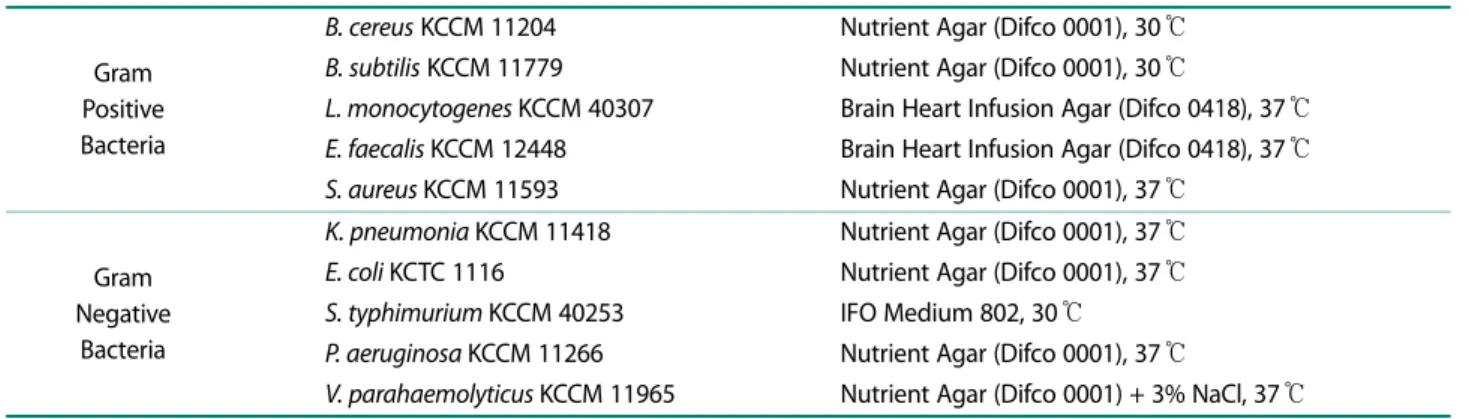
The standard bacterial strains used in this study were purchased from the Korean Collection for Type Cultures (KCTC; Korea) and the Korea Culture Center of Micro- organisms (KCCM; Korea). All strains were cultivated in appropriate media (Table 1).
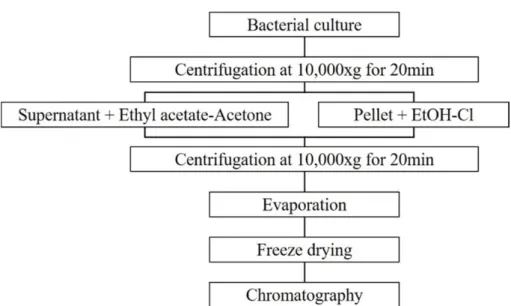
Antimicrobial activity against intestinal pathogens Previous study, we performed the extraction and puri-
fication of prodigiosin produced from Serratia sp.
PDGS
120915and reported [22] (Figs. 1 and 2). To study the antimicrobial activity of prodigiosin produced by Ser- ratia sp. PDGS
120915, purified prodigiosin was inoculated as much as 15 mg, 1.5 mg, 0.15 mg, and 0.015 mg into each paper disc. After dry, it was placed on the surface of the McFarland No. 0.5 of test bacteria. Following 24 h of incubation at each adequate temperature about 25 −37℃, the plates were examined for the MIC is defined as the lowest concentration of antimicrobial activity that inhib- its visual growth of microorganisms after 24 h incuba- tion at 37 ℃ [22]. MICs were determined by a two-fold serial dilution method in each medium as described by the National Committee for Clinical Laboratory Stan- dards (NCCLS) [23]. MBC is defined as the lowest con- centration of an antimicrobial activity required for a 99.9% reduction in the viable cell population [23]. For MBC determination, it was poured onto agar plate which was taken from a MIC test well that did not show turbidity.
Synergistic effect between prodigiosin and antibiotics In order to examine the synergistic effects on the anti- microbial activity between the purified prodigiosin and various antibiotics including amikacin (AN), tobramycin (NN), ceftaxidime (CAZ) and ticarcillin/clavulanic acid (TIM) (BD BBL
TM) against various intestinal pathogens, we have measured the fraction inhibitory concentration (FIC) [12, 7]. FIC was calculated as following equation.
FIC
A= MIC
Ain combination / MIC
A, FIC
B= MIC
Bin combination / MIC
B, FIC Index = FIC
A+ FIC
BFIC index values were; = 0.5, synergic; > to = 1, addi-
Table 1. List of strains and growth conditions used for antimicrobial activity test.
Gram Positive Bacteria
B. cereus KCCM 11204 Nutrient Agar (Difco 0001), 30 ℃ B. subtilis KCCM 11779 Nutrient Agar (Difco 0001), 30 ℃
L. monocytogenes KCCM 40307 Brain Heart Infusion Agar (Difco 0418), 37 ℃ E. faecalis KCCM 12448 Brain Heart Infusion Agar (Difco 0418), 37 ℃ S. aureus KCCM 11593 Nutrient Agar (Difco 0001), 37 ℃
Gram Negative
Bacteria
K. pneumonia KCCM 11418 Nutrient Agar (Difco 0001), 37 ℃
E. coli KCTC 1116 Nutrient Agar (Difco 0001), 37 ℃
S. typhimurium KCCM 40253 IFO Medium 802, 30 ℃
P. aeruginosa KCCM 11266 Nutrient Agar (Difco 0001), 37 ℃
V. parahaemolyticus KCCM 11965 Nutrient Agar (Difco 0001) + 3% NaCl, 37 ℃
tive; >1 to = 2, independent and >2, antagonistic.
Results and Discussion
Antimicrobial activity
To investigate the antimicrobial activity of prodigiosin produced by Serratia sp. PDGS
120915, we have examined the antimicrobial activity of purified prodigiosin against various intestinal pathogenic bacteria. From the results, purified prodigiosin showed a broad spectrum of antimi- crobial activity on the tested bacteria as shown in Fig . 3.
The previous report, S. marcescens showed a higher antimicrobial activity against Gram positive bacteria, including Staphylococcus, Bacillus, Enterococcus and Streptococcus [24]. However, purified prodigiosin iso- lated from Serratia sp. PDGS
120915showed a nonspecific
antimicrobial activity on Gram positive and negative pathogenic bacteria. Especially, it showed the highest antimicrobial effects on L. monocytogenes, causing infec- tious listeriosis. The antimicrobial inhibition zone against L. monocytogenes, B. cereus, P. aeruginosa, S.
typhimurium, and V. parahaemolyticus was 44, 37, 30, 28, and 26 mm, respectively as summarized in Table 2.
The results of antimicrobial activities in this study, we observed highly antimicrobial activity against L.
monocytogenes with treatment 15 mg/ml of purified pro- digiosin. In case of listeriosis, it was recommended ceftri- axone 2 g/12 h plus ampicillin 3 g/6 h treatment [25].
Therefore, purified prodigiosin is expect to a new potent antibiotic for the treatment of listeriosis. In addition, purified prodigiosin showed a wide range of antimicro- bial activities, and it will provide convenience and effi- ciency on the treatment of various diseases.
Determination of MIC and MBC
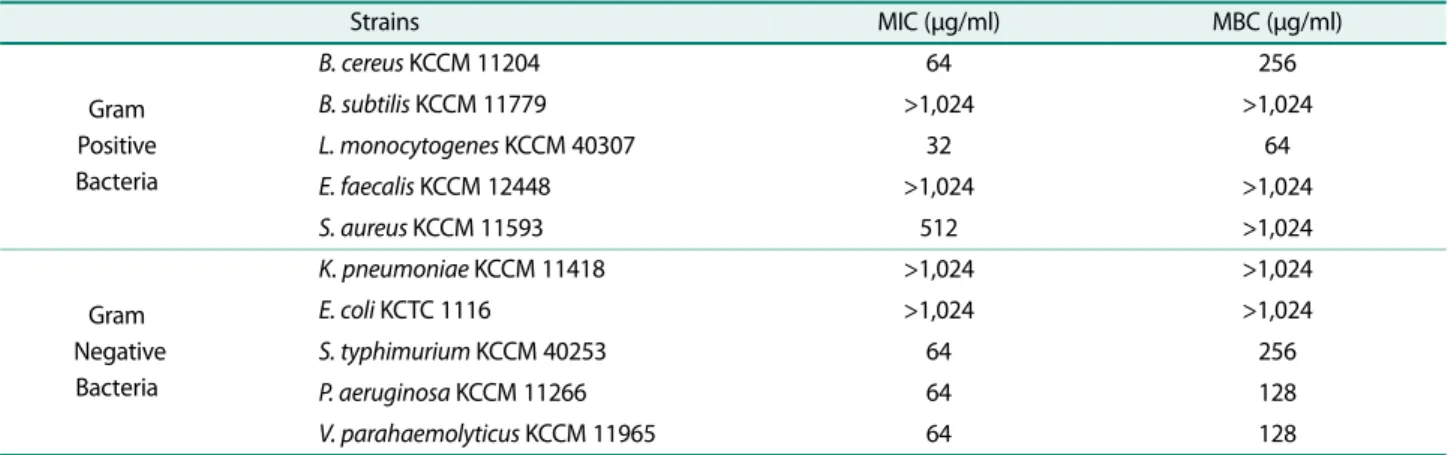
From the results of the MIC and MBC test, purified prodigiosin showed high antimicrobial activity against L. monocytogenes, B. cereus, P. aeruginosa, V. parahae- molyticus, and S. typhimurium. The MIC values were in the range of 32 to 64 µg/ml (Table 3). The antibacterial activities of purified prodigiosin was evaluated by the MBC assay. As summarized in Table 3, the MBC values were higher than MIC values, especially the lowest MBC value showed in L. monocytogenes.
Fig. 1. The procedure for extraction and purification of prodigiosin from Serratia sp. PDGS
120915.
Fig. 2. The chemical structure of prodigiosin.
The MBC results were indicating that it is possible to inhibition of bacterial growth over at 99% against B.
cereus, L. monocytogenes, S. typhimurium, P. aeruginosa and V. parahaemolyticus when the treatment at 256 µg/
ml of purified prodigiosin. Also, it is possible to inhibi-
tion of bacterial growth using maximum 64 µg/ml except L. monocytogenes at 32 µg/ml.
These results means that the low concentration of purified prodigiosin can do inhibition of growth against corresponding pathogenic bacteria. It is considered that Fig. 3. Antimicrobial effects of prodigiosin from Serratia sp. PDGS
120915against intestinal pathogens. Each disc contain dif- ferent concentration of purified prodigiosin. A: 0.15 mg, B: 0.015 mg, C: 15 mg, D: 1.5 mg
Table 2. Antimicrobial activity of prodigiosin from Serratia sp. PDGS
120915against intestinal pathogens.
Strain Inhibition zone (mm)
15 mg 1.5 mg 0.15 mg 0.015 mg
Gram Positive Bacteria
B. cereus KCCM 11204 37 16 0.6 0
B. subtilis KCCM 11779 0 0 0 0
L. monocytogenes KCCM 40307 44 17 15 0
E. faecalis KCCM 12448 0 0 0 0
S. aureus KCCM 11593 25 0.5 0 0
Gram Negative
Bacteria
K. pneumonia KCCM 11418 0 0 0 0
E. coli KCTC 1116 0 0 0 0
S. typhimurium KCCM 40253 28 12 0.5 0
P. aeruginosa KCCM 11266 30 13 0.9 0
V. parahaemolyticus KCCM 11965 26 12 10 0
this will not only reduce the side effects of the overuse of antibiotics, but also enable a decrease in the incidence of antibiotic resistance bacteria.
Determination of FIC indices
The synergistic effects of purified prodigiosin with antibiotics were estimate using the FIC index. These results indicated that the microbial growth suppression was much effective on the combination of the prodigi- osin-amikacin and prodigiosin-tobramycin. Also, when the treated with ceftazidime and ticarcillin/clavulanic acid, microbial growth suppression effect was stronger much in the treatment with the combination of prodigi- osin-ceftazidime and prodigiosin-ticarcillin/clavulanic acid (Table 4). The results from the present study
showed that the combination of purified prodigiosin with certain types of antibiotics showed synergistic or inde- pendent effects on pathogenic bacteria. These results provided that the purified prodigiosin could be potential candidate for developing new antibiotics with strong effect against pathogenic bacteria.
Acknowledgments
This work was supported by the Research Grant of Pukyong National University (year 2017).
Conflict of Interest
The authors have no financial conflicts of interest to declare.
Table 3. MIC and MBC of prodigiosin from Serratia sp. PDGS
120915against intestinal pathogens.
Strains MIC (μg/ml) MBC (μg/ml)
Gram Positive Bacteria
B. cereus KCCM 11204 64 256
B. subtilis KCCM 11779 >1,024 >1,024
L. monocytogenes KCCM 40307 32 64
E. faecalis KCCM 12448 >1,024 >1,024
S. aureus KCCM 11593 512 >1,024
Gram Negative
Bacteria
K. pneumoniae KCCM 11418 >1,024 >1,024
E. coli KCTC 1116 >1,024 >1,024
S. typhimurium KCCM 40253 64 256
P. aeruginosa KCCM 11266 64 128
V. parahaemolyticus KCCM 11965 64 128
Table 4. MIC and FIC indices of prodigiosin from Serratia sp. PDGS
120915in combination with antibiotics against intestinal pathogens.
Strains
Amikacin Tobramycin Ceftazidime Ticarcillin/clavulanic acid MIC (μg/ml) FIC
aMIC (μg/ml) FIC MIC (μg/ml) FIC MIC (μg/ml) FIC
A B C D A B C D A B C D A B C D
B. cereusKCCM 11204 16 8 16 0.75 8 4 16 0.75 16 8 32 1 64 64 32 1.5
L. monocytogenes KCCM 40307 16 2 8 0.375 8 2 2 0.3125 16 4 16 0.75 64 8 16 0.625
S. aureus KCCM 11593 16 4 128 0.5 8 2 128 0.5 16 4 32 0.3125 64 32 256 1
S. typhimurium KCCM 40253 16 4 16 0.5 8 2 4 0.3125 16 8 16 0.75 64 16 8 0.375
P. aeruginosa KCCM 11266 16 4 8 0.375 8 2 4 0.3125 16 4 16 0.5 64 8 8 0.25
V. parahaemolyticus KCCM 11965 16 4 8 0.375 8 2 8 0.375 16 4 16 0.5 64 16 8 0.375
A, without prodigiosin; B, MIC value of antibiotics with prodigiosin; C, MIC value of prodigiosin with antibiotic
a