• 검색 결과가 없습니다.

A Polyoxygenated Ellagitannin from Cercidiphyllum japonicum Bark

N/A
N/A
Protected

Academic year: 2021

Share "A Polyoxygenated Ellagitannin from Cercidiphyllum japonicum Bark"

Copied!
8
0
0

로드 중.... (전체 텍스트 보기)

전체 글

(1)

1. INTRODUCTION

Katsura tree (Cercidiphyllum japonicum Sieb.

Et Zucc), is the only species belonging to Cercidiphyllum genus, which is well repre- sented in the fossil record, with occurrences in the late Cretaceous and Tertiary of North America and Europe. However, it is now con- fined to East Asian countries (Manchester et al., 2009). The tree is a long-lived, deciduous, wind-pollinated tree with dimorphic leaves and up to 30 to 45 m tall with a symmetrical can- opy and new growth is reddish turning a light pale green. Fall color is a spectacular yellow,

with some red. Thus, it is valued as an orna- mental or a shade tree for landscape (Zhang et al., 2009). The natural populations of the tree inhabit distribute sites (600 to 2000 m) of tem- perate deciduous forests scattered across East China and Japan (Isagi et al., 2005).

A hydrolyzable tannin or pyrogallol-type tannin is a type of tannin that, on heating with hydrochloric or sulfuric acids, yields gallic or ellagic acids, and they are mixtures of poly- galloyl glucoses and/or poly-galloyl quinic acid derivatives containing in between 3 up to 12 gallic acid residues per molecule (Haslam, 1989). Ellagitannins are a diverse class of hy-

Original Article

A Polyoxygenated Ellagitannin from Cercidiphyllum japonicum Bark 1

Min-Sung Lee

2

⋅Hee-Jeong Min

2

⋅Jin-Kyu Kim

3

⋅Young-Soo Bae

2,†

ABSTRACT

Katsura tree (Cercidiphyllum japonicum Sieb. Et Zucc) bark was collected, air-dried and extracted with 70%

aqueous acetone, then concentrated and sequentially fractionated using n-hexane, methylene chloride (CH

2

Cl

2

), ethylacetate (EtOAc), and H

2

O. The H

2

O fraction was chromatographed on a Sephadex LH-20 column with various aqueous MeOH eluting solvents to isolate an ellagitannin. The isolate was elucidated as macabarterin, a polyoxygenated ellagitannin by NMR analysis, including HSQC, HMBC, Q-TOF MS, and with the compar- ison of authentic literature data. The compound was an ellagitannin which was isolated, for the first time, from the extracts of Katsura tree bark, and has never been reported before in domestic tree or plant sources.

Keywords : Cercidiphyllum japonicum bark, H

2

O fraction, macabarterin, ellagitannin, column chromatography

1

Date Received June 1, 2016, Date Accepted July 7, 2016

2

Department of Forest Biomaterials Engineering, College of Forest and Environment Sciences, Kangwon National University, Chuncheon 24341, Korea

3

Bio-Center, Gyeonggi Institute of Science & Technology Promotion, Suwon 16229, Korea

Corresponding author: Young-Soo Bae (e-mail: [email protected])

(2)

drolyzable tannins, a type of polyphenol primar- ily formed from the oxidative linkage of galloyl groups in 1,2,3,4,6-pentagalloyl glucose (Kwon and Bae, 2009; Sepulveda et al., 2011;

Steinmetz, 2010). Ellagitannins contain various numbers of hexahydroxydiphenoyl (HHDP) units, as well as galloyl units and/or sangui- sorboyl units bounded to sugar moiety. In order to determine the quantity of every individual unit, the hydrolysis of the extracts with tri- fluoroacetic acid in methanol/water system is performed. Hexahydroxydiphenic acid, created after hydrolysis, spontaneously lactonized to el- lagic acid, and sanguisorbic acid to sanguisorbic acid dilactone, while gallic acid remains intact (Yoshida et al., 2009).

Recently there have been many studies to evaluate biological activities of various natural resources and to develop pharmaceutical or functional food or cosmetic products. However, there are little studies on katsura tree extracts for functional uses in domestic or abroad (Tada and Sakurai, 1991; Takasugi and Katui, 1986;

Towatari et al., 2002). This study was carried out to investigate the extracts of katsura tree bark, and to elucidate the structure of a poly- oxygenated ellagitannin isolated from the extracts.

2. MATERIALS and METHODS 2.1. Plant material

Fresh Cercidiphyllum japonicum bark was collected at Samcheok, Gangwon-do in June

2014, air dried for two weeks and then ground to fine particles to be extracted.

2.2. Sample preparation

The ground bark (1.6 kg) was immersed in 70% aqueous acetone at room temperature for 3 days. After three times extraction and filtration, the filtrates were combined together and evapo- rated on a vacuum evaporator under reduced pressure at 40 ℃. The residue was successively fractionated on a separatory funnel and freeze dried to give n-hexane (1.77 g), CH

2

Cl

2

(1.48 g), EtOAc (31.1 g), and H

2

O (56.3 g) soluble fractions.

2.3. ESI-Q-TOF MS

The following ESI-Q-Tof (AB SCIEX Triple Tof 5600+, Miami, UK) conditions, quadrupole and orthogonal acceleration time-of-flight tan- dem mass spectrometer, were used: ionspray voltage, 5.5 kV; declustering potential (DP), 80 V; the turbo spray temperature, 500 ℃; neb- ulizer gas (Gas 1) of 50 psi; heater gas (Gas 2), 50 psi; curtain gas, 25 psi. Nitrogen was kept as nebulizer and auxiliary gas. The TOF MS scan was operated with the mass range of m/z 300-1800. Recalibration was carried by EasyMass Accuracy

®

device before analysis.

2.4. Structure analysis

1

H and

13

C NMR spectra, including 2D-NMR

such as HSQC (Heteronuclear Single Quantum

Coherence), HMBC (Heteronuclear Multiple

(3)

Bond Correlation), were recorded on a Bruker (USA) Avance DPX 700 MHz spectrometers using TMS (Tetramethylsilane) as an internal standard and chemical shift was given in δ (ppm). Thin layer chromatography (TLC) was done on DC-Plastikfolien Cellulose F (Merck) plates and developed with TBAW (t-BuOH-HOAc-H

2

O (3 : 1 : 1, v/v/v)) and 6%

aqueous HOAc. The spot was detected by illu- minating ultraviolet light (UV, 254 and 365 nm).

2.5. Column chromatography

A portion of H

2

O fraction (6.0 g) was chro- matographed on a Sephadex LH-20 column, eluting with MeOH-H

2

O (1 : 3, v/v) to afford 8 fractions. Fraction 8 was retreated with MeOH-H

2

O (3 : 1, v/v) to isolate the poly- oxygenated ellagitannin (Fig. 1).

Yellowish amorphous powder

R

f

: 0.02 (TBAW) and 0.40 (6% HOAc).

Q-TOF-MS : Found m/z 1103 [M+H]

+

.

1

H (700 MHz) and

13

C (700 MHz) NMR : See Table 1.

3. RESULTS and DISCUSSION

The compound was isolated from the H

2

O fraction of the extracts of katsura tree (Cerdidiphyllum japonicum Sieb, Et Zucc) bark by column chromatography using Sephadex LH-20, and the structure was elucidated by NMR analysis and comparison with the liter- ature data.

In the

1

H NMR spectrum, D-(+)-glucose of

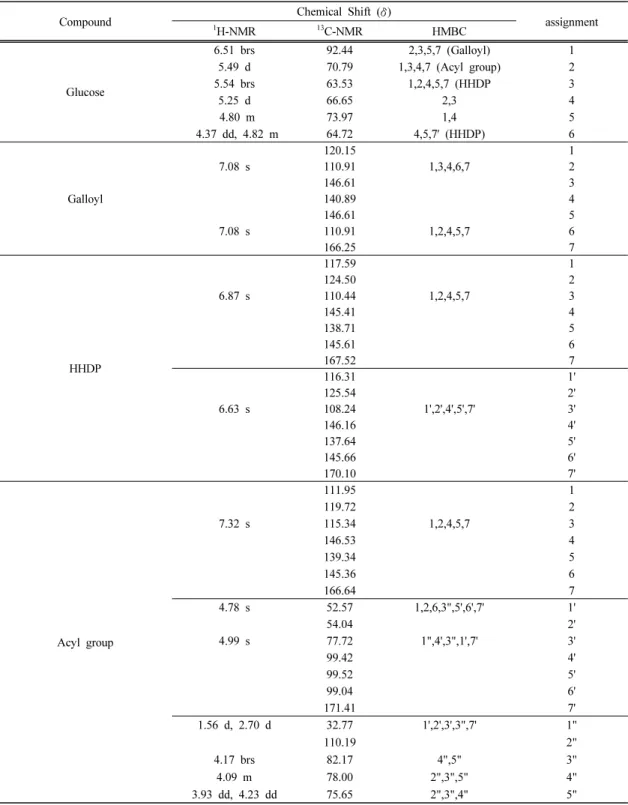
the compound showed a double doublet signal at δ4.37 and δ4.82 for two H-6 protons and H-5 gave a triplet signal at δ4.80. H-2 and H-4 indicated a doublet signal at δ5.49 and δ5.25, respectively. H-3 also showed a singlet signal at δ5.54. H-1 gave a doublet signal at δ6.51 with 8.37 Hz of the coupling constant suggesting the β-anomeric glucose. These proton signals were very close to the previous literature data (Ngoumfo et al., 2008). The one galloyl symmetrical protons, which is attached to C-1 of D-(+)-glucose, indicated a singlet sig- nal at δ7.08 for H-1 and H-6 (Kwon, 2010;

Xianbin et al., 2009). Also two HHDP (hexahy-

droxydiphenoyl) galloyl protons, which are

bound to C-3 and C-6 of D-(+)-glucose, in-

dicated two singlets at δ6.87 and δ6.63 for

H-3 and H-3', respectively (Ngoumfo et al.,

2008; Xianbin et al., 2009). Above proton sig-

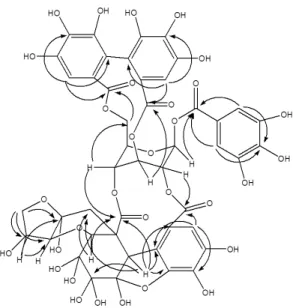
Fig. 1. Structure of the isolated compound.

(4)

Compound Chemical Shift ( δ)

assignment

1
H-NMR

13

C-NMR HMBC

Glucose

6.51 brs 92.44 2,3,5,7 (Galloyl) 1

5.49 d 70.79 1,3,4,7 (Acyl group) 2

5.54 brs 63.53 1,2,4,5,7 (HHDP 3

5.25 d 66.65 2,3 4

4.80 m 73.97 1,4 5

4.37 dd, 4.82 m 64.72 4,5,7' (HHDP) 6

Galloyl

120.15 1

7.08 s 110.91 1,3,4,6,7 2

146.61 3

140.89 4

146.61 5

7.08 s 110.91 1,2,4,5,7 6

166.25 7

HHDP

117.59 1

124.50 2

6.87 s 110.44 1,2,4,5,7 3

145.41 4

138.71 5

145.61 6

167.52 7

116.31 1'

125.54 2'

6.63 s 108.24 1',2',4',5',7' 3'

146.16 4'

137.64 5'

145.66 6'

170.10 7'

Acyl group

111.95 1

119.72 2

7.32 s 115.34 1,2,4,5,7 3

146.53 4

139.34 5

145.36 6

166.64 7

4.78 s 52.57 1,2,6,3",5',6',7' 1'

54.04 2'

4.99 s 77.72 1",4',3",1',7' 3'

99.42 4'

99.52 5'

99.04 6'

171.41 7'

1.56 d, 2.70 d 32.77 1',2',3',3",7' 1"

110.19 2"

4.17 brs 82.17 4",5" 3"

4.09 m 78.00 2",3",5" 4"

3.93 dd, 4.23 dd 75.65 2",3",4" 5"

Table 1.

1

H,

13

C, and HMBC data of the isolated compound (CD

3

OD)

(5)

nals were very similar to those of corilagin and isocorilagin reported by the literatures (Kwon, 2010; Ngoumfo et al., 2008; Xianbin et al., 2009). The acyl group gave very wide range of proton signals. One galloyl proton attached to the C-2 of D-(+)-glucose gave a singlet at δ 7.32 for H-3. Also H-1' and H-3' of the acyl group attached to the C-4 of D-(+)-glucose gave two singlets at δ4.78 and δ4.99, respectively. H-1'' of another acyl ring indicated two doublet signals at δ1.56 and δ2.70 for two methylene protons. H-3'' proton gave a broad singlet at δ4.17 and one H-4'' proton showed a multiplet signal at δ4.09. Two H-5'' hydroxy methylene protons gave two double doublet signals at δ3.93 and δ4.23.

This

1

H NMR spectrum was similar to the previous literature data reported by the literature (Khallouki et al., 2007; Ngoumfo et al., 2008;

Sakanaka et al., 1989).

In the

13

C NMR spectrum, C-6, C-5 and C-4 of D-glucose gave three signals at 64.72, 73.97, and 66.65 ppm, respectively. C-1 of D-glucose indicated at 92.44 ppm, and C-2 and C-3 also showed signals at 70.79 and 63.53 ppm, respectively. These carbon signals were similar to those of the authentic sample (Ngoumfo et al., 2008). The galloyl carbons attached to C-1 of D-glucose gave six signals at 120.15 and 140.89 ppm for C-1 and C-4, respectively. Also two pairs of symmetrical carbons appeared at 110.91 ppm for C-2 and C-6, and 146.61 ppm for C-3 and C-5. The carbonyl C-7 gave a sig- nal at 166.25 ppm (Kwon, 2010; Ngoumfo et al., 2008; Xianbin et al., 2009). HHDP carbons

attached to C-3 and C-6 of D-glucose indicated also 14 signals. The galloyl moiety of glucose C-3 showed three signals at 110.44, 117.59 and 124.50 ppm for C-3, C-1 and C-2, respectively.

C-5, C-4 and C-6 of the galloyl appeared at 138.71, 145.41 and 145.61 ppm, respectively, and the carbonyl C-7 gave a signal at 167.52 ppm (Kwon, 2010; Ngoumfo et al., 2008;

Xianbin et al., 2009). The galloyl moiety of glucose C-6 also gave signals at 108.24, 116.31 and 125.54 ppm for C-3', C-1' and C-2', respectively. The other signals for C-5', C-6' and C-4' appeared at 137.64, 145.66 and 146.16 ppm, respectively. The carbonyl C-7' showed a signal at 170.10 ppm (Kwon, 2010; Ngoumfo et al., 2008; Xianbin et al., 2009).

In the acyl group, the galloyl moiety attached

to the C-2 of D-glucose gave three signals at

111.95, 115.34 and 119.72 ppm for C-1, C-3

and C-2, respectively. Also the other carbons of

the moiety were resonated at 139.34, 145.36

and 146.53 ppm for C-5, C-6 and C-4,

respectively. The carbonyl of the moiety ap-

peared at 166.64 ppm. In the other carbonyl

containing cyclohexyl ring attached to C-4 of

D-glucose, three signals for C-1', C-2' and C-3'

were resonated at 52.57, 54.04 and 77.72 ppm,

respectively. Also the hydroxyl containing C-6',

C-4' and C-5' of the ring showed at 99.04,

99.42 and 99.52 ppm, respectively. The other

heterocyclic pyran and furan ring carbons ap-

peared at 32.77 and 75.65 ppm for C-1'' and

C-5'', respectively. Also C-4'', C-3'' and C-2''

gave signals at 78.0, 82.17 and 110.19 ppm,

respectively. These carbon signals were very

(6)

similar to those of the authentic sample isolated by Ngoumfo et al..

In the HSQC spectrum, δ4.37 (H-6) of D-glucose was correlated with 64.72 ppm (C-6).

Also δ4.80 (H-5) and 73.97 ppm (C-5), 5.25 (H-4) and 66.65 ppm (C-4), 5.54 (H-3) and 63.53 ppm (C-3), δ5.49 (H-2) and 70.79 ppm (C-2), and 6.51 (H-1) and 92.44 ppm (C-1) were correlated each other, respectively. In the galloyl ring bound to C-1 of D-glucose, δ7.08 (H-2 and H-6) was resonated with 110.91 ppm of C-2 and C-6. Also in the HHDP structure, H-3 ( δ6.87) of the galloyl attached to C-3 (110.44 ppm) of D-glucose was correlated and another H-3' ( δ6.63) of the galloyl attached to C-6 of D-glucose was also correlated with C-3' (108.24 ppm). In the acyl group, H-3 of the galloyl ring bound to C-2 of D-glucose had a correlation with C-3 of the ring at 115.34 ppm.

The HSQC spectra of the acyl group indicated correlations between H-1' ( δ4.78) and C-1' (52.57 ppm), H-3' ( δ4.99) and C-3' (77.72 ppm), H-1'' ( δ1.56) and C-1'' (32.77 ppm), H-3'' ( δ4.17) and C-3'' (82.17 ppm), H-4'' (δ 4.09) and C-4'' (78.0 ppm), and H-5'' ( δ3.93) and C-5'' (75.65 ppm). These HSQC correlation data were very identical to the literature by Ngoumfo et al..

HMBC spectral data of the compound were also shown in Table 1 and the correlations with heteroatom of the molecule were also indicated in Fig. 2. H-1 of D-glucose was resonated with the carbonyl C-7 of the galloyl group. Also H-2 of D-glucose was correlated with the carbonyl C-7 of the galloyl of the acyl group. The other

carbonyl C-7' of the acyl group was resonated with H-4 of D-glucose. H-3 and H-6 of D-glu- cose had correlations with the carbonyl C-7 and the other carbonyl C-7' of HHDP moiety, respectively. These HMBC correlations were also identical to the literature (Ngoumfo et al., 2008).

Based on the above results by

1

H and

13

C NMR, HSQC, HMBC, and ESI-Q-Tof MS, this compound was characterized as macabarterin and its spectral data was identical to the au- thentic compound (Ngoumfo et al. 2008). This type of polyoxygenated ellagitannin was iso- lated, for the first time, from katsura tree bark and has never been reported in domestic plant sources. Also we consider that this compound can be an important valuable index marker to distinct the species.

Fig. 2. Selected HMBC correlations observed be-

tween heteroatoms of the compound.

(7)

4. CONCLUSION

Katsura tree (Cercidiphyllum japonicum Sieb.

Et Zucc) bark were collected, air-dried and ex- tracted with 70% aqueous acetone. The extracts were concentrated and then sequentially fractio- nated with n-hexane, CH

2

Cl

2

, EtOAc, and H

2

O to be freeze dried. A portion of H

2

O fraction was chromatographed on a Sephadex LH-20 column, eluting with MeOH-H

2

O (1 : 3 and 3 : 1, v/v) to isolate the polyoxygenated ellagitannin. The structure was elucidated as macabarterin by NMR analysis, including HSQC and HMBC, and comparison with liter- ature data. To our best knowledge, this type of ellagitannin is firstly isolated from katsura tree bark and has never been reported before in do- mestic plant sources. This compound can be used an important valuable index marker to distinct the species.

ACKNOWLEDGEMENTS

This study was supported by the Basic Research Program for Forest Science of Korean Forest Service (No S211315L010130) and also partially supported by Kangwon National University.

REFERENCES

Haslam, E. 1989. Plant polyphenols: Vegetable tan- nins revisited. Chemistry and Pharmacology of Natural Products. 90 ∼146, University of Cambridge Oriental Publications.

Isagi, Y., Kudo, M., Osumi, K., Sato, K., Sakio, H.

2005. Polymorphic microsatellite and markers for a relictual angiosperm Cercidiphyllum japoni-

cum Sieb. et Zucc. and their utility for Cercidiphyllum magnificum. Mol. Ecol. Notes 5:

596 ∼598.

Khallouki, F., Haubner, R., Hull, W.E., Erben, G., Spiegelhalder, B., Bartsch, H., Owen, R.W.

2007. Isolation, purification and identification of ellagic acid derivatives, catechins, and procyani- dins from the root bark of Anisophyllea dichos- tyla R. Br. Food and Chemical Toxicology (45):

472 ∼485.

Kwon, D.J., Bae, Y.S. 2009. Ellagitannins from bark of Juglans mandshurica. Mokchae Konghak.

37(5): 480 ∼485.

Kwon, D.J. 2010. Chemical constituents and bio- logical activities of certain Acer Species growing in Korea. Ph.D. Dissertation, pp. 211 ∼221.

Manchester, S.R., Chen, Z.D., Lu, A.M., Uemura, K.

2009. Eastern asian endemic seed plant genera and their paleogeographic history throughout the northern hemisphere. J. Syst. Evol. 47: 1 ∼42.

Ngoumfo, R.M., Ngounou, G.E., Tchamadeu, C.V., Qadir, M.I., Mbazoa, C.D., Begum, A., Ngninzeko, F.N., Lontsi, D., Choudhary, M.I.

2008. Inhibitory Effect of Macabarterin, a Polyoxygenated Ellagitannin from Macaranga barteri, on Human Neutrophil Respiratory Burst Activity. American Chemical Society and American Society of Pharmacognosy. 71: 1906

∼1910.

Sakanaka, S., Kim, M. Taniguchi, M., Yamamoto, T.

1989. Antibacterial substances in Japanese green tea extract against Streptococcus mutans, a cario- genic bacterium. Agricultural and Biological Chemistry (53): 2307 ∼2311.

Sepulveda, L., Ascacio, A., Raul, R.H., Antonio,

A.C., Cristobal, N.A. 2011. Ellagic acid :

Biological properties and Biotechnological devel-

opment for production processes. African Journal

of Biotechnology. 10(20): 4518 ∼4523.

(8)

Steinmetz, W.E. 2010 NMR assignment and charac- terization of proton exchange of the ellagitannin granatin B. Magnetic Resonance in Chemistry.

48: 565 ∼570.

Tada, M., Sakurai, K. 1991. Antimicrobial compound from Cercidiphyllum japonicum. Phytochemistry.

30(4): 1119 ∼1120.

Takasugi, M., Katui, N. 1986. A biphenyl phytoalexin from Cercidiphyllum japonicum.

Phytochemistry. 25(12): 2751 ∼2752.

Towatari, K., Yoshida, K., Mori, N., Shimizu, K., Kondo, R., Sakai, K. 2002. Polyphenols from the heartwood of Cercidiphyllum japonicum and their effects on proliferation of mouse hair epithelial cells. Planta Med. 68: 995 ∼998.

Xianbin, S., Gemma, L.T., Warren, R.J.D.G., David, S.S., Richard, J.S., David, R.S. 2009. Synthesis of Biaryl-Containing Medium-Ring Systems by Organocuprate Oxidation: Applications in the Total Synthesis of Ellagitannin Natural Products.

Synthesis No.22, pp. 3880 ∼3896.

Yoshida, T., Hatano, T., Ito, H., Okuda, T., Quideau, S. 2009. Structural diversity and an timicrobial activities of ellagitannins. Chemistry and Biology of Ellagitannins. 55 ∼93, World Scientific Publishing, Singapore.

Zhang, X.Y., Yuan, X.Y., Ma, J., Yuan, L.J. 2009.

Research on tissue culture and regeneration of

Ceridiphyllum japonicum. Northern horticulture

(9): 77-79 (in Chinese).

수치

Table 1.  1 H,  13 C, and HMBC data of the isolated compound (CD 3 OD)
Fig. 2. Selected HMBC correlations observed be- be-tween heteroatoms of the compound.

참조

관련 문서

The ethyl acetate fraction, which showed desirable activities, was further purified using reverse-phase silica gel column chromatography followed by sephadex LH-20

The compounds were isolated from the EtOAc fraction of the extracts of japanese anise (Illicium ansisatum L) twigs by column chro- matography using Sephadex LH-20, and the

α-Glucosidase inhibitory activity of several fractions from the ethanolic extract of Morus root bark isolated by Diaion HP-20, silica gel, ODS-A, and Sephadex LH-20

Its anti-clotting component was purified by using DEAE-cellulose, Sephadex G-75, and Sephadex LH-20 column chromatography... 1- A dilution curve for determining

From the EtOAc and n-BuOH fraction, six phenolic compounds were isolated through the silica gel, octadecyl silica gel and sephadex LH-20 column chromatography.. To provide

Repeated column chromatography of silica gel, sephadex LH-20 and HPLC led to the isolation of nine phenolic compounds from ethyl acetate soluble fraction.. These compounds

상충액은 Amberlite lRA-400 ion exchange column chromatography , butanol extraction , cell u1 0se partition column chroma- tography , Sephadex LH-20 gel permeation column

One higher alcohol compound and three flavonoids were isolated from the EtOAc fraction through silica gel and Sephadex LH-20 column chromatographies.. And compounds 1 and 4