• 검색 결과가 없습니다.

Effect of Thermal Compression Treatment on the Surface Hardness, Vertical Density Propile and Thickness Swelling of Eucalyptus Wood Boards by Hot-pressing

N/A
N/A
Protected

Academic year: 2021

Share "Effect of Thermal Compression Treatment on the Surface Hardness, Vertical Density Propile and Thickness Swelling of Eucalyptus Wood Boards by Hot-pressing"

Copied!
8
0
0

로드 중.... (전체 텍스트 보기)

전체 글

(1)

*1 Received on November 12, 2010; accepted on December 22, 2010

*2 Dept. of Forest Products Engineering, Faculty of Forestry, Istanbul University, Bahcekoy, Sariyer, 34473, Istanbul, Turkey

*3 Dept. of Forest Industrial Engineering, Faculty of Forestry, Duzce University, 81620 Duzce, Turkey

*4 Dept. of Forest Sciences, College of Agriculture and Life Sciences, Seoul National University, 599 Gwanak-ro, Gwanak- gu, Seoul 151-921, Korea

*5 Research Institute for Agriculture and Life Sciences, College of Agriculture and Life Sciences, Seoul National University, 599 Gwanak-ro, Gwanak-gu, Seoul 151-921, Korea

Corresponding author : Hwanmyeong Yeo (e-mail: [email protected])

Effect of Thermal Compression Treatment on the Surface Hardness, Vertical Density Propile and Thickness

Swelling of Eucalyptus Wood Boards by Hot-pressing* 1

Oner Unsal*

2

, Zeki Candan*

2

, Umit Buyuksari*

2

, Suleyman Korkut*

3

, Yoon-Seong Chang*

4

, Hwanmyeong Yeo*

4,5†

ABSTRACT

Thermal treatment techniques are used for modifying wood and wood-based materials to improve dimen- sional stability and hygroscopicity. This study investigated the effects of press pressure and temperature on density, vertical density profile, thickness swelling and surface hardness of eucalyptus wood boards.

The experimental wood boards were prepared from Turkish River Gum (Eucalyptus camaldulensis Dehn.).

The surface hardness value increased with increasing press pressure in the treated groups. The application of a higher pressure at the same temperature level increased the amount of swelling of wood. It means that it is not needed for application of higher pressure to enhance the dimensional stability of wood. It is expected that it is possible to produce increased hardness, dimensional stability and durability by appli- cation of hot pressing treatment. This research showed that different press pressure and temperature values should be used to improve the performance properties of eucalyptus wood so that the end-use of the wood materials could be expanded.

Keywords : Thermal compressing, heat modification, dimensional stability, solid wood boards, spring-back phenomenon, density, Eucalyptus camaldulensis

1. INTRODUCTION

Turkish river red gum (Eucalyptus camaldu- lensis Dehn.) has been grown on plantations in

the Tarsus region of Mersin, Turkey. This spe-

cies has some advantageous such as fast growth

and low price. However, it has several un-

desired properties such as low dimensional sta-

(2)

bility and several drying problems limiting its use.

Heat treatment of wood and wood composites is known to improve and control dimensional stability, durability and discoloration (Burmester, 1973; Giebeler, 1983; Yeo et al., 2010). Various heat treatment procedures such as the Plato Process, Retification Process, Boise Perdure, Oil- Heat Treatment Process, and Thermowood Process are widely used in the forest products industry (Militz, 2002). Compression and tem- perature is generally used on wood products to improve their physical and mechanical pro- perties. Thermally compressed wood is known as staypak (Seborg et al., 1945; Stamm, 1964), while compressed wood with phenol form- aldehyde (PF) resin pretreatment is called com- preg (Stamm, 1964; Stamm and Haris, 1953).

Further studies were done by Tarkow and Seborg (1968) studying surface densification of wood. After the 1980s, compressed wood prod- ucts with lower densities from cheaper wood species were produced, especially utilizing some of the fast growing trees in Asia (Norimoto, 1993, 1994; Wang, 2000).

Compression in wood is generally considered to be analogous to hot pressing wood compo- sites, except that it takes longer to obtain a sol- id wood compression set without the bonding effects of resins. Wang and Cooper (2004) stud- ied the effects of grain orientation and surface plasticizing methods on the vertical density pro- files (VDPs) of compressed balsam fir and spruce. In another study, Wang and Cooper (2005) studied the effects of the closing rate of the hot press, the initial moisture content of the wood, and the sample size on the VDPs of ther- mally compressed fir wood. The density dis- tribution throughout the thickness of wood com- posites such as fiberboard and oriented strand- board traditionally exhibits higher surface den- sity and lower core density. The density gra-

dient is affected by the combined influences of pressure, MC, temperature, resin curing, and other factors during pressing and affects the physical and mechanical properties of wood composites (Wang and Winistorfer, 2000; Candan, 2007; Strickler, 1959; Kamke and Casey, 1988).

Since there are differences in material properties and hot pressing parameters for wood composite production, densified solid wood boards could exhibit a different density profile. The Thermal compression process might affect drying charac- teristics, dimensional stability and density, and hardness and surface quality.

Esteves et al. (2007) utilized a steam heating process on eucalyptus wood and found that the equilibrium MC decreased by 61% and dimen- sional stability increased. However, mechanical properties of the material decreased. It was re- ported that modulus of rupture (MOR) de- creased by 50% and modulus of elasticity (MOE) decreased by 15%. Unsal and Ayrilmis (2005) used a heat treatment process on euca- lyptus and determined the properties of density and compression strength. It was stated that density and compression strength decreased with increasing treatment temperature and time.

Unsal et al. (2003) studied the effect of the heat treatment process on the physical and mechan- ical properties of eucalyptus wood. They con- cluded that density, swelling and Janka hardness values decreased with an increasing duration of heat treatment and temperature.

Unsal and Candan (2008) studied the effect- sof press pressure and temperature on vertical density profile, Janka hardness, and MC of pine wood boards. They found that final MC de- creased while density and Janka hardness increased. Unsal et al. (2009) used a thermal compression technique on pine wood panels.

They used a press temperature of 120°C and 150°C with a press pressure of 5 and 7 MPa.

Thickness swelling values for the boards im-

(3)

Table 1. Pressing parameters for experimental groups

Groups Pressure (bar) Temperature (°C)

Time (h)

Control - - -

A 40 130

B 40 150 1

C 60 130

D 60 150

Fig. 1. Thickness swelling (TS) of hot-pressed and untreated specimens after soaking in water.

proved except for the boards pressed at 7 MPa at 150°C.

In this study, the effects of the thermal mod- ification process using a hot-press on final MC, density, VDP, dimensional stability, and Janka hardness of eucalyptus wood boards were investigated.

2. MATERIALS and METHODS 2.1. Material

In this study, Turkish River Gum (Eucalyptus camaldulensis Dehn.) wood was used. The logs were obtained from the Tarsus region of Mersin, Turkey. Experimental boards with dimensions of 250 mm by 500 mm by 16 mm were cut from the logs. Average initial MC of the sam- ples was 16%.

2.2. Thermal Compression Process

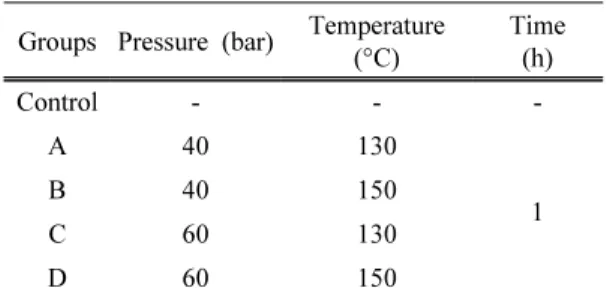
The boards were compressed at a press tem- perature of either 130°C or 150°C and at a press pressure of either 4 or 6 Mpa for 1 hour in a 500 mm by 500 mm laboratory type hot press. A total of five board groups with four treatment groups (A, B, C, and D group) and a control group were investigated. Hot pressing parameters are shown in Table 1.

2.3. Testing Methods

Larger specimens with dimensions of 16 mm (thickness) by 250 mm (width) by 500 mm (length) were cut into 16 mm (thickness) by 50 mm (width) by 50 mm (length) for all tests.

Radial grain wood specimens were chosen for this study. Since there were two solid wood panels in one treatment group, a total of ten boards were initially used in the five groups and five pressed boards were the end products.

Density, vertical density profile, thickness swel- ling, and Janka hardness were evaluated in this study according to international standards.

VDPs weremeasured with an X-ray density pro- filer (GreCon Measurement Systems, Germany) at Kastamonu Integrated Inc., a quality labo- ratory located in Kocaeli. The Janka hardness test was done according to ASTM D1037 (1999) standard using a universal test machine.

The initial MC of the samples was measured

before pressing to determine drying behavior of

the panels. After the treatment, the final MC

(4)

Table 2. Thickness swelling of boards

Groups Thickness swelling (%)

2 h 24 h One week

Control 1.39 2.87 4.50

A 2.12 3.71 6.10

B 1.59 3.95 5.74

C 7.95 13.33 18.07

D 3.14 9.17 13.76

Fig. 2. Thickness of specimen in each state, before hot pressing, after hot pressing and after soaking in water.

was also measured to evaluate the difference.

3. RESULTS and DISCUSSION

3.1. Thickness Swelling (TS)

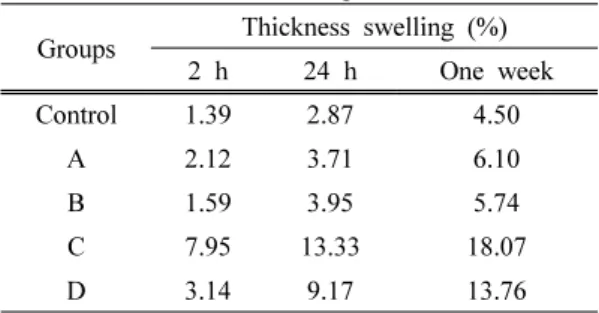
After hot pressing, the thickness of the A, B, C and D boards decreased by 27.4%, 28.7%, 30.1% and 31.4% of original dimension, respectively. Decrement in thickness increased with increasing press time and temperature. 2 h, 24 h and one week thickness swelling (TS) val- ues of the boards are illustrated in Fig. 1 and shown in Table 2. Among the treated groups, the boards pressed at 4 MPa at 150°C (group B) had the lowest thickness swelling value for both 2h and one week. The highest thickness swelling values were obtained from boards pressed at 6 MPa at 130°C (group C) with 2 h, 24 h, and one week water soaking time.

All thermally pressed panels showed higher thickness swelling values than the control group. This result might be explained by spring- back due to the boards’ densification from the thermal compression process. Thickness swel- ling values of the treated boards increased with increasing press pressure while the values de- creased with increasing press temperature. An Increase in TS values with increasing press pressure could be explained with an increasing springback effect. Improvement in TS with in- creasing press temperature could be explained

by the changes in chemical composition of the wood. In a previous study, Unsal et al. (2009) obtained similar results for pine wood. They re- ported that thickness swelling and water absorp- tion of thermally hot pressed boards sig- nificantly increased with increasing press pressure.

The spring-back phenomenon is greatly con- trolled by the pressure level, not temperature level. Higher pressure in hot press treatment causes a greater amount of spring-back. On the other hand, higher temperature causes a bigger permanent deformation. Using the above swel- ling graph and shrinkage data from hot pressing (27.4% (A), 28.7% (B), 30.1% (C), and 31.4%

(D)), a graph can be made to predict the thick- ness change of the boards quantitatively as shown in Fig. 2. Fig. 2 shows the thickness of the wood in each state : before hot pressing, af- ter hot pressing, and after soaking in water. A specimen’s thickness prior to hot-press treat- ment was assigned as 100% of the starting di- mension thickness. And each dimension of thickness after treatment can be presented by % scale. Using this % scale, thickness change of the boards with any other dimension can be predicted.

Fig. 2 shows that a higher pressure applica-

(5)

Fig. 3. Vertical density profile (VDPs) of boards.

tion at the same temperature level and a higher temperature at the same mechanical load (pressure) level in the hot press treatment cause a more decrease in thickness. Viscous and elas- tic deformation in the thickness decrement can’t be separated based on observation of the press- ing process. However, the effect of temperature on viscous deformation could be evaluated by comparing the thickness decrement in hot press treatment to the thickness swelling of boards soaked in water. Since a higher temperature ap- plication at the same pressure level decreases the amount of spring-back, most of the viscous deformation seems to occur due to the temper- ature effect.

Moreover, a higher pressure application at the same temperature level increases the amount of spring-back. This means that the pressure in- duces just recoverable deformation, elastic, and/or viscous-elastic deformation, and there are fewer thermo-chemical modifications in the wood at a higher compressed state. The greater mechanical load by a higher pressure reduces the space in lumen of the woods’ cells and the distance between cellulose chains in cell wall

structures. The greater mechanical load reduces the space of the lumen and the distance be- tween cellulose chains. It seems that the re- duced space in lumen and distance between cel- lulose chains might interrupt thermo-chemical modifications which cause permanent deforma- tion in wood’s cell wall during the hot press treatment.

3.2. Drying Characteristics

Average initial MC of the samples was 16%.

At the end of the process, similar MC values

were obtained. Therefore, it was concluded that

the drying effect of hot pressing was not re-

markable those conditions. Unsal and Candan

(2008) did the thermal compression technique

on pine wood panels, and they obtained sig-

nificant drying effects from the process. One

possible reason for the disparity between our

study and Unsal and Candan study is that they

used a higher press pressure and a higher initial

MC. In addition, the wood species used in that

study was pine which is softer than eucalyptus

wood.

(6)

Table 3. Janka hardness of boards

Groups Janka hardness value (N)

Force per unit area (N/mm

2

)

Control 4295 42.95

A 4011 40.11

B 3027 30.27

C 4914 49.14

D 3815 38.15

Fig. 4. Density, Peak density (PD) and core den- sity(CD) of thermally modified wood boards.

3.3. Density and Vertical Density Profile (VDP)

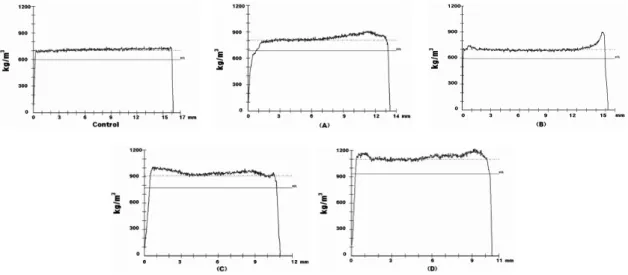
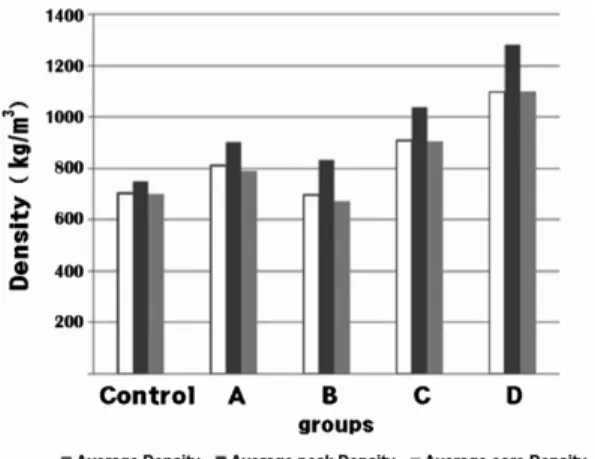
The VDPs are shown in Fig. 3 and mean density values of the boards are shown in Fig.

4. Group D had the highest mean density value with 1,099 kg/m

3

. Group B showed the lowest mean density value with 698 kg/m

3

. Mean den- sity values of the boards both pressed at 130°C and 150°C increased as the press pressure increased. Peak density (PD) and core den- sity(CD) values as VDP characteristics of the boards are shown in Fig. 4. The lowest PD val- ue (748.0 kg/m

3

) was observed in the control group while the highest value (1,278.2 kg/m

3

) was obtained in group D. The lowest CD value (668.9 kg/m

3

) was observed in group B while the highest value (1,097.5 kg/m

3

) was measured in group D. PD values of the boards sig- nificantly increased with increasing press pres- sure for both 130°C and 150°C. PD values of hot pressed boards were higher than the control group. Similarly, Unsal and Candan (2008) found that PD values in the pine wood panels increased with increasing press pressure.

3.4. Janka Hardness

Janka hardness was evaluated for the control and all treatment groups as shown in Table 3.

The lowest Janka hardness value, 3,027 N, which can be expressed to 30.27 MPa in unit of pressure with consideration of 100 mm

2

pro- jected area of steel ball, was observed in group B while the highest value (4,914 N) was ob- tained in group C. When the hot press pressure increased from 4 to 6 MPa at 130°C, the hard- ness value increased from 4,011 to 4,914 N.

Similarly, when the press pressure increased from 4 to 6 MPa, the hardness value of the boards pressed at 150°C increased from 3,027 to 3,815 N. The Increase in Janka hardness val- ues can be attributed to an increase in density.

The Janka values except for group C were low- er than the control group because the brittleness of the boards increased during the hot pressing procedure.

Unsal and Candan (2008) had similar results for the pine boards. It was stated that Janka hardness values increased as press pressure increased. The hardness values were negatively affected by an increase in press temperature.

This result was also similar to Unsal et al.

(2003). They reported that Janka hardness val-

ues of eucalyptus wood significantly decreased

with increasing heat treatment temperatures.

(7)

4. CONCLUSION

The thermal compression procedure did not improve thickness swelling of the boards.

Moisture movement in the wood was not ach- ieved under the treatment conditions because of a low initial MC. Mean density values of the boards increased as press pressure increased. It was concluded that the VDP in the solid wood panels was closely related with the press pres- sure and pressing temperature. An increase in pressure and temperature resulted in improved PD and MD values which are defining factors of VDP.

This research showed that the hardness values of Eucalyptus wood boards increased with in- creasing press pressure for both temperatures.

Because of densification on the surface layers of the solid wood boards, hardness values were positively affected. The highest hardness value was obtained in the board pressed at a pressure of 6 MPa at 130°C.

Consequently, surface hardness of wood ma- terials from fast growing and low quality wood species could be improved by the thermal com- pression procedure using a hot press. Thus, the use of these wood species might be extended.

Future studies will focus on the effects of the pressing parameters on bending properties, sur- face roughness, and decay and termite resist- ance of the solid wood boards.

ACKNOWLEDGEMENT

The authors would like to thank Istanbul University Research Fund (Project Number:

“UDP-4766/24122009”). And this study was carried out with the support of ‘Forest Science

& Technology Projects (Project No. S120810 L140110)’ provided by Korea Forest Service.

REFERENCES

1. American Society for Testing and Materials ASTM-D 1037. 1999. Standard Test Methods for Evaluating Properties of Wood-Base Fiber and Particle Panel Materials. ASTM International.

West Conshohocken, PA.

2. Burmester, A. 1973. Effect of heat-pressure-treat- ment of semi-dry wood on its dimensional stability. Holz Roh-Werkst 31: 237∼243.

3. Candan, Z. 2007. Effects of some production pa- rameters on vertical density profile (VDP) and technological properties of medium density fiber- board (MDF). MS Thesis, Istanbul University.

Istanbul. Turkey. p. 400.

4. Esteves, B., A. V. Marques, I. Domingos, and H.

Pereira. 2007. Influence of steam heating on the properties of pine (Pinus pinaster) and eucalypt (Eucalyptus globulus) wood. Wood Science and Technology 41(3): 193∼207.

5. Giebeler, E. 1983. Dimensional stabilization of wood by moisture-heat-pressure-treatment. Holz Roh-Werkst 41: 87∼94.

6. Kamke, F. A. and L. J. Casey. 1988. Fundamentals of flakeboard manufacture: Internal mat conditions.

Forest Products Journal 38(6): 38∼44.

7. Militz, H. 2002. Thermal treatment of wood:

European processes and their background. In Proceedings of the 33rd Annual Meeting; Cardiff- Wales. 1217 May, 2002: pp. 1∼17. IRG/WP 02-40241.

8. Norimoto, M. 1993. Large compressive deforma- tion in wood. Mokuzai Gakkaishi 39(8): 867∼

874.

9. Norimoto, M. 1994. Heat treatment and steam treatment of wood. Wood Industry 49(12): 588∼

592.

10. Seborg, R. M., M. A. Millett, and A. J. Stamm.

1945. Heat stabilized compressed wood (Staypak).

Mech. Eng. 67: 25∼31.

11. Stamm, A. J. 1964. Wood and cellulose science.

Ronald Press. New York. USA.

12. Stamm, A. J. and E. E. Haris. 1953. Chemical

processing of wood, Chemical Publishing Co.,

Inc. New York. USA.

(8)

13. Strickler, M. D. 1959. Effect of press cycle and moisture content on properties of Douglas fir flakeboard. Forest Products Journal 9(7): 203 ∼ 215.

14. Tarkow, H. and R. M. Seborg. 1968. Surface den- sification of wood. Forest Products Journal 18(9):

104∼107.

15. Unsal, O., S. Korkut, and C. Atik. 2003. The ef- fect of heat treatment on some properties and col- our in eucalyptus (Eucalyptus camaldulensis Dehn.) wood. MADERAS: Ciencia Y Tecnologia Journal 5(2): 145∼152.

16. Unsal, O. and N. Ayrilmis. 2005. Variations in compression strength and surface roughness of heat-treated Turkish river red gum (Eucalyptus camaldulensis Dehn.) wood. Journal of Wood Science 51: 405∼409.

17. Unsal, O. and Z. Candan. 2008. Moisture content, vertical density profile and Janka hardness of thermally compressed pine wood panels as a function of press pressure and temperature.

Drying Technology 26: 1165 ∼1169.

18. Unsal, O., S. N. Kartal, Z. Candan, R. A. Arango, C. A. Clausen, and F. Green. 2009. Decay and termite resistance, water absorption and swelling

of thermally compressed wood panels. International Biodeterioration & Biodegradation 63(5): 548∼

552.

19. Wang, J. M., G. J. Zhao, and I. Lida. 2000. Effect of oxidation on heat fixation of compressed wood of China fir. Forestry Studies in China 2(1): 73∼

79.

20. Wang, J. and P. A. Cooper. 2004. Vertical density profiles in thermally compressed balsam fir wood.

Forest Products Journal 55(5): 65∼68.

21. Wang, J. and P. A. Cooper. 2005. Effect of grain orientation and surface wetting on vertical density profiles of thermally compressed fir and spruce.

Holz als Roh-und Werkstoff 63: 397∼402.

22. Wang, S. and P. M. Winistorfer. 2000. Fund- amentals of vertical density profile formation in wood composites, Part 2, Methodology of vertical density formation under dynamic condition.

Wood and Fiber Science 32(3): 220∼238.

23. Yeo, H., J. J. Lee, I. G. Choi, K. J. Yoon, C. D.

Eom, J. H. Park, and Y. S. Chang. 2010. Color

control of cedar wood and its durability improve-

ment by neat and hot water treatment. In

Proceeding of 11th IUFRO Wood Drying

Conference. Skelleftea. Sweden. pp. 277∼284.

수치

Fig. 1. Thickness swelling (TS) of hot-pressed and  untreated specimens after soaking in water
Fig. 2. Thickness of specimen in each state, before  hot pressing, after hot pressing and after  soaking in water.
Fig. 3. Vertical density profile (VDPs) of boards.
Table 3. Janka hardness of boards

참조

관련 문서

The purpose of this study is to evaluate the effects of heat treatment on the load-deflection properties and transitional temperature range(TTR) of

The data are corrected for temperature error due to solar radiation and the effect of low temperature on the anerod capsule and curvature of the surface of

The effect of Combined Exercise program on Body composition, Physical fitness and thickness of subcutaneous fat in. Obese

From the results of Micro Vickers hardness test, Ti- 40Hf alloy showed significantly increasing of hardness and tensile strength than others in the case of

Comparison of the monthly average difference between surface temperature and sea surface temperature at Chilbaldo on foggy(f_avg) and no foggy(nf_avg) day cases from

The effects of the acceleration voltage, the probe current and the travel speed on the formation, the ingredient variation and the surface roughness of the deposited

RESULTS - THE VIET NAM POPULATION AND HOUSING CENSUS OF 00:00 HOURS ON 1 APRIL 2019 RESULTS - THE VIET NAM POPULATION AND HOUSING CENSUS OF 00:00 HOURS ON 1 APRIL 2019 / 31 |

Micro- and nano-sized pores were formed on the surface of the alloy using PEO and anodization methods, and the pore shape change according to the Zr