구조물의 최적안전지수와 생애주기비용의 상관관계에 관한 연구
방 명 석†
한국교통대학교 교통시스템공학과 (2014. 9 2. 접수 / 2014. 11. 26. 채택)
A Study on the Correlation between Optimal Safety of Structures and Minimization of Life Cycle Cost(LCC)
Bang, Myung-Seok†
Department of Transportation System Engineering, Korea National University of Transportation (Received September 2, 2014 / Accepted November 26, 2014)
Abstract : This study was intend to develop the optimal design method of suspension bridge by the reliability analysis based on minimization of life cycle cost(LCC). The reliability analysis was performed considering aleatory uncertainties included in the result of numerical analysis. The optimal design was estimated based on life-cycle cost analysis depending on the result of reliability analysis. As the effect of epistemic uncertainty, the safety index (beta), failure probability (pf) and minimum life cycle cost were random variables.
The high-level distributions were generated, from which the critical percentile values were obtained for a conservative bridge design through sensitivity assessment.
초록 : 본 연구는 구조물의 최적안전수준과 수명기간동안 투자되는 총비용과의 상관관계를 연구하였다. 설계, 건설 및 공용 중 투자 되는 총비용을 최소화하면서 최적의 안전수준을 결정하기 위하여 신뢰성해석을 수행하였다. 신뢰성해석에는 설계인자들의 불확 실성과 설계 및 공사, 유지관리를 수행하는 인간의 오류 등 인적 불확실성을 확률변수로 고려하였다. 이러한 확률해석을 통한 안전 지수와 생애주기비용의 상관관계를 연구하고, 생애주기비용의 분산도에 따른 안전지수의 민감도해석을 통하여 최적의 안전수준 을 결정하였다. 해석결과는 이러한 평가방법이 교통시설물에 투자되는 비용을 최소화하면서 최적의 안전수준을 결정할 수 있는 정 확하고 유용한 방법임을 보여주었다.
Key Words : uncertainity, safety index, reliability analysis, optimal design, life cycle cost , sensitivity, probability, monte carlo simulation
†Corresponding Author : Bang, Myung-Seok, Tel : +82-31-462-8733, E-mail : [email protected]
Department of Transportation System Engineering, Korea National University of Transportation, 157, Cheoldobangmulgwan-ro, Uiwang-si, Gyeonggi-do 437-763, Korea
1. Introduction
It is difficult to clearly understand the structural behavior with inherent random variables by a conventional deterministic method or a evaluation method by safety factors based on experience. Thus, the safety evaluation should be conducted that can take into consideration the effect of uncertainty included in random variables1,2). It is important for reasonable reliability analysis to consider the influence of two type uncertainties (aleatory and epistemic types)2,3). In the meantime, when performing structural design, it is reasonable in terms of economical efficiency and structural safety to find the optimal design based on
the life cycle cost(LCC) analysis, and many studies were performed for this topic4,5). The expected LCC must include uncertainties in the initial, maintenance and damage costs and may be reasonably evaluated considering the effect of uncertainty contained in cost items6,7). The reliability analysis was performed in such a way of considering the effect of aleatory uncertainty contained in the result of numerical analysis, and the beta and pf were estimated. The expected LCC was evaluated based on the result of reliability analysis, and the optimal design was determined through minimum LCC. The beta, pf and minimum LCC of optimal design were reviewed with regard to the representative percentile values for a
risk-averse bridge design considering the effect of epistemic uncertainty. The cumulative -percentile was illustrated through sensitivity assessment using Monte Carlo Simulation (MCS).
2. Optimal Design with minimum LCC
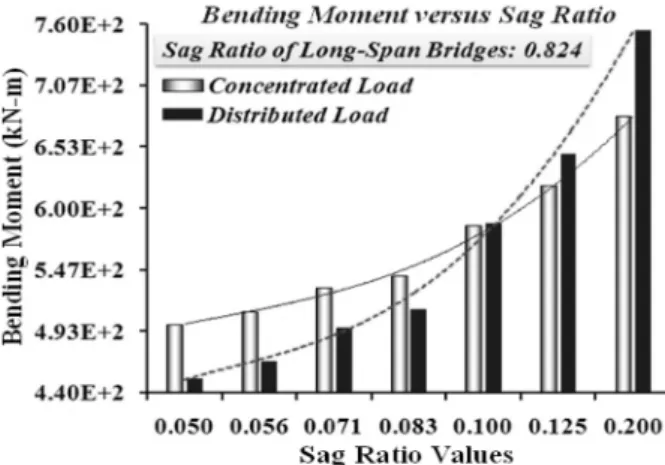
2.1 Reliability analysis with inherent uncertainitiesThe former analytical results was used to find the minimum LCC and the optimal design in this study. The analytical modeling of suspension bridge was performed using 379 nodes, 202 catenary cable elements, 174 3D frame elements, and 204 3D nodal connection elements8,9,10).Unlike ordinary bridges for which linear analysis was sufficient, the initial state of suspension bridge itself was greatly influenced by the nonlinearity of cable due to the self-weight. If a dead load was imposed on the catenary curve, the shape of cable becomes parabolic. The cable stiffness must be determined by conversely assuming the initial length of cable. After performing the initial shape analysis using the developed program8), that study determined the non-stress length of cable and cable stiffness. Fig. 1 illustrates the maximum bending moment of girder according to the change of sag ratio8).
The aspects of beta and pf were quantitatively estimated considering aleatory uncertainties included in structural capacities and applied loads. The dead load was calculated considering the weights of girder, pylon, cable and additional dead load. The concentrated load created a greater maximum bending moment than the distributed load (50kN/m) does with the sag ratio being 1/20~1/10,
Fig. 1. Maximum bending moment of girder by sag ratio.
but at sag ratios above 1/10, the bending moment created by the distributed load tends to become greater than that created by the concentrated load. Therefore, the numerical analysis was performed with the concentrated load of 460.0kN being applied at the center of main span for the completed system with a sag ratio of 0.0824(33.3m/404m).
The reliability analysis was conducted using the First Order Reliability Method (FORM). The random variables containing aleatory uncertainties in the ultimate strength, section modulus(cross section, moment of inertia) and design loads were assumed to have normal, log-normal and extreme (type I) distributions. The ultimate resistant strength was used 1600.0Mpa for the cable, whereas was used 320.0Mpa for the girder and pylon based on the former study8). The reliability analysis was performed by assuming that the coefficient of variation(bias factor) was 12.0%(1.12) for the ultimate resistant strength, 5.0%(1.00) and 2.0%(1.00) for the cross section and moment of inertia, 10.0%(1.05) for the dead load and 15.0%(1.08) for the live load and earthquake load11). The reliability analysis was conducted by computing the mean and the standard deviation of maximum member stress as a function of random variables using the limit state function as Eq. (1).
y p , g 33 z 33 p , g 22
22 p , g y
f c
) ( I
) ( c M ) ( I
) ( M ) ( A
) ( f P ) (
g g,p g,p
⋅
− ⋅
⋅
− ⋅
⋅
− ⋅
=
⋅
c y
f A()
) ( f T ) (
g c c
⋅
− ⋅
=
⋅ (1)
where,
c p , g ,f
f : stress of girder, pylon and main cable;
) (
P ⋅ : axial force of girder and pylon;
) ( M ), (
M22 ⋅ 33 ⋅ : bending moment of girder and pylon;
) (
T⋅ : tension of main cable;
c p , g ,A() ) (
A ⋅ ⋅ : cross section of girder, pylon and main cable;
p , g 33 p , 22()g , I ()
I ⋅ ⋅ : moment of inertia of girder and pylon;
z y,c
c : maximum distance from center of section;
p ,
yg
f
,yc
f
: the ultimate strengths of girder, pylon and cable.Fig. 2 demonstrates the pf of critical members (27th, 160thand 10thmember) by combined loads as the result of
Fig. 2. Safety index considering aleatory uncertainities.
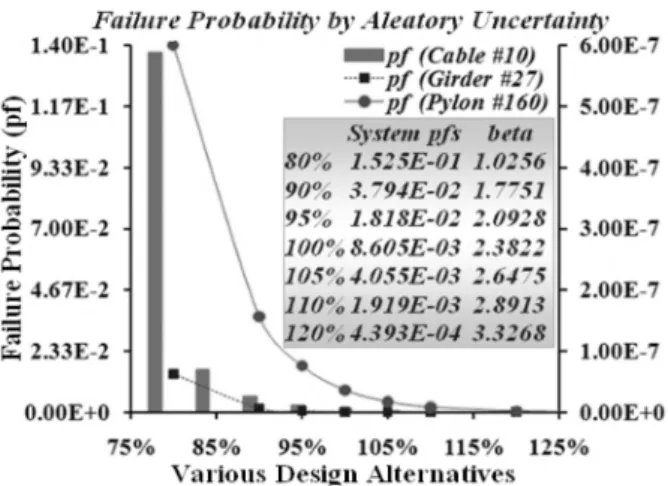
reliability analysis. The values on the left and right axes of Fig. 2 indicate the pf of girder and pylon and the pf of cable, respectively. The pf of critical members was calculated in the following manner: 27th membe (girder):
pf1 = 1.644E-04; 160thmember (pylon): pf2 = 8.442E-03;
10thmember(cable): pf3=1.071E-08. The pf of suspension bridge was calculated the union of the maximum pf of critical members (27th, 160th and 10th member) because the modeling of bridge was composed of series model.
The pf of critical members was assumed statistically independent2). Thus, the system pf and corresponding beta was evaluated as 8.605e-03 and 2.3822, respectively (Fig. 2).
2.2 Minimum LCC assessment for optimum design The target of structural design is to minimize the total investment cost while keeping up the safety during life cycle. The LCC analysis would provide the basic information in evaluating the reasonable optimal safety level in structural design. Generally, the LCC analysis has been applied to the design of bridges as well as to the maintenance of individual bridge networks. Maintenance cost can hardly be calculated by theoretical or logical manner in evaluating the minimum LCC. Thus, maintenance cost shall be estimated based on the analysis of existing investment cost or by statistically using a regression analysis. In this study, 10% of initial cost was considered in case of maintenance cost.
It is assumed to be in inverse proportion relation to variation of initial cost, based on the safety diagnosis report and maintenance cost execution report. The optimal safety level was examined to the beta when the expected
LCC becomes minimum. There are inevitable uncertainties contained such cost items as load or structural capacities, which have a great influence in the expected LCC. It is substantially both the uncertainty included in the structure and the uncertainty derived from incompleteness of human being. Initial cost includes design cost, construction cost and safety diagnosis cost before completion12). The initial cost can be decided corresponding to each design alternative as indicated in Table 1. In such an alternative, labor cost and general expense were assumed to be constant and material cost was only considered to be changed. Damage cost was composed of the slight or serious cost item and the accident cost, which mostly comprises the economic loss resulting from the loss of life and the traffic closed or limited. Generally, bridge collapse seldom occurs but it shall be reasonably considered when examining the damage cost. This composition factor of damage cost was based on related references6,7) and it is assessed by applying proportional coefficient to the initial cost as shown in Fig. 3.
In this process, as maintenance cost and damage cost are based on the present monetary value, future damage cost shall be estimated after multiplying the present worth factor. In this study, the life time of structure and annual discount rate were considered and the expected LCC of bridge can be calculated as Eq. (2).
(2)
Table 1. Initial cost of design alternatives(unit :dollar)
Various Design Alternatives Initial Cost Values 80-percentile
90-percentile 95-percentile Standard Design 105-percentile 110-percentile 120-percentile
164.56 177.65 182.36 187.00 196.35 205.70 233.75
Fig. 3. Contribution of various cost items.
where, E(LCC): expected life cycle cost;
EL: life-time of suspension bridges;
QCT: annual discount rate.
Fig. 4 shows the interrelation between beta and expected LCC of each design alternative. By the estimation result, expected LCC was decreased in line with increase in safety level and then turned to increase. Thus, minimum LCC (210.81 in million USD) and beta (2.382) of optimal safety level were estimated at inflection point when variation of damage cost begins to slow and variation of initial cost begins to increase.
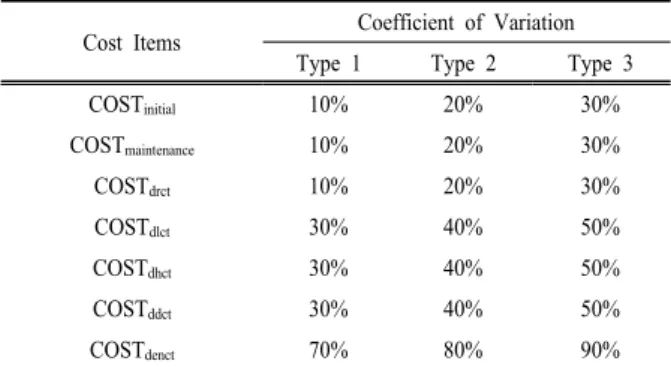
The effect of epistemic uncertainty shall be applied in each cost item for optimal design. Epistemic uncertainties in cost items, as aforementioned, were evaluated based on expert’s experience and adjudication. Table 2 arranges the epistemic uncertainties contained in each cost item for performing sensitivity assessment. The variance of damage cost was obtained with the information summarized in Table 1 and Fig. 3.
Fig. 4. Expected LCC versus safety index.
Table 2. Assumption of epistemic uncertainty for sensitivity analysis
Cost Items Coefficient of Variation Type 1 Type 2 Type 3
COSTinitial 10% 20% 30%
COSTmaintenance 10% 20% 30%
COSTdrct 10% 20% 30%
COSTdlct 30% 40% 50%
COSTdhct 30% 40% 50%
COSTddct 30% 40% 50%
COSTdenct 70% 80% 90%
Fig. 5. Cumulative percentile of minimum LCC.
The coefficient of variation of damage cost was estimated such as 0.210, 0.281 and 0.353, respectively.
Fig. 5 illustrates the cumulative-percentile for minimum LCC of optimal design, which considers epistemic uncertainties.
3. Conclusion
This study evaluated the optimal design of suspension bridge through the the LCC analysis based on the result of reliability analysis. The optimal design examined depending on expected LCC unlike the existing method based on initial cost while considering the maintenance cost and damage cost. It is evaluated to be the reasonable method, which enables to calculate the safety level and economical efficiency. Moreover, the high-percentile distribution of beta, pf and minimum LCC depending on epistemic uncertainties is expected to provide the reasonable basic information for a risk-averse (conservative) bridge design. The beta of optimal design which serves the criterion of safety level was estimated as 2.759~3.035(75%) and 3.078~3.631(90%). In addition, the minimum LCC of optimal design which is the criterion of economical efficiency was evaluated as 223.60~247.74(75%) and 234.93~282.94(90%) (in million USD). According to the assessment results, the structural design of current level was evaluated as the ideal optimal design for the objective bridge. However, as reviewed for sensitivity assessment, it is remarkable that the beta and minimum LCC optimal design may vary according to the assumption value of coefficient of variation by the effect of epistemic uncertainty.
Acknowledgements: The research was supported by a grant from the Academic Research Program of Korea National University of Transportation in 2014
References
1) C. A. Cornell, “A Probability-Based Structural Code”, J. of ACI, Vol. 66, No. 12, 1969.
2) A. H-S. Ang and W. H. Tang, “Probability Concepts in Engineering”, John Wiley & Sons, Inc. 2007.
3) S. H. Han and J. K. Park, “Practical Valuations on the Effect of Two Type Uncertainties for Optimal Design of Cable-stayed Bridges”, Int. J. of Steel Structures IJOSS, Vol. 9, No. 2, pp. 143-152, 2009.
4) M. Liu, Y. K. Wen and S. A. Burns, “Life Cycle Cost Oriented Seismic Design Optimization of Steel Moment Frame Structures with Risk-taking Preference”.
Engineering Structure, Vol. 26, No. 10, pp. 1407-1421, 2004.
5) K. M. Lee, H. N. Cho and C. J. Cha, “Life-cycle Cost-effective Optimum Design of Steel Bridges Considering Environmental Stress”, Engineering Structure, Vol. 28, No.
9, pp. 1252-1265, 2006.
6) S. H. Han and A.H-S. Ang, “Optimal Design of Cable-stayed Bridges Based on Minimum Life-cycle Cost”, IABMAS08 Conference, Seoul, Korea, 2008.
7) S. H. Han and M. S. Bang, “Probabilistic Optimal Safety Valuation Based on Stochastic Finite Element Analysis of Steel Cable-stayed Bridges”, Smart Structures and Systems; An International Journal, Techno-Press, Vol. 10, No. 2, pp. 89-110, 2012.
8) M. S. Bang, “A Study on Design and Construction Method for Long Span Bridges”, Report ID KICT/95-SE-111-64, 1995.
9) M. S. Bang, “The Safe Erection Method of Suspension Bridges by Construction Sequence Analysis”, J. of The Korean Society of Safety, Vol. 22, No. 6, pp. 55-62, 2007.
10) M. S. Bang, “Decision Method on Target Safety Level in Suspension Bridges by Minimization of LCC”, J. of The Korean Society of Safety, Vol. 24, No. 2, pp. 62-68, 2009.
11) A. S. Nowak and K. R. Collins, “Reliability of Structures”, McGraw-Hill, New York, 2000.
12) AH-S Ang and D, De Leon, "Modelling and Analysis of Uncertainties for Risk-informed Decisions in Infrastructure Engineering", Vol. 1, Issue. 1, pp. 19-31, 2005.