215
ABBREVIATIONS: IKr, rapidly-activating delayed rectifier K+ current;
hERG, human ether-a-go-go-related gene; APD90, action potential duration at 90% repolarization; APD, action potential duration.
Received May 21, 2009, Revised June 8, 2009, Accepted June 19, 2009
Corresponding to: Su-Hyun Jo, Department of Physiology, Kangwon National University College of Medicine, Hyoja-dong, Chuncheon 200-701, Korea. (Tel) 82-33-250-8824, (Fax) 82-33-255-8809, (E-mail) [email protected]
Block of hERG K
+Channel by Classic Histamine H
1Receptor Antagonist Chlorpheniramine
Hee-Kyung Hong, and Su-Hyun Jo
Department of Physiology, Institute of Bioscience and Biotechnology, Kangwon National University College of Medicine, Chuncheon 200-701, Korea
Chlorpheniramine is a potent first-generation histamine H1 receptor antagonist that can increase action potential duration and induce QT prolongation in several animal models. Since block of cardiac human ether-a-go-go-related gene (hERG) channels is one of leading causes of acquired long QT syndrome, we investigated the acute effects of chlorpheniramine on hERG channels to determine the electrophysiological basis for its proarrhythmic potential. We examined the effects of chlorpheniramine on the hERG channels expressed in Xenopus oocytes using two-microelectrode voltage-clamp techniques.
Chlorpheniramine induced a concentration-dependent decrease of the current amplitude at the end of the voltage steps and hERG tail currents. The IC50 of chlorpheniramine-dependent hERG block in Xenopus oocytes decreased progressively relative to the degree of depolarization. Chlorpheniramine affected the channels in the activated and inactivated states but not in the closed states. The S6 domain mutations Y652A and F656A partially attenuated (Y652A) or abolished (F656A) the hERG current block. These results suggest that the H1 antihistamine, chlorpheniramine is a blocker of the hERG channels, providing a molecular mechanism for the drug-induced arrhythmogenic side effects.
Key Words: Antihistamine, HERG channel, Chlorpheniramine, Rapidly-activating delayed rectifier K+ channel
INTRODUCTION
Antihistamines are among the most commonly prescribed drugs in the world and have evolved considerably since the first generation of compounds was introduced >50 years ago. The first generation antihistamines are lipid-soluble drugs widely used to treat allergic symptoms through the blocking of peripheral H1 receptors (Katzung, 2003). These drugs freely cross the blood-brain barrier and can affect the central nervous system (Goldberg et al., 1987; Katzung, 2003). The main side effects of these compounds are seda- tion, drowsiness and impaired performance, although anti- cholinergic and antiserotonergic effects may also be observed.
Chlorpheniramine, the p-chloro analogue of bromophenir- amine, is a potent first-generation antihistamine which has been available for medical use since 1951. Over the past 30 years, second-generation antihistamines have been de- veloped, which have less central activity and therefore do not cause the drowsiness. Overdose of both first- and sec- ond- generation antihistamines can cause severe cardiac ar- rhythmia (Hestand and Teske, 1977; Craft, 1986; Tagliala- tela et al., 2000) by directly inhibiting cardiac K+ currents (Taglialatela et al., 1999). These findings led us to hypothe- size that chlorpheniramine, one of first-generation antihist- amines, may exert arrhythmic effects by affecting K+ currents.
Among the various cardiac K+ currents, the rapidly- activating delayed rectifier K+ current (IKr) - mediated by an ion channel encoded by the human ether-a-go-go-related gene (hERG) - is important for the termination of the car- diac action potential and determines the shape of the re- polarization phase (Tie et al., 2000). Therefore, the aim of the present study was to investigate the possibility for an effect of chlorpheniramine on hERG channels and the mo- lecular determinants involved in the possible blocking effect of the drug using mutant hERG channels.
METHODS Expression of hERG in oocytes
hERG (accession no. U04270) cRNA was synthesized by in vitro transcription from 1 μg of linearized cDNA using T7 message machine kits (Ambion, Austin, TX, USA) and stored in 10 mM Tris-HCl (pH 7.4) at −80oC. The amino acid mutations where generated by polymerase chain reaction (PCR) with synthetic mutant oligonucleotide primers. The mutations Y652A and F656A were verified by sequencing (ABI3100). Stage V-VI oocytes were surgically removed from female Xenopus laevis (Nasco, Modesto, CA, USA) an- esthetized with 0.17% tricane methanesulphonate (Sigma, St. Louis, MO, USA). Using fine forceps, the theca and follicle layers were manually removed from the oocytes, and then
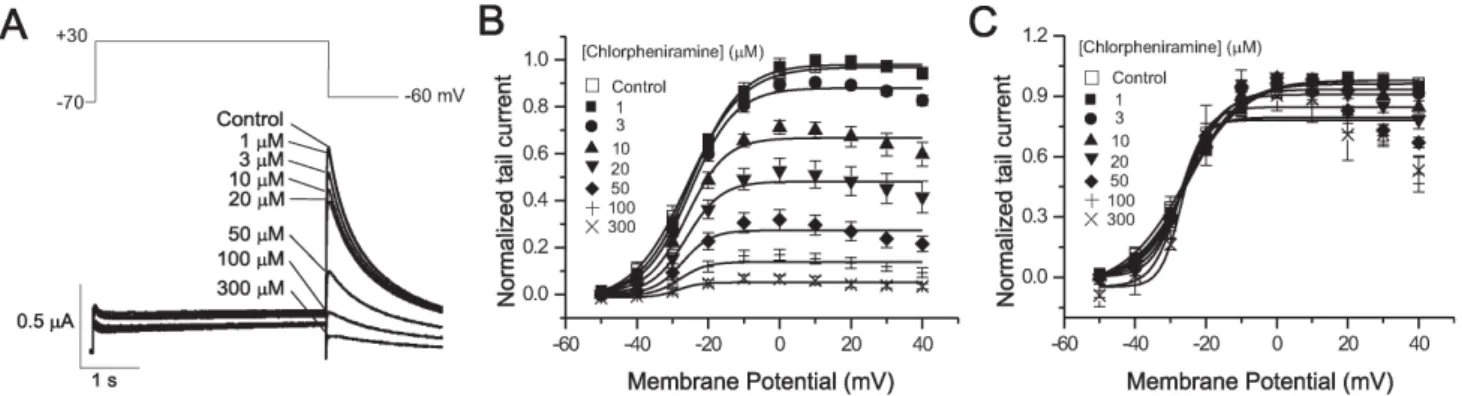
Fig. 1. The effect of chlorpheniramine on human-ether-a-go-go-related gene (hERG) currents (IHERG) elicited by depolarizing voltage pulses.
(A) Superimposed current traces elicited by depolarizing voltage pulses (4 s) to +30 mV steps (upper panel) from a holding potential of
−70 mV in the absence of chlorpheniramine (control) and in the presence of 1∼300 μM chlorpheniramine (lower panel). (B) Plot of the normalized tail current measured at its peak just after repolarization (n=6). The peak amplitude of the tail current in the absence of the drug was set as 1. Control data were fitted to the Boltzmann Equation, y=1/{1+exp[(−V+V1/2)/dx]}, with V1/2 of −25.7 mV. (C) Activation curves with values normalized to the respective maximum value at each concentration of chlorpheniramine. Symbols with error bars represent mean±S.E.M. (n=3∼5).
each oocyte was injected with 40 nl of cRNA (0.1∼0.5 μg/μl).
The injected oocytes were maintained in a modified Barth’s Solution. The modified Barth’s Solution contained (mM): 88 NaCl, 1 KCl, 0.4 CaCl2, 0.33 Ca(NO3)2, 1 MgSO4, 2.4 NaHCO3, 10 HEPES (pH 7.4), and 50 μg/ml gentamicin sulphonate. Currents were studied two to seven days after injection. This study was performed according to the Research Guidelines of Kangwon National University IACUC.
Solutions and voltage-clamp recordings from oocytes Normal Ringer’s Solution contained 96 mM NaCl, 2 mM KCl, 1.8 mM CaCl2, 1 mM MgCl2, and 10 mM HEPES (pH adjusted to 7.4 with NaOH). Solutions were applied to oo- cytes by continuous perfusion of the chamber while recording. Solution exchanges were completed within three min, and the hERG currents were recorded 5 min after the solution exchange. The effects of several concentrations of chlorpheniramine on the hERG currents were determined after the currents showed reversibility when washed with normal Ringer’s Solution. It took about 15 min to wash out
≤50 μM of the drug and about 30 min to wash out ≥100 μM of the drug. If the oocyte did not recover a current to its initial amplitude after 30 min of washing with a normal Ringer’s Solution, it was not used further. Currents were measured at room temperature (20∼23oC) with a two-mi- croelectrode voltage clamp amplifier (Warner Instruments, Hamden, CT, USA). Electrodes were filled with 3 M KCl and had a resistance of 2∼4 MΩ for voltage-recording elec- trodes and 0.6∼1 MΩ for current-passing electrodes.
Stimulation and data acquisition were controlled with an AD-DA converter (Digidata 1200, Axon Instruments) and pCLAMP software (v 5.1, Axon Instruments). The antihist- amine chlorpheniramine and other reagents were pur- chased from Sigma (St. Louis, MO, USA). A stock solution of chlorpheniramine was prepared in distilled water and added to the external solutions at suitable concentrations shortly before each experiment.
Pulse protocols and analysis
To obtain concentration-response curves in the presence
of chlorpheniramine, concentration-dependent inhibition was fitted with the equation:
Itail = Itailㆍmax / [1 + (IC50/D)n],
where Itail indicates peak tail currents, Itailㆍmax is the max- imum peak tail current, D is the concentration of the small molecule, n is the Hill coefficient, and IC50 is the concen- tration at which the half-maximal peak tail currents were inhibited.
Statistical evaluations
All data are expressed as mean±S.E.M. Unpaired or paired Student t tests, or ANOVA were used for statistical comparisons when appropriate, and differences were con- sidered significant at p<0.05.
RESULTS
Concentration-dependence of WT hERG channel block by chlorpheniramine
This study examined the effect of chlorpheniramine on hERG currents (IHERG) using a Xenopus oocyte expression system. Throughout these experiments, the holding poten- tial was maintained at −70 mV, and tail currents (Itail) were recorded at −60 mV after depolarizing pulses from
−50 to +40 mV (Fig. 1). Fig. 1A gives the representative current traces of a voltage-clamp recording obtained at −60 mV after depolarizing pulse to +30 mV both under the con- trol conditions and after exposure to 1∼300 μM chlorphe- niramine. After the depolarizing steps, repolarization to −60 mV induced an outward Itail, which had an amplitude even greater than that of IHERG during depolarization, which is due to rapid recovery from inactivation and a slow deactivation mechanism (Zhou et al., 1998). The amplitude of Itail showed a concentration-dependent decrease with increasing chlor- pheniramine concentration (Fig. 1A). The amplitude of Itail
was normalized to the peak amplitude obtained under the control conditions at the maximum depolarization, and was plotted against the potential of the step depolarization (n=6, Fig. 1B). The data obtained under the control con-
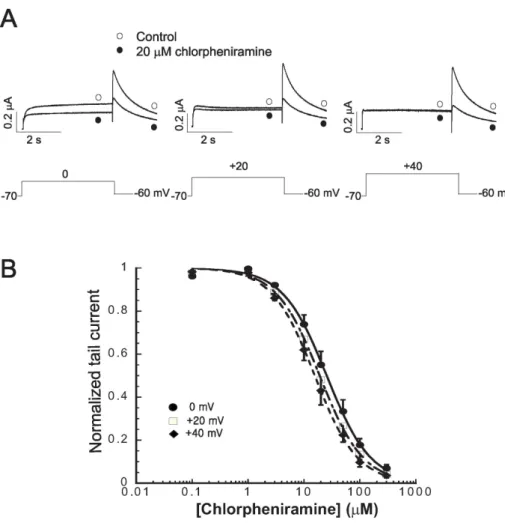
Fig. 2. Voltage dependence of chlor- pheniramine-induced hERG current block. (A) Current traces from a cell depolarized to 0 mV (left panel), +20 mV (middle panel) and +40 mV (right panel), before and after expo- sure to 20 μM chlorpheniramine, showing increased block of hERG current at more positive membrane potentials. The protocol consisted of 4 s depolarizing steps to 0 mV, +20 mV or +40 mV from a holding potential of −70 mV, followed by repolarization to −60 mV. (B) Con- centration-dependent block of IHERG
by chlorpheniramine at different mem- brane potentials. At each depolari- zing voltage step (0 mV, +20 mV or
+40 mV), the tail currents in the presence of various concentrations of chlorpheniramine were normalized to the tail current obtained in the absence of drug, and then plotted against chlorpheniramine concent- rations. Symbols with error bars re- present mean±S.E.M (n=6). The line represents the data fits to the Hill equation.
ditions were well-fitted by the Boltzmann Equation, with a half-maximal activation (V1/2) at −26.2 mV. The peak Itail
amplitude decreased with increasing chlorpheniramine con- centration, which indicates that the maximum conductance of the hERG channels is decreased by chlorpheniramine.
In addition, in the presence of chlorpheniramine, Itail does not reach the steady-state level but decreases at more pos- itive potentials, indicating that the blockade is more pro- nounced at the positive potentials.
The values shown in Fig. 1B were normalized to the re- spective maximum values at each concentration to de- termine if chlorpheniramine shifts the activation curve (Fig. 1C). The activation curves in the control oocytes, as well as those treated with 1, and 3 μM chlorpheniramine overlapped, whereas the curves representing the higher concentrations of the drug (10∼300 μM) were shifted downward without a significant leftward-shift. The V1/2 cal- culations are consistent with this finding, yielding values of −26.2±0.62 mV in the control group and, −25.0±0.63,
−25.1±0.77, −25.7±1.41, −26.0±.87, −27.2±2.67, −27.8±3.51, and −26.9±3.18 mV in the 1, 3, 10, 20, 50, 100 and 300 μM chlorpheniramine-treated groups, respectively (n=3∼5, p>
0.05). Therefore, the V1/2 values in the presence of 1∼300 μM chlorpheniramine were similar, indicating that chlorphe- niramine does not alter the activation gating at this concen- tration range.
Voltage-dependent block of WT hERG channel by chlorpheniramine
The chlorpheniramine-induced decrease in Itail at differ- ent potentials was compared in order to determine if the effect of chlorpheniramine was voltage dependent (Fig. 2A).
Concentration-response relationships were constructed at 0 mV, +20 mV and +40 mV. The percentage inhibition in the hERG current by 20 μM chlorpheniramine at 0, +10,
+20,+30, and +40 mV was 40.6±6.3%, 45.9±6.1%, 50.0±
5.8%, 52.1±5.8%, and 53.0±6.1%, respectively (n=6, data not shown). This suggests that the chlorpheniramine-induced blockade of the hERG currents progressively increases with increasing depolarization. Concentration-response relation- ships were constructed at +40 mV, +20 mV and 0 mV.
The data was modeled using the Hill equation (Fig. 2B), giving IC50 values of 25.5±1.09 μM, 19.2±0.59 μM and 15.6±
0.44 μM, respectively, and Hill coefficients of 1.10±0.05, 1.12±0.04 and 1.13±0.03 at 0 mV, +20 mV and +40 mV, respectively (n=6). These findings indicate that the chlor- pheniramine-induced blockade of the hERG current is volt- age-dependent.
Fig. 3. Blocking of activated hERG channels by chlorpheniramine. (A) An original recording of currents under control conditions (control) and after exposure to 50 μM chlorpheni- ramine (for 13 min, without any inter- mittent test pulse). (B) The degree of hERG-current inhibition in percen- tages (%). Current inhibition increased time-dependently to 76% at 1 s in this representative cell, indicating that mostly open and/or inactivated channels were blocked. (C) Inhibition of inactivated channels by 20 μM chlorpheniramine. hERG channels were inactivated by a first voltage- step to +80 mV, followed by channel opening at 0 mV. (D) The correspon- ding relative block during the 0 mV step is displayed. Maximum inhibi- tion was achieved in the inactivated state during the first step, and no further time-dependent block occurred upon channel opening during the second voltage step.
State-dependence of WT hERG channel block by chlorpheniramine
hERG currents were activated using a protocol contain- ing a single depolarizing step to 0 mV for 8 s to determine if the channel was blocked in the closed or activated (i.e.
open and/or inactivated) state (Fig. 3A). After obtaining the control measurement, 50 μM chlorpheniramine was ap- plied and the recordings were made. Fig. 3B shows the per- cent inhibition calculated by: (1-chlorpheniramine cur- rent/control current) ×100. Analysis of the test pulse after the application of chlorpheniramine revealed a time-de- pendent blockade; a representative cell showing 76% block at 1 s is shown in Fig. 3B. At the beginning of the pulse, the fractional sustained current, which was obtained by normalizing the currents with chlorpheniramine relative to control currents, was 0.83±0.03 of control (n=6). This in- dicates that the hERG channels were only slightly blocked by chlorpheniramine while remaining at the holding potential. In this series of experiments, 50 μM chlorphenir- amine reduced the hERG outward currents at the end of the 0 mV pulse by 68.2±3.7% (n=6).
In order to address the question as to whether the hERG channels are also blocked by chlorpheniramine in its in- activated state, a long test pulse to +80 mV (4 s) was ap- plied to inactivate the channels, which was followed by a second voltage step (0 mV, 3.5 s) to open the hERG channels (n=5). Fig. 3C shows typical current traces under the con- trol conditions and after the application of 20 μM chlor- pheniramine. Fig. 3D shows the normalized relative block- age upon channel opening during the second voltage pulse (0 mV), indicating that the pronounced inhibition of the
hERG channels had already been reached during the pre- vious inactivating +80 mV pulse. No additional time-de- pendent blockade of the open channels was observed during the 0 mV pulse. The currents at the end of the second voltage step (0 mV) were decreased by 37.3±4.3% (n=5). Overall, chlorpheniramine inhibits the hERG channels mainly in the open and inactivated state rather than in the closed state.
Chlorpheniramine block of WT and mutant hERG channels expressed in oocytes
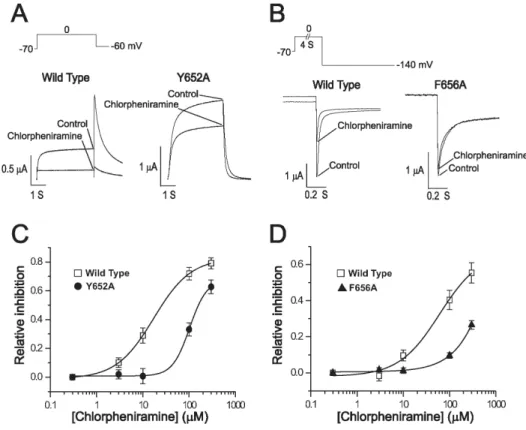
Previous studies reported that two aromatic residues, Tyr-652 and Phe-656, which are located in S6 domain and face the pore cavity of the channel, are important components of the binding site for a number of compounds (Sanchz- Chapula et al., 2002). The potency of a channel block for the wild type and two mutant hERG channels (Y652A and F656A) were compared in order to determine if these key residues are also important in the chlorpheniramine- induced blocking of the hERG channel. As shown in Fig. 4, the inhibitory effect of chlorpheniramine (100 μM) was par- tially attenuated by a Y652A mutation (panel A) or abol- ished by an F656A mutation (panel B). The IC50 values were consistent with this finding. The IC50 values were 17.1±0.1 μM (n=5) in WT (obtained using protocol of panel A), 102.7±27.7 μM (n=7) in Y652A mutant channels, 61.1±
37.8 μM (n=7) in WT (obtained using protocol of panel B), and 2,153.2±3.1 μM (n=7) in F656A mutant hERG channels (panel C, D). This indicates that a mutation of Phe-656 lo- cated in the S6 domain of the hERG channel reduced the potency of the channel block by chlorpheniramine more than a mutation of Tyr-652 in the same region.
Fig. 4. Concentration-dependent inhi- bition of WT and mutant hERG channels expressed in oocytes. (A, B) Representative traces for WT and mutant HERG channel currents in the presence and absence of indi- cated concentrations of chlorpheni- ramine. The effect of the drug on WT and Y652A was quantified during a 4 s activating pulse to 0 mV from a holding potential of −90 mV. To increase the amplitude of poorly expressed F656A mutant channels, tail currents were recorded at −140 mV instead of −60 mV after the 4 s activating pulses. (C, D) The concent- ration-response curves were fitted with a logistic dose-response equation to obtain the IC50 values of 17.1±0.1 μM (n=5), 102.7±27.7 μM (n=7), 61.1±
37.8 μM (n=7), and 2,153.2±3.1 μM (n=7) in WT (obtained using protocol of panel A), Y652A, WT (obtained using protocol of panel B), and F656A HERG channels, respectively.
The potency of chlorpheniramine block was reduced in the mutant channels. Data were expressed as mean±S.E.M..
DISCUSSION
The results of this study suggest that chlorpheniramine inhibits hERG channels expressed heterologously in Xenopus oocytes. A relatively high extracellular concentration of the drug was required to block the hERG channels, with an IC50 value of ~20 μM (at +40 mV). This may be due to the properties of the Xenopus oocyte-expression system.
The concentration of chlorpheniramine at the cell mem- brane may be decreased by the vitelline membrane and egg yolk. The block of hERG by trifluoperazine (Choi et al., 2005) resulted in IC50 values 10 times higher when the drug was applied to Xenopus oocytes rather than to mammalian cells. Therefore, the putative IC50 value for the block of hERG channels by chlorpheniramine in mammalian cells such as human embryonic kidney (HEK) and cardiomyo- cytes might be in the range of ∼2 μM.
The therapeutic plasma concentrations of chlorphenir- amine typically range from 12.5 to 30 nM (Tagawa et al., 2001; Tagawa et al., 2002), The toxic plasma concentrations of chlorpheniramine has been shown to be 500 nM in the case report, which is ~10 times greater than the mean peak plasma level measured after a single therapeutic dose (Baselt and Cravey, 1995). Blood concentrations reported in two overdose fatalities were 1.25 and 2.75 μM (Reed, 1981; Baselt and Cravey, 1995). In guinea pig isolated pap- illary muscle, chlorpheniramine prolonged the action poten- tial duration at 90% repolarization (APD90) at 1 μM (Ki et al., 1996). Also, the rapid and extensive uptake of chlorphe- niramine by various organs was reported in a rabbit model, with concentrations 30∼160 fold higher in the lung, kidney and brain than the blood plasma level (Huang and Chiou, 1981). It has been suggested that drugs with an IC50 at least 30 times greater than the highest achievable free plasma
concentration will not cause torsades de pointes, a potentially fatal ventricular tacharrhythmia (Redfern et al., 2003). In this context, chlorpheniramine could cause ventricular ar- rhythmia by blocking the hERG channel in overdose.
Otherwise, chlorpheniramine could make the heart prone to fatal arrhythmia when it is used in conjunction with other drugs; indeed, case reports of life-threatening prolongation of QTc and QRS complex, as well as polymorphic ventricular tachycardia have been reported in the combinational use of chlorpheniramine with other compounds (Hung and Chang, 2006; Venkatraman et al., 2008).
This report shows that chlorpheniramine decreases the amplitudes of the maximum outward current and max- imum peak tail current (Fig. 1). Moreover, the magnitude of the block was enhanced with increasing positive voltage, which increased the open probability and enhanced in- activation (Fig. 2). In addition, chlorpheniramine block may be state-dependent: the hERG channels are blocked mainly in the open and inactivated states but not in the closed state (Fig. 3). Finally, chlorpheniramine did not sig- nificantly alter the V1/2 values of the activation curve, which suggests that the drug blocks the hERG channels without altering the activation properties (Fig. 1). In view of such a voltage-dependence of chlorpheniramine block of the hERG channels, the drug may well increase the action po- tential duration (APD) and make the heart more prone to arrhythmia, particularly under the pathological conditions associated with rapid heart actions and partially depolar- ized membranes.
It is known that hERG mRNA are abundantly present in the brain as well as in the heart (Wymore et al., 1996).
The role of hERG channels in neuronal cells has been im- plicated in the regulation of the resting membrane poten- tial, the cell cycle, the neurite outgrowth, and the spike-fre-
quency adaptation (Arcangeli et al, 1993; Arcangeli et al., 1995; Chiesa et al., 1997), Therefore, the hERG channel block by chlorpheniramine could change neural conduction activity and neuronal cell differentiation.
A large number of drugs from a range of classes, includ- ing antihistamines, antipsychotics, antiarrhythmics, anti- biotics and gastrointestinal prokinetic agents, have been shown to block the hERG channels. It has been reported that the non-sedating histamine receptor antagonists, terfe- nadine and astemizole, inhibit hERG channels at nano- molar concentrations in a use- and voltage-dependent man- ner (Suessbrich et al., 1996). It has been shown that the inner cavity of the hERG channels is larger than that in the other voltage-gated K+ channels, and can accommodate a wide range of chemical structures (Mitcheson, 2003).
Particularly, the two aromatic residues in the S6 trans- membrane domain, Tyr-652 and Phe-656, have been shown to be important because they could interact with structurally diverse drugs through hydrophobic interactions (Mitcheson et al., 2000). The present results (Fig. 4) indicate that muta- tions of the protein channel pore, Y652A and F656A, sig- nificantly attenuate the drug-induced hERG block, showing the direct action of chlorpheniramine on hERG channels.
In conclusion, chlorpheniramine, the H1-receptor anti- histamine, blocks the hERG channels underlying IKr when expressed in Xenopus oocytes. The inhibition of the channel shows voltage-, time- and state-dependencies; residues Tyr- 652 and Phe-656 in the S6 domain are also important mo- lecular determinants for the blocking interaction. Although the IC50 value for the blocking effect of chlorpheniramine for the hERG channel is a supra-therapeutic concentration, we have nevertheless shown that a conventional antihist- amine could decrease IKr, which may contribute to drug-in- duced ventricular tachyarrhythmia.
ACKNOWLEDGEMENTS
This study was supported by the Korea Research Founda- tion Grant funded by the Korean Government (MOEHRD) (KRF-2008-313-D00543).
REFERENCES
Arcangeli A, Becchetti A, Mannini A, Mugnai G, De Pilippi P, Tarone G, Del Bene MR, Barletta E, Wanke E, Olivotto M.
Integrin-mediated neurite outgrowth in neuroblastoma cells depends on the activation of potassium channels. J Cell Biol 122:
1131−1143, 1993.
Arcangeli A, BIanchi L, Becchetti A, Faravelli L, Coronnello M, Mini E, Olivotto M, Wanke E. A novel inward-rectifier K+ current with a cell-cycle dependence governs the resting potential of mammalian neuroblastoma cells. J Physiol (Lond) 489: 455−
471, 1995.
Baselt R, Cravey R. Disposition of toxic drugs and chemicals in man.
4th ed. Foster City, CA: Chemical Toxicology Institute, 1995.
Chiesa N, Rosati B, Arcangeli A, Olivotto M, Wanke E. A novel role for HERG K+ channels: spike-frequency adaptation. J Physiol (Lond) 501: 313−318, 1997.
Choi SY, Koh YS, Jo SH. Inhibition of human ether-a-go-go-related gene K+ channel and IKr of guinea pig cardiomyocytes by antipsychotic drug trifluoperazine. J Pharmacol Exp Ther 313:
888−895, 2005.
Craft TM. Torsade de pointes after astemizole overdose. Br Med J 292: 60, 1986.
Goldberg MJ, Spector R, Chiang CK. Transport of diphenhydra-
mine in the central nervous system. J Pharmacol Exp Ther 240:
717−722, 1987.
Hestand HE, Teske DW. Diphenhydramine hydrochloride intoxi- cation. J Pediatr 90: 1017−1018, 1977.
Huang SM, Chiou WL. Pharmacokinetics and tissue distribution of chlorpheniramine in rabbits after intravenous administration.
J Pharmacokinet Biopharm 9: 711−723, 1981.
Hung YM, Chang JC. Weight-reducing regimen associated with polymorphic ventricular tachycardia. Am J Emerg Med 24: 714−
716, 2006.
Katzung BG. Histamine, Serotonin, and the ergot alkaloids. Basic and Clinical Pharmacology, 9th ed, McGraw-Hill, San Francisco, p263−268, 2003.
Ki I, Inui A, Ito T. Effects of histamine H1 receptor antagonists on action potentials in guinea-pig isolated papillary muscles.
Arch Int Pharmacodyn Ther 331: 59−73, 1996.
Mitcheson JS. Drug binding to HERG channels: evidence for a
"non-aromatic" binding site for fluvoxamine. Br J Pharmacol 139: 883−884, 2003.
Mitcheson JS, Chen J, Lin M, Culberson C, Sanguinetti MC. A structural basis for drug-induced long QT syndrome. Proc Natl Acad Sci USA 97: 12329−12333, 2000.
Redfern WS, Carlsson L, Davis AS, Lynch WG, MacKenzie I, Palethorpe S, Siegl PK, Strang I, Sullivan AT, Wallis R, Camm AJ, Hammond TG. Relationships between preclinical cardiac electrophysiology, clinical QT interval prolongation and torsade de pointes for a broad range of drugs: evidence for a provisional safety margin in drug development. Cardiovasc Res 58: 32−45, 2003.
Reed D. A fatal case involving chlorpheniramine. Clin Toxicol 18:
941−943, 1981.
Sànchez-Chapula JA, Navarro-Polanco RA, Culberson C, Chen J, Sanguinetti MC. Molecular determinants of voltage-dependent human ether-a-go-go related gene (HERG) K+ channel block. J Biol Chem 277: 23587−23595, 2002.
Suessbrich H, Waldegger S, Lang F, Busch AE. Blockade of HERG channels expressed in Xenopus oocytes by the histamine receptor antagonists terfenadine and astemizole. FEBS Lett 385:
77−80, 1996.
Tagawa M, Kano M, Okamura N, Higuchi M, Matsuda M, Mizuki Y, Arai H, Fujii T, Komemushi S, Itoh M, Sasaki H, Watanabe T, Yanai K. Differential cognitive effects of ebastine and (+)- chlorpheniramine in healthy subjects: correlation between cognitive impairment and plasma drug concentration. Br J Clin Pharmacol 53: 296−304, 2002.
Tagawa M, Kano M, Okamura N, Higuchi M, Matsuda M, Mizuki Y, Arai H, Iwata R, Fujii T, Komemushi S, Ido T, Itoh M, Sasaki H, Watanabe T, Yanai K. Neuroimaging of histamine H1- receptor occupancy in human brain by positron emission tomography (PET): a comparative study of ebastine, a second- generation antihistamine, and (+)-chlorpheniramine, a classical antihistamine. Br J Clin Pharmacol 52: 501−509, 2001.
Taglialatela M, Castaldo P, Pannaccione A, Giorgio G, Genovese A, Marone G, Annunziato L. Cardiac ion channels and antihista- mines: possible mechanisms of cardiotoxicity, Clin Exp Allergy 29: 182−189, 1999.
Taglialatela M, Timmerman H, Annunziato L. Cardiotoxic potential and CNS effects of first-generation antihistamines. Trends Pharmacol Sci 21: 52−56, 2000.
Tie H, Walker BD, Valenzuela SM, Breit SN, Campbell TJ. The heart of psychotropic drug therapy. Lancet 355: 1825, 2000 Venkatraman N, O'Neil D, Hall AP. Life-threatening overdose with
lamotrigine, citalopram, and chlorpheniramine. J Postgrad Med 54: 316−317, 2008.
Wymore RS, Gintant GA, Wymore RT, Dixon JE, Mckinnon D, Cohen IS. Tissue and species distribution of mRNA for the IKr-like K+ channel, erg. Circ Res 80: 261−268, 1996.
Zhou Z, Gong Q, Ye B, Fan Z, Makielski JC, Robertson GA, January CT. Properties of HERG channels stably expressed in HEK 293 cells studied at physiological temperature. Biophys J 74: 230−
241, 1998.