
Effects of Sweet Bee Venom on the Central Nervous System in Rats -using the Functional Observational Battery-
27
0
0
전체 글
(2) 20. Journal of Pharmacopuncture 제 14권 제 3호( 2011년 9월). I. 서론. Sweet BV. 2. Apis melifera. 2.1 Sprague-Dawley SD rat. 106.7. 139.1g. 5. rat 1 anaphylactic shock Bee Venom Sweet BV 40-50 melittin. 10-0744755. melittin. Sweet BV. Sweet Sweet BV 2840 gel filtration. rat. 1. Appendix 2 20.3 23.6 40.5 58.5 Teklad Certified Irradiated Global 18 Protein Rodent Diet 2918C 2005-79 Good Laboratory Practice GLP. 2.2 36. Sweet BV. 32 8. rat battery. Sweet BV Functional observational. FOB. II. 재료 및 방법. 2.3 1 Sweet BV 60. 4. 0.1 0.007 100 0.7 0.175 0.35 Sweet BV normal saline. 1 Sweet BV 0.2 LA230S, CP323S, Sartorius, Germany Normal Saline vortex mixer 0.875, 1.75 3.5. 2. 4. 0.4. 1.
(3) 21. 3. 3.1 1 1. 1. data type: quantitative value way analysis of variance ANOVA p 0.05. 1. 2. Dunnett's tp 0.05 p 0.01 data type: rank Kruskal-Wallis p 0.05 Steel s. test. 1. test. 3.2. One-. 1 test. III. 결과 4. 1 4.1 1. 1. Sweet BV 0. 0.5, 1, 2. 4 Table 1-2. 4.2 Functional observational battery, FOB 1 2 2 Methods and criteria for evaluation of functional observational battery Attachment home cage open field hand held. 50 10 dB. 2. Home cage 0.175, 0.35 0.7 Sweet BV body posture behavior ease of removal from cage 0 0.5, 1, 2 4 Table 3-1, Appen -dix 3-1. 30 white noise 3. Open field parameters 0.175 2 counts. Sweet BV p 0.05 0.5. rearing p 0.01. 5. number of urine pools parameter SAS Ver. 9.1.3, SAS Institute Inc., U.S.A.. p 0.01. 0.
(4) Journal of Pharmacopuncture 제 14권 제 3호( 2011년 9월). 22. respiration rate stereotypy unusual behavior tremor convulsion gait arousal level number of fecal pellets 0.35 2 2. Sweet BV p 0.01 p 0.05. aerial righting reflex hindlimb landing foot splay forelimb grip strength hindlimb grip strength 0 0.5, 1, 2 4 Table 3-4, Appendix 3-4. 0.5 6. 0.175 0.35 rectal temperature 1, 2 4. 0.7 0.5. Sweet BV p 0.01. 0.7. Sweet BV 0. 0.5,. Sweet BV p 0.05. 1. Table 3-5, Appendix 3-5 Table 3-2, Appendix 3-2. IV. 고찰 4. Hand held 0.175, 0.35. 0.7. Sweet BV fur and skin appearance piloerection soiled lower abdominal region lacrimation salivation palpebral closure pupil size pupillary reflex muscle tone extensor-thrust reflex 0 0.5, 1, 2 4 Table 3-3, Appendix 3-3. 4. 3. testing protocol guideline 5. 0.175, 0.35 0.7 visual response click response. Sweet BV touch response tail pinch response. GLP.
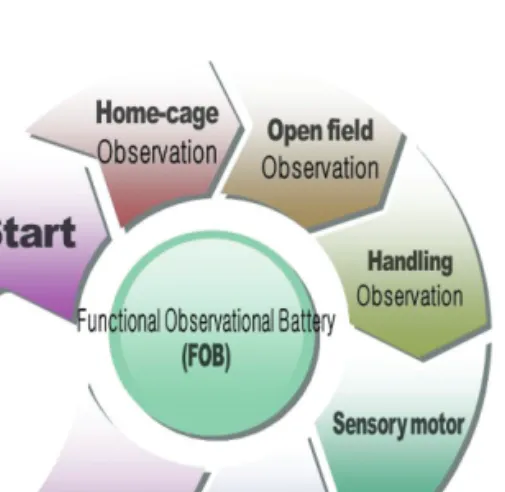
(5) 23. 4. Functional observational battery, FOB FOB. Fig 2. The practical aspect of functional observational battery(FOB) The FOBs were conducted by trained observers working together in pairs; apart from two persons being required for several of the tests within the FOB, this also enabled a consensus view of any equivocal observations.. 30 ICHS7A FOB. home cage home cage. FOB Apis melifera. rat. center circle open field activity, sensorimotor reflex test/physiological measurements Fig. 1-2. 40. onidase. phospholipase A2 PLA2 histamine. hyalurmelittin. Fig 1. The process of functional observational battery(FOB) The sequence of observations in the FOB is consist of five parameter. The parameter is next follows; home cage observations, home cage removal and handling, open field activity, sensorimotor reflex test/physiological measurements and observations throughout FOB.. Sweet BV. B. NF- B. melittin nuclear factorlipopolysaccharide.
(6) Journal of Pharmacopuncture 제 14권 제 3호( 2011년 9월). 24. LPS tumor necrosis factor- TNFum nitroprusside SNP melittin 4. sodi-. 0. 0.7. Sweet BV 0.07. melittin. 0.1. 0.4. 0.007 Sweet BV melittin 50-100. Sweet BV human 60 SD 0.175, 0.35 0.7. FOB. Sweet BV Sweet BV 0.175. FOB 0.175 BV. Sweet. 2. V. 결론. 0.5 0 parameters 0.35 Sweet BV 2 0.5. FOB rat. Sweet BV. 2 parameters 0.7 Sweet BV 0.5 parameters 0.175, 0.35 0.7 0.5. BV. Sweet BV. 1. Home cage Sweet 2. Open field. Sweet BV. Sweet BV. 3. Hand held. 4. Sweet BV rat. Sweet BV. 50. 5.. Sweet BV. 100 0.175. Sweet BV. Sweet BV.
(7) 25. VI. References 1. Academic committee of KPI. Pharmacopuncturology. Elsevier Korea. 2008;167-199. 2. Kwon KR, Koh HK. An Experimental Study with Bee Venom Therapy on Anti-inflammatory and Analgesic Effects. The Journal of Korean Acupuncture & Moxibustion Society. 1998;15(2): 97-103. 3. Ko HK. Experimental Studies on the Effect of Bee Venom Theraphy on the Analgesic, Antipyretic and Anti-inflammatory Action. Korean Journal of Oriental Medicine. 1992;13(1):283-292. 4. Kwon KR, Koh HK, Kim YS, Park YB, Kim CH, Kang SK, The Effect of Bee Venom Aqua -acupuncture on the Antitumor and Immune Response in the Epithelioma by 3 - MCA. The Journal of Korean Acupuncture & Moxibustion Society. 1997;14(2):151-172. 5. Lee SN, Hong SY, Jo HC, Byeon IJ, Song HS,. Kim GH, The Clinical Study on Bee Venom Acupuncture Treatment on Osteoarthritis of Knee Joint. The Journal of Korean Acupuncture & Moxibustion Society. 2003;20(5):73-8. 6. Wang WH, Ahn KB, Lim JK, Jang HS, Clincal Investigation Compared with the Effects of the Bee Venom - Acupuncture on Knee Joint with Osteoarthritis. The Journal of Korean Acupuncture & Moxibustion Society. 2001;18(3):35-47. 7. Kim TH. Kang KS, Kwon KR. Three cases of affections of the hip treated with Korean BeeVenom therapy. Journal of Korean Pharmacopuncture Institute. 2001;4(3):122-130. 8. Lee SH, Lee HJ, Baek YH, Kim SY, Park JK, Hong SJ, Yang HI, Kim KS, Lee JD, Choi DY, Lee DI. Effects of Bee Venom on the pain,. edema, and acute inflammatory reactant of Rheumatoid Arthritis patients. The Journal of Korean Acupuncture & Moxibustion Society. 2003;20(2):77-84. 9. Lee SH, Hong SJ, Kim SY, Yang HI, Lee JD, Choi DY, Lee DI, Lee YH. Randomized Controlled Double Blind Study of Bee Venom Therapy on Rheumatoid Arthritis. The Journal of Korean Acupuncture & Moxibustion Society. 2003;20(6):80-88. 10. Kim KU, Seo BM, Yun JS, Lee YK, Choi SH, Lee KM, Lim SC, Seo JC, Jung TY, Han SW. The Comparison of Bee Venom Herbal-acupuncture Therapy between Neighboring Acupuncture Points and Neighboring-Remote Acupuncture Points on the Treatment of Lumbar Spine Herniation of Nucleus Pulpous. The Journal of Korean Acupuncture & Moxibustion Society. 2005;22(6):181-187. 11. Lee KM, Lee KS, Yem SC, Jang JH, Yun JY, Hwang BC, Kug YS, Jang JY, Choi JS, Kim YJ, Park JU. A Clinical study of Bee-venom acupuncture treatment on protrusion disc Patients. The Journal of Korean Acupuncture & Moxibustion Society. 2004;21(5):13-25. 12. Jun HJ, Hwang U, Kim JS, Nam SS, Kim YS. Clinical Evaluation of Herniation of nucleus purposus patients treated by Bee venom therapy. The Journal of Korean Acupuncture & Moxibustion Society. 2003;20(5):63-72. 13. Lee DY, Lee KM, Yeom SC, Kim DH, Kim DJ. A Clinical Study of Bee Venom Acupuncture Therapy on Shoulder Pain Patients in Stroke Sequelae. The Journal of Korean Acupuncture & Moxibustion Society. 2006;23(4):69-80. 14. Jeoung KS, Kim SH, Park SK, Lim HJ, Yoon HS, Ahn HJ. Clinical Study on the Effect of Bee Venom Acupuncture Therapy on the Poststroke Pain. The Journal of Korean Acupuncture & Moxibustion Society. 2005;22(3):69-75. 15. Choi YC, Kwon KR, Choi SH. Purification of.
(8) 26. Journal of Pharmacopuncture 제 14권 제 3호( 2011년 9월). Peptide Components including Melittin from Bee Venom using gel filtration chromatography and propionic acid/urea polyacrylamide gel electrophoresis. Journal of Pharmacopuncture. 2006;9(2):105-112. 16. Barbara & Rudolf. Chemistry and Pharmacology of Honey Bee venom. Academic Press. 1986;329-402. 17. Park HJ, Lee SH, Son DJ, Oh KW, Kim KH, Song HS, et al. Antiarthritic effect of Bee Venom. Arthritis & Rheumatism. 2004;50(11):3504-3515. 18. Park HJ, Lee HJ, Choi MS, Son DJ, Song HS, Song MJ, et al. JNK pathway is involved on the inhibition of inflammatory target gene expression and NF- B activation by melittin. J. Inflammation. 2008;5(7):1-13. 19. Kim YJ, Lim CS, Kwon KR. Study of single dose test of Sweet Bee Venom in rats. Journal of Pharmacopuncture. 2009;12(4):5-32. 20. 200560 21. Irwin, S. Comprehensive behavioural assessment; A systematic quantitative procedure for assessing the behavioural and physiologic state of the mouse. Psychopharmacologia: 1968;13:222-257. 22. 1993;9-10, 185-186. 23. 200856 24. Redfern W.S., Wakefield I.D., Prior H., Pollard C.E., Hammond T.G., & Valentin J.P. Safety pharmacology-a progressive approach. Fundamental and Clinical Pharmacology. 2002;16:161-173. 25. Moser V.C., McCormick J.P., Creason J.P., and MacPhail R.C. Comparison of chlordimeform and carbaryl using a functional observational battery. Fundam. Appl. Toxicol. 1988;11:189-206.. 26. Anon. ICHS7A-Note for Guidance on Safety Pharmacology Studies for Human Pharmaceuticals. European Agency for the Evaluation of Medicinal Products, Committee for Proprietary Medicinal Products(CPMP), London, UK. Reference CPMP/ICH/539/00. 2000. 27. Hwang YJ, Lee BC. Clinical Study of Anaphylaxis on Bee-Venom Acupuncture. The Journal of Korean Acupuncture & Moxibustion Society. 2000;17(4):149-159. 28. Youn HM. The Clinical Observation of Anaphylaxis on Bee-Venom Acupuncture. The Journal of Korean Acupuncture & Moxibustion Society. 2005;22(4):179-188. 29. Kwon KR, Chu CS, Park HS, Kim MK, Cha BC, Lee E. Experimental studies of quantitative evalution using HPLC and safety of Sweet Bee Venom. Journal of Pharmacopuncture. 2007;10(2):81-86. 30. Kwon KR, Choi SH, Cha BC. Component Analysis of Sweet BV and Clinical Trial on Antibody Titer and Allergic Reactions. Journal of Pharmacopuncture. 2006;9(2):79-86. 31. Lee JS, Lee JY, Kwon KR, Lee HC. A Study on Allergic response between Bee Venom and Sweet Bee venom Pharmacopunture. Journal of Pharmacopuncture. 2006;9(3):61-77. 32. Renata MS, Jorge A, Hugo V. Structural and functional behavior of biologically active monomeric melittin. J. Molecular Graphics and Modelling. 2007;25:767-772..
(9) 27.
(10) 28. Journal of Pharmacopuncture 제 14권 제 3호( 2011년 9월).
(11) 29.
(12) 30. Journal of Pharmacopuncture 제 14권 제 3호( 2011년 9월).
(13) 31.
(14) 32. Journal of Pharmacopuncture 제 14권 제 3호( 2011년 9월).
(15) 33.
(16) 34. Journal of Pharmacopuncture 제 14권 제 3호( 2011년 9월).
(17) 35.
(18) 36. Journal of Pharmacopuncture 제 14권 제 3호( 2011년 9월).
(19) 37.
(20) 38. Journal of Pharmacopuncture 제 14권 제 3호( 2011년 9월).
(21) 39.
(22) 40. Journal of Pharmacopuncture 제 14권 제 3호( 2011년 9월).
(23) 41.
(24) 42. Journal of Pharmacopuncture 제 14권 제 3호( 2011년 9월).
(25) 43.
(26) 44. Journal of Pharmacopuncture 제 14권 제 3호( 2011년 9월).
(27) 45.
(28)
수치
관련 문서
Objectives: This study aims to report the effects of Korean medicine treatment by pattern identification and Sweet Bee Venom Pharmacopuncture on Chronic
Key words: Raynaud’s disease, Gamiguibi-tang (가미귀비탕), sweet bee venom, cooling rewarming ratio (CRR), numeric rating scale (NRS), digital infrared thermographic
Purpose : This research was conducted to investigate the effect of sweet bee venom pharmacopuncture and low level laser acupuncture on paw edema, pain index,
A Clinical Study on the Effects of Sweet Bee Venom Herbal Acupuncture for Patients with Whiplash Injury. Journal of Korean
needle-embedding therapy was performed for group A three times a week dividing face into three areas during 4 weeks and Sweet bee venom pharmacopuncture therapy was performed
These patients were randomly divided into four groups : the group treated with acupuncture, the group cotreated with acupuncture and sweet bee venom
Conclusions It seems that there are no big different treatment effects between the two groups. Sweet Bee Venom Pharmacopuncture appears to be more effective measurement
Effects of Sweet BVmelittin on tidal volume in rats Values are mean S.D., N=6 No statistically significant differences were noted in the control group G1 and the test substance group
