․투고일: 2017.08.22, 심사일: 2017.10.28, 게재확정일: 2017.10.27
․교신저자: 김영균 부산시 부산진구 양정로 62 동의대학교부속한방병원
TEL: 051-850-8620 FAX: 051-867-5162 E-mail: [email protected]
봉약침 치료와 병행한 가미귀비탕으로 호전된 레이노병 환자 치험 1례
이명화, 손변우, 김경민, 김영균 동의대학교 부속한방병원 한방내과
A Case Report on the Effects of Gamiguibi-tang Combined with Sweet Bee Venom to Improve Raynaud’s Disease
Myeong-hwa Lee, byeon-woo Son, Kyoung-min Kim, Young-kyun Kim Dept. of Internal Medicine, Dong-Eui University Korean Medical Hospital
ABSTRACT
Objectives: The aim of this study was to report the clinical effects of a combination of Gamiguibi-tang and sweet bee venom on a patient with Raynaud’s disease.
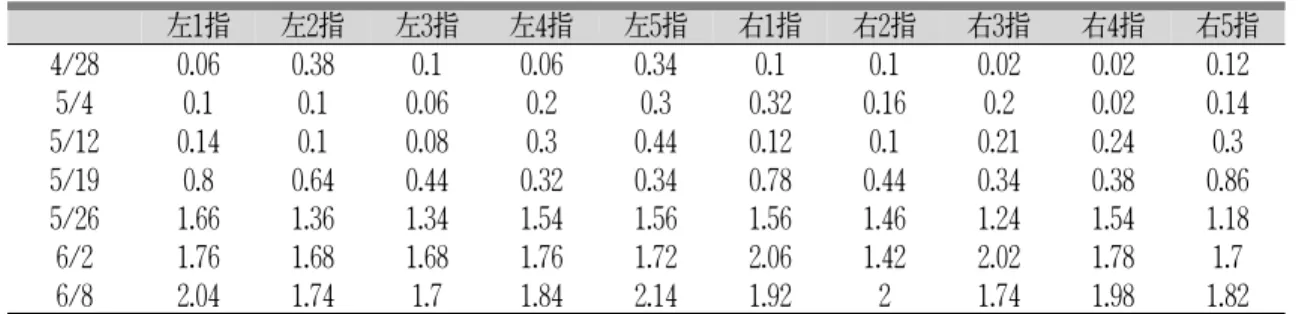
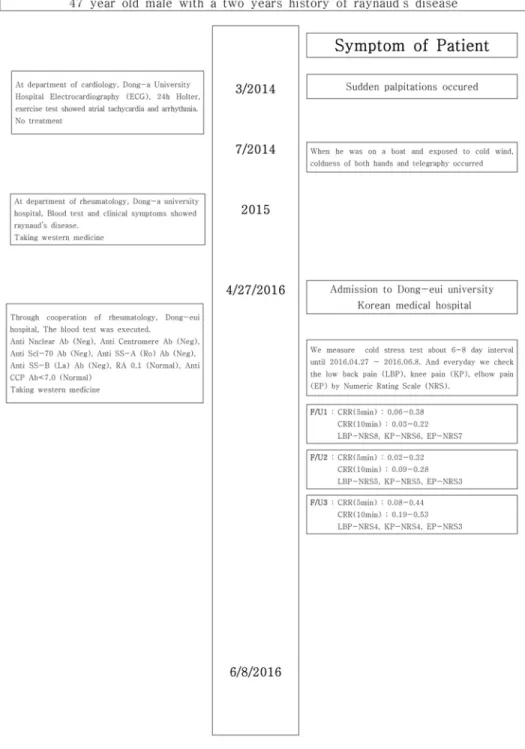
Methods: The patient with Raynaud’s disease was treated with Gamiguibi-tang three times a day for 43 days and with sweet bee venom daily. The effects on Raynaud’s disease were measured on both hands using a cold stress test and an infrared thermometer and by digital infrared thermographic imaging and a NRS (Numeric Rating Scale).
We conducted the cold stress test at 6-8 day intervals from 2016.04.27 to 2016.06.08.
Results: After treatment, the symptoms of pain were decreased in both hands and digital infrared thermographic imaging (DITI) confirmed a rise in the temperature of the fingers. The fingertip temperature increased from 29.6 to 30.4 degrees and the cooling/rewarming ratio (CRR) increased steadily. No adverse events were found at discharge.
Conclusions: Gamiguibi-tang combined sweet bee venom may improve symptoms in patients with Raynaud’s disease.
Key words: Raynaud’s disease, Gamiguibi-tang (가미귀비탕), sweet bee venom, cooling rewarming ratio (CRR), numeric rating scale (NRS), digital infrared thermographic imaging (DITI)