Research Article
Effects of Selected Inoculants on Chemical Compositions and Fermentation Indices of Rye Silage Harvested at Dough Stage
Seong Shin Lee1, Dimas H. V. Paradhipta1, Young Ho Joo1, Hyuk Jun Lee1, Youn Sig Kwak2, Ouk Kyu Han3, Sam Churl Kim1,*
1Division of Applied Life Science (BK21Plus, Insti. of Agri. & Life Sci.), Gyeongsang National University, Jinju 52828, South Korea
2Department of Plant Medicine (Insti. of Agri. & Life Sci.), Gyeongsang National University, Jinju 52828, South Korea
3Central Area Crop Breeding Division, National Institute of Crop Science, RDA, Suwon 16429, South Korea
ABSTRACT
This study was carried out to estimate the effect of selected inoculants on chemical compositions and fermentation characteristics of rye silage. Rye was harvested at dough stage and divided into 5 treatments, following: No additives (CON); L. plantarum R48-27 (LP27); L. buchneri R4-26 (LB26); Mixture of LP27 and LB26 at 1:1 ratio (MIX); and L. buchneri (LB). The rye forage was ensiled into 10 L bucket silo for 100 days. The contents of NDF and ADF were lowest (P<0.05) in LB26. The pH in LB26, MIX, and LB were lower (P<0.05) than CON and LP27. Lactate content in LB was higher (P<0.05) than the others, while acetate content in LB26 and LB were higher (P<0.05) than that in CON and LP27. Lactate to acetate ratio was highest (P<0.05) in LB, but lowest in LB26.
Lactic acid bacteria (LAB) count in LB was higher (P<0.05) than that in CON, while yeast count in CON was lower than in all silages applied inoculants. In conclusion, silages inoculated with LB26 could improve potentially the aerobic stability caused by increases of acetate and propionate concentrations.
(Key words : Aerobic stability, Dough stage, Inoculant, Rye silage)
Ⅰ. INTRODUCTION
Forage is the essential resources for general development of the rumen in ruminant livestock. High quality of forage is a key resource to improve animal productivity (Kim et al., 2012). Digestibility of lignified forage is 10% lower than high quality forage. Oba and Allen (1999) reported that increasing the digestibility of neutral detergent fiber (NDF) improved the dry matter (DM) intake and corrected milk fat to 4%. In addition, Casler and Vogel (1999) noted that increasing 1% of forage DM digestibility could increase 3.2% of animal weight.
Rye is one of annual winter crop in South Korea that can be applied as double-cropping system with rice in paddy (Kim et al., 1986). The other advantage, rye can be used as natural fertilizer to enhance soil quality (Kim et al., 2012). Crop yield of rye will increase by delaying harvest period (Morris and Gardner, 1985). However, delaying harvested stage will increase lignin content, which decrease the nutrient digestibility in the
rumen (Park et al., 1979; Cleale and Bull, 1986) and increase the rapid spoil of silage (Vetter and Von Glan, 1978).
Therefore, after heading stage, the rye has lower quality than other forages such as barley, Italian ryegrass and so on (Ju et al., 2009; Song et al., 2010; Oh et al., 2014).
Bacterial inoculants are used to improve fermentation and nutrient digestibility of silage. Several studies showed that application of microbial inoculants in silage increase the lactic acid production, decrease pH and thereby improve silage preservation (Seale, 1986; Filya et al., 2000; Baah et al., 2011). Silage inoculants is divided into two group consisting of homofermentative and heterofermentative lactic acid bacteria (LAB). The main metabolite product from homofermentative LAB is lactic acid, which decrease the pH rapidly (Zahiroddini et al., 2004). In contrast, heterofermentative LAB produce complex organic acid such as acetic acid and propionic acid (Elferink et al., 2001). The complex organic acid is one of the antimicrobial substances, which inhibit the growth of yeast and mold (Courtin and Spoelstra, 1990).
* Corresponding author : Sam Churl Kim, Division of Applied Life Science (BK21Plus, Insti. of Agri. & Life Sci.), Gyeongsang National University, Jinju 52828, South Korea, Tel: +82-55-772-1947, Fax: +82-55-772-1949, E-mail: [email protected]
Also, Nsereko et al. (2008) reported that L. buchneri as herterofermentative LAB produced ferulate esterase enzyme, which potentially improved rumen digestibility of forages. Applying inoculants which have antifungal and fibrinolysis activity were expected to improve aerobic stability and rumen digestibility of rye silage at dough stage. Therefore, this study was performed to examine the effect of selected inoculants on chemical compositions and fermentation indices of rye silage harvested at dough stage.
Ⅱ. MATERIALS AND METHODS
1. Silage making
Rye (Gogu, Secale cereale L.) forage was grown at the animal research unit, Gyeongsang National University, Jinju, South Korea and harvested at the dough stage (46.5% of DM).
The harvested forage was chopped theoretically to 3-6 cm length and divided into 5 treatments with different addition of inoculant following: 1) No additives (CON); 2) Lactobacillus plantarum R48-27 at rate of 4.0 × 10⁴ cfu/g of fresh forage (LP27); 3) Lactobacillus buchneri R4-26 at rate of 4.0 x 10⁴ cfu/g of fresh forage (LB26); 4) Mixture of LP27 and LB26 at 1:1 ratio (MIX); and 5) L. buchneri KACC 12416 at rate of 4.0 x 10⁴ cfu/g of fresh forage (LB). In the previous study, LP27 and LB26 inoculants were characterized with the antifungal effect and the fibrinolytic activity, respectively (Kim et al., 2017). Each treatment was sub-sampled (1 kg), promptly for analysis of nutrient contents. After then, about 5 kg of forage from each treatment was ensiled into 10 L bucket silo with 4 replications for 0 and 100 days.
2. Chemical compositions and in vitro digestibility The sub-sampled rye forage and silage (10 g) were dried at 105℃ for 24 h to measure DM content. Approximately 500 g of sub-sampled silage in each treatments was collected, dried at 60℃ for 48 h and ground to pass a 1 mm screen using a cutting mill (SHINMYUNG ELECTRIC Co., Ltd, South Korea). The contents of crude protein (CP) and ether extract (EE) were analyzed by the Kjeldahl method and the Soxhlet method (AOAC, 1990), respectively. Crude ash content (CA) was determined with a muffle furnace at 550℃ for 5 h. The method of Van Soest et al. (1991) was used to measure NDF and acid detergent fiber (ADF) contents using an Ankom200
fiber analyzer (Ankom Technology, Macedon, NY, USA). In vitro digestibility of DM (IVDMD) and NDF (IVNDFD) were determined using the method of Tilley and Terry (1963) using AnkomII Daisy Incubators (Ankom Technology).
3. Fermentation indices
Twenty grams of rye forage and silage were homogenized with 200 mL of distilled water by blending for 30 s, and then filtered through two layers of cheesecloth to make silage juice used for pH, ammonia-N, lactate, and volatile fatty acid (VFA) analysis. The pH and ammonia-N concentration were measured with a pH meter (SevenEasy, Mettler Toledo, Switzerland) and colorimetry (Chaney and Marbach 1962), respectively. Silage juice was centrifuged at 5645 × g for 15 min, and then, the supernatant was used to measure the concentrations of lactate and VFA using HPLC (L-2200; Hitachi, Tokyo, Japan) fitted with a UV detector (L-2400; Hitachi) and a column (Metacarb 87H; Varian, CA, USA) described by Adesogan et al. (2004).
4. Microbial enumeration
About 20 g of silage samples from each treatment were diluted with 180 mL of distilled water and macerated in a blender to obtain silage extract for enumeration of LAB, yeast, and mold. Considering the silage extract as the first dilution, serial dilutions were prepared and 100 µL aliquots of three consecutive dilutions (10-5 to 10-7) were plated in triplicate into a selective agar medium. The lactobacilli MRS agar media (MRS; Difco, Detroit, MI, USA) was used for culturing LAB and potato dextrose agar (PDA; Difco, Detroit, MI, USA) for yeasts and molds. The MRS agar plates were placed in a CO2
incubator (Thermo Scientific, USA) at 39℃ for 24 h, while PDA plates were incubated at 39℃ for 24 h in a normal incubator (Johnsam Corporation, Korea). Visible colonies were counted from the plates, and the number of colonies forming units (cfu) was expressed per gram of silage.
5. Statistical analysis
The data were analyzed using ANOVA procedure of SAS (2002). Mean separation was performed by Tukey test and the significant differences were declared at P<0.05.
Ⅲ. RESULTS
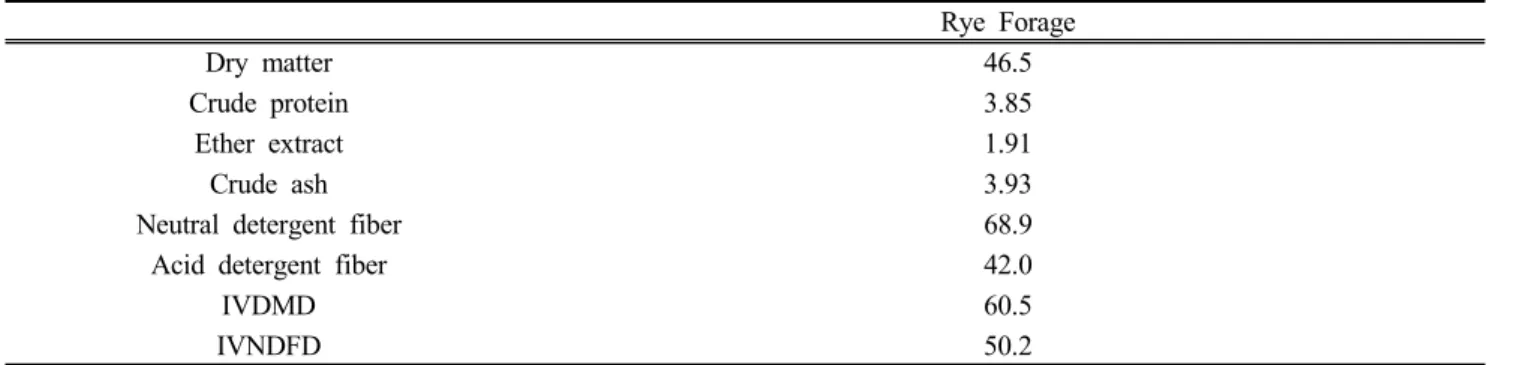
The chemical compositions and in vitro digestibility of the rye forage harvested at dough stage were shown in Table 1.
The contents of CP, NDF, ADF, IVDMD and IVNDFD were 3.85, 68.9, 42.0, 60.5, and 50.2%, respectively.
The chemical compositions and in vitro digestibility of rye silage ensiled for 100 days were shown in Table 2. The selected inoculant applications were not affected (P>0.05) on DM, CP, EE, CA, IVDMD, and IVNDFD of rye silages harvested at dough stage. The CON and MIX silages had higher NDF content than LB26 silage (P<0.05; 76.9 vs.
74.4%). And, LB26 silage had lower ADF content than all other silages (P<0.05; 45.1 vs. 47.7%).
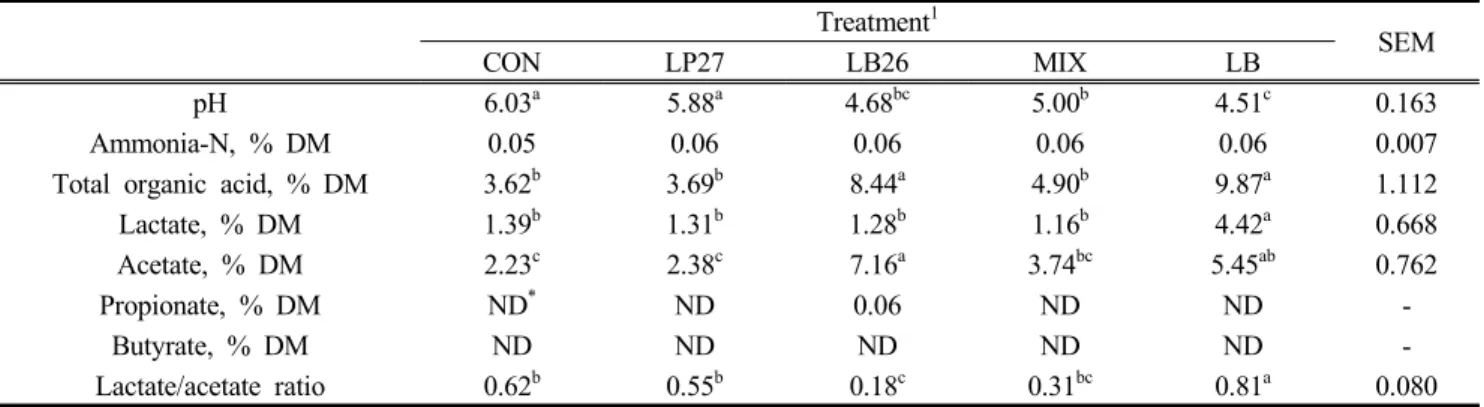
The fermentation characteristics of rye silage ensiled for 100 days were shown in Table 3. The lowest pH was resulted by LB silage, followed by MIX silage, and the highest was in
CON and LP27 silages (P<0.05; 4.51 vs. 5.00 vs. 6.03 and 5.88), while LB26 silage had lower pH (P<0.05, 4.68) than CON and LP27 silages. Ammonia-N concentration was not affected (P>0.05) by inoculant applications. Silage inoculated with LB26 and LB produced higher total organic acid compared to the other treatments (8.44 and 9.87% vs. 3.62, 3.69, and 4.90%). Applied LB in rye silage produced the higher lactate concentration than all other silages (P<0.05; 4.42 vs. 1.29%). Silage inoculated with LB26 had the highest acetate concentration, which had significant difference compared to CON and LP27 silages as the lowest (P<0.05; 7.16 vs. 2.23 and 2.38%). Applied LB (5.45%) also produced higher (P<0.05) acetate than CON and LP27. The concentration of propionate was detected only in LB26, while the concentration of butyrate was not detected in all silages. Lactate to acetate ratio was the highest in LB silage, followed by CON and LP27 silages, and the lowest was in LB26 silage (P<0.05; 0.81 vs.
Rye Forage
Dry matter 46.5
Crude protein 3.85
Ether extract 1.91
Crude ash 3.93
Neutral detergent fiber 68.9
Acid detergent fiber 42.0
IVDMD 60.5
IVNDFD 50.2
IVDMD, in vitro dry matter digestibility; IVNDFD, in vitro neutral detergent fiber digestibility.
Table 1. Chemical compositions and in vitro digestibility of rye before ensiling (% DM)
Treatment1
CON LP27 LB26 MIX LB SEM
Dry matter 44.1 42.1 43.1 43.6 42.6 1.674
Crude protein 4.59 4.59 4.52 4.58 4.64 0.200
Ether extract 2.22 1.87 1.96 2.45 2.08 0.322
Crude ash 4.47 4.29 4.50 4.15 4.27 0.364
Neutral detergent fiber 77.2a 76.3ab 74.4b 76.5a 76.1ab 0.895
Acid detergent fiber 48.2a 47.3a 45.1b 47.7a 47.4a 0.890
IVDMD 43.7 43.0 44.1 42.8 43.8 1.370
IVNDFD 36.8 36.1 36.4 34.3 35.7 1.179
1 CON, distilled water at 2 ml/kg of forage; LP27, L. plantarum R48-27 (4.0×10⁴ cfu/g) of fresh forage; LB26, L. buchneri R4-26 (4.0×10⁴ cfu/g) of fresh forage; MIX, mixture of LP27 and LB26 at 1:1 ratio; LB, L. buchneri (4.0×10⁴ cfu/g) of fresh forage.
IVDMD, in vitro dry matter digestibility; IVNDFD, in vitro neutral detergent fiber digestibility.
a, b Means in the same row with different superscripts differ significantly (P<0.05).
Table 2. Effects of inoculants on chemical compositions and in vitro digestibility of rye silage ensiled for 100 days (% DM)
0.59 vs. 0.18).
The microbial counts of rye silage ensiled for 100 days were shown in Table 4. The count of LAB was higher in LB silage than that in CON and LB26 silages (P<0.05; 7.59 vs.
6.46 and 6.96 log10 cfu/g). The yeast count of CON silage was lower than the other silages (P<0.05; 6.21 vs. 7.06 log10 cfu/g), while there was no difference among the silages applied all inoculants. The mold count was not detected in all silages.
Ⅳ. DISCUSSION
Various studies reported that DM, CP, ADF, and NDF contents of rye forages were approximately at 17.8 to 29.7%, 7.7 to 10.6%, 34.9 to 40.4% and 58.2 to 68.2%, respectively (Kim et al., 2001; Han et al., 2015; Choi et al., 2016). Chemical compositions of rye forage in the present study were different compared to the previous studies due to the differences of maturity or hybrid. In the present study, rye forage had high
DM content, which was influenced by delaying harvest period at dough stage. Kim et al. (2001) reported that the delaying harvest date in rye forage increased DM content, but reduced water soluble carbohydrate (WSC). After ensiled, DM content was decrease in all treatments, which was appropriate with Keady et al. (1994).
Two new species of LAB used in the present study were reported by Kim et al. (2017) that L. plantarum R48-27 (LP27) produced the fibrinolytic enzymes such as cellulase, xylanase, chitinase, and esterase, while L. buchneri R4-26 (LB26) had strong acidification ability and antifungal activities to against mycotoxin-producing fungal. However, applied LP27 did not decrease NDF and ADF contents after ensiled. Applied LP27 also had no effects on IVDMD and IVNDFD of rye silage. These results were contrast with the study reported by Kang et al.
(2009) that esterase producing LAB could breakdown the lignin complex, which increased the digestibilities of DM and NDF in rumen. The reasons of no effects on IVDMD and IVNDFD in the present study are not clear. However, it could be supported
Treatment1
CON LP27 LB26 MIX LB SEM
pH 6.03a 5.88a 4.68bc 5.00b 4.51c 0.163
Ammonia-N, % DM 0.05 0.06 0.06 0.06 0.06 0.007
Total organic acid, % DM 3.62b 3.69b 8.44a 4.90b 9.87a 1.112
Lactate, % DM 1.39b 1.31b 1.28b 1.16b 4.42a 0.668
Acetate, % DM 2.23c 2.38c 7.16a 3.74bc 5.45ab 0.762
Propionate, % DM ND* ND 0.06 ND ND -
Butyrate, % DM ND ND ND ND ND -
Lactate/acetate ratio 0.62b 0.55b 0.18c 0.31bc 0.81a 0.080
1 CON, distilled water at 2 ml/kg of forage; LP27, L. plantarumR48-27 (4.0×10⁴ cfu/g) of fresh forage; LB26, L. buchneri R4-26 (4.0×10⁴ cfu/g) of fresh forage; MIX, mixture of LP27 and LB26 at 1:1 ratio; LB, L. buchneri (4.0×10⁴ cfu/g) of fresh forage.
*ND, not detected.
a~c Means in the same row with different superscripts differ significantly (P<0.05).
Table 3. Effects of microbial additives on fermentation characteristics of rye silage ensiled for 100 days
Treatment1
CON LP27 LB26 MIX LB SEM
LAB, log10 cfu/g 6.46c 7.04ab 6.96bc 7.25ab 7.59a 0.257
Yeast, log10 cfu/g 6.21b 7.04ab 6.94ab 7.00ab 7.24a 0.223
Mold, log10 cfu/g ND* ND ND ND ND -
1 CON, distilled water at 2 ml/kg of forage; LP27, L. plantarumR48-27 (4.0×10⁴ cfu/g) of fresh forage; LB26, L. buchneri R4-26 (4.0×10⁴ cfu/g) of fresh forage; MIX, mixture of LP27 and LB26 at 1:1 ratio; LB, L. buchneri (4.0×10⁴ cfu/g) of fresh forage.
*ND, not detected.
a~c Means in the same row with different superscripts differ significantly (p<0.05).
Table 4. Effects of inoculants on microbial counts of rye silage ensiled for 100 days
partially by the high DM content of rye forage, which the role of these microbes (LP27 and LB26) might not be the optimal.
The ideal moisture is important factor to ensure the role of LAB during ensiling (McDonald et al., 1991). Kaiser et al. (2004) also reported that the DM content in all treatments without wilting process was higher than ideal content for silage production, around 30 to 40%.
Application of LAB is purposed to improve fermentation quality due to stimulate organic acid production during ensiling.
Several researchers suggested that LAB are one of factors to produce high quality of silage (Ilavenil et al., 2014; Arasu et al., 2014). LAB are largely divided into homo and heterofermentative.
Homofermentative LAB lead to the rapid decrease of pH, and it is used to improve fermentation indices of silage (Demirci et al., 2011). Heterofermentative LAB produce not only lactic acid, but also complex of organic acid such as acetic acid and propionic acid (Cho et al., 2014). In the present study, applied LB26, MIX, and LB produced the lower pH than the other treatments. It was occurred by concentrations of total organic acid during ensiling. The reduction of pH in the silage is caused by organic acid especially lactic acid that produce by LAB (Ko et al., 1999). Similar with the results in the present study, previous study reported that applied LAB as silage inoculant increased the concentrations of lactate, acetate, and propionate, which decreased pH (Lee et al., 2014). However, application of LB as heterofermentative LAB had the higher lactate concentration than homofermentative LAB. It might be occurred due to DM content of rye forage. Previous study also reported that applied L. buchneri in high DM content produced higher lactate concentration than in ideal DM condition (Hu et al., 2009). This study had the higher DM content than ideal silage, which restricted the role of homo and heterofermentative LAB during ensiling of rye silage. The silage applied LB26 had highest concentration of acetate and propionate, which has strong antifungal activity (Courtin and Spoelstra, 1990). It implies that application of LB26 might improve the aerobic stability. In the microbial count, all inoculant applications increased LAB count and decreased yeast count after silo opened. Application of inoculants increased the fermentation characteristic of rye silage in the present study, which indicated the inhibition of yeast growth and stimulation of LAB growth. Even though all treatments produced high pH (>4.5) after ensiled, the fermentation
of rye silage was in a good process because there was not detected of butyrate and mold.
Ⅴ. CONCLUSION
Application of LB26 and LB inoculant improved fermentation characteristics of rye silage due to high organic acid production.
However, application of LP27 and LB26 did not confirm the fibrinolytic and antifungal activity, respectively. It was occurred by higher DM content than in ideal silage. Application of LB26 in rye silage with harvested at dough stage might potentially improve the aerobic stability caused by increases of acetate and propionate concentrations, and need to confirm in the further study.
Ⅵ. ACKNOWLEDGMENTS
This research was performed with the support of "Cooperative Research Program for Agriculture Science & Technology Development (Project No. PJ011012032017)" Rural Development Administration, South Korea.
Ⅶ. REFERENCES
Adesogan, A.T., Krueger, N., Salawu, M.B., Dean, D.B. and Staples, C.R. 2004. The influence of treatment with dual-purpose bacterial inoculants or soluble carbohydrates on the fermentation and aerobic stability of bermudagrass. Journal of Dairy Science. 87:3407-3416.
AOAC. 1990. Official method of analysis, 15th ed. Association of Official Analytical Chemists, Arlington, Virginia, USA.
Arasu, M.V., Ilavenil, S., Jane, M., Kim, D.H., Lee, K.D., Park, H.S. and Choi, K.C. 2014. Effect of addition of chlorella with Lactobacillus plantarum on quality, microbial contents and fermentation metabolites of barley and pea silages. Journal of Pure Applied Microbiology.
8:4017-4023.
Baah, J., Addah, W., Okine, E.K. and McAllister, T.A. 2011. Effects of homolactic bacterial inoculant alone or combined with an anionic surfactant on fermentation, aerobic stability and in situ ruminal degradability of barley silage. Asian-Australasian Journal of Animal Sciences. 24:369-378.
Casler, M.D. and Vogel, K.P. 1999. Accomplishments and impact from
breeding for increased forage nutritional value. Crop Science. 39:12-20.
Chaney, A.L. and Marbach, E.P. 1962. Modified reagents for determination of urea and ammonia. Clinical Chemistry. 8:130-132.
Cho, S.B., Kang, J.S., Cho, K.J., Lee, K.H., Kwon, C.H., Song, J.Y., Lee, K.H., Kim, S.Y. and Kim, E.J. 2014. Effect of homofermentative and heterofermentative lactic acid bacteria on the quality and aerobic stability of silage: Meta-Analysis. Journal of the Korean Society of Grassland and Forage Science. 34:247-253.
Choi, K.C., Ilavenil, S., Arasu, M.V., Park, H.S. and Kim, W.H. 2015.
Effect of addition of lactic acid bacteria on fermentation quality of rye silage. Journal of the Korean Society of Grassland and Forage Science. 35:277-282.
Choi, K.C., Soundarranjan, I., Srisesharam, S., Park, H.S., Kim, J.H., Jung, J.S. and Kim, H.S. 2016. Potential effects of novel lactic acid bacteria on fermentation quality of rye haylage. Journal of the Korean Society of Grassland and Forage Science. 36:23-28.
Cleale, R.M.I.V. and Bull, L.S. 1986. Effect of forage maturity on ration digestibility and production by dairy cows. Journal of Dairy Science. 69:1587-1594.
Courtin, M.G. and Spoelstra, S.F. 1990. A simulation model of the microbiological and chemical changes accompanying the initial stage of aerobic deterioration of silage. Grass and Forage Science. 45:153-165.
Demirci, U., Gülşen, N. and Keleş, G. 2011. Effects of bacterial inoculants on fermentation and aerobic stability of baled triticale hungarian vetch silage and lamb performance. Kafkas Üniversitesi Veteriner Fakültesi Dergisi. 17:297-302.
Elferink, S.J.O., Krooneman, J., Gottschal, J.C., Spoelstra, S.F., Faber, F.
and Driehuis, F. 2001. Anaerobic conversion of lactic acid to acetic acid and 1, 2-propanediol by Lactobacillus buchneri. Applied and Environmental Microbiology. 67:125-132.
Filya, I., Ashbell, G., Hen, Y. and Weinberg, Z.G. 2000 The effect of bacterial inoculants on the fermentation and aerobic stability of whole crop wheat silage. Animal Feed Science and Technology.
88:39-46.
Han, O.K., Hwang, J.J., Park, H.H., Kim, D.W., Oh, Y.J., Park, T.I., Ku, J.H., Kwon, Y.U., Kweon, S.J. and Park, K.G. 2015. A new high grain yielding forage rye cultivar, “Seedgreen”. Journal of the Korean Society of Grassland and Forage Science. 35:105-111.
Hu, W., Schmidt, R.J., McDonell, E.E., Klingerman, C.M. and Kung, Jr.L. 2009. The effect of Lactobacillus buchneri 40788 or Lactobacillus plantarum MTD-1 on the fermentation and aerobic stability of corn silages ensiled at two dry matter contents. Journal of Dairy Science. 92:3907-3914.
Ilavenil, S., Arasu, M. V., Vijayakumar, M., Jung, M.W., Park, H.S., Lim, Y.C. and Choi, K.C. 2014. Lactobacillus plantarum improves the nutritional quality of Italian Ryegrass with alfalfa mediated silage. Journal of the Korean Society of Grassland and Forage Science. 34:174-178.
Ju, J.I., Choi, H.G., Kang, Y.S., Lee, J.J., Park, K.H. and Lee, H.B.
2009. Changes of growth and forage yield at different cutting dates among five winter cereals for whole crop silage in middle region.
Journal of the Korean Society of Grassland and Forage Science.
29:111-120.
Kaiser, A.G., Piltz, J.W., Burns, H.M. and Griffiths, N.W. 2004.
Successful silage (2nd Ed). Dairy Australia and New South Wales Department of Primary Industries. Australia. pp. 27.
Kang, T.W., Adesogan, A.T., Kim, S.C. and Lee, S.S. 2009. Effects of an esterase-producing inoculant on fermentation, aerobic stability, and neutral detergent fiber digestibility of corn silage. Journal of Dairy Science. 92:732-738.
Keady, T.W.J., Steen, R.W.J., Kilpatrick, D.J. and Mayne, C.S. 1994.
Effects of inoculant treatment on silage fermentation, digestibility and intake by growing cattle. Grass and Forage Science. 49:284-294.
Kim, D.A., Sung, K.I. and Kwon, C.H. 1986. Effects of sowing time and seeding rate on growth characteristics, winter survival and dry matter yield of forage rye. Journal of the Korean Society of Grassland and Forage Science. 6:164-168.
Kim, H.S., Han, O.K., Kim, S.C., Kim, M.J., and Kwak, Y.S. 2017.
Screening and investigation Lactobacillius spp. to improve Secale cereale silage quality. Animal Science Journal. 88:1538-1546.
Kim, J.G., Chung, E.S., Seo, S., Ham, J.S., Kang, W.S. and Kim, D.A.
2001. Effects of maturity at harvest and wilting days on quality of round baled rye silage. Asian-Australasian Journal of Animal Sciences. 14:1233-1237.
Kim, K.M., Lee, B.J. and Cho, Y.S. 2012. Differences of soil carbon by green manure crops in rotated cropping system. Korean Journal of Soil Science and Fertilizer. 45:1027-1031.
Ko, Y.D., Kang, W.S., Kang, H.S., Kim, D.J., Kim, D.H., Kim, J.H., Nam, G.H., Ryu, Y.M., Shin, J.N. and Yoo, S.O. 1999. Manufacture strategy of silage for ruminants. Sunjin Printing. Seoul. pp. 5-41.
Lee, H.I., Choi, Y.J., Mamuad, L., Kim, E.J., Oh, Y.K., Park, K.K. and Lee, S.S. 2014. Effect of heterofermentative lactic acid bacteria on the quality of Italian ryegrass and whole-crop barley silage. Journal of the Korean Society of Grassland and Forage Science. 34:269-276.
McDonald, P., Henderson, A.R. and Heron, S.J.E. 1991. The biochemistry of silage, 2nd Ed. Chalcombe Publications, Bucks, UK.
Morris, H.D. and Gardner, F.P. 1985. The effect of nitrogen fertilization and duration of clipping period on forage and grain yield of oats, wheat, and rye. Agronomy Journal. 50:454-457.
Nsereko, V.L., Smiley, B.K., Rutherford, W.M., Spielbauer, A., Forrester, K.J., Hettinger, G.H., Harman, E.K. and Harman, B.R. 2008.
Influence of inoculating forage with lactic acid bacterial strains that produce ferulate esterase on ensilage and ruminal degradation of fiber.
Animal Feed Science and Technology. 145:122-135.
Oba, M. and Allen, M.S. 1999. Evaluation of the importance of the digestibility of neutral detergent fiber from forage: Effects on dry
matter intake and milk yield of dairy cows. Journal of Dairy Science. 82:589-596.
Oh, M.G., Jo, I.H. and Hwangbo, S. 2014. Effect of mixed-sowing of legume and applying of cattle manure on the productivity, feed values and organic Hanwoo carrying capacity of rye (Secale cereale L.). Korean Journal of Organic Agriculture. 22:457-468.
Park, C.M., Chun, W.B. and Myung, G.H. 1979. Studies on the utilization of some soiling grasses. Journal of Animal Science and Technology. 21:289-298.
SAS User’s Guide, Version 8 Edition. 2002. SAS Inst., Inc., Cary, NC.
USA.
Seale, D.R. 1986. Bacterial inoculants as silage additives. Journal of Applied Bacteriology. 61(Suppl.):9S-26S.
Song, B.H., Lee, K.A., Jeon, W.T., Kim, M.T., Cho, H.S., Oh, I.S., Kim, C.G. and Kang, U.G. 2010. Effects of green manure crops of legume and gramineae on growth responses and yields in rice cultivation with respect to environment friendly agriculture. Korean Journal of Crop Science. 55:144-150.
Song, T.H., Han, O.K., Yun, S.K., Park, T.I., Seo, J.H., Kim, K.H. and Park, K.H. 2009. Changes in quantity and quality of winter cereal crops for forage at different growing stages. Journal of the Korean Society of Grassland and Forage Science. 29:129-136.
Tilley, J.M.A. and Terry, R.A. 1963. A two-stage technique for the in vitro digestion of forage crops. Grass and Forage Science. 18:104-111.
Van Soest P.J., Robertson, J.B. and Lewis, B.A. 1991. Methods for dietary fiber, neutral detergent fiber and non-starch poly-saccharides in relation to animal nutrition. Journal of Dairy Science. 74:3568-3597.
Vetter, R.L. and Von Glan, K.N. 1978. Abnomal silages and silage related disease problems. National Feed Ingredients Association.
Des Mlines. IA. pp. 291-293.
Zahiroddini, H., Baah, J., Absalom, W. and McAllister, T.A. 2004.
Effect of an inoculant and hydrolytic enzymes on fermentation and nutritive value of whole crop barley silage. Animal Feed Science and Technology. 117:317-330.
(Received : February 13, 2018 | Revised : June 5, 2018 | Accepted : June 11, 2018)