* Corresponding author : Ki Choon Choi, Grassland and Forage division, National Institute of Animal Science, Rural Development Administration, Cheonan, Republic of Korea-330-801, Tel: +82-41-580-6752, Fax: +82-41-580-6779, E-mail: [email protected]
Research Article
Silages of Rye Harvested at Different Stages: A Study on Microbial Inoculants Responses in Improving Rye Silage Fermentation Quality
Srisesharam Srigopalram
1, Soundharrajan Ilavenil
1, Palaniselvam Kuppusamy
1, Yong Hee Yoon
2, Won Ho Kim
1, Ki Choon Choi
1,*
1
Grassland and Forage division, National Institute of Animal Science, Rural Development Administration, Cheonan, Republic of Korea-330-801.
2
Jungnong Bio Inc, Goksung, Chonnam, 57509, Republic of Korea.
ABSTRACT
The present study analyzes the role of Lactic Acid Bacteria Mixture (LBM) on improving rye silage quality. Rye of four different stages (Booting, Heading, Flowering, and Late flowering) was collected and silage was prepared. The nutrient profile analysis of experimental silage groups showed no significant changes between control and LBM inoculation. Interestingly, the pH of rye silage in LBM treatments showed significant reduction than control (p<0.05) in all stages of rye silage. However, lowest pH (3.69) resulted on booting stage among other stages of rye. Subsequently significant lactic acid production was noted in all stages of LBM inoculation than control. Conversely maximum lactic acid production of (5.33%DM) was noted at booting stage followed by (4.86%DM) in heading stage. Further the lactic acid bacterial (LAB) count in LBM inoculated group showed significant increase than control. Similarly, the silage of booting stage group registered maximum LAB population (63.7 ×10⁶CFU/g) after that heading stage (32.3 ×10⁶CFU/g). Further significant reduction in yeast growth and no fungal growth was noted in all LPM treatment groups. Hence, LBM inoculants could be a better additive for improving rye silage quality.
(Key words : Rye, Heading stage, Booting stage, L.plantarum, Lactic acid)
Ⅰ. INTRODUCTION
Rye is a potential stress tolerant crop. It can withstand undesirable growing conditions like deep winter, low fertility soils, sandy soils, and extreme drought climate. Rye requires the smaller amount of water (30%) than other forage crops.
The rye production offers greater economic returns for small land holding farmers as well as large landholders. Winter rye shows better agronomic characteristics than spring verities.
Further rye is the one of the primary cattle feed in Korea.
Subsequently, food production is a primary need for the global population and that is the reason for the significant part of soil has been allocated to agricultural practices worldwide. Among these agricultural practices, some portion has been allocated for animal feed production as grassland (Conant et al., 2001).
Researchers predicted that during 2000-2050 the world population will increase to nine billion. Hence pastures play significant role in agriculture for the increase of meat and milk
production to provide food for the raising human population (Kingston-Smith et al., 2012; Young et al., 2013)(Kingston- Smith et al., 2012; Young et al., 2013). The usage of pastures as animal feed that decrease the purchase of concentrated feed and simultaneously increasing the profitability for farmers.
Further, knowledge in forage preservation can allow development in the quality of forage crops that turns to enhancement ruminant performance(Jacobs, 2014; Stott and Gourley, 2016).
Preservation of dairy products using fermentation is a
classic method that dated 1000 years old technique(Rhee et al.,
2011). Similarly, preserving forage by fermentation is of a
primary need to compensate feed shortage caused by low
pasture growth. Forage crops are known to contain water
soluble carbohydrates that facilitate the homofermentative
process and production of organic acids during ensilation
process. The ensilation process comprises the combination of
both aerobic and anaerobic environment with fermentation of
carbohydrates by microbial inoculants (Muck, 2010). Microbial
inoculants require various nutritional factors for growth at silo conditions. However they grow rapidly, improve the fermentation quality of forages in the silo conditions without influencing in ruminant performance and become dominant microorganisms on the crop.
Addition of microbial inoculants like lactic acid bacteria to the silo reduces the pH of the silage through lactic acid production that inhibits the growth of yeast and mold species (Ni et al., 2015). Based on organic acid production the lactic acid bacteria have been grouped as homofermenter and heterofermenter. In addition, lactic acid bacteria dominate the silage microbial profile using hydrogenperoxide production and anaerobic condition. However the anaerobic condition might be the main reason for the rapid lactic acid bacterial growth at insilo conditions (Muck, 2010). The objective of this study was to estimate the role of lactic acid bacteria mixture (LBM) on the fermentation quality and nutritive value of rye harvested at different stage.
II. MATERIALS AND METHODS 1. Preparation of Lactic acid bacteria mixture (LBM)
L. plantarum KCC-10, KCC-19 and K.46 were isolated and
characterized by biochemical and molecular tools (Valan Arasu et al., 2013; Arasu et al., 2014; Valan Arasu et al., 2015). The LBM was prepared according to the manufacturer protocol, Top Silage private Limited, Korea. Accordingly, fresh culture of L.plantarum KCC-10, L. plantarum KCC-19 and L.
plantarum K-46 were inoculated in mass cultivation medium
containing glucose 1%, soy peptone 0.25%, yeast extract 1%, MgSO4 0.01%, MnSO
40.04%, NaCl 0.1%, CaCO
30.2%, Na
2HPO
40.6% in a fermenter. After mass cultivation, the cultures were freeze dried. This mixture of KCC-10, KCC-19, and K-46 (LBM) was used as inoculants in rye silage preparation.
2. Collection and preparation of silage
Rye was harvested at four different stages such as booting (10
thApril), heading (21
stApril), flowering (28
thApril), and
late flowering stage (11
thMay), National Institute of Animal Science- RDA, Cheonan. The experiment was divided in to control group lactic acid bacteria mixture (LBM) inoculated group for each stage. Two hundred grams of rye was taken for each experimental group of different stages and was packed in different air diffusible bags. Subsequently, silage was prepared with the addition LBM inoculants. Each LBM inoculants (1.5x10
10cfu/g) was dissolved in distilled water (0.004g/10ml) and sprayed in to the 200g of rye in air diffusible bag. Silage was sealed to maintain anaerobic condition. Each of the samples with or without strains was prepared in triplicates.
Silage was stored in room temperature for 45 days. The nutritive values, microbial counts and fermentative metabolites were analyzed.
3. Rye silage Nutrient profile analysis
Silage samples were ground well and passed through a 1 mm sieve prior to nutrient profile analysis. The crude protein (CP) was estimated by standard procedure (AOAC, 1990).
Acid detergent fiber (ADF) and Neutral detergent fiber (NDF) were estimated according to the protocols described by (Soset et al., 1993). Total digestible nutrient (TDN) was calculated as follow; 88.9-(ADF% × 0.79) (Holland et al., 1990).
4. Microbial profile analysis
Ten grams of wet silage samples were transferred into sterile flasks containing 90 mL of sterile water. The sample was kept in an orbital shaker with incubator at the rotation speed of 150 rpm for 30 min. Subsequently, tenfold serial dilution was made using distilled water (Miller and Wolin, 1974). For the counting of LAB colony, the diluted sample (0.1 mL) was spread on selective media (Rogosa, and Sharpe agar (Diffco) and Bromocresol purple blue agar medium) and incubated at 28 ± 1℃ for two days. Yeasts and molds were counted on 3 M petrifilm (3 M Microbiology Products, St.Paul, USA), and followed by aerobic incubation at 28 ± 1℃
for four days. Fungi colonies were counted by using Potato
Dextrose agar (PDA) [4 g/L of potato starch (Diffco), 20 g/L
of starch (Difco), and 20 g/L of agar (Difco)] following
aerobic incubation at 28 ± 1℃ for four days.
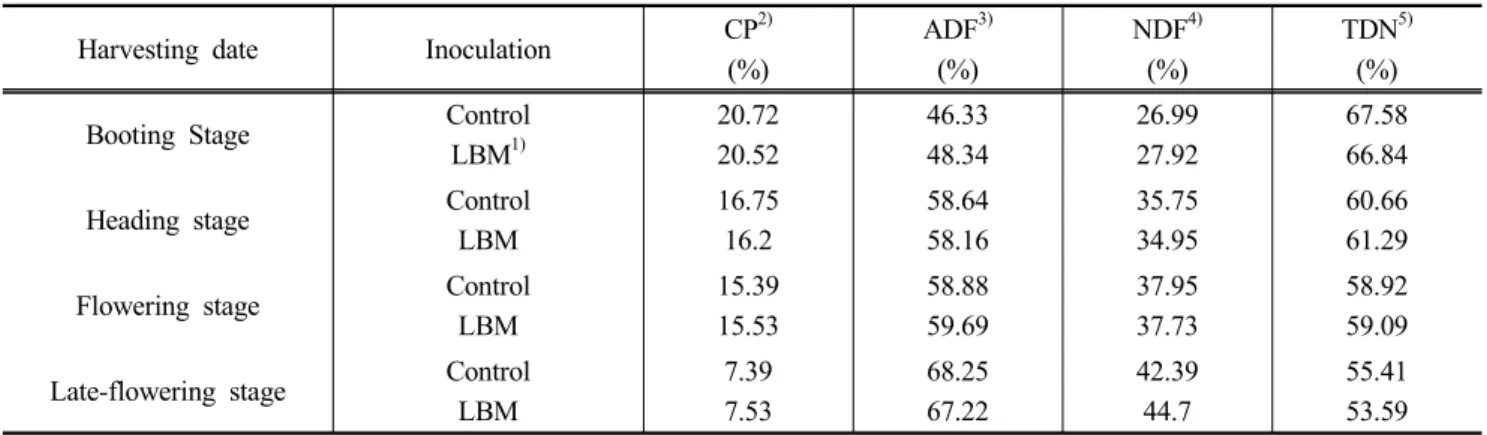
Table 1. Effect of Harvesting date and inoculation of lactic acid bacteria on nutritive values of rye silage
Harvesting date Inoculation CP
2)(%)
ADF
3)(%)
NDF
4)(%)
TDN
5)(%)
Booting Stage Control
LBM
1)20.72 20.52
46.33 48.34
26.99 27.92
67.58 66.84
Heading stage Control
LBM
16.75 16.2
58.64 58.16
35.75 34.95
60.66 61.29
Flowering stage Control
LBM
15.39 15.53
58.88 59.69
37.95 37.73
58.92 59.09 Late-flowering stage Control
LBM
7.39 7.53
68.25 67.22
42.39 44.7
55.41 53.59
1)LBM: Lactic acid bacteria mixture 2)CP: Crude protein, 3)ADF: Acid detergent fiber, 4)NDF: Neutral detergent fiber, 5)TDN: Total digestible nutrient
5. Estimation of organic acids
10 g of rye silage sample of four different stages was weighed, mixed with 90 ml of deionized water and kept in a refrigerator at 4℃ for 24 hr. After that, the samples were filtered through the filter paper (Whatman No. 6) and the filtrate was re-filtered using 0.22㎛ syringe filter before injection of samples in high-performance liquid chromatography (HPLC; HP1100,.
Agilent Co. USA). The pH of the supernatant was measured after centrifugation using a combination electrode. The filtrate was stored at −70℃ with and without stabilization with 5%
meta-phosphoric acid (final concentration). Lactic acid content was analyzed by HPLC. The contents of acetic acid and butyric acid were analyzed by Gas Chromatography (GC-450, Varian Co., USA) method described by Kristensen et al. (2007).
6. Statistical analysis
Samples were analyzed in three replicates and analysis of variance were performed on all the variables measured using SPSS/PC (Statistical Package for the Science, ver 12.0. USA).
The T-test was used to determine the effect of inoculants on the quality of rye silage. Tests were run at the 5 % probability level.
III. RESULTS AND DISCUSSION
This study, deals with the role L. plantarum mixture (LBM)
inoculants on improving the quality of rye silage harvested at different stages. The parameters such as organic acids, microbial counting and nutrient profile play main role in deciding silage quality. Accordingly, the nutrient profile examination of rye silage of different stages has been presented in (Table 1). The highest crude protein concentration (20.52%) was observed LBM mixture treated silage of booting stage. However no significant (P>0.05) changes were noted between the other stages of rye silage when compared to booting stage. According to (Cezário et al., 2015) the early stage forages rich in protein content but it reduces rapidly when it matures. Further there is a slower reduction in protein content of the leaf when compared to other parts of forage. On the other hand, the increased ADF and NDF were observed in late flowering stage silage (67.22% and 44.7%) and this result agreement with that the nutritional quality of forage decreases progressively with the increase in maturity of plant . The steep increase in the ADF, NDF and decrease in TDN level at late flowering stage further confirmed the highest nutrient availability at early stages of harvest than later stage of rye harvest (Bayble et al., 2007; Subhalakshmi et al., 2011).
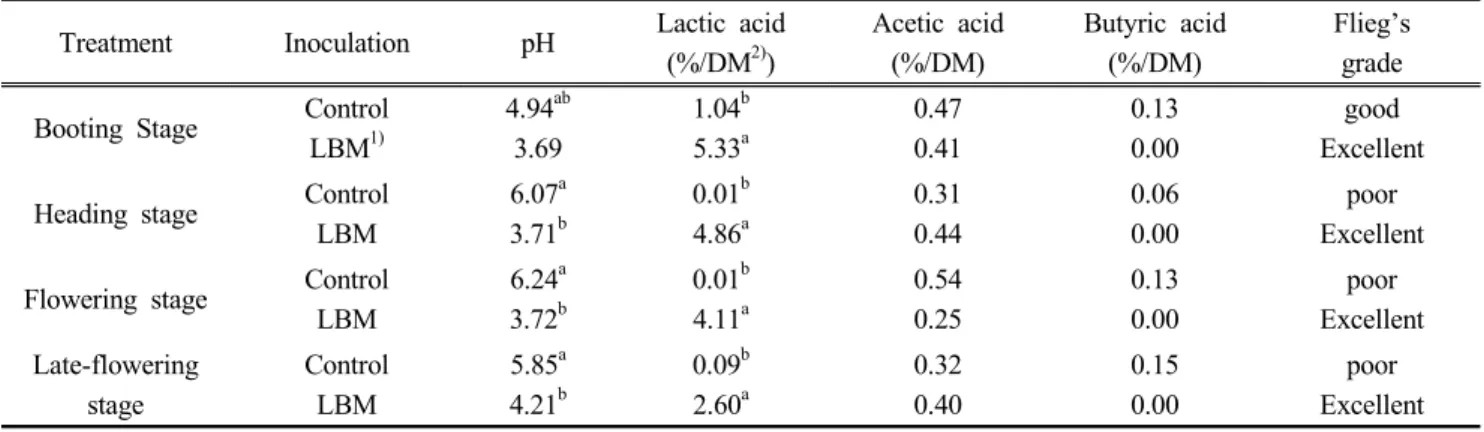
The fermentative acid estimation results of rye silage have
been presented in (Table 2). Subsequently, Low pH of 3.69
was observed at the booting stage of rye silage. Further, there
was significant difference in pH changes was noted between
the control and LBM inoculated group. Steep decrease in the
pH of rye silage from late flower stage to booting stage
(4.21-3.69) indicated the availability of higher dissolved
nutrients in early stages of forage than the mature stage
(Santos et al., 2011; Ferreira et al., 2014). Because of
Table 2. Effect of Harvesting date and inoculation of lactic acid bacteria on pH and organic acids of rye silage
Treatment Inoculation pH Lactic acid
(%/DM
2))
Acetic acid (%/DM)
Butyric acid (%/DM)
Flieg’s grade Booting Stage Control
LBM
1)4.94
ab3.69
1.04
b5.33
a0.47 0.41
0.13 0.00
good Excellent Heading stage Control
LBM
6.07
a3.71
b0.01
b4.86
a0.31 0.44
0.06 0.00
poor Excellent Flowering stage Control
LBM
6.24
a3.72
b0.01
b4.11
a0.54 0.25
0.13 0.00
poor Excellent Late-flowering
stage
Control LBM
5.85
a4.21
b0.09
b2.60
a0.32 0.40
0.15 0.00
poor Excellent
1)LBM: Lactic acid bacteria mixture2)DM: Dry matter,
a,b Means with different letters within a column are significantly different at the 5% level.
Table 3. Effect of Harvesting date and inoculation of lactic acid bacteria on microbes of rye silage
Treatment Inoculation LAB
2)(×10
6CFU
3)/g)
Yeast (×10
3CFU/g)
Fungi (×10
2CFU/g)
Booting Stage Control
LBM
1)5.3
b63.7
a7.7 3.3
- -
Heading stage Control
LBM
6.0
b32.3
a8.7 1.7
- - Flowering stage Control
LBM
5.3
b27.0
a6.3 2.3
- - Lateflowering stage Control
LBM
14.6
b28.7
a2.7 2.7
- -
1)LBM: Lactic acid bacteria mixture,2)LAB: Lactic acid bacteria, 3)CFU: Colony forming unit, a,b Means with different letters within a column are significantly different at the 5% level.
availability of higher nutrients at early stage of forage there is possibility to the growth of Clostridium species using lactic acid produced by the fermentation of dissolved carbohydrate (Ribeiro et al., 2014; Arzate-Vázquez et al., 2016). Hence it is necessary to maintain the anaerobic condition that allows the rapid growth of Lactic acid bacterial strains and reduction in the silo pH (Borreani et al., 2008). This condition inhibits the growth of undesirable organisms and increases the aerobic stability of the silage(Tabacco et al., 2011). Similarly there is significant increase in the lactic acid content was noted in LBM inoculated groups than control at all stages of rye silage.
The lactic acid bacteria like L.buchneri can to convert lactic acid in to acetic acid. This activity will help to maintain the pH level of the silage and thus provide aerobic stability (Filya et al., 2006). In this experiment the LBM inoculated group showed moderate increase in the acetic acid level but no significant changes observed when compared to control group.
Hence this confirmed the acetic acid producing nature of LBM inoculants. Further the reduction of final pH of silage by homofermentative inoculants through acetic acid production will inhibit the production of butyric acid (Danner et al., 2003). Accordingly no butyric acid production was noted in LBM inoculated group.
The enumeration of microbial population has been listed in (Table 3). The fermentation of sugars by lactic acid bacteria is the main criteria of the ensiling process(Ni et al., 2015).
Conversely, the lactic acid bacteria grow rapidly and quickly
become dominant microorganism in most cases of ensilation
process(Weinberg et al., 2010). Similarly in this study, the
counting of L.palntarum strains showed significant increase in
LBM inoculated group than control. Specifically, the LAB
count increased from matured late flowering stage to booting
stage (28.7-63.7×10
6). This indicates higher nutrient availability
of rye harvest at early stages and the possibility of
preservation of the higher nutrients by LAB fermentation (Muck, 2010). Further the dominant L.plamtarum population in silages inhibit the growth of yeast and molds that destroys the quality of the silage by reducing the pH of the silage below 5 (Li et al., 2016). Likewise, lowest yeast count and no mold count were observed in rye silage treated with LBM mixture.
Ⅳ. CONCLUSION
In conclusion, the quality of rye silage based on chemical composition and fiber degradation nature rapidly reduced as advancing maturity. Hence this study suggests that ensilling rye harvested at early stage could contain higher nutrient properties than later harvest stages by fermentation of LBM inoculants.
Ⅴ. ACKNOWLEDGEMENTS
This work was carried out with the support of "Cooperative Research Program for Agriculture Science & Technology Development (Project title: Development of Quality Improvement and Standardization Technique for Low Moisture Storage Forage;
Project No. “PJ01091601” Rural Development Administration, Republic of Korea. This study was supported by (2014) Postdoctoral Fellowship Program of (National Institute of Animal Science), Rural Development Administration, Republic of Korea.
Ⅵ. REFERENCES
AOAC. 1990. Official method of analysis. Association of Official and and Analytical Chemists. 15th edition:1-1298.
Arasu, M.V., Jung, M.W., Kim, D.H., Ilavenil, S., Jane, M., Park, H.S., Al-Dhabi, N.A., Jeon, B.T. and Choi, K.C. 2014. Enhancing Nutritional Quality of Silage by Fermentation with Lactobacillus plantarum. Indian Journal of Microbiology. 54:396-402.
Arzate-Vázquez, G.L., Castrejón-Pineda, F.A., Rosiles-Martínez, R., Carrillo-Pita, S., Angeles-Campos, S. and Vargas-Bello-Pérez, E.
2016. Effect of genus and growth stage on the chemical and mineral composition of tropical grasses used to feed dairy cows. Ciencia e
investigación agraria. 43:476-485.
Bayble, T., Melaku, S. and Prasad, N.K. 2007. Effects of cutting dates on nutritive value of Napier (Pennisetum purpureum) grass planted sole and in association with Desmodium (Desmodium intortum) or Lablab (Lablab purpureus). Livestock Research for Rural Development. 19:1-1.
Borreani, G., Bernardes, T.F. and Tabacco, E. 2008. Aerobic deterioration influences the fermentative, microbiological and nutritional quality of maize and sorghum silages on farm in high quality milk and cheese production chains. Revista Brasileira de Zootecnia. 37:68-77.
Cezário, A.S., Ribeiro, K.G., Santos, S.A., Valadares Filho, S.d.C. and Pereira, O.G. 2015. Silages of Brachiaria brizantha cv. Marandu harvested at two regrowth ages: Microbial inoculant responses in silage fermentation, ruminant digestion and beef cattle performance.
Animal Feed Science and Technology. 208:33-43.
Conant, R.T., Paustian, K. and Elliott, E.T. 2001. Grassland management and conversion into grassland: Effects on soil carbon. Ecological Applications. 11:343-355.
Danner, H., Holzer, M., Mayrhuber, E. and Braun, R. 2003. Acetic Acid Increases Stability of Silage under Aerobic Conditions. Applied and Environmental Microbiology. 69:562-567.
Ferreira, D.J., Zanine, A.M., Lana, R.R.P., Ribeiro, M.D., Alves, G.R.
and Mantovani, H.C. 2014. Chemical composition and nutrient degradability in elephant grass silage inoculated with Streptococcus bovisisolated from the rumen. Anais da Academia Brasileira de Ciências. 86:465-474.
Filya, I., Sucu, E. and Karabulut, A. 2006. The effect of Lactobacillus buchneri on the fermentation, aerobic stability and ruminal degradability of maize silage. Journal of Appllied Microbiology.
101:1216-1223.
Holland, C., Kezar, W., Kautz, W.P., Lazowski, E.J., Mahanna, W.C.
and Reinhart, R. 1990. Pioneer forage manual: A nutritional guide.
Pioneer Hi-Bred International, Inc Des moines. IA:1-55.
Jacobs, J.L. 2014. Challenges in ration formulation in pasture-based milk production systems. Animal Production Science. 54:1130-1140.
Kingston-Smith, A.H., Marshall, A.H., and Moorby, J.M. 2012.
Breeding for genetic improvement of forage plants in relation to increasing animal production with reduced environmental footprint.
animal. 7:79-88.
Li, Y., Wang, F. and Nishino, N. 2016. Lactic Acid Bacteria in Total Mixed Ration Silage Containing Soybean Curd Residue: Their Isolation, Identification and Ability to Inhibit Aerobic Deterioration.
Asian-Australasian Journal of Animal Sciences. 29:516-522.
McDonald, P., Greenhalgh, J.F.D., Morgan, C.A., Edwards, R., Sinclair, L. and Wilkinson, R. 2002. Animal Nutrition. Pearson publications.
7th Ed:1-714.
Muck, R.E. 2010. Silage microbiology and its control through additives.
Revista Brasileira de Zootecnia. 39:183-191.
Ni, K., Wang, Y., Cai, Y. and Pang, H. 2015. Natural Lactic Acid Bacteria Population and Silage Fermentation of Whole-crop Wheat.
Asian-Australas journal of Animal Science. 28:1123-1132.
Rhee, S.J., Lee, J.E. and Lee, C.H. 2011. Importance of lactic acid bacteria in Asian fermented foods. Microbial Cell Factories.
10:S5-S5.
Ribeiro, G.O., Teixeira, A.M., Velasco, F.O., Faria Júnior, W.G., Pereira, L.G.R., Chaves, A.V., Gonçalves, L.C. and McAllister, T.A. 2014.
Production, Nutritional Quality and In vitro Methane Production from Andropogon gayanus Grass Harvested at Different Maturities and Preserved as Hay or Silage. Asian-Australasian Journal of Animal Sciences. 27:330-341.
Santos, E.M., Pereira, O.G., Garcia, R., Ferreira, C.L.L.F., Oliveira, J.S., Silva, T.C. and Rosa, LO. 2011. Microbial populations, fermentative profile and chemical composition of signalgrass silages at different regrowth ages. Revista Brasileira de Zootecnia. 40:747-755.
Soset, P.J.V., In, H.G., Jung, D.R., Buxton, R.D. and Ralph, E. 1993.
Cell wall matrix interactions and degradation session synopsis.
Forage Cell Wall Structure and Digestibility. American Society of Agronomy. WI:377-395.
Stott, K.J. and Gourley, C.J.P. 2016. Intensification, nitrogen use and recovery in grazing-based dairy systems. Agricultural Systems.
144:101-112.
Subhalakshmi, B., Bhuyan, R., Sarma, D.N., Sharma, K.K. and Bora, A.
2011. Effect of Variety and Stage of Harvest on the Yield, Chemical Composition and In-vitro Digestibility of Hybrid Napier (Pennisetum purpureum × P. americanum). Indian Journal of Animal Nutrition. 28:418-420.
Tabacco, E., Righi, F., Quarantelli, A. and Borreani, G. 2011. Dry matter and nutritional losses during aerobic deterioration of corn and sorghum silages as influenced by different lactic acid bacteria inocula. Journal of Dairy Science. 94:1409-1419.
Tilman, D., Cassman, K.G., Matson, P.A., Naylor, R. and Polasky, S.
2002. Agricultural sustainability and intensive production practices.
Nature. 418:671-677.
Valan Arasu, M., Jung, M.W., Ilavenil, S., Jane, M., Kim, D.H., Lee, K.D., Park, H.S., Hur, T.Y., Choi, G.J., Lim, Y.C. and Choi, K.C.
2013. Isolation and characterization of antifungal compound from Lactobacillus plantarum KCC-10 from forage silage with potential beneficial properties. Journal of Applied Microbiology. 115:1172- 1185.
Valan Arasu, M., Jung, M.W., Kim, D.H., Park, H.S., Ilavenil, S., Al-Dhabi, N.A. and Choi, K.C. 2015. Identification and phylogenetic characterization of novel Lactobacillus plantarum species and their metabolite profiles in grass silage. Annals of Microbiology. 65:15-25.
Weinberg, Z.G., Khanal, P., Yildiz, C., Chen, Y. and Arieli, A. 2010.
Effects of stage of maturity at harvest, wilting and LAB inoculant on aerobic stability of wheat silages. Animal Feed Science and Technology. 158:29-35.
Young, C.A., Hume, D.E. and McCulley, R.L. 2013. Forages and pastures symposium: fungal endophytes of tall fescue and perennial ryegrass: pasture friend or foe?. Journal of Animal Science.
91:2379-2394.
(Received : June 25, 2017 | Revised : August 16, 2017 | Accepted : August 21, 2017)