The complete genome sequence of Bacillus coagulans strain ASRS217, isolated from rice straw, was determined. It contains a single circular 3,514,330-bp chromosome with a G + C content of 46.47%. The complete genome of strain ASRS217 does not possess any of genes for virulence, antibiotic-resistance, α- hemolysis, or β-hemolysis. ASRS217 genome harbor the genes for utilization of carbohydrate and protein. Also, ASRS217 genome possess the genes related to bacteriocin, spore-forming, and arginine deiminase pathway. This genomic information suggests that the strain ASRS217 is safe and suitable for use as a starter candidate in food fermentation as well as a probiotic strain.
Keywords: Bacillus coagulans, genome, probiotic, starter
Bacillus coagulans has been used as a probiotic to prevent muscle damage and improve gastrointestinal disorders (Ratna Sudha et al., 2012; Jäger et al., 2016; Majeed et al., 2016).
Bacillus coagulans displayed amylase activities for carbohydrate degradation and protease activities for protein degradation (Babu, 1995; Olajuyigbe, 2013). These extracellular enzyme activities contribute to the enhancement of sensory properties
during food fermentation (Konuray and Erginkaya, 2018). Bacillus coagulans produces bacteriocin, antibacterial compounds against Gram-positive and Gram-negative bacteria (Le Marrec et al., 2000) and can also persist under extreme conditions through spore formation. Because of these properties, it has advantages as a fermentation starter culture as well as a probiotic. Previously, we isolated B. coagulans ASRS217 as a starter candidate from rice straw (Lee et al., 2015). Here, its complete genome was sequenced to analyze its genetic background as a safe fermen- tation starter candidate.
Whole-genome sequencing of B. coagulans ASRS217 was performed using the PacBio RSII platform (Pacific Bioscience) single-molecule real-time (SMRT) with a 20 kb SMRTbell
TMtemplate by ChunLab, Inc.. One contig was generated from a hybrid assembly of reads from the PacBio system (70151 reads and 249.37× coverage), and the reads were assembled using a CLC Genomics Workbench ver. 7.5.1 (CLC Bio) with the HGAP4 algorithm in SMRT Link (version 7.0.1; Pacific Bioscience).
Genome annotation was performed using the NCBI Prokaryotic Genome Annotation Pipeline (version 4.6; Tatusova et al., 2016).
Open reading frames (ORFs) were predicted using Glimmer 3 (Tatusov et al., 1997), followed by annotation through a search against the Clusters of Orthologous Groups (COG) database (Tatusov et al., 1997).
Korean Journal of Microbiology (2020) Vol. 56, No. 3, pp. 321-323 pISSN 0440-2413
DOI https://doi.org/10.7845/kjm.2020.0067 eISSN 2383-9902
Copyright ⓒ 2020, The Microbiological Society of Korea
Complete genome sequence of Bacillus coagulans strain ASRS217, a potential food fermentation starter culture
Jungmin Lee
1†, Sojeong Heo
1†, Yoon-Su Kim
1, Jong-Hoon Lee
2, and Do-Won Jeong
1*
1
Department of Food and Nutrition, Dongduk Women’s University, Seoul 02748, Republic of Korea
2
Department of Food Science and Biotechnology, Kyonggi University, Suwon 16227, Republic of Korea
발효 종균 후보 Bacillus coagulans ASRS217의 유전체 염기서열
이정민
1†・ 허소정
1†・ 김윤수
1・ 이종훈
2・ 정도원
1*
1
동덕여자대학교 식품영양학과,
2경기대학교 식품생물공학과
(Received July 14, 2020; Revised August 3, 2020; Accepted August 4, 2020)
†
These authors contributed equally to this work.
*For correspondence. E-mail: [email protected] / [email protected];
Tel.: +82-2-940-4463; Fax: +82-2-940-4610
322 ∙ Lee et al.
미생물학회지 제56권 제3호
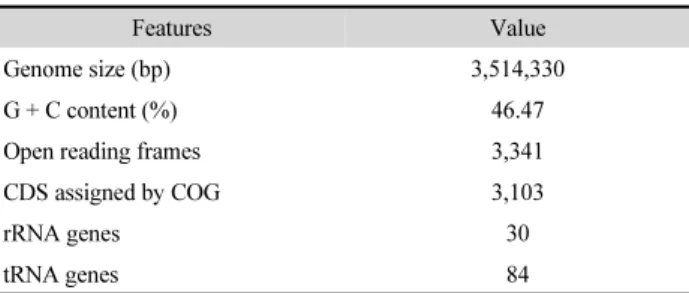
The complete genome of strain ASRS217 consists of a single circular 3,514,330-bp chromosome with a G + C content of 46.47% (Table 1). The genome was predicted to contain 3,341 protein-coding sequences, 84 tRNA genes, and 30 rRNA genes.
In total, 3,103 genes were functionally assigned to categories based on COG. The fraction of the genome in the COG category related to carbohydrate transport and metabolism was at 8.3%
(251 genes), while that of amino acid transport and metabolism was 8.2% (250 genes). Carbohydrate and amino acids are nutrients in food and a high portion of COG categories associated with this implies that strain ASRS217 can utilize carbohydrates and proteins during fermentation. The genome of strain ASRS217 does not possess any of the virulence genes, including enterotoxin genes, detected in the foodborne pathogen Bacillus cereus.
Additionally, no genes related to the resistance against eight antibiotics (ampicillin, chloramphenicol, clindamycin, erythromycin, gentamicin, streptomycin, tetracycline, and vancomycin), α- hemolysis, or β-hemolysis were identified from the annotated genes based on COG. Strain ASRS217 also possesses 42 genes for spore formation and germination, such as spore coat, cortex, sporulation protein, spore germination protein, and small acid soluble protein. Bacitracin is a bacteriocin produced by Gram- positive bacteria (Johnson et al., 1945; Azevedo et al., 1993).
The genome of strain ASRS217 encodes the bceAB genes (HYE74_RS07215-HYE74_RS07220) that confer bacitracin resistance and the bceSR two-component system (HYE74_
RS07225-HYE74_RS07230) involved in the regulation of bacitracin resistance. These spore-forming and bacteriocin genes are advantage as a starter and probiotic strain. Furthermore, to survive acidic condition in the gastric tract tolerance, the genome of strain ASRS217 encode arginine deiminase pathway;
arginine/ornithine antiporter (HYE74_RS01820), ornithine
carbamoyl-transferase (HYE74_RS07985) and arginine repressor (HYE74_RS08855). It is also one of desired traits required as a probiotic strain. Consequently, the genome of strain ASRS217 suggested genetic backgrounds for safe and functional starter candidate for food fermentation as well as probiotic strain.
Nucleotide sequence accession number(s)
The complete genome sequence of B. coagulans ASRS217 has been deposited in DDBJ/ENA/GenBank under accession number CP058594 and strain has been deposited in the Korean Collection for Type Cultures under accession number KCCM 43366.
적 요
볏집에서 분리한 Bacillus coagulans ASRS217 균주의 유 전체를 분석한 결과 G + C 함량 46.47%, 약 3.5 Mb 크기의 단 일 chromosome을 보유하고 있었다. ASRS217 균주의 유전체 로부터 독성, 항생제 저항성, α-용혈소, 및 β-용혈소 관련 유전 자는 확인되지 않았다. ASRS217 균주 유전체는 탄수화물과 단백질을 이용할 수 있는 유전자를 보유하고 있었으며, 항균 물질, 포자 생성 및 arginine deiminase pathway 관련 유전자를 보유하고 있었다. 이는 ASRS217 균주가 안전한 발효식품 제 조용 종균 및 프로바이오틱스로 활용될 수 있음을 제공한다.
Acknowledgments
This research was supported by the Basic Science Research Program through the National Research Foundation of Korea (NRF) funded by the Ministry of Education [NRF-2019R1A2 C1003639 for DWJ and NRF-2020R1A6A3A13077341 for SH].
References