• 검색 결과가 없습니다.

Study of Influence Factors for Prediction of Ground Subsidence Risk

N/A
N/A
Protected

Academic year: 2021

Share "Study of Influence Factors for Prediction of Ground Subsidence Risk"

Copied!
6
0
0

로드 중.... (전체 텍스트 보기)

전체 글

(1)

Journal of Korean Society of Disaster & Security Vol. 10, No. 1, June 2017, pp 29~34

https://doi.org/10.21729/ksds.2017.10.1.29

ISSN 2466-1147 (Print) ISSN 2508-285X (Online) www.dssms.org

Study of Influence Factors for Prediction of Ground Subsidence Risk

Jin Young Park*, Eugene Jang**, and Myeong Hyeok Ihm***

ABSTRACT This Analyzed case study of measuring displacement, implemented laboratory investigation, and in-situ testing in order to interpret ground subsidence risk rating by excavation work. Since geological features of each country are different, it is necessary to objectify or classify quantitatively ground subsidence risk evaluation in accordance with Korean ground character. Induced main factor that could be evaluated and used to predicted ground subsidence risk through literature investigation and analysis study on research trend related to the ground subsidence. Major factors of ground subsidence might be classified by geological features as overburden, boundary surface of ground, soil, rock and water. These factors affect each other differently in accordance with type of ground that’s classified soil, rock, or complex. Then rock could be classified including limestone element or not, also in case of the latter it might be classified whether brittle shear zone or not.

KEYWORDS Ground subsidence, Geological factor, Risk rating

1. Introduction

Recently, there have been few studies on the behavior of soil release, occurrence of sinkholes, ground subsidence and depression according to the geological characteristics of the ground. There is no simple tool that can be used to assess the risk of ground subsidence in the field, which lim- its the expertise and applicability of the design. In the case of foreign countries, technological researches have been carried out in accordance with the geological characteris- tics of each country. However, there is a limit to apply the tech- nology developed in foreign countries directly to the countries with different geological characteristics. Therefore, in this study, the technology of evaluation of the risk of subsidence by geological characteristics of excavation works is devel- oped to reflect the geological characteristics of Korea. It is necessary to derive social consensus from the debate on the necessity of legislation, to clarify its role in related ministries, and to minimize the disputes related to the ground subsidence. It is expected that the regulations including the basic concept of the ground subsidence, the organizational structure to real- ize this, and the basic plan will be enacted.

2. Subsidence Risk Rating Determination Methods Common causes of soil depression are extraction of oil

and natural gas (Yamamoto, 1984d), development of mines (Poulsen and Shen, 2013), excavation of ground (Toan et al., 2010; Liu et al., 2011; Soki, 1984; Tan and Li, 2011; Niko- linakou et al., 2011; Liu et al., 2005; Hou et al., 2015; Seo et al., 2009; Leung and Charles, 2007; Finno and Michele, 2005, Shao and Emir, 2008; Wei and Jun, 2013; Roboski and Richard, 2006), loss of bearing capacity due to pumping of ground water (Shi and Bao, 1984; Yamamoto, 1984a; Yama- moto, 1984b; Yamamoto, 1984c; Figueroa, 1984; Paul, 1984;

Gabrysch, 1984; Poland and Lofgren, 1984; Poland, 1984;

Carbognin et al., 1984) and formation of cavities (Singh, 2007; Finno, 2002), and natural consolidation of unconsoli- dated layer (Perrin et al., 2015; Vilar et al., 2011; Cheng et al., 2013). Research on the development of technology related to the stability of ground motion has been actively carried out in advanced countries such as the USA and Europe. Experimental evaluation techniques, techniques by applying statistical models such as fuzzy theory, numerical analysis evaluation techniques by computer simulation model, etc. and various other approaches have been taken. In the case of Korea, most of them are used by introducing the method of evaluating the subsidence stability developed overseas.

Ground subsidence in Korea is mainly caused by mine development, ground excavation, water supply and drainage,

*Manager, Korea National Oil Corporation, E-mail: [email protected]

**Researcher, Dept. of Construction Safety and Disaster Prevention, Daejeon Univ.

***Professor, Dept. of Construction Safety and Disaster Prevention, Daejeon Univ.

(2)

and limestone cavitation. In the published papers and reports, factors influencing the subsidence are soil properties (Yetton, 1986; Karim, 2005; Reddy, 2001), ground pressure (Tan and Li, 2011), ground water level, permeability coefficient (Perrin et al., 2015; Sakai and Maeda, 2009; Reddy et al, 2001), geolog- ical conditions and land use (Carbognin et al., 1984). There- fore, it is necessary to develop a soil damage risk assessment sheet by selecting common influential factors and determin- ing whether individual influential factors are reflected.

Similar to the case of Japan, the ground subsidence occur- ring in Korea can be broadly divided into damage by the wastewater, the effect of ground excavation, the effect of tunnel construction, and the influence of ground water. In the case of ground subsidence caused by ground excavation (Peck, 1969), it can be classified into primary cause such as inade-

quate order, poor support, bad back up, insufficient reinforce- ment of ground, excessive excavation, and ground water fluctuation, and the secondary causes such as soil leaching due to poor backfilling materials, long-term consolidation due to poor compaction, and scouring. The method for deriving the influential factors of the ground subsidence is to investigate the cause analysis, case analysis and construction data through the analytical model such as finite element analysis, to derive influential factors using expert brainstorming and decision making techniques, and to derive influence factors using statistical methods such as regression analysis (Long, 2001).

Since the derivation of the factors through analytical meth- ods seems to be difficult due to the lack of cases, lack of survey results, and limitations of modeling, it is necessary to construct an influence factor pool based on literature data such

Table 1. Main factors of ground subsidence

Main Factor Contents

Dissolution

· Sedimentary rock is easy to dissolve, especially if the pH is changed by ground water

· Many caves and sinkholes in Florida are the result of karst action

· If the chemical composition of the ground water changes, the rate of dissolution may be accelerated, leading to a larger sinkhole

Disappearance of fine clay · Sinkholes can occur due to the disappearance of fine grained soils after years of construction and operation of buildings, tunnels, subways, etc. in urban areas

Reduction of pore water pressure · Dehydration in underground structures such as mines, tunnels and underground parking lots may result in lowering of pore water pressure by lowering local or regional ground water level

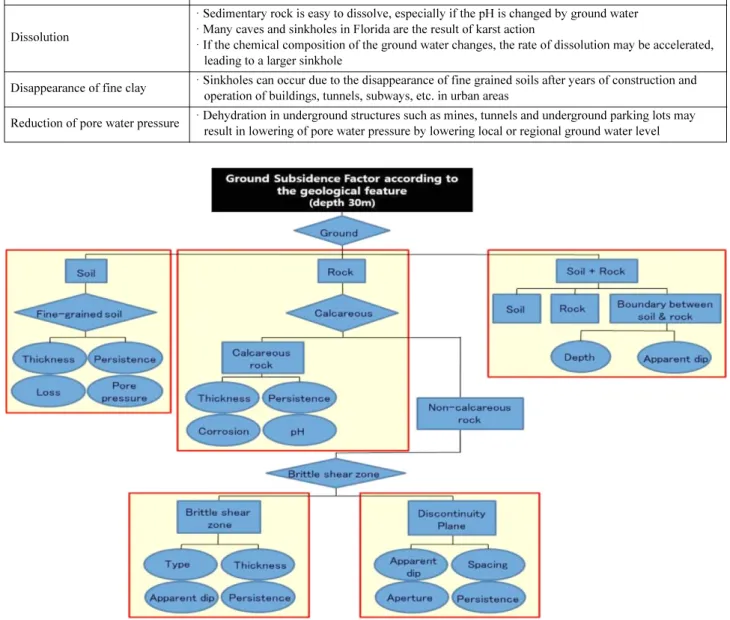
Fig. 1. Classification of influence factors on soil, rock, and composite ground

(3)

as existing case and construction data (Clough, 1990). It is reasonable to derive the final influence factor through the correlation analysis between the influence factors and the depressions using the Delphi technique or the actual depres- sion data, and the derived influencing factors should be ver- ified through field test or statistical analysis. The main factors of the subsidence of the ground are three kinds as shown in Table 1: dissolution of rock, disappearance of fine clay, and reduction of pore water pressure.

It is necessary to elucidate the important factors that can predict and evaluate the risk of subsurface submergence through analysis of research trends related to subsidence and case studies of domestic and foreign literature. It is neces- sary to quantify the risk of subsidence by objectively classi- fying and evaluating the risk of subsidence in accordance with the characteristics of the domestic site.

As shown in Fig. 1, it can be divided into soil, rock, and composite (soil + rock) soil depending on the type of ground. As shown in Fig. 2, the soil can be divided into factors such as thickness, persistence, loss of volume, and pore water pres- sure depending on the presence or absence of silt and clay, and the influence factors such as thickness and persistence. The rocks can be divided into limestone rocks and limestone

rocks depending on the presence or absence of limestone.

As shown in Fig. 3, the limestone rock mass can be divided into factors such as thickness, persistence, drainage, and ground water pH. These factors can identify the risk of sub- sidence in each range.

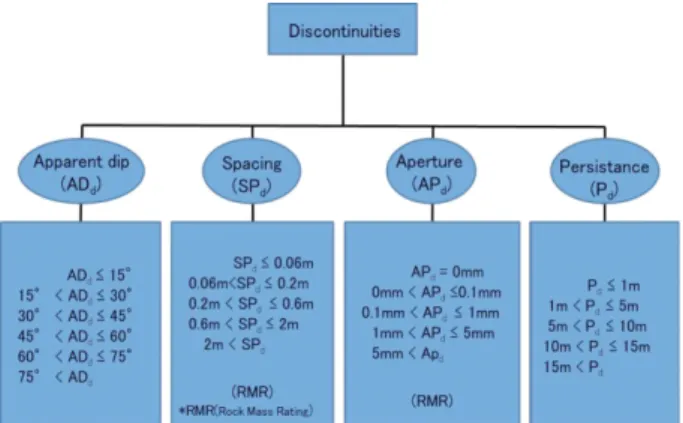
Non-calcareous rocks can be divided into brittle shear zones and discontinuities depending on the presence or absence of brittle shear zones. The non-calcareous rocks belonging to the brittle shear zone can be classified into the type and thickness of brittle shear zone as shown in Fig. 4, non-calcare- ous rocks belonging to discontinuities can be classified as risk factors by orientation and inclination, gaps, and per- sistence as shown in Fig. 5.

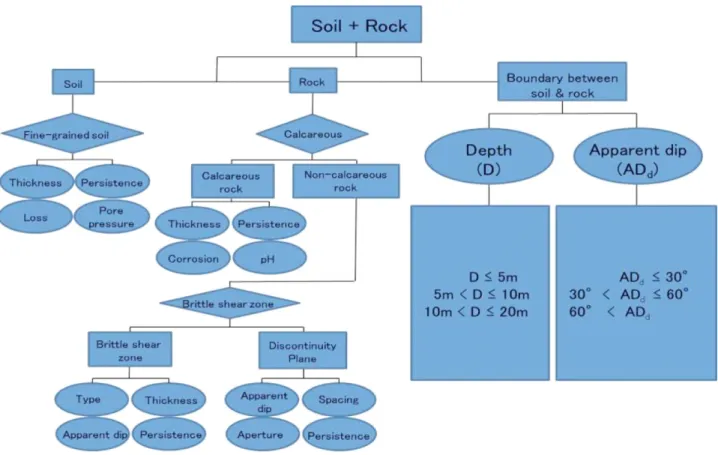
In case of composite soil, consideration should be given to all factors affecting soil and rock grounds (including calcare- ous and calcareous rocks) as shown in Fig. 6, and consideration should also be given to factors affecting depth and orienta- tion and inclination at the boundary between soil and rock.

3. Conclusion

Based on the previous studies, the important factors that can significantly affect the ground subsidence are summarized Fig. 2. Classification of influence factors on soil ground

Fig. 3. Classification of influence factors on rock mass ground

Fig. 4. Classification of influence factors on non-calcareous rock mass ground

Fig. 5. Classification of influence factors on discontinuity plane

(4)

in Table 2. It is expected that the estimation, countermeasures and evaluation of recent ground subsidence such as the con- struction of underground structures in the urban area are essential, so it is expected to utilize this evaluation tech- nique in future technology development actively.

References

1. Carbognin, L., et al. (1984), Case History no 9.3. Venice, Italy.

Guidebook to Studies of Land Subsidence Due to Ground- Water Withdrawal, International Hydrological Programme, Working Group 8, 161~174.

2. Cheng, Yuxiang, Jun Zhang, and Jianbing Peng (2013), ArcGIS-based evaluation of geo-hazards at Yaozhou County, Shaanxi, China. Journal of Rock Mechanics and Geotechnical Engineering 5(4), 330~334.

3. Clough, G. Wayne, and Thomas D. Clough, G. W. and O'Rourke, T. D. (1990), Construction induced movements of insitu walls.

In Design and Performance of Earth Retaining Structures, ASCE, pp. 439~470.

4. Figueroa Vega, G. E. (1984), Case history No. 9.8 Mexico, DF, Mexico. Guidebook to studies of land subsidence due to ground-water withdrawal: Studies and Reports in Hydrology 40, 217~232.

5. Finno, R. J., Bryson, S. and Michele, C. 2002, Performance of a stiff support system in soft clay. Journal of Geotechnical and Geoenvironmental Engineering 128(8), 660~671.

6. Finno, Richard J. and Michele Calvello (2005), Supported excavations: observational method and inverse modeling. Journal of Geotechnical and Geoenvironmental Engineering 131(7), 826~836.

7. Gabrysch, R. K. (1984), Case history no. 9.12. The Houston- Galveston region, Texas, USA. Guidebook to studies of land Fig. 6. Influential factors in composite ground

Table 2. Ground subsidence factors according to the geological features

Division Contents

Overburden (Soil, rock or soil + rock properties) Depth, Thickness

Characteristics of the interface between the soils and bedrock Depth, Orientation (dip-direction), Change of dip

Soil characteristics Soil type, Property

Rock characteristics Rock type, Fracture density, Distance from main fracture, Ratio of soft rock / hard rock

Hydraulic characteristics Precipitation, Date and time of precipitation, Surface water inflow,

Distance to stream, Ground water fluctuations

(5)

subsidence due to groundwater withdrawal: UNESCO Studies and Reports in Hydrology 20, 253~262.

8. Hou, Yanjuan, et al. (2015), Excavation failure due to pipeline damage during shallow tunnelling in soft ground. Tunnelling and Underground Space Technology 46, 76~84.

9. Karim, Mir Fazlul (2005), A Note On Some Geological Advantages For Construction Of Underground Railway Transit System In The City Of Dhaka.

10. Leung, Erin HY, and Charles WW Ng (2007), Wall and ground movements associated with deep excavations supported by cast in situ wall in mixed ground conditions. Journal of geotechnical and geoenvironmental engineering 133(2), 129~143.

11. Liu, G. B., Charles W. Ng, and Z. W. Wang (2005), Observed performance of a deep multistrutted excavation in Shanghai soft clays. Journal of Geotechnical and Geoenvironmental Engineering 131(8), 1004~1013.

12. Liu, Guo B., et al. (2011), Deformation characteristics of a 38 m deep excavation in soft clay. Canadian Geotechnical Journal 48(12), 1817~1828.

13. Long, M. (2001), Database for retaining wall and ground movements due to deep excavations, Journal of Geotechnical and Geoenvironmental Engineering, 207(3), 203~224.

14. Nikolinakou, Maria A., et al. (2011), Prediction and interpretation of the performance of a deep excavation in Berlin sand. Journal of Geotechnical and Geoenvironmental Engineering 137(11), 1047~1061.

15. Paul F. Bixley (1984), Case history No. 9.9. The Wairakei Geothermal Field, New Zealand. Guidebook to studies of land subsidence due to ground-water withdrawal: Studies and Reports in Hydrology 40, 233~240.

16. Peck, R. B. (1969), Deep excavation and tunneling in soft ground. In Proceedings of 7

th

International Conference on Soil Mechanic sand Foundation Engineering, MexicoCity, Mexico, A.A. Balkema, Rotterdam, theNetherlands, State-of-the-artvolume, 225~281.

17. Perrin, Jérôme, et al. (2015), A multicriteria approach to karst subsidence hazard mapping supported by weights-of-evidence analysis. Engineering Geology 197, 296~305.

18. Poland, J. F. and B. E. Lofgren (1984), Case history 9.13, San Joaquin Valley, California, USA. Guidebook to studies of land subsidence due to groundwater withdrawal: UNESCO Studies and Reports in Hydrology 40, 263~277.

19. Poland, J. F. (1984), Case history no. 9.14. Santa Clara Valley, California, USA. Guidebook to Studies of Land Subsidence Due to Ground-Water Withdrawal. Unesco, Paris, 340.

20. Poulsen, B. A. and B. Shen (2013), Subsidence risk assessment of decommissioned bord-and-pillar collieries. International Journal of Rock Mechanics and Mining Sciences 60, 312~320.

21. Reddy, Krishna R. and Jeffrey A. Adams (2001), Effects of soil heterogeneity on airflow patterns and hydrocarbon removal during in situ air sparging. Journal of Geotechnical and Geoenvironmental Engineering 127(3), 234~247.

22. Roboski, Jill, and Richard J. Finno (2006), Distributions of ground movements parallel to deep excavations in clay. Canadian geotechnical journal 43(1), 43~58.

23. Sakai, H. and K. Maeda (2009), Seepage Failure and Erosion Mechanism of Granular Material With Evolution of Air Bubbles Using SPH. AIP Conference Proceedings. Eds. Masami Nakagawa, and Stefan Luding. Vol. 1145. No. 1. AIP, 2009.

24. Seo, Min-Woo, et al. (2009), Sequential analysis of ground movements at three deep excavation sites with mixed ground profiles. Journal of geotechnical and geoenvironmental engineering 136(5), 656~668.

25. Shao, Yong, and Emir Jose Macari (2008), Information feedback analysis in deep excavations. International Journal of Geomechanics 8(1), 91~103.

26. Shi, L. X. and M. F. Bao (1984), Case History No. 9.2;

Shanghai, China. Guidebook to Studies of Land Subsidence due to Ground-water Withdrawal. UNESCO Studies and Reports in Hydrology 40, 155~160.

27. Singh, K. B. (2007), Pot-hole subsidence in son-Mahanadi master coal basin. Engineering Geology, 89(1), 88~97.

28. Soki Yamamoto (1984), Case history No. 9.10. Bangkok, Thailand. Guidebook to studies of land subsidence due to ground-water withdrawal: Studies and Reports in Hydrology 40, 241~244.

29. Tan, Y. and Li, M. (2011), Measured performance of a 26 m deep top-down excavation in downtown Shanghai. Canadian Geotechnical Journal, 48(5), 704~719.

30. Toan, Nguyen Duc, M. Eng, and Luu Xuan Hung (2010), Hanoi Metro Pilot Line Project: Some aspects of risk management and subsidence.

31. Vilar, Orencio Monje, and Roger Augusto Rodrigues (2011), Collapse behavior of soil in a Brazilian region affected by a rising water table. Canadian Geotechnical Journal 48(2), 226~233.

32. Wei, Hong, and Jun Yi. (2013), Gravity Pendulum Tilting Monitor.

Applied Mechanics and Materials. Vol. 313. Trans Tech Publications, 2013.

33. Yamamoto, S. (1984a), Case History No. 9.4. Tokyo, Japan.

Guidebook to Studies of Land Subsidence due to Groundwater Withdrawal. United Nations Educational, Scientific and Cultural Organization (UNESCO), Paris, 175~184.

34. Yamamoto, S. (1984b), Case History No. 9.5. Osaka, Japan.

Guidebook to Studies of Land Subsidence due to Groundwater Withdrawal. UNESCO, Paris, 185~194.

35. Yamamoto, S. (1984c), Case history No. 9.6. Nobi Plain,

(6)

Japan. Guidebook to studies of land subsidence due to ground- water withdrawal, UNESCO International Hydrological Programme, Working Group 8, 195~204.

36. Yamamoto, S. (1984d), Case History No. 9.7. Niigata, Japan.

Guidebook to studies of land subsidence due to ground-water withdrawal, UNESCO International Hydrological Programme, Working Group 8, 205~216.

37. Yetton, Mark D. (1986), Investigation and remedial methods for subsurface erosion control in Banks Peninsula loess.

Received Revised Accepted

June 11, 2017

June 15, 2017

June 27, 2017

수치

Table 1. Main factors of ground subsidence
Fig. 4. Classification of influence factors on non-calcareous rock mass ground
Table 2. Ground subsidence factors according to the geological features

참조

관련 문서

In addition to, the key factors of successful business start-up are demonstrated by synthetically examining how the factors influence the outcome of

The labial surfaces of 24 extracted bovine incisors were used. For the ground enamel, flat enamel surfaces at labial aspect were ground. However, for

The purpose of this study is to examine the influence of PAPS essential evaluation factors by applying soccer programs to middle school students participating

It considers the energy use of the different components that are involved in the distribution and viewing of video content: data centres and content delivery networks

Near Nong Khai, on a terrace of the Mae Nam Khong, adequate water from shallow dug wells, 30 to 50 feet deep in alluvial sand and gravel, supply municipal

After first field tests, we expect electric passenger drones or eVTOL aircraft (short for electric vertical take-off and landing) to start providing commercial mobility

1 John Owen, Justification by Faith Alone, in The Works of John Owen, ed. John Bolt, trans. Scott Clark, "Do This and Live: Christ's Active Obedience as the

The study analyzed how the individual, environmental and regional factors that constitute career decision factors affect career determination of students