http://dx.doi.org/10.5468/ogs.2016.59.3.214 pISSN 2287-8572 · eISSN 2287-8580
Introduction
Pelvic organ prolapse (POP) is defined as the downward descent of the pelvic organs resulting in protrusion of the vagina and/or uterine cervix. POP and overactive bladder (OAB) often co-exist [1-3]. The International Continence Society defines OAB as “ur- gency with or without urge incontinence, usually with frequency and nocturia” [4]. Not only OAB and but also POP is a prevalent disorder in elderly women and may severely impair the quality of life of those affected. Most studies have reported improvement of OAB symptoms after treatment of POP, but pathophysiology of OAB in POP is still not exactly understood [5-7]. The associa- tion between preoperative severity of POP and postoperative
The association of pelvic organ prolapse severity and improvement in overactive bladder symptoms after surgery for pelvic organ prolapse
Mi Sun Kim, Gee Hoon Lee, Eun Duc Na, Ji Hyon Jang, Hyeon Chul Kim
Department of Obstetrics and Gynecology, CHA Bundang Medical Center, CHA University, Seongnam, Korea
Objective
The purpose of this study was to evaluate the impact of pelvic organ prolapse (POP) repair on overactive bladder (OAB) symptoms in women with POP and the effect of baseline POP severity on improvement in OAB after surgical repair of POP. And we also tried to identify any preoperative factors for persistent postoperative OAB symptoms.
Methods
A total of 87 patients with coexisting POP and OAB who underwent surgical correction of POP were included and retrospectively analyzed and postoperative data was obtained by telephone interview. OAB was defined as an affirmative response to item no. 15 (urinary frequency) and item no. 16 (urge incontinence) of the Pelvic Floor Distress Inventory. POP severity was dichotomized by Pelvic Organ Prolapse Quantification stage 1 to 2 (n=22) versus stage 3 to 4 (n=65).
Results
OAB symptoms were significantly improved after surgical treatment (P<0.001). But there was no significant differences in postoperative improvement of frequency and urge incontinence between stage 1 to 2 group versus stage 3 to 4 group. Preoperative demographic factors (age, parity, and POP stage) were not significantly related to persistent postoperative OAB symptoms.
Conclusion
Women with coexisting POP and OAB who undergo surgical repair experience significant improvement in OAB symptoms after surgery, but severity of POP had no significant difference in improvement of OAB symptoms.
Postoperative persistent OAB symptoms were not related to age, parity, body mass index, and POP stage.
Keywords: Overactive urinary bladder; Pelvic organ prolapse; Urge urinary incontinence; Urinary frequency
Articles published in Obstet Gynecol Sci are open-access, distributed under the terms of the Creative Commons Attribution Non-Commercial License (http://creativecommons.
org/licenses/by-nc/3.0/) which permits unrestricted non-commercial use, distribution, and reproduction in any medium, provided the original work is properly cited.
Copyright © 2016 Korean Society of Obstetrics and Gynecology Received: 2015.6.8. Revised: 2015.11.9. Accepted: 2015.11.9.
Corresponding author: Hyeon Chul Kim
Department of Obstetrics and Gynecology, CHA Bundang Medical Center, CHA University, 59 Yatap-ro, Bundang-gu, Seongnam 13496, Korea
Tel: +82-31-780-5297 Fax: +82-31-780-6194 E-mail: [email protected]
http://orcid.org/0000-0002-4894-6140
improvement of OAB, factors associated with persistent OAB symptoms after POP repair are still unknown. And studies for this issue were lacking and results were heterogeneous.
The first study on predictive factors for postoperative OAB symptoms was published by de Boer et al. [7]. They reported postoperative frequency and urgency appeared less common in higher preoperative stages and they also found absence of bothersome OAB symptoms preoperatively is the best predic- tor for the absence of postoperative symptoms. Fletcher et al.
[8] studied for resolution of OAB symptoms after anteriorvagi- nal wall prolapse repair and they sought to identify any pre- operative demographic factors related to persistence of OAB symptoms. They reported there was no significant relation between preoperative cystocele grade and postoperative OAB symptoms improvement. And they also reported age, parity, body mass index, POP grade were not related to persistence of postoperative OAB symptoms. In contrast to their study, Miranne et al. [9] reported stage 3 to 4 POP had a decreased odds of experiencing improvement in OAB symptoms than stage 1 to 2 POP. So they regarded increased severity of POP is a risk factor for persistent OAB symptoms after POP repair.
To sum up, results of studies were inconsistent and different by the author. And it is not certain which factors predict the persis- tence of OAB symptoms after POP repair and whether the sever- ity of POP is associated with improvement of OAB symptoms.
The primary aim of our study was to evaluate whether the surgical repair improves OAB symptoms in women with POP and we tried to identify any preoperative factors related to persistence OAB symptoms postoperatively. As a secondary aim, we evaluate the effect of baseline POP severity on im- provement in OAB symptoms after surgical treatment of POP.
Materials and methods
We conducted a retrospective cohort study. We included all women with POP and coexistent OAB symptoms. All women underwent vaginal hysterectomy with anterior-posterior col- porrhaphy without mesh between January 2008 and July 2014. Women without preoperative OAB symptom, who underwent a concomitant anti-incontinence surgery, with pre- vious prolapse or anti-incontinence surgery and with known neurological condition, active urinary tract infections, bladder tumor or stones were excluded from the study. Also women with uterine fibroid greater than 12 gestational week size and
those who postoperatively feels vaginal bulging sense consis- tent with vaginal prolapse recurrence were also excluded.
A comprehensive urologic and gynecologic history, vaginal examination and the Pelvic Floor Distress Inventory short form (PFDI-20) were completed for all patients. OAB was defined as an affirmative response to item no. 15 and item no. 16 of the PFDI. PFDI item no. 15 (Do you usually experience frequent urination?) was used to assess frequency, item no. 16 (Do you usually experience urine leakage associated with a feeling of urgency that is a strong sensation of needing to go to the bathroom?) was used to assess urge urinary incontinence [10].
Responses to items on the PFDI are based on five- point Likert scale, where 0 represents a negative response and 1 through 4 represent an affirmative response, with higher numbers cor- responding to a greater degree of symptom bother (1, not at all; 2, somewhat; 3, moderately; 4, quite a bit).
Preoperative POP severity was dichotomized as stage 1 to 2 (less severe anatomical group) versus stage 3 to 4 (more severe anatomical group) based on the Pelvic Organ Prolapse Quan- tification (POP-Q) system [11]. Postoperative OAB symptoms (item no. 15 and 16 of PFDI) were obtained by telephone interview. We enrolled women who had postoperative follow up period more than 12 months and mean follow up period was 34.3 months (12 to 79 months). We defined improve- ment as either complete resolution of frequency and/or urge incontinence (affirmative response preoperatively, negative response postoperatively), or improvement (decrease in the degree of symptom bother by at least one number).
Primary outcome of this study was postoperative improve- ment of OAB symptoms and it was assessed by the scores of PFDI item no. 15 and 16. We also evaluated the effect of baseline POP severity on improvement in OAB symptoms after surgical treatment of POP. And we tried to identify any preop- erative factors for persistent postoperative OAB symptoms by analysis of demographic variables, preoperative POP stage.
Data analysis was performed using the Wilcoxon signed rank test, Student t-test, Mann-Whitney U-test, and the Fisher’s ex- act test IBM SPSS ver. 22.0 (IBM Corp., Armonk, NY, USA) and P-value less than 0.05 was considered statistically significant.
Results
Eighty-seven women met inclusion criteria. Table 1 lists the baseline characteristics of the study population. All of the
women had a least one vaginal birth. Twenty-two women (27%) had POP-Q stage 1 to 2 and 65 women (73%) had stage 3 to 4. Women with stage 3 to 4 POP group were older than the women with stage 1 to 2 POP group (64.5±8.9 vs.
59.0 ±8.4 years, P=0.01) and stage 3 to 4 POP group had higher parity than the women with stage 1 to 2 POP group (3.4
±1.1 vs. 2.2±0.8, P<0.01). There was no significant difference in mean body mass index. Ba, C, Bp point (by POP-Q) were significantly higher in stage 3 to 4 POP group than stage 1 to 2 POP group (P<0.001) (Table 1). OAB symptoms (frequency and urge incontinence) were significantly improved after sur- gical POP repair (P<0.001) (Table 2).
Table 1. Baseline characteristics
POP stage 1 and 2
(n=22) POP stage 3 and 4
(n=65) P-value
Age (yr) 59.0±8.4 64.5±8.9 0.014
Parity 2.2±0.8 3.4±1.1 <0.001
Ba point (cm) 0.0±0.6 2.8±1.3 <0.001
C point (cm) -2.2±2.1 1.58±3.0 <0.001
Bp point (cm) -1.2±1.1 -0.3±2.2 <0.001
BMI (kg/m2) 24.3±3.8 25.1±3.1 0.313
Menopause 20 (90.9) 61 (93.8) 0.640
Data are mean±standard deviation or number (%) POP, pelvic organ prolapse; BMI, body mass index.
Table 2. Comparison of changes in the overactive bladder symptoms between before and after the surgery
Preoperative Postoperative P-value
Frequency 2.8±1.0 1.4±1.3 <0.001
Urge incontinence 2.3±1.2 1.1±1.0 <0.001
Total 4.4±2.1 2.2±1.9 <0.001
Data are mean±standard deviation; Data was defined by Pelvic Floor Distress Inventory item no. 15 (frequency) and item no. 16 (urge inconti- nence).
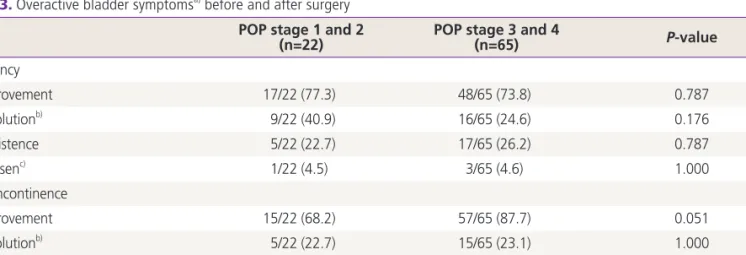
Table 3. Overactive bladder symptomsa) before and after surgery POP stage 1 and 2
(n=22) POP stage 3 and 4
(n=65) P-value
Frequency
Improvement 17/22 (77.3) 48/65 (73.8) 0.787
Resolutionb) 9/22 (40.9) 16/65 (24.6) 0.176
Persistence 5/22 (22.7) 17/65 (26.2) 0.787
Worsenc) 1/22 (4.5) 3/65 (4.6) 1.000
Urge incontinence
Improvement 15/22 (68.2) 57/65 (87.7) 0.051
Resolutionb) 5/22 (22.7) 15/65 (23.1) 1.000
Persistence 7/22 (31.8) 8/65 (12.3) 0.051
Worsenc) 3/22 (13.6) 4/65 (6.2) 0.362
Data are number (%).
POP, pelvic organ prolapse.
a)Urinary frequency defined by Pelvic Floor Distress Inventory item no. 15; urge incontinence defined by Pelvic Floor Distress Inventory item no.
16; b)Women with resolution of symptoms were included in the improvement group; c)Women with worsening of symptoms were included in the persistence group.
Seventeen responders (77.3%) with stage 1 to 2 POP group and 48 responders (73.8 %) with stage 3 to 4 POP group reported improvement in urinary frequency. Fifteen respond- ers (68.2 %) with stage 1 to 2 POP group and 57 responders (87.7%) with stage 3 to 4 POP group reported improvement in urge incontinence. There was no significant difference in improvement of frequency and urge incontinence between stage 1 to 2 POP group and stage 3 to 4 POP group (Table 3). Although stage 3 to 4 POP group showed better result for urge incontinence improvement, it did not reach statistical sig- nificance (P=0.051). Despite of the surgery, 22 (25.3%) wom- en reported persistent or worsen frequency and 15 (17.2%) women reported persistent or worsen urge incontinence. All parameters that we evaluated (age, parity, and severity of pro- lapse stage) were not significantly related with postoperative persistent or worsening OAB symptoms (Table 4).
Discussion
Symptoms of OAB are commonly seen in POP patient and some authors have reported OAB symptoms in up to 88% of women with POP [12]. Pathophysiology of OAB symptoms in relation with POP are still not yet exactly defined. Possibly, bladder outlet obstruction (BOO) from POP is the important factor and BOO is common finding in advanced POP [7].
Symptoms of difficult emptying and low maximum flow rate by uroflometry were noted in POP. Women with improvement
of OAB symptoms after POP repair showed improvement of flow rates but women without improvement in OAB symp- toms whose flow rates stayed same. This finding suggests that changes in flow rates may be important in the etiology of OAB and raises the issue that impairment of flow may be im- portant in the etiology of OAB [13]. The another theory is de- nervation of the obstructed bladder due to POP. Several stud- ies suggest that there is a supersensitivity to neurotransmitters secondary to partial denervation of the obstructed bladder.
Bladder distension and contraction may induce bladder wall ischemia and this might play an important role in denervation [14-16].
In present study, OAB symptoms were significantly improved after surgical repair in women with coexisting POP and OAB.
This may be a consequence of resolution of BOO by surgical POP repair. Other authors also have reported improvement in OAB symptoms in women with POP after pessary insertion and pelvic reconstructive surgery [5,6,9]. As mentioned in in- troduction, studies for the association between baseline sever- ity of POP and improvement of OAB symptoms, and for the which factors predict the persistence of OAB symptoms after POP repair are lacking and results were heterogenous.
In present study, there was no significant difference in improvement of frequency and urge incontinence between stage 1 to 2 POP and stage 3 to 4 POP. We also tried to iden- tify any preoperative factors for persistent postoperative OAB symptoms and all parameters that we evaluated (age, parity, and severity of prolapse stage) were not significantly related Table 4. Preoperative demographic factors related to persistence and worsen of overactive bladder symptoms after POP repair
Frequency (n=87) Urge incontinence (n=87)
Improvement
(n=65, 74.7%) Persistence
(n=22, 25.3%) P-value Improvement
(n=72, 82.8%) Persistence
(n=15, 17.2%) P-value
Age (yr) 62.6±9.1 64.7±9.0 0.608 64.0±7.2 0.262 0.262
Parity 3.0±1.2 3.1±1.2 0.926 2.9±1.1 0.639 0.639
Ba point (cm) 2.2±1.7 1.8±1.5 0.329 1.8±1.8 0.374 0.374
C point (cm) 1.0±3.1 -0.5±3.3 0.052 -0.5±3.7 0.152 0.152
Bp point (cm) -0.4±2.1 -0.8±1.7 0.454 -0.3±2.1 0.682 0.682
BMI (kg/m2) 25.0±2.9 24.6±4.4 0.704 25.5±3.4 0.866 0.866
Menopause 61 (93.8) 21 (95.5) 1.000 14 (93.3) 1.000 1.000
POP stage 0.787 0.051 0.051
Stage 1 and 2 17 (77.3) 5 (22.7) 7 (31.8)
Stage 3 and 4 48 (73.8) 17 (26.2) 8 (12.3)
Data are mean±standard deviation or number (%).
POP, pelvic organ prolapse; BMI, body mass index.
to postoperative persistent or worsening OAB symptoms.
Our results were consistent with study of Fletcher et al. [8]
and different with study of Miranne et al. [9] and de Boer et al. [7]. The causes of conflicting results between our and other studies are not certain but, it may be due to multifactorial etiology of OAB symptoms in POP. Miranne et al. [9] found stage 3 to 4 POP had a decreased odds of experiencing im- provement in frequency or urge incontinence than stage 1 to 2 POP. These authors stated this may be due to permanent denervation of the bladder wall and/or irreversible changes in the detrusor muscle that occur with longstanding POP [15]. As mentioned above, resolution of BOO by surgical POP repair is important factor for postoperative OAB symptom improvement. In the aspect of anatomy, degree of anatomical improvement may be more prominent in higher POP stage.
Romanzi et al. [17] reported there was a much higher rate of BOO in women with grade 3 to 4 cystocele than grade 1 to 2 cystocele (70% vs. 3%) and 94% of grade 3 to 4 cystocele with BOO returned normal free uroflowmetry after POP reduc- tion. Results may be heterogenous by what factors dominantly affect.
There were some differences in study design between our and other studies. Fletcher et al. [8] studied for anterior vagi- nal wall prolapse patient who underwent anterior vaginal wall prolapse repair. Miranne et al. [9] studied for apical or anterior vaginal wall prolapse patient. In the issue of which factors predict the persistence of postoperative OAB symptoms, they did not evaluated preoperative demographic factors and they only assessed preoperative POP stage. And de Boer et al. [7]
focused on the factors which predict the presence of postop- erative OAB symptoms. Performed operations for POP were heterogeneous in other studies but homogeneous (vaginal hysterectomy with anterior and posterior colporrhaphy) in our study.
The strength of this study is that all enrolled women un- derwent same surgical procedure (vaginal hysterectomy and anterior-posterior colporrhaphy without mesh) and this may reduce bias. This study is limited by its retrospective design.
Although 87 women met the inclusion criteria for our study, only 22 women were stage 1 to 2 POP. We think that our findings may have more statistical power if our less severe POP group had been more larger. We obtained postoperative data by telephone interview, so we did not have objective data of pelvic anatomy after surgery. However, we excluded women who subjectively feel vaginal bulging sense consistent with
anatomical recurrence.
In conclusion, women with coexisting POP and OAB who undergo surgical correction of POP experience significant improvement in OAB symptoms after surgery. There was no significant difference in improvement of frequency and urge incontinence between stage 1 to 2 POP group and stage 3 to 4 POP group. All parameters that we evaluated age, parity and severity of prolapse stage) were not significantly related to postoperative persistent or worsening OAB symptoms . Future prospective larger studies are needed to confirm our findings.
Conflict of interest
No potential conflict of interest relevant to this article was reported.
References
1. de Boer TA, Salvatore S, Cardozo L, Chapple C, Kelleher C, van Kerrebroeck P, et al. Pelvic organ prolapse and overac- tive bladder. Neurourol Urodyn 2010;29:30-9.
2. Lawrence JM, Lukacz ES, Nager CW, Hsu JW, Luber KM. Prevalence and co-occurrence of pelvic floor dis- orders in community-dwelling women. Obstet Gynecol 2008;111:678-85.
3. Miedel A, Tegerstedt G, Maehle-Schmidt M, Nyren O, Hammarstrom M. Symptoms and pelvic support defects in specific compartments. Obstet Gynecol 2008;112:851-8.
4. Abrams P, Cardozo L, Fall M, Griffiths D, Rosier P, Ulmsten U, et al. The standardisation of terminology in lower uri- nary tract function: report from the standardisation sub- committee of the International Continence Society. Urol- ogy 2003;61:37-49.
5. Digesu GA, Salvatore S, Chaliha C, Athanasiou S, Milani R, Khullar V. Do overactive bladder symptoms improve after repair of anterior vaginal wall prolapse? Int Urogynecol J Pelvic Floor Dysfunct 2007;18:1439-43.
6. Clemons JL, Aguilar VC, Tillinghast TA, Jackson ND, My- ers DL. Patient satisfaction and changes in prolapse and urinary symptoms in women who were fitted successfully with a pessary for pelvic organ prolapse. Am J Obstet Gy- necol 2004;190:1025-9.
7. de Boer TA, Kluivers KB, Withagen MI, Milani AL, Vier- hout ME. Predictive factors for overactive bladder symp- toms after pelvic organ prolapse surgery. Int Urogynecol J 2010;21:1143-9.
8. Fletcher SG, Haverkorn RM, Yan J, Lee JJ, Zimmern PE, Lemack GE. Demographic and urodynamic factors as- sociated with persistent OAB after anterior compartment prolapse repair. Neurourol Urodyn 2010;29:1414-8.
9. Miranne JM, Lopes V, Carberry CL, Sung VW. The effect of pelvic organ prolapse severity on improvement in overac- tive bladder symptoms after pelvic reconstructive surgery.
Int Urogynecol J 2013;24:1303-8.
10. Barber MD, Walters MD, Bump RC. Short forms of two condition-specific quality-of-life questionnaires for women with pelvic floor disorders (PFDI-20 and PFIQ-7). Am J Ob- stet Gynecol 2005;193:103-13.
11. Bump RC, Mattiasson A, Bo K, Brubaker LP, DeLancey JO, Klarskov P, et al. The standardization of terminology of female pelvic organ prolapse and pelvic floor dysfunction.
Am J Obstet Gynecol 1996;175:10-7.
12. Digesu GA, Chaliha C, Salvatore S, Hutchings A, Khullar V.
The relationship of vaginal prolapse severity to symptoms and quality of life. BJOG 2005;112:971-6.
13. Basu M, Duckett J. Effect of prolapse repair on voiding and the relationship to overactive bladder and detru- sor overactivity. Int Urogynecol J Pelvic Floor Dysfunct 2009;20:499-504.
14. Harrison SC, Hunnam GR, Farman P, Ferguson DR, Doyle PT. Bladder instability and denervation in patients with bladder outflow obstruction. Br J Urol 1987;60:519-22.
15. Harrison SC, Ferguson DR, Doyle PT. Effect of bladder out- flow obstruction on the innervation of the rabbit urinary bladder. Br J Urol 1990;66:372-9.
16. Azadzoi KM, Pontari M, Vlachiotis J, Siroky MB. Canine bladder blood flow and oxygenation: changes induced by filling, contraction and outlet obstruction. J Urol 1996;155:1459-65.
17. Romanzi LJ, Chaikin DC, Blaivas JG. The effect of genital prolapse on voiding. J Urol 1999;161:581-6.